
Middle East and Africa Post Quantum Cryptography Market Size & Forecast:
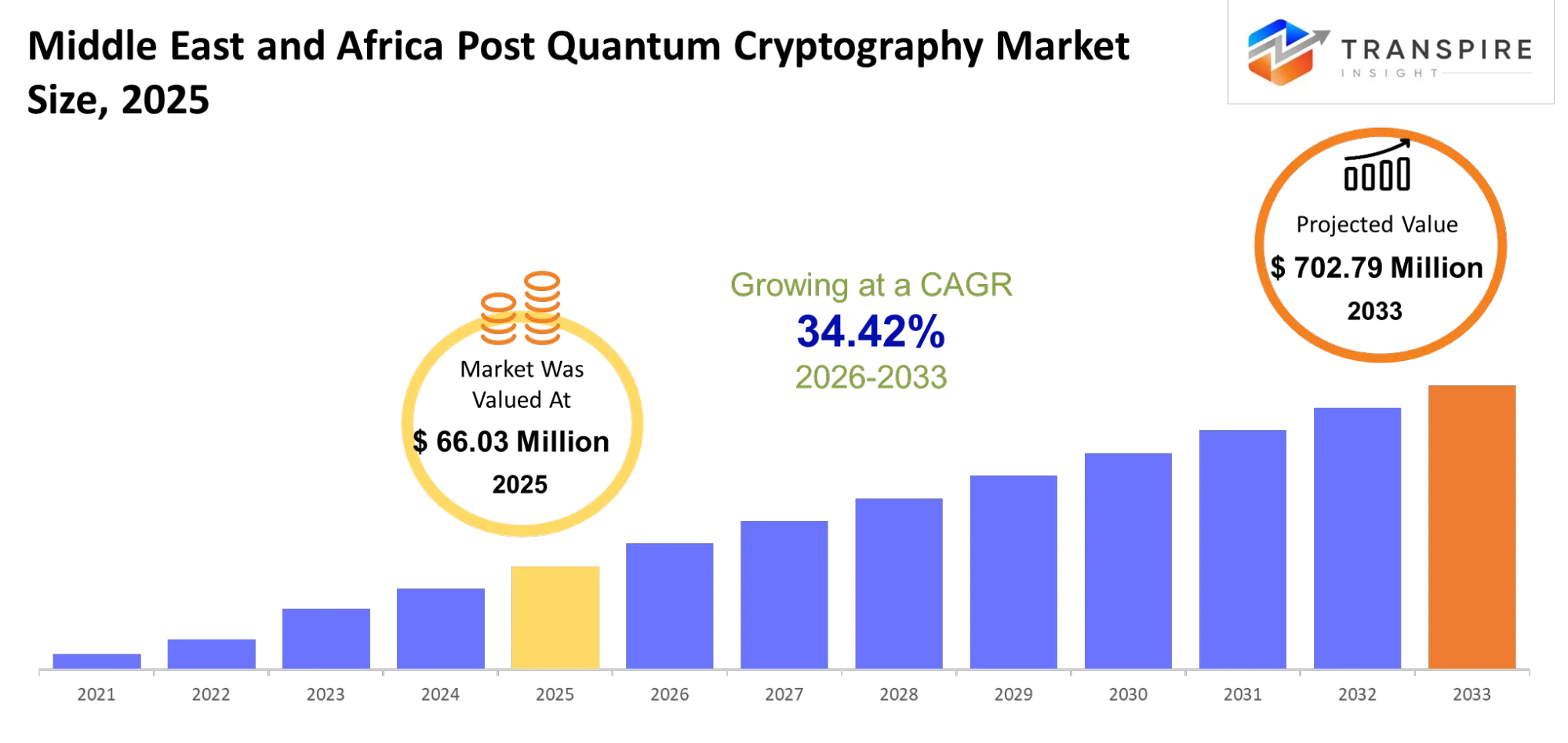
- Middle East and Africa Post Quantum Cryptography Market Size 2025: USD 66.03 Million
- Middle East and Africa Post Quantum Cryptography Market Size 2033: USD 702.79 Million
- Middle East and Africa Post Quantum Cryptography Market CAGR: 34.42%
- Middle East and Africa Post Quantum Cryptography Market Segments: By Type (Lattice-based, Hash-based, Code-based, Multivariate, Isogeny-based, Others); By Application (Data Security, Network Security, Blockchain, Secure Communication, Government Security, Cloud Security, Others); By End-User (Government, Enterprises, BFSI, Defense, IT & Telecom, Healthcare, Others); By Deployment (Cloud, On-premise, Hybrid, Others)
To learn more about this report,  Download Free Sample Report
Middle East and Africa Post Quantum Cryptography Market Summary
The Middle East and Africa Post Quantum Cryptography Market was valued at USD 66.03 Million in 2025. It is forecast to reach USD 702.79 Million by 2033. That is a CAGR of 34.42% over the period.
Post-quantum cryptography protects data transmission between energy systems and maritime tracking and industrial control systems which operate with classified information that needs to remain secure for extended time periods in the Middle East and Africa. The system protects communications between ports and offshore facilities and utility operators from future quantum decryption attacks which would reveal confidential data about long-term infrastructure.
The market has transitioned from testing experimental pilots to adopting crypto-agile architectures which use both traditional encryption methods and upcoming post-quantum algorithms since NIST established worldwide encryption standards. Gulf governments implemented sovereign-grade encryption requirements because of increasing cyberattacks targeting oil and gas and logistics facilities as well as rising geopolitical conflicts that affected shipping routes in the Red Sea. The result of this development shows that companies now use post-quantum readiness as a factor to determine which cloud and telecom and industrial systems they will acquire while this trend creates momentum for early adoption in banking and defense and energy industries.
Key Market Insights
- The Middle East controls the Middle East and Africa Post Quantum Cryptography Market according to its 2025 market share which reaches 38% due to national cybersecurity efforts and sovereign cloud development.
- The Gulf Cooperation Council countries will experience their highest economic expansion between 2025 and 2030 because of smart city projects which will lead to digitization and critical infrastructure security initiatives.
- Africa establishes itself as a secondary expansion area through telecom security improvements and cross-border digital banking growth.
- Quantum-safe encryption software leads the Middle East and Africa Post Quantum Cryptography Market with approximately 42% share due to rapid enterprise integration.
- Defense-grade secure communication systems use hardware-based cryptographic modules which hold the second-largest market share.
- The fastest-growing market segment between 2026 and 2030 will be Cloud-based post-quantum security solutions which hybrid cloud migration drives.
- Government and defense applications dominate with nearly 45% share, securing classified communications and national digital infrastructure.
- The financial services sector experiences its most rapid growth because it now uses quantum-safe transaction frameworks and fraud prevention systems.
- The Middle East and Africa Post Quantum Cryptography Market remains dominated by large enterprises which control approximately 50% market share because they spend more on cybersecurity.
- Telecom operators represent the fastest-growing end-user segment because they implement quantum-safe protocols to protect their 5G and fiber networks.
What are the Key Drivers, Restraints, and Opportunities in the Middle East and Africa Post Quantum Cryptography Market?
The Gulf countries enforce national cybersecurity requirements for quantum-safe encryption because state-sponsored cyber threats which target oil, gas, defense, and financial systems have increased at a rapid pace. The combination of this policy change with existing international cryptography body standardization efforts has created a situation which enables telecom operators and national cloud initiatives to acquire crypto-agile systems at an accelerated pace. The growing trend of enterprises dedicating security funds to post-quantum migration initiatives instead of basic system upgrades has created a stronger financial stream for solution providers.
The main obstacle stems from post-quantum algorithms which require extensive processing power and complicated installation processes that affect existing industrial control systems and banking systems. The majority of African organizations and Middle Eastern companies depend on outdated encryption systems which have become deeply ingrained in their operations and require expensive replacements. The existing system requirements force organizations to maintain slow migration processes which prevent them from achieving complete deployment while hindering short-term revenue generation despite successful pilot operations.
The implementation of Saudi Arabia's Vision 2030 and the UAE's national cloud and AI expansion programs presents a significant opportunity to drive digital transformation across multiple sectors. The development of quantum-safe infrastructure pilots in smart cities and digital government platforms receives funding from these initiatives to support the early commercial implementation of scalable post-quantum cryptography across the entire region.
What Has the Impact of Artificial Intelligence Been on the Middle East and Africa Post Quantum Cryptography Market?
Artificial intelligence and advanced digital technologies are increasingly shaping security modernization across the Middle East and Africa Post Quantum Cryptography Market, especially in energy and telecom and maritime-linked industrial infrastructure sectors. AI-driven automation in operational environments enables organizations to optimize their cryptographic key lifecycle management and their encryption performance monitoring and their compliance reporting through automated processes that work across distributed networks. The system enhances secure communications from ports to offshore assets and critical data centers by decreasing manual supervision which leads to better operational consistency in post-quantum readiness programs.
Machine learning models enable organizations to forecast upcoming events by identifying unusual network traffic that suggests quantum-based security breaches and forecasting when cryptographic systems will start to experience performance issues before they get implemented across entire networks. AI technology in advanced security systems enables organizations to distribute workloads among different encryption methods which results in better data protection and faster data transfer times. The system has enabled organizations to achieve actual results which include faster incident response times and better compliance with regulations and reduced downtime for essential operational systems.
The limited availability of high-quality training data for quantum-safe environments and the challenges of connecting AI models with existing industrial control systems and telecom systems continue to restrict organizations from adopting new technologies. The existing system for training models in offshore and remote locations is restricted by intermittent internet access, which prevents organizations from deploying their systems because the enterprise shows strong interest to use the technology.
Key Market Trends
- GCC governments established quantum-safe cybersecurity frameworks between 2024 and 2026 to require enterprises to build crypto-agile infrastructure for their national digital systems.
- Middle Eastern and African enterprises are transitioning from their old PKI systems to crypto-agile systems which NIST developed through its post-quantum standardization work.
- The UAE and Saudi Arabia data centers saw Microsoft Azure and regional hyperscalers boost their quantum-safe cloud services which enabled enterprises to securely transfer workloads since 2025.
- GCC telecom operators implemented post-quantum encryption technology for their 5G and fiber networks to enhance secure data transmission capabilities after experiencing increased cyber threats to their infrastructure.
- UAE and Saudi Arabian defense procurement programs increased their post-quantum cryptography spending to protect classified communications and satellite-linked systems.
- IBM Thales Group and Microsoft established partnerships with regional governments to test quantum-safe encryption systems in critical infrastructure projects.
- African banks started using post-quantum technology for their cross-border payment systems but implementation has been delayed due to existing infrastructure problems and insufficient skilled workers.
- Security vendors implemented AI-based cryptographic management systems in 2025 which provided better key rotation capabilities while decreasing the need for encryption operations.
Middle East and Africa Post Quantum Cryptography Market Segmentation
By Type :
Lattice-based cryptography will provide strong protection against quantum attacks and businesses will adopt it because of its effective and scalable capabilities. Hash-based systems will focus on secure digital signatures with high reliability in data protection use cases.
Code-based approaches will support secure encryption with proven hardness assumptions, while multivariate techniques will enhance authentication strength. Isogeny-based methods will provide compact key structures, and other emerging approaches will address specialized security requirements.
By Application :
Data security will focus on protecting sensitive information from quantum threats using advanced encryption methods. Network security will provide stronger protection against intrusion and unauthorized access throughout public and private system communication channels. Blockchain technology will enhance trust between parties while securing all transaction activities.
Secure communication will enable protected data exchange between digital platforms, while government security will establish measures for protecting classified information and safeguarding national infrastructure. Cloud security will protect stored data and processed information, while other applications will handle specialized security needs that are emerging.
To learn more about this report, Download Free Sample Report
By End-User :
The government will use its resources to safeguard essential data protection systems together with its national digital infrastructure against threats from quantum-based cyber attacks. The business sector will implement secure frameworks which will protect their operational data during their digital activities. The BFSI sector will implement security measures which will protect both financial transactions and customer identification processes.
Defense operations will depend on high-level cryptographic systems which protect their essential mission communications and intelligence information. The IT and telecom industries will enhance their network defense capabilities together with their secure service connection systems. The healthcare industry will safeguard patient data together with digital health records while different users will solve security challenges specific to their industry requirements.
By Deployment :
Organizations with extensive distributed data operations will utilize cloud deployment to implement post-quantum cryptographic systems that can scale according to their needs. The implementation of strong encryption protects both stored data and transmitted data on cloud platforms which provides ongoing security for all digital operations and remote access activities.
The organization will implement on-premise deployment to maintain control over its internal systems which will provide security solutions that protect its entire network. The hybrid deployment system will provide organizations with cloud-based flexibility while they maintain their on-premise security controls which will help them achieve better security management and data protection together with seamless system integration in all operational areas.
What are the Key Use Cases Driving the Middle East and Africa Post Quantum Cryptography Market?
The Post Quantum Cryptography Market in the Middle East and Africa has government and defense secure communications as its primary application because it protects classified information and satellite communication and essential infrastructure systems which experience ongoing state-sponsored cyber attacks. The demand exists because strategic intelligence information requires extended protection during its entire lifespan.
The telecom and banking industries are adopting quantum-safe encryption to secure 5G networks and protect cross-border payment processes which Gulf digital banks and cloud service providers have updated since 2025.
The initial testing phase for securing IoT-based monitoring systems and satellite-linked assets has started in maritime energy operations and smart industrial environments. The regulatory environment together with AI-powered automation solutions has begun to drive growth for these emerging applications.
|
Report Metrics |
Details |
|
Market size value in 2025 |
USD 66.03 Million |
|
Market size value in 2026 |
USD 88.61 Million |
|
Revenue forecast in 2033 |
USD 702.79 Million |
|
Growth rate |
CAGR of 34.42% from 2026 to 2033 |
|
Base year |
2025 |
|
Historical data |
2021 - 2024 |
|
Forecast period |
2026 - 2033 |
|
Report coverage |
Revenue forecast, competitive landscape, growth factors, and trends |
|
Regional scope |
Middle East and Africa (Saudi Arabia, United Arab Emirates, South Africa, Rest of Middle East and Africa) |
|
Key company profiled |
IBM, Microsoft, Google, Intel, Thales, PQShield, ISARA, QuintessenceLabs, Infineon, NXP, Cisco, Huawei, Toshiba, Amazon, Oracle |
|
Customization scope |
Free report customization (country, regional & segment scope). Avail customized purchase options to meet your exact research needs. |
|
Report Segmentation |
By Type (Lattice-based, Hash-based, Code-based, Multivariate, Isogeny-based, Others); By Application (Data Security, Network Security, Blockchain, Secure Communication, Government Security, Cloud Security, Others); By End-User (Government, Enterprises, BFSI, Defense, IT & Telecom, Healthcare, Others); By Deployment (Cloud, On-premise, Hybrid, Others) |
Which Regions are Driving the Middle East and Africa Post Quantum Cryptography Market Growth?
The Middle East and Africa Post Quantum Cryptography Market exists because Middle Eastern countries implement national cybersecurity requirements while building their national digital systems. The UAE and Saudi Arabia established quantum-safe requirements for their defense communications and essential energy systems which led to early system adoption in both countries. The need for secure cryptographic systems increases because both sovereign cloud platforms and smart port digitization projects require them. The ecosystem consists of hyperscalers, defense contractors and telecom operators who together provide essential infrastructure for ongoing system deployment.
The African market develops at a steady pace but maintains its fundamental structure through digital banking growth and telecom modernization and cross-border payment system development. The region experiences different growth patterns because its development relies more on financial inclusion programs and regional connectivity initiatives than on national security mandates. South Africa and Kenya have made cybersecurity improvements their main goal for both banking networks and mobile money systems. The need for scalable encryption solutions creates ongoing demand which persists despite extended deployment schedules caused by infrastructure limitations.
The momentum of growth shows its highest development rate in the smart infrastructure corridors of GCC maritime and industrial sectors which currently operate their fastest expansion in Saudi Arabia's Red Sea projects and UAE smart logistics zones. Recent financial backing for automated ports and AI-powered shipping logistics systems and industrial IoT networks has generated a new requirement for quantum-safe communication systems. The shift started to gain speed after the occurrence of cybersecurity incidents which affected supply chain systems and maritime operations during the year 2024. The region serves as the primary market opportunity for investors and vendors who want to implement pilot projects between 2026 and 2033.
Who are the Key Players in the Middle East and Africa Post Quantum Cryptography Market and How Do They Compete?
The Middle East and Africa Post Quantum Cryptography Market exhibits semi-fragmented competition because global cybersecurity vendors and cloud hyperscalers and defense integrators all compete to implement their initial quantum-safe systems. Existing companies maintain their market position through platforms that meet compliance requirements and obtain government certifications, whereas new companies concentrate on developing crypto-agile technology. The primary factors that determine market competition involve companies' technological expertise and their ability to combine existing systems with customer-controlled cloud solutions.
The Gulf ministries collaborate with IBM to test their crypto-agile migration programs through hybrid cloud security and consulting-based deployment methods which they use to secure essential infrastructure systems. Microsoft develops Azure sovereign cloud regions for the UAE and Saudi Arabia with post-quantum security features that enable businesses to move their operations through cloud-native protection systems. Thales Group strengthens its military and aerospace contract presence in the region by developing defense-grade hardware encryption modules and certified secure communication systems.
Infineon Technologies supplies secure hardware cryptographic chips and embedded security elements which enable industrial and telecom devices to achieve quantum-safe protection at edge-level. Palo Alto Networks establishes its unique position in the market by offering AI-based security solutions which provide post-quantum protection in enterprise network firewalls and threat detection systems used throughout hybrid systems. Post-Quantum develops algorithms and migration toolkits that enable financial networks to implement standardized post-quantum systems while transitioning from traditional encryption methods.
Company List
- IBM
- Microsoft
- Intel
- Thales
- PQShield
- ISARA
- QuintessenceLabs
- Infineon
- NXP
- Cisco
- Huawei
- Toshiba
- Amazon
- Oracle
Recent Development News
In January 2026, Forward Edge-AI expanded its global channel partner network, including partners across the Middle East and Africa, to deliver post-quantum cryptography and quantum-safe cybersecurity solutions. The expansion strengthens regional availability of hardware-based PQC encryption systems and supports enterprise adoption of NSA CNSA 2.0–aligned quantum-safe infrastructure in emerging cybersecurity markets.
Source https://thequantuminsider.com/
In 2026, Thales Group continued scaling its quantum-safe security and post-quantum cryptography offerings across global defense and critical infrastructure markets, including deployment programs and partnerships relevant to Middle East security and government modernization initiatives. These efforts support migration toward hybrid and PQC-ready encryption systems in high-security environments. (No MEA-specific standalone press release was publicly isolated for 2026 PQC launches, but regional deployment is embedded in global rollout programs. Source https://www.thalesgroup.com/
What Strategic Insights Define the Future of the Middle East and Africa Post Quantum Cryptography Market?
The Middle East and Africa Post Quantum Cryptography Market will develop through mandatory quantum-safe integration which governments will implement for their digital security systems between now and 2027. The adoption of cryptographic agility will progress from pilot programs to mandatory requirements for cloud procurement and telecom licensing and defense modernization contracts because it has become a standard requirement for all systems.
The hidden danger stems from different standards being adopted at varying speed across different regions because these disjointed regulatory systems will hinder the ability of national systems to work with international cloud services. Vendors who spend excessively on developing regional compliance systems will face financial losses when they need to spend money on redesigning those systems after international standards become established.
Crypto-agile middleware platforms create major business opportunities which businesses need to develop in order to support Gulf Cooperation Council smart infrastructure systems and African financial networks who are pursuing digitalization efforts. Enterprises will need these solutions to develop quantum-safe capabilities that enable existing systems to work with new technologies.
Market participants should select modular architectural systems which comply with established standards because these systems enable quick updates to their systems when post-quantum algorithms experience development. The selected architecture solution will provide organizations with operational system capabilities which extend beyond their current needs.
Middle East and Africa Post Quantum Cryptography Market Report Segmentation
By Type
- Lattice-based
- Hash-based
- Code-based
- Multivariate
- Isogeny-based
By Application
- Data Security
- Network Security
- Blockchain
- Secure Communication
- Government Security
- Cloud Security
By End-User
- Government
- Enterprises
- BFSI
- Defense
- IT & Telecom
- Healthcare
By Deployment
- Cloud
- On-premise
- Hybrid
Frequently Asked Questions
Find quick answers to common questions.
The Middle East and Africa Post Quantum Cryptography Market size is USD 702.79 Million in 2033.
Key segments for the Middle East and Africa Post Quantum Cryptography Market are By Type (Lattice-based, Hash-based, Code-based, Multivariate, Isogeny-based, Others); By Application (Data Security, Network Security, Blockchain, Secure Communication, Government Security, Cloud Security, Others); By End-User (Government, Enterprises, BFSI, Defense, IT & Telecom, Healthcare, Others); By Deployment (Cloud, On-premise, Hybrid, Others).
Major Middle East and Africa Post Quantum Cryptography Market players are IBM, Microsoft, Google, Intel, Thales, PQShield, ISARA, QuintessenceLabs, Infineon, NXP, Cisco, Huawei, Toshiba, Amazon, Oracle.
The Middle East and Africa Post Quantum Cryptography Market size is USD 66.03 Million in 2025.
The Middle East and Africa Post Quantum Cryptography Market CAGR is 34.42% from 2026 to 2033.
- IBM
- Microsoft
- Intel
- Thales
- PQShield
- ISARA
- QuintessenceLabs
- Infineon
- NXP
- Cisco
- Huawei
- Toshiba
- Amazon
- Oracle
Recently Published Reports
-
Apr 2026
3D Optical Profiler Market
3D Optical Profiler Market Size, Share & Analysis Report By Type (Desktop 3D Optical Profiler, and Portable 3D Optical Profiler), By Technology (Confocal Technology, and White Light Interference), By End-Use Industry (Manufacturing, Research Institutions, Automotive, Aerospace and Defense, Medical Devices, and Other), and Geography (North America, Europe, Asia-Pacific, Middle East and Africa, South and Central America), 2021 - 2031
-
Apr 2026
Depth Sensor Market
Depth Sensor Market Size, Share & Analysis Report By Type (Infrared Depth Sensors, Time-of-Flight (ToF) Sensors, Stereo Vision Sensors, Structured Light Sensors, Ultrasonic Depth Sensors), By Application (Automotive, Robotics, Gaming, Consumer Electronics, Industrial Automation, Healthcare, Security & Surveillance, Others), By End Users (Automotive Manufacturers, Consumer Electronics Companies, Healthcare Providers, Industrial Companies, Security Agencies, Gaming Companies, Robotics Companies, Others), and Geography (North America, Europe, Asia-Pacific, Middle East and Africa, South and Central America), 2021 – 2031
-
Apr 2026
Digital Manufacturing Market
Digital Manufacturing Market Size, Share & Analysis Report By Component (Hardware, Software, and Services), By Technology (Robotics, 3D Printing, Internet of Things (IoT), and Others), By Application (Automotive and Transportation, Aerospace and Defense, Consumer Electronics, Industrial Machinery, and Others), By Process Type (Computer-Based Designing, Computer-Based Simulation, Computer 3D Visualization, Analytics, and Others), and Geography (North America, Europe, Asia-Pacific, Middle East and Africa, South and Central America), 2021 – 2031
-
Apr 2026
Digital Visa Services Market
Digital Visa Services Market Size, Share & Analysis Report By Type (Individual Travelers, Group Travelers), By Application (Tourism, Business Travel, Others), and Geography (North America, Europe, Asia-Pacific, Middle East and Africa, South and Central America), 2021 – 2031