
Middle East and Africa PE Pipes Market Size & Forecast:
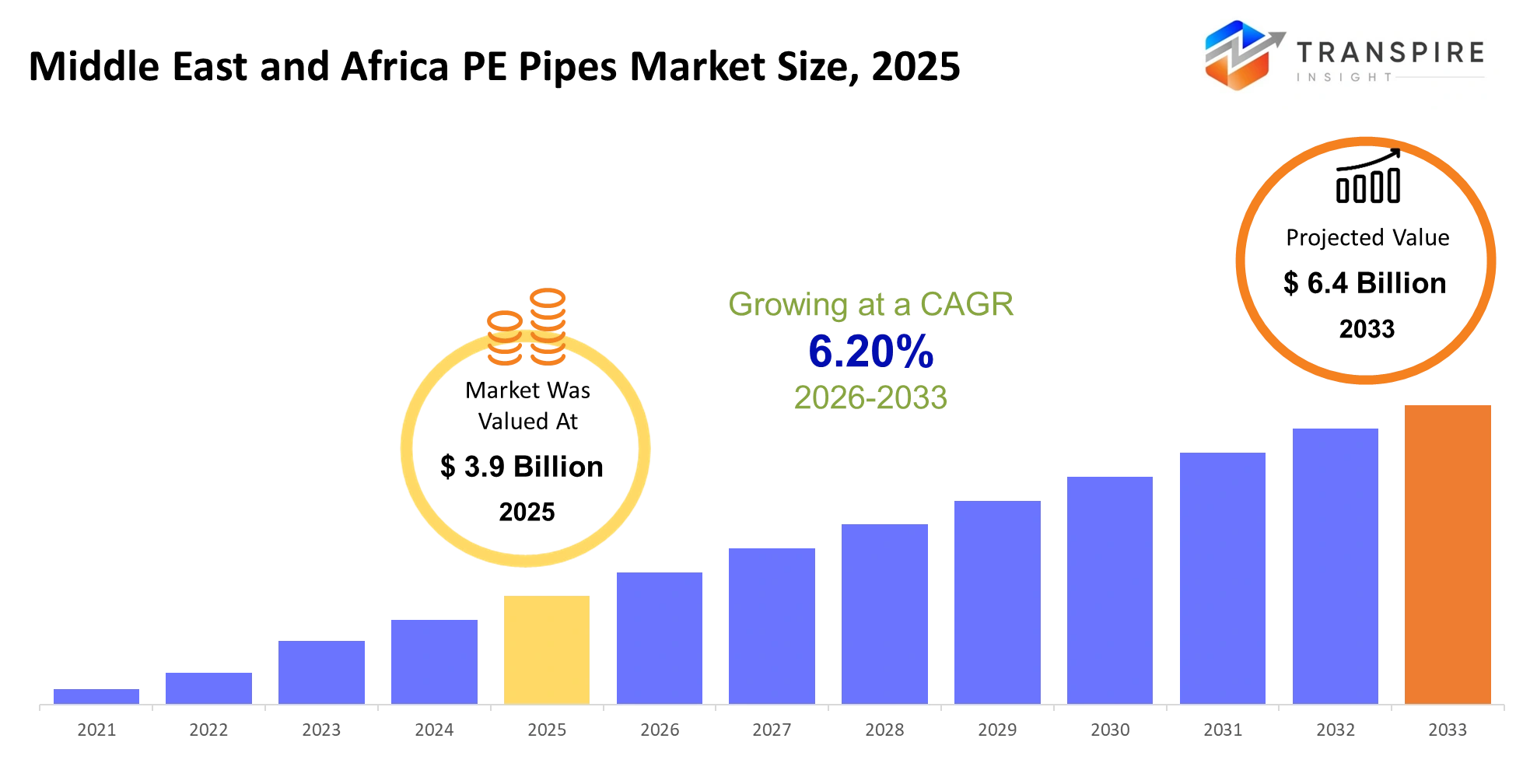
- Middle East and Africa PE Pipes Market Size 2025: USD 3.9 Billion
- Middle East and Africa PE Pipes Market Size 2033: USD 6.4 Billion
- Middle East and Africa PE Pipes Market CAGR: 6.20%
- Middle East and Africa PE Pipes Market Segments: By Type (HDPE, LDPE, MDPE, Others); By Application (Water Supply, Gas Distribution, Sewage Systems, Irrigation, Others); By End-User (Municipal Sector, Construction Industry, Agriculture, Industrial Sector, Others); By Diameter (Small, Medium, Large, Others).
To learn more about this report,  Download Free Sample Report
Middle East and Africa PE Pipes Market Summary
The Middle East and Africa PE Pipes Market was valued at USD 3.9 Billion in 2025. It is forecast to reach USD 6.4 Billion by 2033. That is a CAGR of 6.20% over the period.
The Middle East and Africa PE pipes market kind of supports the moving of water, gas, and different industrial fluids through aging and expanding infrastructure, where corrosion, leakage ,and harsh environmental conditions keep creating persistent operational losses . Utilities and industrial operators lean on polyethylene piping systems to swap out metal networks, stabilize flow efficiency and extend the working life of assets across municipal water grids, desalination corridors, gas distribution lines, and irrigation systems
Over the last 3–5 years, you can see a shift toward corrosion-free polymer networks, and that has sped up adoption, especially when utilities replaced legacy steel pipelines with HDPE systems in high temperature and high salinity settings. At the same time, the 2020–2022 global supply chain disruption tightened resin availability ,so governments and contractors started pushing to secure localized production, plus long term supply commitments. That kind of changed procurement behavior a bit too
Together, these modernization initiatives and supply volatility have improved demand visibility for manufacturers. Operators now focus on lifecycle cost reduction and system reliability more than the up front material cost, which boosts the use of higher grade polyethylene pipes and in turn accelerates replacement cycles across key water and energy infrastructure networks.
Key Market Insights
- Middle East kinda dominates the Middle East and Africa PE Pipes Market , with something like 55–60% share in 2025, mostly because desalination pipeline buildouts and city scale water infrastructure investment keep rolling.
- Africa is still the fastest mover through 2032, pushed by irrigation expansion and municipal sanitation upgrades in Sub-Saharan development corridors, you know that kind of thing.
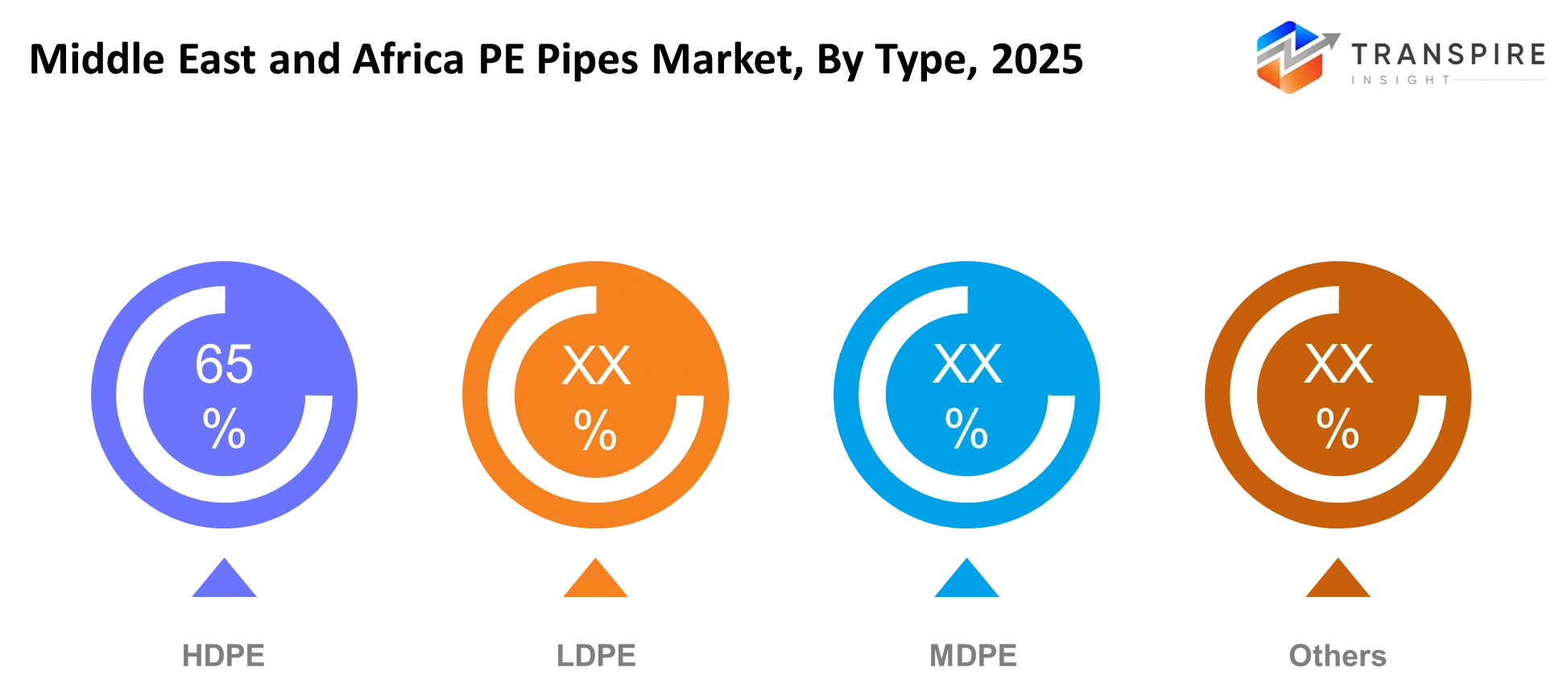
- On the product side , the HDPE segment takes the lead with more than 65% share, mainly for high-pressure resistance and that corrosion-free behavior in water plus gas transmission setups.
- Meanwhile MDPE seems to show the fastest growth from 2023–2030, fueled by the regulated growth of urban gas distribution , plus safety compliance requirements that basically can’t be skipped.
- In applications , water supply is on top at around 40% share, because utilities are prioritizing leakage reduction and modernizing potable networks, which is pretty standard lately.
- Irrigation also shows up as the fastest-growing use case, linked to precision farming adoption and climate-driven water efficiency programs across arid regions.
- For end users , the municipal side leads with over 45% share, backed by public infrastructure spending and national water security initiatives.
- Agriculture as an end-user category expands quickly too, especially in North Africa, driven by drip irrigation uptake and food security policies.
- Major players, including Aliaxis, JM Eagle, Wavin, National Pipe Company, and Uponor, are focusing on extrusion expansion and regional partnerships , so yeah.
- Overall competition tends to center around HDPE innovation, localized production facilities, and smart pipeline integration, all aiming to improve leakage detection and lifecycle efficiency, over time.
What are the Key Drivers, Restraints, and Opportunities in the Middle East and Africa PE Pipes Market?
Driver:
The way large-scale water security programs expand really acts like the main growth motor for the Middle East and Africa PE pipes market. A mix of chronic freshwater shortage plus higher urban demand basically forced governments to speed up desalination-linked transmission corridors and municipal water replacement efforts, after those drought cycles kept repeating. So you end up with a pretty steady pull for high-density polyethylene systems, because utilities tend to favor corrosion resistance and low leakage, more than the older metallic layouts. In practice, adoption climbs fast in newer urban neighborhoods and in cross-regional water transfer builds, which then boosts pipeline demand in a lasting manner, and also supports long-term utility contracts.
Restraint:
Still, there is a serious pushback, mainly tied to how much the sector leans on imported polymer feedstock and how unstable resin pricing can get. A lot of regional converters depend on naphtha-based polyethylene imports, so project teams face cost fluctuations that are hard to predict, plus procurement timelines that get delayed. The issue sticks around because local petrochemical integration differs a lot from country to country, and in many places procurement spending is basically locked under public utility rules. The result is that smaller municipalities often postpone projects, and manufacturers can see weaker margin steadiness, especially when global supply disruptions hit.
Opportunity:
There’s also a forward-looking opening in hydrogen-ready and smarter water infrastructure. Gulf Cooperation Council countries are now piloting hydrogen blending networks, along with digitally observed desalination pipelines, so demand is growing for more advanced PE pipe grades. These are aimed at higher pressure tolerance and better sensor compatibility, which is kind of the next step toward monitored and flexible water systems.For example, ongoing smart water grid investments in Saudi Arabia and the United Arab Emirates are enabling real time leakage analytics, predictive maintenance systems that run before issues happen and so on. This is opening up brand new revenue streams for technology integrated pipe manufacturers who are willing to bet on everything being monitored all the time.
What Has the Impact of Artificial Intelligence Been on the Middle East and Africa PE Pipes Market?
Artificial intelligence is getting more and more wired into pipeline design, making, and day to day utility control across water and gas networks throughout the Middle East and Africa PE pipes ecosystem. Pipe makers are leaning on AI vision systems on their extrusion lines to spot tiny micro defects in PE pipes, basically in real time and that trims scrap rates and helps dimensional accuracy too, specially when production runs are high volume and fast paced.
At the same time utility operators bring machine learning models together with SCADA and IoT sensor streams, to dial in pressure regulation automatically, catch leak signals early and handle flow balancing across long distance transmission grids. Not just that, predictive analytics tools are being pushed into service to estimate pipe fatigue, joint stress, and pump station failures by chewing through old operating records plus soil interaction measurements. In practice this can mean fewer surprise shutdowns and longer asset life, operators often noting less maintenance spend and steadier uptime in networks that are being monitored digitally. And then digital twin simulations are used to tune desalination-linked water transport setups before anything is built in the field, which boosts design efficiency and can curb overbuilding, sometimes by quite a bit.
Still, despite all the progress, uptake is not evenly spread. Integration costs stay high, and data infrastructures are pretty fragmented across utilities. On top of that, limited connectivity along remote desert corridors slows down true real time monitoring, while not having enough localized training data can make the models less reliable under extreme temperature and pressure swings.
Key Market Trends
- Utilities sort of shifted from metal pipelines into polyethylene setups over the past decade, mainly because corrosion failures kept showing up and the whole life cycle cost pressure thing got worse in arid climates.
- Governments, meanwhile, expanded desalination-linked pipeline investments since 2020, which pushed more demand for high pressure PE systems along coastal water transfer routes.
- Also, gas distribution operators started taking on more MDPE after 2018 , kind of because regulatory safety standards got tighter for leakage prevention, especially in denser urban networks.
- For irrigation, buyers have been leaning toward drip compatible PE piping systems as precision farming grew across North African agricultural modernization plans after 2021 , and that’s been a slow steady pull.
- Municipal agencies then accelerated HDPE replacement cycles post 2022, driven by stricter non revenue water reduction mandates and aging city infrastructure that just won’t quit.
- In the industrial side, mining operators moved away from PVC toward PE pipelines for slurry handling, because abrasion resistance needs kept climbing since 2019.
- Regional manufacturers also increased local extrusion capacity after 2020, aiming to reduce import dependence, and to keep pricing steadier amid global polymer volatility.
- On the tech end, smart water grid pilots expanded after 2023, so adoption moved toward sensor compatible PE pipes for real time leak detection, and monitoring systems.
- Finally, construction developers increased their use of medium diameter PE pipes, since urban expansion projects needed faster installation and flexible routing, solutions that just work out better on site.
Middle East and Africa PE Pipes Market Segmentation
By Type
HDPE segment holds the leading position in the Middle East and Africa PE Pipes Market, mostly because it keeps good tensile strength, handles chemicals well, and it’s simply the right choice for high-pressure water and gas networks. You also see large scale infrastructure programs and utility upgrades, especially across the more arid regions, so HDPE gets picked again and again, as the main material for municipal plus industrial pipelines.
MDPE starts to gain traction in gas distribution setups, largely due to its flexibility and crack resistance when pressure keeps changing. LDPE still holds a limited share, mostly in low-pressure irrigation and for that sort of flexible tubing use, where it fits but doesn’t dominate. The Others segment stays more niche, covering specialty chemical and protective conduit applications, where normal grades won’t really meet the technical needs.
Looking ahead, growth seems to favor HDPE through desalination tied transmission lines and cross border pipeline projects. MDPE uptake should rise with city gas network rollouts, while LDPE stays limited, because its performance ceiling is pretty clear. Material improvements and cost optimization will decide which suppliers stay competitive, across those spec driven procurement periods.
To learn more about this report, Download Free Sample Report
By Application
Water Supply leads, mainly due to municipal investments in potable distribution networks, plus scarcity-driven efficiency programs across arid and semi arid zones. Pipeline replacement efforts and leak reduction mandates, both push polyethylene pipes into wider use across urban and peri urban corridors in the Middle East and Africa PE Pipes Market.
Irrigation applications keep growing fast, with drip systems and sprinkler setups driving a lot of it in agriculture intensive economies, but it’s not only that. Gas distribution is also expanding, mostly because of urban energy transitions and the way city gas expansion programs roll out over time. Then there are sewage systems, they get more relevant through wastewater reuse projects and those sanitation infrastructure upgrades happening in fast growing urban clusters , like you see everywhere now.
Looking ahead, demand seems to move toward integrated water reuse setups, desalination discharge pipelines, and distribution grids that are enabled by smart monitoring. For irrigation, the demand stays supportive because precision farming gets more adoption, while for gas distribution it benefits from utility diversification and those cleaner fuel policies across industrial corridors.
By End-User
Municipal sector still holds the strongest position, mainly due to large scale public infrastructure investments in water supply, sanitation, and the overall urban expansion pushes. Government backed utility modernization programs keep creating steady procurement of durable polyethylene piping, across cities and regional networks in the Middle East and Africa , in the PE Pipes Market.
Agriculture shows up as a high growth end user, guided by irrigation modernization and food security initiatives. Industrial sector also keeps widening its share, especially for chemical handling, mining activities, and process water systems. Construction contributes fairly steady demand too, through residential and commercial development pipeline build outs in expanding urban zones.
In the future, demand trends should strengthen for municipal and agriculture segments , driven by climate adaptation funding and resource efficiency mandates. Industrial uptake should rise with mining expansion and manufacturing localization strategies. Procurement preferences also shift toward longer life, low maintenance piping systems across essentially all end user categories.
By Diameter
Small diameter pipes take the major share since they are used a lot in the last-mile distribution networks , for water supply irrigation and residential plumbing setups. Because installation numbers stay high and replacements keep coming, the demand looks pretty steady across municipal and agricultural plans in the Middle East and Africa PE Pipes market.
Medium diameter pipes are starting to get more attention in urban trunk lines and in commercial infrastructure, where an even balance between flow capability and on-site install ease is needed. Large diameter pipes are typically tied to big bulk transmission projects , like intercity water transfers and industrial discharge systems, though these are more case-by-case, and also capital heavy.
Looking ahead the bigger bet is on large diameter pipes , especially with desalination-linked transmission and cross-regional water transport deals. Medium sizes should benefit from the continued urban expansion cycle, and small diameters keep holding baseline pull from farming and home plumbing networks. The overall infrastructure scale up is what will decide how the diameter mix shifts over time.
What are the Key Use Cases Driving the Middle East and Africa PE Pipes Market?
In the Middle East and Africa PE pipes market, you see municipal water supply and agricultural irrigation are basically the big ones, like the main use case kind of thing. Governments and utilities lean on polyethylene piping to push efficient potable water distribution and drip irrigation networks, mostly because of chronic water scarcity, plus ongoing infrastructure modernization programs that keep coming.
On top of that, there are expanding applications like oil and gas gathering systems, and then also wastewater management infrastructure. PE pipes are getting picked more and more for corrosion-prone environments, for example upstream hydrocarbon fields , and even around mining operations where slurry transport needs something dependable and consistent. Same story for industrial effluent handling across these emerging industrial hubs
Then there are the newer, more emerging use cases, like desalination plant discharge networks and district cooling systems in Gulf cities. People are also testing pilot hydrogen distribution projects. Utilities, meanwhile, are looking at PE-based conduits for smart water metering and leak detection networks, which helps with long-term efficiency as well as sustainability targets.
|
Report Metrics |
Details |
|
Market size value in 2025 |
USD 3.9 Billion |
|
Market size value in 2026 |
USD 4.2 Billion |
|
Revenue forecast in 2033 |
USD 6.4 Billion |
|
Growth rate |
CAGR of 6.20% from 2026 to 2033 |
|
Base year |
2025 |
|
Historical data |
2021 - 2024 |
|
Forecast period |
2026 - 2033 |
|
Report coverage |
Revenue forecast, competitive landscape, growth factors, and trends |
|
Regional scope |
Middle East and Africa (Saudi Arabia, United Arab Emirates, South Africa, Rest of Middle East and Africa) |
|
Key company profiled |
Aliaxis, GF Piping Systems, JM Eagle, WL Plastics, Chevron Phillips, Uponor, China Lesso, Sekisui Chemical, Pipelife, Supreme Industries, Astral Pipes, Finolex, Prince Pipes, Radius Systems, Polypipe. |
|
Customization scope |
Free report customization (country, regional & segment scope). Avail customized purchase options to meet your exact research needs. |
|
Report Segmentation |
By Type (HDPE, LDPE, MDPE, Others); By Application (Water Supply, Gas Distribution, Sewage Systems, Irrigation, Others); By End-User (Municipal Sector, Construction Industry, Agriculture, Industrial Sector, Others); By Diameter (Small, Medium, Large, Others). |
Which Regions are Driving the Middle East and Africa PE Pipes Market Growth?
The Gulf Cooperation Council region sorta leads the Middle East and Africa PE Pipes Market, mostly because of big water security efforts and sustained desalination infrastructure investments. Saudi Arabia and the United Arab Emirates are really pushing the demand, via national water grid growth, industrial city build outs, and those cross-country pipeline interconnection schemes. When you see policy support that clearly favors non-oil infrastructure diversification, it also makes procurement pipelines for HDPE and high-pressure systems run more smoothly. And there’s this kind of mature ecosystem, with certified manufacturers, utility operators, and EPC contractors, which helps keep large-volume deployments steady over time.
North Africa ends up in the second slot, with Egypt and Morocco leading the way, where demand is shaped by irrigation setups for agriculture, municipal water distribution networks, and slow but constant upgrades to city infrastructure. Still, unlike the Gulf, growth here leans more on population driven water access expansion rather than mega-desalination networks. Economic steadiness and long-term public financing keep procurement cycles consistent. Also, regional manufacturing capability backs localized supply, so there’s less import dependence and pricing feels more stable across public utility projects.
Sub-Saharan Africa is where the growth pace looks strongest, since rapid urbanization and urgent water access gaps are hitting many places, like Nigeria, Kenya, and Tanzania. Investments recently, including municipal water rehabilitation programs and donor supported infrastructure funding, have sped up pipeline rollout since 2023. On top of that, expanding irrigation corridors for farming keeps demand rising for PE pipe systems. For 2026–2033, the region basically signals strong entry potential for manufacturers that can pair cost-efficient production with on-the-ground distribution, plus public sector partnerships.
Who are the Key Players in the Middle East and Africa PE Pipes Market and How Do They Compete?
The Middle East and Africa PE Pipes Market stays kinda moderately fragmented, with a blend of global polymer infrastructure specialists and regional makers jostling for position across water, gas, and irrigation lines. Most incumbents try to hold on to share via long-term utility agreements and certified pipeline setups, but then new entrants from Asia come in and add real pricing pressure during public infrastructure tenders . In practice the fight seems more about material performance benchmarks, lifecycle durability, and adherence to municipal water rules, not really glossy branding or short-term costs only.
Wavin leans into integrated water management systems, kind of bundling PE pipes together with smart drainage and leak detection technologies for urban utilities. Aliaxis, on the other hand, pushes high-pressure HDPE engineering solutions designed for desalination-linked water conveyance and also industrial uses across Gulf infrastructure. JM Eagle plays the large-scale production efficiency angle and export-driven pricing, so they supply cost-sensitive municipal and irrigation projects around Africa.
Uponor strengthens its stance using advanced cross-linked polyethylene setups for temperature-sensitive uses and building services network work. Saudi Pipe Systems taps domestic manufacturing capacity and government infrastructure contracts, which helps keep demand steadier inside Saudi Arabia, especially as utility modernization ramps up. Overall, these companies expand through utility collaborations, regional distribution routes, and long-term infrastructure framework agreements that tend to lock in multi-year demand visibility, even if the market looks busy and split.
Company List
- Aliaxis
- GF Piping Systems
- JM Eagle
- WL Plastics
- Chevron Phillips
- Uponor
- China Lesso
- Sekisui Chemical
- Pipelife
- Supreme Industries
- Astral Pipes
- Finolex
- Prince Pipes
- Radius Systems
- Polypipe
Recent Development News
In November 2025, Aliaxis announced enhanced investment in polyethylene piping production capabilities in its MEA operations, focusing on high-performance HDPE systems for water and gas infrastructure projects. The expansion supports growing demand from urban water security and desalination-linked pipeline networks.
Source: https://www.aliaxis.com
In January 2026, JM Eagle expanded its export distribution agreements targeting African infrastructure projects, increasing supply of HDPE pressure pipes for municipal water and irrigation systems. The move strengthens its position in fast-growing import-reliant PE pipe markets across Sub-Saharan Africa.
Sourcee: https://www.jmeagle.com
What Strategic Insights Define the Future of the Middle East and Africa PE Pipes Market?
The Middle East and Africa PE Pipes Market is kind of moving toward higher specification, infra-linked demand as governments expand water security, urban sanitation networks, and industrial fluid transport systems, even if it looks “normal” on the surface. Over the next 5–7 years, growth will be shaped less by simple commodity pipe replacement and more by bigger pipeline modernization programs, pushed by water scarcity pressures and cross-border utility investments, especially around Gulf desalination networks and African municipal expansion programs.
There’s also a quieter, less visible risk in the raw material side… polyethylene feedstock volatility. When petrochemical price cycles swing, and supply concentration sits with just a few upstream producers, margins can get squeezed pretty fast, kinda unexpectedly. So even during strong infrastructure spending, exposure shows up, in particular for mid tier manufacturers that don’t have much vertical integration.
On the upside there’s an emerging opportunity in smart PE piping setups, with embedded monitoring for leakage detection and pressure optimization. You’ll see this especially in UAE and Saudi utility modernization efforts. It’s still early, but it lines up with digital water grid initiatives. Market participants should focus on partnerships with utility authorities and put resources into differentiated, sensor enabled pipeline solutions, so they can secure long-term contracts and keep more recurring service revenue streams, rather than just one-off supply deals.
Middle East and Africa PE Pipes Market Report Segmentation
By Type
- HDPE
- LDPE
- MDPE
- Others
By Application
- Water Supply
- Gas Distribution
- Sewage Systems
- Irrigation
- Others
By End-User
- Municipal Sector
- Construction Industry
- Agriculture
- Industrial Sector
- Others
By Diameter
- Small
- Medium
- Large
- Others
Frequently Asked Questions
Find quick answers to common questions.
The Middle East and Africa PE Pipes Market size is USD 6.4 Billion in 2033.
Key segments for the Middle East and Africa PE Pipes Market are By Type (HDPE, LDPE, MDPE, Others); By Application (Water Supply, Gas Distribution, Sewage Systems, Irrigation, Others); By End-User (Municipal Sector, Construction Industry, Agriculture, Industrial Sector, Others); By Diameter (Small, Medium, Large, Others).
Major Middle East and Africa PE Pipes Market players are Aliaxis, GF Piping Systems, JM Eagle, WL Plastics, Chevron Phillips, Uponor, China Lesso, Sekisui Chemical, Pipelife, Supreme Industries, Astral Pipes, Finolex, Prince Pipes, Radius Systems, Polypipe.
The Middle East and Africa PE Pipes Market size is USD 3.9 Billion in 2025.
The Middle East and Africa PE Pipes Market CAGR is 6.20% from 2026 to 2033.
- Aliaxis
- GF Piping Systems
- JM Eagle
- WL Plastics
- Chevron Phillips
- Uponor
- China Lesso
- Sekisui Chemical
- Pipelife
- Supreme Industries
- Astral Pipes
- Finolex
- Prince Pipes
- Radius Systems
- Polypipe
Recently Published Reports
-
May 2026
Healthcare Polymer Packaging Market
Healthcare Polymer Packaging Market Size, Share & Analysis Report By Packaging Type (Syringes, IV Bottles and Pouches, Clamshells, Blisters, Bottles & Jars, Containers, Tubes, IV Parental Packaging, Others), By Type (Regulated, Non-regulated), By Polymer Type (LDPE (Low-Density Polyethylene), HDPE (High-Density Polyethylene), Homo-polymer (Homo), Random Copolymer (Random), Block Copolymer (Block), PET, Polystyrene, Polyvinyl Chloride, Polyamide/EVOH, Others), and Geography (North America, Europe, Asia-Pacific, Middle East and Africa, South and Central America), 2021 - 2031
-
Apr 2026
Hydrophilic Tape (Waterstop) Market
Hydrophilic Tape (Waterstop) Market Size, Share & Analysis Report By Type (Bentonite-Based Hydrophilic Tape, Rubber-Based Hydrophilic Tape), By Application (Residential Buildings, Commercial Buildings, Infrastructure Projects), and Geography (North America, Europe, Asia-Pacific, Middle East and Africa, South and Central America), 2021 - 2031
-
Apr 2026
Metalens Market
Metalens Market Size, Share & Analysis Report By Type (Visible Light Metalens, and Infrared Metalens), By Application (Consumer Electronics, Automotive Electronics, Industrial, Medical, and Others), and Geography (North America, Europe, Asia-Pacific, Middle East and Africa, South and Central America), 2021 - 2031
-
Apr 2026
PBT Resin Market
PBT Resin Market Size, Share & Analysis Report By Type (Reinforced PBT Resin, Unreinforced PBT Resin), By Processing Method (Injection Molding, Extrusion, Blow Molding, Others), By End-User (Automotive, Electrical & Electronics, Consumer Appliances, Industrial Machinery, Medical Devices, Packaging, Others), and Geography (North America, Europe, Asia-Pacific, Middle East and Africa, South and Central America), 2021 - 2031