
Middle East and Africa Metallocene Polyethylene Market Size & Forecast:
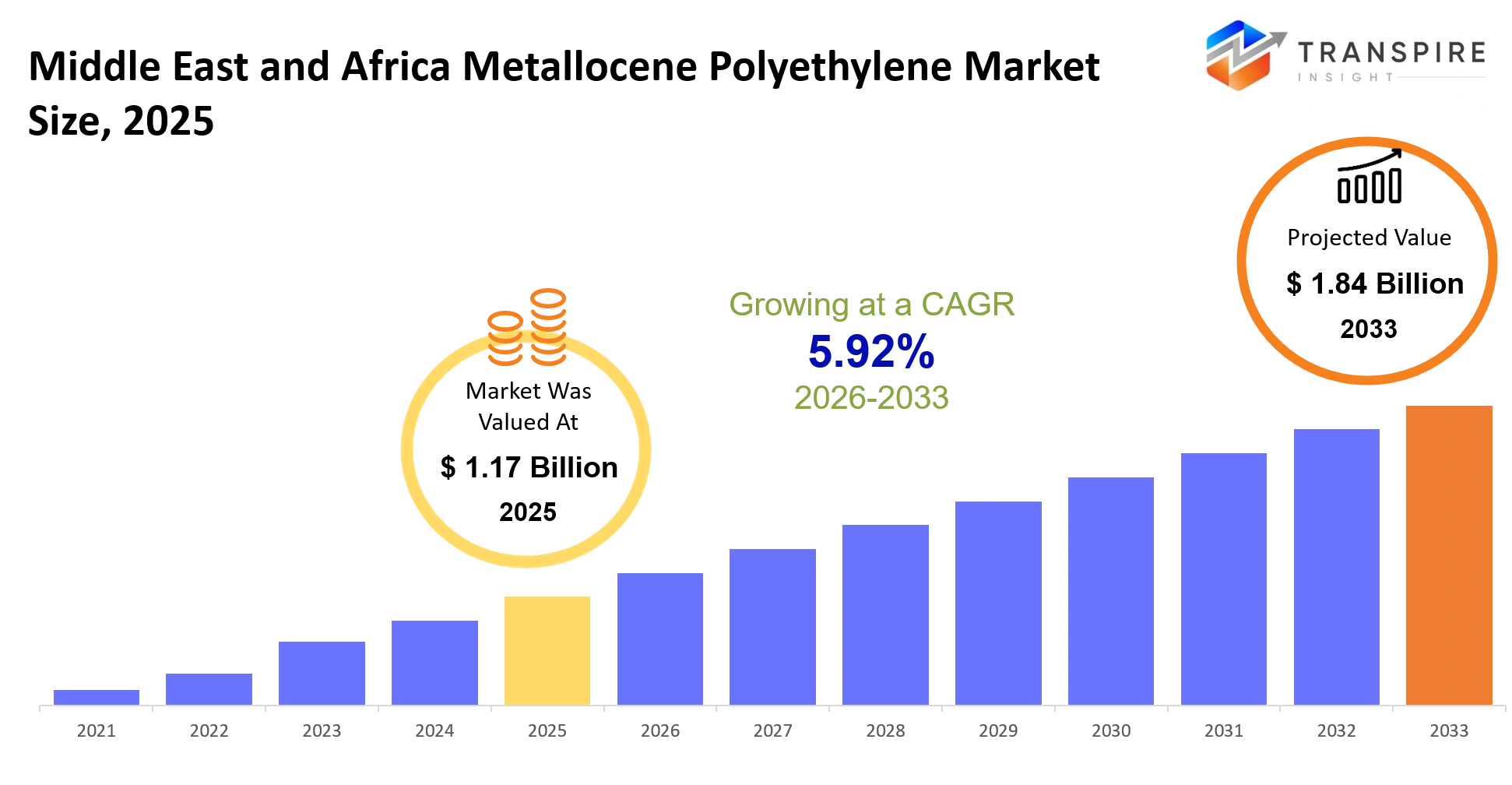
- Middle East and Africa Metallocene Polyethylene Market Size 2025: USD 1.17 Billion
- Middle East and Africa Metallocene Polyethylene Market Size 2033: USD 1.84 Billion
- Middle East and Africa Metallocene Polyethylene Market CAGR: 5.92%
- Middle East and Africa Metallocene Polyethylene Market Segments: By Product Type (mLLDPE, mHDPE, mLDPE, Plastomers, Elastomers, Specialty PE, High Performance PE, Others); By Application (Packaging Films, Stretch Wraps, Agricultural Films, Industrial Packaging, Consumer Packaging, Medical Packaging, Automotive Components, Others); By End User (Packaging Industry, Agriculture, Healthcare, Automotive, Construction, Consumer Goods, Others); By Processing (Blown Film, Cast Film, Injection Molding, Extrusion, Others).
Middle East and Africa Metallocene Polyethylene Market Summary
The Middle East and Africa Metallocene Polyethylene Market was valued at USD 1.17 Billion in 2025. It is forecast to reach USD 1.84 Billion by 2033. That is a CAGR of 5.92%over the period.
Metallocene polyethylene kind of does a major job in today’s packaging and industrial manufacturing, it helps make plastic films that are thinner yet noticeably stronger, and they last longer too, which basically cuts down material use while still keeping the same performance level. Across the Middle East and Africa, converters and packaging makers are using these materials more and more, mainly because they boost puncture resistance, improve sealing efficiency, and offer better product protection in food, healthcare, agriculture, and also in industrial uses. In the last five years, things have been moving toward high-performance polyethylene grades, mainly because brand owners and regulators pushed harder on packaging efficiency plus recyclability targets. Then during the global logistics crisis, supply chain problems made everyone look for materials that can deliver more output with less resin consumption, so metallocene-based solutions got taken up more broadly. At the same time, investments in regional petrochemical capacity, flexible packaging production, and film-processing technology that’s more advanced keep supporting demand. Now, as manufacturers chase lightweight packaging and cost optimization, adoption of metallocene polyethylene is creeping into applications that used to rely on standard polyethylene grades, and that’s opening up fresh revenue opportunities all along the value chain .
Key Market Insights
- Saudi Arabia kinda owned the regional consumption landscape in 2025 with something like 35%+ market share, and it was basically backed up by integrated petrochemical production capacity.
- Gulf Cooperation Council countries still stayed as the biggest revenue drivers, mostly because resin manufacturing is on a large scale, and export-oriented packaging industries just keep pushing demand.
- East Africa should be the fastest-moving regional market all the way to 2033, supported by food processing activities , and agricultural packaging investments going in too.
- For product demand in 2025, mLLDPE showed up at more than 40% , and it seemed to benefit from better film strength , plus its downgauging capabilities.
- mHDPE was the second-largest product segment , largely tied to rigid packaging and industrial applications where it’s used widely.
- Specialty PE grades are forecast to grow the quickest through 2033 too, as converters chase higher performance and more differentiated packaging solutions, not just “standard” options.
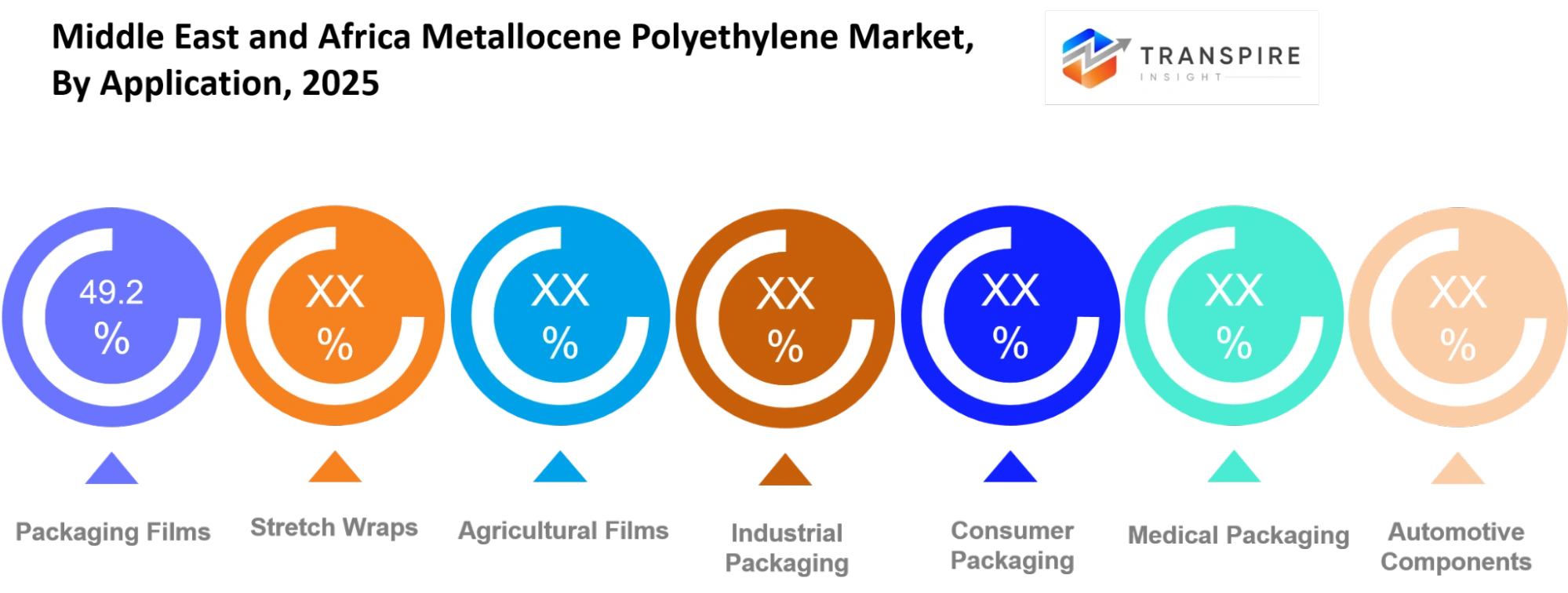
- When it comes to applications, packaging films brought in around 45% of application revenue in 2025, so yeah it was the dominant segment.
- Medical packaging is expected to expand at over 6% annual growth, and that’s said to be supported by healthcare infrastructure investments across the region.
- Overall, the packaging industry maintained more than 50% of end-user demand in 2025, which basically mirrors strong consumption of flexible packaging materials.
- Companies like SABIC, Dow, ExxonMobil, LyondellBasell, Borealis, and INEOS are also working to boost competitiveness using advanced resin technologies, circular economy initiatives , and regional expansion strategies.
What are the Key Drivers, Restraints, and Opportunities in the Middle East and Africa Metallocene Polyethylene Market?
The strongest growth catalyst seems to come from the packaging industry’s move toward downgauged and higher performance films, kind of like a quiet shift that keeps building over time. Brand owners , retailers, and food processors are still under that constant push to reduce packaging costs while also protecting the product and keeping shelf life steady. Metallocene polyethylene helps enable thinner film grades with better toughness , easier sealing behavior, and stronger puncture resistance. That combination lets manufacturers cut down material usage but not at the expense of real-world performance. In a pretty direct way, this performance-to-cost edge is pushing wider use across food packaging, industrial wrapping, and everyday consumer goods , which then boosts higher resin consumption and market revenue.
One big structural issue is the higher production cost tied to metallocene catalyst technology, especially when you compare it to more conventional polyethylene manufacturing. The advanced catalyst systems, plus the fact that there are specialized processing requirements , and also the limited number of production sites concentrated with major petrochemical suppliers. All of that creates a pricing premium that many smaller and mid sized converters simply find difficult to absorb. And because this is all linked to scale, it really can’t be fixed quickly; it depends on major technology investments, intellectual property, and a more integrated manufacturing setup. So penetration tends to be slower in markets that are very cost sensitive, and adoption often lags among smaller packaging manufacturers.
Looking ahead, the clearest opportunity is in recyclable mono material flexible packaging systems. Companies in food, healthcare, and consumer goods are increasingly asking for packaging designs that align with circular economy goals , but still meet performance requirements without compromise.
What Has the Impact of Artificial Intelligence Been on the Middle East and Africa Metallocene Polyethylene Market?
Artificial intelligence together with more advanced digital tech are, little by little, changing metallocene polyethylene production and conversion routines across the Middle East and Africa. Resin makers end up using AI based process control platforms to keep an eye on reactor behavior, catalyst effectiveness , heat steadiness, and polymerization output all at once, in real time. With these platforms, operational tweaks get handled automatically, so product consistency gets better, and at the same time energy use drops, along with some of the usual production swings.
There’s also machine learning for predictive maintenance across petrochemical sites. These models take a look at equipment vibration, pressure pulses, and past operating records, and they can point to likely issues before a sudden stop happens. A lot of facilities say they see real gains in plant uptime and in the efficiency of how maintenance plans are built and followed. On top of that, AI enabled quality control systems assist manufacturers by spotting shifts in film thickness, mechanical behavior, and sealing performance during the run.
Meanwhile digital twins and analytics engines are being used more often to refine film extrusion and packaging conversion steps. They tend to raise throughput, lower scrap, and make raw material usage feel more efficient. Still, take-up is not always smooth because the initial setup costs are high, integration can be tricky, and specialized operational data isn’t always easy to obtain, which is important for training industrial AI models that are actually accurate. Smaller converters often struggle to earn enough back from these digital transformation investments, even when the tools look promising.
Key Market Trends
- Since 2021, a bit of downgrading in several initiatives , like not as heavy film thickness , ended up cutting the film gauge by roughly 10%–20% across multiple packaging uses, while still keeping performance benchmarks in place.
- From 2023 to 2026, petrochemical producers expanded their metallocene resin lineups and aimed to cover food, healthcare, and industrial packaging, kind of in a broader push.
- Recyclable mono-material packaging efforts rose across GCC countries, as brand owners started aligning more directly with circular economy targets, even when timelines got tight.
- Food packaging manufacturers also moved faster toward high clarity films, so shelf appearance looked better , and overall packaging efficiency improved.
- Meanwhile, regional converters invested in upgraded blown-film lines that can handle premium polyethylene grades with steadier output consistency.
- After 2022, healthcare packaging demand picked up , which helped specialty resins get used in wider ways, especially where sealing characteristics matter.
- There were more strategic collaborations between resin suppliers and packaging converters, to basically tailor solutions to specific applications rather than using generic grades.
- Big producers including SABIC, Dow and ExxonMobil increased their attention on circular polymers, and on integrating mechanically recycled feedstock into production flows.
- Agricultural film makers increasingly shifted to higher performance formulations , designed to boost durability and support crop protection.
- And export-driven packaging manufacturers kept strengthening investments in premium materials to satisfy international quality requirements.
Middle East and Africa Metallocene Polyethylene Market Segmentation
By Product Type
mLLDPE kinda holds a major position, thanks to excellent toughness, puncture resistance and sealing performance, especially in flexible packaging applications. mHDPE is often used for rigid packaging, industrial containers and durable products, where you need higher strength. mLDPE still remains important, for film applications that want flexibility and clarity in one go. Plastomers bring in enhanced softness, plus those sealing characteristics, for premium packaging structures too.
Elastomers are for cases where flexibility, impact resistance and long lasting durability matter, specially under demanding conditions. Specialty PE grades also exist to tackle more niche requirements in healthcare, industrial and advanced packaging sectors, kind of. High Performance PE products back the situations that demand better mechanical properties and processing efficiency, without the fuss. Then other grades fulfill specialized manufacturing requirements across multiple industrial areas, more or less.
By Application
Packaging films end up taking a pretty big share of consumption, mostly because they’re used everywhere, especially for food preservation, product defense, and general retail packing. Stretch wraps stay kinda crucial for logistics and warehouse operations, since load stability really needs to hold. Agricultural films help with crop protection too, keeping moisture in check and supporting productivity gains across farming steps. For industrial packaging, the win is usually strong but still light material traits, which can lower transportation costs in practice.
Consumer packaging keeps growing as manufacturers chase formats that look good and last longer, not just some basic covering. Medical packaging in particular needs dependable sealing performance, plus solid protection against contamination. Automotive components are also starting to include more advanced polyethylene materials, mainly to cut weight while still holding up well under stress. There are more use cases as well, like specialty industrial products and customized manufacturing solutions.
By End User
The packaging industry sort of represents the largest consumer of these materials because advanced polyethylene helps improve efficiency , along with durability and product presentation. Agriculture also takes advantage of this, especially in films and protective coverings that support crop management in a practical way. For healthcare, there’s a need for consistent material quality for sterile, protective packaging solutions. Meanwhile the automotive makers lean on high-performance grades for selected lightweight component uses
In construction, polyethylene gets used for protective barriers, insulation products and a bunch of industrial applications. Consumer goods manufacturers tend to fold these materials into packaging and product components that need real durability as well as flexibility. Other end users include industrial processing sectors that use specialized polyethylene performance characteristics across different tasks , pretty much where it matters most.
By Processing
Blown film processing takes up a noticeable part, mainly because it makes packaging films that have solid mechanical strength and can be used in many ways. Cast film tech supports use cases where clarity matters, plus you want a steady uniform thickness, and also a production line that stays efficient. Injection molding lets producers manufacture containers, closures, and industrial parts while keeping quality consistent, not wobbly. Extrusion is still really important for making sheets, pipes, and a bunch of other industrial products, no question.
On top of that, processing improvements keep showing up, and they enhance output efficiency along with better material utilization across different plants. Companies more often put money into modern equipment that can handle premium polyethylene grades with more precision, which helps. Other methods also step in for specialized production needs, and they back customization in many industrial scenarios.
What are the Key Use Cases Driving the Middle East and Africa Metallocene Polyethylene Market?
Flexible packaging is still the main use, because food processors, retailers, and consumer goods manufacturers need long lasting films that cut down on how much material they use, but also keep the product safe. The really good sealing behavior together with puncture resistance is what makes metallocene polyethylene a pretty spot on fit for food packaging, pouch packaging, and that kind of protective film work.
Then there are agricultural films plus industrial packaging, which sit as secondary but still matter a lot. In the fields, agricultural producers lean on these advanced films for better crop protection, plus water management, so it’s not just about coverage. In logistics, operators depend on high strength wrapping materials that hold shipments in place and lower product damage during transport.
Lately, more new ideas are showing up too like healthcare packaging that’s more advanced, and lighter automotive parts. For healthcare, providers want dependable sterile packaging solutions, while automotive manufacturers look at durable polymer materials, aiming for less vehicle weight reduction and better manufacturing efficiency, even if it’s only part of the story.
|
Report Metrics |
Details |
|
Market size value in 2025 |
USD 1.17 Billion |
|
Market size value in 2026 |
USD 1.23 Billion |
|
Revenue forecast in 2033 |
USD 1.84 Billion |
|
Growth rate |
CAGR of 5.92%from 2026 to 2033 |
|
Base year |
2025 |
|
Historical data |
2021 - 2024 |
|
Forecast period |
2026 - 2033 |
|
Report coverage |
Revenue forecast, competitive landscape, growth factors, and trends |
|
Regional scope |
United States; Canada; Mexico; United Kingdom; Germany; France; Italy; Spain; Denmark; Sweden; Norway; China; Japan; India; Australia; South Korea; Thailand; Brazil; Argentina; South Africa; Saudi Arabia; United Arab Emirates |
|
Key company profiled |
Dow, ExxonMobil, LyondellBasell, SABIC, Chevron Phillips, Borealis, INEOS, TotalEnergies, Mitsui Chemicals, LG Chem, Reliance Industries, Hanwha Solutions, Braskem, Formosa Plastics, Westlake. |
|
Customization scope |
Free report customization (country, regional & segment scope). Avail customized purchase options to meet your exact research needs. |
|
Report Segmentation |
By Product Type (mLLDPE, mHDPE, mLDPE, Plastomers, Elastomers, Specialty PE, High Performance PE, Others); By Application (Packaging Films, Stretch Wraps, Agricultural Films, Industrial Packaging, Consumer Packaging, Medical Packaging, Automotive Components, Others); By End User (Packaging Industry, Agriculture, Healthcare, Automotive, Construction, Consumer Goods, Others); By Processing (Blown Film, Cast Film, Injection Molding, Extrusion, Others). |
Which Regions are Driving the Middle East and Africa Metallocene Polyethylene Market Growth?
The Gulf region is basically leading the market growth, mostly thanks to a pretty extensive petrochemical manufacturing setup. There is also this steady supply of feedstock around, plus big investments going into polymer production. Saudi Arabia along with the United Arab Emirates actually house major resin production sites, which helps them cover domestic needs while also pushing exports. You can see how strong industrial ecosystems, connected supply chains, and fairly advanced processing capabilities keep that regional edge in place. And, with ongoing funding for packaging and manufacturing activities, the expansion is likely to stay on track for the long term , even if things change a bit.
South Africa, though, feels like it’s doing things a little differently. It shows up as an important contributor, but with a distinct growth pattern. Here, market development is backed by diversified manufacturing activity. There are already well established packaging industries, plus industrial infrastructure that is relatively mature. Demand remains stable from consumer goods, healthcare, and industrial segments, so there’s more resilience when the wider economy wobbles. And the steady investment in packaging modernization should keep market revenue trends relatively consistent.
East Africa shows the strongest growth momentum during the forecast period. The rise is tied to expanding food processing industries, agricultural modernization programs and of course the bigger urbanization trend . All of that has lifted demand for advanced packaging materials. At the same time, new investments in manufacturing capacity and logistics infrastructure have improved regional growth outlook . This momentum, honestly, opens up nice prospects for resin suppliers, packaging converters, and investors who want exposure to developing industrial markets, roughly between 2026 and 2033.
Who are the Key Players in the Middle East and Africa Metallocene Polyethylene Market and How Do They Compete?
Competition is still fairly concentrated across global petrochemical and polymer producers, those with strong technological know how and real production scale. In practice, technology leadership, catalyst innovation, how well the products perform, and regional supply dependability are the main things that decide who wins. Big producers keep defending their market share mostly via product differentiation, not just by racing on price.
Dow is pushing advanced packaging solutions, the kind that helps enable downgauging and more recyclable packaging structures. The edge there comes less from a single material, more from application development knowhow, plus tight collaboration with packaging converters, which often turns into faster problem solving. ExxonMobil highlights premium metallocene technologies built for high-performance film uses, so converters can improve productivity and material efficiency. SABIC leans on solid regional manufacturing power and integrated feedstock access, to keep supply competitive and to keep product innovation moving.
LyondellBasell keeps funding advanced polyolefin technologies, along with circular economy programs, to reinforce its differentiation story. Borealis concentrates on higher value specialty polyethylene solutions, and sustainability minded innovations that are meant to stick. Overall, these players increasingly go after partnerships, application development programs, and regional expansion steps, all to strengthen customer ties and build longer term competitive advantages.
Company List
- Dow
- ExxonMobil
- LyondellBasell
- SABIC
- Chevron Phillips
- Borealis
- INEOS
- TotalEnergies
- Mitsui Chemicals
- LG Chem
- Reliance Industries
- Hanwha Solutions
- Braskem
- Formosa Plastics
- Westlake
Recent Development News
In May 2026, ExxonMobil announced the startup and expansion of advanced recycling capacity, increasing plastic waste processing capability to more than 250 million pounds annually. The investment strengthens circular polymer production and supports sustainable polyethylene supply chains.
Source: https://corporate.exxonmobil.com/
In February 2025, ExxonMobil's China Chemical Complex produced its first on-spec linear low-density polyethylene pellets during test operations ahead of commercial startup. The project expands global polyethylene production capacity and strengthens supply for high-performance packaging applications.
Source: https://www.reuters.com
In 2025, Dow introduced INNATE™ TF 220 Precision Packaging Resin for recyclable BOPE flexible packaging applications. The launch improves packaging recyclability, reduces manufacturing waste, and supports circular economy objectives across consumer packaging markets.
Source: https://www.ourmidland.com/
What Strategic Insights Define the Future of the Middle East and Africa Metallocene Polyethylene Market?
The market is kinda moving, structurally , toward high performance, recyclable and resource-efficient polyethylene solutions. What really pushes this shift is balancing packaging performance , cost efficiency, and circular economy needs all at once. In practice manufacturers that manage to deliver tougher materials while using less resin will grab a larger chunk of what’s coming next.
There is also a risk that’s not as obvious, but still matters. It comes from concentration in advanced catalyst technologies and in premium resin production capacity. If there are supply disruptions , tech licensing limits , or feedstock volatility, pricing pressure can show up fast and smaller converters may find market access gets tighter.
At the same time there’s an emerging opening in mono-material flexible packaging systems built for mechanical recycling streams. As recycling infrastructure keeps improving across Gulf economies, and multinational consumer brands keep tightening their circular packaging promises, these uses could turn into a real growth engine.
Market participants should put money into application development partnerships with converters and brand owners. The players that blend material innovation, recyclability performance, and dependable regional supply—those will likely be best set up for long term growth and to protect margins during the next decade.
Middle East and Africa Metallocene Polyethylene Market Report Segmentation
By Product Type
- mLLDPE
- mHDPE
- mLDPE
- Plastomers
- Elastomers
- Specialty PE
- High Performance PE
- Others
By Application
- Packaging Films
- Stretch Wraps
- Agricultural Films
- Industrial Packaging
- Consumer Packaging
- Medical Packaging
- Automotive Components
- Others
By End User
- Packaging Industry
- Agriculture
- Healthcare
- Automotive
- Construction
- Consumer Goods
- Others
By Processing
- Blown Film
- Cast Film
- Injection Molding
- Extrusion
- Others
Frequently Asked Questions
Find quick answers to common questions.
The expected Middle East and Africa Metallocene Polyethylene Market size for the market will be USD 1.84 Billion in 2033.
Key segments for the Middle East and Africa Metallocene Polyethylene Market are By Product Type (mLLDPE, mHDPE, mLDPE, Plastomers, Elastomers, Specialty PE, High Performance PE, Others); By Application (Packaging Films, Stretch Wraps, Agricultural Films, Industrial Packaging, Consumer Packaging, Medical Packaging, Automotive Components, Others); By End User (Packaging Industry, Agriculture, Healthcare, Automotive, Construction, Consumer Goods, Others); By Processing (Blown Film, Cast Film, Injection Molding, Extrusion, Others).
Major Middle East and Africa Metallocene Polyethylene Market players are Dow, ExxonMobil, LyondellBasell, SABIC, Chevron Phillips, Borealis, INEOS, TotalEnergies, Mitsui Chemicals, LG Chem, Reliance Industries, Hanwha Solutions, Braskem, Formosa Plastics, Westlake.
The Middle East and Africa Metallocene Polyethylene Market size is USD 38489.2 Billion in 2025.
The Middle East and Africa Metallocene Polyethylene Market CAGR is 5.92% from 2026 to 2033.
- Dow
- ExxonMobil
- LyondellBasell
- SABIC
- Chevron Phillips
- Borealis
- INEOS
- TotalEnergies
- Mitsui Chemicals
- LG Chem
- Reliance Industries
- Hanwha Solutions
- Braskem
- Formosa Plastics
- Westlake
About the Authors

Pankaj Ghogare Patil
I am Pankaj Ghogare Patil, a Senior Research Analyst at Transpire Insight, specializing in the Pharmaceutical, Chemicals & Materials, Healthcare IT, and Biotechnology industry. My expertise lies in conducting comprehensive market research, analyzing industry trends, evaluating competitive landscapes, and translating complex data into actionable insights. At Transpire Insight, I closely follow emerging technologies, regulatory developments, and market innovations to create accurate, well-researched, and informative content that helps businesses and professionals make informed decisions. I am committed to producing credible, evidence-based articles that reflect industry best practices while making technical topics accessible and valuable for a broad audience.

Chakradhar Khansole
Chakradhar serves as the Research Director at Transpire Insight, bringing over 8 years of experience in technology, innovation, and strategic market intelligence. He specializes in transforming complex market data into actionable business insights that enable organizations to make informed, growth-oriented decisions. Recognized for his strategic vision and analytical expertise, Chakradhar leads high-impact research initiatives, delivering comprehensive market assessments, competitive intelligence, and forward-looking industry analysis.
Recently Published Reports
-
May 2026
Healthcare Polymer Packaging Market
Healthcare Polymer Packaging Market Size, Share & Analysis Report By Packaging Type (Syringes, IV Bottles and Pouches, Clamshells, Blisters, Bottles & Jars, Containers, Tubes, IV Parental Packaging, Others), By Type (Regulated, Non-regulated), By Polymer Type (LDPE (Low-Density Polyethylene), HDPE (High-Density Polyethylene), Homo-polymer (Homo), Random Copolymer (Random), Block Copolymer (Block), PET, Polystyrene, Polyvinyl Chloride, Polyamide/EVOH, Others), and Geography (North America, Europe, Asia-Pacific, Middle East and Africa, South and Central America), 2021 - 2031
-
Apr 2026
Hydrophilic Tape (Waterstop) Market
Hydrophilic Tape (Waterstop) Market Size, Share & Analysis Report By Type (Bentonite-Based Hydrophilic Tape, Rubber-Based Hydrophilic Tape), By Application (Residential Buildings, Commercial Buildings, Infrastructure Projects), and Geography (North America, Europe, Asia-Pacific, Middle East and Africa, South and Central America), 2021 - 2031
-
Apr 2026
Metalens Market
Metalens Market Size, Share & Analysis Report By Type (Visible Light Metalens, and Infrared Metalens), By Application (Consumer Electronics, Automotive Electronics, Industrial, Medical, and Others), and Geography (North America, Europe, Asia-Pacific, Middle East and Africa, South and Central America), 2021 - 2031
-
Apr 2026
PBT Resin Market
PBT Resin Market Size, Share & Analysis Report By Type (Reinforced PBT Resin, Unreinforced PBT Resin), By Processing Method (Injection Molding, Extrusion, Blow Molding, Others), By End-User (Automotive, Electrical & Electronics, Consumer Appliances, Industrial Machinery, Medical Devices, Packaging, Others), and Geography (North America, Europe, Asia-Pacific, Middle East and Africa, South and Central America), 2021 - 2031