

Middle East and Africa Mass Notification System Market Size & Forecast:
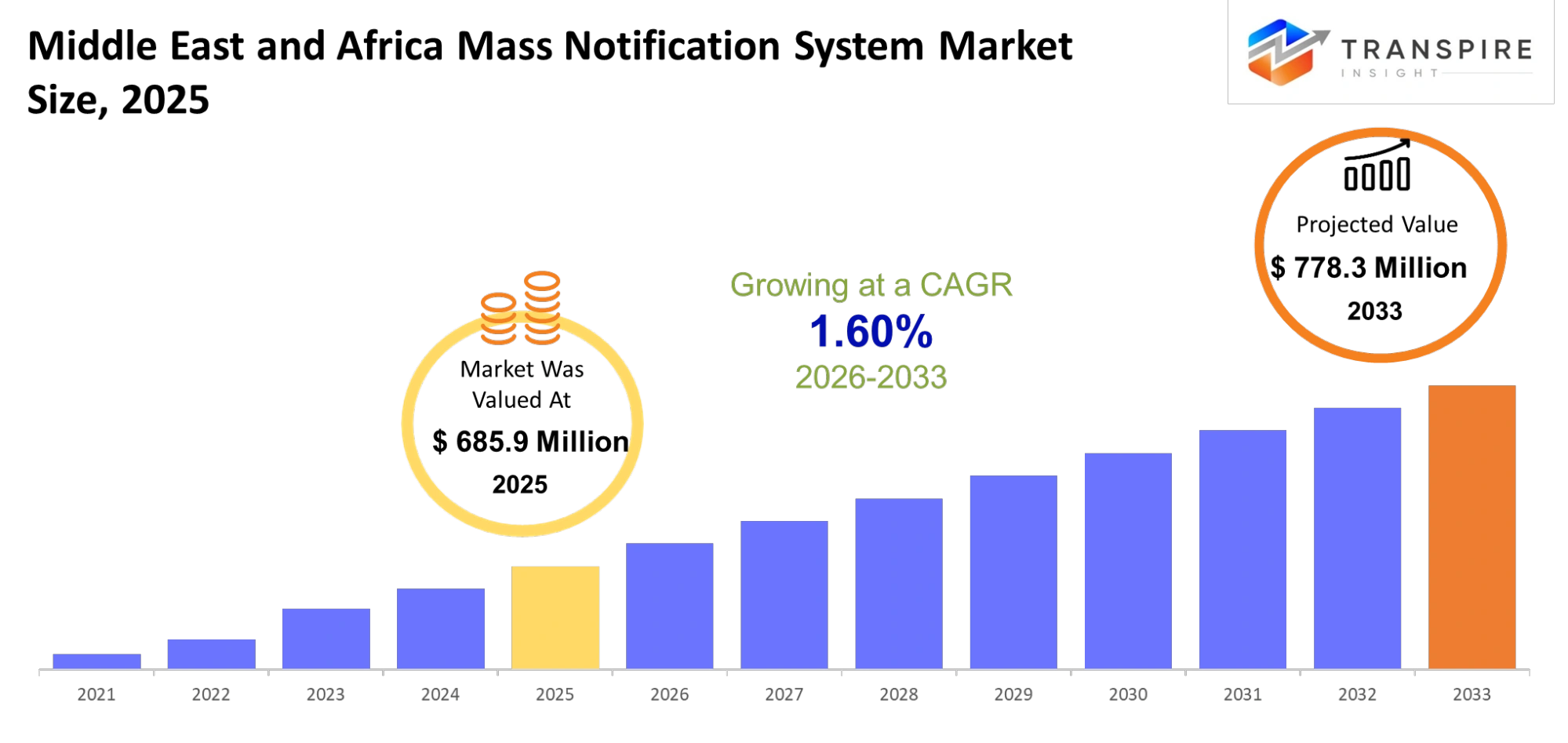
- Middle East and Africa Mass Notification System Market Size 2025: USD 685.9 Million
- Middle East and Africa Mass Notification System Market Size 2033: USD 778.3 Million
- Middle East and Africa Mass Notification System Market CAGR: 1.60%
- Middle East and Africa Mass Notification System Market Segments: By Component (Software, Hardware, Services), By Deployment (Cloud, On-Premise, Hybrid), By End-User (Government, Enterprises, Healthcare, Education)
To learn more about this report,  Download Free Sample Report
Middle East and Africa Mass Notification System Market Summary:
The Middle East and Africa Mass Notification System Market size is estimated at USD 685.9 Million in 2025 and is anticipated to reach USD 778.3 Million by 2033, growing at a CAGR of 1.60% from 2026 to 2033. The public safety and enterprise communication industry in the Middle East and Africa (Saudi Arabia, United Arab Emirates, South Africa, Rest of Middle East and Africa) will implement mass notification systems that operate through real-time location-based alert systems which urban development and heightened security requirements. The governments of Saudi Arabia and the United Arab Emirates will establish smart city networks through which they need to develop comprehensive warning systems while South Africa will use its mobile-first strategy to create communication systems that operate despite its limited infrastructure. Users will demand faster, multilingual alerts across devices. AI-based targeting systems and cloud-based delivery will achieve better accuracy because new regulatory requirements will demand organizations to establish interoperable communication systems that function through centralized control.
Key Market Trends & Insights:
The Middle East and African mass notification system market will see authorities in Saudi Arabia, United Arab Emirates, South Africa, and other Middle Eastern and African countries implement unified communication systems which link emergency alerts to their transportation and healthcare and municipal systems. Gulf economies will see their smart infrastructure projects develop into unified public safety systems which use multiple communication methods to deliver emergency alerts through public displays and mobile apps and other connected devices with immediate playback capabilities.
People who live in urban areas will expect immediate and custom alerts which will notify them about emergencies in their specific location using their preferred language. The South African population requires organizations to use multiple languages when they deliver information because this practice supports their need for accessibility. Organizations will build systems which can target specific neighborhoods because this method helps them maintain essential communication during emergencies while protecting public safety.
Technological progress will reshape how alerts are generated and distributed, with artificial intelligence expected to assist in threat detection and automated message creation. Cloud-native architectures will replace legacy on-premise setups, allowing faster scalability during emergencies. Integration with Internet of Things networks will enable systems to pull data from sensors, cameras, and environmental monitors, creating a more responsive and context-aware communication network across both urban and remote environments.
Regulatory direction across the region will increasingly emphasize coordinated communication standards, especially as governments strengthen disaster preparedness frameworks. Authorities will move toward centralized command systems that can override fragmented communication channels during crises. Data privacy considerations will also gain attention, prompting stricter controls over user information. These developments will shape how vendors design platforms, ensuring compliance while maintaining speed, accuracy, and reliability in high-pressure situations.
Middle East and Africa Mass Notification System Market Segmentation
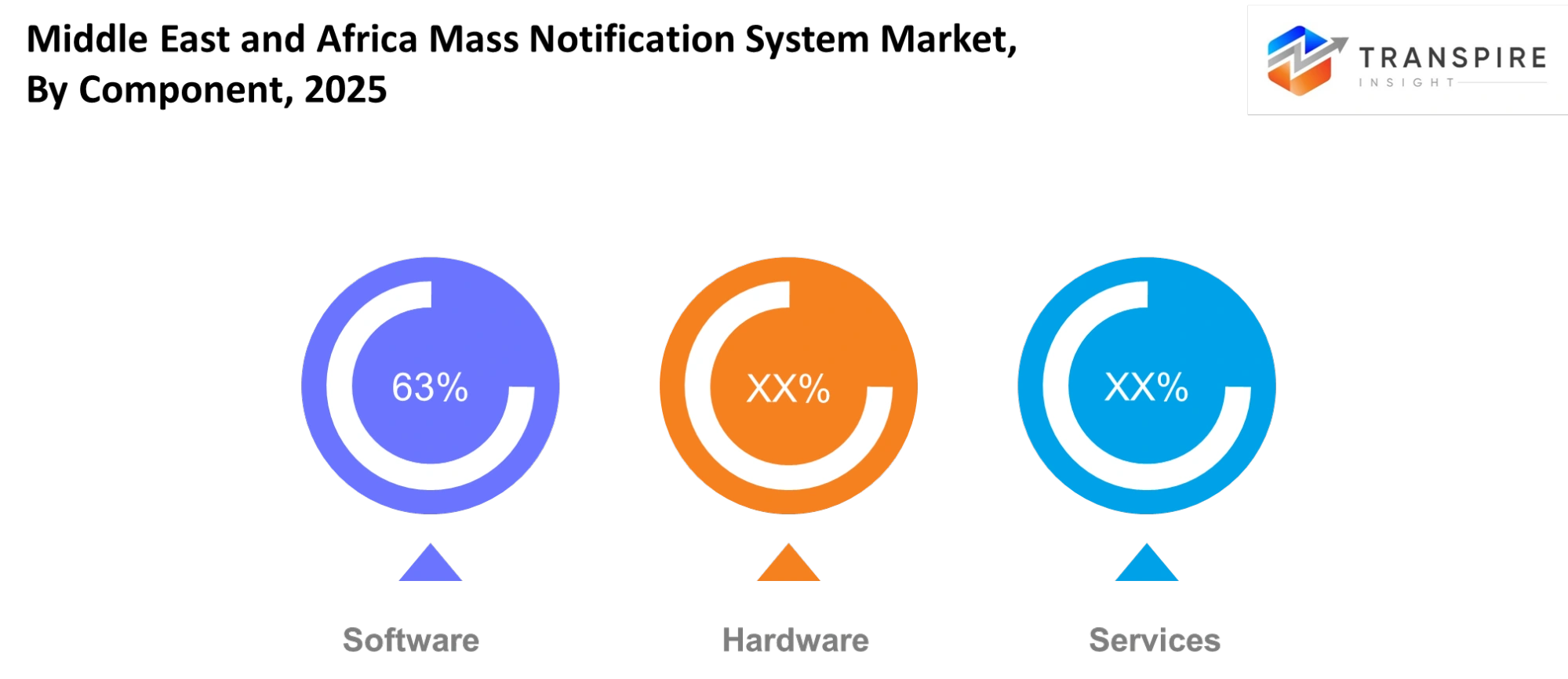
By Component
Software- The notification platforms will use software as their main operational system which will handle centralized control and message creation and real-time communication across multiple channels. The system will progress to develop user-friendly dashboards which enable authorities and businesses to activate alerts through simple procedures that require no more than basic operations. The system will include advanced analytics to assess response rates and communication success while providing integration features that enable compatibility with all current enterprise software and surveillance equipment and public communication systems.
Hardware- The hardware system will enable physical alert transmission through various devices which include sirens and digital display boards and control panels and network infrastructure. These components will remain essential for message delivery in areas where connectivity gaps still exist throughout multiple locations in the region. The government will spend money on building long-lasting systems which can withstand extreme weather conditions while cities will combine their hardware systems with intelligent urban networks to enable coordinated emergency alerts throughout transportation centers and public areas and vital institutions.
Services- The services will maintain system operation through system maintenance and software updates and system customization according to organizational requirements. The providers will deliver consulting services together with system integration and maintenance and training assistance to enable users to achieve peak operational performance. The demand for managed services will increase as organizations handle more complicated deployments because this service enables them to delegate their operational monitoring and system management duties to external providers. The organization needs to provide ongoing support services which will guarantee operational capacity in high-risk zones where quick response times determine the success of safety operations.
To learn more about this report, Download Free Sample Report
By Deployment
Cloud- Cloud-based deployment will establish notification systems that users can access from any location while needing only basic equipment to operate. Organizations will gain advantages through faster system setup and automatic software upgrades which enable them to manage unexpected emergency communication surges. Enterprises and governments will find this model attractive because it delivers cost savings and enables direct connections to mobile solutions and data analysis systems and remote monitoring technologies.
On-Premise- On-premise solutions will remain relevant for organizations that require full control over their data and communication systems. Defense and critical infrastructure and specific government agencies will continue to use this model because of its security advantages. The system will provide operational customization through its deployment process which requires organizations to invest time and money for system upkeep and maintenance to achieve ongoing system dependability and operational efficiency.
Hybrid- Hybrid deployment will create a system that enables organizations to maintain both operational flexibility and complete system supervision through its combination of cloud and on-premise system capabilities. Organizations will use cloud capabilities for scalability and remote access, while retaining critical data and operations within local infrastructure. This method will gain increasing popularity in areas where internet access conditions differ because it enables systems to operate normally during times of internet service interruption while using advanced digital technologies.
By End-User
Government- The primary users of notification systems will be government agencies which they will use to handle public safety and disaster response and civic communication operations. Emergency services and transportation networks and urban management systems will work together to create integrated systems which provide coordinated response during emergency situations. The authorities will use rapid population assessment techniques to identify people in urban environments while making sure their results are accurate which will help them monitor high-risk areas.
Enterprises- Enterprises will use notification systems to protect their employees and handle disruptions to their operations and safeguard their business activities. Organizations of significant size will connect these systems with their existing communication platforms so they can send emergency notifications about fires and system failures and security incidents. Companies will establish dependable multi-channel communication systems because their workplace safety standards require establishing. systems that enable employees to receive work-related communication at any time and from any location.
Healthcare- In terms of emergency response coordination, it is vital for the healthcare facilities to employ the systems of notifications and at the same time be able to control movements of patients as well as share necessary information with their employees. Healthcare institutions will rely on notification systems to facilitate the integration of their administrative and clinical systems and thus be able to share important information promptly during emergencies.
Education- Institutions in education will also need to employ systems of notification with respect to ensuring safety of students, faculty members, and the institution. Schools and colleges will use these platforms as means of communication in case of emergencies or even scheduling changes. Increasing safety concerns at educational institutions will push the institutions towards adopting means of multi-channel communication with all their students.
Regional Insights
Saudi Arabia will improve its communication systems by developing notification networks for both its major urban projects and its national security plans. Authorities will establish alert systems within smart city networks which will permit synchronized communication through transportation networks and public spaces and residential areas. The emergency communication system will prioritize quick message distribution for extreme weather events and large public events because it needs to provide clear messages to citizens and visitors.
The United Arab Emirates will become a leader in digital alert systems by creating notification systems which will function throughout its smart city networks. The system will enable users to access its functions through mobile networks and public display systems and government digital platforms. The authorities will implement innovative technologies for real-time location tracking which will produce automatic alerts that deliver essential information to users in fast-moving urban environments.
South Africa will implement its notification system through two primary methods which will support both people living in cities and people living in rural areas. The organization will prioritize mobile communication because most people own handsets but it will use additional channels to assist areas which face connectivity challenges. The organization will focus on developing better emergency alert systems which will allow public agencies to deliver notifications to all community members who face different infrastructure challenges during emergency situations and service interruptions.
The Middle East and Africa region will show different patterns of technology adoption because each country will adopt digital technologies according to its economic progress and digital infrastructure development. Emerging markets will gradually invest in scalable solutions that can operate within existing infrastructure constraints. The system design will receive its primary direction from regional partnerships and international collaborations which will promote interoperability and knowledge exchange while communication strategies will be customized to match local cultural and linguistic and technological needs.
Recent Development News
IN March 2026, UAE Upgrades National Early Warning System Signals. The United Arab Emirates introduced updated alert sound protocols under its national early warning system, adjusting tones based on time intervals between 9:00 AM and 10:30 PM. This refinement will standardize how alerts are perceived by residents and improve clarity during emergencies. The system will operate with differentiated tones for start and end signals, ensuring consistent communication across urban populations and strengthening response accuracy in critical situations.
In March 2026, Rising Regional Demand Driven by Security and Crisis Alerts. Across Gulf nations including Saudi Arabia and the UAE, authorities intensified the use of mobile emergency alerts amid regional tensions, with real-time notifications reaching millions of residents. These alerts will guide civilians during security incidents, reflecting a shift toward continuous, high-frequency communication. The increased reliance on instant alerts highlights how systems will handle large-scale dissemination under pressure, reinforcing their importance in rapidly changing risk environments.
|
Report Metrics |
Details |
|
Market size value in 2025 |
USD 685.9 Million |
|
Market size value in 2026 |
USD 696.6 Million |
|
Revenue forecast in 2033 |
USD 778.3 Million |
|
Growth rate |
CAGR of 1.60% from 2026 to 2033 |
|
Base year |
2025 |
|
Historical data |
2021 – 2024 |
|
Forecast period |
2026 – 2033 |
|
Report coverage |
Revenue forecast, competitive landscape, growth factors, and trends |
|
Country scope |
Middle East and Africa (Saudi Arabia, United Arab Emirates, South Africa, Rest of Middle East and Africa) |
|
Key company profiled |
Everbridge, Honeywell, Siemens, IBM, Motorola Solutions, BlackBerry AtHoc, OnSolve, Singlewire, AlertMedia, Rave Mobile Safety, Omnilert, Eaton, Mir3, xMatters, F24 |
|
Customization scope |
Free report customization (country, regional & segment scope). Avail customized purchase options to meet your exact research needs. |
|
Report Segmentation |
By Component (Software, Hardware, Services), By Deployment (Cloud, On-Premise, Hybrid), By End-User (Government, Enterprises, Healthcare, Education) |
Key Middle East and Africa Mass Notification System Market Company Insights
The mass notification system market in the Middle East and Africa will develop through competition between worldwide technology companies and specialized communication firms that develop systems for sending alerts through multiple channels. The companies Johnson Controls Siemens Honeywell Everbridge and Motorola Solutions will expand their business operations through platforms that connect voice communication with mobile devices and digital notification systems. New companies and local system integrators will develop cloud-based solutions that prioritize mobile access to satisfy regional requirements. The vendors will establish their unique identity through three elements which include AI-based audience targeting and real-time data processing and complete security system connections.
Company List
- Everbridge
- Honeywell
- Siemens
- IBM
- Motorola Solutions
- BlackBerry AtHoc
- OnSolve
- Singlewire
- AlertMedia
- Rave Mobile Safety
- Omnilert
- Eaton
- Mir3
- xMatters
- F24
Middle East and Africa Mass Notification System Market Report Segmentation
By Component
- Software
- Hardware
- Services
By Deployment
- Cloud
- On-Premise
- Hybrid
By End-User
- Government
- Enterprises
- Healthcare
- Education
Frequently Asked Questions
Find quick answers to common questions.
The approximate Middle East and Africa Mass Notification System Market size for the market will be USD 778.3 Million in 2033.
Key segments for the Middle East and Africa Mass Notification System Market By Component (Software, Hardware, Services), By Deployment (Cloud, On-Premise, Hybrid), By End-User (Government, Enterprises, Healthcare, Education).
Major players in the Middle East and Africa Mass Notification System Market are Everbridge, Honeywell, Siemens, IBM, Motorola Solutions, BlackBerry AtHoc, OnSolve, Singlewire, AlertMedia, Rave Mobile Safety, Omnilert, Eaton, Mir3, xMatters, F24.
The Middle East and Africa Mass Notification System Market size is USD 685.9 Million in 2025.
The Middle East and Africa Mass Notification System Market CAGR is 1.60%.
- Everbridge
- Honeywell
- Siemens
- IBM
- Motorola Solutions
- BlackBerry AtHoc
- OnSolve
- Singlewire
- AlertMedia
- Rave Mobile Safety
- Omnilert
- Eaton
- Mir3
- xMatters
- F24
Recently Published Reports
-
Apr 2026
3D Optical Profiler Market
3D Optical Profiler Market Size, Share & Analysis Report By Type (Desktop 3D Optical Profiler, and Portable 3D Optical Profiler), By Technology (Confocal Technology, and White Light Interference), By End-Use Industry (Manufacturing, Research Institutions, Automotive, Aerospace and Defense, Medical Devices, and Other), and Geography (North America, Europe, Asia-Pacific, Middle East and Africa, South and Central America), 2021 - 2031
-
Apr 2026
Depth Sensor Market
Depth Sensor Market Size, Share & Analysis Report By Type (Infrared Depth Sensors, Time-of-Flight (ToF) Sensors, Stereo Vision Sensors, Structured Light Sensors, Ultrasonic Depth Sensors), By Application (Automotive, Robotics, Gaming, Consumer Electronics, Industrial Automation, Healthcare, Security & Surveillance, Others), By End Users (Automotive Manufacturers, Consumer Electronics Companies, Healthcare Providers, Industrial Companies, Security Agencies, Gaming Companies, Robotics Companies, Others), and Geography (North America, Europe, Asia-Pacific, Middle East and Africa, South and Central America), 2021 – 2031
-
Apr 2026
Digital Manufacturing Market
Digital Manufacturing Market Size, Share & Analysis Report By Component (Hardware, Software, and Services), By Technology (Robotics, 3D Printing, Internet of Things (IoT), and Others), By Application (Automotive and Transportation, Aerospace and Defense, Consumer Electronics, Industrial Machinery, and Others), By Process Type (Computer-Based Designing, Computer-Based Simulation, Computer 3D Visualization, Analytics, and Others), and Geography (North America, Europe, Asia-Pacific, Middle East and Africa, South and Central America), 2021 – 2031
-
Apr 2026
Digital Visa Services Market
Digital Visa Services Market Size, Share & Analysis Report By Type (Individual Travelers, Group Travelers), By Application (Tourism, Business Travel, Others), and Geography (North America, Europe, Asia-Pacific, Middle East and Africa, South and Central America), 2021 – 2031