
Middle East and Africa Grid Modernization Market Size & Forecast:
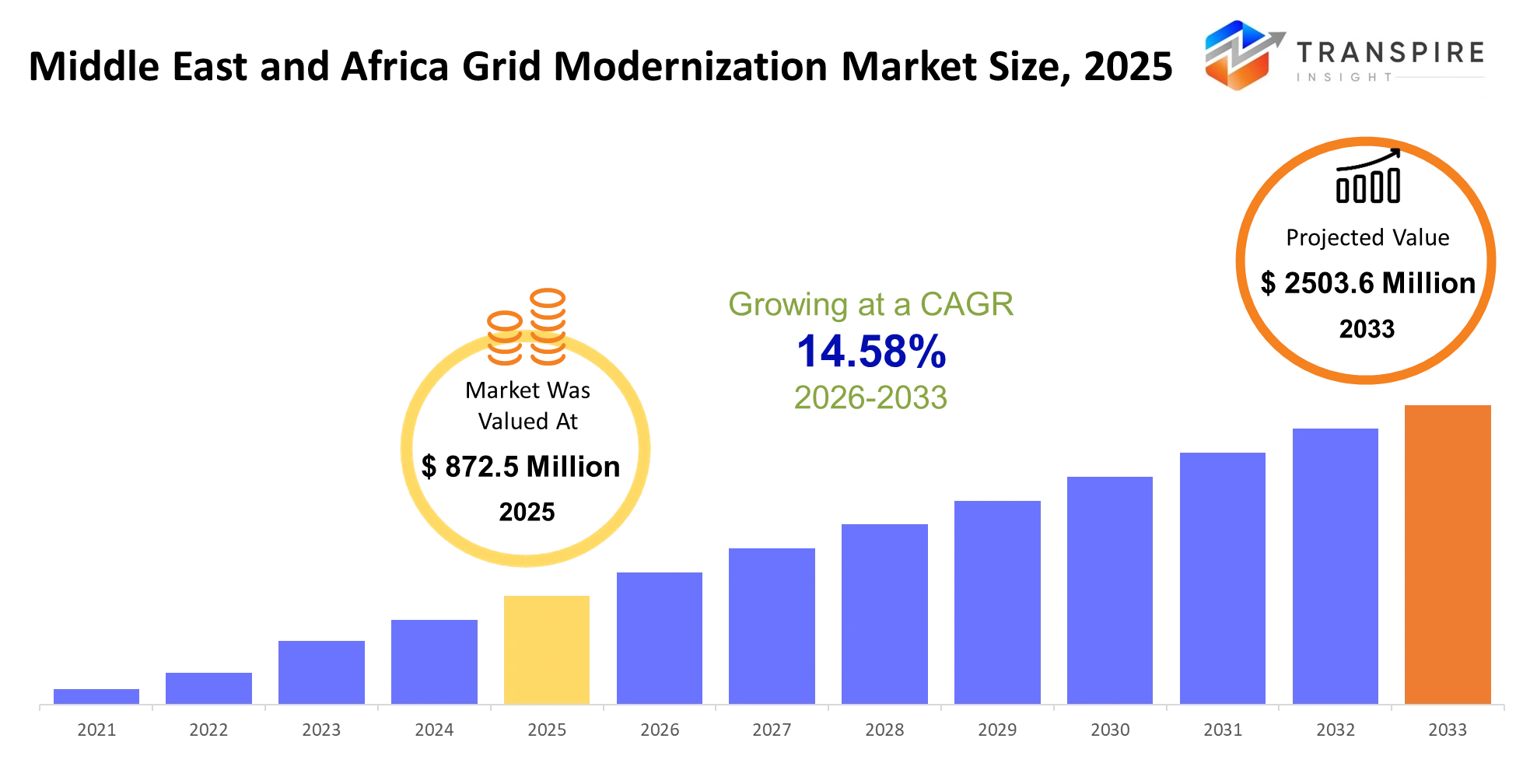
- Middle East and Africa Grid Modernization Market Size 2025: USD 872.5 Million
- Middle East and Africa Grid Modernization Market Size 2033: USD 2503.6 Million
- Middle East and Africa Grid Modernization Market CAGR: 14.58%
- Middle East and Africa Grid Modernization Market Segments: By Type (Smart Grid, Advanced Metering Infrastructure, Grid Automation, Others); By Application (Energy Distribution, Demand Response, Renewable Integration, Grid Security, Others); By End-User (Utilities, Government, Energy Companies, Industrial Sector, Others); By Technology (IoT, AI, Big Data, Others).
To learn more about this report,  Download Free Sample Report
Middle East and Africa Grid Modernization Market Summary
The Middle East and Africa Grid Modernization Market was valued at USD 872.5 Million in 2025. It is forecast to reach USD 2503.6 Million by 2033. That is a CAGR of 14.58% over the period.
The Middle East and Africa Grid Modernization Market helps utilities, industrial operators, and government energy agencies deal with electricity networks in a more efficient way, using digital monitoring, automated transmission steering, and real time power matching systems. With a modernized grid, electricity losses can be cut, shaky networks can feel more steady, renewable resources get easier to connect, and outage response tends to improve, even as cities and factories keep growing across many fast changing economies. In the past five years, the whole market vibe seems to have moved away from just replacing older physical assets , toward software driven grid intelligence powered by IoT sensing, AI style analytics, and cloud linked control environments.
One key cause behind this shift came from ambitious renewable energy expansion efforts happening across Gulf states and North Africa. Big solar and wind deployments showed obvious limits in transmission systems that were built for centralized fossil fuel output, and those older systems don’t always handle variability well. Meanwhile, in several African regions, recurring instability and continuing power shortfalls pushed more spending into automated substations, along with smart distribution frameworks. Put together, energy transition policy plus infrastructure strain plus ongoing digital utility change is basically boosting demand for advanced grid solutions, while also creating longer term service and software monetization chances for technology providers.
Key Market Insights
- In 2025, the Gulf Cooperation Council region took the lead and somehow held over 40% market share, mainly thanks to aggressive smart grid and renewable integration investments, which feels like a big deal.
- Between 2026 and 2033, North and East Africa became the fastest-moving regional markets, driven by electrification efforts and expansion of transmission corridors, and you could say this momentum just kept building.
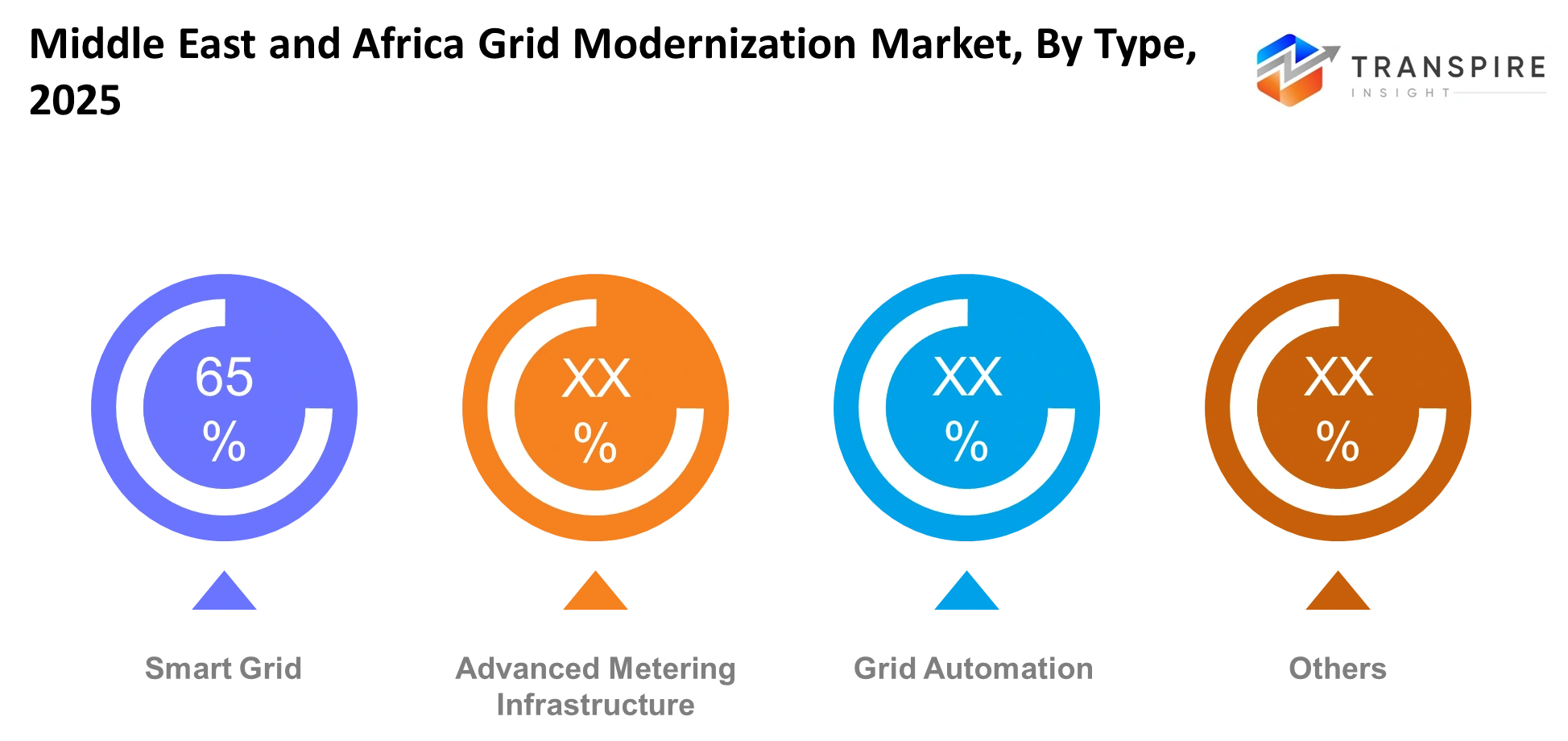
- In the Middle East and Africa Grid Modernization Market, smart grid systems still claimed the largest share in 2025 because utilities leaned hard on automated grid monitoring ,and faster outage management too.
- After Saudi Arabia and the UAE pushed forward national smart city and digital utility programs, Advanced Metering Infrastructure adoption jumped noticeably, almost immediately.
- Grid automation solutions also showed the quickest growth arc, since many utilities modernized older transmission infrastructure and focused on shrinking electricity distribution losses.
- Energy distribution applications made up nearly half of the overall industry demand , largely because utilities upgraded substations and added real-time network control capabilities.
- Renewable integration applications gathered real traction too, especially when Egypt and Morocco accelerated utility-scale solar and wind deployment targets in 2025.
- On the end-user side, utilities stayed out in front, contributing more than 55% of revenue because of large-scale transmission modernization spending programs, end of story.
- Industrial facilities and mining operators increased their microgrid investments afterward, since recurring power instability started disturbing manufacturing and resource extraction operations.
- Lastly, IoT-based monitoring systems dominated technology adoption, as utilities rolled out connected sensors and predictive maintenance platforms across transmission networks, like it was the natural next step.
What are the Key Drivers, Restraints, and Opportunities in the Middle East and Africa Grid Modernization Market?
Government-backed renewable energy expansion is still the strongest push behind accelerating grid modernization spend across Middle East and Africa, somehow. Big solar and wind rollouts in Saudi Arabia, the United Arab Emirates, Egypt, and Morocco, have effectively nudged utilities to refresh transmission assets using digital monitoring tools, automated substations, and more intelligent load balancing, too. Old school grid layouts were built around centralized fossil fuel generation and so they just don’t handle intermittent renewable power flows very smoothly unless upgrades happen. As a result, spending has been drifting toward smart grid software, advanced metering solutions, and grid automation platforms, which means steady demand for technology providers and engineering contractors keeps showing up.
One major stop factor is the region’s fragmented and aging electricity infrastructure, especially across a lot of developing African economies. Quite a few utilities still run legacy transmission setups with minimal digital integration ability, so modernization efforts become pricey and technically complicated. At the same time weak grid connectivity , inconsistent regulatory follow-through, and restricted access to long-term infrastructure financing are still dragging out the overall timelines. These structural snags end up squeezing revenue upside too, because they delay utility purchasing cycles and they raise implementation costs for global vendors.
Meanwhile a larger, longer horizon opportunity is taking shape via cross-border interconnections and regional electricity trading initiatives. Nations across North and East Africa are putting money into high-voltage transmission corridors and digital grid coordination systems in order to strengthen energy security while also easing renewable integration.You can see why more and more money is going toward AI enabled grid management platforms and, especially utility scale battery storage, will likely mean new revenue streams for software developers automation providers, and infrastructure investors through 2033. It feels like those efforts kinda line up, not just tech, but also the whole automation angle, could pay off in different ways.
What Has the Impact of Artificial Intelligence Been on the Middle East and Africa Grid Modernization Market?
Artificial intelligence and advanced digital tech are quietly moving through grid modernization programs in the Middle East and Africa, sort of, by giving more operational visibility, automating grid steering, and making predictive energy management stronger. Utilities are more often deploying AI-enabled control systems, to automate load balancing, fault isolation and substation monitoring across big transmission networks. Smart grid operators in Gulf nations now lean on cloud connected digital twins and IoT sensors to watch how the grid behaves in real time, which cuts outage response speed and lifts electricity distribution efficiency. There are also automated compliance tracking platforms that let utilities keep tabs on renewable integration targets voltage stability and cybersecurity rules across interconnected energy infrastructure, in a more controlled way.
Machine learning models are taking on a larger part in predictive upkeep and energy forecasting use cases. Utilities sort through historical equipment behavior, weather patterns, and electricity consumption records to spot likely transformer failures and transmission bottlenecks before disruptions actually show up. A few digital grid rollouts have already mentioned tangible drops in maintenance expense, plus less unplanned downtime, thanks to AI driven asset surveillance and predictive analytics. On top of that, more sophisticated forecasting helps operators use renewable generation better by coordinating uneven solar and wind output with the live electricity demand curve.
Still, even with all these gains, AI adoption runs into limits—mostly tied to heavy integration costs and fragmented legacy infrastructure that still sits inside many African electricity networks.In less developed utility environments , the limited access to good operational data, plus that inconsistent digital connection also makes the accuracy and scalability of advanced analytics platforms kind of less reliable, and you know it really hits hard.
Key Market Trends
- Since 2023, Gulf utilities have kinda shifted their capital spending away from the more classical substation builds and toward AI enabled digital grid oversight, plus predictive maintenance platforms, you know.
- Saudi Arabia and the UAE pushed smart meter rollouts a bit harder after national smart city programs grew, and with that, electricity demand surveillance expectations went up.
- In Africa, more utilities have been swapping manual outage reaction workflows for automated distribution management systems, aiming to trim transmission losses and keep reliability steady.
- Starting in 2024, Schneider Electric , Siemens and ABB widened their cloud based grid analytics offerings because utilities wanted interoperable digital infrastructure, not isolated stacks.
- Renewable hookup programs picked up across Egypt Morocco and Kenya after governments reinforced decarbonization targets and cross border electricity trading rules.
- Cybersecurity funding rose notably after utilities saw higher operational exposure tied to connected grid infrastructure and those remote monitoring technologies that never really stop.
- Over time, utilities moved down the road away from standalone hardware suppliers and leaned into longer term software integration agreements with technology focused energy companies.
- Between 2024 and 2026, mining and industrial operators have broadened microgrid adoption, mostly to steady power availability and also to reduce reliance on diesel generation.
- AI driven demand prediction tools started getting real traction after regional utilities ran into more grid swings due to distributed solar plus battery storage moving in.
- Since 2025, international infrastructure funders have increased backing for African transmission modernization initiatives, especially those centered on digital grid toughness and expanded electrification reach.
Middle East and Africa Grid Modernization Market Segmentation
By Type
Smart grid systems right now are holding the biggest market share, mostly because governments keep pouring money into digital electricity infrastructure and renewable linking programs across Gulf nations and also South Africa. Big utilities are still rolling out smart transmission networks, intelligent substations, and automated grid control platforms, to cut down power losses and raise overall reliability. Demand stays really high in the urban energy corridors, where population growth plus industrial expansion keeps stressing older transmission infrastructure, so they kind of have no choice.
Grid automation is running close behind, since operators want real-time oversight and outage management, and that stuff tends to move first. Advanced Metering Infrastructure is also increasing steadily, pushed by smart city programs and utility billing modernization, especially across the United Arab Emirates and Saudi Arabia. Looking ahead, growth across basically every technology category will depend more and more on interoperability, cybersecurity rules, and cloud-enabled grid analytics. Product teams and investors are expected to concentrate more on connected software ecosystems rather than only placing separate hardware units, for the rest of the forecast period.
To learn more about this report, Download Free Sample Report
By Application
Energy distribution is still the main application segment, because regional utilities keep upgrading transmission and distribution networks to handle higher electricity demand. Also in parts of Africa, high transmission losses and somewhat unstable grid behavior are still pushing investment into automated substations, feeder monitoring mechanisms, and intelligent distribution control platforms. Renewable integration has turned into another major growth lane too, as countries speed up solar and wind deployment aligned with national decarbonization commitments.
Demand response together with grid security use cases is getting more traction, because utilities are getting hit with rising pressure to stabilize electricity delivery, and to keep critical infrastructure safe from cyber threats. In practice , industrial sites, mining operations, and oil and gas producers are starting to look for digital load balancing and predictive grid management, so they can avoid those annoying operational disruptions. Over the forecast period, AI-enabled energy forecasting and cybersecurity platforms should pull in more investment too, especially as utilities move toward decentralized power networks and more data-driven ecosystems, a kind of smarter electricity setup.
By End-User
Utilities take the biggest slice of spending, mostly because national grid operators are still the ones responsible for large-scale transmission modernization and renewable energy connectivity work. In the Gulf Cooperation Council countries, public utilities keep setting aside major budgets for digital substations, smart transmission infrastructure and outage management systems. The long project timelines and centralized purchasing processes also help keep utilities in a dominant position across overall market revenue generation.
Government agencies are another notable end-user segment, mainly due to national electrification initiatives and smart city infrastructure programs. Energy firms and industrial operators are also increasing investment in captive power setups, microgrids, and energy optimization tools, to improve reliability on the ground. Industrial demand should grow quite a lot during the forecast period, since mining, manufacturing, and petrochemical facilities are adopting more intelligent energy management systems, to reduce downtime , and to squeeze out better energy efficiency.
By Technology
Right now, IoT technology is basically running the market, because connected sensors, smart meters and remote monitoring systems become like the practical base for most modern grid infrastructure. Utilities depend on IoT enabled devices to speed up fault detection, do continuous asset watching, and keep real time grid visibility steady across widely spread electricity networks. Also, this big connected rollout of infrastructure helps predictive maintenance approaches, and supports more automated power distribution governance.
Then there is the AI and big data side which is growing fast, mainly because utilities want better demand forecasting and quicker grid reaction. AI driven analytics platforms are turning more and more important for things like renewable energy balancing, outage prediction, and cyber security risk detection. Looking ahead, the market expansion is expected to move toward more unified digital ecosystems where IoT devices, cloud computing, and machine learning platforms work together inside a centralized utility management environment. Tech providers who can deliver scalable , and interoperable software solutions will likely end up with a stronger competitive position by 2033.
What are the Key Use Cases Driving the Middle East and Africa Grid Modernization Market?
Utility scale transmission and distribution automation still feels like the main reason people are buying into the Middle East and Africa Grid Modernization Market. A lot of utilities are putting in advanced sensors, digital substations , and smart grid control platforms, basically to cut down transmission losses speed up outage response and handle the whole rising renewable energy thing across different national power grids.
On the customer side, smart metering along with demand response is getting more attention from commercial and industrial users. This is especially true in heavy energy environments like mining, manufacturing, and oil and gas. At the same time, utilities are stretching grid monitoring solutions out into urban infrastructure programs and these fast moving smart city initiatives you see in several Gulf countries.
More and more, you can also hear about use cases that sound newer. Like AI driven predictive maintenance, and grid edge energy management platforms built for decentralized renewable setups. There’s also microgrid rollout in remote parts of Africa, plus hybrid renewable integration for industrial sites. Together these are showing pretty strong long term promise as electrification efforts and distributed energy investments keep accelerating across the region.
|
Report Metrics |
Details |
|
Market size value in 2025 |
USD 872.5 Million |
|
Market size value in 2026 |
USD 965.8 Million |
|
Revenue forecast in 2033 |
USD 2503.6 Million |
|
Growth rate |
CAGR of 14.58% from 2026 to 2033 |
|
Base year |
2025 |
|
Historical data |
2021 - 2024 |
|
Forecast period |
2026 - 2033 |
|
Report coverage |
Revenue forecast, competitive landscape, growth factors, and trends |
|
Regional scope |
Middle East and Africa (Saudi Arabia, United Arab Emirates, South Africa, Rest of Middle East and Africa) |
|
Key company profiled |
ABB, Siemens, Schneider Electric, GE, Cisco, IBM, Oracle, SAP, Honeywell, Hitachi Energy, Eaton, Itron, Landis+Gyr, Trilliant, Silver Spring Networks. |
|
Customization scope |
Free report customization (country, regional & segment scope). Avail customized purchase options to meet your exact research needs. |
|
Report Segmentation |
By Type (Smart Grid, Advanced Metering Infrastructure, Grid Automation, Others); By Application (Energy Distribution, Demand Response, Renewable Integration, Grid Security, Others); By End-User (Utilities, Government, Energy Companies, Industrial Sector, Others); By Technology (IoT, AI, Big Data, Others). |
Which Regions are Driving the Middle East and Africa Grid Modernization Market Growth?
The Gulf Cooperation Council region is currently out front in the Middle East and Africa Grid Modernization Market, largely because governments keep pushing energy transition efforts and because there are big, sustained investments in smart transmission infrastructure. Saudi Arabia and the United Arab Emirates for example are bringing renewable power capacity into the national grids while also trying to modernize older utility networks at the same time, with digital monitoring, and automation systems. The overall financial strength, plus a more centralized utility governance model and clear national decarbonization targets, help these initiatives jump from design to actual deployment faster than what you typically see across much of Africa. On top of that, the region gets an advantage from a well established ecosystem of global technology vendors, engineering contractors, and long-run utility partnerships that keep grid modernization work moving forward.
South Africa, though, is the second most meaningful contributor, but the market feel is not quite the same as the Gulf states. Here the demand leans more toward energy reliability and infrastructure resilience rather than greenfield expansion. Ongoing power shortages and grid instability have nudged utilities and industrial players to keep funding transmission improvements, distributed energy integration, and substation automation in a steady way. Regulatory changes that back private generation, along with independent energy producers, are also making the long term investment picture more dependable. So even when the wider continental economy is shaky, this pattern of steady utility spending, and fairly consistent policy execution, tends to support recurring market revenue that stays reliable.
North and East Africa look like the fastest growing regions, as governments speed up their electrification programs and also push cross-border power link initiatives. Egypt, Kenya, and Morocco have put more money into renewables integration, smart metering, and high voltage transmission infrastructure, to help handle the rising electricity appetite and also the regional energy commerce. Since 2025, international development financing plus public–private infrastructure partnerships have expanded quite a lot, which lets utilities modernize networks that previously had no real digital abilities. This whole push should, in turn, open real substantial chances for technology providers, software integrators and infrastructure investors that want early positioning in these high-growth utility modernization markets from 2026 until 2033.
Who are the Key Players in the Middle East and Africa Grid Modernization Market and How Do They Compete?
The Middle East and Africa Grid Modernization Market is still sort of moderately consolidated, like you have multinational energy technology firms holding a lot of the bigger utility contracts, while regional integrators and digital solution providers go at it for the more specialized deployments. What used to be mostly about equipment pricing, is now more and more about digital intelligence, grid automation and renewable integration know-how. Utilities in the Gulf Cooperation Council countries and South Africa are pushing for resilient, data-driven grid infrastructure, so naturally competition has heated up around AI-enabled grid management, cybersecurity, and interoperable software platforms that just fit together properly. Even so, the incumbents keep defending share with long-term utility relationships and localized service networks, but software-centric entrants are getting more traction by promising faster deployment cycles and cloud based operational toolsets.
ABB stands out, mostly because it offers electrification and automation systems that are built for utility-scale renewable integration. Its partnerships across the Middle East electric mobility ecosystem help it in smart infrastructure rollouts, and they also create extra grid-related demand that crosses sectors. Siemens, meanwhile, stays competitive by putting real money into digital grid orchestration platforms like Gridscale X, which supports autonomous transmission planning and real-time grid analytics. That software-forward strategy gives Siemens an edge in countries aiming for major renewable buildouts, plus cross-border power connectivity, so everyone is basically looking at it as a smarter route forward, not only a cheaper one.
Schneider Electric is mostly about an integrated digital grid layout and energy management software, built for utilities that are moving toward more decentralized energy, like okay. Its One Digital Grid Platform ties operational technology together with AI enabled analytics, which in practice lets utilities push reliability up while also cutting down operational inefficiencies, sort of. On the other side Honeywell has been growing its regional footprint by leaning into industrial cybersecurity and grid control solutions. Those offerings tend to fit utilities that are dealing with aging infrastructure and also higher cyber risk exposure across critical energy assets.
Company List
- ABB
- Siemens
- Schneider Electric
- GE
- Cisco
- IBM
- Oracle
- SAP
- Honeywell
- Hitachi Energy
- Eaton
- Itron
- Landis+Gyr
- Trilliant
- Silver Spring Networks
Recent Development News
In May 2026, Siemens launched the next evolution of its Gridscale X platform with AI-powered transmission planning capabilities. The upgrade enables utilities to integrate third-party applications and accelerate autonomous grid operations, strengthening digital grid modernization initiatives relevant to utilities across the Middle East and Africa.
Source: https://press.siemens.com
In March 2025, Schneider Electric launched its One Digital Grid Platform, an AI-enabled integrated platform designed to modernize utility grid operations. The platform supports utilities in improving grid resiliency, integrating renewable energy sources, and accelerating digital transformation, with significant implications for emerging smart grid deployments across the Middle East and Africa.
Source: https://www.se.com
What Strategic Insights Define the Future of the Middle East and Africa Grid Modernization Market?
The Middle East and Africa Grid Modernization market is kind of moving into a more structurally transformative phase, pushed by faster electrification renewable energy uptake and those government energy security directions. In the next five to seven years, investment should gradually shift away from piecemeal grid improvements toward digitally linked, tough transmission ecosystems that can handle decentralized generation as well as cross border energy trade.
That said, there’s a risk that is less obvious, the region still leans on imported grid technologies and semiconductor-heavy infrastructure. This can open the door to supply chain hiccups and currency stress, especially across many emerging African economies, where financing is already touchy.
Meanwhile, utility-scale battery storage paired with AI enabled grid control is starting to look like a real high potential opportunity, notably for Gulf countries chasing aggressive net zero commitments. Market players, in practice, should lean into strategic relationships with regional utilities and local manufacturing ecosystems to boost supply resilience, lock in long-term agreements, and stay aligned with procurement policies that are increasingly focused on localization.
Middle East and Africa Grid Modernization Market Report Segmentation
By Type
- Smart Grid
- Advanced Metering Infrastructure
- Grid Automation
- Others
By Application
- Energy Distribution
- Demand Response
- Renewable Integration
- Grid Security
- Others
By End-User
- Utilities
- Government
- Energy Companies
- Industrial Sector
- Others
By Technology
- IoT
- AI
- Big Data
- Others
Frequently Asked Questions
Find quick answers to common questions.
The expected Middle East and Africa Grid Modernization Market size is USD 2503.6 Million in 2033.
Key segments for the Middle East and Africa Grid Modernization Market are By Type (Smart Grid, Advanced Metering Infrastructure, Grid Automation, Others); By Application (Energy Distribution, Demand Response, Renewable Integration, Grid Security, Others); By End-User (Utilities, Government, Energy Companies, Industrial Sector, Others); By Technology (IoT, AI, Big Data, Others).
Major Middle East and Africa Grid Modernization Market players are ABB, Siemens, Schneider Electric, GE, Cisco, IBM, Oracle, SAP, Honeywell, Hitachi Energy, Eaton, Itron, Landis+Gyr, Trilliant, Silver Spring Networks.
The Middle East and Africa Grid Modernization Market size is USD 872.5 Million in 2025.
The Middle East and Africa Grid Modernization Market CAGR is 14.58% from 2026 to 2033.
- ABB
- Siemens
- Schneider Electric
- GE
- Cisco
- IBM
- Oracle
- SAP
- Honeywell
- Hitachi Energy
- Eaton
- Itron
- Landis+Gyr
- Trilliant
- Silver Spring Networks
Recently Published Reports
-
Apr 2026
Active Power Filter Market
Active Power Filter Market Size, Share & Analysis Report By Type (Shunt Active Power Filters, Series Active Power Filter, Hybrid Active Power Filter), By Application (Harmonics Mitigation, Reactive Power Compensation, Voltage Regulation, Power Factor Correction), By Phase (Single Phase, Three Phase), By End-User Industry (Manufacturing, Healthcare, Commercial, Automotive, Oil and Gas, Others), and Geography (North America, Europe, Asia-Pacific, Middle East and Africa, South and Central America), 2021 - 2031
-
Apr 2026
Electrical Transformer Market
Electrical Transformer Market Size, Share & Analysis Report By Core (Closed, Shell, and Berry), By Insulation (Gas, Oil, Solid, Air, and Other), By Phase (Single, and Three), By Rating (100 MVA to 500 MVA, 501 MVA to 800 MVA, and 801 MVA to 1200 MVA), and Geography (North America, Europe, Asia-Pacific, Middle East and Africa, South and Central America), 2021 – 2031
-
Apr 2026
Hydraulic Piston Pumps Market
Hydraulic Piston Pumps Market Size, Share & Analysis Report By Type (Axial Piston Pumps, Radial Piston Pumps), By Operating Pressure (Low Pressure, Medium Pressure, High Pressure), By Application (Construction, Mining, Agriculture, Automotive, Oil & Gas, Industrial Machinery, Others), By End-User (OEMs, Aftermarket), and Geography (North America, Europe, Asia-Pacific, Middle East and Africa, South and Central America), 2021 – 2031
-
Apr 2026
Laboratory Gas Generators Market
Laboratory Gas Generators Market Size, Share & Analysis Report By Product (Nitrogen Gas Generator, Hydrogen Gas Generator, Zero Air Gas Generator, Purge Gas Generator, TOC Gas Generators, Others), By Application (Gas Chromatography, Liquid Chromatography-mass Spectrometry (LC-MS), Gas Analyzers, Others), By End-user (Life Science, Chemical & Petrochemical, Food & Beverage, Others), and Geography (North America, Europe, Asia-Pacific, Middle East and Africa, South and Central America), 2021 – 2031