

Middle East and Africa Geospatial Intelligence Market Size & Forecast:
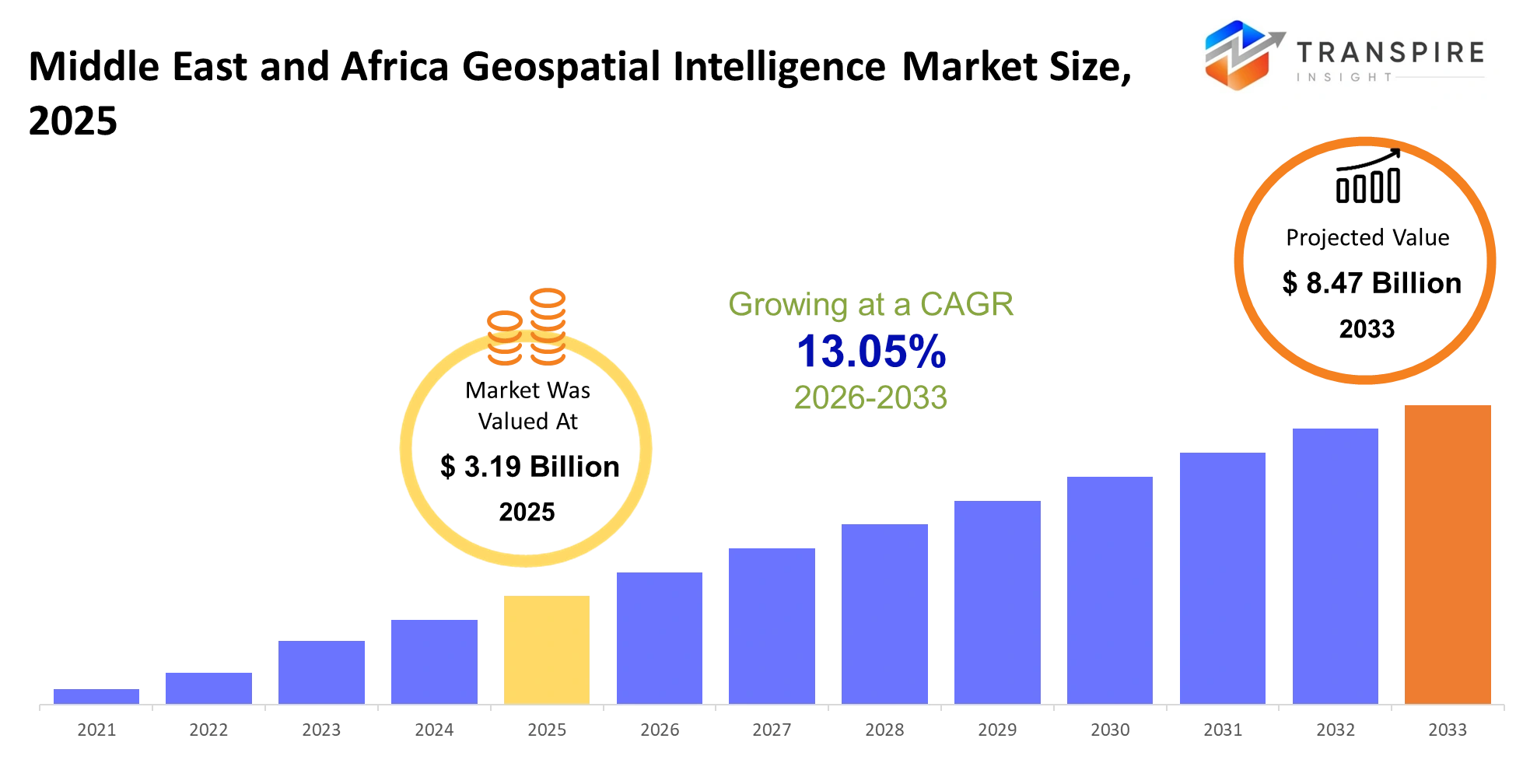
- Middle East and Africa Geospatial Intelligence Market Size 2025: USD 3.19 Billion
- Middle East and Africa Geospatial Intelligence Market Size 2033: USD 8.47 Billion
- Middle East and Africa Geospatial Intelligence Market CAGR: 13.05%
- Middle East and Africa Geospatial Intelligence Market Segments: By Component (Software, Services), By Technology (GIS, Remote Sensing, GPS), By Data Type (Raster, Vector), By Application (Defense, Urban Planning, Disaster Management), By End-User (Government, Enterprises, Defense Organizations).
To learn more about this report,  Download Free Sample Report
Middle East and Africa Geospatial Intelligence Market Summary:
The Middle East and Africa Geospatial Intelligence Market size is estimated at USD 3.19 Billion in 2025 and is anticipated to reach USD 8.47 Billion by 2033, growing at a CAGR of 13.05% from 2026 to 2033. The geospatial intelligence market in the Middle East and Africa, consisting of Saudi Arabia, UAE, South Africa, and the rest of Middle East & Africa, will come up with new ways of analyzing spatial data due to the involvement of analytics and location based services. The need for real-time data will be more prevalent especially in urban planning and defense surveillance applications. There will be an increasing need from consumers to have their maps accurately mapped on their mobile devices, and this would be possible due to advancements in satellite imagery and analytics driven by artificial intelligence. The laws on data sovereignty will be very strict, and this will influence the implementation of intelligence solutions.
What Has the Impact of Artificial Intelligence Been on the Middle East and Africa Geospatial Intelligence Market?
Artificial Intelligence results in a revolution within the Middle East and Africa geospatial intelligence industry through providing more effective means for spatial data analysis. The Middle East and Africa geospatial intelligence market employs artificial intelligence technology to improve the quality of market research via real-time analysis of satellite imagery as well as data obtained through sensors and geographical analysis. Artificial intelligence algorithms can detect new patterns that would be invisible using other methods. This way, organizations receive better opportunities to make timely and evidence-based decisions while enhancing the accuracy of geospatial analytics.
Applications of artificial intelligence technology in the Middle East and Africa geospatial intelligence market allow organizations to forecast future needs and recognize emerging trends. Various predictive analytics techniques can be employed to make more accurate predictions about the growth of cities, development of infrastructure, and environmental threats. With the help of new technology, both government agencies and private companies have the opportunity to improve the planning process while mitigating different types of risks. Improved automation allows increasing efficiency in data collection, image analysis, and map creation resulting in lower costs.
Moreover, there are various positive impacts that the middle east and Africa geospatial intelligence market is experiencing due to the automation process involving supply chain optimization and improved decision intelligence. This development helps companies have optimal allocations of resources, optimal routes for transportation, and optimal management of risks within industries like the defense sector, logistics industry, and the energy industry. In essence, this not only facilitates innovation but also personalizes the geospatial intelligence experience.
Key Market Trends & Insights:
- Saudi Arabia enjoys leadership status in the Middle East and Africa Geospatial intelligence market holding a market share of about 28% due to its defense modernization initiatives and Vision 2030.
- UAE is the fastest growing region in the market with a compounded annual growth rate over 14% until 2030 owing to its smart city initiatives.
- Geospatial analytics software is the segment leader capturing more than 42% of the market share due to increased demands for predictive analysis and AI-driven mapping solutions.
- Data collection services come second in the market capturing the largest share owing to the rising demand for satellite imaging and drone surveys.
- AI-driven analysis platforms are set to grow significantly from 2025 to 2030 owing to increased automation levels in the geospatial intelligence industry.
- Defence and security applications are leaders accounting for a market share of more than 35% owing to high investments made in surveillance and intelligence operations.
- Urban planning and infrastructure monitoring applications are the fastest growing owing to increased interests in smart cities and sustainability efforts.
- Government agencies dominate the geospatial intelligence market sharing almost 48% due to usage for security and planning purposes.
- Commercial firms enjoy rapid growth owing to needs for logistics optimization and location-based services.
Middle East and Africa Geospatial Intelligence Market Segmentation
By Component
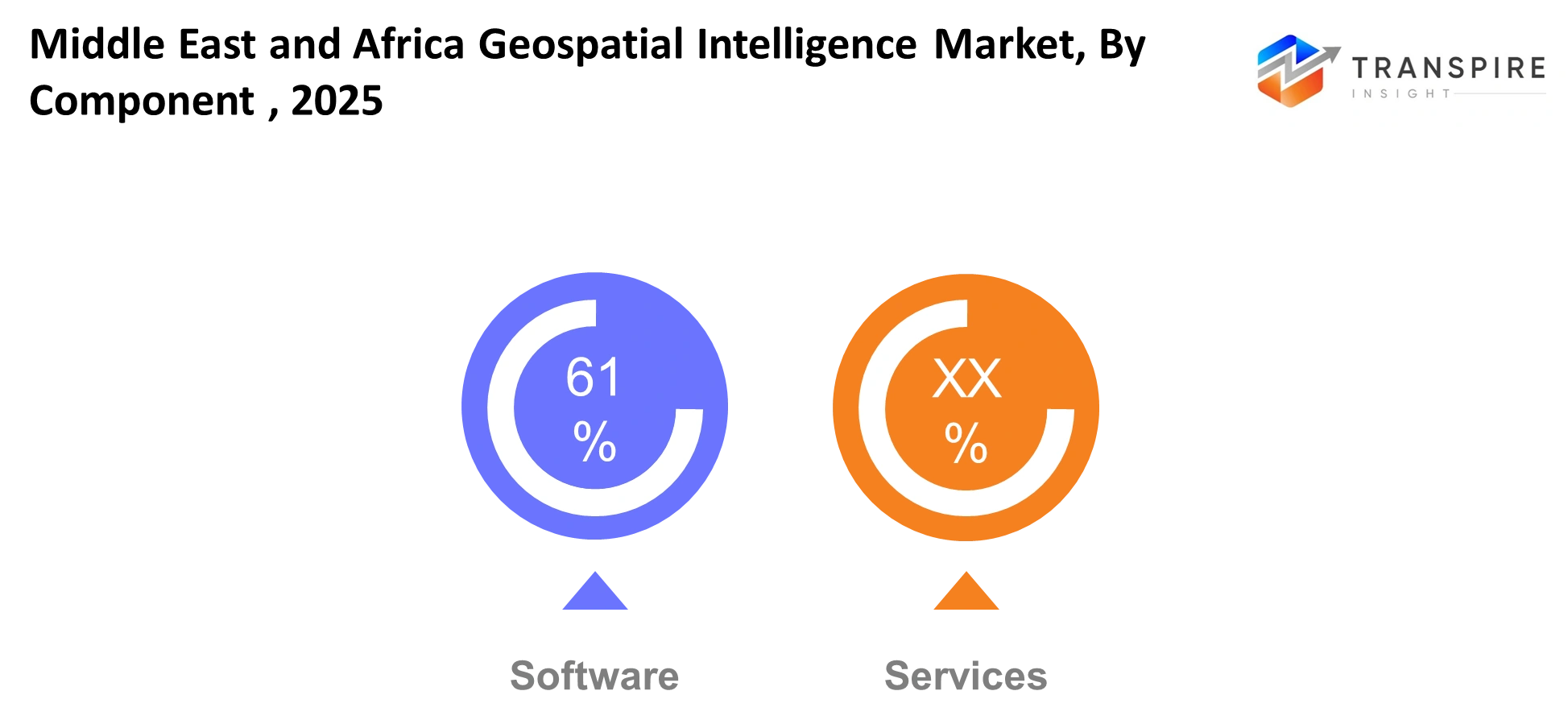
The software will be crucial as businesses would rely on state-of-the-art software for mapping, modelling, and forecasting. The AI-based software solutions will ensure fast processing and accurate handling of huge amounts of geospatial data. There is going to be increased demand because industries will require real-time data insights for planning and monitoring purposes.
The services sector will play an important role in ensuring successful deployment and maintenance of geospatial solutions. Companies will require assistance from experts in integrating the technology with their systems and interpreting geospatial information. Managed services will become popular because businesses will prefer to outsource the technical aspect in order to lessen their burden.
To learn more about this report, Download Free Sample Report
By Technology
GIS will experience high demand because it provides tools for spatial data visualization and spatial data analysis. The government and other agencies would largely rely on GIS technology for managing land, infrastructures, and resource allocation. GIS systems will achieve better operational results through their combination with artificial intelligence technology which will improve mapping activities and automatic process execution. Cloud-based GIS system would be highly efficient.
Remote sensing would be a significant part as it would be responsible for collecting satellite data and drone data. The high-resolution imagery would facilitate the study of the environment, crop assessment, and the development of disaster-mitigating strategies. At the same time, navigation systems which include GPS will continue to provide valuable services. Their integration would make them even more efficient.
By Data Type
Raster data shall prove useful when dealing with imagery data as well as other continuous surfaces such as satellite and aerial pictures. The data will allow for effective analysis of environmental issues as well as terrain mapping. With improvements in image processing techniques, the quality of data will improve making it more usable. Raster data will find increased use in relation to the need for real-time monitoring.
The vector data format shall find extensive use in terms of accurate mapping of boundary lines as well as road networks. Vector data format shall ensure ease in storing and manipulating spatial information. Raster and vector data formats can be used together for a balanced geospatial analysis system.
By Application
The ongoing requirements for surveillance and intelligence gathering and border security activities will make defense applications the most important field. Operational activities will benefit from advanced geospatial tools, which enable mission planners to assess risks. Governments will invest in secure systems to enhance national security operations. The system will achieve better situational understanding and emergency response capabilities through its connection to current operational information.
Urban planning will develop further because cities will expand and require improved infrastructure management. Geospatial intelligence will support land use planning and traffic control and smart city development. Disaster management will also gain importance with tools that predict risks and support emergency response. Accurate data will help reduce damage and improve recovery planning.
By End-User
Government agencies will remain the leading users who employ geospatial intelligence for their needs in policy planning and resource management and public safety operations. Accurate spatial data will serve as the essential requirement which large-scale projects need to achieve their successful execution. The ongoing digital transformation programs will result in increased technology adoption throughout different regions. Data-driven governance will develop into a more effective and organized framework.
Enterprises will expand usage for logistics optimization site selection and market analysis. Businesses will use location-based insights to make better decisions while reducing their operational expenses. Defense organizations will continue their investment in advanced systems which support intelligence and surveillance operations. The collaboration between public and private sectors will enhance both adoption rates and innovative development.
What are the Main Challenges for the Middle East and Africa Geospatial Intelligence Market Growth?
The middle east and africa geospatial intelligence market experiences serious technical and operational problems which will decrease its ability to grow and its operational efficiency. The process of combining satellite and drone and ground sensor data creates challenges which result in data discrepancies that decrease the effectiveness of analytic processes. Organizations need to invest in powerful computing systems because their operations require these capabilities, but this requirement creates financial burdens that prevent smaller organizations from accessing these systems. The middle east and africa geospatial intelligence market operations will experience ongoing challenges which prevent successful system implementation that works in multiple operational environments.
The middle east and africa geospatial intelligence market experiences growth limitations because of existing manufacturing and commercialization obstacles. The high expenses connected to advanced imaging systems and software development will create obstacles for establishing widespread usage of these technologies. The process of meeting regulatory requirements for data security and cross-border data transfer will introduce additional difficulties that will postpone project progress. The market will face restrictions because government projects need extended periods for procurement processes which include getting approvals and funding.
The existing digital infrastructure and workforce skills present major problems that hinder adoption efforts in certain areas. The absence of certified experts who can manage sophisticated geospatial systems and analytics software will create difficulties for numerous organizations. Organizations will continue to experience growth challenges because they lack equal possibilities to obtain both high-speed internet connections and cloud computing resources. Technology development and implementation will face further delays in multiple developing nations because of their budgetary restrictions.
The geospatial intelligence market in the Middle East and Africa will experience two main challenges from existing technologies and their pricing structures. The use of alternative data analytics solutions will decrease the need for organizations to use traditional geospatial systems. The rise in vendor competition will create pricing difficulties which will decrease profit margins. Market players must adjust continuously because regulatory frameworks and technological advancements are developing at a rapid pace.
Regional Insights
In terms of the adoption of Geospatial Data Solutions, Saudi Arabia will lead in adopting these systems due to the heavy government spending in developing defense, surveillance and intelligent infrastructure systems. The vision-led initiatives will also help in developing more powerful mapping and spatial analytic applications. The need for real-time intelligence will help drive the adoption of these systems. Demand from the public sector will also remain stable and will shape the strategy for development in the area.
The rapid urban growth and infrastructure development will increase the need for the adoption of Geospatial Data Solutions. AI-based analytics will be integrated into decision-making and will make the decisions more effective.
In UAE, there will be fast-paced growth and a keen focus on smart cities and digital governance. Technologies such as artificial intelligence, cloud geographic information system, and automation will be employed on a large scale. Innovation initiatives of the government will lead to the creation of innovative solutions. An increasing demand for high resolution map in urban and logistics sectors will also arise.
For South Africa, the rate of adoption will remain steady since it will have to meet infrastructure and environmental needs. Private and public sectors will make use of geospatial technology for disaster response activities and land management. The region will have a growth due to rising awareness and digitization. All other regions within the MEA region will have steady growth due to poor infrastructure facilities.
Recent Development News
In April 2026, Omnix International announced a partnership with Dataiku. The collaboration will integrate advanced AI capabilities into geospatial and analytics solutions to enhance decision-making across the Middle East region.
Source: https://www.consultancy-me.com
In March 2026, Planet Labs announced restricted access to satellite imagery over parts of the Middle East. The company will temporarily limit data availability in conflict zones to prevent misuse of sensitive geospatial intelligence.
Source: https://www.washingtonpost.com
|
Report Metrics |
Details |
|
Market size value in 2025 |
USD 3.19 Billion |
|
Market size value in 2026 |
USD 3.59 Billion |
|
Revenue forecast in 2033 |
USD 8.47 Billion |
|
Growth rate |
CAGR of 13.05% from 2026 to 2033 |
|
Base year |
2025 |
|
Historical data |
2021 - 2024 |
|
Forecast period |
2026 - 2033 |
|
Report coverage |
Revenue forecast, competitive landscape, growth factors, and trends |
|
Regional scope |
Middle East and Africa (Saudi Arabia, United Arab Emirates, South Africa, Rest of Middle East and Africa) |
|
Key company profiled |
Esri, Hexagon, Trimble, Maxar, L3Harris, Airbus, Thales, Oracle, IBM, Google, SAP, HERE, TomTom, Planet Labs, BlackSky. |
|
Customization scope |
Free report customization (country, regional & segment scope). Avail customized purchase options to meet your exact research needs. |
|
Report Segmentation |
By Component (Software, Services), By Technology (GIS, Remote Sensing, GPS), By Data Type (Raster, Vector), By Application (Defense, Urban Planning, Disaster Management), By End-User (Government, Enterprises, Defense Organizations). |
How Can New Companies Establish a Strong Foothold in the Middle East and Africa Geospatial Intelligence Market?
The new entrants that wish to position themselves in the middle east and africa geospatial intelligence market must ensure their positioning strategy is specific enough to make an impact. Competing against the whole world in a broad manner may not yield the desired results. Therefore, the firms must identify and focus on niche markets such as smart cities, environment, and defense sectors. Value propositions coupled with high levels of precision and fast delivery times will be key in establishing a firm footing in the market.
Innovations in technology will enable the new startups in the middle east and africa geospatial intelligence market to become relevant in the industry. Companies that offer AI technologies and machine learning together with cloud-based GIS systems will be able to provide faster and more accurate results to the customers. One company comparable to Bayanat in the United Arab Emirates (UAE) will employ AI in the provision of geographic services. In addition, another upcoming company in the south of Africa will use drones for agricultural and mining purposes.
Partnerships will aid the process of entering the market, as the new businesses will have a chance to work with governmental organizations, telecom companies, and those who are responsible for the development of infrastructure. Partnership will provide the new businesses with information, financial resources, and other things that are hard to obtain otherwise. The process of technology differentiation will be aided with the help of localized solutions, which will help the business follow regional trends.
Key Middle East and Africa Geospatial Intelligence Market Company Insights
The competition will also stay fierce because there is still much room for expansion into the international arena for both regional and multinational companies through analytics and mapping tools. There will be constant efforts aimed at enhancing precision, efficiency, and the capability for integration. Investment in artificial intelligence and cloud computing will enable superior performance levels. The position in the market will also be based on technology proficiency and contractual ties with the public authorities.
Partnerships with other organizations such as governments, telecommunication companies, and developers will grow. This will provide assistance in gaining access to local data. Another important factor will be product development, particularly in automation and prediction tools.
Company List
- Esri
- Hexagon
- Trimble
- Maxar
- L3Harris
- Airbus
- Thales
- Oracle
- IBM
- SAP
- HERE
- TomTom
- Planet Labs
- BlackSky
What are the Key Use-Cases Driving the Growth of the Middle East and Africa Geospatial Intelligence Market?
Demand from defense and security use-cases will continue to boost the middle east and africa geospatial intelligence market, as spatial intelligence will facilitate surveillance activities, border security, and mission planning. There will be increasing government spending on real-time intelligence solutions for enhancing threat detection, thereby ensuring greater efficiency in dealing with threats to national security. These application areas will serve as the primary catalysts for growth in the geospatial intelligence market in the Middle East and Africa.
Urbanization and construction of smarter cities will significantly contribute to the growth of the middle east and africa geospatial intelligence market. Increasing urbanization means more opportunities for effective city planning with the help of geospatial intelligence. In addition, integration with internet of things (IoT) and artificial intelligence (AI) technologies will make the solution more scalable, thereby providing city planners with greater scope for efficient resource management.
With regards to the fields of energy, agriculture, and environmental management, geospatial intelligence will play an important role in improving surveillance and resource distribution. Oil and gas firms will utilize location-based analysis for the purposes of monitoring pipelines and carrying out explorations. Agricultural firms, on the other hand, will employ the use of satellite images in evaluating crops and yields.
Furthermore, the healthcare and logistics industries will drive growth through their application of geospatial information in planning facilities and emergencies. In addition, logistics will utilize geospatial intelligence in optimizing routes. Therefore, the middle east and africa geospatial intelligence market is bound to grow due to the various application areas within the industries.
Middle East and Africa Geospatial Intelligence Market Report Segmentation
By Component
- Software
- Services
By Technology
- GIS
- Remote Sensing
- GPS
By Data Type
- Raster
- Vector
By Application
- Defense
- Urban Planning
- Disaster Management
By End-User
- Government
- Enterprises
- Defense Organizations
Frequently Asked Questions
Find quick answers to common questions.
The approximate Middle East and Africa Geospatial Intelligence Market size for the market will be USD 8.47 Billion in 2033.
Key segments for the Middle East and Africa Geospatial Intelligence Market are By Component (Software, Services), By Technology (GIS, Remote Sensing, GPS), By Data Type (Raster, Vector), By Application (Defense, Urban Planning, Disaster Management), By End-User (Government, Enterprises, Defense Organizations).
Major Middle East and Africa Geospatial Intelligence Market players are Esri, Hexagon, Trimble, Maxar, L3Harris, Airbus, Thales, Oracle, IBM, Google, SAP, HERE, TomTom, Planet Labs, BlackSky.
The Middle East and Africa Geospatial Intelligence Market size is USD 3.19 Billion in 2025.
The Middle East and Africa Geospatial Intelligence Market CAGR is 13.05%.
- Esri
- Hexagon
- Trimble
- Maxar
- L3Harris
- Airbus
- Thales
- Oracle
- IBM
- SAP
- HERE
- TomTom
- Planet Labs
- BlackSky
Recently Published Reports
-
Dec 2024
3D Optical Profiler Market
3D Optical Profiler Market Size, Share & Analysis Report By Type (Desktop 3D Optical Profiler, and Portable 3D Optical Profiler), By Technology (Confocal Technology, and White Light Interference), By End-Use Industry (Manufacturing, Research Institutions, Automotive, Aerospace and Defense, Medical Devices, and Other), and Geography (North America, Europe, Asia-Pacific, Middle East and Africa, South and Central America), 2021 - 2031
-
Feb 2025
Depth Sensor Market
Depth Sensor Market Size, Share & Analysis Report By Type (Infrared Depth Sensors, Time-of-Flight (ToF) Sensors, Stereo Vision Sensors, Structured Light Sensors, Ultrasonic Depth Sensors), By Application (Automotive, Robotics, Gaming, Consumer Electronics, Industrial Automation, Healthcare, Security & Surveillance, Others), By End Users (Automotive Manufacturers, Consumer Electronics Companies, Healthcare Providers, Industrial Companies, Security Agencies, Gaming Companies, Robotics Companies, Others), and Geography (North America, Europe, Asia-Pacific, Middle East and Africa, South and Central America), 2021 – 2031
-
Feb 2025
Digital Manufacturing Market
Digital Manufacturing Market Size, Share & Analysis Report By Component (Hardware, Software, and Services), By Technology (Robotics, 3D Printing, Internet of Things (IoT), and Others), By Application (Automotive and Transportation, Aerospace and Defense, Consumer Electronics, Industrial Machinery, and Others), By Process Type (Computer-Based Designing, Computer-Based Simulation, Computer 3D Visualization, Analytics, and Others), and Geography (North America, Europe, Asia-Pacific, Middle East and Africa, South and Central America), 2021 – 2031
-
Feb 2025
Digital Visa Services Market
Digital Visa Services Market Size, Share & Analysis Report By Type (Individual Travelers, Group Travelers), By Application (Tourism, Business Travel, Others), and Geography (North America, Europe, Asia-Pacific, Middle East and Africa, South and Central America), 2021 – 2031