
Middle East and Africa Generative AI in Metaverse Market Size & Forecast:
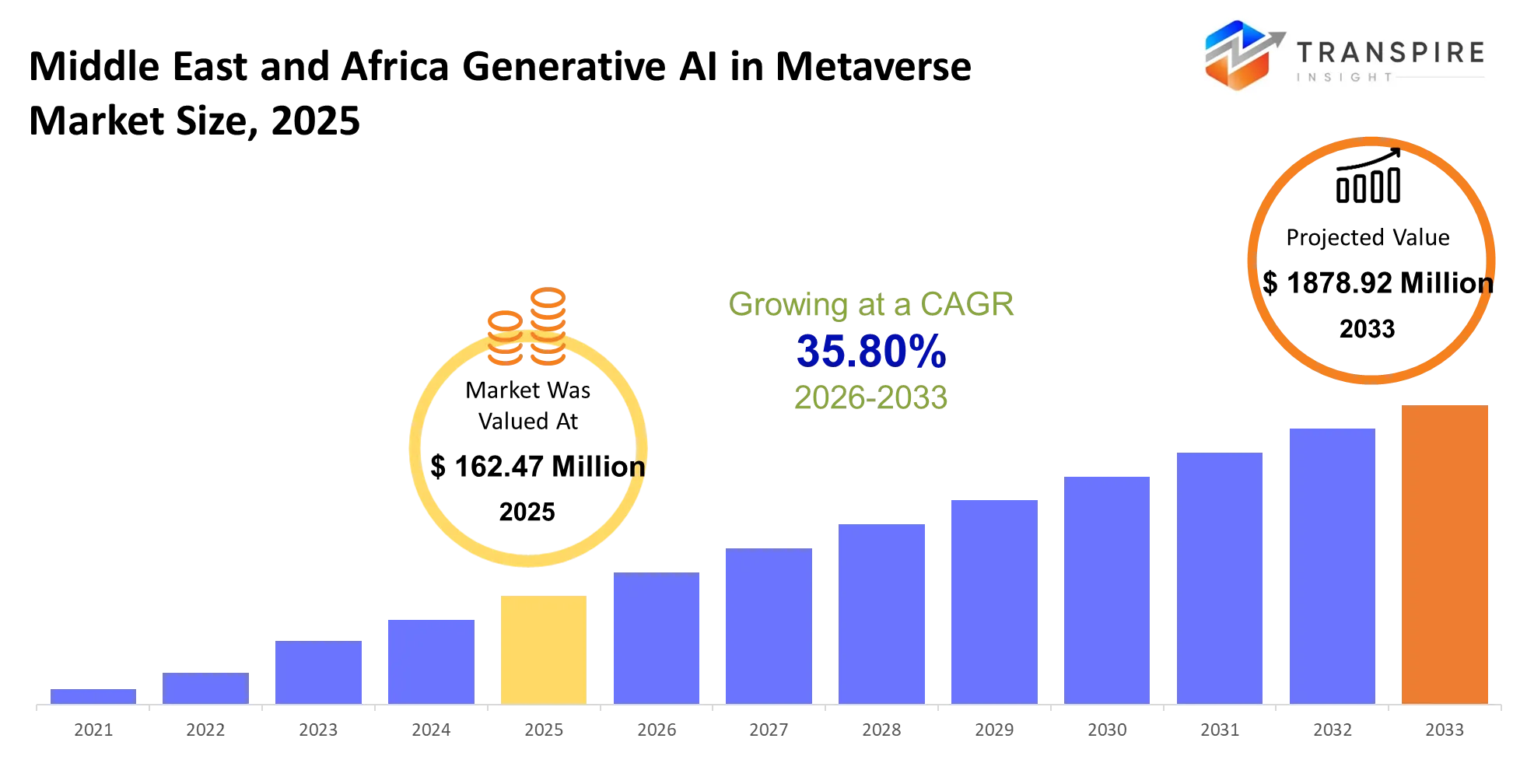
- Middle East and Africa Generative AI in Metaverse Market Size 2025: USD 162.47 Million
- Middle East and Africa Generative AI in Metaverse Market Size 2033: USD 1878.92 Million
- Middle East and Africa Generative AI in Metaverse Market CAGR: 35.80%
- Middle East and Africa Generative AI in Metaverse Market Segments: By Type (Software, Platforms, Services, AI Models, Others); By Application (Virtual Worlds, Gaming, Digital Avatars, Content Creation, Virtual Events, Simulation, Others); By End-User (Enterprises, Gaming Companies, Content Creators, Tech Firms, Media Companies, Others); By Deployment (Cloud, On-premise, Hybrid, Others)
To learn more about this report,  Download Free Sample Report
Middle East and Africa Generative AI in Metaverse Market Summary
The Middle East and Africa Generative AI in Metaverse Market was valued at USD 162.47 Million in 2025. It is forecast to reach USD 1878.92 Million by 2033. That is a CAGR of 35.80% over the period.
The Middle East and Africa Generative AI in Metaverse Market is like it lets organizations and governments build immersive digital spaces, for training, simulation, industrial planning, and also customer engagement, in place of those rather static 2D setups, with real time interactive 3D environments. What happens in practice is that it backs oil and gas operators, logistics companies, and smart city planners, by simulating how infrastructure behaves, running workforce training situations , and testing urban mobility systems before anything physical gets deployed.
Over the last 3 to 5 years , the market kinda moved in a real structural way, from simple virtual reality activities into AI-generated, data driven digital twins that are powered by generative models. This shift went faster after big national digital transformation programs in the Gulf, where governments told everyone to use smart city and industrial simulation frameworks. One of the more direct triggers was the global supply chain disruption during the pandemic era, which pushed enterprises to lean on virtual teamwork and remote operations for infrastructure design, plus workforce training.
Because of that, today the adoption story is mostly about cost avoidance and operational resilience, not so much about experimenting. Enterprises put money into generative metaverse platforms because they cut down the expenses tied to physical prototyping, speed up decision rhythms, and boost cross border collaboration across energy, logistics, and urban development communities in the region.
Key Market Insights
- Middle East still seems to dominate the whole Middle East and Africa Generative AI in Metaverse market, with almost 52 percent share in 2025, because of sovereign backed digital twin efforts, plus smart city initiative kinda.
- Africa is also emerging as the quickest growing region through 2033, pushed by industrial training simulation and a growing habit of remote infrastructure planning adoption.
- Meanwhile, AI generated 3D environments are shaping product segmentation, holding more than 45 percent share, helped by the fast enterprise metaverse rollouts.
- Digital twin platforms become the fastest-growing segment too, since oil, gas, and urban infrastructure operators keep bringing in real time simulation systems.
- On the application side, industrial training apps hold the leading share at around 40 percent, supported by energy and logistics workforce simulation demand which is pretty specific and consistent.
- Smart city planning and urban mobility simulation are turning into the fastest-growing application areas, especially across Gulf transformation projects.
- For end users, enterprises dominate the adoption rate, through big scale deployments across energy, construction, and logistics.
- And for growth speed, government plus public sector agencies are showing the strongest momentum as digital infrastructure mandates keep expanding across GCC countries.
- The Middle East and Africa Generative AI in Metaverse Market is evolving into an enterprise-grade immersive infrastructure ecosystem driven by digital twin adoption, AI content generation, and sovereign AI investments.
- The Middle East and Africa Generative AI in Metaverse Market is projected to expand steadily through 2033, supported by smart city programs, industrial simulation demand, and enterprise metaverse integration exceeding 25 percent growth in leading Gulf economies.
What are the Key Drivers, Restraints, and Opportunities in the Middle East and Africa Generative AI in Metaverse Market?
Driver:
The strongest driver of the Middle East and Africa Generative AI in Metaverse Market seems to be sovereign-led digital transformation programs in Gulf economies, where governments are funding digital twin ecosystems for cities, energy infrastructure, and transport systems. This movement was kind of pushed forward by national smart city mandates in the UAE and Saudi Arabia that basically demanded real-time simulation muscle for urban planning plus industrial operations. Because of that, enterprises are now putting more money into generative AI platforms that can quickly create immersive 3D worlds, which, in turn, lifts enterprise software licensing and cloud infrastructure revenues in a direct way
Restraint:
The biggest restraint is the high computational and infrastructure price needed to keep large-scale generative models running for real-time metaverse environments. This limitation feels structural , since it relies on continued access to high-performance GPUs, low-latency cloud networks, and local data centers, which still are not evenly spread across Africa and parts of the Middle East. The cost barrier ends up slowing adoption among mid-sized enterprises, so monetization stays delayed beyond government-backed efforts and major industrial programs, which then suppresses wider market reach
Opportunity:
A notable opportunity that is starting to show up is industrial metaverse deployment across energy and logistics nodes in Saudi Arabia and Morocco, where digital twin directives are growing quickly. Businesses that are integrating NVIDIA Omniverse or Siemens Xcelerator platforms into national infrastructure projects can end up taking the best shot at long-term agreements. That also opens a route to scalable generative AI ecosystems that are tied closely to smart city operations and cross-border industrial planning initiatives through 2030, in other words, it’s not just pilots.
What Has the Impact of Artificial Intelligence Been on the Middle East and Africa Generative AI in Metaverse Market?
Artificial intelligence plus advanced digital technologies are, sort of, reworking immersive enterprise environments across the Middle East and Africa. The idea is that automated simulation, monitoring, and optimization of complex industrial systems are getting easier, faster, in practice. Generative AI models now handle the creation of digital twins, used for infrastructure planning , fleet compliance tracking, and operational control systems throughout energy, logistics, and smart city initiatives. These systems cut down manual modeling work by producing real-time 3D surroundings that mirror what’s happening right now from physical assets, like live operational signals.
Meanwhile, machine learning improves predictive abilities. It can forecast equipment degradation, help fine-tune energy consumption, and run performance scenarios for industrial plus urban infrastructure. In energy and logistics use cases, predictive systems back up maintenance scheduling and operational plans, raising asset utilization while lowering unplanned downtime by about 15 to 25 percent in digitally integrated setups. On top of that, generative simulation tools speed up design workflows, because teams can test infrastructure adjustments quickly before anything physical is deployed.
Still, there’s a big constraint. The shortage of high-quality training data that’s region-specific remains an issue. Without enough of that, the models can’t simulate environmental, industrial, and urban conditions with enough precision. That data gap affects accuracy in large-scale deployments, especially in tricky places like desert climate infrastructure and cross-border logistics networks, which in turn slows the full rollout of advanced generative metaverse systems.
Key Market Trends
- Gulf governments kind of shifted from pilot scale VR attempts in 2022 toward these huge digital twin requirements by 2026, and it kind of sped up enterprise take up.
- Enterprises moved from static 3D drafting in 2021 to generative AI powered real time simulation setups, that were tied into operational feed streams by 2026.
- NVIDIA Omniverse use cases went broader across industrial areas after 2024, helping teams build high fidelity virtual infrastructure surroundings more quickly.
- Siemens Xcelerator rollout increased in energy and manufacturing, and it replaced older CAD routines with AI augmented simulation platforms.
- Meanwhile the smart city efforts in the UAE and Saudi Arabia evolved from rough concept plans into actual metaverse style integration , to support transport and utilities management in day to day operations.
- On the Africa side, industrial teams moved from manual infrastructure layout toward AI supported logistics and training simulation systems after 2023, right after that digitization wave started.
- Cloud providers also went from generic infrastructure services to sovereign cloud collaborations, supporting locally focused generative AI model delivery by 2025.
- Enterprise buyers started asking for real time digital twins more often, and they drifted away from periodic simulation tools toward operational models that keep getting updated.
- And the data scarcity fears got worse after 2024, because companies realized those narrow regional training datasets tend to lower accuracy in environmental and industrial simulations.
Middle East and Africa Generative AI in Metaverse Market Segmentation
By Type
Platforms take the largest slice because many enterprises keep pushing toward integrated environments, for building and managing those immersive digital ecosystems. It is not just about “one piece” either, these platforms help with simulation, visualization and real-time data linking, so they become kind of unavoidable for industrial-scale rollout across energy, logistics and smart city programs. After that, software tools come next, mostly because people use them a lot for content creation and for tailoring digital surroundings. Meanwhile AI models slowly but surely gain momentum since they sit at the foundation and they enable generative capabilities.
Services also keep growing, pretty steadily, since enterprises want help with integration support, system customization and continuous refinement for complicated deployments. The reason growth looks different by segment is mostly that platforms are pulled by infrastructure consolidation, while services rise because implementation becomes more and more intricate inside enterprise settings. AI models, though, tend to accelerate when localized training is needed, and when domain-specific simulation accuracy becomes a reliability requirement for day to day operations.
During the forecast window, platforms should remain in the lead, but AI models will show the fastest expansion. This happens because the market keeps demanding localized generative intelligence. Investors will lean toward platform ecosystems with embedded AI features, and developers will instead emphasize modular architectures, that allow cross-sector deployment across industrial use cases and urban applications.
By Application
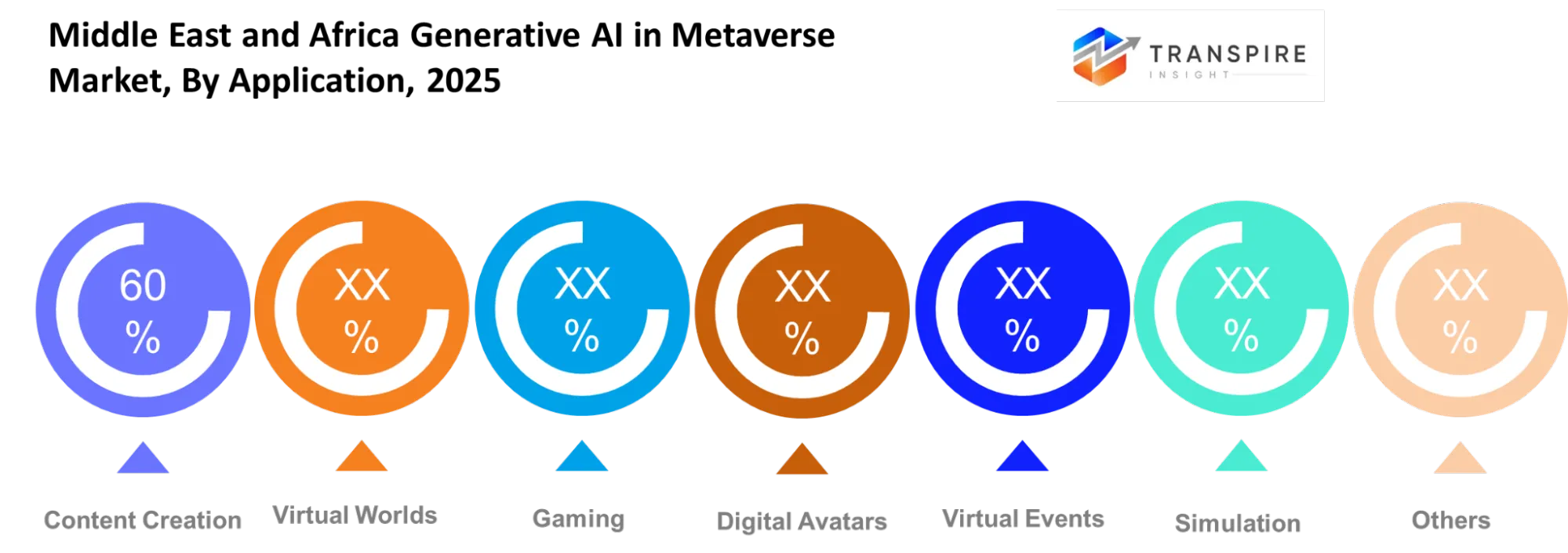
Simulation leads the application segment , sort of, thanks to strong demand coming from industrial planning, energy infrastructure modeling, and smart city development projects. Virtual worlds plus content creation applications follow along, backed by enterprise training and marketing use cases. Digital avatars with virtual events show moderate adoption, mainly in media and entertainment sectors (not everywhere).
Growth logic is a bit different here , since simulation demand is pulled by operational risk reduction, while content creation expands because of cost-efficient digital production needs. Gaming applications grow slower compared with other categories in enterprise-focused markets but they stay relevant inside consumer engagement ecosystems. Virtual worlds gain traction mostly through government-backed digital transformation initiatives, not only because entertainment is pushing it.
Simulation should keep its dominance, while content creation and virtual worlds will grow fastest as generative AI reduces production barriers, quite a lot. Enterprises will also shift budgets from static modeling tools toward real time immersive simulation platforms that connect with operational data systems.
To learn more about this report, Download Free Sample Report
By End-User
Enterprises dominate adoption because they make large-scale investments in digital twins, industrial simulation, and infrastructure optimization. Tech firms come next, acting as key enablers and providing the underlying AI infrastructure , along with cloud platforms. Media companies and content creators participate in a steady way but at smaller scale, focused on immersive storytelling and digital engagement.
Gaming companies tend to grow more slowly than industrial users, basically because the region leans more heavily toward infrastructure plus enterprise workloads. The growth logic kinda feels different too, like enterprises push for operational efficiency, while media groups are more into audience engagement and monetization of content. Tech firms then end up expanding their reach by steering AI infrastructure and building out platform ecosystems.
Enterprises will still lead the demand side, but tech firms should become the quickest growing slice. This is mainly tied to cloud AI expansion and deeper platform integration. Investors will also shift their attention more and more toward enterprise-grade solutions that link industrial processes with generative simulation capabilities, yes.
By Deployment
Cloud deployment stays in the lead since centralized computing is needed for generative AI workloads, real time rendering, and large scale simulation processing. Hybrid setups are starting to pick up momentum because companies try to balance performance expectations with data sovereignty worries, especially in regulated contexts. On-premise deployment is still pretty constrained, mostly showing up in very sensitive government and defense related applications.
The growth logic here is pretty cloud driven by scalability, and hybrid grows as latency-sensitive industrial use cases meet regulatory limits. On-premise systems grow slowly, mainly because the infrastructure costs are high, so adoption only happens beyond the “critical operators” group. Cloud providers can strengthen their position through sovereign partnerships and investments in localized data centers, too.
Overall cloud will remain dominant, while hybrid deployment should end up expanding the fastest as enterprises connect real time industrial operations with centralized AI training. Developers will increasingly craft deployment agnostic architectures, so the same setup can flex across cloud, edge, and hybrid environments without too much friction.
What are the Key Use Cases Driving the Middle East and Africa Generative AI in Metaverse Market?
Industrial simulation via digital twins is pretty much taking over, because energy operators, infrastructure developers, and smart city authorities want generative environments to test how assets behave before they even touch physical deployment. And yeah, this particular use case keeps pulling the most demand in, since it lowers capital risk, it makes planning a bit more accurate , and it supports continuous observation of complicated systems in real time.
On another front, enterprise training simulation, plus immersive content creation, is spreading fast among logistics firms and technology providers. Their workforce development programs lean on AI-generated settings to mimic dangerous operational scenarios in energy plants and transport hubs. Meanwhile, content groups inside media companies use generative tools to speed up the making of interactive 3D assets, and also to craft virtual engagement experiences, more or less on a faster cadence than usual.
There are even newer things showing up, like virtual regulatory compliance testing for infrastructure projects, and AI-driven urban planning simulations for government agencies. Defense plus emergency response groups are also trying scenario modeling environments to check disaster readiness , and that suggests pretty strong potential for long-term institutional adoption as these generative systems keep maturing.
|
Report Metrics |
Details |
|
Market size value in 2025 |
USD 162.47 Million |
|
Market size value in 2026 |
USD 220.64 Million |
|
Revenue forecast in 2033 |
USD 1878.92 Million |
|
Growth rate |
CAGR of 35.80% from 2026 to 2033 |
|
Base year |
2025 |
|
Historical data |
2021 - 2024 |
|
Forecast period |
2026 - 2033 |
|
Report coverage |
Revenue forecast, competitive landscape, growth factors, and trends |
|
Regional scope |
Middle East and Africa (Saudi Arabia, United Arab Emirates, South Africa, Rest of Middle East and Africa) |
|
Key company profiled |
Meta, Microsoft, Google, NVIDIA, Unity, Epic Games, Amazon, IBM, Roblox, Tencent, Adobe, Autodesk, ByteDance, Qualcomm, Samsung |
|
Customization scope |
Free report customization (country, regional & segment scope). Avail customized purchase options to meet your exact research needs. |
|
Report Segmentation |
By Type (Software, Platforms, Services, AI Models, Others); By Application (Virtual Worlds, Gaming, Digital Avatars, Content Creation, Virtual Events, Simulation, Others); By End-User (Enterprises, Gaming Companies, Content Creators, Tech Firms, Media Companies, Others); By Deployment (Cloud, On-premise, Hybrid, Others) |
Which Regions are Driving the Middle East and Africa Generative AI in Metaverse Market Growth?
The Gulf Cooperation Council region kind of leads the Middle East and Africa Generative AI in Metaverse Market, mostly because of strong sovereign investment into digital infrastructure and these national digital twin programs. In the UAE and Saudi Arabia, governments are actively backing smart city ecosystems that weave generative AI into urban planning , energy modeling , and transport simulation too, more or less. This lead gets reinforced by advanced cloud infrastructure, higher enterprise digital maturity , and centralized regulatory frameworks that speed up the whole large-scale deployment. Also, you can feel the effect of global technology vendors and government-supported innovation hubs, they add real ecosystem depth, and commercialization starts moving faster.
Africa is a bit more incremental but still steady as a contributor, and it is driven by enterprise-led adoption across logistics, mining, and infrastructure development. Unlike the Gulf’s top-down deployment approach, many African markets depend more on private sector investment and donor-supported digital transformation initiatives. Economic diversification efforts in places like South Africa and Kenya encourage a gradual uptake of simulation and training platforms. So, you end up with a predictable demand base, where organizations roll out generative metaverse tools slowly, mainly to boost operational efficiency, not so much to chase huge ecosystem transformation in one shot.
North Africa is actually the fastest-growing region, backed by industrial modernization programs in Morocco and Egypt that tie manufacturing expansion to digital infrastructure upgrades. More recently, investments in smart ports, export-oriented industrial zones , and energy corridor development have sped up demand for AI-driven simulation systems.
Who are the Key Players in the Middle East and Africa Generative AI in Metaverse Market and How Do They Compete?
Competition across the Middle East and Africa Generative AI in Metaverse Market is still kind of moderately consolidated when you look at infrastructure, but it feels more fragmented once you reach the application layer. On one hand, the big global hyperscalers and AI platform providers pretty much control the key compute paths and the whole model ecosystem… on the other hand, regional integrators plus smaller startups push hard in vertical solutions, like digital twins, immersive simulation and other related use cases. Honestly the “who wins” battle seems mostly about tech depth, and also about who can actually access high performance computing faster, with less friction. Then there is the next step, regional partnerships with governments and enterprise buyers, since they often steer those large-scale infrastructure programs, and that gives everyone leverage.
Microsoft plays the Azure route, with digital twin capabilities plus enterprise metaverse integration. They leverage cloud dominance, and also tie in with industrial IoT systems, which helps them secure longer term enterprise contracts. NVIDIA, meanwhile, differentiates via Omniverse, a platform that supports high fidelity real time simulation and generative environment creation, so it lands an edge in industrial and infrastructure modeling workloads. Siemens leans into industrial specialization, it embeds generative simulation into engineering and manufacturing workflows, especially for energy and heavy industry projects across Gulf markets.
Meta is going for immersive virtual spaces by leaning into social experiences and enterprise collaboration platforms, while Epic Games reinforces its advantage through Unreal Engine, which basically drives high precision real-time 3D content authoring and creation. Google builds momentum by integrating AI models tightly with its cloud stack, so scalable generative applications can move faster and at broader scale.These companies tend to grow mostly by using strategic partnerships with sovereign AI programs, regional cloud rollouts, and joint co-development efforts with energy, logistics, and smart city stakeholders, across that whole region. In practice it’s kind of a network of initiatives, more than a single path.
Company List
- Meta
- Microsoft
- NVIDIA
- Unity
- Epic Games
- Amazon
- IBM
- Roblox
- Tencent
- Adobe
- Autodesk
- ByteDance
- QualcommSamsung
Recent Development News
“In November 2025, Adobe and Qualcomm entered a strategic partnership with Humain to develop generative AI tools for Arabic content creation and immersive digital experiences. The initiative integrates Adobe Firefly Foundry and Qualcomm AI chips to accelerate localized metaverse and creative AI applications across the Middle East.https://www.reuters.com
“In February 2025, Microsoft expanded its strategic AI investment program in the United Arab Emirates through infrastructure expansion and equity partnerships with G42. The initiative strengthens cloud-based generative AI and mixed-reality platforms supporting enterprise metaverse workloads and regional AI ecosystem development.https://www.windowscentral.com
What Strategic Insights Define the Future of the Middle East and Africa Generative AI in Metaverse Market?
Over the next 5 to 7 years, the Middle East and Africa Generative AI in Metaverse Market is expected to shift from mostly experimental digital spaces toward enterprise-ready spatial computing platforms. This movement is being pushed by sovereign digital economy programs in the Gulf, also by a steady rise in enterprise demand for immersive training and simulation tools. Underneath all of that, there’s this more basic convergence, where generative AI meets real-time 3D infrastructure, letting companies generate content at scale for industrial, education, and public service uses.
A not so obvious concern is platform concentration, where only a few major cloud and AI model providers end up controlling the essential generative foundation. When that happens, regional teams can lose autonomy over data governance ,and the content ecosystems around them. In practical terms it may limit long-term monetization for local developers, and it can also increase dependence on outside technology stacks , even when local capacity exists.
At the same time, there’s an opportunity that’s starting to show up clearly in industrial metaverse use cases across energy, logistics, and urban planning in Saudi Arabia and the UAE. Digital twin mandates are expanding there, and that means the timing is getting better for localized deployments. Market players should focus on localized generative AI models that are tied into government supported digital twin programs. If they align early with public infrastructure initiatives, competitive position through 2030 could become much easier to establish, and less risky too.
Middle East and Africa Generative AI in Metaverse Market Report Segmentation
By Type
- Software
- Platforms
- Services
- AI Models
- Others
By Application
- Virtual Worlds
- Gaming
- Digital Avatars
- Content Creation
- Virtual Events
- Simulation
- Others
By End-User
- Enterprises
- Gaming Companies
- Content Creators
- Tech Firms
- Media Companies
- Others
By Deployment
- Cloud
- On-premise
- Hybrid
- Others
Frequently Asked Questions
Find quick answers to common questions.
The estimated Middle East and Africa Generative AI in Metaverse Market size is USD 1878.92 Million in 2033.
Key segments for the Middle East and Africa Generative AI in Metaverse Market are By Type (Software, Platforms, Services, AI Models, Others); By Application (Virtual Worlds, Gaming, Digital Avatars, Content Creation, Virtual Events, Simulation, Others); By End-User (Enterprises, Gaming Companies, Content Creators, Tech Firms, Media Companies, Others); By Deployment (Cloud, On-premise, Hybrid, Others).
Major Middle East and Africa Generative AI in Metaverse Market players are Meta, Microsoft, Google, NVIDIA, Unity, Epic Games, Amazon, IBM, Roblox, Tencent, Adobe, Autodesk, ByteDance, Qualcomm, Samsung.
The Middle East and Africa Generative AI in Metaverse Market size is USD 162.47 Million in 2025.
The Middle East and Africa Generative AI in Metaverse Market CAGR is 35.80% from 2026 to 2033.
- Meta
- Microsoft
- NVIDIA
- Unity
- Epic Games
- Amazon
- IBM
- Roblox
- Tencent
- Adobe
- Autodesk
- ByteDance
- QualcommSamsung
Recently Published Reports
-
Apr 2026
3D Optical Profiler Market
3D Optical Profiler Market Size, Share & Analysis Report By Type (Desktop 3D Optical Profiler, and Portable 3D Optical Profiler), By Technology (Confocal Technology, and White Light Interference), By End-Use Industry (Manufacturing, Research Institutions, Automotive, Aerospace and Defense, Medical Devices, and Other), and Geography (North America, Europe, Asia-Pacific, Middle East and Africa, South and Central America), 2021 - 2031
-
Apr 2026
Depth Sensor Market
Depth Sensor Market Size, Share & Analysis Report By Type (Infrared Depth Sensors, Time-of-Flight (ToF) Sensors, Stereo Vision Sensors, Structured Light Sensors, Ultrasonic Depth Sensors), By Application (Automotive, Robotics, Gaming, Consumer Electronics, Industrial Automation, Healthcare, Security & Surveillance, Others), By End Users (Automotive Manufacturers, Consumer Electronics Companies, Healthcare Providers, Industrial Companies, Security Agencies, Gaming Companies, Robotics Companies, Others), and Geography (North America, Europe, Asia-Pacific, Middle East and Africa, South and Central America), 2021 – 2031
-
Apr 2026
Digital Manufacturing Market
Digital Manufacturing Market Size, Share & Analysis Report By Component (Hardware, Software, and Services), By Technology (Robotics, 3D Printing, Internet of Things (IoT), and Others), By Application (Automotive and Transportation, Aerospace and Defense, Consumer Electronics, Industrial Machinery, and Others), By Process Type (Computer-Based Designing, Computer-Based Simulation, Computer 3D Visualization, Analytics, and Others), and Geography (North America, Europe, Asia-Pacific, Middle East and Africa, South and Central America), 2021 – 2031
-
Apr 2026
Digital Visa Services Market
Digital Visa Services Market Size, Share & Analysis Report By Type (Individual Travelers, Group Travelers), By Application (Tourism, Business Travel, Others), and Geography (North America, Europe, Asia-Pacific, Middle East and Africa, South and Central America), 2021 – 2031