
Middle East and Africa Generative AI in Coding Market Size & Forecast:
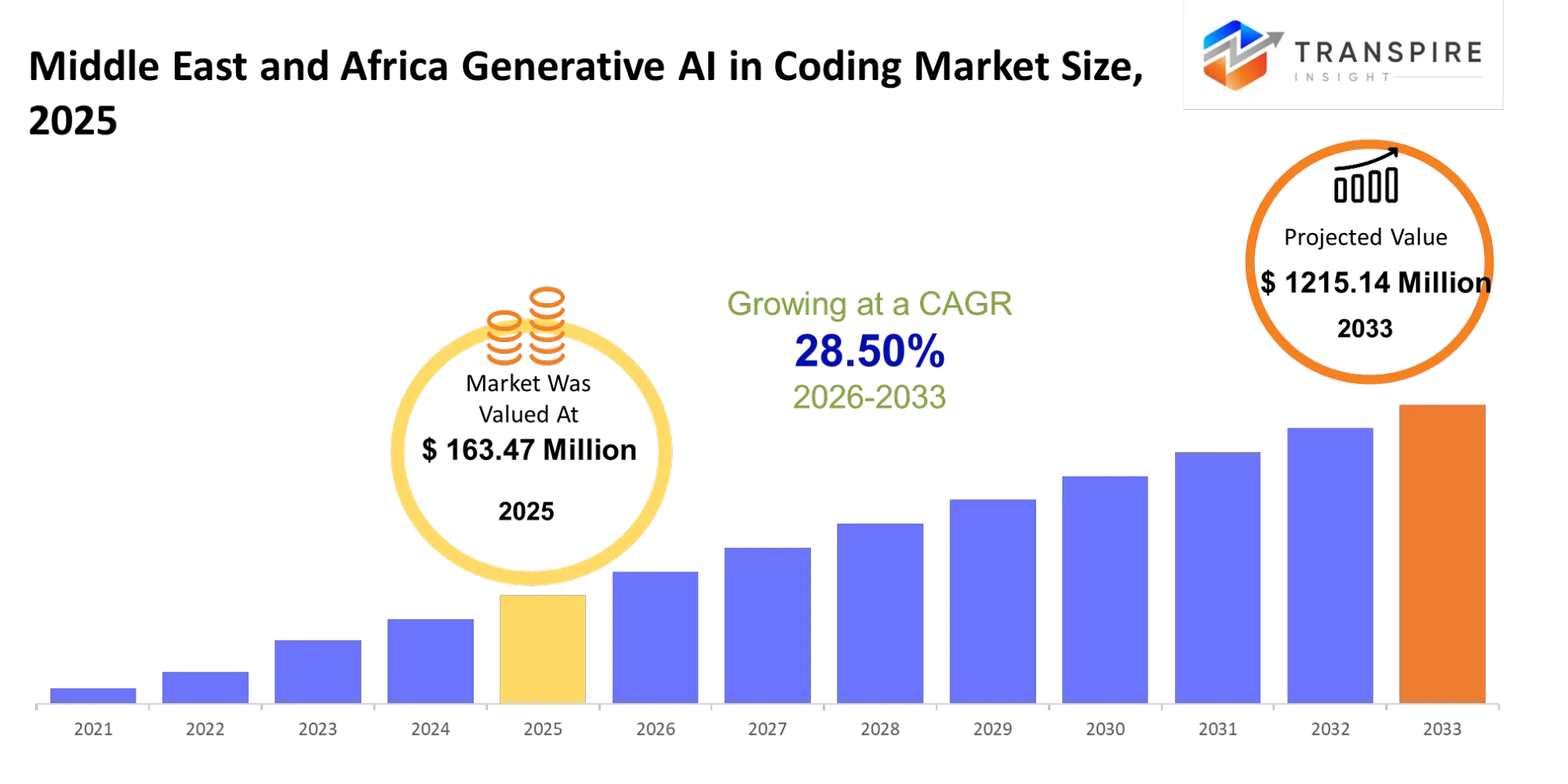
- Middle East and Africa Generative AI in Coding Market Size 2025: USD 163.47 Million
- Middle East and Africa Generative AI in Coding Market Size 2033: USD 1215.14 Million
- Middle East and Africa Generative AI in Coding Market CAGR: 28.50%
- Middle East and Africa Generative AI in Coding Market Segments: By Type (Code Generators, Code Assistants, Debugging Tools, AI Platforms, Others); By Application (Software Development, Testing, DevOps, Code Optimization, Automation, Others); By End-User (Developers, Enterprises, IT Companies, Startups, Tech Firms, Others); By Deployment (Cloud, On-premise, Hybrid, Others)
To learn more about this report,  Download Free Sample Report
Middle East and Africa Generative AI in Coding Market Summary
The Middle East and Africa Generative AI in Coding Market was valued at USD 163.47 Million in 2025. It is forecast to reach USD 1215.14 Million by 2033. That is a CAGR of 28.50% over the period.
In the Middle East and Africa, the generative AI in coding market really looks like that kind of toolkit that helps software teams inside banks, energy firms, logistics operators, and government digital units to write, test, and keep code in motion quicker, so they’re less dependent on those scarce senior developers and they can launch digital services sooner. Over the last five years, it seems like the whole thing has moved in a more structural way, from older developer tools toward cloud-native AI copilots that are embedded right in IDEs, and also inside enterprise platforms. One of the big triggers, that’s been quietly accelerating adoption, is regional digital sovereignty plus those diversification programs, especially across the Gulf. That push got even stronger because of global supply chain disruptions and the geopolitical fragmentation, basically, it forced a lot of organizations to localize their software development capacity more, than they might have planned before. So now enterprises are putting money into AI-assisted engineering, not just for faster iterations but also to squeeze development cycles, reduce outsourcing expenses, and scale internal teams in a cleaner, more efficient way. And that combination is showing up as higher enterprise software spending plus steadier recurring SaaS revenues across the region.
Key Market Insights
- Gulf Cooperation Council GCC sort of dominates the Middle East and Africa Generative AI in Coding market, with about 52% share in 2025, mainly because of heavy digital transformation investments and, well, momentum.
- South Africa comes in as the fastest mover, expected to grow really quickly from 2025–2030, driven by fintech adoption and broader enterprise cloud take up.
- North Africa meanwhile is showing early traction as governments modernize their public sector software infrastructure and digital services, step by step.
- In terms of offerings, AI coding assistants lead the Middle East and Africa Generative AI in Coding Market with roughly 45% share in 2025.
- Cloud based development platforms take the second spot, largely from scalability plus smoother integration benefits for enterprises, that kind of thing.
- On premise AI coding solutions are the fastest growing from 2025–2030, mostly tied to data sovereignty needs and related compliance pressures.
- Looking at software development use cases, enterprise software development stays on top with nearly 48% share, because organizations want quicker product releases and more automation.
- DevOps automation is the fastest growing application area too, as companies weave AI into CI/CD pipelines and testing workflows.
- Mobile application development is also picking up pace, since startups scale their digital-first platforms across various MEA markets.
- Finally, large enterprises hold the top slice of the Middle East and Africa Generative AI in Coding Market, at around 55% in 2025, overall.
What are the Key Drivers, Restraints, and Opportunities in the Middle East and Africa Generative AI in Coding Market?
The Middle East and Africa Generative AI in Coding Market is sort of being pulled along by a set of structural forces that decides, more or less, how fast companies adopt AI-assisted software building and how deeply this stuff fits into what they already do day-to-day.
One of the biggest reasons is large-scale digital transformation, supported by government-led diversification programs, mainly across the Gulf area. Things like Saudi Arabia’s Vision 2030 and the UAE’s AI-first governance model basically pushed many enterprises to modernize their old IT setups and speed up the software delivery rhythm. Then, with cloud migration growing steadily in banking, energy, and telecom, teams end up depending on AI coding tools more often. Those tools cut development time and, in a practical sense, boost engineering efficiency. So software groups manage quicker release cycles, and that tends to lift vendor revenues too, because enterprise subscriptions get picked up at higher rates.
On the downside, there’s still a stubborn shortage of really capable AI engineers and data-literate developers across multiple African and Middle Eastern economies. The skills gap stays there mostly because it’s structural, not temporary. It comes from long-term education limits and workforce development constraints, which can’t just be fixed overnight. This slows enterprise rollout, makes legacy-system integration take longer, and it dampens the near-term upside for solution providers trying to sell in the region.
A solid opportunity shows up through the expansion of sovereign cloud infrastructure in places such as Saudi Arabia and South Africa. Those investments are helping make secure deployments possible for generative AI coding platforms, especially inside regulated environments. That, in turn, encourages adoption in public sector software development, and also in heavily governed sectors like finance and healthcare.
What Has the Impact of Artificial Intelligence Been on the Middle East and Africa Generative AI in Coding Market?
Artificial intelligence along with advanced digital technologies is kind of reshaping software development ecosystems across the Middle East and Africa. Specifically the Generative AI in Coding Market is being talked about, because it improves how industrial and maritime-linked enterprises build, deploy and maintain mission-critical systems, even when things get messy. In day to day practice, AI-driven coding assistants are increasingly used to automate configuration together with monitoring logic for scrubber performance systems and exhaust gas cleaning technology, which cuts down manual coding effort in environments that are full of compliance requirements. Engineering teams also roll out generative models to speed up fleet compliance tracking software, and in some cases rules-based updates are generated and then validated automatically inside CI/CD pipelines.
On the predictive side, machine learning models placed within development workflows back predictive maintenance for marine emission control systems, so degradation patterns in sensors and filtration units can be spotted before failures happen. These same models also strengthen emissions forecasting tools and help tune vessel performance software, which supports better fuel efficiency and fewer unplanned downtime situations. Early deployments sometimes show directional improvements, like 10–18% gains in operational uptime, plus real reductions in compliance reporting delays, mostly because automated data processing and validation take over.
Still, adoption is constrained by a lack of high-quality maritime operational data and uneven connectivity offshore. That makes model accuracy weaker in actual field conditions, so organizations end up leaning on hybrid manual–AI workflows. As a result, full-scale integration of generative AI systems across industrial software stacks tends to move slower than expected, not always but often.
Key Market Trends
- After 2023, GCC enterprises sort of increased how much they used AI coding copilots, moving away from pilot checks into full on, enterprise wide integration for software development.
- Microsoft GitHub Copilot usage also jumped in MEA banking, where some firms replaced the old manual coding routines with AI-assisted development spaces, kinda straightforward.
- AWS and Google Cloud expanded their regional infrastructure post 2022, so the generative AI coding tools could land faster across latency sensitive industries, which matters a lot.
- In South Africa, fintech companies leaned into AI driven DevOps after 2024, and that helped shrink release cycles from months into weeks, not a small change.
- Meanwhile, regulatory frameworks in UAE and Saudi Arabia evolved after 2023, and that basically nudged organizations toward validation systems for AI-generated code that can stay compliant.
- Between 2022 and 2025, enterprises also moved away from outsourcing-heavy delivery patterns, and toward in house AI augmented engineering teams instead, more control.
- Telecom operators across Africa began folding generative AI tools into their network software systems, improving the automation of configuration plus fault detection workflows, and less manual chasing.
- IBM and Oracle increased hybrid cloud AI deployments in regulated sectors after 2024, concentrating on safer, secure code generation environments.
- And demand for low-code, AI guided platforms rose quite sharply among SMEs after 2023, as subscription based SaaS models lowered the entry hurdles, so adoption felt easier.
Middle East and Africa Generative AI in Coding Market Segmentation
By Type
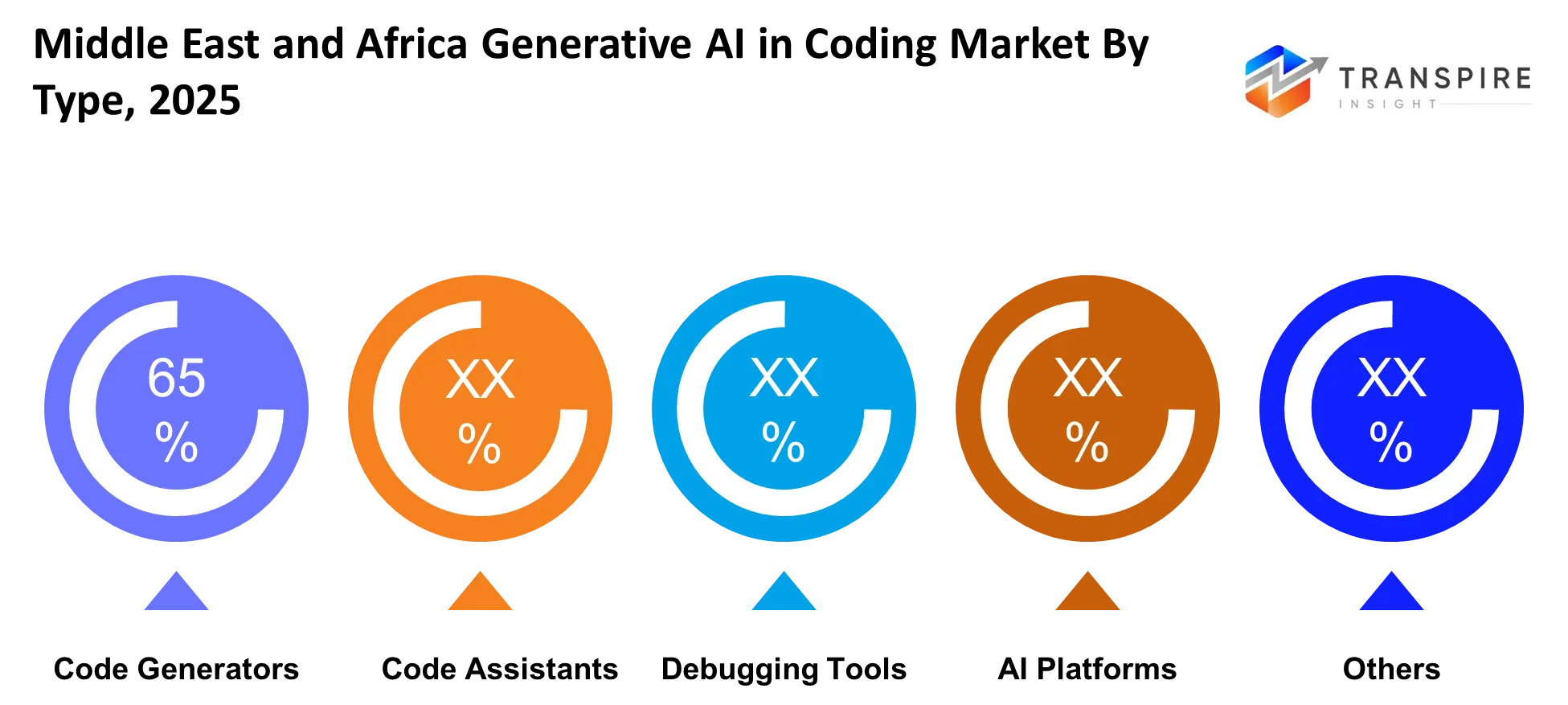
Right now code assistants kind of sit in the strongest place inside the MEA generative AI coding ecosystem, they grab the biggest chunk mainly because companies are moving fast with enterprise adoption in day-to-day developer routines. People usually like assistant-based tools, because these things plug straight into IDEs, and that helps reduce onboarding friction, instead of replacing everything with a full platform. Code generators come next, pretty close behind, pushed by demand for quick prototyping in fintech and telecom software efforts. Debugging tools are still smaller overall, but they’re getting more attention in regulated industries, where lowering mistakes and doing compliance validation isn’t just “nice to have” it’s mandatory.
The growth story isn’t the same for every segment, like it varies a lot. Code assistants grow faster in business environments, since they lower reliance on senior engineers and they also shorten the whole development cycle. Debugging tools can expand because software keeps getting more complex in cloud-native architectures. AI platforms also climb steadily, acting like underlying infrastructure, especially through integrations with AWS, Microsoft, and Google, which in turn support scalable deployment approaches.
Going forward, it looks like these tools will kinda converge into one combined AI development workspace. Vendors that merge generation, debugging, and optimization features into a single environment should see better uptake at enterprise scale. Investment activity probably leans toward integrated platforms, more than standalone utilities.
To learn more about this report, Download Free Sample Report
By Application
Software development is still the main piece, enterprises lean on generative AI mainly to speed up programming work and to reduce development bottlenecks. Testing applications follow not far behind, mostly due to the rising need for automated quality assurance across large enterprise systems.
Growth logic is kind of different depending on the application you look at. DevOps adoption goes up because there’s a need for real time deployment cycles, especially in banking and telecom systems. Code optimization also starts gaining more interest since companies want performance efficiency in cloud-heavy architectures, like they want everything to run faster but with fewer bottlenecks. Testing tools keep expanding too, because regulatory setups in finance and government basically demand validated, error free code outputs. So yeah, the whole stack is being pushed forward at once.
Future direction seems to point toward stronger integration between development and DevOps functions, which in practice reduces the separation between writing the code and shipping the changes. Vendors that embed automation right inside development workflows, tend to keep enterprises more often, because the experience feels smoother and less disconnected. Buyers will likely lean toward platforms that unify testing, optimization, and deployment under one AI layer, instead of mixing multiple tools and hoping they work well together.
By End-User
Enterprises dominate adoption , mainly due to large-scale software modernization efforts and their stronger ability to invest in AI driven development tools. IT companies come right behind them, as service providers integrate generative AI into how they deliver to customers. Startups are growing too, and this part is fairly quick, since cost effective SaaS access lowers the bar, and also reduces how many developers you need at the beginning.
Growth patterns vary a lot across these end user groups. Enterprises use AI coding tools to cut long-term engineering expenses and increase delivery speed across legacy modernization tasks. Startups scale faster because AI tooling cuts down on the need for big engineering teams during early product cycles. IT companies adopt these tools to speed up project turnaround time and to offer more competitive service pricing, which basically helps them win deals.
The future trajectory looks like it will trend toward more democratization of coding tools, especially across smaller firms. Meanwhile the big enterprises tend to concentrate on governance and security “layers”, not sure why exactly but it feels like that’s the pattern. Startups, on the other hand, keep pushing experimentation, agile trials , and innovation. And the vendors… they will probably switch toward flexible pricing models , so they can win both high-value enterprise deals and also a lot of SME adoption at volume.
By Deployment
Cloud deployment stays in the lead position, mainly because it’s scalable, needs lower upfront spend, and works well with global AI model providers. In banking, telecom, and retail, enterprises are moving more and more to cloud-based coding platforms, for quicker release cycles. Hybrid deployment comes next, particularly where regulation forces some control over data , but not all.
The growth logic changes depending on the deployment model. Cloud adoption keeps rising, partly due to regional investment as hyperscalers roll out infrastructure across the Middle East and Africa. On-premise solutions gain traction in government and defense, where data sovereignty is still a hard constraint. Hybrid expands as enterprises try to “split the difference” between compliance obligations and performance efficiency, kind of a balanced compromise.
In terms of direction going forward, cloud still looks dominant but with stronger hybrid uptake in regulated areas. Vendors that can offer flexible deployment architectures will likely get an edge. Buyers will start judging platforms more often on compliance compatibility, latency performance , and their ability to run across different environments without friction.
What are the Key Use Cases Driving the Middle East and Africa Generative AI in Coding Market?
Software development acceleration is still, kind of the big dominant use case, with enterprises in banking telecom and energy areas using generative AI to help write and also keep production-grade code running. The demand is strongest right now, largely because organizations feel that pressure to shorten release cycles, while at the same time modernizing legacy systems at scale.
Testing automation together with DevOps integration is getting more attention too, and it’s especially visible among IT companies and big enterprises running cloud-native infrastructure. AI-assisted testing tools cut down the manual QA grind, and then automated pipeline generation helps teams push deployments faster, like in fintech platforms and government digital services.
Newer use cases show up as AI-driven code optimization for high-performance systems, plus compliance-aware coding for regulated places such as maritime logistics and energy trading platforms. And yes, startups and tech firms are also experimenting with autonomous code generation agents that can assemble modular applications with very little human intervention, which sort of signals that future workflow transformation might be a lot more dramatic than before.
|
Report Metrics |
Details |
|
Market size value in 2025 |
USD 163.47 Million |
|
Market size value in 2026 |
USD 210.06 Million |
|
Revenue forecast in 2033 |
USD 1215.14 Million |
|
Growth rate |
CAGR of 28.50% from 2026 to 2033 |
|
Base year |
2025 |
|
Historical data |
2021 - 2024 |
|
Forecast period |
2026 - 2033 |
|
Report coverage |
Revenue forecast, competitive landscape, growth factors, and trends |
|
Regional scope |
Middle East and Africa (Saudi Arabia, United Arab Emirates, South Africa, Rest of Middle East and Africa) |
|
Key company profiled |
Microsoft, GitHub, Google, Amazon, IBM, OpenAI, Replit, Tabnine, Codeium, Oracle, SAP, Intel, NVIDIA, Salesforce, Atlassian |
|
Customization scope |
Free report customization (country, regional & segment scope). Avail customized purchase options to meet your exact research needs. |
|
Report Segmentation |
By Type (Code Generators, Code Assistants, Debugging Tools, AI Platforms, Others); By Application (Software Development, Testing, DevOps, Code Optimization, Automation, Others); By End-User (Developers, Enterprises, IT Companies, Startups, Tech Firms, Others); By Deployment (Cloud, On-premise, Hybrid, Others) |
Which Regions are Driving the Middle East and Africa Generative AI in Coding Market Growth?
The Gulf Cooperation Council kind of leads regional activity because of really strong, state-led digital transformation policies, and also these big scale enterprise modernization programs. Saudi Arabia and the UAE seem to drive adoption through national AI strategies, where they kind of push enterprises to integrate generative coding tools into both government and enterprise software systems. Plus, the cloud foundation is already well developed, and there’s a lot of money going into hyperscale data centers, which makes rapid deployment easier across banking, energy and telecom. All of that, this whole ecosystem, ends up creating steady demand for AI assisted development tools, that boost output and also reduce how much they depend on imported software engineering services.
North Africa looks more stability driven as a market compared to the Gulf, with adoption happening slowly but still in a consistent way across telecom operators, public administration systems, and IT service providers that focus on outsourcing. Egypt and Morocco, for example, depend on steady foreign investment in digital services and long running outsourcing contracts, rather than aggressive national AI mandates. In practice, enterprises there tend to prioritize cost efficiency and incremental modernization, instead of trying to force rapid transformation. So the demand base stays fairly predictable for coding automation tools that get connected into service delivery workflows, kind of quietly over time.
Sub-Saharan Africa is the fastest growing region, mostly because fintech ecosystems have expanded recently, and there’s been real investment in mobile first digital infrastructure. Nigeria, Kenya, and South Africa have accelerated cloud migration after 2024, and this is backed by new submarine cable projects plus extra data center expansions. As a result, startups and digital banks can reach AI development platforms more easily than before.For investors and vendors, this region presents high upside potential between 2026 and 2033, especially for scalable SaaS-based coding solutions targeting emerging developer ecosystems.
Who are the Key Players in the Middle East and Africa Generative AI in Coding Market and How Do They Compete?
Competition in the Middle East and Africa Generative AI in Coding market looks, kind of like moderately consolidated structure, where the big global cloud and developer platform players mostly own the “plumbing”, while smaller AI tooling startups still push in that application layer. The bigger companies usually keep their ground via ecosystem integration, like they literally drop generative coding capabilities inside their cloud suites and enterprise developer environments, so it feels less “replaceable”. In practice the fight is not so much about pricing, but more about technical depth and that hard to move platform stickiness. Enterprises, they really care about reliability, security compliance and how smoothly it plugs into their already-existing DevOps pipelines, even if they’re working with legacy setups.
Microsoft, and the whole GitHub ecosystem, improves its position by making Copilot fit deeply into how enterprises actually build software. So teams can go from manual coding to AI-assisted engineering without needing to swap IDE environments, which is a big practical win. AWS goes another route, leaning on cloud-native AI services, where coding assistance is tied into wider infrastructure management. That helps it serve scaling requirements for banking and telecom clients, while still keeping operational control in one place. Both companies also try to grow regionally by increasing data center capacity in the Gulf, and by building partnerships with government digital transformation programs, because yeah those partnerships can move timelines.
Google leans hard on model innovation plus developer experience improvements, using cloud-based coding assistants that are integrated into its Vertex AI ecosystem. It tends to target startups and mobile-first developers, where the workflow expectations are a bit different. IBM differentiates through hybrid cloud, with governance-oriented AI coding tools that are aimed at regulated sectors—energy and finance are the usual examples—where compliance is not optional and can’t be handwaved. Oracle expands by using enterprise software integration, basically embedding generative coding features across its SaaS and database ecosystems, with the goal of keeping long-term corporate customers from drifting elsewhere.
Company List
- Microsoft
- GitHub
- Amazon
- IBM
- OpenAI
- Replit
- Tabnine
- Codeium
- Oracle
- SAP
- Intel
- NVIDIA
- Salesforce
- Atlassian
Recent Development News
“In May 2026, IBM announced collaboration with Aramco to advance agentic AI and automation across industrial software systems. The initiative focuses on deploying AI-driven development tools for complex energy and enterprise environments, strengthening IBM’s enterprise coding ecosystem in the Middle East.https://mea.newsroom.ibm.com/IBM-Aramco-Collaboration-to-Accelerate-AI (IBM Newsroom).”
“In March 2026, IBM launched Enterprise Advantage service to scale secure generative AI software development across regulated industries in the UAE and Saudi Arabia. The service provides reusable AI assets and standardized coding frameworks, accelerating enterprise adoption of AI-assisted development workflows.https://www.ibm.com/newsroom (IBM Newsroom).”
What Strategic Insights Define the Future of the Middle East and Africa Generative AI in Coding Market?
The Middle East and Africa Generative AI in Coding Market is kind of drifting, toward more fully integrated AI native software engineering areas, where writing code, testing, deployment, and ongoing optimization kind of happen inside one unified cloud setting. This change is mostly pushed by sovereign digital transformation programs and the steady hyperscaler spending in regional infrastructure, which together lower the latency obstacles and allow enterprises to adopt these AI tools at a bigger scale, even in regulated sectors and such.
There is also a less obvious risk though, like platform concentration. In this case a smaller crowd of global cloud providers is gradually holding the keys to access to core generative coding models and developer ecosystems. So enterprises can end up depending too much, especially if pricing shifts, API access gets constrained, or compliance frameworks become stricter. Then innovation can slow down, for everyone not strongly tied to the dominant platforms.
A major emerging opportunity is localizing AI coding systems for Arabic first experiences and for industry specific enterprise use, particularly within public sector modernization programs in Saudi Arabia and the UAE. This is still pretty early, but it’s picking up momentum as governments are leaning into digital sovereignty and localized model training. Players in the market should focus on modular and interoperable AI coding architectures, so they can plug into several cloud environments and still keep compliance flexibility. That way resilience against ecosystem lock in improves, while also helping capture these larger enterprise scale contracts.
Middle East and Africa Generative AI in Coding Market Report Segmentation
By Type
- Code Generators
- Code Assistants
- Debugging Tools
- AI Platforms
- Others
By Application
- Software Development
- Testing
- DevOps
- Code Optimization
- Automation
- Others
By End-User
- Developers
- Enterprises
- IT Companies
- Startups
- Tech Firms
- Others
By Deployment
- Cloud
- On-premise
- Hybrid
- Others
Frequently Asked Questions
Find quick answers to common questions.
The estimated Middle East and Africa Generative AI in Coding Market size is USD 1215.14 Million in 2033.
Key segments for the Middle East and Africa Generative AI in Coding Market are By Type (Code Generators, Code Assistants, Debugging Tools, AI Platforms, Others); By Application (Software Development, Testing, DevOps, Code Optimization, Automation, Others); By End-User (Developers, Enterprises, IT Companies, Startups, Tech Firms, Others); By Deployment (Cloud, On-premise, Hybrid, Others).
Major Middle East and Africa Generative AI in Coding Market players are Microsoft, GitHub, Google, Amazon, IBM, OpenAI, Replit, Tabnine, Codeium, Oracle, SAP, Intel, NVIDIA, Salesforce, Atlassian.
The Middle East and Africa Generative AI in Coding Market size is USD 163.47 Million in 2025.
The Middle East and Africa Generative AI in Coding Market CAGR is 28.50% from 2026 to 2033.
- Microsoft
- GitHub
- Amazon
- IBM
- OpenAI
- Replit
- Tabnine
- Codeium
- Oracle
- SAP
- Intel
- NVIDIA
- Salesforce
- Atlassian
Recently Published Reports
-
Apr 2026
3D Optical Profiler Market
3D Optical Profiler Market Size, Share & Analysis Report By Type (Desktop 3D Optical Profiler, and Portable 3D Optical Profiler), By Technology (Confocal Technology, and White Light Interference), By End-Use Industry (Manufacturing, Research Institutions, Automotive, Aerospace and Defense, Medical Devices, and Other), and Geography (North America, Europe, Asia-Pacific, Middle East and Africa, South and Central America), 2021 - 2031
-
Apr 2026
Depth Sensor Market
Depth Sensor Market Size, Share & Analysis Report By Type (Infrared Depth Sensors, Time-of-Flight (ToF) Sensors, Stereo Vision Sensors, Structured Light Sensors, Ultrasonic Depth Sensors), By Application (Automotive, Robotics, Gaming, Consumer Electronics, Industrial Automation, Healthcare, Security & Surveillance, Others), By End Users (Automotive Manufacturers, Consumer Electronics Companies, Healthcare Providers, Industrial Companies, Security Agencies, Gaming Companies, Robotics Companies, Others), and Geography (North America, Europe, Asia-Pacific, Middle East and Africa, South and Central America), 2021 – 2031
-
Apr 2026
Digital Manufacturing Market
Digital Manufacturing Market Size, Share & Analysis Report By Component (Hardware, Software, and Services), By Technology (Robotics, 3D Printing, Internet of Things (IoT), and Others), By Application (Automotive and Transportation, Aerospace and Defense, Consumer Electronics, Industrial Machinery, and Others), By Process Type (Computer-Based Designing, Computer-Based Simulation, Computer 3D Visualization, Analytics, and Others), and Geography (North America, Europe, Asia-Pacific, Middle East and Africa, South and Central America), 2021 – 2031
-
Apr 2026
Digital Visa Services Market
Digital Visa Services Market Size, Share & Analysis Report By Type (Individual Travelers, Group Travelers), By Application (Tourism, Business Travel, Others), and Geography (North America, Europe, Asia-Pacific, Middle East and Africa, South and Central America), 2021 – 2031