

Middle East and Africa GaAs Wafer Market Size & Forecast:
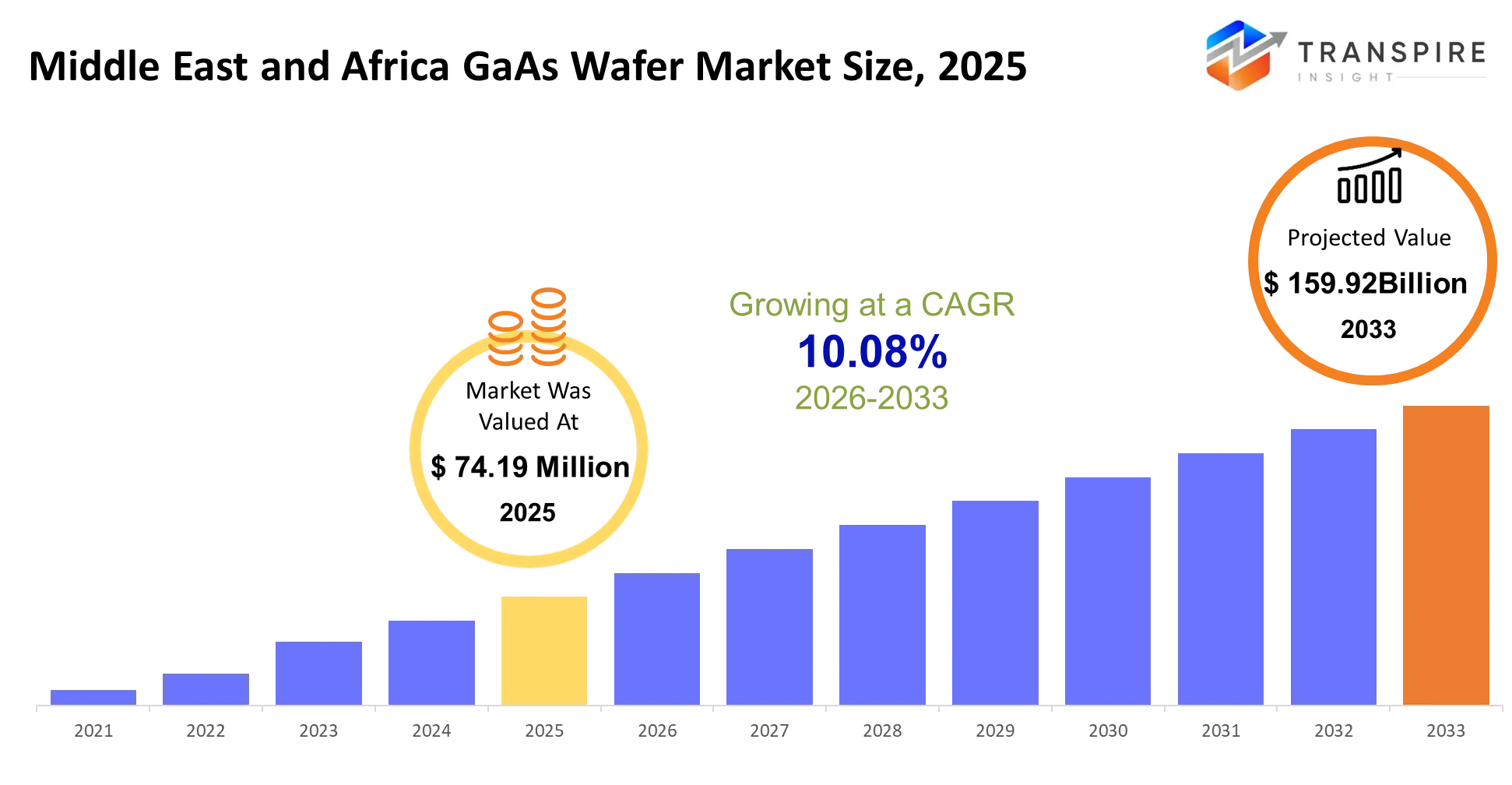
- Middle East and Africa GaAs Wafer Market Size 2025: USD 74.19 Million
- Middle East and Africa GaAs Wafer Market Size 2033: USD 159.92 Million
- Middle East and Africa GaAs Wafer Market CAGR: 10.08%
- Middle East and Africa GaAs Wafer Market Segments: By Type (Semi-insulating GaAs, Semi-conducting GaAs, Others); By Application (RF Devices, Optoelectronics, Solar Cells, LEDs, Others); By End-User (Electronics Industry, Telecom Sector, Solar Industry, Defense Sector, Others); By Diameter (2-inch, 4-inch, 6-inch, Others)
To learn more about this report,  Download Free Sample Report
Middle East and Africa GaAs Wafer Market Summary
The Middle East and Africa GaAs Wafer Market was valued at USD 74.19 Million in 2025. It is forecast to reach USD 159.92 Million by 2033. That is a CAGR of 10.08% over the period.
In practice, the Middle East and Africa GaAs wafer market sort of allows makers to produce high-frequency semiconductor components that end up in satellite links, 5G base stations, radar systems, and industrial sensing gear where silicon just can’t do the job efficiently at microwave and millimeter-wave ranges. Over the past five years, there’s been a kind of structural turn toward compound semiconductor RF front-ends and because of that there is less dependence on silicon-based designs for high-frequency use cases. That change got pushed faster during pandemic-era supply chain disruptions, plus you had defense modernization efforts ramping up across Gulf states and also parts of Africa. Now, governments and operators are leaning into diversified sourcing , and they’re building sovereign connectivity programs, which makes GaAs wafer procurement feel like a priority for reliable, high-frequency communication setups. So, demand is getting more and more focused in specialized defense, and telecom integration programs. This supports higher-value wafer imports and longer-term supplier relationships, rather than just doing commodity-scale purchasing.
Key Market Insights
- GCC countries are kinda dominating the Middle East and Africa GaAs Wafer Market, with something like 42% share in 2025, mostly because defense plus telecom modernization programs keep moving forward .
- South Africa meanwhile looks like the fastest-growing regional hub for 2025–2030, in large part due to satellite communication growth, also mining automation systems are getting more attention, and yeah that helps.
- North Africa shows that “newer” demand trend, tied to cross-border broadband expansion and more digital infrastructure investments, it’s a gradual but noticeable lift.
- Semi-insulating GaAs wafers still lead, holding around 55% share in 2025, and the reason is basically RF device efficiency.
- Epitaxial GaAs wafers come in second, they’re used a lot in high-speed optoelectronics and laser applications so the demand stays steady.
- Semi-conducting wafer variants are the fastest-growing segment through 2030, and this is supported by advanced 5G RF integration, with better performance needs pushing purchases.
- RF and microwave devices dominate with nearly 48% share in 2025, and that pattern remains strong across upgrades.
- Optoelectronics is the fastest-growing application, driven by fiber-optic expansion plus data center interconnect demand.
- Satellite communication systems keep expanding usage, mostly because sovereign connectivity priorities and defense communication upgrades keep getting funded.
- Telecommunications stays the top end-user segment with about 46% share, fueled by 5G rollout and broader infrastructure upgrades, pretty straightforward.
What are the Key Drivers, Restraints, and Opportunities in the Middle East and Africa GaAs Wafer Market?
The Middle East and Africa GaAs Wafer Market is mainly propelled by quick expansion of high-frequency communication infrastructure , especially since Gulf nations and a few African economies are pushing ahead with 5G rollout and satellite connectivity efforts. In a way this change was set off by the growing requirement for dependable, low-latency defense and telecom networks, after global supply chain instability and more geopolitical focus on secure communications. Because of that, operators are leaning more into GaAs-based RF front-end parts , to make signal integrity better in places where silicon performance hits a wall fast. That directly lifts wafer purchasing volumes and also raises contract values.
At the same time a restraint is still there, and it’s pretty obvious , the region relies heavily on imported compound semiconductor wafers, while local epitaxial growth and fabrication capability stay limited. This structural mismatch is reinforced by big upfront capital needs and also complicated manufacturing conditions for GaAs materials, so it’s hard to localize production quickly across the region. So supply is kind of concentrated among a few major global producers, which causes lead-time swings and leaves smaller telecom and industrial buyers with less flexibility, and that slows broader deployment . In turn it can suppress downstream revenue growth too.
Still there’s an emerging opportunity that looks credible, especially around sovereign investments in semiconductor and telecom infrastructure, and that is particularly tied to the GCC’s digital transformation programs. Nations like the UAE and Saudi Arabia are funding advanced satellite communication corridors and building out defense electronics ecosystems. That tends to create early demand for localized assembly work , plus longer term wafer supply relationships and partnership models.This setting is slowly opening up routes for strategic co investment with global GaAs wafer producers, and it is allowing the Middle East and Africa GaAs Wafer Market to move toward higher priced, regionally rooted supply chains.
What Has the Impact of Artificial Intelligence Been on the Middle East and Africa GaAs Wafer Market?
Artificial intelligence is, you know, getting more and more involved in the Middle East and Africa GaAs Wafer Market by changing how high frequency communication plus monitoring systems are designed , deployed, and then kept running across telecom defense and industrial ecosystems. In real life terms AI driven automation is starting to help improve scrubber performance systems and marine emission control technology by constantly tweaking operating parameters via connected control units . The whole setup usually depends on GaAs based RF and sensor parts to pass along real time diagnostic information, and that allows stricter automation for fleet compliance tracking , so there is less need for manual fixes during operational monitoring
On the predictive side, machine learning models are used to foresee component deterioration in satellite communication modules, and also in RF front end systems. This makes “predictive maintenance” possible before signal loss or performance dips show up. Similar analytics show up when people try to anticipate emissions performance in industrial maritime situations, which boosts regulatory compliance accuracy and helps avoid the kind of surprise downtime that nobody wants. Operators often mention directional improvements like better system uptime, lower fuel burn thanks to optimized routing adjustments , and fewer compliance penalties because the emissions reporting is more precise
Still though, adoption is not fully smooth because there is limited actual training data in many places, plus intermittent connectivity offshore. That combination can drop model accuracy and slow down real time decisions. Also, the integration expenses for AI platforms inside older telecom and maritime infrastructure are pretty high , so large scale rollout across the Middle East and Africa GaAs Wafer Market tends to lag, especially with mid tier operators who just have less budget and fewer resources for upgrades.
Key Market Trends
- GCC defense procurement kind of shifted from silicon RF modules to GaAs based systems after 2023, which ended up improving high frequency signal reliability a bit and resilience too.
- Satellite communication adoption expanded a lot after 2022 supply disruptions, and it basically pushed operators toward diversified GaAs wafer sourcing strategies, not just one or two places.
- Telecom operators in the UAE and Saudi Arabia started integrating GaAs RF front ends between 2023 and 2025, especially for 5G network densification projects that keep getting rolled out.
- Import dependency on Japan and U.S. wafer suppliers tightened the supply chains a lot, and that made lead times longer for Middle East semiconductor procurement cycles since 2024.
- Aerospace programs in Saudi Arabia and the UAE moved toward GaAs enabled radar systems over the last few upgrade cycles , replacing older microwave architectures that had been used before.
- Industrial IoT deployments in mining heavy African economies also shifted toward GaAs based sensing modules , mainly for more dependable high frequency data transmission.
- Strategic partnerships between IQE plc and regional telecom integrators grew after 2023, so wafer supply visibility got stronger across MEA infrastructure projects.
- Defense modernization budgets increased across GCC countries, and procurement was redirected toward compound semiconductor technologies, with better thermal and frequency efficiency overall.
- Epitaxial wafer demand went up as manufacturers moved away from standard substrates, and toward performance optimized layers for satellite and radar applications, since 2024.
Middle East and Africa GaAs Wafer Market Segmentation
By Type
Semi-insulating GaAs wafers kind of hold the top spot in the compound semiconductor supply structure , mostly because RF and microwave applications still pull very hard on them. In practice this segment keeps the largest share, since telecom base stations and defense radar systems depend a lot on high-resistivity substrates, for low signal loss and a steadier frequency behavior. The manufacturing ecosystem in Japan and the United States keeps anchoring supply, which basically reinforces the usual procurement habits across MEA operators .
And the growth story , it comes from 5G rollout, plus satellite communication networks scaling up quickly, where signal integrity at high frequencies stays a big deal. On top of that defense modernization programs across Gulf states also add more demand for high-performance semi-insulating materials. Semi-conducting GaAs is starting to gain a bit more ground in optoelectronics and integrated photonic systems, mainly because device efficiency looks better and miniaturization trends keep pushing forward.
Through the forecast period, semi-insulating wafers will still lead, while the semi-conducting options will grow faster, largely because they show up in advanced RF chips. Material developers will likely prioritize thermal stability and yield improvements, but buyers will probably lean toward longer-term supply agreements , to cut down on volatility related risks.
By Application
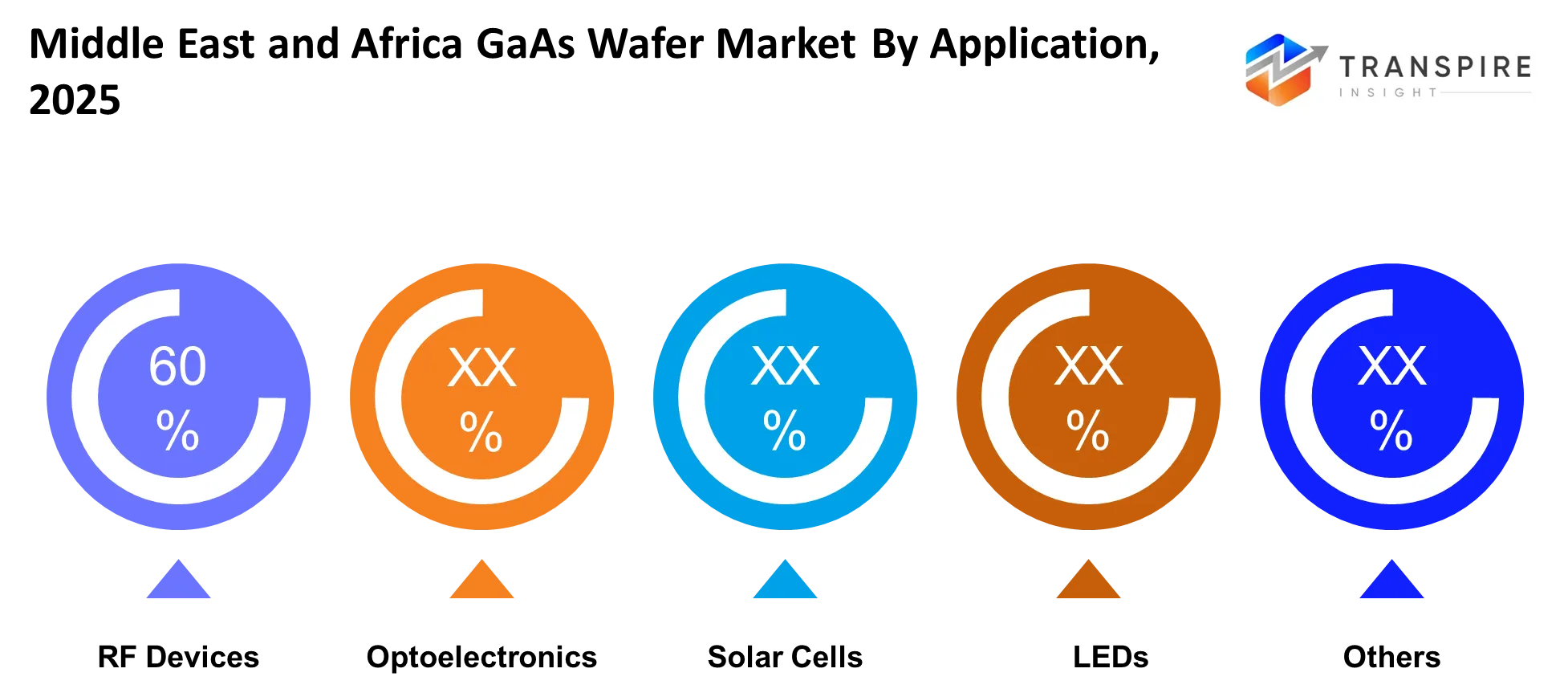
RF devices really look like the top application slice, mostly because they are widely used in telecom infrastructure , satellite systems and radar technologies. The high-frequency performance needs, plus the requirement for signal stability and basically tight consistency, is why GaAs wafers stay so essential here. Optoelectronics sit in the second place, you can see it in fiber-optic communication expansion , and then in laser-based sensing setups that keep getting more traction.
RF growth picked up more after the 5G rollout programs moved forward across GCC countries, and that drove demand up for small, efficient power amplifiers. On the other side, optoelectronics demand rose too, helped by data center expansion, plus cross-border connectivity investments across Africa and the Middle East. Solar cell and LED use is still more like a niche. That’s largely because silicon-based options, and other semiconductor materials, tend to compete aggressively.
Looking ahead, future development will probably lean toward combining RF and optoelectronics within hybrid semiconductor platforms. Companies will put more emphasis on multi-functional chip architectures , while investors will prefer higher-margin RF innovation cycles rather than generic commodity-style applications.
To learn more about this report, Download Free Sample Report
By End-User
Telecom operators dominate end-use consumption. It’s driven by heavy spending on 5G infrastructure, satellite backhaul, and network densification projects across the region. Defense comes next , with radar modernization, surveillance systems, and secure communication upgrade programs. Electronics industry adoption stays more moderate, mainly due to higher material costs , and also because the use cases are more specialized and narrow
Telecom demand also accelerated after regional governments pushed digital sovereignty agendas, along with building resilient communication networks. Defense procurement rose quite sharply following geopolitical instability, and modernization initiatives that were launched after 2022.Solar and industrial sectors show slower uptake, mostly because cost competitiveness is a bit limited versus alternative semiconductor materials, and that kind of thing drags the pace.
Over time, defense and telecom will keep anchoring demand , while industrial applications slowly widen their footprint as costs decline. Suppliers likely will strengthen longer-term contracts with government-linked entities, and buyers will lean toward safer and high-reliability wafer sourcing plans, rather than taking risks on cheaper options.
By Diameter
Four-inch wafers still hold the strongest market position , since they balance cost efficiency with broad compatibility for established fabrication routines. Six-inch wafers are picking up speed in advanced manufacturing setups that really want higher throughput, plus better device scaling. Two-inch wafers keep slipping in relevance as production moves toward larger substrate formats, it feels like that shift is basically steady.
Demand for four-inch wafers remains solid, because telecom and defense manufacturers still lean on legacy production lines that were tuned for this size. Six-inch adoption is also accelerating , as fabs upgrade to improve yield efficiency and support next-generation RF and optoelectronic devices. Smaller diameters are getting more and more fenced off for research uses, and for low-volume specialty production, not for mainstream output.
Looking ahead, future trends point to a gradual transition toward six-inch wafers as scaling efficiency becomes the main priority for many global suppliers. Equipment manufacturers and investors will likely concentrate on capacity upgrades, while buyers will tilt procurement toward higher-yield substrate formats in order to squeeze per-unit production costs down, even if ramping takes time.
What are the Key Use Cases Driving the Middle East and Africa GaAs Wafer Market?
RF and microwave communication systems are kind of the core demand engine in the Middle East and Africa GaAs Wafer Market ,because telecom operators and defense networks still want stable high frequency signal transmission especially for 5G base stations, radar, and satellite links. From there, these setups drive the largest wafer consumption, since silicon solutions can struggle when you push extreme frequency and thermal loads a bit too far.
Meanwhile, satellite backhaul networks ,and optoelectronic communication modules, are becoming more and more visible use cases, mainly within telecom operators and aerospace defense initiatives across GCC nations. In addition industrial sensing in mining and oilfield operations across Africa is leaning more often toward GaAs-based components for dependable fast data handling.
Some newer directions are starting to show up too, like phased array radar systems for advanced defense platforms and photonic integrated circuits aiming at next generation data centers. These areas are still early stage but they are quietly gaining traction through sovereign digital infrastructure programs, along with rising investment in secure high bandwidth communication ecosystems.
|
Report Metrics |
Details |
|
Market size value in 2025 |
USD 74.19 Million |
|
Market size value in 2026 |
USD 81.67 Million |
|
Revenue forecast in 2033 |
USD 159.92 Million |
|
Growth rate |
CAGR of 10.08% from 2026 to 2033 |
|
Base year |
2025 |
|
Historical data |
2021 - 2024 |
|
Forecast period |
2026 - 2033 |
|
Report coverage |
Revenue forecast, competitive landscape, growth factors, and trends |
|
Regional scope |
Middle East and Africa (Saudi Arabia, United Arab Emirates, South Africa, Rest of Middle East and Africa) |
|
Key company profiled |
Sumitomo Electric, Freiberger Compound Materials, AXT Inc, Wafer Technology, IQE, Visual Photonics, Hitachi Cable, Mitsubishi Chemical, DOWA Electronics, II-VI Incorporated, Skyworks, Qorvo, Broadcom, NXP, Infineon |
|
Customization scope |
Free report customization (country, regional & segment scope). Avail customized purchase options to meet your exact research needs. |
|
Report Segmentation |
By Type (Semi-insulating GaAs, Semi-conducting GaAs, Others); By Application (RF Devices, Optoelectronics, Solar Cells, LEDs, Others); By End-User (Electronics Industry, Telecom Sector, Solar Industry, Defense Sector, Others); By Diameter (2-inch, 4-inch, 6-inch, Others) |
Which Regions are Driving the Middle East and Africa GaAs Wafer Market Growth?
The GCC region is leading the Middle East and Africa GaAs wafer market , mainly because of aggressive state backed spending in defense electronics, 5G build outs, and satellite communication networks. There is also strong policy alignment with national digital sovereignty programs in Saudi Arabia and the UAE , which speeds up ordering of high-frequency RF technologies. With advanced telecom systems already in place, plus sovereign space initiatives running in parallel , it forms this tightly linked environment that keeps pulling wafer demand forward. On top of that, established collaborations with major semiconductor suppliers keep supply steady and help with technology transfer.
South Africa , meanwhile, is more of a stable secondary contributor, supported by a diversified industrial base and a more structured telecom regulatory setup. Compared with the GCC, the expansion is less connected to defense budgets and more tied to steady upgrades in telecommunications, mining automation, and industrial IoT rollouts. The regulatory framework is fairly mature, so spectrum allocation tends to be predictable and network investment cycles feel consistent. That kind of steadiness backs gradual but dependable consumption of compound semiconductor components for RF and sensing use cases.
North Africa is starting to look like the fastest-growing area. This is driven by submarine cable projects, broader digital infrastructure expansion, and cross-border connectivity efforts that were launched after 2023. In Egypt and Morocco, broadband penetration initiatives have been pushed harder , and there are port linked digital logistics systems too. As a result , the need for high-frequency communication components rises across telecom and industrial applications. Over the 2026–2033 period, this momentum should bring in more suppliers and investors who want early-stage, infrastructure linked growth opportunities.
Who are the Key Players in the Middle East and Africa GaAs Wafer Market and How Do They Compete?
Competition in the Middle East and Africa GaAs Wafer market is still kind of moderately consolidated at the upstream wafer production stage, but then downstream looks more fragmented across telecom, defense, and optoelectronic buyers. The upstream side stays dominated by established compound semiconductor suppliers, mainly because wafer fabrication is capital intense, needs exact epitaxy supervision, and comes with long qualification cycles, especially when RF device manufacturers are involved. In practice, competition is driven more by tech output and dependable delivery rather than simple pricing, because end users care about signal integrity, thermal stability, and also defense-grade approval. So, incumbents usually protect their position by leaning on long-term supply commitments and close, practical integration with RF component makers.
IQE plc seems to concentrate on epitaxial wafer technology leadership, it supplies high-performance GaAs layers that are tuned for RF front end modules used in 5G and satellite systems. Its edge comes from careful epitaxy control and a track record of qualification with tier-one RF chip designers, which tends to cut down redesign risk for telecom integrators. The way they expand is through joint development arrangements with device manufacturers who want next generation high-frequency architectures.
Skyworks Solutions and Murata Manufacturing seem to compete through these vertically integrated RF module ecosystems, so GaAs wafer utilization is kind of baked into the whole front-end setup. Skyworks, it builds and strengthens its advantage by keeping the power amplifiers and filters very tightly integrated, that helps in practice. Murata on the other hand leans on miniaturization know how, turning it into compact RF modules, for dense telecom networks where space is always kind of an issue. And both companies are expanding with partnerships involving 5G infrastructure providers across Gulf countries, which is where the momentum is at.
Sumitomo Electric Industries and Wolfspeed differentiate in a more material science way, plus they both have this compound semiconductor manufacturing scale behind them. Sumitomo Electric is more centered on high-reliability wafers, for defense and also for aerospace-grade RF systems. Wolfspeed instead extends production capacity, and also pushes epitaxial innovation aimed at next-generation high-power RF applications. Together they pursue capacity expansion plus regional supply agreements, and that tends to strengthen their positioning in sovereign infrastructure programs, even when the timelines get messy at times.
Company List
- Sumitomo Electric
- Freiberger Compound Materials
- AXT Inc
- Wafer Technology
- IQE
- Visual Photonics
- Hitachi Cable
- Mitsubishi Chemical
- DOWA Electronics
- II-VI Incorporated
- Skyworks
- Qorvo
- Broadcom
- NXP
- Infineon
Recent Development News
“In January 2026, IQE plc reported strong order book momentum driven by defense, photonics, and AI-related demand, reflecting higher uptake of compound semiconductor wafers. The update highlights improved visibility in RF and GaAs wafer shipments supporting telecom and military communication systems.https://www.tradingview.com
“In October 2025, Skyworks Solutions and Qorvo disclosed preliminary earnings ahead of Wall Street expectations during merger announcements. Strong RF demand in 5G and connectivity markets reinforced wafer utilization rates across compound semiconductor supply chains, including GaAs-based front-end modules.https://www.investors.com
What Strategic Insights Define the Future of the Middle East and Africa GaAs Wafer Market?
The Middle East and Africa GaAs Wafer Market is kind of moving, in a more security led and sovereign infrastructure direction , where demand is anchored mostly in defense electronics satellite connectivity and high frequency telecom networks, not so much in commercial volume scaling. This change is pushed by national digital sovereignty programs, plus continued funding for 5G densification and space based communication systems across the GCC economies. Over the next 5 to 7 years , procurement habits will likely concentrate even more around long term strategic contracts rather than quick spot purchasing , and that should tighten the link between wafer suppliers and system integrators.
There is also a less obvious risk, supply chain concentration i mean, because the region is relying on just a small set of East Asian and U.S. epitaxial wafer producers. That situation can expose everything to geopolitical export controls and capacity bottlenecks. So even when demand growth looks strong, structural vulnerability can still show up. At the same time, a less talked about opportunity is rising in localized compound semiconductor packaging and RF module assembly hubs in the UAE and Saudi Arabia, enabled by sovereign investment funds and defense industrial policies.
Market players should really focus on strategic co location models with regional defense and telecom initiatives, and set up early stage partnerships. That way they get clearer long term demand visibility, plus some insulation from global supply shocks , which is not trivial.
Middle East and Africa GaAs Wafer Market Report Segmentation
By Type
- Semi-insulating GaAs
- Semi-conducting GaAs
- Others
By Application
- RF Devices
- Optoelectronics
- Solar Cells
- LEDs
- Others
By End-User
- Electronics Industry
- Telecom Sector
- Solar Industry
- Defense Sector
- Others
By Diameter
- 2-inch
- 4-inch
- 6-inch
- Others
Frequently Asked Questions
Find quick answers to common questions.
The estimated Middle East and Africa GaAs Wafer Market size will be USD 159.92 Million in 2033.
Key segments for the Middle East and Africa GaAs Wafer Market are By Type (Semi-insulating GaAs, Semi-conducting GaAs, Others); By Application (RF Devices, Optoelectronics, Solar Cells, LEDs, Others); By End-User (Electronics Industry, Telecom Sector, Solar Industry, Defense Sector, Others); By Diameter (2-inch, 4-inch, 6-inch, Others).
Major Middle East and Africa GaAs Wafer Market players are Sumitomo Electric, Freiberger Compound Materials, AXT Inc, Wafer Technology, IQE, Visual Photonics, Hitachi Cable, Mitsubishi Chemical, DOWA Electronics, II-VI Incorporated, Skyworks, Qorvo, Broadcom, NXP, Infineon.
The Middle East and Africa GaAs Wafer Market size is USD 74.19 Million in 2025.
The Middle East and Africa GaAs Wafer Market CAGR is 10.08% from 2026 to 2033.
- Sumitomo Electric
- Freiberger Compound Materials
- AXT Inc
- Wafer Technology
- IQE
- Visual Photonics
- Hitachi Cable
- Mitsubishi Chemical
- DOWA Electronics
- II-VI Incorporated
- Skyworks
- Qorvo
- Broadcom
- NXP
- Infineon
Recently Published Reports
-
Apr 2026
Healthcare Polymer Packaging Market
Healthcare Polymer Packaging Market Size, Share & Analysis Report By Packaging Type (Syringes, IV Bottles and Pouches, Clamshells, Blisters, Bottles & Jars, Containers, Tubes, IV Parental Packaging, Others), By Type (Regulated, Non-regulated), By Polymer Type (LDPE (Low-Density Polyethylene), HDPE (High-Density Polyethylene), Homo-polymer (Homo), Random Copolymer (Random), Block Copolymer (Block), PET, Polystyrene, Polyvinyl Chloride, Polyamide/EVOH, Others), and Geography (North America, Europe, Asia-Pacific, Middle East and Africa, South and Central America), 2021 - 2031
-
Apr 2026
Hydrophilic Tape (Waterstop) Market
Hydrophilic Tape (Waterstop) Market Size, Share & Analysis Report By Type (Bentonite-Based Hydrophilic Tape, Rubber-Based Hydrophilic Tape), By Application (Residential Buildings, Commercial Buildings, Infrastructure Projects), and Geography (North America, Europe, Asia-Pacific, Middle East and Africa, South and Central America), 2021 - 2031
-
Apr 2026
Metalens Market
Metalens Market Size, Share & Analysis Report By Type (Visible Light Metalens, and Infrared Metalens), By Application (Consumer Electronics, Automotive Electronics, Industrial, Medical, and Others), and Geography (North America, Europe, Asia-Pacific, Middle East and Africa, South and Central America), 2021 - 2031
-
Apr 2026
PBT Resin Market
PBT Resin Market Size, Share & Analysis Report By Type (Reinforced PBT Resin, Unreinforced PBT Resin), By Processing Method (Injection Molding, Extrusion, Blow Molding, Others), By End-User (Automotive, Electrical & Electronics, Consumer Appliances, Industrial Machinery, Medical Devices, Packaging, Others), and Geography (North America, Europe, Asia-Pacific, Middle East and Africa, South and Central America), 2021 - 2031