

Middle East and Africa Fruit Juice Market Size & Forecast:
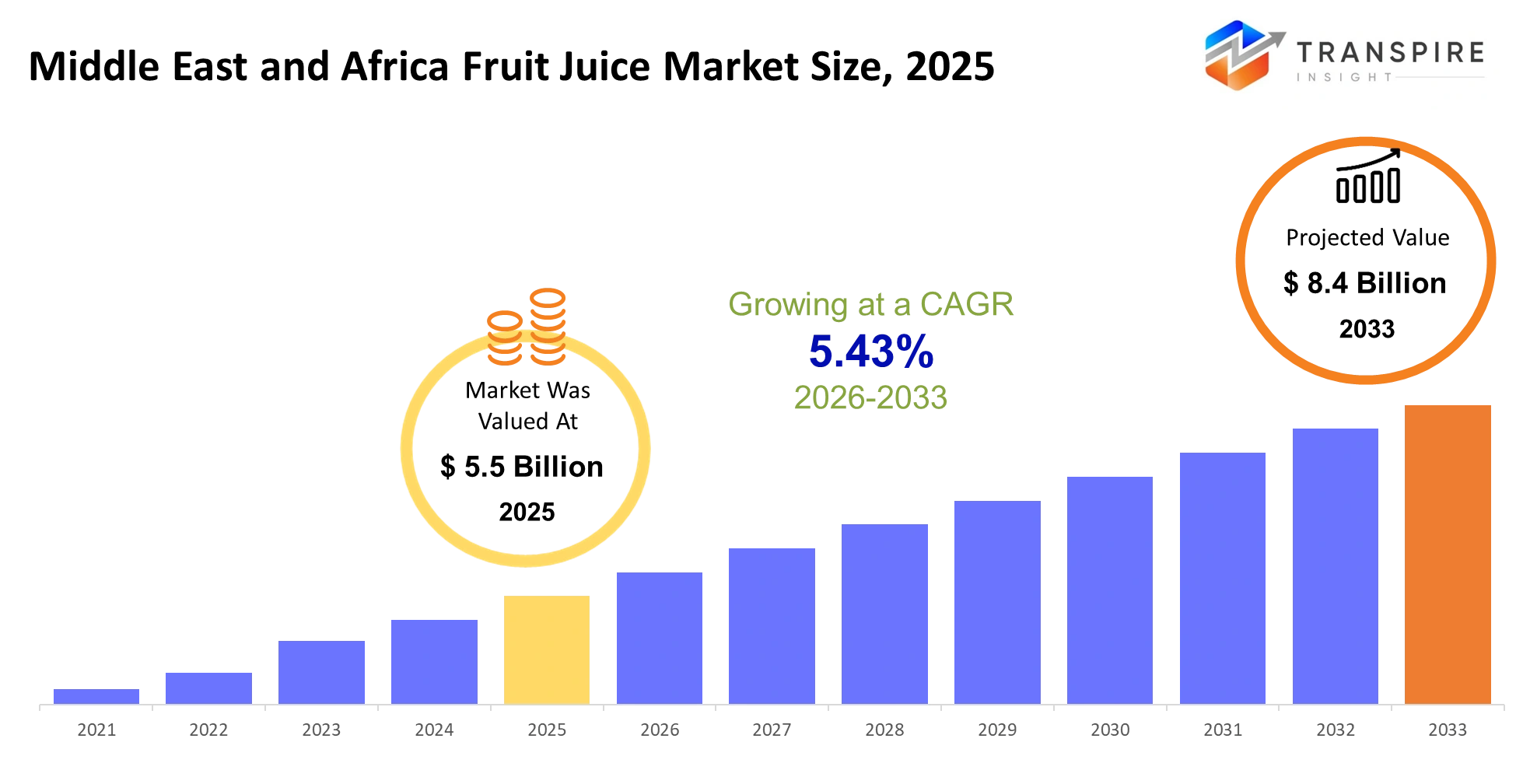
- Middle East and Africa Fruit Juice Market Size 2025: USD 5.5 Billion
- Middle East and Africa Fruit Juice Market Size 2033: USD 8.4 Billion
- Middle East and Africa Fruit Juice Market CAGR: 5.43%
- Middle East and Africa Fruit Juice Market Segments: By Type (100% Juice, Nectar, Juice Drinks, Concentrates, Others); By Application (Household Consumption, Food Service, Retail, Hospitality, Others); By End-User (Consumers, Restaurants, Hotels, Cafes, Retailers, Others); By Distribution (Supermarkets, Convenience Stores, Online, Others).
To learn more about this report,  Download Free Sample Report
Middle East and Africa Fruit Juice Market Summary
The Middle East and Africa Fruit Juice Market was valued at USD 5.5 Billion in 2025. It is forecast to reach USD 8.4 Billion by 2033. That is a CAGR of 5.43% over the period.
The Middle East and Africa fruit juice market sort of works like a production and distribution flow that turns seasonal fruit supply into shelf-stable drinks, which then end up in supermarkets, convenience stores, hotels, and also quick-service outlets. I mean in practice it helps with the storage problem and the perishability thing, while still covering everyday hydration and nutrition needs in fast-growing urban areas .
Over the last three to five years, the market has been bending more structurally toward low-sugar and fortified formulations, plus a more organized retail network that’s backed by cold chain infrastructure that keeps expanding. One big trigger was pandemic-era disruption, when food service consumption went down, and households shifted toward packaged retail beverages. At the same time it highlighted import dependence because global shipping routes became a bit unstable , and honestly harder to trust.
Because of that mix, local bottling investments have moved faster and supply chains are getting localized too. Right now growth feels less about simple awareness trends and more about logistics resilience, deeper urban retail penetration, and the economic advantage of processing fruit closer to the places people actually drink it, like consumption hubs .
Key Market Insights
- GCC countries kind of dominate the Middle East and Africa Fruit Juice Market, with an estimated 35–40% share in 2024, mostly because of higher-income urban consumers.
- And yeah, it looks like Africa is the fastest-growing region through 2024–2030, fueled by retail expansion and also by better cold-chain logistics infrastructure which is improving a lot there.
- North Africa meanwhile, shows steady demand growth inside the Middle East and Africa Fruit Juice Market, supported by tourism and hospitality sector recovery—so the whole “out-and-about” economy is helping.
- In the product side, the 100% fruit juice segment keeps the leading share, mainly due to premium positioning and health oriented consumption habits in urban households.
- Then you’ve got nectar-based beverages, which sit as the second-largest segment, driven by affordability and broader mass-market reach across Africa too.
- Also, functional and fortified juices are the fastest-growing segment through 2024–2030 in the Middle East and Africa Fruit Juice Market, and this is largely due to immunity-focused demand, like “drink it for protection” type thinking.
- For applications, retail packaged beverages take the lead with nearly 60% share, backed by supermarkets, hypermarkets and convenience-store expansion.
- Food service and hospitality applications are emerging faster though, because tourism is bouncing back and there are QSR partnerships forming across GCC economies.
- For end users, urban households stay the biggest chunk, contributing most of the demand in packaged juice consumption patterns.
- Young adult consumers are also the fastest-growing group, driven by fitness trends, and this includes a strong desire for low-sugar functional drinks, which people want more often these days.
What are the Key Drivers, Restraints, and Opportunities in the Middle East and Africa Fruit Juice Market?
The primary growth push is kinda the rapid expansion of organized retail plus cold-chain infrastructure across the GCC and the bigger urban African routes. That change seems to have been sparked by major investments in logistics modernization and supermarket penetration , after pandemic-era supply disruptions got messy. Because of that, packaged juice distribution has turned out to be more dependable, so manufacturers can ramp up shelf-stable along with chilled items into markets that used to be fragmented, and this does two things at once, it raises volume sales while also making margin stability feel steadier.
The biggest holdback still feels like inconsistent fruit raw material availability, mainly from climate variability and from the lack of large-scale agricultural integration across several African economies. This is structural, like it really hinges on long-term agribusiness development, irrigation capability and even reducing import dependency, none of which is quick to fix. The market soaks up these issues through price swings, periodic production pauses and tighter limits on product standardization, which together end up weakening revenue predictability for the manufacturers.
A strong future-facing opportunity sits in aseptic processing and localized bottling hubs, especially in East Africa , where investment inflows are rising. For instance new processing plants in Kenya and Ethiopia are helping producers source fruit within the region, process it close to the consumption centers, and dial down dependence on imported concentrates. In effect it opens the door for a regional expansion that is more scalable and also more cost-efficient.
What Has the Impact of Artificial Intelligence Been on the Middle East and Africa Fruit Juice Market?
Artificial intelligence and advanced digital technologies are quietly reshaping the Middle East and Africa Fruit Juice Market, in the sense that manufacturers are changing how they produce, forecast, and push beverages through those pretty fragmented supply chains. In production settings, automation systems now rely on IoT-enabled sensors and a form of computer vision, they watch bottling lines more closely, spot packaging defects in real time, and fine-tune filling precision with almost no manual involvement. As a result, wastage drops, and product consistency becomes more stable even when production volumes are high.
At the same time predictive analytics is being used more often to anticipate demand patterns across retail outlets, and also during tourism-driven consumption cycles. Machine learning models even help with predictive maintenance for filling machines, pasteurizers, and refrigeration units, so operators can line up servicing before anything actually breaks down. These arrangements boost uptime too, and they support cold-chain performance, which can reduce spoilage rates and, at the same time lower energy use in distribution networks serving the Middle East and Africa Fruit Juice Market.
From an operational viewpoint, many companies mention better equipment uptime, less production downtime, and improved inventory turnover, mainly because demand alignment gets sharper and automated production scheduling becomes more reliable. Still, adoption is not uniform, because integration costs are high and regional suppliers have uneven levels of digital readiness. A lot of fruit sourcing networks depend on smallholder farms, where connectivity can be limited and data capture is inconsistent. That, in turn, reduces model accuracy and makes it harder to roll out full-scale AI across end-to-end juice production systems.
Key Market Trends
Retail modernization really kicked into higher gear after 2021, so juice sales kinda drifted away from those old style kiosks toward supermarkets and more organized grocery chains. At the same time cold-chain investment went up a lot since 2020 , and that helped lower spoilage rates , plus it made it easier to send chilled juice products into hot climate regions.
Between 2022 and 2025 consumer habits moved from sugary drinks to low sugar options and 100% juice variants, and that basically rewired the product mix overall. After 2023, The Coca-Cola Company rolled out more region based juice SKUs, with an emphasis on smaller pack sizes , mainly for better affordability in African urban centers.
Meanwhile local bottlers added capacity post pandemic, so they became less tied to imported concentrates, and they also strengthened domestic production ecosystems across GCC markets. Digital retail platforms kept expanding after 2022, and the way online grocery actually spread had an effect on how people buy juice in UAE, Saudi Arabia, and South Africa.
From 2023 onwards the demand for functional beverages climbed fast, pushed by immunity oriented consumption trends and also by fortified juice innovation from big global manufacturers. And after 2020, climate variability felt more intense, so manufacturers had to diversify fruit sourcing and lean into multi origin supply chain approaches.
Packaging innovation also changed direction, with recyclable PET bottles getting more common since 2022, partly because sustainability rules got tighter and because corporate ESG commitments kept getting stronger. Finally, competition got sharper , because multinational brands and regional players expanded aggressively into Tier 2 African cities , using localized pricing strategies that fit local budgets.
Middle East and Africa Fruit Juice Market Segmentation
By Type
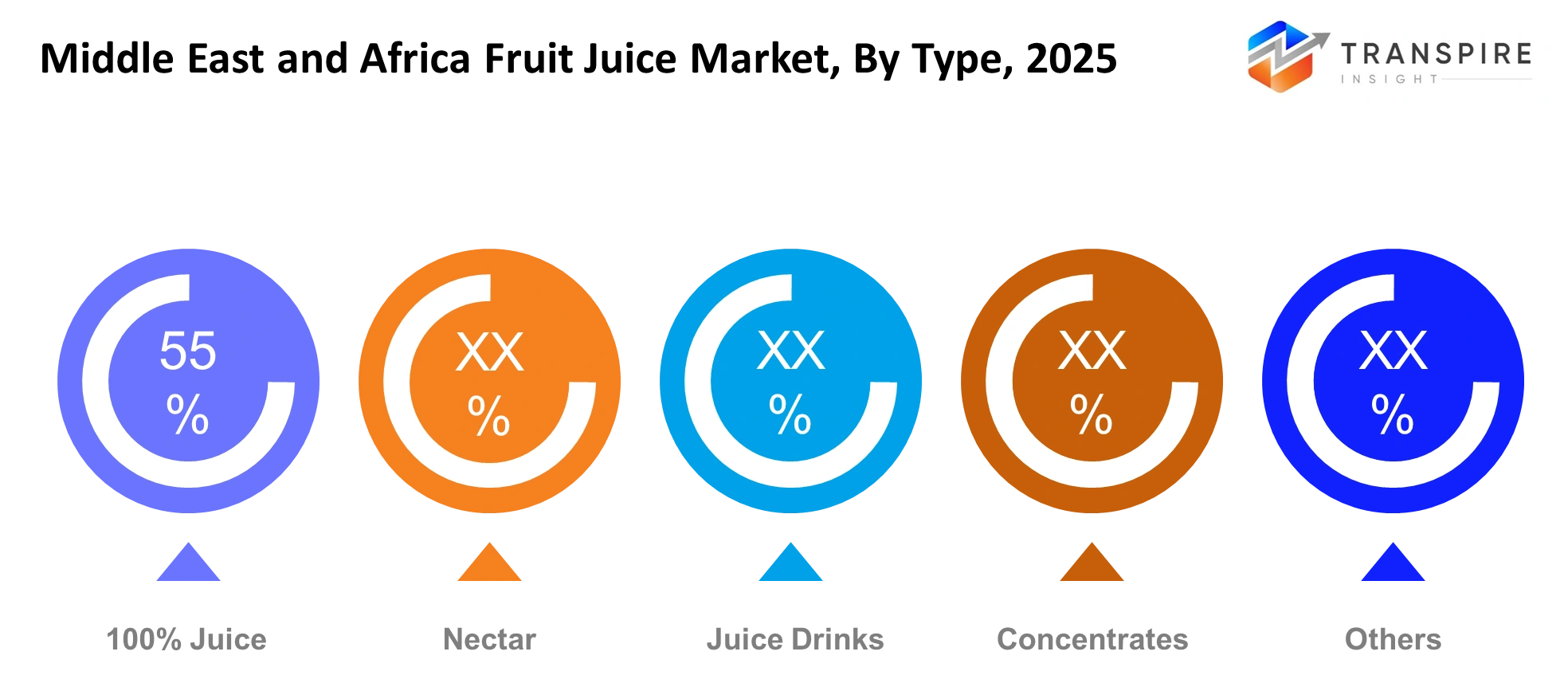
The type segmentation shows 100% juice holding the strongest position, because consumption is rising in a more health-conscious way, plus the premium retail positioning in urban Middle Eastern and African cities. Nectar products keep a solid mid-tier share too, sort of like they’re a compromise, affordability with decent fruit content, so they stay popular in broader mass-market channels. Juice drinks and concentrates end up with smaller roles, even if they’re still operationally important, mainly in places where cost-sensitive consumers dominate— it’s that kind of mix.
The growth logic really differs from category to category though. 100% juice benefits from premiumization momentum, also from hotel and airline demand, so it rides higher confidence. Nectar grows more through price accessibility in emerging African retail networks, not necessarily through “premium” mindsets. Concentrates stay structurally important for manufacturers as well, because they cut transportation costs and help stabilize supply, especially in regions where the cold-chain isn’t consistent.
Looking ahead, the direction points toward stronger expansion of fortified 100% juice and functional variants, while nectar will keep anchoring volume demand. Over time, manufacturers will likely reformulate their portfolios to balance premium margins with mass affordability, especially in export-heavy production hubs tied to the Middle East and Africa Fruit Juice Market.
To learn more about this report, Download Free Sample Report
By Application
Retail consumption kind of holds the dominant position since supermarkets and hypermarkets became the main buy-points for packaged beverages across most urban centers. Household consumption keeps most of the steady demand going because daily hydration habits are just, well, routine. Food service and hospitality bring in smaller volumes but they can be pretty high-value at different times of year , especially during seasonal peaks. Other applications stay kind of niche, but still meaningful in institutional catering.
The growth angle is mostly influenced by retail modernization and the deeper penetration of cold-chain systems, which has moved purchasing away from informal outlets. Hospitality tends to expand quicker than household consumption, mainly because tourism is recovering across GCC economies and urban leisure keeps spreading. Food service also rides the wave from quick-service restaurant growth and more standardized beverage menus in many markets.
Looking ahead, the outlook points to retail continuing to anchor the overall volume, while hospitality and food service gain more share when you look at value terms. Product developers are going to focus on packaging formats that match fast-turn retail shelves and also the premium hospitality supply agreements across the Middle East , and Africa in general for the Fruit Juice Market.
By End-User
Consumers are the biggest end-user group, mostly because household purchasing stays consistent across urban populations and because packaged beverages are increasingly preferred over fresh alternatives. Restaurants, hotels and cafes together create a strong secondary demand base, and this is extra visible in tourism driven Gulf economies. Retailers act as both distributors and demand shapers, particularly through private label expansion and controlled shelf presence.
Growth patterns shift a bit depending on the end-user category. On one hand consumer demand climbs with urbanization and that convenience minded type of shopping, on the other hospitality demand tends to pick up faster as tourism comes back and food service expands. Retailers also keep tightening their influence, they lean into private-label juice as a kind of quiet differentiator and they get more control over the supply chain, which really matters.
Looking ahead, the focus points to stronger institutional pull from hospitality venues and cafés, while consumer demand sort of settles at a high baseline level. Retailers will also shape pricing and product visibility tactics across the Middle East and Africa Fruit Juice Market more and more, even if it feels incremental.
By Distribution
Supermarkets and hypermarkets currently take the lead in distribution because organized retail keeps expanding and they have solid penetration in urban regions. Convenience stores help with quick, small volume buying, and online channels stay smaller overall but still get more relevant in major cities. Other channels include informal trade networks and specialty shops, kind of niche but persistent.
The strongest growth sits in online distribution, which grew sharply after digital grocery adoption went up a lot after 2020. Supermarkets grow steadily due to infrastructure development plus consumer trust in branded packaged beverages. Convenience stores remain resilient in dense urban zones where immediate consumption dominates.
Future trends point towards more online penetration, backed by better logistics and more reliable digital payments, especially across GCC and South African markets. Supermarkets will still be the core of distribution , even while manufacturers start adjusting their packaging and pricing approaches for multi channel growth, stretching through the Middle East and Africa fruit juice market.
What are the Key Use Cases Driving the Middle East and Africa Fruit Juice Market?
Retail consumption of packaged beverages stays sort of the main use case, pushed along by supermarket and hypermarket networks that keep urban households supplied with ready-to-drink juice choices. This channel mostly wins the demand race, because it keeps things steadily on shelf , with consistent quality and the packaging being easy enough for day to day hydration across crowded city populations, you know.
Hospitality, and food service as well, is growing too, notably as tourism bounces back in Gulf economies and café culture is getting more rooted in big African cities. Restaurants plus quick-service chains are increasingly folding fruit juice into their standardized drink menus, so the demand starts to link up with branded supply contracts, and also bulk procurement systems inside organized end-user groups.
Then you see other up-and-coming uses, like institutional catering in schools and healthcare facilities , where fortified juice products back nutrition programs. There’s also airline catering across GCC carriers, they often want premium non-carbonated beverage options. These areas are still pretty early, but they look promising, mainly because health regulations and standardized nutrition policies are broadening across regional public and private institutions, step by step.
|
Report Metrics |
Details |
|
Market size value in 2025 |
USD 5.5 Billion |
|
Market size value in 2026 |
USD 5.8 Billion |
|
Revenue forecast in 2033 |
USD 8.4 Billion |
|
Growth rate |
CAGR of 5.43% from 2026 to 2033 |
|
Base year |
2025 |
|
Historical data |
2021 - 2024 |
|
Forecast period |
2026 - 2033 |
|
Report coverage |
Revenue forecast, competitive landscape, growth factors, and trends |
|
Regional scope |
Middle East and Africa (Saudi Arabia, United Arab Emirates, South Africa, Rest of Middle East and Africa) |
|
Key company profiled |
Coca-Cola, PepsiCo, Tropicana, Minute Maid, Del Monte, Nestle, Dole, Welch’s, Ocean Spray, Innocent Drinks, Capri Sun, Dabur, Real, Parle Agro, Suntory. |
|
Customization scope |
Free report customization (country, regional & segment scope). Avail customized purchase options to meet your exact research needs. |
|
Report Segmentation |
By Type (100% Juice, Nectar, Juice Drinks, Concentrates, Others); By Application (Household Consumption, Food Service, Retail, Hospitality, Others); By End-User (Consumers, Restaurants, Hotels, Cafes, Retailers, Others); By Distribution (Supermarkets, Convenience Stores, Online, Others). |
Which Regions are Driving the Middle East and Africa Fruit Juice Market Growth?
GCC countries kinda lead the Middle East and Africa Fruit Juice Market , mainly because the retail infrastructure is solid , per capita income feels higher, and the cold chain logistics are pretty advanced, so premium packaged beverages can move without much drama. Big supermarket clusters in the UAE and Saudi Arabia help products turn over fast ,and give multinational juice brands strong visibility, even when shelves get crowded. On top of that, the regulatory setup often nudges standardized food safety compliance , which adds consumer confidence and basically shores up organized retail dominance. And yeah this whole thing gets further strengthened by tourism related demand , from hotels, airlines, and food service operators, who usually stick to consistent bulk procurement cycles.
North Africa works like a stable secondary region too, with steady urban population growth and a gradual modernization of retail channels across Egypt, Morocco and Algeria. But unlike the GCC, the consumption style there is more price sensitive , and people often choose locally made nectar based beverages rather than leaning heavily on premium imports. The economic resilience comes from diversified agricultural output and domestic processing capacity, so the region is less exposed to global supply swings. Also, shipowners and distributors tend to see more predictable demand cycles tied to household consumption, not the tourism style fluctuations.
Sub Saharan Africa is the fastest growing region , largely because there have been recent investments in logistics corridors , especially port upgrades in Kenya and Nigeria. The cold chain is expanding and modern retail formats are getting more traction, which has improved packaged juice accessibility quite a bit since 2022. At the same time, more foreign direct investment in food processing has pushed localized bottling and sourcing strategies. For market entrants and investors, this region can offer high volume upside through 2026–2033, and the momentum looks , overall, pretty durable.
Who are the Key Players in the Middle East and Africa Fruit Juice Market and How Do They Compete?
Competition in the Middle East and Africa Fruit Juice Market is sort of moderately consolidated, but not in a clean way exactly. Large beverage corporations control many of the premium retail channels, while local producers tend to dominate the more price-sensitive areas. In practice, the fight is mostly about distribution strength, access to cold-chain logistics, and pricing efficiency, more than about pure product differentiation, or whatever label they want to use. The incumbents keep their footing with long-term retailer contracts and localized packaging formats that fit local habits , and the newer entrants often chase functional options, low-sugar claims, and fortified beverage niches, which seem to line up with the changing health interests of urban consumers.
The Coca-Cola Company keeps pushing its position via a diversified juice portfolio and pretty aggressive retail distribution control, especially in GCC supermarkets and convenience chains. PepsiCo leans into Tropicana-led branding, regional flavor adaptation, and bundled supply agreements with food service operators , so they stay embedded across multiple channels. Nestlé meanwhile centers on fortified and nutrition-oriented drinks, using its health narrative plus regulatory compliance skills to grow in premium urban segments across North Africa and the Gulf.
Del Monte Foods builds its edge through fruit sourcing integration and shelf-stable reliability, which helps it reach stronger penetration in places that depend on imports. Almarai uses its GCC distribution muscle and cold-chain infrastructure to cross-sell juices alongside its dairy portfolios, and that supports tighter retail shelf control. Overall, these companies keep expanding through localized production investments, strategic partnerships with retailers , and focused entry into fast-growing African urban corridors, where affordability plus distribution efficiency basically decides who wins.
Company List
- Coca-Cola
- PepsiCo
- Tropicana
- Minute Maid
- Del Monte
- Nestle
- Dole
- Welch’s
- Ocean Spray
- Innocent Drinks
- Capri Sun
- Dabur
- Real
- Parle Agro
- Suntory
Recent Development News
In March 2026, Dabur secured and deployed a Rs 60 crore strategic investment through Dabur Ventures into D2C brand RAS Beauty. The move marked the first investment under Dabur Ventures and signaled the company’s broader expansion strategy across wellness foods and beverages, including its international juice business in the Middle East and Africa.
Source: https://indianretailer.com
In December 2025, PepsiCo launched an integrated food and beverage supply chain pilot program. The initiative introduced AI-driven logistics and distribution optimization technologies designed to improve operational efficiency across PepsiCo’s beverage portfolio, including juice products distributed in Middle East and African markets.
Source: https://millingmea.com
What Strategic Insights Define the Future of the Middle East and Africa Fruit Juice Market?
The Middle East and Africa Fruit Juice Market seems to be moving, sort of structurally, toward more localized, value-added production that sits inside urban retail ecosystems and bets on supply chain resilience. In other words, growth will rely more on proximity sourcing and those integrated cold-chain networks, instead of the import heavy concentrate way of doing things. Retailers and manufacturers, you know, are reacting to fruit supply volatility and logistics costs that keep shifting around. So the producers that do best may be the ones who can vertically integrate processing close to the main consumption hubs, especially along the GCC corridors and in African megacities.
But there is also this hidden risk, market concentration is quietly rising among a few multinational beverage groups, and that can reduce pricing flexibility. That part alone can squeeze smaller regional processors which won’t have the same bargaining power. At the same time, climate driven variability in fruit yields adds a long-term problem of raw material instability, and it may not be fully captured in today’s demand projections. So even if you see top-line expansion on paper, margins could still be eroded in a more silent, steady way.
The emerging opportunity, though, is localized functional juice production linked to public nutrition and wellness programs across Africa. Fortified beverages can end up aligning with school feeding efforts and healthcare initiatives, which is pretty practical. Over the next five to seven years, market participants might want to focus on modular production units near fast growing urban clusters. They should also invest in adaptive sourcing networks, because those can cut exposure to agricultural volatility while still enabling scalable regional expansion.
Middle East and Africa Fruit Juice Market Report Segmentation
By Type
- 100% Juice
- Nectar
- Juice Drinks
- Concentrates
- Others
By Application
- Household Consumption
- Food Service
- Retail
- Hospitality
- Others
By End-User
- Consumers
- Restaurants
- Hotels
- Cafes
- Retailers
- Others
By Distribution
- Supermarkets
- Convenience Stores
- Online
- Others
Frequently Asked Questions
Find quick answers to common questions.
The estimated Middle East and Africa Fruit Juice Market size is USD 8.4 Billion in 2033.
Key segments for the Middle East and Africa Fruit Juice Market are By Type (100% Juice, Nectar, Juice Drinks, Concentrates, Others); By Application (Household Consumption, Food Service, Retail, Hospitality, Others); By End-User (Consumers, Restaurants, Hotels, Cafes, Retailers, Others); By Distribution (Supermarkets, Convenience Stores, Online, Others).
Major Middle East and Africa Fruit Juice Market players are Coca-Cola, PepsiCo, Tropicana, Minute Maid, Del Monte, Nestle, Dole, Welch’s, Ocean Spray, Innocent Drinks, Capri Sun, Dabur, Real, Parle Agro, Suntory.
The Middle East and Africa Fruit Juice Market size is USD 5.5 Billion in 2025.
The Middle East and Africa Fruit Juice Market CAGR is 5.43% from 2026 to 2033.
- Coca-Cola
- PepsiCo
- Tropicana
- Minute Maid
- Del Monte
- Nestle
- Dole
- Welch’s
- Ocean Spray
- Innocent Drinks
- Capri Sun
- Dabur
- Real
- Parle Agro
- Suntory
Recently Published Reports
-
Apr 2026
Baby Infant Formula Market
Baby Infant Formula Market Size, Share & Analysis Report By ype (Infant Milk, Follow On Milk, Specialty Baby Milk, Growing-Up Milk), By Ingredient (Carbohydrate, Fat, Protein, Minerals, Vitamins, and Others), By Product Form (Powder, Liquid, and Ready-to-feed), By Distribution Channels (Supermarket/Hypermarket, Specialty Store, Pharmacies, Online Retail, and Others), and Geography (North America, Europe, Asia-Pacific, Middle East and Africa, South and Central America), 2021 - 2031
-
Apr 2026
Edible Insects for Animal Feed Market
Edible Insects for Animal Feed Market Size, Share & Analysis Report By Type (Insect Powder, Insect Meal, Insect Bar, Insect Paste, Insect Oil, and Others), By Insect Type (Beetles, Cricket, Caterpillar, Hymenoptera, Orthoptera, Tree Bugs, and Others), By Application (Livestock, Pet Food, and Aquaculture), By Livestock Type (Poultry, Swine, and Others), and Geography (North America, Europe, Asia-Pacific, Middle East and Africa, South and Central America), 2021 - 2031
-
Apr 2026
Food Industry Disinfection and Bacterial Control Market
Food Industry Disinfection and Bacterial Control Market Size, Share & Analysis Report By Type (Chemical Disinfectants, Physical Disinfectants, and Biocides and Antimicrobials), By Application (Food Processing Equipment Surface Disinfection, Food Preparation Areas Surface Disinfection, Storage Areas Surface Disinfection, Anti-microbial Coatings Food Preservation, and Preservative Solutions Food Preservation), By End User (Meat and Poultry Processing, Dairy Processing, Seafood Processing, Bakery and Confectionery, Restaurants and Commercial Kitchens, and Food Service Providers), By Sales Channel (Online, Offline), and Geography (North America, Europe, Asia-Pacific, Middle East and Africa, South and Central America), 2021 - 2031
-
Apr 2026
Freeze Dried Food Market
Freeze Dried Food Market Size, Share & Analysis Report By Product Type (Fruits, Vegetables, Freeze-Dried Dairy Products, Freeze-Dried Meat and Seafood, Freeze-Dried Pet Food, and Prepared Meal), By Nature (Organic, and Conventional), By Form (Powdered, Granules, and Diced), By End Use (Breakfast Cereals, Dairy Products, Bakery & Confectionery, Nutritional Bars & Supplements, Powdered Beverages, Snacks, and Retail (Household)), and Geography (North America, Europe, Asia-Pacific, Middle East and Africa, South and Central America), 2021 - 2031