
Middle East and Africa Digital Twin in Marine Market Size & Forecast:
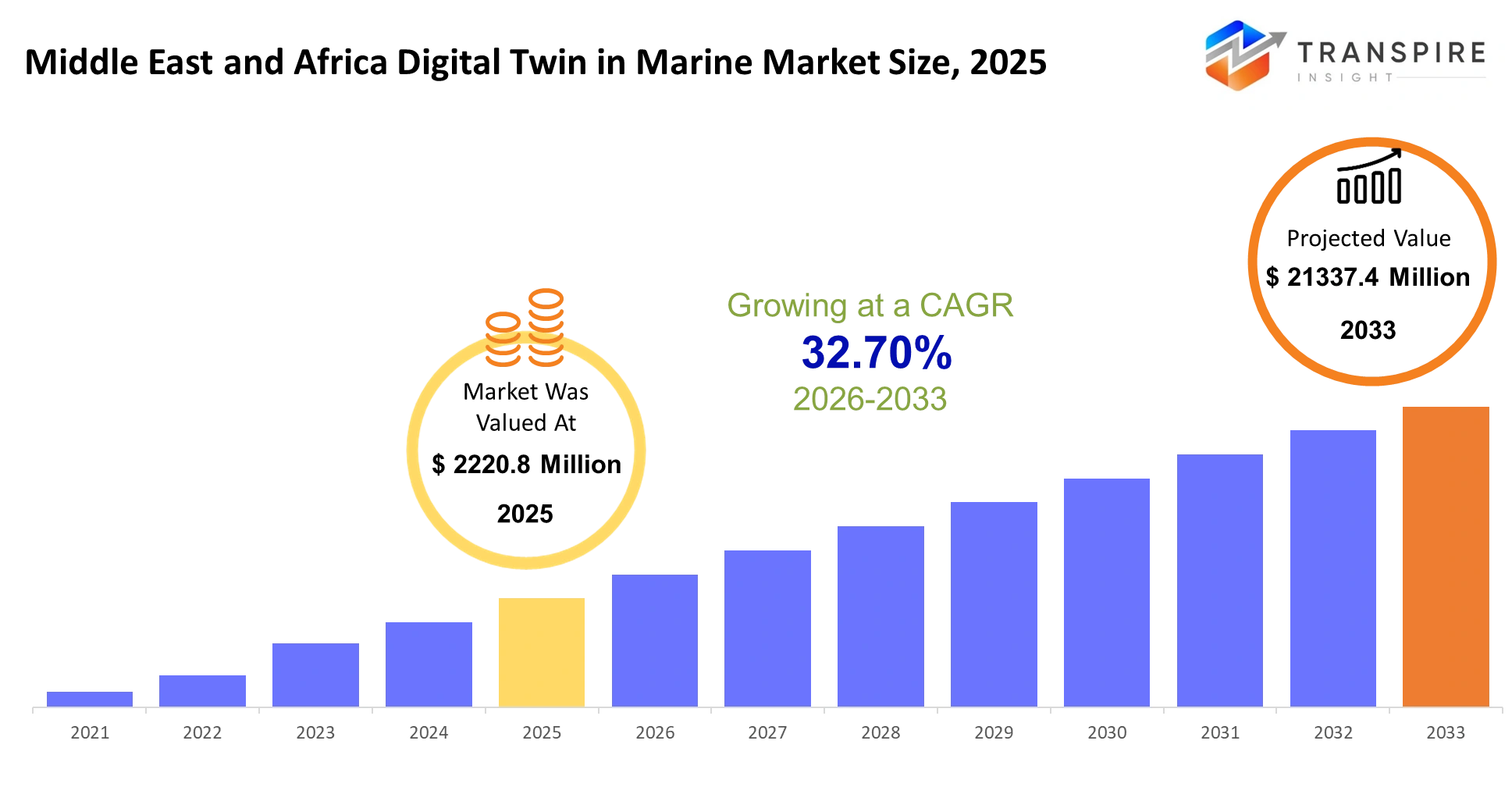
- Middle East and Africa Digital Twin in Marine Market Size 2025: USD 2220.8 Million
- Middle East and Africa Digital Twin in Marine Market Size 2033: USD 21337.4 Million
- Middle East and Africa Digital Twin in Marine Market CAGR: 32.70%
- Middle East and Africa Digital Twin in Marine Market Segments: By Component (Software, Services), By Twin Type (Asset, System, Process), By Technology (IoT, AI, Simulation), By Application (Shipbuilding, Maintenance, Fleet Management), By End-User (Marine Operators, Shipbuilders)
To learn more about this report,  Download Free Sample Report
Middle East and Africa Digital Twin in Marine Market Summary:
The Middle East and Africa Digital Twin in Marine Market size is estimated at USD 2220.8 Million in 2025 and is anticipated to reach USD 21337.4 Million by 2033, growing at a CAGR of 32.70% from 2026 to 2033. The digital twin of the Middle East and Africa (Saudi Arabia, United Arab Emirates, South Africa, remaining part of the Middle East and Africa) in the marine sector belongs to the larger scope of the maritime technology industry, which involves making digital twins of actual vessels and ports based on data from virtual models.
The product will increasingly focus on the visibility requirements of local maritime companies, offshore energy players, and ports. Maintenance prediction and optimization of fuel usage will be more prevalent because of the customer's requirements for cost savings and sustainability. Restrictions on emissions and safety will drive market growth for this product, while advancements in IoT, satellite communications, and artificial intelligence will boost its performance.
What Has the Impact of Artificial Intelligence Been on the Middle East and Africa Digital Twin in the Marine Market?
Artificial intelligence is gradually transforming the Middle East and Africa digital twin in the marine market by changing static simulations into dynamic and adaptive systems through which real-time information about the marine environment will be analyzed.
Artificial intelligence in the Middle East and Africa, in digital twin applications for marine market operations, will further facilitate the production process and increase efficiency through smart automation. By applying predictive analytics, AI will enable companies to predict when equipment failures are likely to occur. Moreover, decision-making processes will also be automated, making it possible to maximise production through effective resource allocation, optimizing routing and reducing fuel consumption in order to minimize production cost. Supply chain processes will be facilitated through the use of AI in improving coordination between ports and logistics companies.
With increased competition, the Digital Twin Middle East & Africa of the marine industry will depend on AI-based innovation to distinguish their offerings and provide customized insights into operations. Firms will apply advanced analytics to tailor their products according to the nature of the ships, nature of cargo, and associated dangers in the region’s seas. This will not only increase the performance of such products but also establish them as key players in meeting customers' demands.
Key Market Trends & Insights:
- AI in Middle East & Africa Digital Twin in the Marine Market is boosting Predictive Analytics implementation in order to optimize vessel operations and enhance the process of real-time decision making in the maritime industry.
- Smart Automation software solutions have seen a remarkable growth rate due to the application of Machine Learning technology in fuel optimization, route planning, and maintenance management processes.
- The emphasis on reducing maritime emissions and improving marine safety regulations is a key factor driving the rising demand for Digital Twins in the market.
- The application of IoT sensors and satellite data to enable real-time simulation will positively impact demand for Digital Twins.
- Saudi Arabia and the United Arab Emirates will take up over 35% market share in 2025 due to smart port developments and digitization of marine activities.
- South Africa is the fastest-growing region, expected to deliver a CAGR of more than 20% until 2030 due to ongoing port upgrades.
- Software Platforms lead with almost 60% market share due to rising adoption of simulation software and analytic tools.
- The services segment takes the second position in the market due to integration services requirements.
- Cloud-based digital twin offerings will be fastest growing, seeing strong growth through 2030 owing to scalable deployment approaches.
- Monitoring vessel performance is leading with over 40% market share due to growing preference for fuel savings and operational efficiency.
- Increasing cargo volumes and related congestion issues have been driving port management and logistics optimization solutions' growth rapidly.
- Shipping companies dominate the market with more than 45% market share.
Middle East and Africa Digital Twin in Marine Market Segmentation
By Component
Software will prevail due to increasing requirements for analytical platforms capable of creating simulation models and tracking processes in marine systems. These platforms will enable predictive maintenance, operation scheduling, and monitoring of fleet and infrastructure efficiency. Businesses will choose flexible, adaptable software to accommodate changes in their operations. Cloud technology will make the use of such software even more advantageous.
Services will have great significance because of the increasing need to deploy and customize digital twins in different areas. Consulting and integration services will assist in adapting these digital technologies to the current infrastructure. Training and technical assistance will also be needed more often as adoption rates continue to grow.
To learn more about this report, Download Free Sample Report
By Twin Type
The asset twins will be designed to monitor each piece of equipment and its individual parts. The asset twins will provide information about the equipment performance and help prevent the breakdowns. The asset twins will be used by the operators for proper equipment maintenance and extended life cycle of their operations. Information provided by the asset twins can also indicate problems with machine operation or its failure.
On the other hand, the system twins will join various assets in one structure. This will help to coordinate all operations performed. Process twins will help design efficient workflows to ensure faster work.
By Technology
IoT technologies will be used to collect real-time data across different marine settings. Sensors will collect information about the operations as well as the surrounding environment, which will then be fed into the digital twin platforms continuously. Advanced analysis and predictions will become easier through the use of artificial intelligence (AI) and simulation.
Machine learning algorithms will help in predicting future trends by analyzing historical data and drawing conclusions based on the identified patterns. Simulation tools will be used to test various hypothetical scenarios that may occur during operation.
By Application
Digital twins will be used in ship construction to support design and testing before building ships physically. There will be fewer mistakes, and the design will become more accurate. Planning will become more effective, and waste will be reduced when constructing ships. Digital validation will lead to faster project development and higher-quality builds.
Digital twins will play an essential role in maintenance and fleet management processes. Maintenance using predictive models will decrease the time equipment spends out of service and increase its lifespan. Effective fleet management will improve routing and fuel consumption.
By End-User
Adoption by marine operators will be propelled by the need to manage fleets effectively and keep costs low. Digital twins will facilitate the tracking of performance, minimizing fuel consumption, and planning operations. The operators will use these systems to meet regulatory requirements while improving their safety standards. The process of scientific research will advance through the use of digital solutions which need to be adopted by competitors.
Digital twins will be used in shipbuilding to enhance design and produce better results during production processes. Virtual models will enable the testing of systems and structures prior to building. This process will minimize mistakes and optimize results. The rising demand for modern ships will ensure that digital twin technology remains a key part of shipbuilding.
What are the Main Challenges for the Middle East and Africa Digital Twin in Marine Market Growth?
There are technical and operational difficulties in deploying Middle East and Africa Digital Twins in marine markets. The primary technical problem is data integration, where there is a dependency on various unstandardized inputs. Moreover, the performance of Middle East and Africa Digital Twins in marine markets may be hampered by poor connectivity in marine environments. The aforementioned issues in the Middle East and Africa Digital Twins in marine markets have implications for reliability and decision-making processes.
High costs associated with implementation and system integration constitute some of the barriers to adoption of Middle East and Africa Digital Twins in marine markets. Substantial investment in software development, infrastructure improvements, and adherence to maritime safety and data security regulations is necessary. In addition, the technology takes time before being commercialized due to integration into the existing system of the firm.
Challenges in adoption remain significant for the Middle East and Africa digital twin market in marine industry, particularly in areas where digital infrastructure is underdeveloped and there is a shortage of skilled labor. Most marine businesses lack the necessary skills to operate and maintain their digital twins efficiently. The financial constraints and lack of awareness on long-term gains also hinder the application of technology in developing countries. Such market constraints limit the rate of digitalization in the marine industry.
The competitive threats from other technologies and shifting regulations create additional hurdles in the forecast period. Old monitoring systems and independent analytics software provide cheaper alternatives, thus posing a threat to price competition. Moreover, rapid technological innovation requires constant upgrading, increasing investment risks.
Regional Insights
The two nations will lead deployment efforts because they have made major technological infrastructure expenditures and developed smart port systems. Government maritime projects will enable the deployment of advanced monitoring systems. The critical need to achieve efficiency and sustainability targets will result in the widespread requirement for digital twin technology throughout industrial and coastal regions.
South Africa will experience rapid growth while using enhanced port facilities and better logistics systems. The increasing trade volume will create a demand for sophisticated data analytics systems. The local area will implement these technologies when their infrastructure enters the next development phase. The smaller economies will face challenges that obstruct their technology adoption efforts, but they will experience gradual progress in all technology areas.
Recent Development News
In April 2026, FutureOn announced contract award. The company secured a three-year contract with Azule Energy to deploy its FieldTwin digital twin platform for offshore marine field development in West Africa, marking its regional expansion.https://oceannews.com
|
Report Metrics |
Details |
|
Market size value in 2025 |
USD 2220.8 Million |
|
Market size value in 2026 |
USD 2944.8 Million |
|
Revenue forecast in 2033 |
USD 21337.4 Million |
|
Growth rate |
CAGR of 32.70% from 2026 to 2033 |
|
Base year |
2025 |
|
Historical data |
2021 - 2024 |
|
Forecast period |
2026 - 2033 |
|
Report coverage |
Revenue forecast, competitive landscape, growth factors, and trends |
|
Regional scope |
Middle East and Africa (Saudi Arabia, United Arab Emirates, South Africa, Rest of Middle East and Africa) |
|
Key company profiled |
Siemens, Dassault Systemes, AVEVA, Hexagon, IBM, Microsoft, Oracle, SAP, Bentley Systems, Ansys, PTC, GE, Kongsberg, Wärtsilä, DNV |
|
Customization scope |
Free report customization (country, regional & segment scope). Avail customized purchase options to meet your exact research needs. |
|
Report Segmentation |
By Component (Software, Services), By Twin Type (Asset, System, Process), By Technology (IoT, AI, Simulation), By Application (Shipbuilding, Maintenance, Fleet Management), By End-User (Marine Operators, Shipbuilders) |
How Can New Companies Establish a Strong Foothold in the Middle East and Africa Digital Twin in Marine Market?
To establish themselves successfully in the market of the Middle East and africa digital twin in marine, new businesses should target more narrow problem areas instead of providing some generic solutions. It is important to focus more specifically on solving problems, such as predictive maintenance or management of port congestion. By aligning their solutions with current industry trends, including sustainability and cost efficiency, entrepreneurs will be able to demonstrate that their services are a necessary part of business rather than an option. In addition, advanced capabilities of collecting and processing data would help them stand out.
The use of innovation will be one of the key factors in achieving success for the newcomers in the Middle East and Africa digital twin in the marine. The combination of technologies used in this case, including AI, IoT, and simulation, and their implementation in user-friendly products will be highly appealing to operators seeking solutions which could be deployed quickly. Differentiation through cloud technology and modularity will enable faster adoption by mid-size companies. Some companies, such as i4sea and Sensegrass, have already demonstrated the effectiveness of their platforms.
Market penetration efforts will become easier due to partnerships as these partnerships will bring trust and build networks. New companies will benefit from network capabilities and solution deployment through their partnerships with the port authority, a logistics company, and local technology partners. Adoption rates will increase as companies address their biggest barriers, including cost and visibility issues. In the marine digital twin technology market in the Middle East and Africa, strategic partnerships will help companies compete.
Key Middle East and Africa Digital Twin in Marine Market Company Insights
Competition will remain shaped by strong technology providers who focus on developing advanced analytics, deploying cloud solutions, and building scalable platforms. Established companies will invest in product upgrades and regional expansion to strengthen market presence. Leading players will sustain their performance advantages through continuous AI innovation and IoT integration advancements which will also enhance solution reliability in marine operations.
New entrants will compete by offering flexible pricing models and simplified solutions which have been designed specifically for mid-sized operators. Regional partners will help companies enter markets more quickly through their strategic collaborations while also building customer trust. The smaller players will gain traction through their efforts to solve cost control and operational visibility problems while established companies will focus on extending their long-term contracts and developing their service ecosystems.
Company List
- Siemens
- Dassault Systemes
- AVEVA
- Hexagon
- IBM
- Microsoft
- Oracle
- SAP
- Bentley Systems
- Ansys
- PTC
- GE
- Kongsberg
- Wärtsilä
- DNV
What are the Key Use-Cases Driving the Growth of the Middle East and Africa Digital Twin in Marine Market?
The Middle East and Africa digital twin in the marine market is gaining traction, with practical applications already demonstrating immediate benefits and cost savings. Among them, one of the most promising ones is predictive maintenance, during which digital replicas of machines help predict their future failures. As a result, companies save time and resources while increasing the lifespan of their assets.
One of the other main applications of digital twins, which is currently in growing demand in the Middle East and Africa, in the marine market, is related to the optimization of fleet performance. With the help of digital technology, fleet operation and its improvement becomes easier due to the analysis of environmental factors and operational behavior of vessels.
Port and logistics management has become a crucial component that drives the growth of digital twin technology in marine markets across the Middle East and Africa. Digital twin technology enables organizations to track cargo movements while it helps to decrease traffic congestion and expedite cargo processing times. Supply chain systems achieve their full potential when they incorporate digital twin technology because it allows all stakeholders to work together. The implementation of digital twin technology in port and logistics management enables organizations to maintain their revenue streams by avoiding operational delays.
Virtual training and simulation technology has emerged as a key driver behind digital twin industry growth because it delivers groundbreaking solutions. Digital twin technology enables users to create virtual scenarios for testing purposes which do not endanger actual operational activities. The system improves safety measures while it trains workers to respond during emergency situations.
Middle East and Africa Digital Twin in Marine Market Report Segmentation
By Component
- Software
- Services
By Twin Type
- Asset
- System
- Process
By Technology
- IoT
- AI
- Simulation
By Application
- Shipbuilding
- Maintenance
- Fleet Management
By End-User
- Marine Operators
- Shipbuilders
Frequently Asked Questions
Find quick answers to common questions.
The Approximate Middle East and Africa Digital Twin in Marine Market size for the Market will be USD 21337.4 Million in 2033.
Key Segments for the Middle East and Africa Digital Twin in Marine Market are By Component (Software, Services), By Twin Type (Asset, System, Process), By Technology (IoT, AI, Simulation), By Application (Shipbuilding, Maintenance, Fleet Management), By End-User (Marine Operators, Shipbuilders).
Major Middle East and Africa Digital Twin in Marine Market players are Siemens, Dassault Systemes, AVEVA, Hexagon, IBM, Microsoft, Oracle, SAP, Bentley Systems, Ansys, PTC, GE, Kongsberg, Wärtsilä, DNV.
The Middle East and Africa Digital Twin in Marine Market size is USD 2220.8 Million in 2025.
The Middle East and Africa Digital Twin in Marine Market CAGR is 32.70%.
- Siemens
- Dassault Systemes
- AVEVA
- Hexagon
- IBM
- Microsoft
- Oracle
- SAP
- Bentley Systems
- Ansys
- PTC
- GE
- Kongsberg
- Wärtsilä
- DNV
Recently Published Reports
-
Dec 2024
3D Optical Profiler Market
3D Optical Profiler Market Size, Share & Analysis Report By Type (Desktop 3D Optical Profiler, and Portable 3D Optical Profiler), By Technology (Confocal Technology, and White Light Interference), By End-Use Industry (Manufacturing, Research Institutions, Automotive, Aerospace and Defense, Medical Devices, and Other), and Geography (North America, Europe, Asia-Pacific, Middle East and Africa, South and Central America), 2021 - 2031
-
Feb 2025
Depth Sensor Market
Depth Sensor Market Size, Share & Analysis Report By Type (Infrared Depth Sensors, Time-of-Flight (ToF) Sensors, Stereo Vision Sensors, Structured Light Sensors, Ultrasonic Depth Sensors), By Application (Automotive, Robotics, Gaming, Consumer Electronics, Industrial Automation, Healthcare, Security & Surveillance, Others), By End Users (Automotive Manufacturers, Consumer Electronics Companies, Healthcare Providers, Industrial Companies, Security Agencies, Gaming Companies, Robotics Companies, Others), and Geography (North America, Europe, Asia-Pacific, Middle East and Africa, South and Central America), 2021 – 2031
-
Feb 2025
Digital Manufacturing Market
Digital Manufacturing Market Size, Share & Analysis Report By Component (Hardware, Software, and Services), By Technology (Robotics, 3D Printing, Internet of Things (IoT), and Others), By Application (Automotive and Transportation, Aerospace and Defense, Consumer Electronics, Industrial Machinery, and Others), By Process Type (Computer-Based Designing, Computer-Based Simulation, Computer 3D Visualization, Analytics, and Others), and Geography (North America, Europe, Asia-Pacific, Middle East and Africa, South and Central America), 2021 – 2031
-
Feb 2025
Digital Visa Services Market
Digital Visa Services Market Size, Share & Analysis Report By Type (Individual Travelers, Group Travelers), By Application (Tourism, Business Travel, Others), and Geography (North America, Europe, Asia-Pacific, Middle East and Africa, South and Central America), 2021 – 2031