

Middle East and Africa Dental Laboratories Market Size & Forecast:
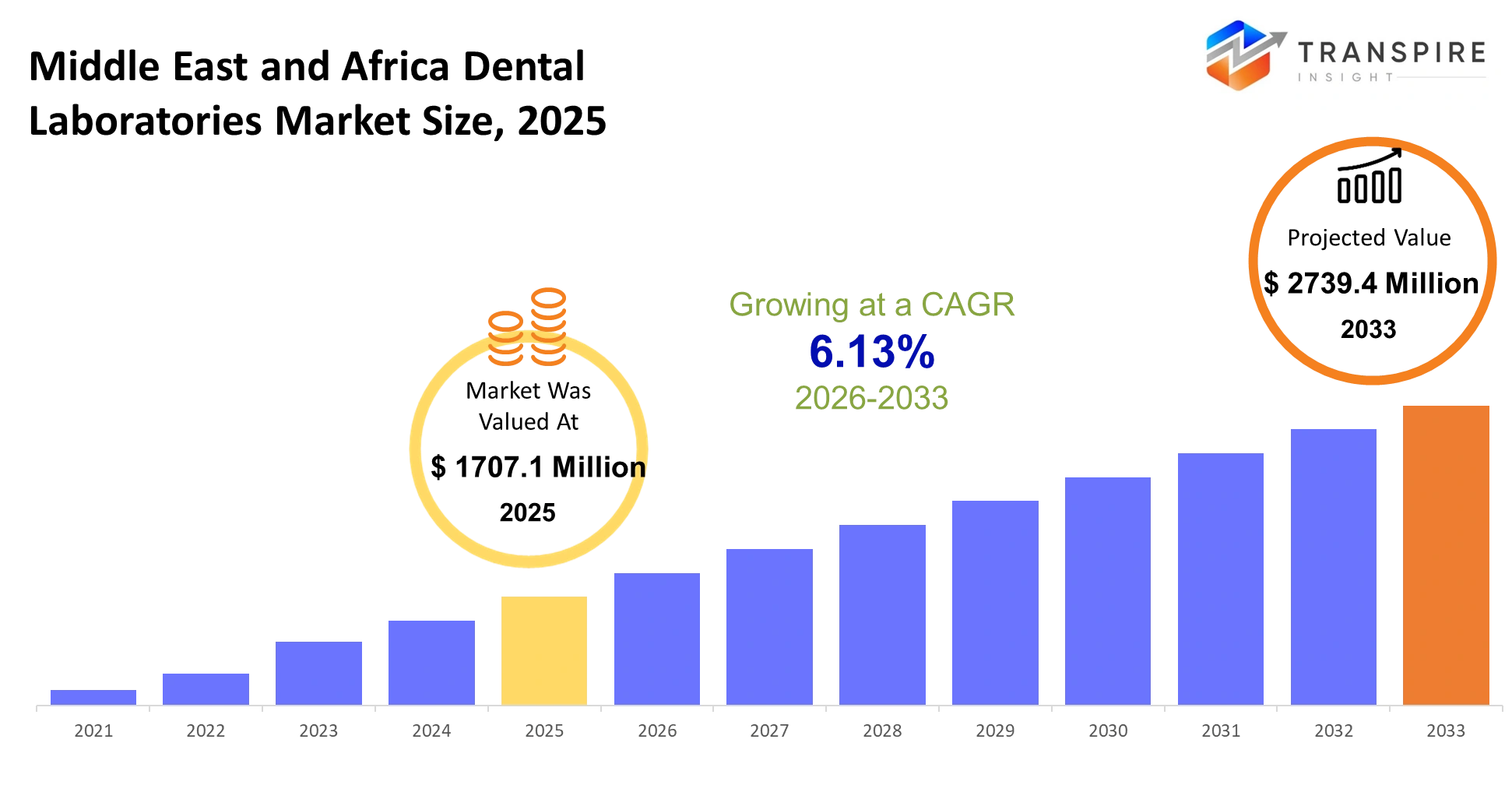
- Middle East and Africa Dental Laboratories Market Size 2025: USD 1707.1 Million
- Middle East and Africa Dental Laboratories Market Size 2033: USD 2739.4 Million
- Middle East and Africa Dental Laboratories Market CAGR: 6.13%
- Middle East and Africa Dental Laboratories Market Segments: By Product Type (Crowns & Bridges, Dentures, Orthodontic Appliances, Implants, Veneers, Others); By Material (Ceramics, Metal Alloys, Resin, Zirconia, Others); By End User (Dental Clinics, Hospitals, Academic Institutes, Others); By Technology (CAD/CAM, 3D Printing, Conventional Methods, Others)
To learn more about this report,  Download Free Sample Report
Middle East and Africa Dental Laboratories Market Summary
The Middle East and Africa Dental Laboratories Market was valued at USD 1707.1 Million in 2025. It is forecast to reach USD 2739.4 Million by 2033. That is a CAGR of 6.13% over the period.
Dental laboratories kind of act as the manufacturing backbone for restorative and cosmetic dentistry. In other words these places turn digital scans, impressions and treatment blueprints into things like crowns, bridges, dentures , orthodontic appliances, implants and veneers. Those products then help dental clinics and hospitals bring back oral function and also aesthetics, which is kind of the whole point. In practice, labs help clinicians deliver more tailored treatments with higher precision while also cutting down on chairside tweaking and faster turnaround, even if it depends on the case.
Over the last five years the market went through a structural change from manual fabrication toward digital workflows, powered by CAD/CAM systems, intraoral scanning, and 3D printing. This change made production more consistent and helped laboratories take on more complicated restorative work. The COVID-19 pandemic and the later supply chain disruptions pushed more investment into local manufacturing and digital production, so there’s less reliance on imported parts, and also less dependence on pure manual labor. At the same time, as healthcare providers widen access to implantology, cosmetic dentistry , and orthodontic treatments, labs are now processing a higher volume of customized restorations. This whole transition supports higher value procedures, boosts laboratory productivity, and creates new income channels across the dental care ecosystem, even where demand was previously flat.
Key Market Insights
- Honestly the Middle East and Africa Dental Laboratories Market is kinda riding on wider adoption of digital dentistry platforms, which is improving turnaround time by roughly 30–50% in more advanced labs.
- It looks like in 2025 Gulf Cooperation Council countries will hold around 40%+ of the regional revenue share, mainly because of solid private healthcare investment and continuing expansion.
- South Africa still shows up as a big contributor, mostly due to its dental infrastructure that is already well set, and also because restorative procedures are getting a higher penetration rate.
- When you look at what’s being produced, CAD/CAM-based restorations will make up over 45% of advanced laboratory output in 2025, so digital manufacturing is basically the leading production method there.
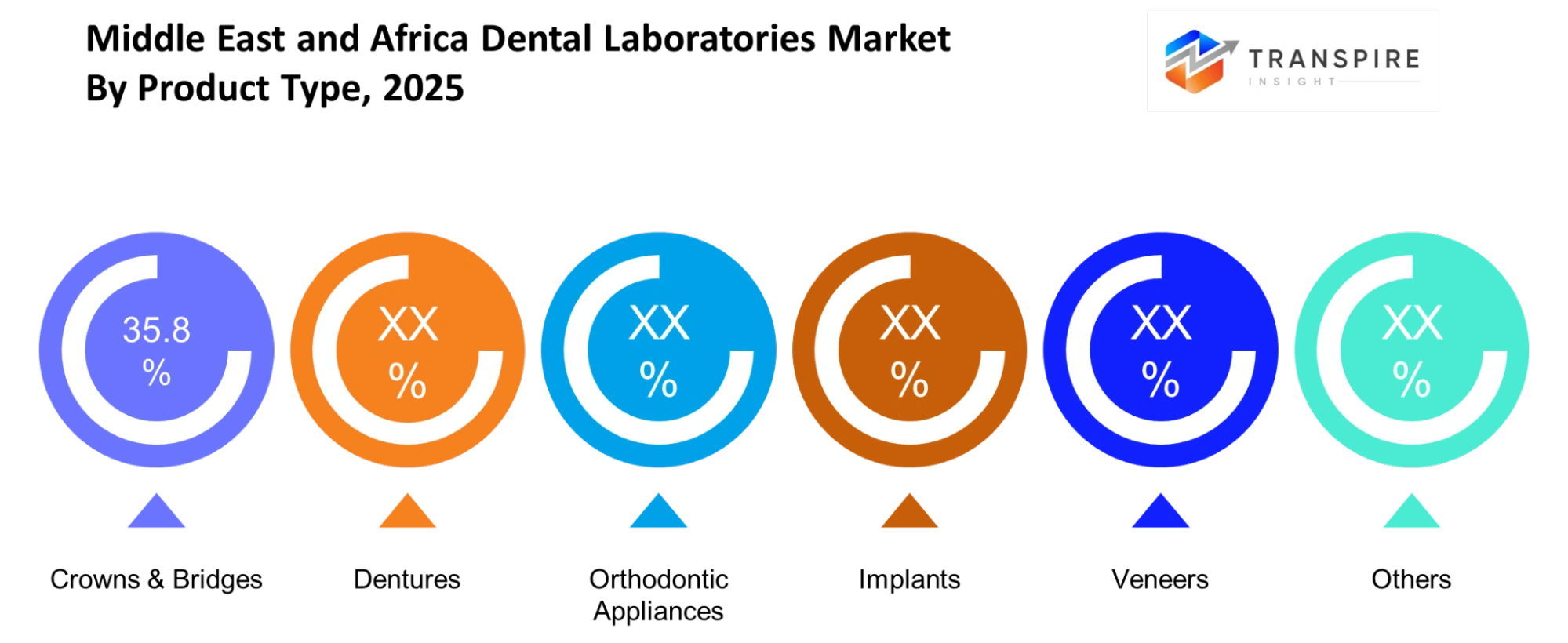
- Crowns and bridges also kept the top spot as the largest product segment, sitting at about 30% of total lab revenues in 2025.
- Meanwhile implant-supported restorations are expected to grow the fastest through 2033, driven by expanding implant adoption and the demand for premium treatment options.
- Also, dental clinics contributed more than 60% of laboratory outsourcing revenues across the region in 2025, which is a pretty big number for the outsourcing side.
- On materials, zirconia-based restorations gained meaningful share, with usage up by nearly 20% over the last five years due to durability and aesthetics , and just that overall patient appeal.
- Strategic partnerships between laboratories, dental chains, and technology providers are speeding up the integration of digital workflows, so things move less in isolation and more in sync.
- Companies like Envista, Dentsply Sirona, Straumann, Ivoclar, and Zimmer Biomet are still pushing investments in digital manufacturing platforms, materials innovation, and regional expansion initiatives.
What are the Key Drivers, Restraints, and Opportunities in the Middle East and Africa Dental Laboratories Market?
The strongest growth catalyst is the pretty rapid shift toward digital dentistry. The adoption of CAD/CAM systems, intraoral scanners, and digital impression technologies, has reduced production errors and also shortened the restoration delivery cycles. Dental clinics are increasingly leaning toward laboratories that can integrate digital workflows because a faster turnaround helps with patient scheduling more neatly and supports higher treatment completion rates. This technology transition basically lets laboratories process more cases with greater consistency and, it also directly supports revenue growth and improved utilization rates.
The most significant barrier still remains the high capital requirement that comes with digital manufacturing infrastructure. Advanced milling machines, scanners, 3D printers, design software, and skilled technicians require a big investment upfront. And yeah, this challenge feels structural since workforce development and equipment modernization cannot be done quickly, or at least not at the pace some owners want. Smaller laboratories often postpone upgrades so productivity stays lower, and that then limits market-wide adoption of these advanced restorative solutions.
A major opportunity is showing up through the expansion of centralized digital laboratory networks across Gulf countries, and also in emerging African healthcare hubs. Investments in dental tourism, private healthcare facilities and specialty dental centers are building demand for high-volume digital production. AI-assisted design software, cloud-based case management platforms, and next generation zirconia materials give laboratories new ways to boost efficiency and to serve broader geographic markets too. Labs that can combine digital manufacturing with regional distribution networks, will likely be better placed to capture the next phase of growth.
What Has the Impact of Artificial Intelligence Been on the Middle East and Africa Dental Laboratories Market?
Artificial intelligence is kinda reshaping dental laboratory operations, automating design, production planning, and quality control, in a way that feels pretty fast these days. Nowadays AI-enabled CAD software can take intraoral scans and then generate crown, bridge, and implant restoration designs almost by itself, with only a little hand work needed. That cuts down on design time while keeping a steadier consistency across cases, even when different cases come in back to back.
Also machine learning is being used more often to spot manufacturing bottlenecks before they happen, tune milling parameters, and flag likely restoration defects ahead of time, before production starts. In some advanced digital workflows there is AI-assisted margin detection as well as occlusal analysis, and it really trims down technician intervention, which in turn shortens the whole production cycle. Because of this, laboratories can push higher throughput and, in the end, help lower remake rates, that can be a big operational cost for many teams.
Predictive analytics even helps with equipment maintenance by monitoring how milling machines run and catching wear patterns earlier, before failures show up. So the lab gets better uptime and delivery dates that feel more reliable, instead of constantly adjusting schedules. AI-driven case management platforms also improve communication between labs and dental clinics by automating workflow tracking and case prioritization, so things do not get stuck between handoffs.
Still, adoption isn’t perfect, even everywhere. Integration costs can be high, some African markets have limited digital infrastructure, and there are shortages of experienced digital dental technicians, all of which keep large-scale implementation from moving smoothly. On top of that, data standardization can be a problem, plus scanner formats vary, so interoperability becomes messy and it slows deployment across multi-site laboratory networks.
Key Market Trends
- Between 2020 and 2025, CAD/CAM adoption grew quite noticeably , and digital workflows started becoming the norm in bigger lab networks.
- Over those same five years, zirconia restorations got almost 20% more market traction, mostly because durability stayed strong and the aesthetic result looked better overall.
- 3D printing also sort of pivoted, from being mainly for prototypes into actual commercial output, so fabrication time dropped as much as 60% in a few selected use cases.
- Meanwhile, dental chains began consolidating lab outsourcing agreements more and more, so you saw larger, centralized production hubs forming across several Gulf countries.
- Implant-supported restoration volumes kept climbing too , following the expansion of implant procedures across private healthcare services.
- Straumann, plus Dentsply Sirona, placed more emphasis on connected digital ecosystems, where scanners , software and lab production fit together as one flow.
- AI-supported restoration design tools moved out of early trials and into everyday practice, especially within advanced laboratories during 2024–2026.
- At the same time, material suppliers expanded their zirconia and ceramic ranges to back restorative needs that require higher strength, yet still want strong aesthetic outcomes.
- Regional labs also started investing in local manufacturing capacity, after pandemic related supply chain disruptions made import dependency feel too risky.
- Lastly, cloud based collaboration platforms improved case monitoring and clinician-to-lab communication, which cut down on production delays and also reduced remakes.
Middle East and Africa Dental Laboratories Market Segmentation
By Product Type
Crowns and bridges still create a lot of lab activity, because restorative treatments are, well, a routine need at most dental practices. Digital design systems have helped with the accuracy of crown fabrication, and advanced ceramic plus zirconia materials seem to improve both durability and appearance. Dentures also stay in a strong position, since a big segment of the population needs some kind of tooth replacement, you know. Laboratories are basically mixing long-standing craftsmanship with digital workflows these days, to get a better fit and faster output.
At the same time orthodontic appliances have expanded a lot, especially with clear aligner treatments and customized corrective solutions. Implant-supported restorations are another high value segment, mainly because implant procedures demand precise laboratory manufacturing along with advanced materials. Veneers, meanwhile, back cosmetic dentistry services, and they’re especially common in urban healthcare markets where aesthetic options keep getting more accepted. There are other lab products too, like surgical guides, splints, and specialized prosthetic devices, which handle complex clinical needs.
To learn more about this report, Download Free Sample Report
By Material
Ceramics still get used quite a bit, mainly for their natural looking finish, and because they generally match well with restorative procedures , even when the workflow is a bit demanding. Metal alloys also keep showing up in places where you really need structural strength and the expectation of long term durability . Meanwhile resin materials help with temporary restorations , working models, and a few different 3D printing applications. On top of that, resin formulations have been improving steadily, so labs use them more often, across restorative as well as orthodontic procedures.
Zirconia, though, has sort of risen to one of the top picks thanks to how strong it is, how biocompatible it tends to be, and the overall aesthetic character it brings. Dental laboratories are more and more selecting zirconia for crowns, bridges, and implant supported restorations. You’ll also find hybrid composites, plus specialized dental materials that are designed for narrower clinical needs. Material selection keeps shifting, because labs are balancing beauty and durability, production efficiency and treatment costs , all at the same time .
By End User
Dental clinics take up the biggest part of laboratory demand, because a lot of restorative and cosmetic procedures start inside private dental practices. There is always patient traffic, and the more common digital impressions have become it also helps with outsourcing to labs. Clinics increasingly work with laboratories that can deliver quick turnaround times, but also keep a steady level of quality.
Hospitals add demand as well, mainly for more specialized restorative work and surgical dental procedures, where advanced laboratory support matters. Academic institutes drive demand too, but in a different way, for example through educational models, research applications, and training-related restorations. There are also other end users such as government dental facilities, specialty care centers, and public healthcare providers. Together, these groups support a broad range of laboratory services, spanning restorative, orthodontic, and prosthetic uses.
By Technology
CAD/CAM technology kind of flipped laboratory production, because it allows very accurate digital design and then automated manufacturing too. When you use digital workflows, you usually cut down on manual mistakes and also keep results more consistent across big batches of restorations. So, labs that adopt CAD/CAM systems can manage more intricate cases while still hitting predictable quality levels, more or less.
Then again, 3D printing is still pushing forward and it shows up across different areas like models, surgical guides, aligner production, and a few picked restoration uses. Meanwhile, classic methods are not going away, especially for labs that serve cost sensitive markets, or where people want truly specialized handcrafted restorations. You also see hybrid manufacturing approaches, which blend digital design with more traditional finishing steps. Over time, this whole tech landscape will keep moving toward higher automation, and more connected digital production systems , in one place.
What are the Key Use Cases Driving the Middle East and Africa Dental Laboratories Market?
So, the main use case kind of focuses on restorative dentistry, mostly crowns, bridges, and also implant supported restorations. These things create the biggest laboratory workload, because dental providers basically want bespoke products that can bring back chewing function, hold the structure together, and keep the overall look. A lot of advanced restorative situations need precise making, which is why laboratory know how becomes kinda essential, not just “nice to have”.
More extra applications are starting to show up in orthodontics and cosmetic dentistrytoo. Clear aligner programs, retainers, and aesthetic veneer work are opening new doors for labs that have digital design in their toolbox. Dental clinics, along with specialist orthodontic practices, are leaning more and more on outsourced digital production, since it helps speed up treatment logistics and the whole workflow.
And then there are the newer use cases, like AI aided restoration design, patient specific surgical guides, and more advanced 3D printed dental devices. As digital dentistry ecosystems keep maturing across the region, laboratories will likely branch out into very tailored treatment solutions that can back implant surgery, complex prosthetics, and individualized dental care pathways.
|
Report Metrics |
Details |
|
Market size value in 2025 |
USD 1707.1 Million |
|
Market size value in 2026 |
USD 1806.1 Million |
|
Revenue forecast in 2033 |
USD 2739.4 Million |
|
Growth rate |
CAGR of 6.13% from 2026 to 2033 |
|
Base year |
2025 |
|
Historical data |
2021 - 2024 |
|
Forecast period |
2026 - 2033 |
|
Report coverage |
Revenue forecast, competitive landscape, growth factors, and trends |
|
Regional scope |
Middle East and Africa (Saudi Arabia, United Arab Emirates, South Africa, Rest of Middle East and Africa) |
|
Key company profiled |
Envista, Dentsply Sirona, Straumann, Zimmer Biomet, Ivoclar, 3M Oral Care, GC Corporation, VITA Zahnfabrik, Kulzer, Shofu, Mitsui Chemicals, Nobel Biocare, Align Technology, Planmeca, Henry Schein |
|
Customization scope |
Free report customization (country, regional & segment scope). Avail customized purchase options to meet your exact research needs. |
|
Report Segmentation |
By Product Type (Crowns & Bridges, Dentures, Orthodontic Appliances, Implants, Veneers, Others); By Material (Ceramics, Metal Alloys, Resin, Zirconia, Others); By End User (Dental Clinics, Hospitals, Academic Institutes, Others); By Technology (CAD/CAM, 3D Printing, Conventional Methods, Others) |
Which Regions are Driving the Middle East and Africa Dental Laboratories Market Growth?
The Gulf Cooperation Council region kind of leads the market in revenue generation, like clearly. Strong private healthcare investment, plus advanced dental infrastructure, and overall widespread adoption of digital dentistry technologies really back up that claim. In practice, countries such as Saudi Arabia and the United Arab Emirates keep on expanding their specialty dental services, also the cosmetic dentistry offerings. There’s a fairly well-developed ecosystem of clinics, laboratories, distributors, and technology providers which sustains regional leadership, even when things shift.
South Africa is another major contributor, though it plays by a slightly different growth pattern. Market performance is supported by established healthcare infrastructure, experienced dental professionals, and steady demand for restorative procedures. The growth itself seems driven less by rapid expansion and more by stable adoption of advanced materials and laboratory technologies, you know that gradual but consistent kind of uptake. This steadiness makes South Africa an important revenue contributor within the broader regional landscape.
Meanwhile, the fastest growth momentum is emerging across selected African economies where healthcare investment is rising, and urbanization is expanding access to dental care. New private dental facilities are appearing, digital equipment availability is increasing, and clinicians are adopting implant procedures more often, which creates fresh opportunities. Continued modernization of healthcare infrastructure is also improving laboratory demand, step by step. For investors, and for newcomers, these markets offer a chance to set up digital laboratory networks before competition intensifies during the 2026–2033 period
Who are the Key Players in the Middle East and Africa Dental Laboratories Market and How Do They Compete?
Competition is still pretty moderately fragmented, with multinational dental tech firms side by side with regional lab operators, plus specialized material suppliers. Basically, the big things people fight over are technology integration, digital workflow skills, material innovation and then service quality, too. More and more companies try to stand out using full digital ecosystems, not just a single product sitting on its own.
Envista tends to concentrate on integrated dental solutions that tie imaging, treatment planning, and restorative workflows together, in one kind of connected experience. Dentsply Sirona instead differentiates heavily via CAD/CAM technologies, digital scanning platforms and lab production systems that help restorative manufacturing run smoother. Straumann leans into implantology and digital treatment ecosystems, so labs and clinicians can keep working inside connected workflows. More recently, investments in digital platforms plus ceramic implant capabilities, they’ve helped reinforce its competitive edge.
Ivoclar goes after advanced ceramic materials and laboratory manufacturing equipment. Its newer milling systems and zirconia materials launches, they support its ongoing emphasis on productivity and restoration quality. Zimmer Biomet leans on implant know-how and surgical solutions, while Henry Schein keeps strengthening its market presence through distribution networks and tech partnerships. Overall, these firms keep putting money into digital manufacturing, education programs, and regional expansion so they can hold onto long term competitive advantages, even as the market keeps shifting.
Company List
- Envista
- Dentsply Sirona
- Straumann
- Zimmer Biomet
- Ivoclar
- 3M Oral Care
- GC Corporation
- VITA Zahnfabrik
- Kulzer
- Shofu
- Mitsui Chemicals
- Nobel Biocare
- Align Technology
- Planmeca
- Henry Schein
Recent Development News
In May 2026, Ivoclar launched the PrograMill 7 and PrograMill 7 Pure 5-axis milling systems. The launch expanded laboratory automation capabilities and improved productivity for digital restoration manufacturing.https://www.ivoclar.com
In May 2026, Ivoclar launched IPS e.max Zirconia. The new zirconia material expanded options for high-strength aesthetic restorations and strengthened digital laboratory workflows.https://www.ivoclar.com
In July 2025, Straumann acquired full ownership of maxon dental GmbH. The acquisition strengthened Straumann's ceramic implant manufacturing capabilities and expanded its innovation platform for advanced implant solutions.https://www.straumann.com
What Strategic Insights Define the Future of the Middle East and Africa Dental Laboratories Market?
The market is kinda moving, structurally, toward a fully digital and data-driven setup where design, manufacturing, and clinical communication run inside integrated platforms. What’s really driving that shift is the need for higher efficiency, more exactness, and scalability, especially as restorative and implant procedures get more elaborate. Labs that still lean on labor-intensive workflows will run into bigger competitive pressure from digitally enabled operators, kind of fast.
There is also a quieter risk, not immediately obvious, around having concentration among a few technology vendors and material suppliers. If a lab leans too heavily on proprietary software ecosystems, or depends on imported high-performance materials it could get hit by pricing stress, and supply interruptions. Over time, as digital workflows get embedded into the actual production processes, that exposure may become more significant.
On the opportunity side, one thing that’s emerging is AI-assisted restoration design paired with cloud-connected lab networks that serve multiple countries out of centralized production hubs. If companies invest early in these capabilities, they can gain meaningful operational benefits. Market participants should focus on interoperable digital infrastructure, workforce training, and smarter strategic partnerships that link clinics, laboratories, and technology providers into one connected treatment ecosystem, without too much friction.
Middle East and Africa Dental Laboratories Market Report Segmentation
By Product Type
- Crowns & Bridges
- Dentures
- Orthodontic Appliances
- Implants
- Veneers
- Others
By Material
- Ceramics
- Metal Alloys
- Resin
- Zirconia
- Others
By End User
- Dental Clinics
- Hospitals
- Academic Institutes
- Others
By Technology
- CAD/CAM
- 3D Printing
- Conventional Methods
- Others
Frequently Asked Questions
Find quick answers to common questions.
The expected Middle East and Africa Dental Laboratories Market size for the market will be USD 2739.4 Million in 2033.
Key segments for the Middle East and Africa Dental Laboratories Market are By Product Type (Crowns & Bridges, Dentures, Orthodontic Appliances, Implants, Veneers, Others); By Material (Ceramics, Metal Alloys, Resin, Zirconia, Others); By End User (Dental Clinics, Hospitals, Academic Institutes, Others); By Technology (CAD/CAM, 3D Printing, Conventional Methods, Others)
Major Middle East and Africa Dental Laboratories Market players are Envista, Dentsply Sirona, Straumann, Zimmer Biomet, Ivoclar, 3M Oral Care, GC Corporation, VITA Zahnfabrik, Kulzer, Shofu, Mitsui Chemicals, Nobel Biocare, Align Technology, Planmeca, Henry Schein
The Middle East and Africa Dental Laboratories Market size is USD 1707.1 Million in 2025.
The Middle East and Africa Dental Laboratories Market CAGR is 6.13% from 2026 to 2033.
- Envista
- Dentsply Sirona
- Straumann
- Zimmer Biomet
- Ivoclar
- 3M Oral Care
- GC Corporation
- VITA Zahnfabrik
- Kulzer
- Shofu
- Mitsui Chemicals
- Nobel Biocare
- Align Technology
- Planmeca
- Henry Schein
About the Authors

Pankaj Ghogare Patil
I am Pankaj Ghogare Patil, a Senior Research Analyst at Transpire Insight, specializing in the Pharmaceutical, Chemicals & Materials, Healthcare IT, and Biotechnology industry. My expertise lies in conducting comprehensive market research, analyzing industry trends, evaluating competitive landscapes, and translating complex data into actionable insights. At Transpire Insight, I closely follow emerging technologies, regulatory developments, and market innovations to create accurate, well-researched, and informative content that helps businesses and professionals make informed decisions. I am committed to producing credible, evidence-based articles that reflect industry best practices while making technical topics accessible and valuable for a broad audience.

Chakradhar Khansole
Chakradhar serves as the Research Director at Transpire Insight, bringing over 8 years of experience in technology, innovation, and strategic market intelligence. He specializes in transforming complex market data into actionable business insights that enable organizations to make informed, growth-oriented decisions. Recognized for his strategic vision and analytical expertise, Chakradhar leads high-impact research initiatives, delivering comprehensive market assessments, competitive intelligence, and forward-looking industry analysis.
Recently Published Reports
-
Apr 2026
AI in Diabetic Retinopathy Market
AI in Diabetic Retinopathy Market Size, Share & Analysis Report By Type (Screening AI Systems, Diagnostic AI Systems, and Predictive AI Models), By Application Segment (Hospitals, Ophthalmology Clinics, Diagnostic Centers, and Research and Development), and Geography (North America, Europe, Asia-Pacific, Middle East and Africa, South and Central America), 2021 - 2031
-
Apr 2026
Psychometric Tests Market
Psychometric Tests Market Size, Share & Analysis Report By Type (Personality Tests, Ability/Aptitude Tests, Skill/Knowledge Tests, and Others), By Application (Talent Acquisition and Talent Management), and Geography (North America, Europe, Asia-Pacific, Middle East and Africa, South and Central America), 2021 – 2031
-
Apr 2026
Rare Biological Sample Collection Market
Rare Biological Sample Collection Market Size, Share & Analysis Report By Type (Isolation Kits & Reagent, Blood Collection Tubes, and Others), By Application (Oncology, Transcriptomics, Pharmacogenomics, and Others), and Geography (North America, Europe, Asia-Pacific, Middle East and Africa, South and Central America), 2021 – 2031
-
Jul 2026
Diabetic Retinopathy Market
Diabetic Retinopathy Market Size, Share & Analysis Report By Type (Proliferative Diabetic Retinopathy, and Diabetic Macular Edema (DME)), By Treatment Type (Anti VEGF Drug, Steroid Implants, Laser Surgeries, and Vitrectomy), and Geography (North America, Europe, Asia-Pacific, Middle East and Africa, South and Central America), 2021 – 2031
Our Clients







