

Middle East and Africa Data Center Infrastructure Management Market Size & Forecast:
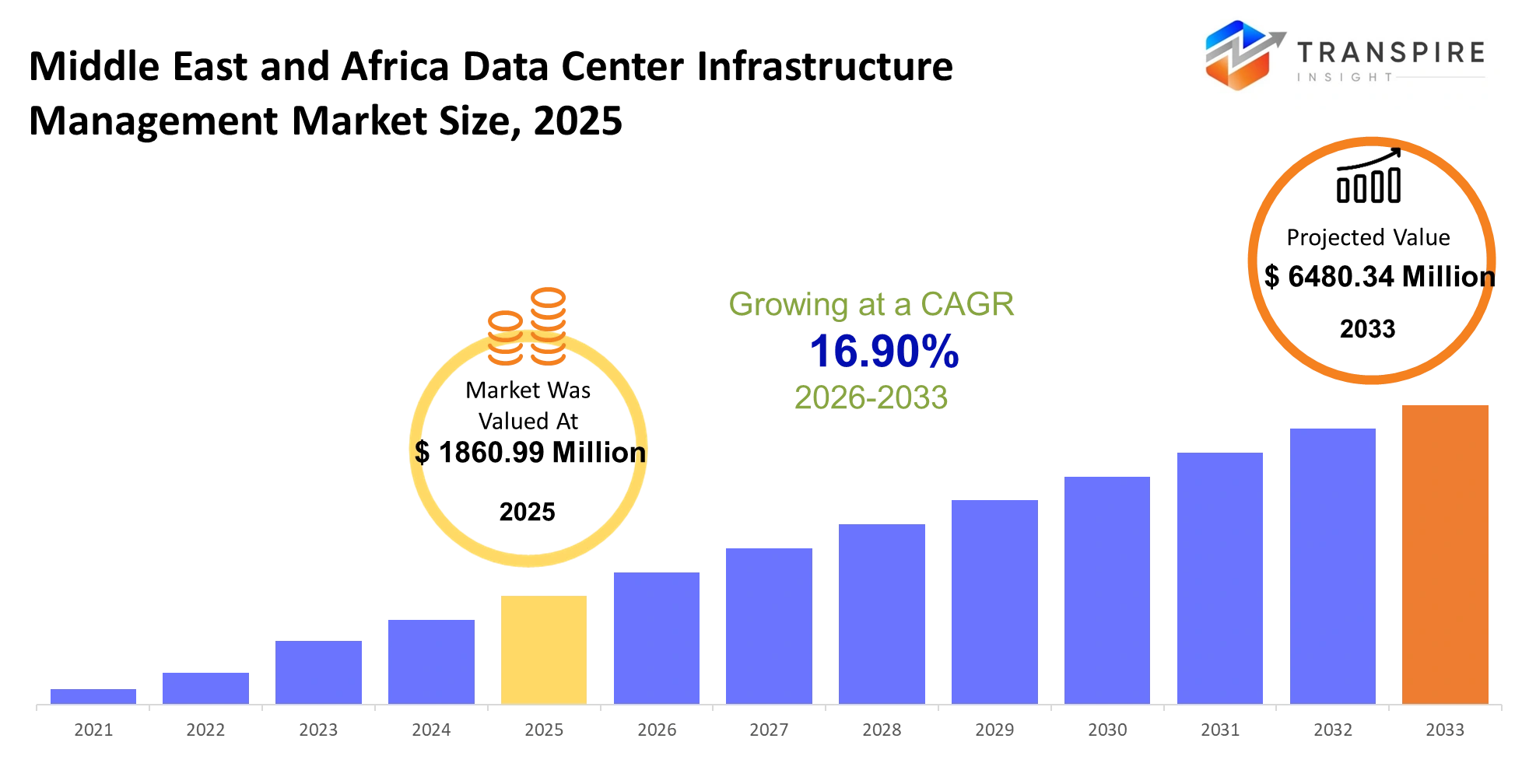
- Middle East and Africa Data Center Infrastructure Management Market Size 2025: USD 1860.99 Million
- Middle East and Africa Data Center Infrastructure Management Market Size 2033: USD 6480.34 Million
- Middle East and Africa Data Center Infrastructure Management Market CAGR: 16.90%
- Middle East and Africa Data Center Infrastructure Management Market Segments: By Component (Software, Services, Tools), By Deployment (Cloud, On-Prem, Hybrid), By Application (Asset, Energy, Capacity, Network Management), By End-User (IT, Telecom, Enterprises, Colocation Providers)
To learn more about this report,  Download Free Sample Report
Middle East and Africa Data Center Infrastructure Management Market Summary:
The Middle East and Africa Data Center Infrastructure Management Market size is estimated at USD 1860.99 Million in 2025 and is anticipated to reach USD 6480.34 Million by 2033, growing at a CAGR of 16.90% from 2026 to 2033. The Middle East and Africa market for data center infrastructure management which includes Saudi Arabia and United Arab Emirates and South Africa and the rest of Middle East and Africa regions will progress its development through enterprises' requirements to monitor their remote assets with greater accuracy. Gulf economies together with African hubs will adopt hybrid architectures which will enable organizations to track energy usage and monitor cooling systems while implementing remote management capabilities. The deployment decisions of organizations will be affected by the energy consumption regulations in the United Arab Emirates and South Africa's sustainability objectives. The operators will focus on implementing automation-driven systems which match their increasing data usage needs and local cloud service growth.
Key Market Trends & Insights:
- Data center management is shifting from manual processes to software-driven dashboards, giving real-time visibility across power, cooling, and networking to reduce downtime.
- Sustainability is becoming a priority, with operators using tools to track energy use and carbon emissions, guided by government policies and corporate environmental goals.
- Growth of edge computing and localized data hubs is driving demand for platforms that support distributed infrastructure with low latency and remote management capabilities.
- Vendors are expected to deliver simple, centralized interfaces that can manage multiple smaller facilities efficiently instead of relying only on large centralized systems.
- Increasing adoption of automation and predictive maintenance, where systems detect issues early and help maintain uptime especially valuable in regions with limited technical resources.
Middle East and Africa Data Center Infrastructure Management Market Segmentation
By Component
Software- The software solutions will function as the central control system for contemporary data center operations which will use user-friendly interfaces to monitor power usage and cooling systems and equipment efficiency. Organizations will increasingly favor platforms that can integrate with existing enterprise systems which allows them to exchange data without complications. The tools will develop capabilities to provide immediate data analysis which enables operators to identify operational problems and optimize their processes through automatic monitoring which works throughout their multiple locations.
Services- Businesses require external expertise to manage their complicated infrastructure environments which makes service offerings more important to them. Organizations will receive customized solutions through consulting and integration and support services which match their operational needs and technical capabilities. Service providers usually support customers with system upgrades and training plus extended maintenance services to ensure that their installed systems maintain value while evolving with operational needs and regulatory requirements.
Tools- Specialized tools will support detailed management of each element from power distribution units to cooling systems and network equipment. These tools function as additional components of complete management systems which deliver comprehensive system analysis and performance monitoring. Operators will use these tools to solve particular operational problems which will enable them to fix problems more quickly while achieving better system performance in environments where precise operations and fast reactions are necessary to keep machines running.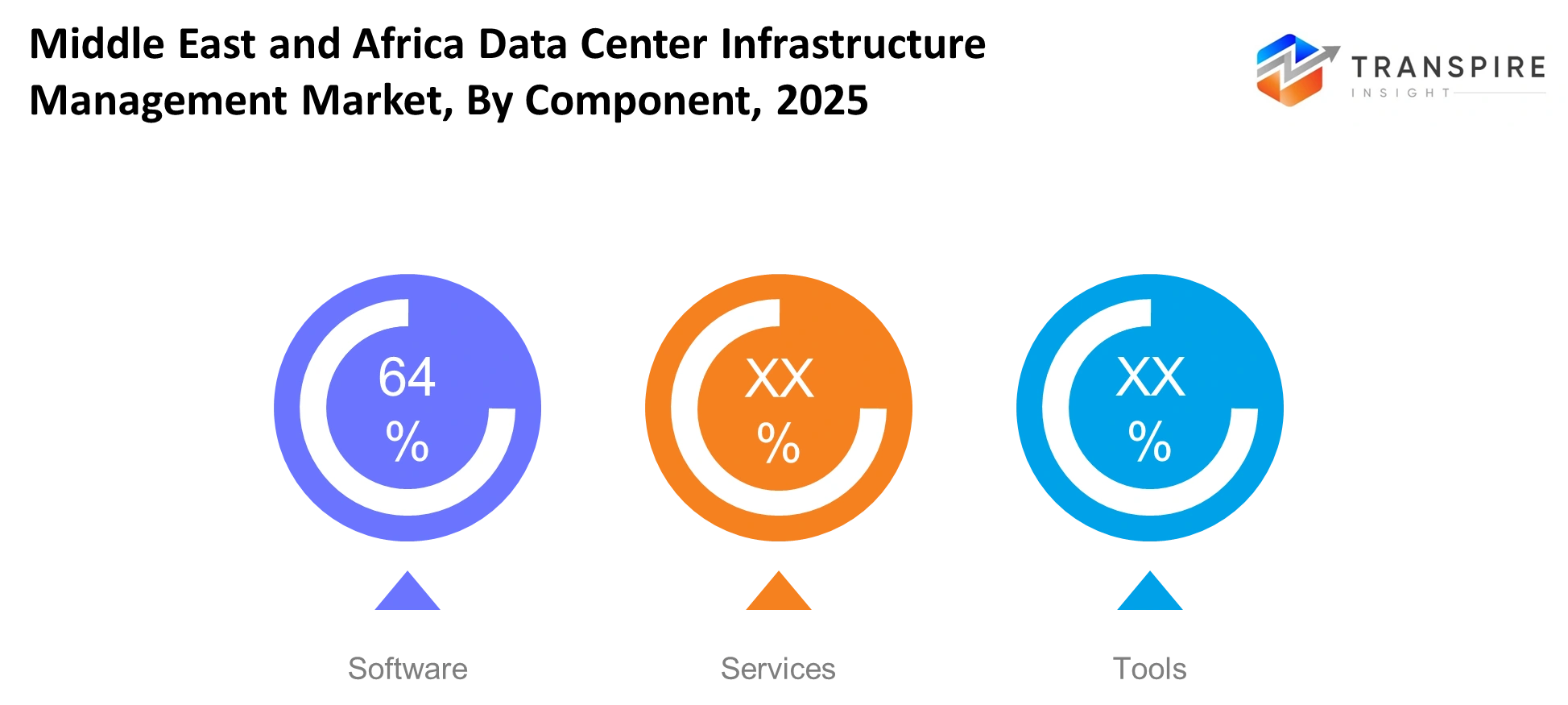
To learn more about this report, Download Free Sample Report
By Deployment
Cloud- The cloud-based deployment system provides organizations with operational flexibility because it enables remote infrastructure management without needing to build on-site systems. Companies that need fast system implementation together with low initial expenses will find this solution to be their ideal choice. The system will provide businesses with simple system updates together with access to high-level analytical tools which make it suitable for organizations with multiple operational sites that need to monitor their activities from a central location without needing physical monitoring equipment.
On-Prem- Organizations that need to maintain complete power over their operations together with protection of their data assets and adherence to regional legal requirements will continue to use on-prem deployment. The facility will host these systems which will enable operators to view infrastructure data directly without needing to access outside networks. This model remains the preferred choice for industries handling sensitive information because it enables organizations to establish governance practices which match their internal rules and operational guidelines.
Hybrid- Organizations with multiple operational requirements will benefit from hybrid deployment because it combines the advantages of both cloud and on-prem solutions. The organization will handle its most sensitive data and critical processes through on-site operations while using cloud platforms to manage less critical functions. The model enables organizations to maintain operational control while adopting flexible business practices which makes it suitable for organizations that want to shift from conventional business models toward modern digital operational systems.
By Application
Asset- The applications for asset management will concentrate on monitoring hardware components throughout their entire operational lifespan which includes tracking their current location within data centers. The systems will deliver complete information about how equipment operates and when maintenance should occur and when equipment needs to be replaced. The organizations will achieve their goals through precise record-keeping because they will decrease their losses and improve their resource distribution and maintain their operational resources which they need for their entire operational time.
Energy- Operators will use energy management applications to track and manage power usage for multiple systems. The solutions will provide immediate energy usage information which enables identification of wasteful practices while helping to decrease business expenses. The applications will help organizations meet environmental regulations through their sustainability features which enable users to collect data that supports energy efficiency improvements and decreases environmental waste.
Capacity- Capacity management will address the need to optimize space, power, and cooling resources within facilities. The applications will assist organizations in developing expansion plans through their capacity to evaluate current resource usage and forecast upcoming needs. Businesses can maintain their daily operations through optimal resource allocation which prevents both resource underuse and resource overuse thus decreasing the need for extra infrastructure spending.
Network Management- The applications for network management will handle both network connectivity and data transmission operations between different facilities. The systems will deliver complete information about network operations which helps users identify both performance issues and potential service interruptions. The operators will use these tools to create reliable communication links which maintain secure and effective data transmission especially in environments that need high security.
By End-User
IT- The IT organizations will depend on management platforms to sustain their system performance and system reliability because they constitute their main customer base. The teams will use these solutions to check their infrastructure health while they solve problems and protect their operational activities from any service interruptions. The tools will assist in managing increasingly complicated IT environments because they will enable technical staff to operate their networks while achieving better results.
Telecom- The telecom operators will utilize these solutions to oversee their extensive communication network infrastructure which extends throughout multiple locations. The growing need for connectivity requires them to establish systems which can process extensive data volumes while maintaining reliable performance. Telecom providers will use management platforms to maintain their service quality standards while they optimize resource management and resolve network problems that occur at different sites.
Enterprises- The various industry sectors will implement these solutions as their enterprises need them to manage their internal digital operations. The tools will enable organizations to operate their data centers and maintain their business applications to required operational standards. Organizations will use these solutions to establish better infrastructure control while they work to decrease downtime and connect their IT functions with their overall business goals.
Colocation Providers- Colocation providers will depend heavily on these platforms to manage shared infrastructure used by multiple clients. The organization requires systems which provide complete insights about resource distribution and actual resource use and system performance across all customers. The advanced management solutions will enable providers to deliver reliable services while maintaining operational transparency and delivering consistent performance across their shared environment to all customers.
Regional Insights
Saudi Arabia is expected to remain a major digital hub through its national transformation programs and infrastructure investments in intelligent technologies. The data centers in the country will enhance their operational visibility while developing energy tracking systems to meet their environmental sustainability targets. Organizations will implement automated infrastructure management systems which will enable them to handle their expanding digital operations throughout different business sectors as their need for local data processing increases.
The United Arab Emirates will strengthen its role as a regional technology gateway which results from its growing adoption of cloud services together with its policies that support innovation. The operators will use sophisticated monitoring systems to achieve operational efficiency within their facilities that handle high equipment usage. Organizations will follow energy efficiency regulations and environmental sustainability rules which will motivate them to use technologies that deliver immediate updates on energy consumption and cooling system performance within their networked digital systems.
The African continent will continue to rely on South Africa as its main gateway for establishing digital infrastructure because there is increasing demand for dependable data services. Organizations will create infrastructure management solutions which will enable them to solve power stability issues and optimize their expenses. Organizations will select predictive solutions which allow remote access because these solutions enable them to achieve steady performance during operational limitations while their digital network grows.
Localized data centers will gradually spread throughout Middle Eastern and African nations as new urban areas develop into established cities. The region will see countries work to develop better digital access systems which will need improved infrastructure management systems. Operators will implement adaptable management solutions which will enable them to run their operations across multiple smaller locations while maintaining system dependability to better meet user needs during their digital transformation processes.
Recent Development News
In April 2026, a major AI data center project in the United Arab Emirates has come under threat amid escalating geopolitical tensions, signaling how strategic digital assets are becoming high-value targets. This situation will likely influence how infrastructure is monitored and protected, encouraging adoption of advanced management platforms capable of real-time risk detection, security integration, and rapid response to ensure operational continuity in sensitive environments.
In January 2026, Saudi Arabia accelerated its push into advanced computing by securing significant funding to expand AI-focused data center capacity. The initiative aims to build large-scale infrastructure supporting next-generation workloads, reflecting a broader regional commitment to digital transformation. This expansion will increase the need for sophisticated infrastructure management systems that can efficiently oversee power usage, cooling, and asset performance across high-capacity facilities.
|
Report Metrics |
Details |
|
Market size value in 2025 |
USD 1860.99 Million |
|
Market size value in 2026 |
USD 2171.72 Million |
|
Revenue forecast in 2033 |
USD 6480.34 Million |
|
Growth rate |
CAGR of 16.90% from 2026 to 2033 |
|
Base year |
2025 |
|
Historical data |
2021 – 2024 |
|
Forecast period |
2026 – 2033 |
|
Report coverage |
Revenue forecast, competitive landscape, growth factors, and trends |
|
Country scope |
Middle East and Africa (Saudi Arabia, United Arab Emirates, South Africa, Rest of Middle East and Africa) |
|
Key company profiled |
Schneider Electric, Vertiv, Siemens, ABB, Eaton, Nlyte Software, Sunbird Software, Device42, IBM, Microsoft, Oracle, Huawei, Cisco, Delta Electronics, Panduit |
|
Customization scope |
Free report customization (country, regional & segment scope). Avail customized purchase options to meet your exact research needs. |
|
Report Segmentation |
By Component (Software, Services, Tools), By Deployment (Cloud, On-Prem, Hybrid), By Application (Asset, Energy, Capacity, Network Management), By End-User (IT, Telecom, Enterprises, Colocation Providers) |
Key Middle East and Africa Data Center Infrastructure Management Market Company Insights
The middle east and Africa data center infrastructure management market in Saudi Arabia, United Arab Emirates, South Africa and other Middle East and African countries will show mixed capacity from global technology companies and local infrastructure service providers. The companies ABB Schneider Electric Cisco and Vertiv will maintain their important role in delivering advanced monitoring and automation solutions while Khazna Data Centers and Africa Data Centres will develop their local operational abilities. The organization will develop its operational approach through the combination of energy intelligence systems and scalable software and remote management solutions which will enable them to manage growing data networks and address changing business needs.
Company List
- Schneider Electric
- Vertiv
- Siemens
- ABB
- Eaton
- Nlyte Software
- Sunbird Software
- Device42
- IBM
- Microsoft
- Oracle
- Huawei
- Cisco
- Delta Electronics
- Panduit
Middle East and Africa Data Center Infrastructure Management Market Report Segmentation
By Component
- Software
- Services
- Tools
By Deployment
- Cloud
- On-Prem
- Hybrid
By Application
- Asset
- Energy
- Capacity
- Network Management
By End-User
- IT
- Telecom
- Enterprises
- Colocation Providers
Frequently Asked Questions
Find quick answers to common questions.
The Approximate Middle East and Africa Data Center Infrastructure Management Market size for the Market will be USD 6480.34 Million in 2033.
Key Segments for the Middle East and Africa Data Center Infrastructure Management Market By Component (Software, Services, Tools), By Deployment (Cloud, On-Prem, Hybrid), By Application (Asset, Energy, Capacity, Network Management), By End-User (IT, Telecom, Enterprises, Colocation Providers).
Major Players in the Middle East and Africa Data Center Infrastructure Management Market are Schneider Electric, Vertiv, Siemens, ABB, Eaton, Nlyte Software, Sunbird Software, Device42, IBM, Microsoft, Oracle, Huawei, Cisco, Delta Electronics, Panduit.
The Current Middle East and Africa Data Center Infrastructure Management Market size is USD 1860.99 Million in 2025.
The Middle East and Africa Data Center Infrastructure Management Market CAGR is 16.90%.
- Schneider Electric
- Vertiv
- Siemens
- ABB
- Eaton
- Nlyte Software
- Sunbird Software
- Device42
- IBM
- Microsoft
- Oracle
- Huawei
- Cisco
- Delta Electronics
- Panduit
Recently Published Reports
-
Apr 2026
3D Optical Profiler Market
3D Optical Profiler Market Size, Share & Analysis Report By Type (Desktop 3D Optical Profiler, and Portable 3D Optical Profiler), By Technology (Confocal Technology, and White Light Interference), By End-Use Industry (Manufacturing, Research Institutions, Automotive, Aerospace and Defense, Medical Devices, and Other), and Geography (North America, Europe, Asia-Pacific, Middle East and Africa, South and Central America), 2021 - 2031
-
Apr 2026
Depth Sensor Market
Depth Sensor Market Size, Share & Analysis Report By Type (Infrared Depth Sensors, Time-of-Flight (ToF) Sensors, Stereo Vision Sensors, Structured Light Sensors, Ultrasonic Depth Sensors), By Application (Automotive, Robotics, Gaming, Consumer Electronics, Industrial Automation, Healthcare, Security & Surveillance, Others), By End Users (Automotive Manufacturers, Consumer Electronics Companies, Healthcare Providers, Industrial Companies, Security Agencies, Gaming Companies, Robotics Companies, Others), and Geography (North America, Europe, Asia-Pacific, Middle East and Africa, South and Central America), 2021 – 2031
-
Apr 2026
Digital Manufacturing Market
Digital Manufacturing Market Size, Share & Analysis Report By Component (Hardware, Software, and Services), By Technology (Robotics, 3D Printing, Internet of Things (IoT), and Others), By Application (Automotive and Transportation, Aerospace and Defense, Consumer Electronics, Industrial Machinery, and Others), By Process Type (Computer-Based Designing, Computer-Based Simulation, Computer 3D Visualization, Analytics, and Others), and Geography (North America, Europe, Asia-Pacific, Middle East and Africa, South and Central America), 2021 – 2031
-
Apr 2026
Digital Visa Services Market
Digital Visa Services Market Size, Share & Analysis Report By Type (Individual Travelers, Group Travelers), By Application (Tourism, Business Travel, Others), and Geography (North America, Europe, Asia-Pacific, Middle East and Africa, South and Central America), 2021 – 2031