

North America Cloud-Managed Wi-Fi Market Size & Forecast:
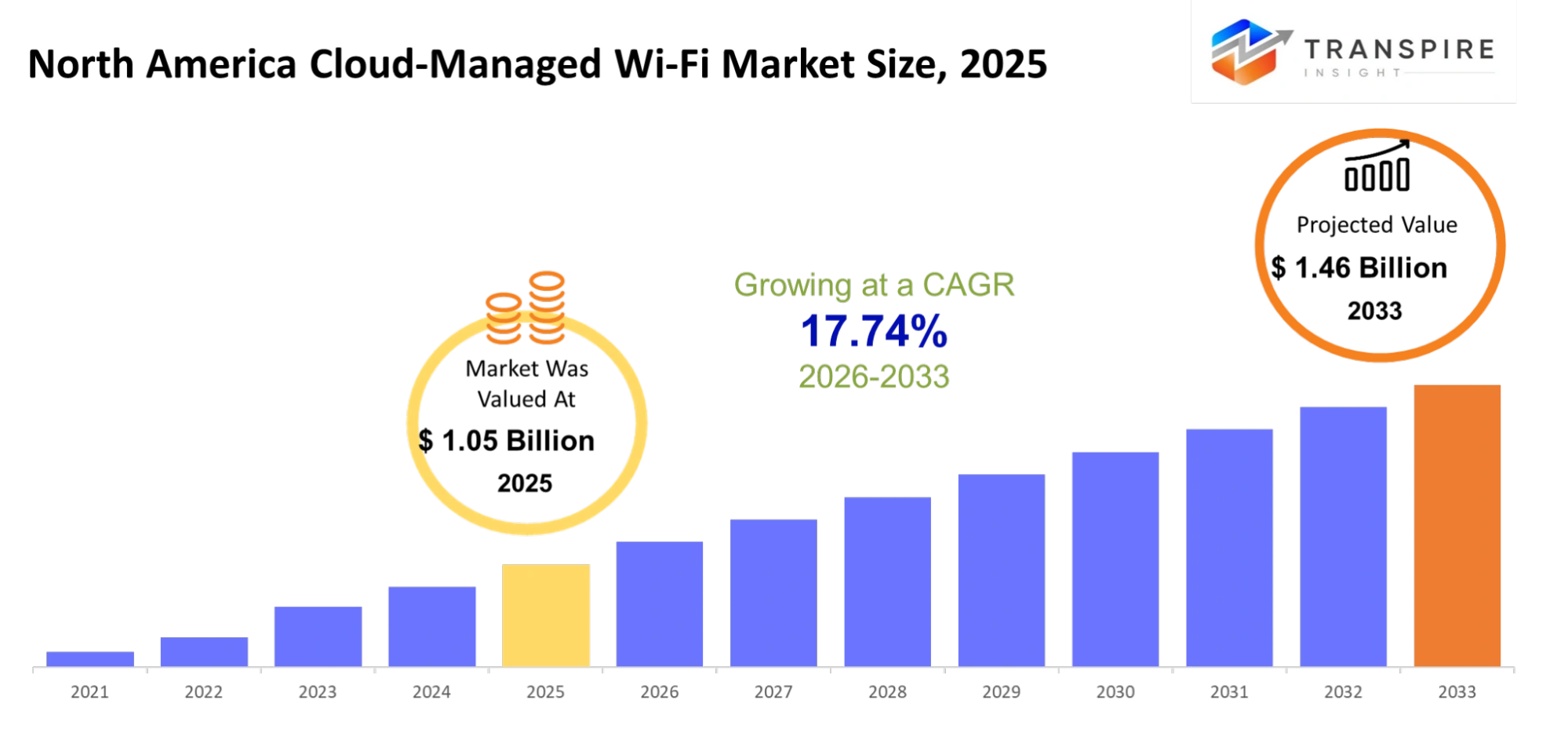
- North America Cloud-Managed Wi-Fi Market Size 2025: USD 1.05 Billion
- North America Cloud-Managed Wi-Fi Market Size 2033: USD 1.46 Billion
- North America Cloud-Managed Wi-Fi Market CAGR: 17.74%
- North America Cloud-Managed Wi-Fi Market Segments: By Component (Hardware, Software, Services), By Deployment (Public Cloud, Private Cloud), By End-User (Enterprises, SMBs, Government).
To learn more about this report,  Download Free Sample Report
North America Cloud-Managed Wi-Fi Market Summary:
The North America Cloud-Managed Wi-Fi Market size is estimated at USD 1.05 Billion in 2025 and is anticipated to reach USD 1.46 Billion by 2033, growing at a CAGR of 17.74% from 2026 to 2033. The Cloud-Managed Wi-Fi Market in North America which includes Canada, the United States and Mexico exists within the enterprise networking and wireless infrastructure industry. Businesses will increasingly expect seamless connectivity across distributed locations. Vendors must improve their intuitive dashboard systems and automation capabilities. Service providers will create scalable subscription-based products which satisfy consumer demand for continuous online access. The development of data privacy regulations together with rules about international data transfer will determine how organizations implement their systems. AI-powered network optimization technologies will transform the management of performance security and user experience across multiple environments.
Key Market Trends & Insights:
The North American Cloud-Managed Wi-Fi Market which includes Canada and the United States and Mexico will undergo a fundamental transformation because of its adoption of experience-first networking. Enterprises will no longer judge connectivity only by uptime but by how consistently applications perform for end users. The requirement for providers to include advanced analytics in their platforms will enable IT teams to predict service outages while optimizing system performance before issues arise in hybrid work environments and crowded public spaces.
The upcoming trend will show how artificial intelligence technology combines with network management systems. Platforms will increasingly rely on predictive algorithms to automate troubleshooting bandwidth allocation and security responses. The systems of tomorrow will use self-correcting environments instead of their current maintenance system which only identifies problems. The new system will decrease the need for human operators while it creates better system reliability throughout multiple locations which retail chains, healthcare facilities and educational institutions need to manage their changing user traffic patterns.
The security requirements of organizations will create new deployment methods because their data protection rules have become more stringent across the entire region.← Organizations will choose solutions that enable them to create zero-trust security systems which operate as integral components of their wireless networks.← The cloud-managed systems will provide identity-based access controls together with continuous monitoring tools as their new adaptive feature.← The upcoming regulations will impact businesses which handle confidential materials because their compliance requirements will determine which vendors they choose and which network systems they will maintain for the future.
Consumer behavior will also influence how services are packaged and delivered.← Businesses will seek flexible subscription models that align with operational costs rather than large upfront investments.← The vendors will introduce modular services which permit organizations to expand their available features whenever required.← The region will experience a transformation in its IT spending practices which will prioritize service-based solutions because organizations need fast access to their resources and streamlined system updates.
North America Cloud-Managed Wi-Fi Market Segmentation
By Component
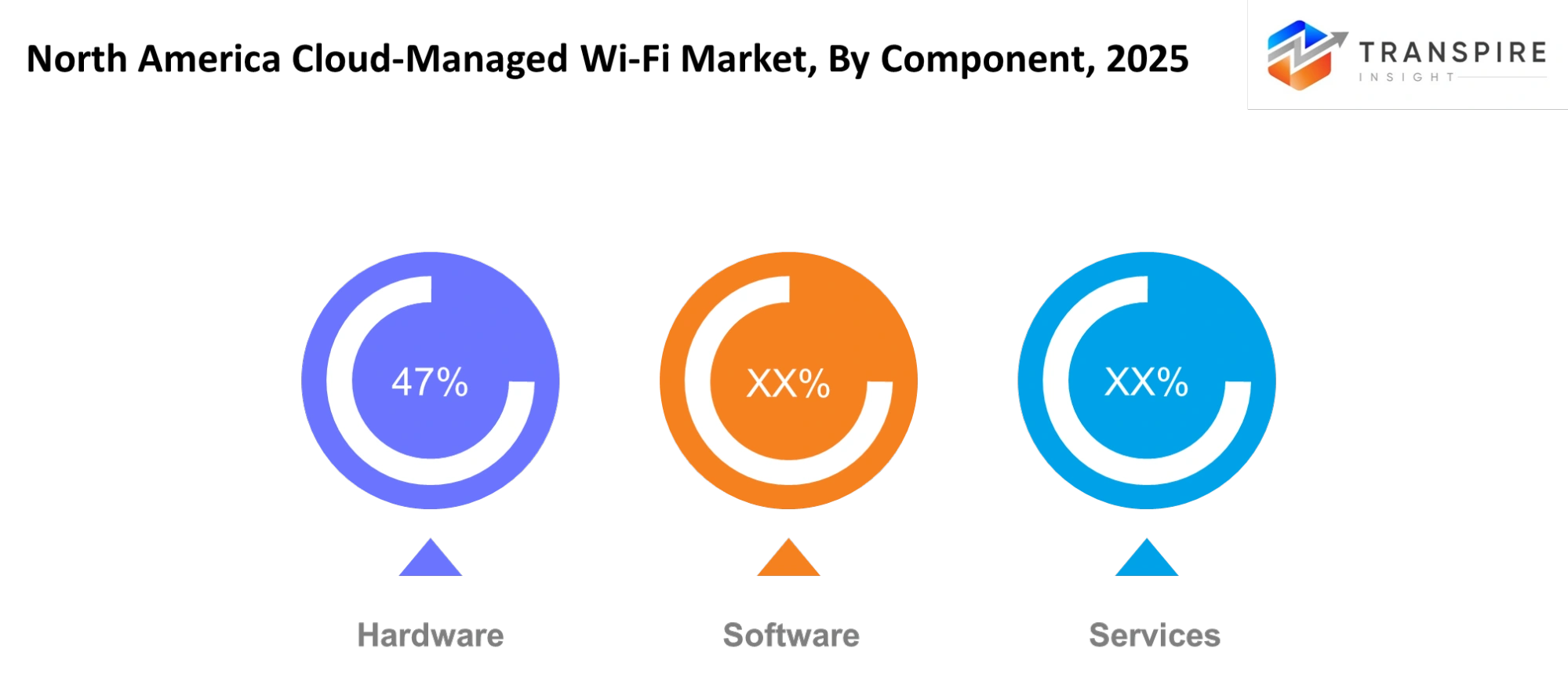
Hardware- Managed wireless environments will use hardware to create their physical infrastructure which includes access points and gateways and controllers that enable centralized system management through cloud-based platforms. The development of devices will proceed to create advanced chipsets which can manage multiple users while processing real-time data. Vendors will develop products which meet enterprise demands for dependable systems by designing energy-efficient components that include security functions at their hardware foundation.
Software- Networks will use software as their primary intelligence system which establishes their remote configuration and monitoring and optimization methods. Cloud-based dashboards will provide organizations with advanced capabilities to track their users' activities and their bandwidth consumption and system performance. The software development process will advance to create automation systems which enable IT personnel to operate remote sites without needing to be present. The cloud-based system will provide continuous updates which help the system function according to current standards and operational needs.
Services- Services will develop into strategic offerings which provide network design and remote monitoring and lifecycle management services beyond their basic installation and support functions. Managed service providers will assist organizations in achieving reliable operational performance throughout their distributed network environments. Training and consulting services will receive increased significance because businesses need help to achieve wireless network compliance with their internal policies and external regulatory standards.
To learn more about this report, Download Free Sample Report
By Deployment
Public Cloud- Organizations that need flexible solutions with affordable initial expenses will choose public cloud deployment. The shared cloud infrastructure will let networks operate at their maximum capacity while enabling quick system enhancements. The model enables businesses with multiple locations to maintain continuous network access without needing to establish physical network resources. Users will gain more trust in shared digital platforms because data isolation improvements and encryption advancements will create better protection against their security concerns.
Private Cloud- Organizations that need complete power over their data will choose private cloud deployment. Networks will operate within specialized settings that provide advanced security features and greater control over network operations. The method is essential for businesses that manage sensitive data because their compliance demands require them to maintain strict monitoring. The initial expenses for system installation will be higher because organizations need to adapt their systems according to their operations but these customized setups will deliver dependable performance throughout their entire operational life.
By End-User
Enterprises- Large enterprises will operate their wireless needs through a centralized management system to ensure their office locations in different areas and their remote work sites maintain uniformity. The demand for uninterrupted connections will increase as businesses proceed with their digital transformation projects which require them to adopt technologies that work with their complete IT infrastructure. Enterprises will establish performance monitoring systems which will protect their network security while delivering optimal user experience to their employees and customers who require uninterrupted access during busy operational times.
SMBs- Small and medium-sized businesses will use cloud-managed wireless systems because these solutions enable them to operate their networks without needing deep technical knowledge. Cost-effective subscription models will make advanced features accessible, enabling SMBs to compete with larger organizations in terms of connectivity quality. Business owners will gain two major benefits from this system because it enables them to deploy their operations while solving remote technical issues which lets them work on their core business functions instead of handling complicated system operations.
Government- Government organizations will focus on developing secure wireless networks which also provide public-facing and administrative services while being able to handle large volumes of traffic. The use of cloud-managed solutions will enable departments to achieve better connectivity results which will be managed from a central location. The focus will be on achieving compliance standards, safeguarding data, and ensuring network reliability especially for critical functions which include public safety operations, transportation services, and civic administration because these systems must provide constant access to enable effective service delivery.
Regional Insights
The United States will experience cloud-managed wireless adoption according to the specific needs and different types of business operations which exist throughout the country. The centralized control requirement for multiple site operations in large organizations will create a demand for platforms which provide organizations with complete operational visibility and automated system management capabilities. Advanced digital infrastructure implementation will drive the quick adoption of AI-based network optimization because data privacy regulations will determine how service providers organize their services and establish local service areas.
The Canadian market will achieve a balanced solution which combines innovative development with regulatory compliance. Organizations will establish secure and dependable network systems which will meet their requirements particularly in the healthcare, education and public service industries. The increasing geographic distribution of people will create greater demands for remote network management systems which need to operate effectively in both city and rural environments. The establishment of data sovereignty regulations will determine which deployment methods organizations will choose because they need to select solutions that enable them to manage data storage and transmission methods.
The digital infrastructure in Mexico will develop new adoption patterns because of its expanding digital infrastructure and growing internet access. Companies will search for solutions that minimize expenses while enabling them to expand their business operations. Retail and hospitality and logistics businesses will use cloud-managed systems to ensure their operations maintain continuous internet access as they grow their businesses. Organizations in different regions will use different ways to deliver their products because vendors will create solutions that fit the technical ability and infrastructure development of each region.
North America will demonstrate how technological goals and regulatory knowledge are becoming aligned through its regional development. Organizations that operate between borders will require single management systems that can handle multiple compliance standards that their business needs. Companies will continue to develop their products in response to user demands for creating consistent experiences while service providers work on developing versatile deployment systems. Wireless infrastructure development will undergo changes because technology companies and businesses will work together to meet evolving operational and user demands.
Recent Development News
United States: Telecom–Cloud Convergence Accelerates Network Modernization
Recent developments in the United States highlight deeper collaboration between telecom operators and cloud providers to modernize wireless infrastructure. A notable move involves AT&T expanding its partnership with Amazon Web Services to migrate network workloads into cloud environments and integrate AI-led capabilities. This shift will strengthen scalable connectivity and support enterprise-grade wireless performance, reinforcing how cloud-managed systems are becoming central to next-generation networking strategies.
Canada: Rising Focus on Secure and Compliant Cloud Networking Solutions
In Canada, recent industry movements indicate stronger emphasis on secure cloud-managed networking frameworks aligned with national data protection expectations. Enterprises and public institutions are increasingly adopting solutions that balance performance with strict compliance standards. Vendors are responding by enhancing encryption protocols and localized data controls. This direction reflects a broader shift where regulatory alignment and trust will shape how cloud-managed wireless solutions are deployed across sensitive sectors.
Mexico: Expanding Digital Infrastructure Drives Cloud-Based Wi-Fi Adoption
Mexico is witnessing notable progress as businesses accelerate digital transformation through cloud-based connectivity solutions. Recent market activity shows increased adoption of scalable wireless systems that reduce infrastructure complexity while supporting growing user demand. Industries such as retail and logistics are actively integrating managed Wi-Fi platforms to maintain consistent operations. This momentum will continue as organizations seek cost-efficient technologies that align with expanding internet access and evolving business environments.
|
Report Metrics |
Details |
|
Market size value in 2025 |
USD 1.05 Billion |
|
Market size value in 2026 |
USD 1.24 Billion |
|
Revenue forecast in 2033 |
USD 1.46 Billion |
|
Growth rate |
CAGR of 17.74% from 2026 to 2033 |
|
Base year |
2025 |
|
Historical data |
2021 – 2024 |
|
Forecast period |
2026 – 2033 |
|
Report coverage |
Revenue forecast, competitive landscape, growth factors, and trends |
|
Country scope |
North America (Canada, The United States, and Mexico) |
|
Key company profiled |
Cisco Systems Inc., Hewlett Packard Enterprise (Aruba Networks), Ubiquiti Inc., Juniper Networks Inc., Extreme Networks Inc., Huawei Technologies Co. Ltd., Fortinet Inc., TP-Link Technologies Co. Ltd., NETGEAR Inc., Cambium Networks Corporation, Ruckus Networks (CommScope), Dell Technologies Inc., Aerohive Networks (Extreme), Alcatel-Lucent Enterprise, Zyxel Communications Corp. |
|
Customization scope |
Free report customization (country, regional & segment scope). Avail customized purchase options to meet your exact research needs. |
|
Report Segmentation |
By Component (Hardware, Software, Services), By Deployment (Public Cloud, Private Cloud), By End-User (Enterprises, SMBs, Government). |
Key North America Cloud-Managed Wi-Fi Market Company Insights
The North America Cloud-Managed Wi-Fi Market, which includes Canada and the United States and Mexico, will showcase established networking companies together with new companies that focus on cloud-based solutions to develop standards for enterprise connectivity. The companies Cisco through Meraki and HPE Aruba and Juniper Mist and Extreme Networks will enhance their market positions by adding AI-powered analytical tools and automated systems and unified performance monitoring solutions to their product lines. The vendors will work to create simple solutions that enable users to manage multiple networks while they build stronger security systems. Ubiquiti and Ruckus will attract customers from budget-conscious markets through their products which offer different installation options. The industry competition will continue to be determined by breakthroughs in cloud-native systems and improvements in user experience and development of scalable service delivery solutions.
Company List
- Cisco Systems Inc.
- Hewlett Packard Enterprise (Aruba Networks)
- Ubiquiti Inc.
- Juniper Networks Inc.
- Extreme Networks Inc.
- Huawei Technologies Co. Ltd.
- Fortinet Inc.
- TP-Link Technologies Co. Ltd.
- NETGEAR Inc.
- Cambium Networks Corporation
- Ruckus Networks (CommScope)
- Dell Technologies Inc.
- Aerohive Networks (Extreme)
- Alcatel-Lucent Enterprise
- Zyxel Communications Corp
North America Cloud-Managed Wi-Fi Market Report Segmentation
By Component
- Hardware
- Software
- Services
By Deployment
- Public Cloud
- Private Cloud
By End-User
- Enterprises
- SMBs
- Government
Frequently Asked Questions
Find quick answers to common questions.
The approximate North America Cloud-Managed Wi-Fi Market size for the market will be USD 1.46 Billion in 2033.
Key segments for the North America Cloud-Managed Wi-Fi Market By Component (Hardware, Software, Services), By Deployment (Public Cloud, Private Cloud), By End-User (Enterprises, SMBs, Government).
Major players in the North America Cloud-Managed Wi-Fi Market are Cisco Systems Inc., Hewlett Packard Enterprise (Aruba Networks), Ubiquiti Inc., Juniper Networks Inc., Extreme Networks Inc., Huawei Technologies Co. Ltd., Fortinet Inc., TP-Link Technologies Co. Ltd., NETGEAR Inc., Cambium Networks Corporation, Ruckus Networks (CommScope), Dell Technologies Inc., Aerohive Networks (Extreme), Alcatel-Lucent Enterprise, Zyxel Communications Corp.
The North America Cloud-Managed Wi-Fi Market size is USD 1.05 Billion in 2025.
The North America Cloud-Managed Wi-Fi Market CAGR is 17.74%.
- Cisco Systems Inc.
- Hewlett Packard Enterprise (Aruba Networks)
- Ubiquiti Inc.
- Juniper Networks Inc.
- Extreme Networks Inc.
- Huawei Technologies Co. Ltd.
- Fortinet Inc.
- TP-Link Technologies Co. Ltd.
- NETGEAR Inc.
- Cambium Networks Corporation
- Ruckus Networks (CommScope)
- Dell Technologies Inc.
- Aerohive Networks (Extreme)
- Alcatel-Lucent Enterprise
- Zyxel Communications Corp
Recently Published Reports
-
Apr 2026
3D Optical Profiler Market
3D Optical Profiler Market Size, Share & Analysis Report By Type (Desktop 3D Optical Profiler, and Portable 3D Optical Profiler), By Technology (Confocal Technology, and White Light Interference), By End-Use Industry (Manufacturing, Research Institutions, Automotive, Aerospace and Defense, Medical Devices, and Other), and Geography (North America, Europe, Asia-Pacific, Middle East and Africa, South and Central America), 2021 - 2031
-
Apr 2026
Depth Sensor Market
Depth Sensor Market Size, Share & Analysis Report By Type (Infrared Depth Sensors, Time-of-Flight (ToF) Sensors, Stereo Vision Sensors, Structured Light Sensors, Ultrasonic Depth Sensors), By Application (Automotive, Robotics, Gaming, Consumer Electronics, Industrial Automation, Healthcare, Security & Surveillance, Others), By End Users (Automotive Manufacturers, Consumer Electronics Companies, Healthcare Providers, Industrial Companies, Security Agencies, Gaming Companies, Robotics Companies, Others), and Geography (North America, Europe, Asia-Pacific, Middle East and Africa, South and Central America), 2021 – 2031
-
Apr 2026
Digital Manufacturing Market
Digital Manufacturing Market Size, Share & Analysis Report By Component (Hardware, Software, and Services), By Technology (Robotics, 3D Printing, Internet of Things (IoT), and Others), By Application (Automotive and Transportation, Aerospace and Defense, Consumer Electronics, Industrial Machinery, and Others), By Process Type (Computer-Based Designing, Computer-Based Simulation, Computer 3D Visualization, Analytics, and Others), and Geography (North America, Europe, Asia-Pacific, Middle East and Africa, South and Central America), 2021 – 2031
-
Apr 2026
Digital Visa Services Market
Digital Visa Services Market Size, Share & Analysis Report By Type (Individual Travelers, Group Travelers), By Application (Tourism, Business Travel, Others), and Geography (North America, Europe, Asia-Pacific, Middle East and Africa, South and Central America), 2021 – 2031