
Middle East and Africa China Hydrogen Generation Market Summary
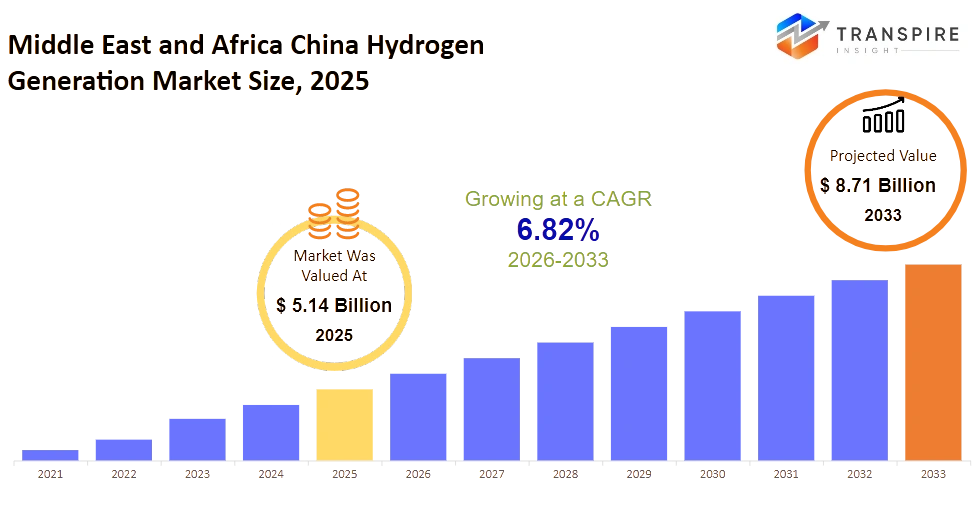
As per Transpire Insight Analysis the Middle East and Africa China Hydrogen Generation Market size is estimated at USD 5.14 Billion in 2025 and is anticipated to reach USD 8.71 Billion by 2033, growing at a CAGR of 6.82% from 2026 to 2033.
The Middle East and Africa China Hydrogen Generation Market basically does this big thing, supplying hydrogen for refining, fertilizer production, chemical making, steel production, and even the newer clean energy uses that are popping up. It helps companies cut carbon intensity a bit, while also backing energy diversification plans and those industrial decarbonization efforts. Over the last five years, the whole market seems to be moving from the older, fossil fuel centered hydrogen toward low-carbon, even “green hydrogen” type output, especially after governments rolled out national hydrogen roadmaps and industrial decarbonization policies.
Then the Russia-Ukraine conflict created these energy security worries, and that sort of pushed faster investment into domestic hydrogen infrastructure, also prompting more diversified energy supply chains across the Middle East, while at the same time boosting China’s manufacturing capability for electrolyzers, kind of a double win. This shift then encouraged large scale production initiatives, and it also expanded cross border collaborations, plus it drove more capital into hydrogen value chains. As the production technologies get more efficient and they’re better integrated with renewable energy sources, the project economics keep looking better and better, which supports wider commercial use and opens up fresh revenue opportunities in industrial channels, and export markets too.
Middle East and Africa China Hydrogen Generation Market Size & Forecast:
- Middle East and Africa China Hydrogen Generation Market Size 2025: USD 5.14 Billion
- Expected Market Value 2033: USD 8.71 Billion
- Forecast CAGR: 6.82%
- Leading region in 2025:China
- Fastest Growing region:Africa (led by Namibia, Egypt, and South Africa due to green hydrogen investments and export-focused projects)
- Key Profile: Sinopec, China Energy Investment Corporation, Air Liquide, Linde, Air Products, Plug Power, Cummins, Nel ASA, Siemens Energy, ITM Power, Longi Hydrogen, PERIC Hydrogen Technologies, HydrogenPro, John Cockerill, Bloom Energy
Key Market Insights
- The Middle East and Africa China Hydrogen Generation Market is projected to hit USD 8.71 Billion by 2033, mainly backed by more hydrogen production capacity and those industrial decarbonization programs that keep getting expanded.
- China basically leads the space with an estimated over 70% market share in 2025, pulled along by electrolyzer manufacturing leadership and big scale hydrogen rollouts, even at national level.
- Meanwhile, the Middle East shows up as the quickest growing regional market during the forecast period, mostly because of giga scale green hydrogen projects in Saudi Arabia, the UAE, and Oman.
- For production types, green hydrogen generation is the fastest growing segment, but grey hydrogen still brings in the biggest revenues due to the already installed industrial infrastructure, sort of “ready to go” pipelines.
- On technology, Steam Methane Reforming continues to be the leading production method, while PEM electrolyzers are the ones posting the strongest growth through 2033.
- In terms of applications, petroleum refining stays on top, with nearly 40% market share, and steelmaking plus ammonia production are the fastest emerging industrial users.
- Looking at end use, chemical manufacturing remains the leading end user segment, while mobility and hydrogen export infrastructure are ramping up quickly across Middle Eastern economies, and it’s not just one country either.
- Key players like Sinopec, Air Liquide, Linde, Air Products, Siemens Energy, and Longi Hydrogen keep pushing strategic expansion via electrolyzer manufacturing, joint ventures and integrated hydrogen ecosystems
- Manufacturers are also increasingly investing in gigawatt scale electrolyzer production, renewable powered hydrogen plants, and digital monitoring platforms.
- Public private partnerships plus cross border hydrogen supply agreements are reshaping the Middle East and Africa China Hydrogen Generation Market, and they are speeding up commercialization along with export opportunities.
What are the Key Drivers, Restraints, and Opportunities in the Middle East and Africa China Hydrogen Generation Market?
Government backed hydrogen strategies, plus industrial decarbonization targets, have turned into the most solid force behind market growth. In China, the national hydrogen development plan ,and then the hydrogen roadmaps that Saudi Arabia, the UAE , and Oman rolled out, helped speed up investment across electrolyzer manufacturing, renewable powered hydrogen facilities, and the transport build out that goes with it. When electrolyzer costs drop and renewable electricity becomes more available, the project numbers start looking better. That makes it easier for industrial producers to switch away from carbon heavy hydrogen toward cleaner options. As a result , commercial use is broadening in refining, fertilizer production, chemicals, and even new steel related applications. It also creates fresh income channels for technology providers and for the project developers.
Still, the biggest structural obstacle is high capital expenditure. To make green hydrogen you typically need major funding for renewable power generation, electrolyzers, storage, pipelines, and export terminals . A lot of Middle Eastern and African countries also have weak hydrogen transport networks and, on top of that, not enough demand bundling. This combo slows down commercial scale deployment. Even when investors want to move quickly, financing big integrated projects remains difficult, because returns hinge on electricity prices, the strength of policy support , and long term purchase agreements . These structural issues ,at the end, slow commissioning timelines and push back wider industrial take up.
For the strongest long term opportunity, market participants are increasingly looking at large hydrogen export corridors. Saudi Arabia, the UAE, and Oman are putting billions of dollars into renewable powered hydrogen and ammonia production, with the plan pointed toward European and Asian energy markets.
What Has the Impact of Artificial Intelligence Been on the Middle East and Africa China Hydrogen Generation Market?
Artificial intelligence and advanced digital technologies are kinda reshaping hydrogen generation by pushing plant efficiency higher, boosting operational reliability, and usually improving the economics of production too. With AI backed energy management systems running all the time, electrolyzer performance gets tuned almost constantly, sorta by balancing the electricity input against whatever renewable energy is actually on hand. So operators can squeeze out more hydrogen output while trying to keep power costs as low as possible, which is basically the whole point.
Then machine learning takes sensor readings from compressors, storage systems, pipelines, and the electrolysis units themselves and it tries to foresee equipment failures before a breakdown happens. That reduces maintenance costs , and it also tends to improve overall plant availability. In practice it’s like moving repairs from “after something breaks” to “before it breaks”, even if the timeline is never perfect.
Digital twins together with more advanced analytics help operators play out production scenarios in simulation. They can optimize hydrogen purity, forecast electricity demand, and improve asset utilization without having to risk the real system each time. Predictive methods also help producers schedule maintenance during low-demand windows, which cuts down unplanned downtime while extending equipment life. A lot of industrial hydrogen sites even blend AI with Industrial Internet of Things platforms to automate process control, keep an eye on safety conditions, and support operational compliance across larger and more complex production locations.
Still, AI adoption is not totally free from obstacles. Integration costs can be high, and operational data quality is often inconsistent, especially across older facilities that already have legacy control setups. Many hydrogen plants use heterogeneous control systems, and that creates fragmented datasets. When the data is scattered like that, machine learning accuracy drops, and digital transformation can slow down or stall. Expanding standardized industrial data infrastructure will probably be essential, before AI can deliver its full operational plus commercial value across the wider regional hydrogen production ecosystem.
Key Market Trends
- After 2021, several national hydrogen strategies sorta kicked in , and they started moving money away from tiny pilot facilities into more commercial-scale hydrogen production , plus the whole integrated industrial ecosystems thing.
- China then expanded gigawatt-scale electrolyzer manufacturing from 2022 through 2025 , which helped bring equipment costs down and also made the project economics feel better globally not just locally.
- Saudi Arabia and the UAE pushed forward renewable powered hydrogen projects, with a strong focus on ammonia exports. That in turn reshaped what kinds of regional investments people were prioritizing.
- Meanwhile, industrial buyers were more and more signing long term hydrogen supply agreements , instead of counting on short term procurement. The idea was to increase investment certainty, even if the timelines felt slower.
- Electrolyzer manufacturers also leaned harder into strategic partnerships with renewable energy developers. So rather than selling standalone equipment, they were delivering integrated production solutions, sort of like a package and not a single item.
- After 2023, digital monitoring platforms and AI based optimization tools became pretty standard in new hydrogen production facilities. Not an extra upgrade, but almost baseline features.
- Cross border hydrogen and ammonia export corridors got extra momentum too , as European energy diversification strategies opened up new commercial opportunities.
- Steel producers increasingly assessed hydrogen based direct reduced iron technology, mostly to cut carbon emissions from conventional production processes.
- On the technology side, providers gravitated toward bigger PEM and alkaline electrolyzer systems , which improved production efficiency and also reduced lifecycle operating costs.
- And overall competitive strategies moved away from just equipment sales, toward full hydrogen ecosystem development , including storage, transport, digital monitoring, and renewable integration.
Middle East and Africa China Hydrogen Generation Market Segmentation
By Technology
Steam Methane Reforming still ends up as the main production route, largely because there is already big industrial infrastructure in place, and the production costs stay relatively competitive. Water Electrolysis keeps growing too, as more renewable energy capacity shows up across China and also in a few Middle Eastern countries. Coal Gasification helps when regions have lots of coal and need huge hydrogen output, whereas Biomass Gasification starts getting a lot of attention for changing agricultural, organic waste into a cleaner type of fuel.
Partial Oxidation gets used for sites that handle heavier hydrocarbons. Then there’s Photoelectrochemical Process which is drawing research money, because people think it could move toward real commercial production later on.
Methane Pyrolysis makes hydrogen but it also leaves behind solid carbon, instead of carbon dioxide. That tradeoff makes it interesting for industrial operations that want lower emissions overall. Other options, like emerging electrochemical approaches and mixed or hybrid production methods, are also being explored, mostly aiming for better efficiency and lower day to day operating costs. What technology to pick depends on feedstock availability, local energy prices carbon rules, and the basic economics of a project. Continued investment in innovation should raise production efficiency while also backing longer term industrial expansion.
By Source
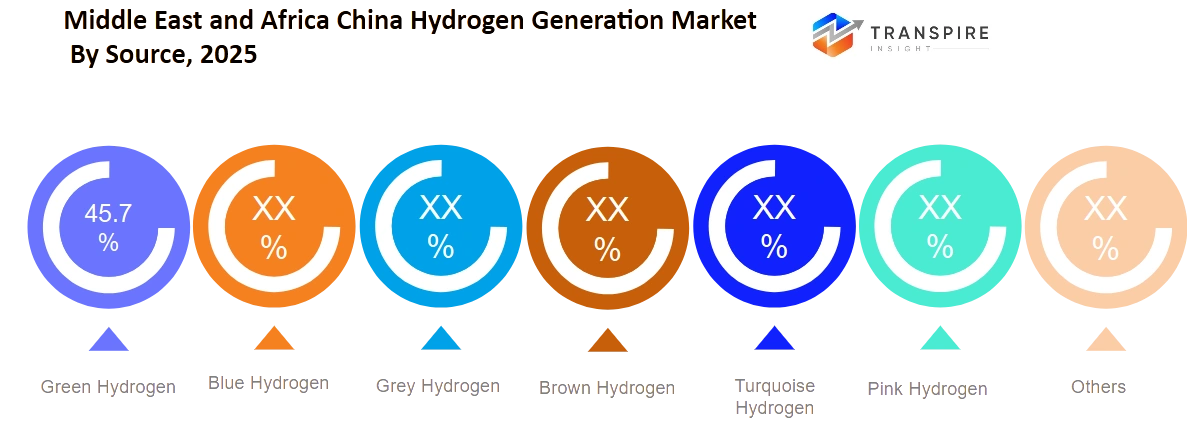
Green Hydrogen is seeing the fastest kind of expansion, because renewable electricity helps power low carbon hydrogen production, with pretty minimal emissions overall. Blue Hydrogen keeps drawing investor attention, mostly thanks to carbon capture systems that cut down emissions coming from natural gas based production. Grey Hydrogen still stays widely used, since the existing facilities are already there, and they keep offering a dependable supply for refining and chemical manufacturing. Brown Hydrogen keeps showing up in a few selected industrial operations, where coal is still the more economical energy source.
Turquoise Hydrogen is getting more interest these days, because methane pyrolysis can produce hydrogen with lower carbon output while also yielding valuable solid carbon byproducts. Pink Hydrogen is used where nuclear generated electricity is available, supporting production in countries with the right energy infrastructure. Other hydrogen sources include trial like production methods, relying on alternative feedstocks, or hybrid energy systems. In practice source selection comes down to environmental targets, energy availability, production costs, and how much industrial demand there is.
By Application
Petroleum Refining is still the biggest application, since refineries really do need a continuous supply of hydrogen for hydrocracking and desulfurization workflows. Ammonia Production is another large one too, helping fertilizer manufacturing, and it supports export driven industries. Methanol Production keeps growing alongside chemical production, while Fuel Cell Vehicles open up new commercial pathways for heavy transport and public mobility. Power Generation also matters, because it backs energy storage projects that mix renewable electricity with hydrogen-based systems, more or less.
Steel Manufacturing is starting to use hydrogen more often, aiming to cut carbon emissions that come from older production methods. Chemical Processing relies on hydrogen across several industrial reactions, where consistent product quality , and operational reliability both matter a lot. Other uses show up in electronics manufacturing, food processing, and specialty industrial operations. And as industrial diversification ramps up, hydrogen utilization will keep spreading across multiple production sectors.
By End User
Oil & Gas Companies are still the prime end users, mostly because refining needs huge and dependable hydrogen volumes, like every day, not “sometimes”. Chemical Manufacturers take major amounts for ammonia, methanol, and specialty chemical making. Utilities keep looking at hydrogen for long duration energy keeping, plus adaptable power output, especially as renewable electricity capacity keeps climbing. Steel Producers are putting more money into hydrogen based manufacturing tech, to back lower carbon output.
Transportation Companies are scouting hydrogen infrastructure for commercial vehicle fleets and for long range freight runs. Government Projects help fund demonstration plants, national hydrogen blueprints, and industrial development efforts. Research Institutes chip in via research and improvement programs, efficiency upgrades, and pilot scale production setups. Other end users also show up, such as electronics manufacturers, industrial gas suppliers, and new clean energy developers.
By Distribution
On-Site generation tends to take over distribution because big industrial sites get hydrogen right away, no need for long transportation runs. Pipeline distribution helps keep things flowing steadily between production plants and nearby industrial customers, assuming the local infrastructure is already there. Liquid hydrogen transport is more for long-distance routes, especially when it’s tied to major commercial projects or export work. Tube trailer distribution gives a kind of flexible, day to day option for medium-volume users in developing markets.
Cylinder supply is still a fit for laboratories, research centers, and smaller industrial facilities where the hydrogen demand stays limited. Other pathways include integrated storage systems, plus newer hydrogen carrier technologies aimed at international trade. What you pick usually comes down to the travel distance, the production scale, how ready the infrastructure is, and what kind of storage is required on site. Ongoing investment in logistics networks should boost supply reliability, and it will help as commercial deployment keeps expanding.
What are the Key Use Cases Driving the Middle East and Africa China Hydrogen Generation Market?
Petroleum refining is still kind of the biggest use case , since refinery operations really need hydrogen for hydrocracking, and also for sulfur removal so the final fuels actually hit required quality benchmarks. With fuel regulation getting tighter across China, and some Middle Eastern economies too , companies are pushed to do refinery upgrades, which in turn creates demand that’s fairly steady for high volume hydrogen production.
Ammonia production and steelmaking also keep pulling more hydrogen in, mainly because industrial sites are shifting toward lower-carbon ways of making products. On top of that, chemical makers are leaning harder into hydrogen for methanol and for specialty chemicals, while transportation players are putting money into hydrogen refueling stations that serve commercial vehicle fleets.
There’s also this newer angle with power storage projects tied to renewables , and it has good upside over the long term. Hydrogen energy storage, sustainable aviation fuel manufacturing, and bigger hydrogen export initiatives keep drawing investment, especially as governments tighten energy security plans and push industrial decarbonization initiatives.
|
Report Metrics |
Details |
|
Market size value in 2025 |
USD 5.14 Billion |
|
Market size value in 2026 |
USD 5.49 Billion |
|
Revenue forecast in 2033 |
USD 8.71 Billion |
|
Growth rate |
CAGR of 6.82% from 2026 to 2033 |
|
Base year |
2025 |
|
Historical data |
2021 - 2024 |
|
Forecast period |
2026 - 2033 |
|
Report coverage |
Revenue forecast, competitive landscape, growth factors, and trends |
|
Regional scope |
Middle East and Africa (Saudi Arabia, United Arab Emirates, South Africa, Rest of Middle East and Africa) |
|
Key company profiled |
Sinopec, China Energy Investment Corporation, Air Liquide, Linde, Air Products, Plug Power, Cummins, Nel ASA, Siemens Energy, ITM Power, Longi Hydrogen, PERIC Hydrogen Technologies, HydrogenPro, John Cockerill, Bloom Energy |
|
Customization scope |
Free report customization (country, regional & segment scope). Avail customized purchase options to meet your exact research needs. |
|
Report Segmentation |
By Technology (Steam Methane Reforming, Water Electrolysis, Coal Gasification, Biomass Gasification, Partial Oxidation, Photoelectrochemical Process, Methane Pyrolysis, Others); By Source (Green Hydrogen, Blue Hydrogen, Grey Hydrogen, Brown Hydrogen, Turquoise Hydrogen, Pink Hydrogen, Others); By Application (Petroleum Refining, Ammonia Production, Methanol Production, Fuel Cell Vehicles, Power Generation, Steel Manufacturing, Chemical Processing, Others); By End User (Oil & Gas Companies, Chemical Manufacturers, Utilities, Steel Producers, Transportation Companies, Government Projects, Research Institutes, Others); By Distribution (On-Site Generation, Pipeline Distribution, Liquid Hydrogen Transport, Tube Trailer Distribution, Cylinder Supply, Others) |
Which Regions are Driving the Middle East and Africa China Hydrogen Generation Market Growth?
China is still, kind of the dominant regional market overall , mainly because the national hydrogen strategies, big industrial demand at scale, and huge manufacturing capacity work together to form a solid production ecosystem . On top of that the government keeps pushing electrolyzer manufacturing, plus those bundled renewable energy projects, and broader industrial decarbonization rules , so capacity has been able to expand quickly in many provinces. There are also pretty mature industrial clusters, pipeline infrastructure, and well-established refining and chemical industries , which together make a dependable customer base for hydrogen producers . And yes, strong domestic equipment manufacturing helps bring project costs down, it also makes China stronger as both a producer and a technology supplier .
The Middle East stays the second-largest regional contributor , but it’s backed more by long-term energy diversification plans, not so much by large domestic industrial consumption . Saudi Arabia, the United Arab Emirates, Oman , and a few others keep putting money into integrated hydrogen production, ammonia export facilities, and renewable energy projects that are meant to feed future export markets . Their modern ports , solid financial resources, and steady government spending create stable conditions for big commercial builds . This investment-led model is different from China’s manufacturing-centric approach, and it tends to provide a dependable flow of long-term project revenue.
Africa is expected to see the fastest growth from 2026 to 2033 , as renewable energy investments plus international funding both speed up hydrogen project development . Nations like Namibia, Egypt, and South Africa have rolled out national hydrogen strategies while also drawing global investors who want competitive renewable electricity . In other words, the outside capital plus local policy direction is really doing the heavy lifting here , and that’s why growth looks so quick.
Who are the Key Players in the Middle East and Africa China Hydrogen Generation Market and How Do They Compete?
Competition still stays pretty moderately consolidated, mainly because big industrial gas companies, energy producers, and electrolyzer manufacturers kind of steer most of the commercial scale projects. What mostly shapes which contracts get won is cost competitiveness, electrolyzer efficiency, integrated engineering know how, and then these longer term industrial partnerships. Meanwhile the established firms are still pushing out and growing manufacturing capacity, and the specialized technology providers answer by chasing better production efficiency, lowering operating costs, and selling full hydrogen production system packages—pretty much end to end.
Sinopec is centered on big integrated hydrogen production facilities tied into refining operations and renewable energy projects across China. Strong domestic infrastructure and government supported investment programs, also help enable quick commercialization for these large hydrogen projects. Air Liquide, goes a different route by leaning on industrial gas know how plus engineering services and an integrated hydrogen supply network that supports chemical and refining customers in multiple countries. Longi Hydrogen keeps its edge with high efficiency alkaline electrolyzer technology and ongoing manufacturing expansion that, step by step, brings equipment costs down.
Siemens Energy competes using digitalized electrolysis systems, linked with renewable power generation and industrial automation platforms. John Cockerill focuses on large scale pressurized alkaline electrolyzers for industrial hydrogen production and export oriented initiatives, backed by international technology partnerships and manufacturing expansion. Strategic collaborations among technology providers, renewable developers, and industrial buyers continue to speed up commercialization while, at the same time, expanding regional hydrogen production capacity.
Company List
• Sinopec
• China Energy Investment Corporation
• Air Liquide
• Linde
• Air Products
• Plug Power
• Cummins
• Nel ASA
• Siemens Energy
• ITM Power
• Longi Hydrogen
• PERIC Hydrogen Technologies
• HydrogenPro
• John Cockerill
• Bloom Energy
Recent Development News
In September 2025, Sinopec started operations at its Inner Mongolia green hydrogen demonstration project, integrating wind and solar power with hydrogen production for industrial applications. The project expands renewable hydrogen supply and supports low-carbon refining and chemical production.https://www.sinopecgroup.com
What Strategic Insights Define the Future of the Middle East and Africa China Hydrogen Generation Market?
The market is kind of moving toward integrated hydrogen ecosystems, where renewable electricity generation , electrolyzer manufacturing , storage, transport, and industrial use all operate like connected value chains, not just separate little projects. Dropping electrolyzer costs and tighter government support will stay the main forces shaping investment through the next five to seven years, probably.
There’s also a less obvious risk that people don’t talk about as much: more reliance on a small set of electrolyzer manufacturers and critical material suppliers, and that could lead to supply bottlenecks or unexpected pricing pressure, if project pipelines grow quicker than manufacturing can keep up.
At the same time there’s an emerging opening in hydrogen derivatives like green ammonia and sustainable aviation fuel, especially along Middle Eastern and African export corridors aimed at Europe and Asia. If companies want in, they should really focus on partnerships that bring together renewable power, industrial demand, and logistics infrastructure, instead of putting money only into stand alone hydrogen production assets. That approach should make long term commercial resilience stronger and, in general, improve project profitability.
Middle East and Africa China Hydrogen Generation Market Report Segmentation
By Technology
• Steam Methane Reforming
• Water Electrolysis
• Coal Gasification
• Biomass Gasification
• Partial Oxidation
• Photoelectrochemical Process
• Methane Pyrolysis
• Others
By Source
• Green Hydrogen
• Blue Hydrogen
• Grey Hydrogen
• Brown Hydrogen
• Turquoise Hydrogen
• Pink Hydrogen
• Others
By Application
• Petroleum Refining
• Ammonia Production
• Methanol Production
• Fuel Cell Vehicles
• Power Generation
• Steel Manufacturing
• Chemical Processing
• Others
By End User
• Oil & Gas Companies
• Chemical Manufacturers
• Utilities
• Steel Producers
• Transportation Companies
• Government Projects
• Research Institutes
• Others
By Distribution
• On-Site Generation
• Pipeline Distribution
• Liquid Hydrogen Transport
• Tube Trailer Distribution
• Cylinder Supply
• Others
Frequently Asked Questions
Find quick answers to common questions.
The expected Middle East and Africa China Hydrogen Generation Market size for the market will be USD 8.71 Billion in 2033.
Key segments for the Middle East and Africa China Hydrogen Generation Market are By Technology (Steam Methane Reforming, Water Electrolysis, Coal Gasification, Biomass Gasification, Partial Oxidation, Photoelectrochemical Process, Methane Pyrolysis, Others); By Source (Green Hydrogen, Blue Hydrogen, Grey Hydrogen, Brown Hydrogen, Turquoise Hydrogen, Pink Hydrogen, Others); By Application (Petroleum Refining, Ammonia Production, Methanol Production, Fuel Cell Vehicles, Power Generation, Steel Manufacturing, Chemical Processing, Others); By End User (Oil & Gas Companies, Chemical Manufacturers, Utilities, Steel Producers, Transportation Companies, Government Projects, Research Institutes, Others); By Distribution (On-Site Generation, Pipeline Distribution, Liquid Hydrogen Transport, Tube Trailer Distribution, Cylinder Supply, Others).
Major Middle East and Africa China Hydrogen Generation Market players are Sinopec, China Energy Investment Corporation, Air Liquide, Linde, Air Products, Plug Power, Cummins, Nel ASA, Siemens Energy, ITM Power, Longi Hydrogen, PERIC Hydrogen Technologies, HydrogenPro, John Cockerill, Bloom Energy.
The Middle East and Africa China Hydrogen Generation Market size is USD 5.14 Billion in 2025.
The Middle East and Africa China Hydrogen Generation Market CAGR is 6.82% from 2026 to 2033.
• Sinopec
• China Energy Investment Corporation
• Air Liquide
• Linde
• Air Products
• Plug Power
• Cummins
• Nel ASA
• Siemens Energy
• ITM Power
• Longi Hydrogen
• PERIC Hydrogen Technologies
• HydrogenPro
• John Cockerill
• Bloom Energy
About the Authors

Avinash Kumar
I’m Avinash Kumar, a Senior Research Analyst at Transpire Insight, with expertise in the Electronics and Semiconductor and Energy & Power industry. My work focuses on analyzing emerging technologies, market trends, industry developments, and innovation across these sectors. I specialize in transforming complex technical and market insights into clear, research-backed content that helps professionals, businesses, and decision-makers stay informed. Through continuous industry research and data-driven analysis, I strive to deliver accurate, reliable, and practical perspectives on the latest advancements shaping the semiconductor and energy landscape.

Chakradhar Khansole
Chakradhar serves as the Research Director at Transpire Insight, bringing over 8 years of experience in technology, innovation, and strategic market intelligence. He specializes in transforming complex market data into actionable business insights that enable organizations to make informed, growth-oriented decisions. Recognized for his strategic vision and analytical expertise, Chakradhar leads high-impact research initiatives, delivering comprehensive market assessments, competitive intelligence, and forward-looking industry analysis.
Recently Published Reports
-
Apr 2026
Active Power Filter Market
Active Power Filter Market Size, Share & Analysis Report By Type (Shunt Active Power Filters, Series Active Power Filter, Hybrid Active Power Filter), By Application (Harmonics Mitigation, Reactive Power Compensation, Voltage Regulation, Power Factor Correction), By Phase (Single Phase, Three Phase), By End-User Industry (Manufacturing, Healthcare, Commercial, Automotive, Oil and Gas, Others), and Geography (North America, Europe, Asia-Pacific, Middle East and Africa, South and Central America), 2021 - 2031
-
Apr 2026
Electrical Transformer Market
Electrical Transformer Market Size, Share & Analysis Report By Core (Closed, Shell, and Berry), By Insulation (Gas, Oil, Solid, Air, and Other), By Phase (Single, and Three), By Rating (100 MVA to 500 MVA, 501 MVA to 800 MVA, and 801 MVA to 1200 MVA), and Geography (North America, Europe, Asia-Pacific, Middle East and Africa, South and Central America), 2021 – 2031
-
Apr 2026
Hydraulic Piston Pumps Market
Hydraulic Piston Pumps Market Size, Share & Analysis Report By Type (Axial Piston Pumps, Radial Piston Pumps), By Operating Pressure (Low Pressure, Medium Pressure, High Pressure), By Application (Construction, Mining, Agriculture, Automotive, Oil & Gas, Industrial Machinery, Others), By End-User (OEMs, Aftermarket), and Geography (North America, Europe, Asia-Pacific, Middle East and Africa, South and Central America), 2021 – 2031
-
Apr 2026
Laboratory Gas Generators Market
Laboratory Gas Generators Market Size, Share & Analysis Report By Product (Nitrogen Gas Generator, Hydrogen Gas Generator, Zero Air Gas Generator, Purge Gas Generator, TOC Gas Generators, Others), By Application (Gas Chromatography, Liquid Chromatography-mass Spectrometry (LC-MS), Gas Analyzers, Others), By End-user (Life Science, Chemical & Petrochemical, Food & Beverage, Others), and Geography (North America, Europe, Asia-Pacific, Middle East and Africa, South and Central America), 2021 – 2031