
Middle East and Africa Artificial Intelligence In Banking Market Size & Forecast:
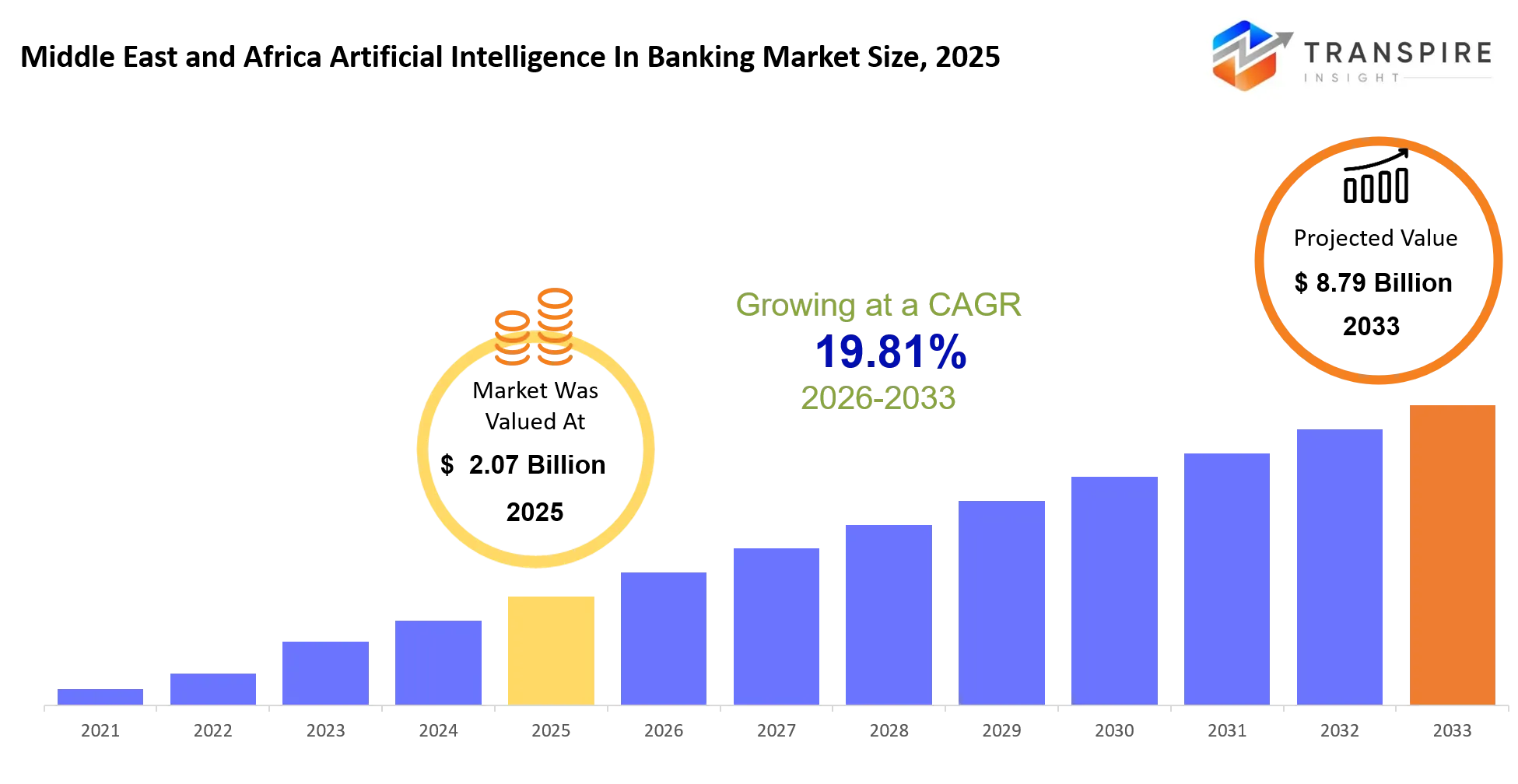
- Middle East and Africa Artificial Intelligence In Banking Market Size 2025: USD 2.07 Billion
- Middle East and Africa Artificial Intelligence In Banking Market Size 2033: USD 8.79 Billion
- Middle East and Africa Artificial Intelligence In Banking Market CAGR: 19.81%
- Middle East and Africa Artificial Intelligence In Banking Market Segments: By Solution Type (Chatbots, Fraud Detection Systems, Credit Scoring Solutions, Risk Management Solutions, Robo-Advisors, Predictive Analytics, Others); By Deployment Mode (Cloud-Based, On-Premise, Hybrid, Others); By Application (Customer Service, Fraud Detection, Compliance Management, Wealth Management, Loan Processing, Others); By End User (Retail Banks, Commercial Banks, Investment Banks, FinTech Companies, Others)
To learn more about this report,  Download Free Sample Report
Middle East and Africa Artificial Intelligence In Banking Market Summary
The Middle East and Africa Artificial Intelligence In Banking Market was valued at USD 2.07 Billion in 2025. It is forecast to reach USD 8.79 Billionby 2033. That is a CAGR of 19.81% over the period.
The Middle East and Africa Artificial Intelligence In Banking Market plays a critical role in helping banks do things like automate decision-making , detect fraud in real time and assess credit risk, also personalize customer interactions, and handle regulatory compliance in a more efficient way. In practice, AI lets financial institutions process big volumes of transactions and customer data while cutting operational costs and raising service quality at the same time, even if it sounds simple on paper.
Over the last five years, the whole market shifted away from basic automation tools toward generative AI, predictive analytics, and AI-driven banking platforms that are now integrated into core banking systems. A major structural change happened too, with more banking workloads moving to cloud-based environments, so banks can roll out advanced AI models at scale, more or less without the usual bottlenecks. Then, after the post pandemic acceleration of online financial services, the expansion of digital banking and fintech ecosystems reshaped adoption patterns in a pretty noticeable way.
Right now, as banks deal with higher transaction volumes, stronger cybersecurity threats, and tighter compliance requirements, AI investments are moving from small pilots and experimental efforts into enterprise-wide deployments. This is also creating new revenue streams for both technology providers and banking institutions.
Key Market Insights
- The GCC region basically dominates the Middle East and Africa Artificial Intelligence In Banking Market , pulling in something like 45% + share around 2025.
- Meanwhile Sub-Saharan Africa is seen as the fastest-growing regional market through 2033 because mobile banking is spreading, plus financial inclusion efforts are really picking up.
- On the solution side, fraud detection together with risk management tools makes up roughly 30% of the total market revenue, mainly as digital transactions keep multiplying.
- Customer experience , and also conversational AI platforms, sit as the second-largest slice, since banks are modernizing how they do digital engagement most days.
- Generative AI is forecast to keep growing at above 25% per year from 2026 to 2033, in other words, it’s not slowing down.
- For applications, retail banking stays the top area with more than 40% share, pushed by customer onboarding needs and personalization requirements that just don’t go away.
- Compliance and anti-money laundering use cases are also among the quickest AI deployments, largely because regulatory scrutiny is getting tougher.
- Looking at end users, large commercial banks account for close to 60% of spending, but digital banks and fintech firms are the ones expanding faster.
- On the vendor list, IBM , Microsoft, Google Cloud, AWS, Oracle, and Temenos keep widening their presence via cloud-native AI platforms and banking-specific solutions.
- And competition is getting sharper too, with vendors leaning into explainable AI, responsible AI frameworks, and real-time analytics capabilities to lock in longer-term banking contracts.
What are the Key Drivers, Restraints, and Opportunities in the Middle East and Africa Artificial Intelligence In Banking Market?
The strongest force that really seems to push market expansion is the fast digital transformation of banking operations across the Gulf Cooperation Council countries as well as some major African financial centers. In practice, banks are now processing notably larger volumes of digital payments, mobile banking activities, and online customer interactions compared to what they were handling five years ago. And because of that change traditional rule based systems end up being less effective, especially when it comes to fraud detection , credit assessment, and even customer service. AI platforms basically let institutions examine huge sets of transactions in real time, cut down the number of false alerts, and raise overall operational efficiency. So the outcome is pretty direct—banks are setting aside bigger technology budgets for AI enabled platforms. That in turn creates clear revenue chances for software vendors, cloud providers, and system integrators too.
\The biggest constraint however is still the lack of high quality banking data infrastructure and, at the same time, specialized AI talent across a few emerging economies in the region. A lot of financial institutions still rely on legacy core banking systems. Those setups are hard to blend with modern AI platforms, and they can be expensive as well. These kinds of structural issues end up slowing down launch timelines, pushing implementation costs upward, and also trimming the speed at which banks can actually see returns on investment.
Looking ahead, a big opportunity is generative AI combined with agent based banking platforms. Banks are starting to roll out AI copilots for customer support, product design, compliance investigations, and financial advisory services. Also the UAE and Saudi Arabia are showing up as regional hubs for AI infrastructure investments, plus cloud data centers. That mix creates conditions that feel favorable for wide scale AI adoption , at least compared to other places in the region.
What Has the Impact of Artificial Intelligence Been on the Middle East and Africa Artificial Intelligence In Banking Market?
Artificial intelligence has pretty much changed how banks across the Middle East and Africa handle day to day operations, customer ties, and risk. In many places, financial institutions now lean on AI powered automation to run through loan applications, watch transactions, flag suspicious behavior, and also speed up regulatory reporting. Automated compliance tools can scan huge transaction streams in real time, which cuts back the manual checks, and it tends to push decisions faster.
Then there are machine learning models that are increasingly used for fraud detection, credit scoring, customer segmentation, and predictive risk evaluation. They look at customer behavior and transaction history to spot unusual signals before actual losses start piling up. Plus, advanced analytics are used to guess customer churn, tune product suggestions, and improve cross selling chances. AI enabled money laundering and fraud prevention solutions have been showing noticeable drops in false positive alerts, so compliance teams can work more efficiently, and the overall operations feel more productive.
On the operations side, banks often see faster customer onboarding, reduced processing costs, better service uptime and, yes, more precise risk control. Generative AI assistants are also improving employee output by helping teams move quicker with reporting, product development, and customer support. Still, AI adoption isn’t a smooth ride everywhere. Merging AI into older banking platforms is costly, and some institutions do not have enough solid, high quality data to train the models in a reliable way. Data privacy rules, governance demands, and the usual regulatory expectations keep shaping how these tools are rolled out across the region.
Key Market Trends
- Since 2022, adoption of generative AI sort of moved from small pilot programs into production deployments, across many major regional banking institutions.
- Cloud based AI banking platforms rose quite a bit, as GCC banks leaned harder into digital transformation , during 2024 and 2025.
- AI powered fraud detection systems now end up handling millions of transactions every single day, which cuts the investigator workload by more than 30% in some setups.
- Meanwhile real time compliance monitoring solutions started gaining traction after tighter AML and financial crime rules were introduced across different markets, one after another.
- More than 75% of banks worldwide are actively probing generative AI initiatives, and that has been shaping regional funding priorities, pretty directly.
- Banking software vendors also increasingly tuck AI copilots right into core banking platforms, instead of pushing a stand alone product.
- Strategic partnerships between cloud providers and banking technology firms sped up through 2025 and 2026, and yes it shows in the rollout pace.
- Explainable AI frameworks came up as a competitive edge, because regulators are asking for transparency in automated financial decisions.
- Banks shifted their spend toward predictive analytics, and also customer intelligence tools, to support retention and more personalized product recommendations.
- Finally, regional AI infrastructure investments in Saudi Arabia and the UAE picked up, leading to faster deployment of large scale banking AI applications.
Middle East and Africa Artificial Intelligence In Banking Market Segmentation
By Solution Type
The solution type segment kinda points out that artificial intelligence tools back up banking operations, mostly via automation, analytics , and decision support, like that. Chatbots are in an important spot here because financial institutions use conversational interfaces to deal with customer questions, account services, and those routine transactions , all day long. Fraud Detection Systems also matter a lot since they help spot suspicious transaction patterns. In turn, they reduce financial losses and strengthen security controls across digital banking channels. Credit Scoring Solutions back lending choices by looking at customer data, financial behavior, and risk indicators, with more speed and also a certain steadiness.
Then there are Risk Management Solutions which assist institutions in keeping an eye on financial exposure, operational risks , and regulatory requirements in these complicated banking surroundings. Robo-Advisors help with investment planning and portfolio management through automated recommendations that are based on customer preferences along with financial goals. Predictive Analytics lets organizations foresee customer behavior, product demand, and possible business risks by working through huge volumes of data. Other options exist too, for example specialized artificial intelligence applications built for odd banking requirements, emerging technologies, and institution-specific operational objectives.
By Deployment Mode
The deployment mode segment kind of mirrors how banking organizations roll out artificial intelligence technologies, guided by day-to-day operational priorities security requirements, and what their infrastructure can really handle. Cloud-Based deployment, has a substantial share, largely because cloud environments bring scalability and flexibility, plus quicker access to advanced computing resources. Financial institutions are increasingly moving toward cloud platforms in order to run large-scale data processing, machine learning workloads and also those digital banking initiatives. And yeah, cloud adoption can lower how much time and effort goes into infrastructure management, while still enabling ongoing system upgrades, without too much headache.
Meanwhile On-Premise deployment is still a thing for organizations that strongly prefer direct control over sensitive financial information and their internal technology surroundings. Hybrid deployment keeps gaining attention, because many institutions want the cloud’s elasticity, but also need on-site security and compliance management lined up. This method lets organizations juggle performance, cost efficiency, and regulatory duties across different workloads, more or less at the same time. Others meanwhile use alternative deployment arrangements, designed to satisfy specific operational needs technological boundaries, or regulatory requirements within banking contexts, depending on the situation.
By Application
The application segment shows, sort of indirectly, how artificial intelligence helps with major banking operations across customer engagement, security management, and operational efficiency activities, or whatever you want to call it. Customer Service is a big application area, mainly because financial institutions are more and more relying on intelligent systems to raise response times , keep service availability steadier, and push customer satisfaction higher. Fraud Detection still feels like a top investment focus as digital transactions keep expanding through online plus mobile banking channels. Advanced analytical tools support the spotting of odd behavior, and in turn they strengthen financial security frameworks that otherwise stay pretty static.
Compliance Management supports staying aligned with regulatory requirements by means of automated monitoring, reporting, and risk assessment processes, which sounds simple but it helps a lot. Wealth Management benefits from data driven insights that can improve investment recommendations, portfolio strategies, and the whole customer engagement side. Loan Processing applications assist with document evaluation, credit assessment, and approval workflows , which in practice cuts processing times and reduces operational burdens. There are also other areas, like specialized banking applications that are built for evolving business needs, technical progress, and newly appearing financial services, even if those categories overlap a bit.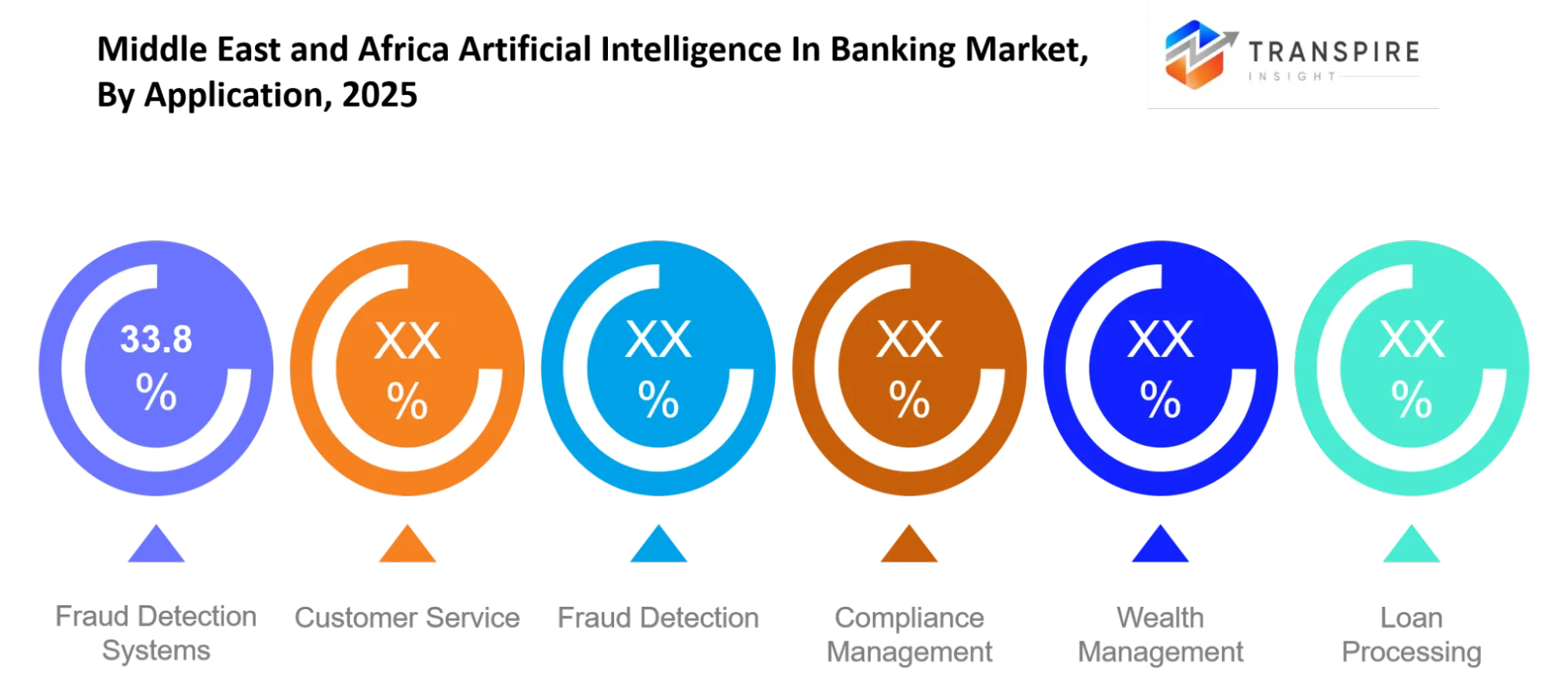
To learn more about this report, Download Free Sample Report
By End User
The end user segment kinda points to the organizations that employ artificial intelligence technologies to bump up operational performance, customer experience, and financial decision-making. Retail Banks take a big chunk here because those large customer bases create a lot of demand for automation, personalization, and more modern digital banking services. Commercial Banks lean on advanced analytical tools so they can strengthen risk assessment, lend ing operations, and also regulatory compliance work. Technology adoption tends to improve efficiency too, while it helps manage all those complicated financial operations.
Investment Banks use artificial intelligence for market analysis, trading operations, portfolio management, and research related tasks. FinTech Companies keep expanding their use since their innovative business models basically require automation, predictive analytics, and digital customer engagement. With rapid integration, organizations can deliver service quicker, and scale operations in a more reliable way. And then there are others, like specialized financial institutions and service providers that deploy artificial intelligence solutions for particular business goals, plus whatever market requirements are shifting over time.
What are the Key Use Cases Driving the Middle East and Africa Artificial Intelligence In Banking Market?
Fraud detection and risk management are still the big ones, kind of driving AI adoption every time. Banks lean on machine learning models to watch transaction patterns, spot suspicious behaviors, and stop financial losses in real time, you know. And this use case creates serious investment, because it hits operational security compliance outcomes and customer trust straight on.
Then there is also customer experience optimization, which is a major growth area too. Financial institutions are rolling out virtual assistants, more intelligent chatbots, and some recommendation engines to raise customer engagement across mobile plus online banking. Wealth management firms and retail banks are using predictive analytics more and more to personalize financial offerings and services.
More emerging stuff includes generative AI powered financial advisors, automated systems for regulatory reporting, and AI copilots meant for bank staff. These solutions are still taking shape but they have solid potential to reshape product development, customer service, and even the internal decision-making process over the forecast period.
|
Report Metrics |
Details |
|
Market size value in 2025 |
USD 2.07 Billion |
|
Market size value in 2026 |
USD 2.48 Billion |
|
Revenue forecast in 2033 |
USD 8.79 Billion |
|
Growth rate |
CAGR of19.81% from 2026 to 2033 |
|
Base year |
2025 |
|
Historical data |
2021 - 2024 |
|
Forecast period |
2026 - 2033 |
|
Report coverage |
Revenue forecast, competitive landscape, growth factors, and trends |
|
Regional scope |
Middle East and Africa (Saudi Arabia, United Arab Emirates, South Africa, Rest of Middle East and Africa) |
|
Key company profiled |
IBM, Microsoft, Google Cloud, AWS, Oracle, SAP, SAS Institute, FIS, Fiserv, Temenos, Salesforce, NVIDIA, Infosys Finacle, Accenture, Cognizant |
|
Customization scope |
Free report customization (country, regional & segment scope). Avail customized purchase options to meet your exact research needs. |
|
Report Segmentation |
By Solution Type (Chatbots, Fraud Detection Systems, Credit Scoring Solutions, Risk Management Solutions, Robo-Advisors, Predictive Analytics, Others); By Deployment Mode (Cloud-Based, On-Premise, Hybrid, Others); By Application (Customer Service, Fraud Detection, Compliance Management, Wealth Management, Loan Processing, Others); By End User (Retail Banks, Commercial Banks, Investment Banks, FinTech Companies, Others) |
Which Regions are Driving the Middle East and Africa Artificial Intelligence In Banking Market Growth?
The Gulf Cooperation Council region seems to lead the market, with the United Arab Emirates and Saudi Arabia basically taking the largest slice of regional investment. Strong government driven digital transformation programs , advanced financial infrastructure, and a lot of cloud investment really keep that leadership spot intact . In these countries , banks are actively rolling out AI for fraud detection, compliance management ,and also for more direct customer engagement. Add to that the presence of major technology providers, plus the continued expansion of AI data center investments, and the regional ecosystem feels even more durable.
South Africa is showing up as the second-largest contributor to market revenue. But unlike the GCC, its growth is supported by a mature banking sector, well established financial regulations, and consistent modernization of technology programs. Big commercial banks keep funding analytics, cybersecurity, and customer intelligence platforms. Overall, this forms a fairly stable setup for long term AI deployment and also for that recurring technology spending you tend to see over time.
The remainder of Sub-Saharan Africa is expected to capture the highest growth momentum through 2033. Rapid expansion of mobile banking, digital payments, and financial inclusion programs has built a large foundation of digital financial users. Meanwhile, new investments in fintech infrastructure and cloud connectivity are steadily making it easier for AI adoption to happen at scale. For investors, and technology providers as well, this area offers real opportunities to serve underbanked populations, while also supporting emerging digital financial ecosystems.
Who are the Key Players in the Middle East and Africa Artificial Intelligence In Banking Market and How Do They Compete?
Market competition is, kind of moderately concentrated, with global cloud providers, banking software vendors, and consultancies all pushing their way forward via tech capability, AI performance, regulatory compliance and cloud integration know how. Lately the balance seems to tilt toward firms that can deliver banking-specific AI solutions, not just general-purpose AI platforms. Since banks want outcomes they can actually measure vendors end up racing on automation efficiency, explainability, and scalability.
Microsoft uses Azure cloud infrastructure, plus generative AI, to handle banking workloads at large scale. With help from collaboration with banking technology providers, financial institutions can roll out AI services and still keep regulatory compliance in place. Temenos sets itself apart using AI-native banking applications, placed right inside core banking systems. It has brought in AI-powered compliance tools, generative AI solutions, and banking copilots that are designed for financial institutions, not as a generic add-on.
Oracle leans into integrating AI across financial operations, payment modernization, and enterprise banking platforms. The move is basically a mix of expanding cloud infrastructure together with industry-specific AI applications. IBM and AWS compete using hybrid cloud architectures, advanced analytics, and AI deployment frameworks built for regulated financial settings. At the same time, Accenture and Cognizant expand through implementation services, AI integration experience, and big banking transformation programs.
Company List
- IBM
- Microsoft
- Google Cloud
- Amazon Web Services (AWS)
- Oracle
- SAP
- SAS Institute
- FIS
- Fiserv
- Temenos
- Salesforce
- NVIDIA
- Infosys Finacle
- Accenture
- Cognizant
Recent Development News
In May 2026, Atos entered a partnership with Backbase. The collaboration supports secure AI-native banking transformation across regulated markets in Africa and the Middle East, accelerating adoption of AI-driven banking platforms.https://atos.net/en/2026/
In September 2025, Temenos launched its AI-powered Money Movement & Management platform. The solution integrates payments, accounts, treasury, and risk management functions, helping banks streamline operations and improve transaction efficiency.https://www.temenos.com
What Strategic Insights Define the Future of the Middle East and Africa Artificial Intelligence In Banking Market?
The market is drifting, sort of, toward AI-native banking ecosystems where intelligent automation gets built in across basically every stage of banking operations, instead of sitting there as a separate technology layer. And yeah this shift is likely being pushed by cloud infrastructure expansion, generative AI maturing, and that growing pressure for real-time financial choices and decisions. Over the next seven years, banks and institutions that manage to weave AI into their core banking platforms will probably end up with more day to day operational efficiency, plus better ways to connect with customers.
There’s also a less obvious risk, the kind that stays in the background. It’s the market becoming more concentrated around a small handful of cloud and AI infrastructure providers. If a financial institution leans too hard on only a limited set of tech ecosystems, it could face higher operational headaches and regulatory exposure. At the same time, agentic AI and autonomous banking assistants are showing up as a real opportunity, but in many parts of the region it still feels largely unused, not fully tapped yet.
So for market players, the most workable play is to put emphasis on explainable AI, choose deployment models that fit the rules, and keep cloud architectures scalable and ready. The companies that match AI innovation with governance requirements, will be in a better position for long-term value, as banking modernization speeds up across Middle East and Africa.
Middle East and Africa Artificial Intelligence In Banking Market Report Segmentation
By Solution Type
- Chatbots
- Fraud Detection Systems
- Credit Scoring Solutions
- Risk Management Solutions
- Robo-Advisors
- Predictive Analytics
- Others
By Deployment Mode
- Cloud-Based
- On-Premise
- Hybrid
- Others
By Application
- Customer Service
- Fraud Detection
- Compliance Management
- Wealth Management
- Loan Processing
- Others
By End User
- Retail Banks
- Commercial Banks
- Investment Banks
- FinTech Companies
- Others
Frequently Asked Questions
Find quick answers to common questions.
The Expected Middle East and Africa Artificial Intelligence In Banking Market size for the market will be USD 8.79 Billion in 2033.
Key Segments for the Middle East and Africa Artificial Intelligence In Banking Market are By Solution Type (Chatbots, Fraud Detection Systems, Credit Scoring Solutions, Risk Management Solutions, Robo-Advisors, Predictive Analytics, Others); By Deployment Mode (Cloud-Based, On-Premise, Hybrid, Others); By Application (Customer Service, Fraud Detection, Compliance Management, Wealth Management, Loan Processing, Others); By End User (Retail Banks, Commercial Banks, Investment Banks, FinTech Companies, Others).
Major Middle East and Africa Artificial Intelligence In Banking Market players are IBM, Microsoft, Google Cloud, AWS, Oracle, SAP, SAS Institute, FIS, Fiserv, Temenos, Salesforce, NVIDIA, Infosys Finacle, Accenture, Cognizant.
The Current Middle East and Africa Artificial Intelligence In Banking Market size is USD 2.07 Billion in 2025.
The Middle East and Africa Artificial Intelligence In Banking Market CAGR is 19.81% from 2026 to 2033.
- IBM
- Microsoft
- Google Cloud
- Amazon Web Services (AWS)
- Oracle
- SAP
- SAS Institute
- FIS
- Fiserv
- Temenos
- Salesforce
- NVIDIA
- Infosys Finacle
- Accenture
- Cognizant
About the Authors

Mayur Shinde
I am Mayur Shinde, a Senior Research Analyst at Transpire Insight, specializing in the Automotive & Transportation and Information & Communication Technology (ICT) Industry. My work focuses on analyzing emerging market trends, technological advancements, competitive landscapes, and industry developments to deliver accurate, data-driven insights. I am passionate about transforming complex market information into clear, actionable content that helps businesses, professionals, and decision-makers stay informed and make confident strategic decisions.

Chakradhar Khansole
Chakradhar serves as the Research Director at Transpire Insight, bringing over 8 years of experience in technology, innovation, and strategic market intelligence. He specializes in transforming complex market data into actionable business insights that enable organizations to make informed, growth-oriented decisions. Recognized for his strategic vision and analytical expertise, Chakradhar leads high-impact research initiatives, delivering comprehensive market assessments, competitive intelligence, and forward-looking industry analysis.
Recently Published Reports
-
Apr 2026
3D Optical Profiler Market
3D Optical Profiler Market Size, Share & Analysis Report By Type (Desktop 3D Optical Profiler, and Portable 3D Optical Profiler), By Technology (Confocal Technology, and White Light Interference), By End-Use Industry (Manufacturing, Research Institutions, Automotive, Aerospace and Defense, Medical Devices, and Other), and Geography (North America, Europe, Asia-Pacific, Middle East and Africa, South and Central America), 2021 - 2031
-
Apr 2026
Depth Sensor Market
Depth Sensor Market Size, Share & Analysis Report By Type (Infrared Depth Sensors, Time-of-Flight (ToF) Sensors, Stereo Vision Sensors, Structured Light Sensors, Ultrasonic Depth Sensors), By Application (Automotive, Robotics, Gaming, Consumer Electronics, Industrial Automation, Healthcare, Security & Surveillance, Others), By End Users (Automotive Manufacturers, Consumer Electronics Companies, Healthcare Providers, Industrial Companies, Security Agencies, Gaming Companies, Robotics Companies, Others), and Geography (North America, Europe, Asia-Pacific, Middle East and Africa, South and Central America), 2021 – 2031
-
Apr 2026
Digital Manufacturing Market
Digital Manufacturing Market Size, Share & Analysis Report By Component (Hardware, Software, and Services), By Technology (Robotics, 3D Printing, Internet of Things (IoT), and Others), By Application (Automotive and Transportation, Aerospace and Defense, Consumer Electronics, Industrial Machinery, and Others), By Process Type (Computer-Based Designing, Computer-Based Simulation, Computer 3D Visualization, Analytics, and Others), and Geography (North America, Europe, Asia-Pacific, Middle East and Africa, South and Central America), 2021 – 2031
-
Apr 2026
Digital Visa Services Market
Digital Visa Services Market Size, Share & Analysis Report By Type (Individual Travelers, Group Travelers), By Application (Tourism, Business Travel, Others), and Geography (North America, Europe, Asia-Pacific, Middle East and Africa, South and Central America), 2021 – 2031