
Middle East and Africa AI Supercomputer Market Size & Forecast:
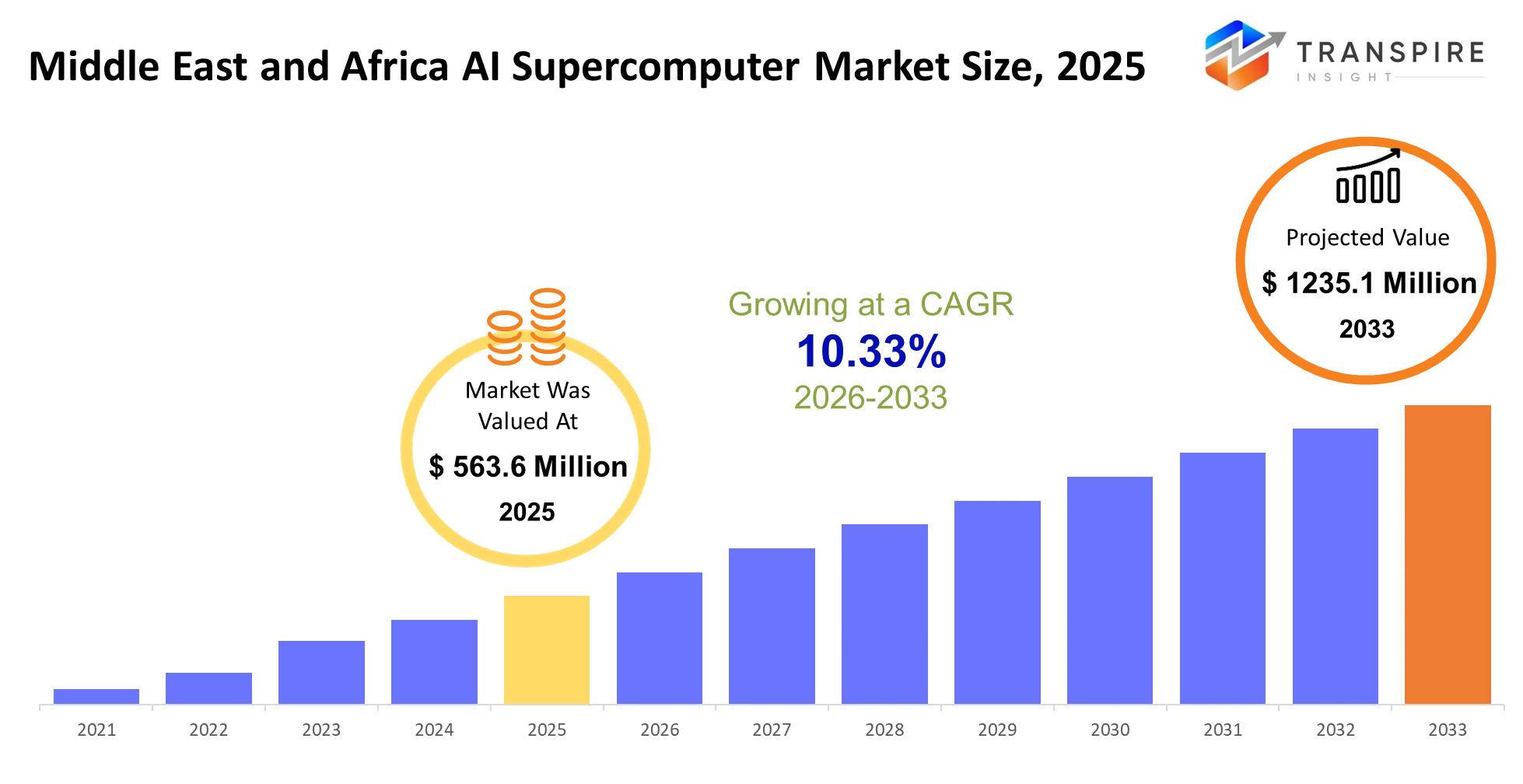
- Middle East and Africa AI Supercomputer Market Size 2025: USD 563.6 Million
- Middle East and Africa AI Supercomputer Market Size 2033: USD 1235.1 Million
- Middle East and Africa AI Supercomputer Market CAGR: 10.33%
- Middle East and Africa AI Supercomputer Market Segments: By Type (Hardware, Software, Services, AI Accelerators, Others); By Application (Scientific Research, Weather Forecasting, Drug Discovery, Defense, AI Training, Others); By End-User (Research Institutes, Government, Enterprises, Defense Organizations, Tech Companies, Others); By Deployment (On-premise, Cloud, Hybrid, Others).
To learn more about this report,  Download Free Sample Report
Middle East and Africa AI Supercomputer Market Summary
The Middle East and Africa AI Supercomputer Market was valued at USD 563.6 Million in 2025. It is forecast to reach USD 1235.1 Million by 2033. That is a CAGR of 10.33% over the period.
The Middle East and Africa AI Supercomputer Market basically lets governments, energy operators, and enterprises handle huge AI jobs like national language model training, energy system simulation, and defense analytics that honestly cant work on normal cloud infrastructure. In real life, it also helps with real time optimization for industrial systems, predictive modeling for oil and gas output, and big cybersecurity activities across sovereign digital networks, which is not the same as just “running an app” somewhere else.
Over the past 3–5 years, the market has gone through a noticeable structural change, away from generic cloud computing toward sovereign , GPU dense supercomputing campuses built for local AI training. This change got much stronger after 2022, when global semiconductor supply chain disruptions showed how fragile dependency can be and then encouraged Gulf governments to put money into domestic compute capacity. At the same time, stricter data sovereignty rules in Saudi Arabia and the UAE pushed hyperscalers and OEMs to deploy AI clusters inside the country, instead of doing offshore processing.
Because of that, capital flows have increased into the high performance computing ecosystem and the revenue picture is now more connected to long term GPU provisioning agreements and AI model training services. So adoption is becoming more aligned with national digital transformation roadmaps, not just routine enterprise IT cycles. That in turn has reshaped how procurement decisions are made across the region, bit by bit, and kind of permanently.
Key Market Insights
- In 2025 GCC region kind of dominates, with nearly 62% share, mostly because of Saudi Arabia and UAE sovereign AI campuses, plus a lot of hyperscale investments that keep stacking up.
- North Africa looks like the fastest-growing region over 2025–2032, mainly due to research computing getting bigger and the digital infrastructure programs that are rolling out.
- For product segmentation, AI accelerators take the lead with more than 48% share, and that basically tracks the fast GPU adoption used for large scale model training workloads.
- Hardware systems sit as the second-largest segment, as data centers expand high-density compute infrastructure across these sovereign cloud efforts.
- When it comes to deployment, hybrid deployment shows up as the fastest-growing segment from 2025–2030, because workload distribution is getting split between cloud and on-premise supercomputing nodes, and that split is sticking.
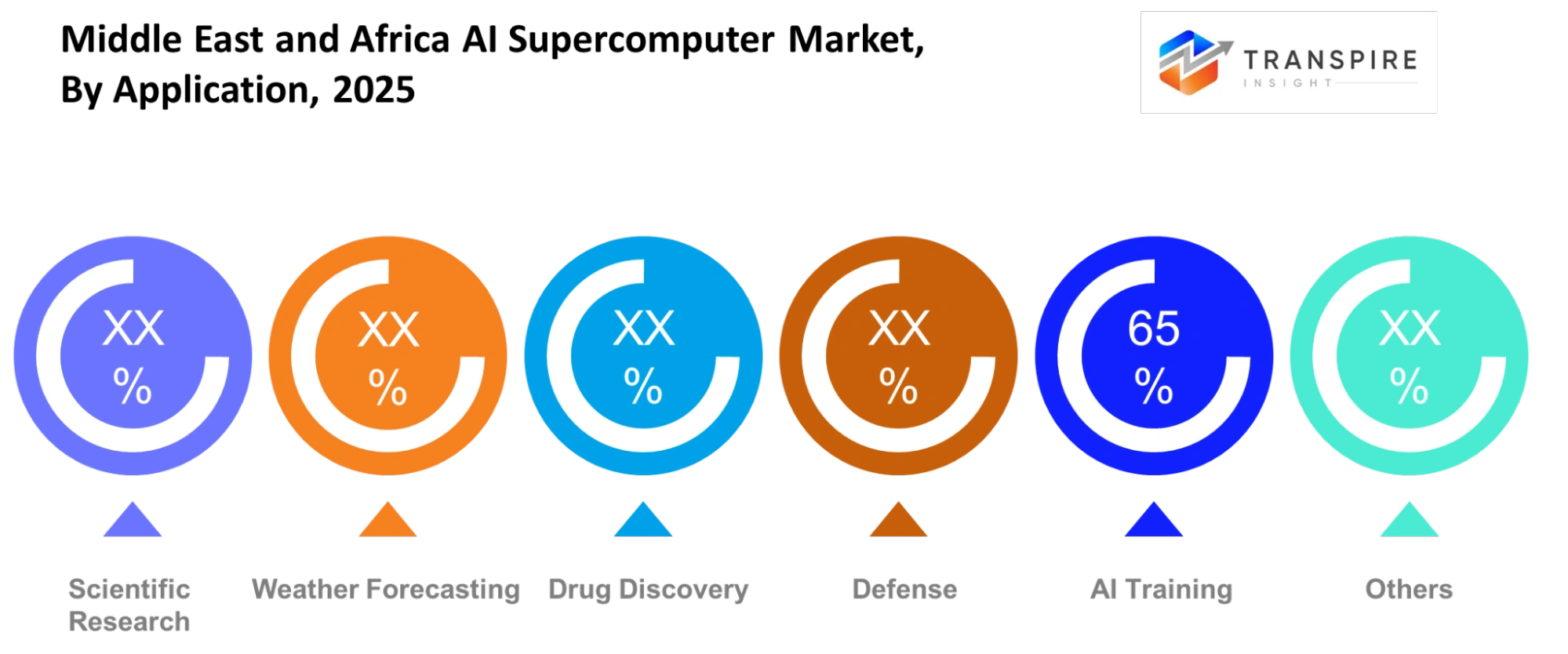
- In applications, AI training is the biggest chunk, at almost 55%, backed by national language models and enterprise scale generative AI development.
- Defense and cybersecurity workloads are emerging as the fastest-growing applications, due to rising geopolitical risk, and all the intelligence modernization programs in motion.
- For end users, government leads overall adoption at 58% share, driven by sovereign AI policies, and national digital transformation strategies too.
- Enterprises then become the fastest-growing end-user group, especially as financial services and energy sectors move into predictive analytics and simulation workloads.
- Product innovation leans toward energy-lean accelerators, AI-tuned servers , and scalable distributed compute architecture, in a kind of forward, quietly aggressive way.
What are the Key Drivers, Restraints, and Opportunities in the Middle East and Africa AI Supercomputer Market?
The main force pushing the Middle East and Africa AI supercomputer market forward is sovereign AI infrastructure development , mostly driven by national digital transformation programs in Saudi Arabia and the UAE. In practice governments kind of nudged this shift by emphasizing localized AI training capacity for defense , energy optimization and public sector analytics. That has then increased the buying of GPU-dense supercomputing clusters and also longer service contracts with hyperscalers and Tier-1 hardware vendors. So the whole revenue picture shifts, not just “cloud hosting” anymore, but also new streams that come from owning and running the capacity itself.
The biggest structural restraint, though, is the region’s reliance on imported semiconductor supply chains. This is especially true for advanced GPUs and AI accelerators, which means a lot depends on external availability. Procurement delays show up, pricing can swing, and the region has limited leverage when it comes to hardware availability, particularly during periods of global chip shortages. Because of that, rollouts of large-scale AI campuses can end up stretching past their intended cycles , which in turn tends to reduce near-term revenue realization. It also makes it harder for enterprises to adopt high-performance computing infrastructure at the pace they originally expected.
A clear emerging opportunity sits in energy-optimized AI supercomputing clusters, powered by renewable-integrated data centers. You can see this in Saudi Arabia’s NEOM and in the UAE’s clean energy zones. The projects blend low-carbon power with high-density compute design, aiming to support next-generation model training at scale. As the infrastructure starts maturing , roughly between 2026 and 2030, vendors that bring in energy-efficient GPU architectures and modular cooling systems should be able to win early long-term contracts. They can also lock in stronger, almost “preferred” positions inside sovereign AI ecosystems before competition fully intensifies.
What Has the Impact of Artificial Intelligence Been on the Middle East and Africa AI Supercomputer Market?
Artificial intelligence is sort of reshaping high-performance computing ecosystems across the Middle East and Africa , by enabling automated control optimization, and compliance over energy, defense, and industrial workloads that run on supercomputing platforms. Basically in practice, AI-driven orchestration tools manage GPU clusters by automatically allocating compute resources for model training, and they balance workloads across sovereign cloud nodes also reducing idle compute time in those big national AI campuses. In defense and energy-linked scenarios, AI systems also help automate monitoring of complex operational data streams, so control system responsiveness gets better in mission-critical environments, even when conditions get messy.
Machine learning models increasingly support predictive maintenance by looking at server temperature, GPU utilization patterns, and network latency to forecast hardware degradation before failures happen. And in energy and logistics simulations, AI-based forecasting improves performance optimization by adjusting computational models dynamically, which brings directional gains like 15–25% improvements in compute efficiency and less downtime in hyperscale environments. All these improvements end up meaning better resource utilization, and lower operational costs for data center operators, overall.
That said, adoption still hits a structural limitation , mostly because integration costs are high and there is a shortage of region-specific training data sets. Many AI models continue to depend on globally sourced data, but that doesn’t fully reflect regional climate, infrastructure load, or energy variability , so prediction accuracy drops in localized deployments.
Key Market Trends
- Since 2024, Saudi Arabia and UAE have been ramping up their sovereign AI funding, and you can see procurement moving away from pretty general cloud services toward dedicated supercomputing campuses, like not just renting but really building.
- Between 2023 and 2026, GPU demand jumped by more than 40% across the region, as AI training workloads kinda replaced traditional enterprise compute clusters, and it’s been a noticeable change.
- After 2025, hyperscalers such as Microsoft, and IBM pushed more localized data centers, so the need for cross-border cloud processing got smaller for regulated workloads.
- From 2024 onward, defense agencies shifted from imported analytics platforms to in-country AI supercomputing systems, for intelligence and surveillance operations.
- Between 2022 and 2026, enterprises leaned more toward hybrid deployment models, they overtook pure on-premise setups. The idea was scalable yet compliant AI processing frameworks, which sounds obvious but it happened fast.
- Since 2025, NVIDIA based accelerator ecosystems have been taking over new deployments, because regional AI labs standardized on GPU optimized training infrastructure, and that basically set the tone.
- Over 2023–2026, research institutes in North Africa increased their participation in climate and energy simulations, often using shared regional HPC clusters, even when budgets were tight.
- After 2024, cloud providers added AI workload orchestration tools, and compute utilization rates improved by nearly 25% across enterprise deployments, which surprised some teams.
- Since 2025, competition has shifted less about just hardware supply and more about full stack AI ecosystem control, including software, networking, and sovereign cloud services, not just one piece of the puzzle.
Middle East and Africa AI Supercomputer Market Segmentation
By Type
Hardware still seems to have the strongest position in the Middle East and Africa AI supercomputer market mostly because companies keep pouring money into GPU clusters, storage systems,and high-performance servers that are needed for very large compute jobs. The government backed AI campuses and hyperscale data centers also lean toward spending on physical infrastructure because compute density basically sets how fast training can happen and it also shapes national AI ability. Software and services are kinda second place ,but they are getting more attention now that orchestration layers and workload management tools are pulling more weight across hybrid setups.
AI accelerators create the clearest growth logic inside this part of the market, since demand is converging on high-throughput GPU deployments and also custom ASIC designs for model training and simulation type work. The energy rich Gulf countries often favor accelerator-heavy blueprints to back sovereign AI models and industrial optimization activities. Still, supply constraints together with high procurement costs slow things down, especially when you look at African markets where access to capital is weaker.
Over the forecast period this move toward more integrated hardware-software stacks will likely change how buyers plan purchases. Investors will probably zero in on modular infrastructure providers that bundle compute hardware with optimization software. And that change should favor vendors who can bring scalable, energy efficient architectures across distributed data center networks.
By Application
AI training is the main application segment because investment keeps flowing into large language models, national AI programs,and enterprise-scale analytics workloads. The computational load is high, and training tends to repeat in cycles, so it keeps demand steady for supercomputing capacity across both government environments and hyperscale facilities.
Defense and industrial simulation apps tend to create these kinda different, growth patterns because they really push for secure, high reliability compute settings, almost like it is non negotiable. In the energy space, operators lean on simulation models to tune extraction workflows and grid behavior, while defense teams lean on secure modeling for surveillance, plus threat analysis. As a result, these groups often want localized compute, so they limit how much they depend on foreign cloud infrastructure.
Next, the future push should gather around AI driven industrial optimization and climate modeling style use cases. Governments will keep folding predictive environmental systems into infrastructure planning, sort of turning forecasts into something actionable. Developers that can match their architectures to sector specific compliance and security needs will likely see steadier long term contract stability.
To learn more about this report, Download Free Sample Report
By End-User
In terms of who leads, government orgs sit at the front because of sovereign AI roadmaps, digital transformation programs, and national supercomputing efforts. Public sector demand is mostly about secure data processing, infrastructure planning , and improving citizen service delivery. Defense organizations stay in the picture too, since classified compute needs are still there, and procurement remains strongly security driven.
Enterprise adoption also grows at a steady pace, especially with financial services, telecom operators, and logistics firms using AI for automation and risk management. Tech companies expand usage via cloud based AI model training and platform creation. Research institutes keep a fairly consistent demand but generally at a smaller scale, compared to state backed deployments.
The future is gonna shift toward enterprise heavy consumption like, as cloud access expands and the expenses start to decline. You’ll likely see hybrid partnerships between government and private operators, these kinds of arrangements will grow infrastructure sharing in a kind of practical way. And the vendors who build flexible deployment models will end up pulling in more wide spread multi sector demand too, because people aren’t just buying one thing anymore.
By Deployment
On-premise deployment keeps a pretty strong position because data sovereignty needs , and also national security rules around sensitive AI workloads. In many cases governments and defense agencies lean toward localized compute infrastructure so they can keep direct control over data and the model training pipelines. This kind of setup continues to support heavy, long term investment in dedicated supercomputing facilities, even when budgets get tight.
The momentum in this segment is largely tied to regulatory frameworks that limit cross border data movement. They also push organizations to do localized AI processing instead of outsourcing everything. Cloud deployment meanwhile keeps expanding as hyperscale providers bring scalable compute options for enterprises and research organizations. Hybrid deployment is getting more traction where companies try to mix both worlds, putting the more sensitive stuff on-premise while still using cloud based training environments when it helps.
During the forecast period, hybrid deployment is expected to become the dominant architecture as workload complexity rises. Organizations will likely move toward distributed compute strategies, trying to balance cost efficiency with performance scalability. Vendors that can coordinate and orchestrate across cloud and on-premise systems with minimal friction should see a structural edge in long-term agreements .
What are the Key Use Cases Driving the Middle East and Africa AI Supercomputer Market?
The main thing that pushes the Middle East and Africa AI supercomputer market is basically the need for large-scale AI model training, especially for sovereign cloud setups and national digital transformation efforts. In practice, governments and state-backed organizations lean on serious compute power so they can handle industrial data, tune energy systems, and reinforce cybersecurity frameworks too. The demand really shows up where data centers back smart city initiatives and public-sector digital infrastructure, because huge datasets need constant, high-throughput processing, all the time.
At the same time, the use of these systems keeps spreading into things like industrial simulation, plus predictive analytics across energy and logistics. In the Gulf, oil and gas operators often rely on supercomputing for reservoir performance modeling, and to squeeze better extraction efficiency out of existing assets. Meanwhile logistics companies use AI clusters for route optimization, and for overall fleet efficiency. On the financial side, institutions are adding more need as they roll out risk modeling and real-time fraud detection across heavy transaction networks, so it’s not just one sector.
Newer use cases are also showing up, climate modeling for arid-region adaptation planning is one example, and AI-driven smart port optimization is another. African research groups and Gulf sustainability programs are increasingly running simulations around water scarcity and renewable integration scenarios. Overall, these types of workloads are expected to grow in size as governments connect supercomputing access with environmental resilience, and also with next-generation infrastructure roadmaps, which is kind of the big direction.
|
Report Metrics |
Details |
|
Market size value in 2025 |
USD 563.6 Million |
|
Market size value in 2026 |
USD 620.5 Million |
|
Revenue forecast in 2033 |
USD 1235.1 Million |
|
Growth rate |
CAGR of 10.33% from 2026 to 2033 |
|
Base year |
2025 |
|
Historical data |
2021 - 2024 |
|
Forecast period |
2026 - 2033 |
|
Report coverage |
Revenue forecast, competitive landscape, growth factors, and trends |
|
Regional scope |
Middle East and Africa (Saudi Arabia, United Arab Emirates, South Africa, Rest of Middle East and Africa) |
|
Key company profiled |
NVIDIA, IBM, HPE, Dell, Lenovo, Fujitsu, Cray, Intel, Google, Amazon, Microsoft, Huawei, Inspur, Atos, NEC. |
|
Customization scope |
Free report customization (country, regional & segment scope). Avail customized purchase options to meet your exact research needs. |
|
Report Segmentation |
By Type (Hardware, Software, Services, AI Accelerators, Others); By Application (Scientific Research, Weather Forecasting, Drug Discovery, Defense, AI Training, Others); By End-User (Research Institutes, Government, Enterprises, Defense Organizations, Tech Companies, Others); By Deployment (On-premise, Cloud, Hybrid, Others). |
Which Regions are Driving the Middle East and Africa AI Supercomputer Market Growth?
The Middle East really sits in that top spot for the AI supercomputer market, mostly because of these aggressive sovereign AI moves, plus a lot of state backed infrastructure spending. Places like Saudi Arabia and the UAE have made policy settings that , almost on purpose, keep channeling money into hyperscale data centers and into national AI compute platforms. A bunch of bigger efforts connected to Vision 2030 and the national digital transformation themes keep pushing ongoing buying of high performance computing systems. And it’s not just policy—there’s also that advantage of energy availability, which lets them run power hungry supercomputer clusters while still keeping operating costs fairly competitive. On top of that there’s a pretty mature ecosystem with hyperscalers, telecom operators, and sovereign wealth backed tech funds, so deployments don’t just happen once, they keep rolling through longer timelines.
Africa, meanwhile, is growing too but in a more stable and structurally different way. Here the momentum tends to come from enterprise digitization rather than big sovereign compute programs. South Africa leads adoption, mainly because it has comparatively more developed data center infrastructure, and financial as well as telecom sectors that are already fairly established. Compared with the Middle East, expansion tends to be incremental, and it’s more closely linked to multinational cloud rollouts rather than state-led supercomputing initiatives. Economic resilience in areas like banking, mining, and telecommunications helps keep demand steady for distributed AI workloads. So you end up with a revenue stream that’s reliable, but it’s lower intensity, which matters for providers that concentrate on hybrid and edge compute models.
If we talk about the fastest-growing area, it’s basically the Gulf Cooperation Council sub region inside the wider Middle East. That acceleration is being pulled along by a recent wave of AI sovereignty requirements, and also multi billion dollar partnerships with major global technology firms.New investments in Saudi Arabia’s AI campuses and UAE cloud expansions, have pretty much sped up compute capacity additions since 2025, noticeably. The whole thing seems to show a structural pivot, more like localized AI training, and less need to lean on outside cloud regions. For people entering the market, this feels like a high value opening window, where going in early with infrastructure positioning can lock in long term government contracts, and also anchor tenancy in the next generation supercomputing clusters through 2033.
Who are the Key Players in the Middle East and Africa AI Supercomputer Market and How Do They Compete?
The Middle East and Africa AI Supercomputer Market stays somewhat consolidated on the infrastructure level, but it gets really competitive when you look at platform and cloud services. In practice, global hyperscalers and HPC vendors are going head to head with initiatives that are backed by states, so you get this kind of dual structure where sovereign AI ambitions steer procurement choices. What mostly moves competition is access to high-density computing, the energy-efficient GPU design approach , and meeting regional data sovereignty requirements more than “cheaper” leadership. More and more governments in Saudi Arabia, the UAE, and some African innovation pockets end up favoring suppliers who can localize the compute infrastructure and handle big AI training loads inside national boundaries.
Microsoft Corporation is strengthening its position via sovereign cloud deployments and additional AI data center investments in the UAE, essentially betting on regulatory-compliant AI infrastructure that can support enterprise scale model training . IBM leans into hybrid cloud AI supercomputing setups, and it also teams up with energy and industrial players such as Aramco , so high performance computing gets woven into industrial optimization workflows. Huawei Technologies Co., Ltd. brings a vertically integrated model around AI hardware and networking, which helps it in running cost-efficient “full stack” AI cluster deployments across newer Gulf data center projects.
NVIDIA Corporation, meanwhile , tends to lead the accelerator tier through GPU ecosystem lock in, providing the AI supercomputing infrastructure that ends up backing most of the regional large-scale model training efforts.Meanwhile, Lenovo Group Limited is expanding, through modular HPC alongside edge AI systems that are sort of tailored for hybrid deployments, targeting enterprises that want scalable yet lower footprint compute infrastructure across Africa and the Gulf.
Company List
Recent Development News
In September 2025, NVIDIA Corporation and Abu Dhabi’s Technology Innovation Institute launched a joint AI and robotics research lab in the UAE. The initiative establishes the region’s first NVIDIA AI Technology Center to accelerate advanced AI model development and robotics computing capabilities.
Source: https://www.reuters.com
In March 2026, Microsoft announced expanded AI infrastructure investments in the United Arab Emirates as part of a $15.2 billion long-term commitment. The expansion strengthens cloud and AI supercomputing capacity across Gulf data centers, enabling large-scale AI model training and regional compute sovereignty.
Source: https://www.reuters.com
What Strategic Insights Define the Future of the Middle East and Africa AI Supercomputer Market?
Over the next 5–7 years, the Middle East and Africa Automotive Engine Management System Market is kinda shifting, structurally toward fully software-defined powertrain control, where ECU platforms are going to be treated more like continuously updated computing layers rather than fixed engine parts. I mean, this direction is pulled by tighter emissions alignment with European standards, and also by hybrid penetration that’s growing in Gulf mobility programs. On top of that OEMs increasingly lean on data driven calibration to keep control stable across really diverse operating conditions, across African and Middle Eastern fleets, so it all has to adapt, kind of constantly.
There’s another risk that is not so obvious until you look under the headlines: technology concentration inside a small group of global Tier-1 suppliers. That concentration can drive pricing rigidity and make localized innovation move slower, especially if supply chain diversification doesn’t deepen over time.
At the same time, there’s a fresh opportunity forming too, around edge-AI enabled retrofit ECUs for aging commercial fleets in North and West Africa. In those areas, full vehicle replacement cycles still feel economically constrained, but emissions enforcement is gradually tightening. For market participants, the most actionable strategy feels pretty clear: invest early in modular, software-upgradable EMS architectures that effectively separate the hardware lifecycle from the software revenue stream. That way, recurring monetization becomes more realistic, and dependency on one-time ECU replacement cycles can be reduced, even when budgets are tight.
Middle East and Africa AI Supercomputer Market Report Segmentation
By Type
- Hardware
- Software
- Services
- AI Accelerators
- Others
By Application
- Scientific Research
- Weather Forecasting
- Drug Discovery
- Defense
- AI Training
- Others
By End-User
- Research Institutes
- Government
- Enterprises
- Defense Organizations
- Tech Companies
- Others
By Deployment
- On-premise
- Cloud
- Hybrid
- Others
Frequently Asked Questions
Find quick answers to common questions.
The estimated Middle East and Africa AI Supercomputer Market size will beUSD 1235.1 Million in 2033.
Key segments for the Middle East and Africa AI Supercomputer Market are By Type (Hardware, Software, Services, AI Accelerators, Others); By Application (Scientific Research, Weather Forecasting, Drug Discovery, Defense, AI Training, Others); By End-User (Research Institutes, Government, Enterprises, Defense Organizations, Tech Companies, Others); By Deployment (On-premise, Cloud, Hybrid, Others).
Major Middle East and Africa AI Supercomputer Market players are NVIDIA, IBM, HPE, Dell, Lenovo, Fujitsu, Cray, Intel, Google, Amazon, Microsoft, Huawei, Inspur, Atos, NEC.
The Middle East and Africa AI Supercomputer Market size is USD 563.6 Million in 2025.
The Middle East and Africa AI Supercomputer Market CAGR is 10.33% from 2026 to 2033.
- NVIDIA
- IBM
- HPE
- Dell
- Lenovo
- Fujitsu
- Cray
- Intel
- Amazon
- Microsoft
- Huawei
- Inspur
- Atos
- NEC
Recently Published Reports
-
Apr 2026
3D Optical Profiler Market
3D Optical Profiler Market Size, Share & Analysis Report By Type (Desktop 3D Optical Profiler, and Portable 3D Optical Profiler), By Technology (Confocal Technology, and White Light Interference), By End-Use Industry (Manufacturing, Research Institutions, Automotive, Aerospace and Defense, Medical Devices, and Other), and Geography (North America, Europe, Asia-Pacific, Middle East and Africa, South and Central America), 2021 - 2031
-
Apr 2026
Depth Sensor Market
Depth Sensor Market Size, Share & Analysis Report By Type (Infrared Depth Sensors, Time-of-Flight (ToF) Sensors, Stereo Vision Sensors, Structured Light Sensors, Ultrasonic Depth Sensors), By Application (Automotive, Robotics, Gaming, Consumer Electronics, Industrial Automation, Healthcare, Security & Surveillance, Others), By End Users (Automotive Manufacturers, Consumer Electronics Companies, Healthcare Providers, Industrial Companies, Security Agencies, Gaming Companies, Robotics Companies, Others), and Geography (North America, Europe, Asia-Pacific, Middle East and Africa, South and Central America), 2021 – 2031
-
Apr 2026
Digital Manufacturing Market
Digital Manufacturing Market Size, Share & Analysis Report By Component (Hardware, Software, and Services), By Technology (Robotics, 3D Printing, Internet of Things (IoT), and Others), By Application (Automotive and Transportation, Aerospace and Defense, Consumer Electronics, Industrial Machinery, and Others), By Process Type (Computer-Based Designing, Computer-Based Simulation, Computer 3D Visualization, Analytics, and Others), and Geography (North America, Europe, Asia-Pacific, Middle East and Africa, South and Central America), 2021 – 2031
-
Apr 2026
Digital Visa Services Market
Digital Visa Services Market Size, Share & Analysis Report By Type (Individual Travelers, Group Travelers), By Application (Tourism, Business Travel, Others), and Geography (North America, Europe, Asia-Pacific, Middle East and Africa, South and Central America), 2021 – 2031