Medical Gases And Equipment Market Summary:
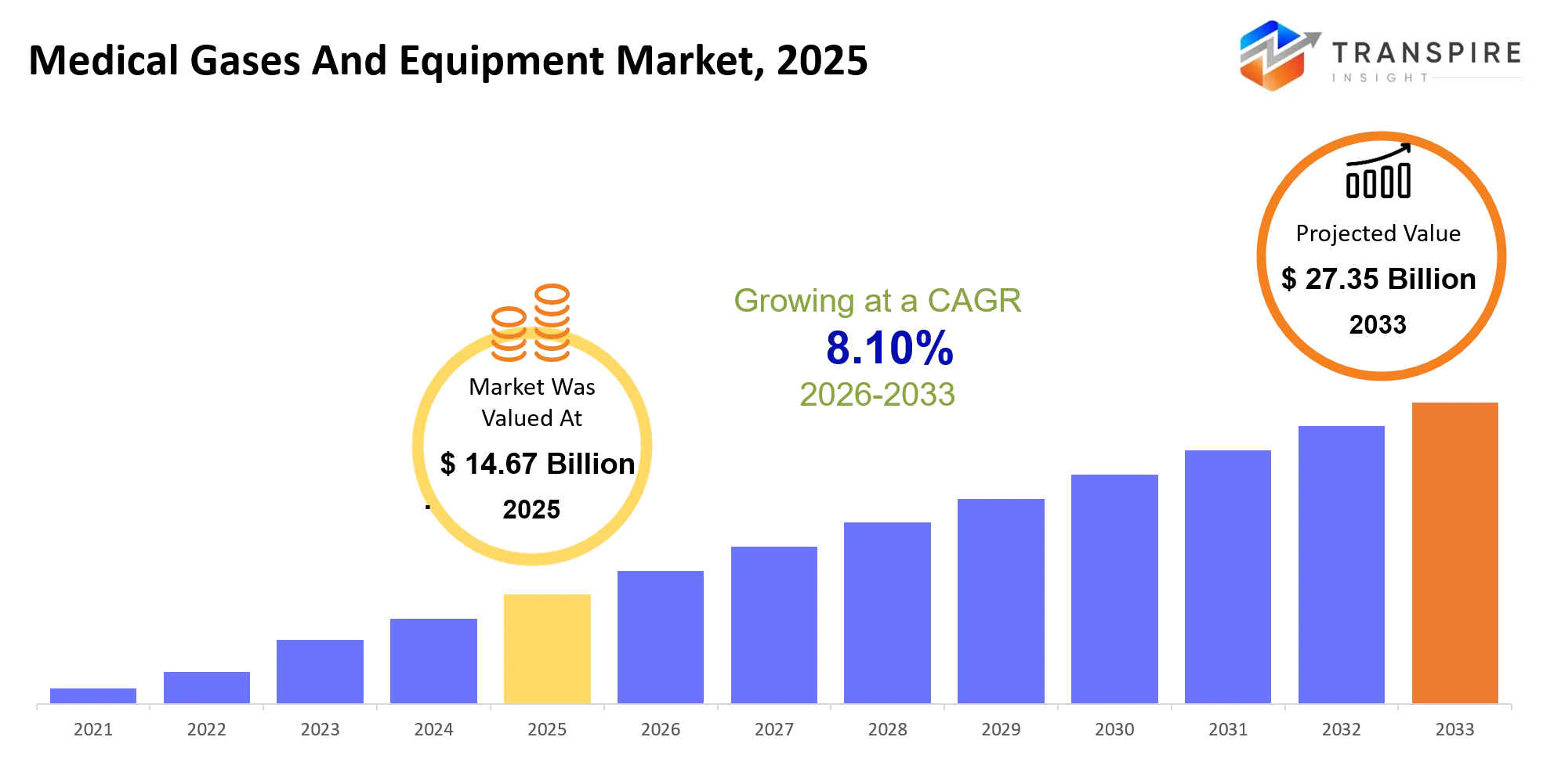
As per the Transpire Insight Analysis, The Medical Gases and Equipment Market size is estimated at USD 14.67 billion in 2025 and is anticipated to reach USD 27.35 billion by 2033, growing at a CAGR of 8.10% from 2026 to 2033.
The market supplies oxygen, medical air, anaesthetic gases, delivery networks and monitoring hardware that keep ICUs, operating rooms, ambulances and home-respiratory patients functioning safely. Over the past three to five years, a major change has been the shift from short-term emergency oxygen projects to national, long-term oxygen-access programmes. The Oxygen Strategic Framework proposed investment to expand access in low- and middle-income countries, reinforcing medical oxygen as permanent health infrastructure rather than a crisis-only resource. The key structural shift is from manually managed, externally supplied cylinders toward on-site pressure-swing adsorption plants, concentrators, piped networks and digitally monitored supply systems. WHO guidance now emphasises reliable facility-level oxygen ecosystems, including electricity, maintenance, trained personnel and data systems. Respiratory, surgical and ageing-care demand requires uninterrupted gas availability; this drives investment in backup supply, monitoring and portable respiratory equipment. The result is higher equipment attachment, servicing and replacement revenue alongside gas consumption.
Medical Gases And Equipment Market Size & Forecast:
- Market Size 2025: USD 14.67 Billion
- Expected Market Value (2033): USD 27.35 Billion
- Forecast CAGR (2026–2033): 8.10%
- Leading Region in 2025: North America
- Fastest Growing Region: Asia-Pacific
- Key Company Profiles: Linde, Air Liquide, Air Products, Messer Group, Nippon Sanso Holdings, SOL Group, Taiyo Nippon Sanso, Atlas Copco, Chart Industries, Praxair, Rotarex, GCE Group, Gentec, Amico Group, Dräger.
Key Medical Gases And Equipment Market Insights:
The market is evolving into an infrastructure and service business: Reliability of supply, digital visibility, and carbon reduction are increasingly shaping procurement decisions. Providers are transitioning away from cylinders to data-rich, resilient systems that enable intensive-care ward to home care.
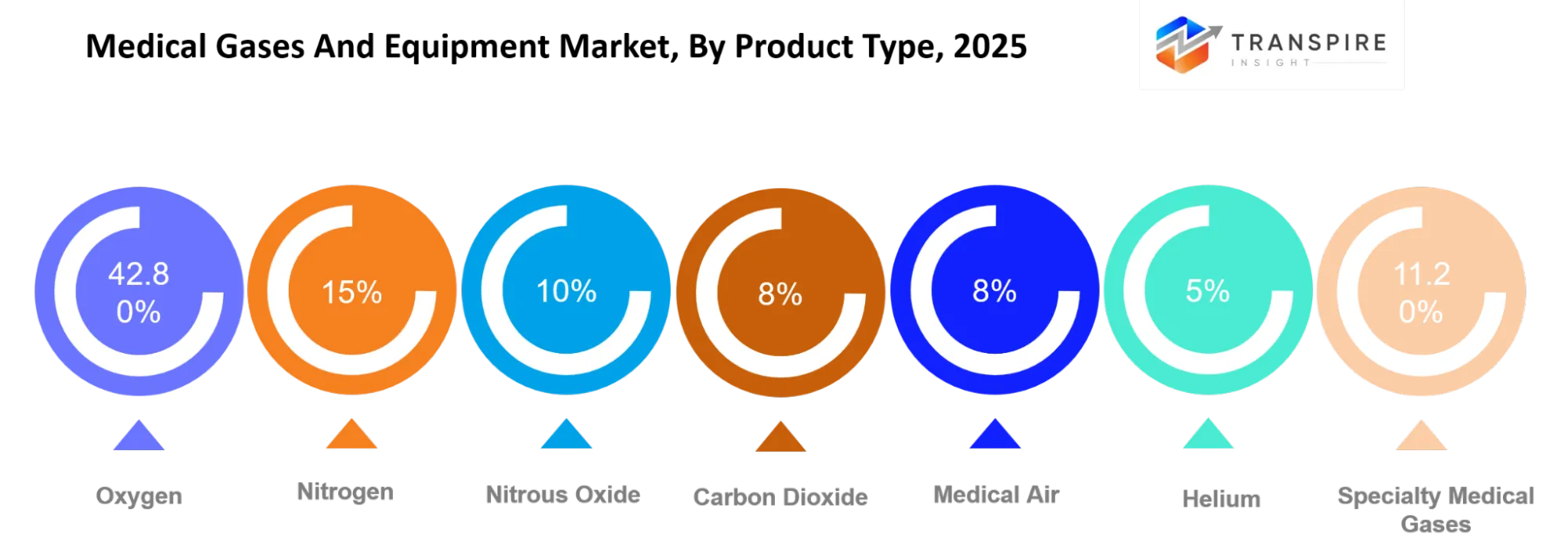
- Oxygen, 42.80%, remains the top priority as Linde increases PSA-related supply capability; hospitals prefer on-site generation in the event of disruption.
- Nitrogen, 15.00%, is used in cryogenic and laboratory applications, and Air Products distinguishes itself by bulk-supply engineering and logistics control.
- Speciality gases, 11.20%, benefit from precision diagnostics; Messer expands through application-specific mixtures and local technical service.
- Nitrous oxide, 10.00%, is the anchor of anaesthesia demand, while GCE Group pushes the safer side of flow-control devices with the advent of dose precision as a standard.
- Home respiratory care is driven by the oxygen concentrator, 8.40% CAGR, with Air Liquide's offering of equipment, digital support, and patient services.
- Carbon dioxide, 8.00%, remains vital to minimally invasive surgery; Rotarex advances valve safety as operating rooms seek traceability.
- Medical air, 8.00%, is used for compressor and filtration upgrades; Atlas Copco aims for energy-efficient, continuously monitored air systems.
- Helium, 5.00%, continues to be a specialist in imaging and respiratory applications, and Nippon Sanso is dedicated to supply security, given sourcing challenges.
- Monitors clinical distribution networks: Amico Group and Dräger support cylinder delivery. Air Liquide is already offering digital monitoring and controlling medical-gas parameters within hospital systems.
What are the Key Drivers, Restraints, and Opportunities in the Medical Gases And Equipment Market?
Driver:
The biggest growth catalyst is healthcare providers’ shift from emergency oxygen procurement to permanent supply resilience. The oxygen crisis revealed that cylinder availability, transport capacity, and oxygen purity can become immediate clinical constraints during respiratory surges. Hospitals are consequently upgrading pipelines, alarm systems, vacuum networks and oxygen-generation capacity, while home-care providers are deploying concentrators for long-term respiratory therapy. This increases revenue beyond gas volumes: every installed system requires regulators, flowmeters, backup manifolds, purity testing, maintenance and periodic replacement. WHO technical resources have also formalised oxygen-system planning as a health-facility capability rather than a temporary pandemic intervention.
Restraint:
High installation and compliance costs limit adoption, particularly in smaller hospitals and lower-resource markets. Pipeline systems, cryogenic storage, PSA plants, and alarm networks require engineering design, reliable electricity, trained biomedical teams, and recurring calibration. The constraint persists because medical-gas failure is a patient-safety risk; providers cannot simply substitute lower-grade industrial components or defer quality validation. Legacy infrastructure also makes digital retrofits complex.
Opportunity:
Decentralised oxygen generation and digitally managed equipment can reduce dependence on centralised cylinder logistics while improving visibility of consumption and asset condition. The opportunity is strongest in emerging healthcare systems and remote facilities where transport is costly or unreliable. For example, WHO’s 2025 health-facility specifications emphasise oxygen sources, storage, distribution, and safety, while its medical-device maintenance guidance promotes data-driven inventory and maintenance management. This creates room for connected concentrators, automated alarms, remote diagnostics, service contracts, and modular oxygen-generation projects. Service providers are also shifting toward maintenance and managed oxygen contracts, improving recurring revenue beyond initial equipment sales. It supports longer relationships.
What Has the Impact of Artificial Intelligence Been on the Medical Gases And Equipment Market?
AI shifts medical-gas management from reactive repairs to continuous control. Connected pressure sensors, flowmeters, purity analysers and pipeline alarms within hospitals provide data on oxygen flows, tank levels, line pressure and ward consumption; artificial intelligence-based models can recognise anomalous patterns (a probable leak, a blocked filter, a failing compressor or unusual ICU load) and send a maintenance alert before pressure drops below a safe level of delivery in an operating- or critical-care setting. AI can also support planning – for example, predicting daily oxygen demands based on patient occupancy, ventilator use, surgery schedules and past trends to help centres time bulk oxygen deliveries, manage PSA output and keep backup reserves.
For providers managing multiple sites, reduced emergency cylinder purchasing, less wasted gas and fewer technician callouts could mean significant savings, as well as more accurate reporting. However, this depends on a good infrastructure and connected sensors, as many older pipelines don't have compatible sensors, standards, or reliable connections, requiring capital investment and integration into building- and clinical-management systems. Poorly calibrated sensors or incomplete data can trigger false alarms, requiring clinical engineers to monitor and ensure they don't interfere with oxygen supply.
In August 2026, the published clinical trial results for the SAVE-O2 AI system utilising the O2matic carbon dioxide PRO100 autonomous oxygen titration device. The AI-driven system continuously monitored and dynamically adjusted oxygen flow in real time, keeping hospitalised patients within their target oxygen range 85% of the time compared to 63% under manual clinician care.
https://medicalxpress.com/news/2026-08-clinical-trial-ai-oxygen-delivery.html
Key Medical Gases And Equipment Market Trends:
The market is moving from logistics services for gas delivery to infrastructure-based, digitally managed clinical utility management. Today, reliability, purity visibility, and supply autonomy are at least as influential as the unit gas cost when it comes to purchasing.
- To minimise exposure to transport disruptions, hospitals are moving away from the cylinder-heavy workflow to PSA generation and bulk systems.
- Pipeline investments are increasingly incorporating digital pressure and purity alarms instead of periodic manual checks.
- The oxygen concentrator is playing a pivotal role in the decentralisation of respiratory care, taking therapy out of the acute ward.
- As home healthcare takes the place of longer hospitalisations, portable systems are growing lighter and more battery-friendly.
- Real-time consumption information is helping facility managers identify leaks, manage inventory and schedule backup power.
- Breakdown maintenance is being replaced by predictive maintenance for compressors, manifolds, valves and vacuum systems.
- More accurate electronic gas-control and respiratory-monitoring capabilities are being incorporated into anaesthesia workstations.
- Traceability, calibration and documented gas purity are becoming a more important focus for regulators and procurement teams.
- Increasingly, oxygen generation and redundancy are being seen as a component of core resilience infrastructure when building new hospitals.
- Suppliers are diversifying their offerings from gas supply to service contracts for monitoring, maintenance, and compliance support.
Medical Gases And Equipment Market Segmentation
Gas Type:
Oxygen demand demonstrates the highest share of 42.80% in the market owing to the vital necessity of oxygen for inhalation support, stabilisation, intensive care, surgical procedures, and for oxygen that is utilised for the treatment of nose and throat at home. Room oxygen has a chance to acquire a constant demand, which is not possible in the case of other gases. The application of cryogenically maintained gas also requires high requirements of nitrogen from labs and surgical procedures. Anaesthesia and pain adjustment are the major applications of nitrous oxide, which has a market share of 10.00%. Helium is used for specialised imaging, breathing, and various medical applications and holds 5.00% of the market share.
Equipment:
Gas cylinders retain importance for mobility, emergency reserves, and backup supply, while oxygen concentrators are the fastest-growing category at an 8.40% CAGR, supported by home respiratory care and decentralised facilities. Regulators, manifolds, and flowmeters are gaining importance as providers prioritise pressure stability and precise delivery. Gas-monitoring systems are becoming increasingly valuable for real-time visibility, alarms, and compliance. Cryogenic systems remain essential for hospitals and institutions requiring high-volume oxygen storage and continuous supply, particularly during demand peaks.
Application:
Therapeutic and respiratory care remain the principal revenue base because oxygen and medical gases are integral to critical treatment and long-term respiratory support. Surgical and anaesthesia applications sustain demand for controlled gas mixtures, accurate flow regulation, and reliable pipeline delivery. Diagnostic and laboratory applications broaden requirements for specialised gases and purity control, while emergency care depends on immediately available oxygen infrastructure. Home healthcare is expanding equipment utilisation as concentrators and portable systems enable respiratory treatment outside conventional hospital environments.
End User:
Hospitals remain dominant because their extensive infrastructure requires continuous multi-gas distribution, pipeline networks, monitoring, and backup systems. Clinics, ambulatory surgical centres, and diagnostic centres increasingly adopt compact equipment tailored to lower-volume procedures and targeted therapies. Home healthcare represents a strategic growth channel as respiratory treatment shifts toward decentralised care and patients require dependable concentrators and portable systems. Pharmaceutical companies and research laboratories provide additional demand for high-purity speciality gases, controlled environments, and precision gas-delivery equipment.
Delivery Mode:
Pipeline and bulk delivery remain central to high-throughput hospitals because they provide continuous gas availability across multiple departments. On-site generation is gaining relevance where healthcare providers prioritise supply continuity, reduced cylinder dependence, and greater logistics independence. Cylinder delivery remains essential for backup capacity, emergency response, smaller facilities, and remote locations. Liquid-gas delivery supports high-volume requirements, while portable systems enable mobility across home and field-care settings. These models increasingly operate as complementary layers within resilient medical-gas networks.
Gas Form:
Compressed gases remain fundamental to cylinders, pipelines, and routine clinical supply, while liquid gases support large-volume storage and distribution. Cryogenic gas systems remain important where hospitals require substantial reserves and reliable high-capacity supply. Medical air and vacuum are increasingly managed as engineered utilities requiring controlled pressure and continuous monitoring. Speciality gases and precisely formulated mixtures support anaesthesia, diagnostics, laboratory work, and pharmaceutical applications. This is encouraging providers to integrate gas generation, storage, monitoring, alarms, and distribution into centralised management systems.
What are the Key Use Cases Driving the Medical Gases And Equipment Market?
Oxygen remains the core use case, supported by its 42.80% gas-type share, and is central to respiratory support, intensive care, emergency treatment, surgery, and neonatal care. This supports investment in pipelines, cylinders, regulators, monitoring systems, and oxygen concentrators.
Expanding applications are moving respiratory care beyond acute hospitals into home healthcare, ambulatory settings, and long-term treatment. Oxygen concentrators, representing an equipment category growing at an 8.40% CAGR, support this shift by reducing reliance on cylinder delivery for selected patients.
Emerging uses include decentralised oxygen generation for remote facilities, digitally monitored gas systems, anaesthesia waste-gas capture, and predictive maintenance, linking medical gases with energy resilience, sustainability, and data-driven healthcare operations.
|
Report Metrics |
Details |
|
Market size value in 2025 |
USD 14.67 Billion |
|
Market size value in 2026 |
USD 15.86 Billion |
|
Revenue forecast in 2033 |
USD 27.35 Billion |
|
Growth rate |
CAGR of 8.10% from 2026 to 2033 |
|
Base year |
2025 |
|
Historical data |
2021 - 2024 |
|
Forecast period |
2026 - 2033 |
|
Report coverage |
Revenue forecast, competitive landscape, growth factors, and trends |
|
Regional scope |
United States; Canada; Mexico; United Kingdom; Germany; France; Italy; Spain; Denmark; Sweden; Norway; China; Japan; India; Australia; South Korea; Thailand; Brazil; Argentina; South Africa; Saudi Arabia; United Arab Emirates |
|
Key companies profiled |
Linde, Air Liquide, Air Products, Messer Group, Nippon Sanso Holdings, SOL Group, Taiyo Nippon Sanso, Atlas Copco, Chart Industries, Praxair, Rotarex, GCE Group, Gentec, Amico Group, Dräger |
|
Customization scope |
Free report customisation (country, regional & segment scope). Available customised purchase options to meet your exact research needs. |
|
Report Segmentation |
Gas Type (Oxygen, Nitrogen, Nitrous Oxide, Carbon Dioxide, Helium, Medical Air, Specialty Medical Gases); Equipment (Gas Cylinders, Regulators, Manifolds, Vacuum Systems, Oxygen Concentrators, Flowmeters, Gas Monitoring Systems, Cryogenic Systems); Application (Therapeutic, Diagnostic, Surgical, Respiratory Care, Anesthesia, Emergency Care, Home Healthcare, Laboratory); End User (Hospitals, Clinics, Ambulatory Surgical Centers, Home Healthcare, Diagnostic Centers, Pharmaceutical Companies, Research Laboratories); Delivery Mode (Cylinder Delivery, Bulk Delivery, Pipeline Systems, On-Site Generation, Liquid Gas Delivery, Portable Systems, Centralized Supply); Gas Form (Compressed Gas, Liquid Gas, Cryogenic Gas, Gas Mixtures, Specialty Gas, Medical Air, Vacuum). |
Which Regions are Driving the Medical Gases And Equipment Market Growth?
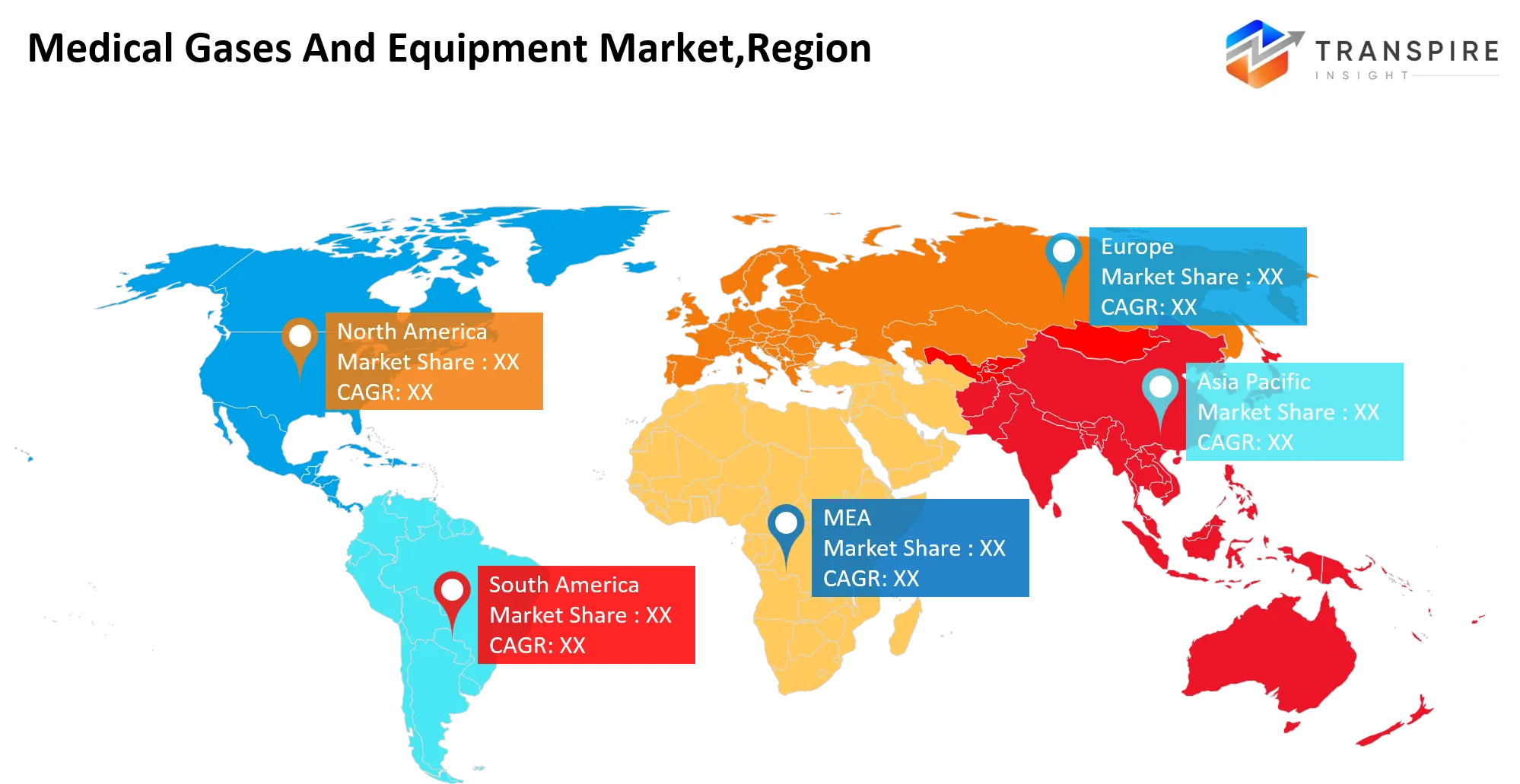
North America contributes 36.20% of the market owing to mature hospital systems, mature bulk-gas logistics, and robust piped gas infrastructure. North America has high outpatient surgery volume and acute-care capacity, which translates into increased oxygen, vacuum, monitoring, and portable equipment requirements. Strict safety, accreditation, and maintenance requirements drive the replacement of legacy alarms, manifolds, and flow-control equipment, as opposed to outright purchase. Leading players have the opportunity to leverage this ecosystem with long-term gas, equipment, and service contracts.
In July 2026, Air Liquide expanded its localised, multi-year medical gas contract capabilities by securing a major multi-year healthcare services agreement integrating medical gases with digital care platforms.
https://www.openpr.com/news/4615685/medical-gas-market-to-reach-us-68-31-billion-by-2033-driven
Europe makes up 29.00% of the market and is of a growth profile driven by compliance, sustainability, and capacity. The decarbonisation of hospitals, better energy efficiency and traceability of medical-gas supply all mean the demand for modernised delivery systems is high. Air Liquide's low-carbon medical-gas solution is already locked into 19 hospitals and clinics across six European countries, reflecting how environmental procurement is becoming a differentiator in the market. Ongoing public healthcare funding, demographics, and regulated replacement cycles all mean recurring replacement demand.
In June 2026, Air Liquide signed a strategic partnership with ArianeGroup, securing two major contracts for the operational phase of Ariane 6 to supply critical cryogenic equipment and propulsion gases.
https://www.airliquide.com/group/press-releases-news
Asia Pacific, representing a 25.00% share and the highest CAGR of 8.10%, is a market in transition with new-build hospitals, expanded critical-care capacity, and decentralised access. While recent investments in the Middle East and Africa are shifting the focus away from emergency cylinder procurement towards PSA, concentrators, and building capacity at healthcare facilities, compared to Europe, which is shifting towards retrofitting existing infrastructure, growth is at the secondary city and rural healthcare level through new-build. The highest-value opportunity within Asia Pacific remains a combination of low-cost onsite generation and a remote monitoring and technician training service. Latin America is 5.00%, Middle East & Africa 4.80%, with further growth potential.
In March 2026, Oxair India partnered with Zenox Gas Systems to develop a scalable PSA medical oxygen plant with smart automation that adjusts oxygen output to changing hospital demand. The solution is designed to reduce energy waste during lower-utilisation periods while maintaining supply during ICU and emergency demand peaks, supporting the shift toward flexible on-site oxygen generation in Asia Pacific.
Who are the Key Players in the Medical Gases and Equipment Market, and how do they compete?
gas producers and technical equipment suppliers compete on supply security, clinical interoperability, and lifecycle services, not just gas prices. Linde, Air Liquide, Air Products, Messer Group, Nippon Sanso Holdings, Taiyo Nippon Sanso, SOL Group and Praxair compete on production volume, bulk logistics, cylinder networks and hospital agreements for several years. Air Liquide also applies this to home health care, digital management of assets and accredited lower-carbon medical gases, thus combining security with sustainability-influenced sourcing.
Mueller Industries, Wieland, KME Group, Furukawa Electric, Mitsubishi Materials and KMCT focus upstream on medical-grade copper tubing, fittings and pipeline: at this end of the supply chain, cost is of less concern than installation quality and regulatory conformity. Compressor/cryogen handling/getting to hospital autonomy: Atlas Copco and Chart Industries are the primary suppliers to this, the second end of the life-support pipeline. Dräger's focus is integrating respiratory and gas-detection data from clinical devices into the hospital workflow.
Key Players are:
- Linde
- Air Liquide
- Air Products
- Messer Group
- Nippon Sanso Holdings
- SOL Group
- Taiyo Nippon Sanso
- Atlas Copco
- Chart Industries
- Praxair
- Rotarex
- GCE Group
- Gentec
- Amico Group
- Dräger
Recent Development News
- In February 2026, Piramal Critical Care partnered with Blue-Zone Technologies to develop a full-lifecycle system for capturing, collecting, and recycling waste anaesthetic gases. The collaboration is expected to support hospitals in reducing the environmental impact of volatile anaesthetics while adding sustainability-focused gas-management capabilities to critical-care operations.
- In February 2026, Unitaid and PATH launched the four-year INNOVATE initiative to pilot next-generation medical oxygen technologies and sustainable delivery models across India, Kenya, Malawi, Nigeria, and Senegal. The project will test oxygen-generation technologies, cylinder and mini-tank distribution, spare-parts supply, and outsourced plant operation to improve the reliability and affordability of medical oxygen systems in low-resource healthcare settings.
- In September 2026, Oxysure launched its Home 5L Oxygen Concentrator in India with a 24/7 oxygen-purity display for continuous monitoring. The product is designed to strengthen home-based oxygen therapy by giving patients and caregivers real-time visibility into oxygen purity and equipment performance outside hospital settings.
What Strategic Insights Define the Future of the Medical Gases And Equipment Market?
The market is slowly transitioning towards an interconnected medical-gas infrastructure that enables the generation, storage, pipeline, monitoring, maintenance, and home-care equipment to interact as a system of systems. However, this digitalisation may pose some cybersecurity, interoperability, sensor quality, and legacy system challenges that differ from traditional gas safety concerns. Regulatory changes will likely reinforce this trend; The World Health Organization's 2026 Guide to Good Prescribing, Storage and Use of Medicinal Oxygen may provide considerations for medicinal oxygen (production, quality control, storage, distribution, and post-market) activities. An emerging opportunity will be decentralised oxygen generation with remote monitoring and predictive maintenance, filling gaps in underserved healthcare systems. Additionally, the 2026 ISO concentrator standard will define the safety and performance of the expanding use of home oxygen. Manufacturers should have the strategic foresight to focus on interoperability of equipment, ramped-up service business models, remote diagnostics, energy-efficient generation, and ready-to-comply designs rather than simply unit price.
Key Segmentations are:
Gas Type
- Oxygen
- Nitrogen
- Nitrous Oxide
- Carbon Dioxide
- Helium
- Medical Air
- Specialty Medical Gases
Equipment
- Gas Cylinders
- Regulators
- Manifolds
- Vacuum Systems
- Oxygen Concentrators
- Flowmeters
- Gas Monitoring Systems
- Cryogenic Systems
Application
- Therapeutic
- Diagnostic
- Surgical
- Respiratory Care
- Anesthesia
- Emergency Care
- Home Healthcare
- Laboratory
End User
- Hospitals
- Clinics
- Ambulatory Surgical Centres
- Home Healthcare
- Diagnostic Centres
- Pharmaceutical Companies
- Research Laboratories
Delivery Mode
- Cylinder Delivery
- Bulk Delivery
- Pipeline Systems
- On-Site Generation
- Liquid Gas Delivery
- Portable Systems
- Centralized Supply
Gas Form
- Compressed Gas
- Liquid Gas
- Cryogenic Gas
- Gas Mixtures
- Specialty Gas
- Medical Air
- Vacuum
Frequently Asked Questions
Find quick answers to common questions.
The medical gases and equipment market size was valued at USD 14.67 billion in 2025 and is poised to reach USD 27.35 billion by 2033, expanding at an 8.10% CAGR.
Key segments for the medical gases and equipment market are Gas Type (Oxygen, Nitrogen, Nitrous Oxide, Carbon Dioxide, Helium, Medical Air, Specialty Medical Gases); Equipment (Gas Cylinders, Regulators, Manifolds, Vacuum Systems, Oxygen Concentrators, Flowmeters, Gas Monitoring Systems, Cryogenic Systems); Application (Therapeutic, Diagnostic, Surgical, Respiratory Care, Anesthesia, Emergency Care, Home Healthcare, Laboratory); End User (Hospitals, Clinics, Ambulatory Surgical Centers, Home Healthcare, Diagnostic Centers, Pharmaceutical Companies, Research Laboratories); Delivery Mode (Cylinder Delivery, Bulk Delivery, Pipeline Systems, On-Site Generation, Liquid Gas Delivery, Portable Systems, Centralized Supply); Gas Form (Compressed Gas, Liquid Gas, Cryogenic Gas, Gas Mixtures, Specialty Gas, Medical Air, Vacuum).
Growth is primarily driven by hospital oxygen infrastructure upgrades, decentralised oxygen generation, expansion of respiratory and home healthcare, critical-care capacity, digital gas monitoring, and demand for reliable backup supply systems.
The medical gases and equipment market is led by major manufacturers, including Linde, Air Liquide, Air Products, Messer Group, Nippon Sanso Holdings, SOL Group, Taiyo Nippon Sanso, Atlas Copco, Chart Industries, Praxair, Rotarex, GCE Group, Gentec, Amico Group, and Dräger.
North America, holding 36.20%, influences market dynamics through mature hospital infrastructure, stringent safety requirements, advanced home respiratory care, replacement of ageing systems, and adoption of connected monitoring technologies
Commercial opportunities include decentralised PSA oxygen generation, connected gas monitoring, predictive maintenance, home-care concentrators, remote diagnostics, low-carbon gas systems, and managed oxygen services for underserved healthcare facilities.
- Linde
- Air Liquide
- Air Products
- Messer Group
- Nippon Sanso Holdings
- SOL Group
- Taiyo Nippon Sanso
- Atlas Copco
- Chart Industries
- Praxair
- Rotarex
- GCE Group
- Gentec
- Amico Group
- Dräger
About the Authors

Pankaj Ghogare Patil
I am Pankaj Ghogare Patil, a Senior Research Analyst at Transpire Insight, specializing in the Pharmaceutical, Chemicals & Materials, Healthcare IT, and Biotechnology industry. My expertise lies in conducting comprehensive market research, analyzing industry trends, evaluating competitive landscapes, and translating complex data into actionable insights. At Transpire Insight, I closely follow emerging technologies, regulatory developments, and market innovations to create accurate, well-researched, and informative content that helps businesses and professionals make informed decisions. I am committed to producing credible, evidence-based articles that reflect industry best practices while making technical topics accessible and valuable for a broad audience.

Chakradhar Khansole
Chakradhar serves as the Research Director at Transpire Insight, bringing over 8 years of experience in technology, innovation, and strategic market intelligence. He specializes in transforming complex market data into actionable business insights that enable organizations to make informed, growth-oriented decisions. Recognized for his strategic vision and analytical expertise, Chakradhar leads high-impact research initiatives, delivering comprehensive market assessments, competitive intelligence, and forward-looking industry analysis.
Recently Published Reports
-
Apr 2026
AI in Diabetic Retinopathy Market
AI in Diabetic Retinopathy Market Size, Share & Analysis Report By Type (Screening AI Systems, Diagnostic AI Systems, and Predictive AI Models), By Application Segment (Hospitals, Ophthalmology Clinics, Diagnostic Centers, and Research and Development), and Geography (North America, Europe, Asia-Pacific, Middle East and Africa, South and Central America), 2021 - 2031
-
Apr 2026
Psychometric Tests Market
Psychometric Tests Market Size, Share & Analysis Report By Type (Personality Tests, Ability/Aptitude Tests, Skill/Knowledge Tests, and Others), By Application (Talent Acquisition and Talent Management), and Geography (North America, Europe, Asia-Pacific, Middle East and Africa, South and Central America), 2021 – 2031
-
Apr 2026
Rare Biological Sample Collection Market
Rare Biological Sample Collection Market Size, Share & Analysis Report By Type (Isolation Kits & Reagent, Blood Collection Tubes, and Others), By Application (Oncology, Transcriptomics, Pharmacogenomics, and Others), and Geography (North America, Europe, Asia-Pacific, Middle East and Africa, South and Central America), 2021 – 2031
-
Jul 2026
Diabetic Retinopathy Market
Diabetic Retinopathy Market Size, Share & Analysis Report By Type (Proliferative Diabetic Retinopathy, and Diabetic Macular Edema (DME)), By Treatment Type (Anti VEGF Drug, Steroid Implants, Laser Surgeries, and Vitrectomy), and Geography (North America, Europe, Asia-Pacific, Middle East and Africa, South and Central America), 2021 – 2031
Our Clients