

Marketing Analytics Market Summary:
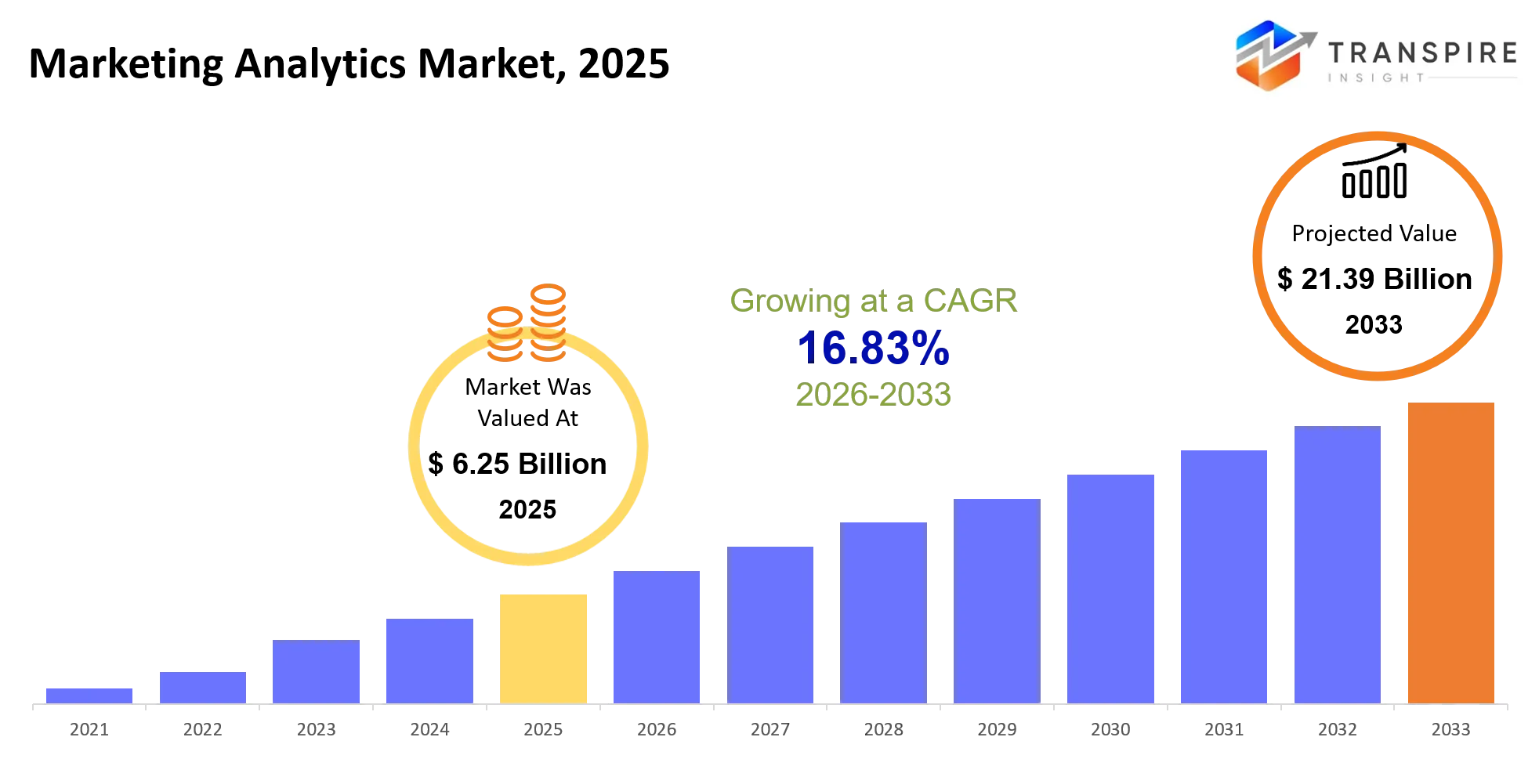
As per the Transpire Insight Analysis, the Marketing Analytics Market size is estimated at USD 6.25 billion in 2025 and is anticipated to reach USD 21.39 billion by 2033, growing at a CAGR of 16.83% from 2026 to 2033.
The marketing analytics market is used to establish a link between activity and customer behaviour, sales, and advertising spend on digital and offline channels. It allows organisations to budget effectively, target the most valuable audiences, and fix sub-optimal campaigns. In the past three to five years, the analytics market has evolved from dashboards that look back at past performance to machine-learning forecast-based optimisation, as well as cross-channel measurement. Perhaps most importantly, we are in the middle of the big structural shift from third-party tracking to consent-based first-party data sets due to GDPR, CCPA/CPRA, browser restrictions, cookie obsolescence, and platform privacy changes - which make it harder to attribute sales and revenue in a consistent way across the customer journey. In response, organisations are investing in data unification platforms and machine-learning-based, privacy-safe measurement capabilities that help sustain personalisation, performance, and business case accuracy.
Marketing Analytics Market Size & Forecast:
- Market Size 2025: USD 6.25 Billion
- Expected Market Value (2033): USD 21.39 Billion
- Forecast CAGR (2026–2033): 16.83%
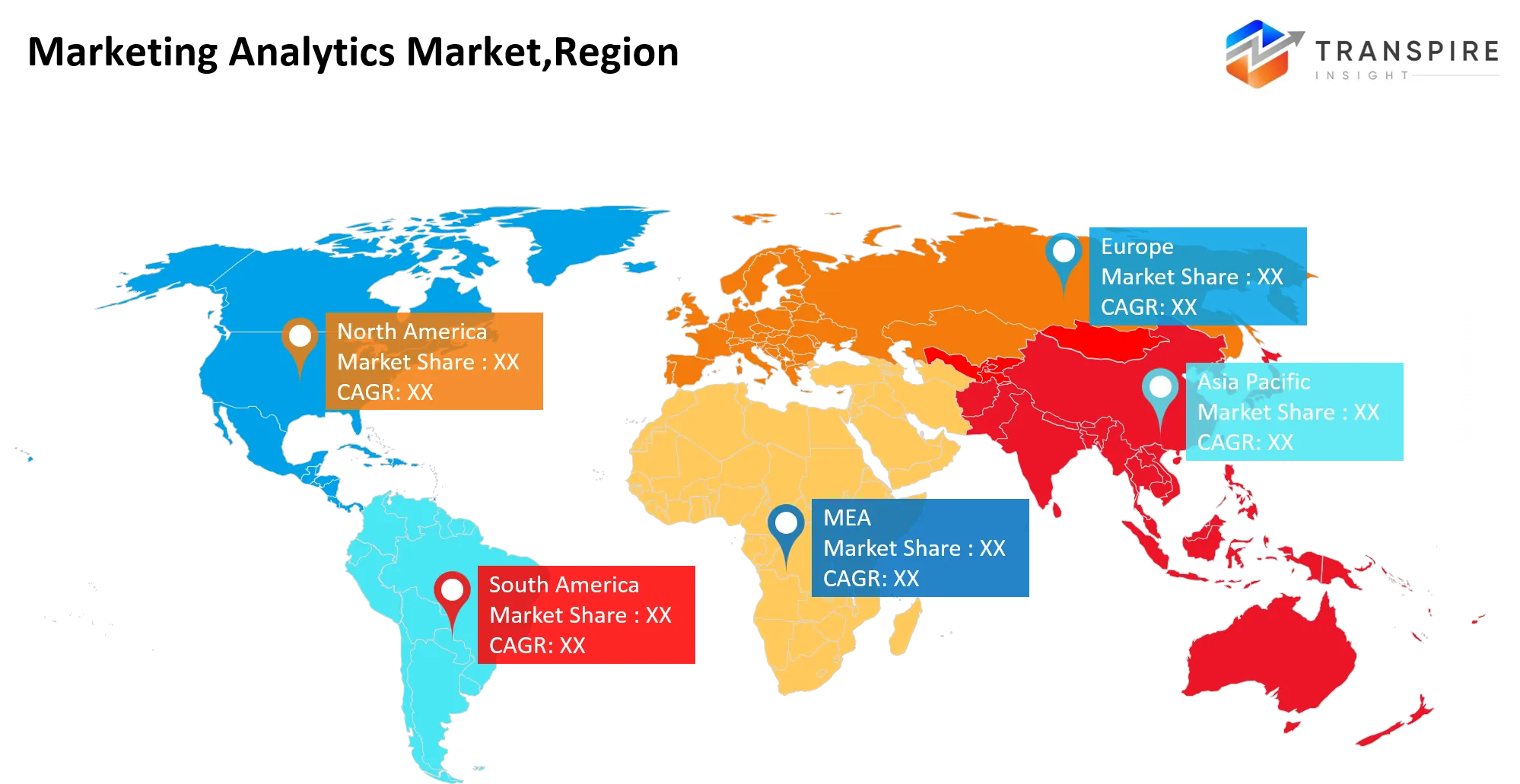
- Leading Region in 2025: North America
- Fastest Growing Region: Asia Pacific
- Key Company Profiles: Adobe, Salesforce, SAS Institute, Oracle, IBM, Google, Microsoft, SAP, Teradata, Nielsen, Datorama, HubSpot, Amplitude, Mixpanel, Contentsquare.
Key Marketing Analytics Market Insights:
The market is moving towards measurable business outcomes, and AI is transforming data from campaigns into quicker investment decisions. Causal measurement, unified customer data, and actionable intelligence are more critical for competitive differentiation than dashboard functionality.
- North America represents 40.2% of demand, fuelled by high levels of martech adoption and enterprise AI investment.
- In Europe, 27% are using consent, transparency, and explainable analytics to drive product design.
- Asia Pacific is projected to expand at 17.3% CAGR, accounting for 24% of the market, due to the growth of mobile commerce and digital advertising.
- Latin America accounts for 5% of the growth, which is tied to e-commerce formalisation and SMEs' adoption of cloud.
- Government digital agendas and retail-media investments create early demand in the Middle East and Africa, which are home to 3.8% of the market.
- Adobe has introduced Marketing Campaign Analytics, which integrates warehouse, CRM, commerce, Google, and Meta connectors to help organisations measure ROI faster.
- At the same time, Adobe also launched Brand Visibility, which enables businesses to measure brand visibility across AI-search surfaces.
- Amplitude has acquired two new companies: Kraftful and InfiniGrow, to enhance its AI voice-of-customer and revenue-attribution capabilities.
- Contentsquare has combined Hotjar and Heap into a single platform called Sense AI, which connects experience, product, and voice-of-customer analytics.
- Mixpanel and HubSpot are championing event-based, CRM-enabled analytics for mid-market companies looking for closed-loop measurement.
What are the Key Drivers, Restraints, and Opportunities in the Marketing Analytics Market?
Driver:
The main growth driver is the shift from channel-level performance reporting to revenue-based measurement. As customer journeys spread across search, social media, retail platforms, email, and connected television, businesses can no longer assess campaign success through clicks or impressions alone. The expansion of AI-driven advertising has intensified this challenge by automating bidding and audience targeting, making independent measurement essential for validating returns. Google’s 2026 measurement updates, including first-party data integration and improvements to marketing mix modelling, reflect this movement toward connecting advertising investment with incremental business outcomes. These capabilities encourage adoption by helping marketing teams defend budgets and identify profitable channels.
Restraint:
Fragmented enterprise data remains the biggest constraint. CRM, commerce, advertising, web, mobile, and offline-sales systems often use different identifiers, definitions, and update cycles, preventing a dependable single customer view. The issue persists because it is structural: legacy systems, departmental data ownership, inconsistent consent records, and weak data governance cannot be resolved through analytics software alone. Poor data quality also limits AI accuracy and delays return on investment.
Opportunity:
The strongest opportunity lies in privacy-conscious predictive analytics and accessible measurement tools for mid-sized businesses. Cloud-based platforms, automated modelling, and aggregated data can reduce dependence on large in-house data science teams. In 2026, Google's expansion of Meridian capabilities illustrates how automated model diagnostics, causal experiments, and scenario planning can help businesses improve budget allocation. Vendors that simplify implementation while providing transparent, explainable results can expand adoption across emerging markets and digitally transforming industries.
What Has the Impact of Artificial Intelligence Been on the Marketing Analytics Market?
AI also shifts marketing analytics from a reporting function to a decision-making function. Machine-learning-based automation tracks bid management, budget distribution, targeting, creative testing, and delivery optimisation, replacing manual review or routine rules. Predictive models forecast churn, customer purchase propensity, quality of leads, lifetime value, and conversion likelihood, allowing firms to take action earlier in the customer journey. Generative and agentic AI also provide automation for campaign creation, performance summaries, natural-language-based questions, and suggestions for next-best actions. Salesforce's AI marketing agents and Adobe's CX Enterprise effort focus on automating personalised, campaign-temporal, and predictive-motivational marketing across customer contacts, channels, and journeys. These capabilities can help marketing teams act more quickly to "future-proof" performance and more properly allocate marketing resources. Automation poses measurement challenges if the underlying data is patchy, the system integration fragile, or the AI confuses correlation with causality. These limitations can in turn lead to spurious recommendations, even if they seem to be profitable when measured. Falsified results should be validated through try-test-control and high-quality first-party data inputs to avoid bogus recommendations.
In September 2026, Adobe acquired Indian AI marketing automation startup Rilo to integrate its natural-language workflow builder and agentic marketing capabilities directly into its enterprise ecosystem. This acquisition accelerates Adobe's ability to help go-to-market teams build automated workflows.
Key Marketing Analytics Market Trends:
Marketing analytics is shifting from back-then-you-reported-on-campaigns to always, and always, and always, evidence-based investment decisions. With privacy restrictions and AI-powered media buying on the rise, there is a growing need for integrated data, causal measurement, and transparent recommendations.
- Third-party-cookie reliance is on the wane as companies are rebuilding identity and measurement based on consented first-party data.
- Multi-touch and algorithmic models are gaining in relevance to the detriment of the last-click attribution model, which is becoming less relevant.
- Media mix modelling is making a comeback because it can measure marketing impact when user-level tracking is limited.
- AI copilots are reallocating analysts from dashboard creation to scenario testing and decision recommendations.
- Real-time analytics is growing as brands look to make corrections to their campaign as soon as possible.
- Retail media networks are establishing new metrics for commerce, advertising, and in-store sales.
- Attribution, media mix modelling, and controlled experiments are being used increasingly by marketing teams in conjunction with each other to validate results.
- Federated learning and differential privacy are emerging as privacy-enhancing technologies that are being introduced into commercial measurement stacks.
- As generative search impacts brand discovery, AI-search visibility is emerging as a new frontier in analytics.
Marketing Analytics Market Segmentation
By Component:
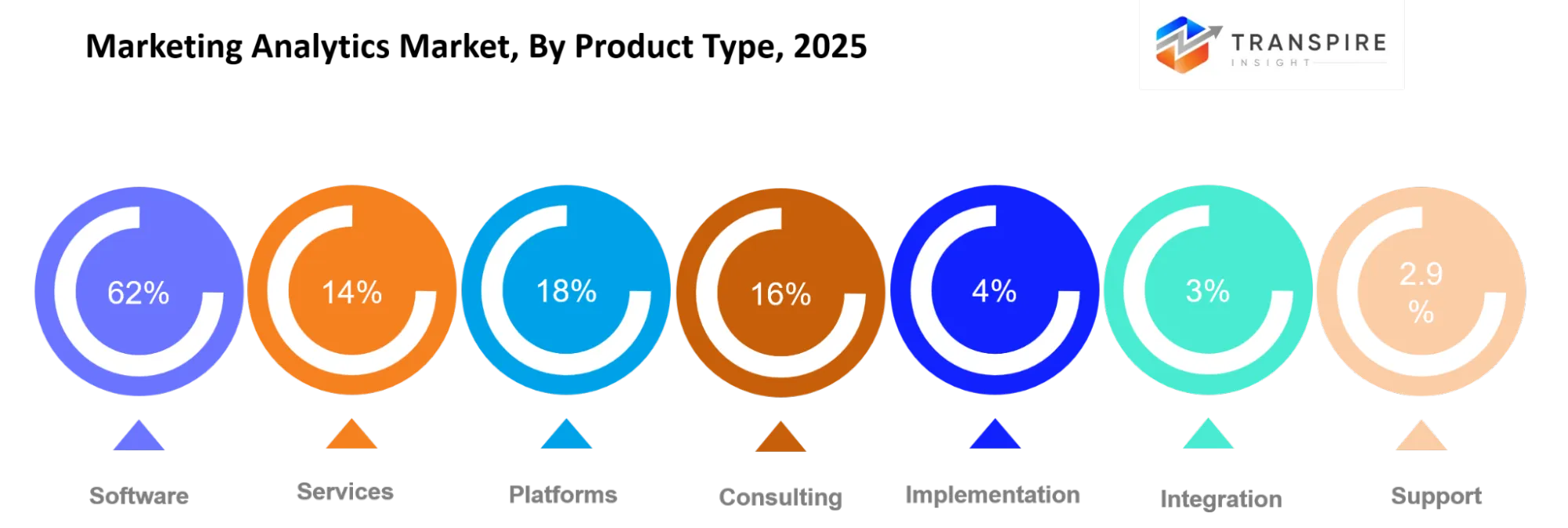
Software dominates the marketing analytics market with a 62.1% share, providing core modelling, dashboards, attribution, and campaign activation. Services account for 14%, platforms 8%, consulting 6%, implementation 4%, integration 3%, support 2%, and others 0.9%. Software adoption benefits from embedded AI and cloud delivery, while services and integration gain traction as enterprises consolidate fragmented data. By analytics type, predictive marketing analytics is the fastest-growing category, at a 15.7% CAGR, driven by demand for churn prediction, lead scoring, demand forecasting, and next-best-action recommendations that improve campaign efficiency and revenue planning.
By Analytics Type:
Descriptive analytics summarises historical campaign performance, while diagnostic analytics identifies the factors behind changing results. Predictive marketing analytics is the fastest-growing category, with a 15.7% CAGR, as businesses adopt purchase-propensity scoring, churn forecasting, and conversion prediction. Prescriptive analytics recommends actions based on forecasted outcomes, while real-time analytics enables immediate campaign adjustments. Customer analytics improves segmentation and lifetime-value estimation, whereas campaign analytics evaluates channel effectiveness. Together, these capabilities help marketers anticipate customer needs, allocate budgets efficiently, and make evidence-based decisions that improve commercial performance.
By Application:
Customer analytics helps businesses understand purchasing patterns, segment audiences, and estimate customer lifetime value, supporting more relevant engagement strategies. Campaign management coordinates marketing activities, while attribution evaluates the contribution of different channels to conversions. Market research identifies emerging preferences, and lead generation improves prospect qualification through behavioural signals. Pricing analytics supports competitive positioning and revenue optimisation, whereas brand analytics measures awareness, sentiment, and reputation. Integrating these applications with experimental measurement helps organisations distinguish genuine campaign impact from coincidental customer activity, improving budget allocation and strategic planning.
By Deployment:
Cloud and software-as-a-service deployments support rapid implementation, flexible capacity, and continuous feature updates without substantial infrastructure investment. These advantages appeal to businesses managing multiple campaigns and geographically dispersed customer data. On-premises solutions remain relevant for organisations requiring greater infrastructure control, customised security, or restricted data access. Hybrid deployments balance cloud scalability with internal governance, while private-cloud, public-cloud, and hosted models address different operational requirements. Future adoption will depend on integration costs, data residency obligations, security controls, and the ability to connect analytics with existing CRM and advertising systems.
By Enterprise Size:
Large enterprises invest in marketing analytics to coordinate campaigns across markets, standardise performance measurement, and strengthen governance over extensive customer datasets. SMEs and startups increasingly benefit from subscription-based platforms that provide automated reporting, audience segmentation, and predictive insights without requiring large analytics teams. Mid-sized businesses use these tools to improve customer acquisition efficiency as marketing operations expand. Agencies depend on analytics to demonstrate client outcomes and justify campaign expenditure, while government bodies and nonprofit organisations use measurement tools to evaluate outreach effectiveness, resource utilization, and accountability across diverse stakeholder groups.
By Channel:
Social media analytics measures engagement, audience sentiment, and campaign response, while search analytics evaluates keyword performance, conversion behaviour, and acquisition costs. Email analytics tracks opens, clicks, and downstream customer actions, whereas display and video analytics assess reach, frequency, and engagement quality. Mobile analytics provides insight into app interactions and location-related behaviour where consent permits. Offline measurement connects traditional advertising with sales and customer research. As consumers move between platforms, businesses increasingly combine channel data to reduce measurement gaps, identify overlapping audiences, and improve cross-channel budget allocation.
By End User:
Retail organisations use marketing analytics to improve purchase conversion, personalise promotions, and assess customer lifetime value. Banking, financial services, and insurance companies focus on acquisition efficiency, retention, and compliant customer engagement, while healthcare providers prioritise appropriate outreach and privacy protection. IT and telecom businesses analyse churn signals and subscription behaviour to improve retention. Manufacturers use lead-quality scoring to strengthen business-to-business sales pipelines, while media companies evaluate audience engagement and content performance. Travel and hospitality businesses apply demand forecasting and personalisation to increase bookings, improve customer loyalty, and optimise promotional spending across changing travel seasons.
What are the Key Use Cases Driving the Marketing Analytics Market?
The core use case is campaign performance optimisation, supported by software's 62.1% component share. Businesses combine customer interactions, advertising costs, and sales outcomes to identify profitable channels, reduce inefficient spending, and improve return on marketing investment. Predictive marketing analytics, growing at a 15.7% CAGR, supports this process by forecasting conversion probability and identifying audiences most likely to purchase.
Expanding applications include customer lifetime-value analysis, lead scoring, pricing optimisation, brand measurement, and cross-channel attribution. Retailers use these insights to connect promotions with purchases, while BFSI companies evaluate acquisition costs and customer retention.
Emerging use cases include AI-assisted budget planning, privacy-conscious measurement, and causal experimentation. These capabilities help organisations estimate incremental sales, anticipate campaign outcomes, and adjust investment before performance deteriorates.
|
Report Metrics |
Details |
|
Market size value in 2025 |
USD 6.25 Billion |
|
Market size value in 2026 |
USD 7.20 Billion |
|
Revenue forecast in 2033 |
USD 21.39 Billion |
|
Growth rate |
CAGR of 16.83% from 2026 to 2033 |
|
Base year |
2025 |
|
Historical data |
2021 - 2024 |
|
Forecast period |
2026 - 2033 |
|
Report coverage |
Revenue forecast, competitive landscape, growth factors, and trends |
|
Regional scope |
United States; Canada; Mexico; United Kingdom; Germany; France; Italy; Spain; Denmark; Sweden; Norway; China; Japan; India; Australia; South Korea; Thailand; Brazil; Argentina; South Africa; Saudi Arabia; United Arab Emirates |
|
Key companies profiled |
Adobe, Salesforce, SAS Institute, Oracle, IBM, Google, Microsoft, SAP, Teradata, Nielsen, Datorama, HubSpot, Amplitude, Mixpanel, Contentsquare. |
|
Customization scope |
Free report customization (country, regional & segment scope). Available customised purchase options to meet your exact research needs. |
|
Report Segmentation |
By Component (Software, Services, Platforms, Consulting, Implementation, Integration, Support, Others); By Analytics Type (Descriptive, Diagnostic, Predictive, Prescriptive, Real-time, Customer Analytics, Campaign Analytics, Others); By Application (Customer Analytics, Campaign Management, Market Research, Lead Generation, Pricing, Brand Analytics, Attribution, Others); By Deployment (Cloud, On-premise, Hybrid, SaaS, Private Cloud, Public Cloud, Hosted, Others); By Enterprise Size (Large Enterprises, SMEs, Startups, Mid-sized, Agencies, Government, Non-profit, Others); By Channel (Social Media, Search, Email, Display, Mobile, Video, Offline, Others); By End User (Retail, BFSI, Healthcare, IT & Telecom, Manufacturing, Media, Travel & Hospitality, Others) |
Which Regions are Driving the Marketing Analytics Market Growth?
North America accounts for 40.2% of the marketing analytics market with advanced marketing technology environments, sophisticated cloud infrastructures, mature advertising environments, and competent artificial intelligence skills in the region. Strong venture capital investment and early adoption of customer data platforms are encouraging enterprises to invest in attribution, experimentation, and predictive analytics. Furthermore, digital competition is fierce, which increases the demand for ROI and campaign insights, while the presence of numerous cloud providers, marketing agencies and analytics vendors supports the quick implementation and adoption of more advanced measurement solutions.
In January 2026, Amplitude announced the strategic acquisition of AI-powered marketing attribution vendor InfiniGrow. This action integrates advanced machine learning models, predictive revenue forecasting tools, and automated multi-channel campaign optimization recommendations natively into Amplitude's existing platform.
https://entrepreneurloop.com/amplitude-infinigrow-acquisition-ai-marketing-analytics/
Europe makes up 27% of the marketing analytics market, an area that has seen continued, regulation-driven investment. GDPR, other national privacy laws, and increasing demands for transparent AI all lead companies to invest in better consent management, data governance and privacy-safe measurement. Organisations are prioritising investing in a compliant analytics infrastructure instead of simple tracking solutions, leading to steady growth in the banking and financial services, retail, automotive and public-sector sectors, where managing data responsibly allows long-term digital operations.
In January 2026, Munich-based privacy data technology firm Usercentrics completed the acquisition of MCP Manager, a next-generation data governance platform built for the Model Context Protocol (MCP).
https://usercentrics.com/press/usercentrics-acquires-mcp-manager/
Asia Pacific is the fastest-growing region in the marketing analytics market, with a 17.3% CAGR and 24% market share. Initiatives to drive traffic to mobile payment apps, super apps, social commerce, and localised advertising are being adopted by local and regional players, creating massive customer-behaviour data sets. More companies can now tailor campaigns for higher conversion and ad-spend efficiency. SaaS, multi-language and cloud-native solutions for SMEs have scope for growth in India, Southeast Asia and through China's growing digital-commerce segment.
In October 2026, Maharashtra-based MarketingTech startup Unveilr AI secured $1.74 million in Pre-Seed funding led by AJVC. This injection of capital will scale its enterprise marketing applications and predictive analytics capabilities, allowing businesses across South Asia to gain sharper customer-behaviour insights and drive efficient, highly localised campaign performance.
https://startuptalky.com/indian-startups-funding-investors-data-2026/
Who are the Key Players in the Marketing Analytics Market, and how do they compete?
The worldwide aggressive marketing analytics market concentrates on data integration, measurement accuracy, synthetic intelligence skills, and ease of deployment. E-commerce options like Adobe, Salesforce, SAS Institute, Oracle, IBM, Google, Microsoft, and SAP compete on their enterprise ecosystems integrating buyer knowledge, marketing campaign execution, and enterprise intelligence. Teradata focuses on scalable knowledge administration, whereas Nielsen differentiates itself in media measurement and viewer intelligence. Datorama, now a part of Salesforce Marketing Cloud Intelligence, has a historical past of partnering with cross-channel advertising and marketing knowledge harmonisation.
Adobe, utilising causal synthetic intelligence, campaign measurement, and situation planning, is making its mark, serving to help companies connect media funding with incremental enterprise outcomes. Google integrates advertising platform knowledge with open-source Meridian modelling and enterprise instruments for organisations seeking versatile measurement and financial forecasting. Salesforce joins CRM knowledge with advertising and marketing intelligence and synthetic intelligence brokers, specialising in related buyer profiles, automated reporting, and marketing campaign execution. While Oracle employs AI agents in enterprise marketing, IBM and Microsoft are competing on data infrastructure, cloud analytics, and AI. SAS differentiates with advanced modelling, while HubSpot is marketing analytics for SMBs seeking something more integrated and simpler to get started with. Amplitude and Mixpanel are competing in product/behavioral analytics, versus Contentsquare in digital experience analytics. Growth is no longer driven by dashboards, but by real-world integrations, new industries, and actual results in lead generation and retention.
Key Players are:
- Adobe
- Salesforce
- SAS Institute
- Oracle
- IBM
- Microsoft
- SAP
- Teradata
- Nielsen
- Datorama
- HubSpot
- Amplitude
- Mixpanel
- Contentsquare
Recent Development News
In April 2026, LiveRamp partnered with Akkio to integrate AI-powered analytics into its data collaboration network, enabling agencies and brands to access media measurement insights through natural-language queries. The partnership improves cross-channel performance analysis, simplifies data interpretation, and helps marketing teams make faster, data-driven investment decisions.
In September 2026, NIQ expanded its partnership with Google by integrating Google’s open-source Meridian marketing mix modelling framework into NIQ Cadence. The integration links marketing measurement with scenario planning and continuous optimisation, helping businesses assess channel performance, improve marketing budget allocation, and more efficiently evaluate return on investment.
In June 2026, Zeta formed a strategic partnership with data software enterprise Palantir. This collaboration integrates Palantir Foundry into the Zeta Marketing Platform to establish a unified data and AI infrastructure tailored specifically for enterprise-grade marketing teams. This infrastructure accelerates real-time customer acquisition analysis and lets brands deploy complex campaign attribution metrics across fragmented digital channels.
https://www.zetaglobal.com/news/palantir-and-zeta-global-announce-strategic-partnership/
What Strategic Insights Define the Future of the Marketing Analytics Market?
The industry is heading towards a future of monitored, agentic AI that not only provides insights but also enables automated budget orchestration, audience activation and campaign correction. However, the risk of "automation without causality" exists: automated algorithms will optimise for inaccurate signals of performance if attribution models aren't validated with experiments and backed up by first-party data. The opportunity lies in AI-search measurement, as brands need improved ways to measure trust, visibility and conversion in generative search. Brands' automation investments should focus on interoperable data pipelines, privacy-preserving identity, causal measurement and transparent AI governance. They should also develop clear governance to verify that automated decisions don't compromise commercial or privacy outcomes. Companies that combine predictive analytics with experiment-based validation are likely to win higher-value enterprise budgets. In the end, competitive advantage will shift from reporting capabilities to business outcomes, trusted automation, and continued optimisation of customer journeys.
Key Segmentations are:
By Component
- Software
- Services
- Platforms
- Consulting
- Implementation
- Integration
- Support
- Others
By Analytics Type
- Descriptive
- Diagnostic
- Predictive
- Prescriptive
- Real-time
- Customer Analytics
- Campaign Analytics
- Others
By Application
- Customer Analytics
- Campaign Management
- Market Research
- Lead Generation
- Pricing
- Brand Analytics
- Attribution
- Others
By Deployment
- Cloud
- On-premise
- Hybrid
- SaaS
- Private Cloud
- Public Cloud
- Hosted
- Others
By Enterprise Size
- Large Enterprises
- SMEs
- Startups
- Mid-sized
- Agencies
- Government
- Non-profit
- Others
By Channel
- Social Media
- Search
- Display
- Mobile
- Video
- Offline
- Others
By End User
- Retail
- BFSI
- Healthcare
- IT & Telecom
- Manufacturing
- Media
- Travel & Hospitality
- Others
Frequently Asked Questions
Find quick answers to common questions.
The marketing analytics market size was valued at USD 6.25 billion in 2025 and is poised to reach USD 21.39 billion by 2033, expanding at a 16.83% CAGR.
Key segments for the marketing analytics market are By Component (Software, Services, Platforms, Consulting, Implementation, Integration, Support, Others); By Analytics Type (Descriptive, Diagnostic, Predictive, Prescriptive, Real-time, Customer Analytics, Campaign Analytics, Others); By Application (Customer Analytics, Campaign Management, Market Research, Lead Generation, Pricing, Brand Analytics, Attribution, Others); By Deployment (Cloud, On-premise, Hybrid, SaaS, Private Cloud, Public Cloud, Hosted, Others); By Enterprise Size (Large Enterprises, SMEs, Startups, Mid-sized, Agencies, Government, Non-profit, Others); By Channel (Social Media, Search, Email, Display, Mobile, Video, Offline, Others); By End User (Retail, BFSI, Healthcare, IT & Telecom, Manufacturing, Media, Travel & Hospitality, Others).
Growth is primarily driven by AI-powered predictive analytics, increasing adoption of first-party data, cross-channel campaign measurement, marketing automation, and the need to improve advertising ROI.
The marketing analytics market is led by major manufacturers, including Adobe, Salesforce, SAS Institute, Oracle, IBM, Google, Microsoft, SAP, Teradata, Nielsen, Datorama, HubSpot, Amplitude, Mixpanel, and Contentsquare.
North America holds a 40.2% share, supported by advanced cloud infrastructure, mature marketing technology ecosystems, strong AI investment, and widespread enterprise adoption.
Key opportunities include privacy-safe analytics, AI-driven marketing automation, predictive measurement, cloud-based solutions for SMEs, and AI-search performance tracking.
- Adobe
- Salesforce
- SAS Institute
- Oracle
- IBM
- Microsoft
- SAP
- Teradata
- Nielsen
- Datorama
- HubSpot
- Amplitude
- Mixpanel
- Contentsquare
About the Authors

Mayur Shinde
I am Mayur Shinde, a Senior Research Analyst at Transpire Insight, specializing in the Automotive & Transportation and Information & Communication Technology (ICT) Industry. My work focuses on analyzing emerging market trends, technological advancements, competitive landscapes, and industry developments to deliver accurate, data-driven insights. I am passionate about transforming complex market information into clear, actionable content that helps businesses, professionals, and decision-makers stay informed and make confident strategic decisions.

Chakradhar Khansole
Chakradhar serves as the Research Director at Transpire Insight, bringing over 8 years of experience in technology, innovation, and strategic market intelligence. He specializes in transforming complex market data into actionable business insights that enable organizations to make informed, growth-oriented decisions. Recognized for his strategic vision and analytical expertise, Chakradhar leads high-impact research initiatives, delivering comprehensive market assessments, competitive intelligence, and forward-looking industry analysis.
Recently Published Reports
-
Apr 2026
3D Optical Profiler Market
3D Optical Profiler Market Size, Share & Analysis Report By Type (Desktop 3D Optical Profiler, and Portable 3D Optical Profiler), By Technology (Confocal Technology, and White Light Interference), By End-Use Industry (Manufacturing, Research Institutions, Automotive, Aerospace and Defense, Medical Devices, and Other), and Geography (North America, Europe, Asia-Pacific, Middle East and Africa, South and Central America), 2021 - 2031
-
Apr 2026
Depth Sensor Market
Depth Sensor Market Size, Share & Analysis Report By Type (Infrared Depth Sensors, Time-of-Flight (ToF) Sensors, Stereo Vision Sensors, Structured Light Sensors, Ultrasonic Depth Sensors), By Application (Automotive, Robotics, Gaming, Consumer Electronics, Industrial Automation, Healthcare, Security & Surveillance, Others), By End Users (Automotive Manufacturers, Consumer Electronics Companies, Healthcare Providers, Industrial Companies, Security Agencies, Gaming Companies, Robotics Companies, Others), and Geography (North America, Europe, Asia-Pacific, Middle East and Africa, South and Central America), 2021 – 2031
-
Apr 2026
Digital Manufacturing Market
Digital Manufacturing Market Size, Share & Analysis Report By Component (Hardware, Software, and Services), By Technology (Robotics, 3D Printing, Internet of Things (IoT), and Others), By Application (Automotive and Transportation, Aerospace and Defense, Consumer Electronics, Industrial Machinery, and Others), By Process Type (Computer-Based Designing, Computer-Based Simulation, Computer 3D Visualization, Analytics, and Others), and Geography (North America, Europe, Asia-Pacific, Middle East and Africa, South and Central America), 2021 – 2031
-
Apr 2026
Digital Visa Services Market
Digital Visa Services Market Size, Share & Analysis Report By Type (Individual Travelers, Group Travelers), By Application (Tourism, Business Travel, Others), and Geography (North America, Europe, Asia-Pacific, Middle East and Africa, South and Central America), 2021 – 2031