
Japan Submarine Cable Systems Market Summary
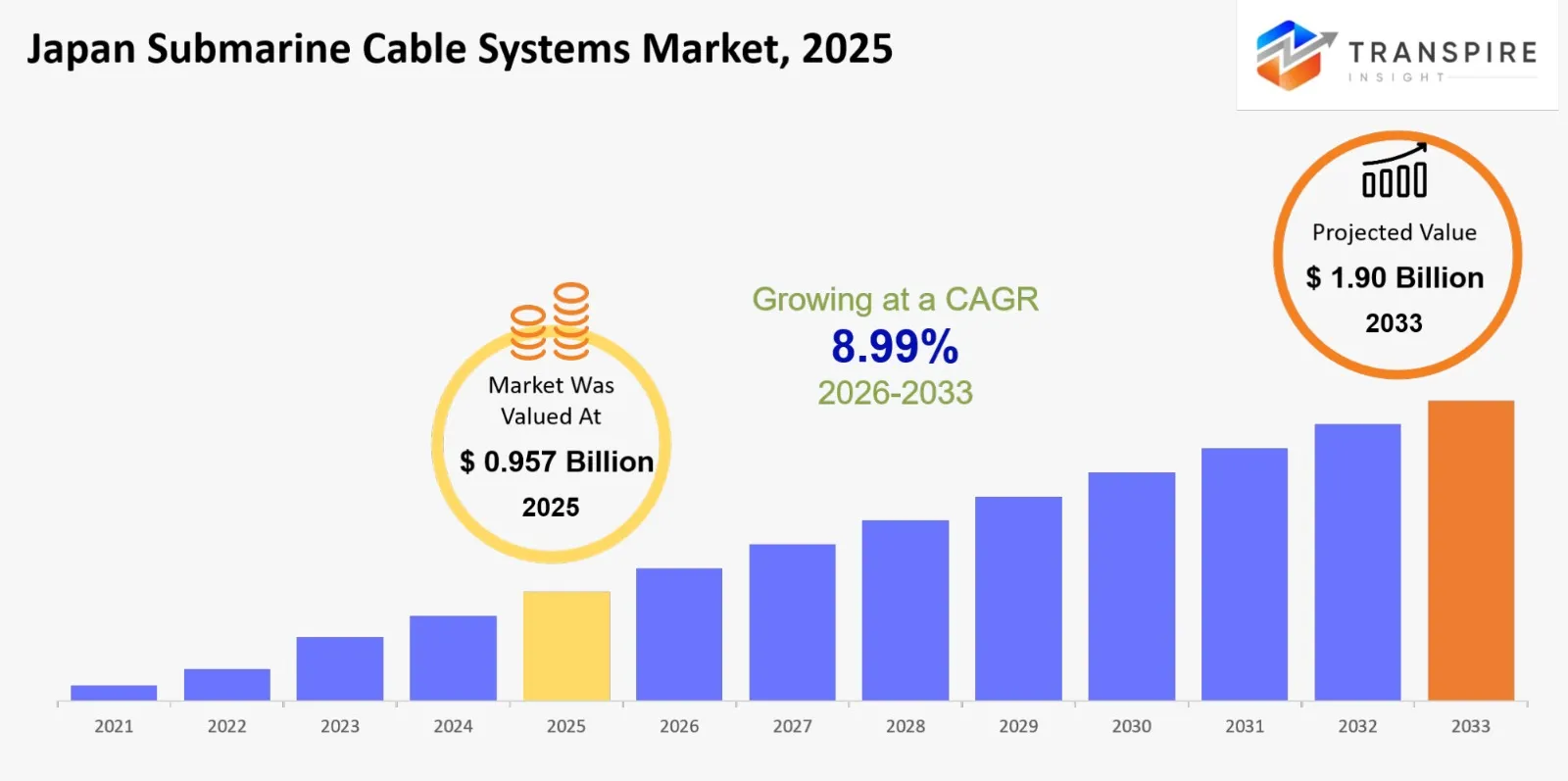
As per Transpire Insight Analysis theJapan Submarine Cable Systems Market size is estimated at USD 0.957 Billion in 2025 and is anticipated to reach USD 1.90 Billion by 2033, growing at a CAGR of 8.99% from 2026 to 2033.
The Japan submarine cable systems market really does underpin the country’s international internet traffic, cloud connectivity, offshore energy transmission, and also secure government communications, mostly by tying together islands, data centers, and cross-border networks via high-capacity seabed infrastructure. In the last five years, things kind of moved away from older telecom-first deployments, and now they’re more hyperscale and cloud led in the network architecture, with operators mapping cable routes around big data center zones in Tokyo as well as Osaka. One major trigger was the jump in digital traffic, and the resilience planning that followed after the pandemic, plus those later supply chain disruptions which showed the hazards of depending on just a few international cable corridors. So, carriers and cloud providers now look to construct more redundant paths, and upgrade what’s already there with larger fiber counts, plus more modern optical tech. And as new cable landings draw in fresh data center investment, the operators end up earning revenue not just from transmission capacity but also from longer term infrastructure leasing, routine maintenance, and interconnection services, sort of the full chain.
Japan Submarine Cable Systems Market Size & Forecast:
- Japan Submarine Cable Systems Market Size 2025: USD 0.957 Billion
- Expected Market Value 2033: USD 1.90 Billion
- Forecast CAGR: 8.99%
- Leading region in 2025:
- Fastest Growing region:
- Key Profile: NEC Corporation, Fujitsu, Sumitomo Electric Industries, NKT A/S, Prysmian Group, Nexans, Furukawa Electric, LS Cable & System, SubCom, Hengtong Group, ZTT Group, Mitsubishi Electric, Hitachi Energy, ABB Ltd., JDR Cable Systems
Key Market Insights
- The Japan Submarine Cable Systems Market is projected to reach about USD 1.90 billion by 2033, while still showing steady infrastructure investment and that kind of momentum that doesnt really slow down.
- Kanto seemed to dominate, with roughly 48% market share in 2025 ,mostly tied to Tokyo’s dense data center ecosystem and the usual spillover of demand that follows it.
- Kansai is the fastest moving region all the way through 2033, since Osaka is starting to look like a secondary cloud plus interconnection place, more or less gradually but clearly.
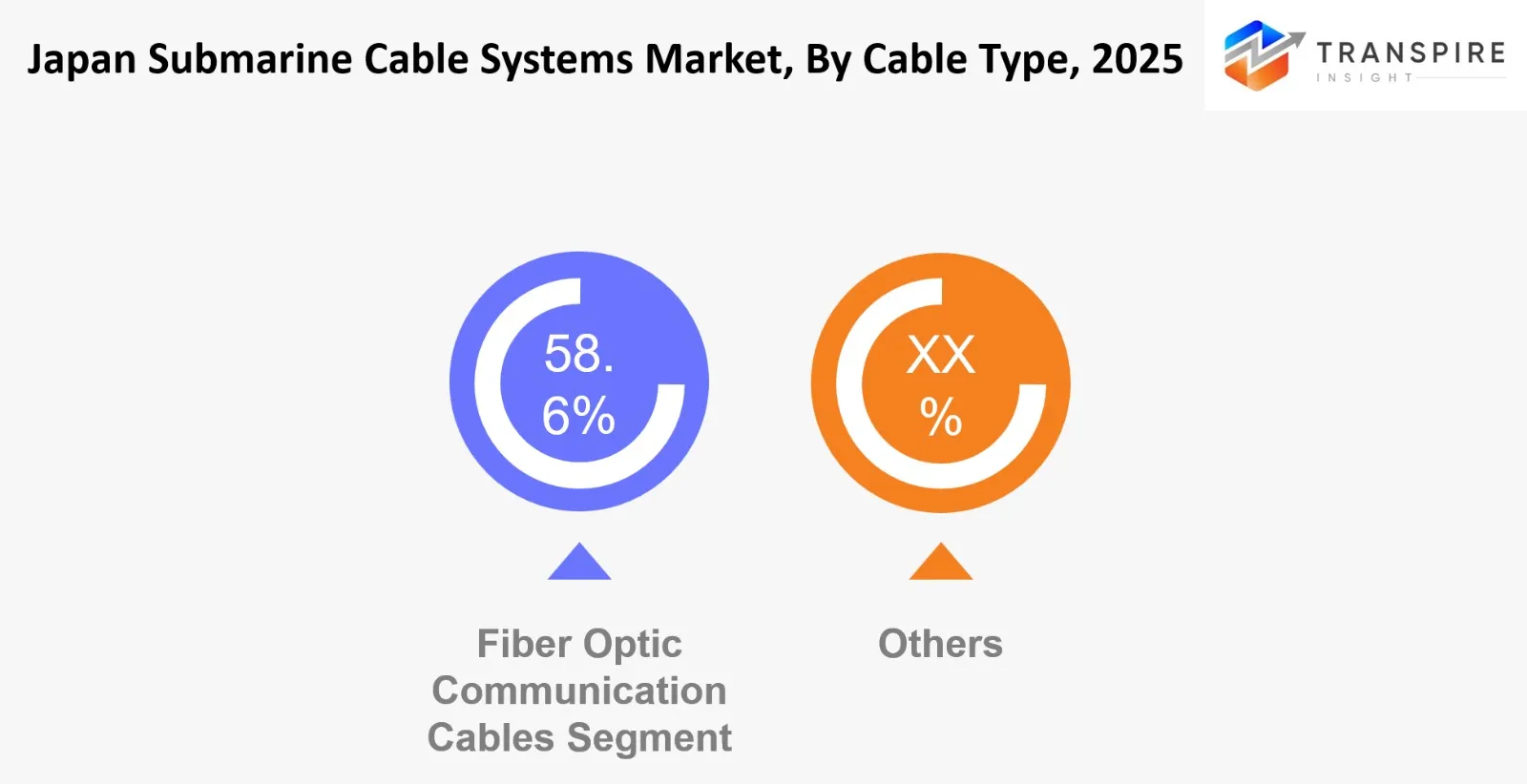
- Fiber optic communication cables held around 62% of the share in 2025, because they keep fitting international internet and cloud traffic needs with decent reliability.
- Hybrid power and communication cable systems are growing fast, especially where offshore wind farms and island grid setups need one integrated approach, not just a single line.
- International connectivity applications made up about 55% of deployments in 2025, driven by trans-Pacific capacity upgrades, and you can see the scale behind those upgrades.
- Offshore renewable energy is emerging as the quickest application area too, as Japan ramps up offshore wind development and keeps pushing timelines forward.
- Cloud and hyperscale operators accounted for nearly 46% of end-user demand, and that share is moving past traditional telecom carriers in terms of fresh capacity commitments.
- Companies like NEC Corporation, Sumitomo Electric, Fujitsu, Prysmian Group, and Nexans are strengthening their positions via joint cable undertakings and optical technology upgrades.
- On the vendor side, investment is trending toward higher fiber-count cable systems, plus more advanced optical amplification, in order to boost route efficiency and also bring transmission cost per terabit down, bit by bit.
What are the Key Drivers, Restraints, and Opportunities in theJapan Submarine Cable Systems Market?
Driver: The strongest growth driver is kind of the reshaping of international network architecture around cloud and AI infrastructure. Hyperscale operators now want geographically diverse cable routes linking Japan to North America and other Asian markets, so they can deliver low-latency cloud services, plus AI data movement. This change was set off by the fast expansion of cloud computing and the need for network resilience after pandemic-era traffic spikes and also supply chain disruptions. So, as a consequence, cable operators often lock in long term capacity agreements before systems are commissioned, which helps project financing, and speeds up revenue realization via transmission, maintenance, and interconnection contracts
Restraint: The biggest restraint is the overall structural complexity of permitting, and actually building submarine cable infrastructure in Japan’s seismic, and pretty densely utilized coastal environment. Environmental assessments, fishing industry coordination, seabed surveys, and landing station approvals can stretch project timelines by several years. These constraints can’t be solved quickly, because they involve multiple regulatory bodies, plus maritime stakeholders. And the delay, it bumps up capital costs too, while revenue generation for new cable routes gets pushed out
Opportunity: One big opportunity sits in offshore wind transmission networks and island energy interconnections. Japan’s offshore wind targets are driving demand for hybrid submarine cable systems that mix power transmission with fiber-optic communication. For instance, planned offshore wind developments in northern Japan will need high-capacity export cables, along with monitoring networks. That opens a new revenue stream for cable manufacturers and system integrators, beyond the usual telecom infrastructure lane
What Has the Impact of Artificial Intelligence Been on theJapan Submarine Cable Systems Market?
Artificial intelligence is quietly reshaping how submarine cable operators, monitor , keep in shape, and get the most out of critical network infrastructure. Lately, they’re leaning on AI-enabled network management platforms that can watch the optical signal quality, check repeater behavior, read power feed conditions, and even pull in environmental sensor information, pretty much in real time. The whole idea is that these systems can basically do the routine work: automate fault finding and suggest route optimization, so network control centers react sooner when something weird shows up, and there’s less need for constant manual involvement.
Then there is the predictive maintenance side, where machine learning models come in. Operators feed them with past repeater behavior, temperature rhythms, and the usual signal degradation trajectories. From that, the models flag components that are likely to fail months, or sometimes longer, ahead of time. So maintenance vessels can be planned more sensibly, and the chance of surprise outages drops. On big trans-Pacific spans, that kind of predictive maintenance can boost overall cable availability and also cut down the emergency repair spend.
On top of that, AI-driven traffic engineering is gaining traction because cloud and AI workloads create international data flows that can swing around a lot. With dynamic capacity allocation, operators improve fiber utilization, and they can keep latency low when demand spikes. For hyperscale customers, that translates into steadier service-level outcomes, even when the traffic pattern acts a bit unpredictable.
Still, AI adoption is not fully smooth, because one big snag remains: getting strong training data from the submarine setting. Fault events are uncommon, and the operational data tends to be scattered across different equipment vendors and network owners, so it’s hard to build models that are accurate and still generalize well across conditions.
Key Market Trends
- Since 2021, cable route planning has kinda drifted away from “just the shortest route” designs and instead more often goes toward geographically diverse paths, that help resilience when seismic events pop up or when operations get disrupted.
- More and more, hyperscale cloud providers show up as actual cable investors, not only capacity buyers. That swap in role changes ownership structures and it also reshapes long term revenue models in ways that are pretty noticeable.
- Since 2023, higher fiber-count cable systems have been the go to specification for new trans Pacific deployments. This is especially true when they’re meant to carry AI and cloud workloads, not just standard traffic.
- Also since around then, offshore wind developers have been asking for integrated power and fiber communication cables. So this is turning into this new procurement category, for submarine infrastructure suppliers who can handle both at once.
- Cable operators have expanded their real time monitoring and digital twin capabilities since 2022, partly to get fault localization faster and to make maintenance planning less guesswork.
- Japanese manufacturers meanwhile have increased collaboration with global cable vendors. The goal is to secure technology access and also take part in bigger international consortium projects, not just stay on the sidelines.
- Data center operators increasingly select locations based on proximity to cable landing stations. That strengthens the connection between submarine infrastructure and regional digital investment, more than before.
- Since 2024, supply chain strategies shifted toward diversified component sourcing after earlier disruptions hit optical equipment and cable manufacturing schedules.
- Governments and operators have also increased investment in route redundancy and repair readiness, after several high profile cable outage events across the Asia Pacific region.
- And in the last stretch, AI driven traffic engineering has become a priority since 2025. The reason is that international data flows are less predictable now, because cloud and AI workload concentration keeps changing where demand actually shows up.
Japan Submarine Cable Systems Market Segmentation
By Cable Type
Power cables help move electricity between islands, offshore energy assets, and mainland grids where overhead transmission can’t really work. Fiber optic communication cables move huge digital traffic, for international communications, cloud services, and financial networks , and that’s why this category is often the biggest by deployment volume. Hybrid cables mix electrical transmission together with fiber communication so, one system can manage power delivery plus operational data exchange at the same time.
Inter-array cables link offshore wind turbines and other offshore infrastructure so they can collect the power first before it gets exported to the mainland. Beyond that there are other cable kinds for specialized industrial work, research programs, military use, and environmental monitoring projects that need a more unique engineering approach. Product selection normally comes down to transmission capacity, how deep the installation is, what the operating environment looks like, and what long-term maintenance will demand. Over time, ongoing improvements in insulation materials and optical fiber technology should enable better reliability and longer service life across all of these cable categories.
By Voltage
Low Voltage systems are mainly for monitoring gear, communications links, and those smaller offshore facilities where the power transmission amount stays limited but still has to meet day to day needs. Medium Voltage installations, in contrast, tend to back regional energy distribution, offshore platforms, and industrial environments that call for a more balanced transmission capacity , plus easier installation and setup. High Voltage is the one that pushes long distance electricity transfer, with reduced transmission losses, so it fits big offshore energy undertakings and island connections.
Extra High Voltage infrastructure takes that further, handling large scale power transfer across long stretches, while also helping grid stability and overall transmission performance. The other voltage classes cover specialized industrial and research uses, with their own operating constraints. Choosing the right voltage is usually about transmission distance, project capacity, installation cost, and the intentions behind network design. With ongoing grid modernization and offshore renewable work, people will keep going toward broader use of higher-voltage cable systems, even when the planning feels complicated.
By Application
Telecommunications is still the biggest use case, because the international internet traffic, cloud computing, financial transactions, and enterprise connectivity all kind of rely on dependable submarine communication infrastructure. Offshore Wind Farms are also showing up fast as an application, since renewable electricity projects need dependable transmission between offshore generation areas and the mainland grids. Oil & Gas keeps using submarine cable systems for offshore production platforms, operational monitoring, and the general communications between different facilities, without much of a break.
Island Power Transmission gives reliable electricity to remote communities where conventional overhead infrastructure just doesn’t fit quite right. Defense applications support secure communication networks, surveillance systems, and strategic maritime operations, and they use dedicated high-security infrastructure for that. Other applications, like scientific research, environmental observation, and marine monitoring initiatives, want dependable underwater connectivity too. As digital infrastructure keeps expanding and offshore energy investment keeps rising, demand will strengthen across several of these application areas.
By Installation
Shallow Water installation supports coastal communication links, island connections, and nearshore renewable energy projects where things stay relatively reachable during install and upkeep. Deep Water installation makes it possible to run international communication routes across oceans, but it leans on specialized vessels and laying tools that are made for rougher seabed conditions. Offshore Platforms need dedicated cable systems so they can carry continuous communication and also power transmission, for offshore industrial work.
Other installation approaches cover more specific environments, like river crossings, research facilities, and temporary industrial infrastructure. The whole plan usually depends on what the seabed is like, the water depth, the environmental rules, and how reliable the operation must be. Newer survey technologies keep improving route planning, and they also help cut installation risks and reduce project delays. In the long run better installation methods can improve system performance, and maintenance efficiency too.
By End User
Telecom Operators take the biggest slice of the market, mostly because international communication services, cloud connectivity and digital infrastructure need steady spending on submarine cable networks. Utilities also lean on submarine transmission systems to link offshore renewable projects, reinforce regional grids and generally push better electricity reliability across coastal areas, even when conditions change. Government organizations put money into strategic communication infrastructure, national security networks, and public digital connectivity initiatives, that kind of thing.
Energy Companies in turn deploy submarine cable systems so offshore oil, gas, and renewable energy operations run with secure power as well as communication connections. Other end users cover research institutions , port authorities, and industrial organizations running specialized offshore infrastructure. Investment priorities shift based on day to day operational needs, network expansion plans, and ongoing modernization efforts. In the long run, digital transformation along with offshore energy development should keep producing new openings across basically every end user group.
What are the Key Use Cases Driving theJapan Submarine Cable Systems Market?
International telecommunications still feel like the main use case , because submarine cable infrastructure does most of the heavy lifting for cross border internet traffic, cloud services , payments, and enterprise information flowing between Japan and those global digital hubs. At the same time the continuous growth of hyperscale data centers plus the need for lower latency connectivity, kind of drives the biggest round of infrastructure spending.
Offshore wind projects and island electricity transmission have meanwhile turned into secondary use cases that matter quite a bit. Utility firms and energy developers roll out submarine transmission networks to link offshore generation sites back to mainland grids, while also making power delivery more dependable for remote islands. Then defense agencies add another layer, by extending secure underwater communication networks, for surveillance and maritime security operations.
Looking ahead, emerging use cases are starting to show up too , for example offshore hydrogen production facilities and smart offshore energy hubs , where communication, monitoring, and power transmission get blended into one infrastructure network. Marine environmental monitoring and seabed observation programs also seem promising for the long run, especially as government agencies sharpen disaster preparedness plans and ocean resource stewardship.
|
Report Metrics |
Details |
|
Market size value in 2025 |
USD 0.957 Billion |
|
Market size value in 2026 |
USD 1.04 Billion |
|
Revenue forecast in 2033 |
USD 1.90 Billion |
|
Growth rate |
CAGR of 8.99% from 2026 to 2033 |
|
Base year |
2025 |
|
Historical data |
2021 - 2024 |
|
Forecast period |
2026 - 2033 |
|
Report coverage |
Revenue forecast, competitive landscape, growth factors, and trends |
|
Regional scope |
Japan |
|
Key company profiled |
NEC Corporation, Fujitsu, Sumitomo Electric Industries, NKT A/S, Prysmian Group, Nexans, Furukawa Electric, LS Cable & System, SubCom, Hengtong Group, ZTT Group, Mitsubishi Electric, Hitachi Energy, ABB Ltd., JDR Cable Systems |
|
Customization scope |
Free report customization (country, regional & segment scope). Avail customized purchase options to meet your exact research needs. |
|
Report Segmentation |
By Cable Type (Power Cables, Fiber Optic Communication Cables, Hybrid Cables, Inter-Array Cables, Others); By Voltage (Low Voltage, Medium Voltage, High Voltage, Extra High Voltage, Others); By Application (Telecommunications, Offshore Wind Farms, Oil & Gas, Island Power Transmission, Defense, Others); By Installation (Shallow Water, Deep Water, Offshore Platforms, Others); By End User (Telecom Operators, Utilities, Government, Energy Companies, Others) |
Which Regions are Driving the Japan Submarine Cable Systems Market Growth?
The Kanto region has the biggest market share, sort of because Tokyo works as Japan’s main international communications gateway and it also has the highest density of hyperscale data centers. There are several submarine cable landing stations there, plus strong digital infrastructure policies , and the whole proximity to major financial institutions helps keep the momentum for extra cable capacity. On top of that, port infrastructure is well-developed, and there’s this experienced circle of telecom operators, equipment manufacturers engineering firms, and maintenance service providers , so projects get executed more smoothly. Also, research institutions and global cloud providers showing up early tends to push advanced optical transmission technologies, which kind of keeps Kanto in the lead.
The Kansai region is next, ranking second, but it grows in a slightly different way. It’s more about balanced digital expansion rather than just piling everything into one place. Osaka has become a big interconnection hub, and it complements Tokyo by giving cloud and enterprise networks more geographic diversity. Industrial activity there stays steady, the power infrastructure is reliable, and telecommunications companies keep investing consistently, so long term infrastructure development stays on track. This kind of balanced operating setting makes Kansai a dependable part of national connectivity efforts, while also lowering network concentration risks.
For Hokkaido and the northern Japan region, growth is expected to be the fastest through 2033. That’s mainly due to offshore wind investment, plus regional digital infrastructure projects picking up speed. Government support lately for renewable energy transmission, and improved regional connectivity , have increased the demand for submarine power and communication cable installations.
Who are the Key Players in theJapan Submarine Cable Systems Market and How Do They Compete?
Competition still looks somewhat concentrated, mostly because submarine cable projects call for very specialized manufacturing know-how, serious marine engineering skills, and years and years of actual installation experience. In other words , it is not really a pure price game . Instead, the main thing competitors lean on is technology leadership, project execution muscle, optical transmission performance, and also long-term maintenance services . Even the established players keep defending their market share with higher-capacity cable designs, while international suppliers, they keep pushing partnerships so they can get a seat in those big communication and offshore energy programs.
NEC Corporation tends to stand out with turnkey submarine communication systems that kind of bundle cable manufacturing together with optical transmission equipment, plus the system installation work as well. Their expertise across Asia-Pacific is solid and they keep investing in higher-capacity optical technologies, which helps them join international consortium projects. Sumitomo Electric Industries , on its side, leans into advanced power transmission and communication cable technologies and has strong capability for offshore energy infrastructure. With high-performance insulation materials and broad engineering know-how, they seem to gain an edge in harsh marine conditions where everything is harder.
Prysmian Group expands its reach by focusing on technology innovation and selective acquisitions that boost installation capability and vertical integration, all at once. Nexans highlights high-voltage submarine power transmission for offshore wind plus international interconnectors, and they also keep investing in higher-capacity transmission technologies. SubCom concentrates on big international communication cable deployments , and they do that by pairing marine installation expertise with global project management know-how, so they can take part in complicated transoceanic network builds.
Company List
- NEC Corporation
• Fujitsu
• Sumitomo Electric Industries
• NKT A/S
• Prysmian Group
• Nexans
• Furukawa Electric
• LS Cable & System
• SubCom
• Hengtong Group
• ZTT Group
• Mitsubishi Electric
• Hitachi Energy
• ABB Ltd.
• JDR Cable Systems
Recent Development News
In May 2026, NEC Corporation completed construction of the East Micronesia Cable System (EMCS). The project connected the Federated States of Micronesia, Kiribati, and Nauru, strengthening regional digital connectivity and expanding NEC's submarine cable delivery portfolio.https://www.nec.com
In March 2026, Prysmian Group launched a new 525 kV HVDC submarine cable system capable of operating at 90°C. The technology increases transmission capacity from 2 GW to 2.5 GW per link, improving efficiency for offshore wind and interconnector projects.https://www.prysmian.com
In January 2026, Prysmian Group announced the acquisition of ACSM, a specialist in submarine cable survey and installation solutions. The acquisition strengthens vertical integration by adding seabed surveying, route planning, and installation capabilities to Prysmian's offshore transmission business.https://www.prysmian.com
What Strategic Insights Define the Future of theJapan Submarine Cable Systems Market?
The market seems to be heading toward more resilient, high-capacity digital plus energy infrastructure that can hold up cloud computing, artificial intelligence workloads, and also offshore renewable power transmission. In practice, growth is going to rely less on conventional telecommunications infrastructure alone, and more on integrated communication with power cable systems, kind of all tied together.
There is also a risk that s a bit less noticeable, and it has to do with how manufacturing capacity and specialized installation vessels are concentrated. That concentration could cause project delays, especially if multiple big developments move forward at the same time.
On the other hand there’s a new and interesting opportunity too: hybrid submarine cable systems for offshore wind farms, alongside smart grid integration. This looks especially relevant around northern Japan, where renewable energy investment keeps accelerating.
Japan Submarine Cable Systems Market Report Segmentation
By Cable Type
• Power Cables
• Fiber Optic Communication Cables
• Hybrid Cables
• Inter-Array Cables
• Others
By Voltage
• Low Voltage
• Medium Voltage
• High Voltage
• Extra High Voltage
• Others
By Application
• Telecommunications
• Offshore Wind Farms
• Oil & Gas
• Island Power Transmission
• Defense
• Others
By Installation
• Shallow Water
• Deep Water
• Offshore Platforms
• Others
By End User
• Telecom Operators
• Utilities
• Government
• Energy Companies
• Others
Frequently Asked Questions
Find quick answers to common questions.
The expectedJapan Submarine Cable Systems Market size for the market will be USD 1.90 Billion in 2033.
Key segments for theJapan Submarine Cable Systems Market are By Cable Type (Power Cables, Fiber Optic Communication Cables, Hybrid Cables, Inter-Array Cables, Others); By Voltage (Low Voltage, Medium Voltage, High Voltage, Extra High Voltage, Others); By Application (Telecommunications, Offshore Wind Farms, Oil & Gas, Island Power Transmission, Defense, Others); By Installation (Shallow Water, Deep Water, Offshore Platforms, Others); By End User (Telecom Operators, Utilities, Government, Energy Companies, Others)
MajorJapan Submarine Cable Systems Market players are NEC Corporation, Fujitsu, Sumitomo Electric Industries, NKT A/S, Prysmian Group, Nexans, Furukawa Electric, LS Cable & System, SubCom, Hengtong Group, ZTT Group, Mitsubishi Electric, Hitachi Energy, ABB Ltd., JDR Cable Systems
The Japan Submarine Cable Systems Market size is USD 0.957 Billion in 2025.
The Japan Submarine Cable Systems Market CAGR is 8.99% from 2026 to 2033
- NEC Corporation
• Fujitsu
• Sumitomo Electric Industries
• NKT A/S
• Prysmian Group
• Nexans
• Furukawa Electric
• LS Cable & System
• SubCom
• Hengtong Group
• ZTT Group
• Mitsubishi Electric
• Hitachi Energy
• ABB Ltd.
• JDR Cable Systems
About the Authors

Mayur Shinde
I am Mayur Shinde, a Senior Research Analyst at Transpire Insight, specializing in the Automotive & Transportation and Information & Communication Technology (ICT) Industry. My work focuses on analyzing emerging market trends, technological advancements, competitive landscapes, and industry developments to deliver accurate, data-driven insights. I am passionate about transforming complex market information into clear, actionable content that helps businesses, professionals, and decision-makers stay informed and make confident strategic decisions.

Chakradhar Khansole
Chakradhar serves as the Research Director at Transpire Insight, bringing over 8 years of experience in technology, innovation, and strategic market intelligence. He specializes in transforming complex market data into actionable business insights that enable organizations to make informed, growth-oriented decisions. Recognized for his strategic vision and analytical expertise, Chakradhar leads high-impact research initiatives, delivering comprehensive market assessments, competitive intelligence, and forward-looking industry analysis.
Recently Published Reports
-
Apr 2026
3D Optical Profiler Market
3D Optical Profiler Market Size, Share & Analysis Report By Type (Desktop 3D Optical Profiler, and Portable 3D Optical Profiler), By Technology (Confocal Technology, and White Light Interference), By End-Use Industry (Manufacturing, Research Institutions, Automotive, Aerospace and Defense, Medical Devices, and Other), and Geography (North America, Europe, Asia-Pacific, Middle East and Africa, South and Central America), 2021 - 2031
-
Apr 2026
Depth Sensor Market
Depth Sensor Market Size, Share & Analysis Report By Type (Infrared Depth Sensors, Time-of-Flight (ToF) Sensors, Stereo Vision Sensors, Structured Light Sensors, Ultrasonic Depth Sensors), By Application (Automotive, Robotics, Gaming, Consumer Electronics, Industrial Automation, Healthcare, Security & Surveillance, Others), By End Users (Automotive Manufacturers, Consumer Electronics Companies, Healthcare Providers, Industrial Companies, Security Agencies, Gaming Companies, Robotics Companies, Others), and Geography (North America, Europe, Asia-Pacific, Middle East and Africa, South and Central America), 2021 – 2031
-
Apr 2026
Digital Manufacturing Market
Digital Manufacturing Market Size, Share & Analysis Report By Component (Hardware, Software, and Services), By Technology (Robotics, 3D Printing, Internet of Things (IoT), and Others), By Application (Automotive and Transportation, Aerospace and Defense, Consumer Electronics, Industrial Machinery, and Others), By Process Type (Computer-Based Designing, Computer-Based Simulation, Computer 3D Visualization, Analytics, and Others), and Geography (North America, Europe, Asia-Pacific, Middle East and Africa, South and Central America), 2021 – 2031
-
Apr 2026
Digital Visa Services Market
Digital Visa Services Market Size, Share & Analysis Report By Type (Individual Travelers, Group Travelers), By Application (Tourism, Business Travel, Others), and Geography (North America, Europe, Asia-Pacific, Middle East and Africa, South and Central America), 2021 – 2031