
Fire Sprinkler Systems Market Summary:
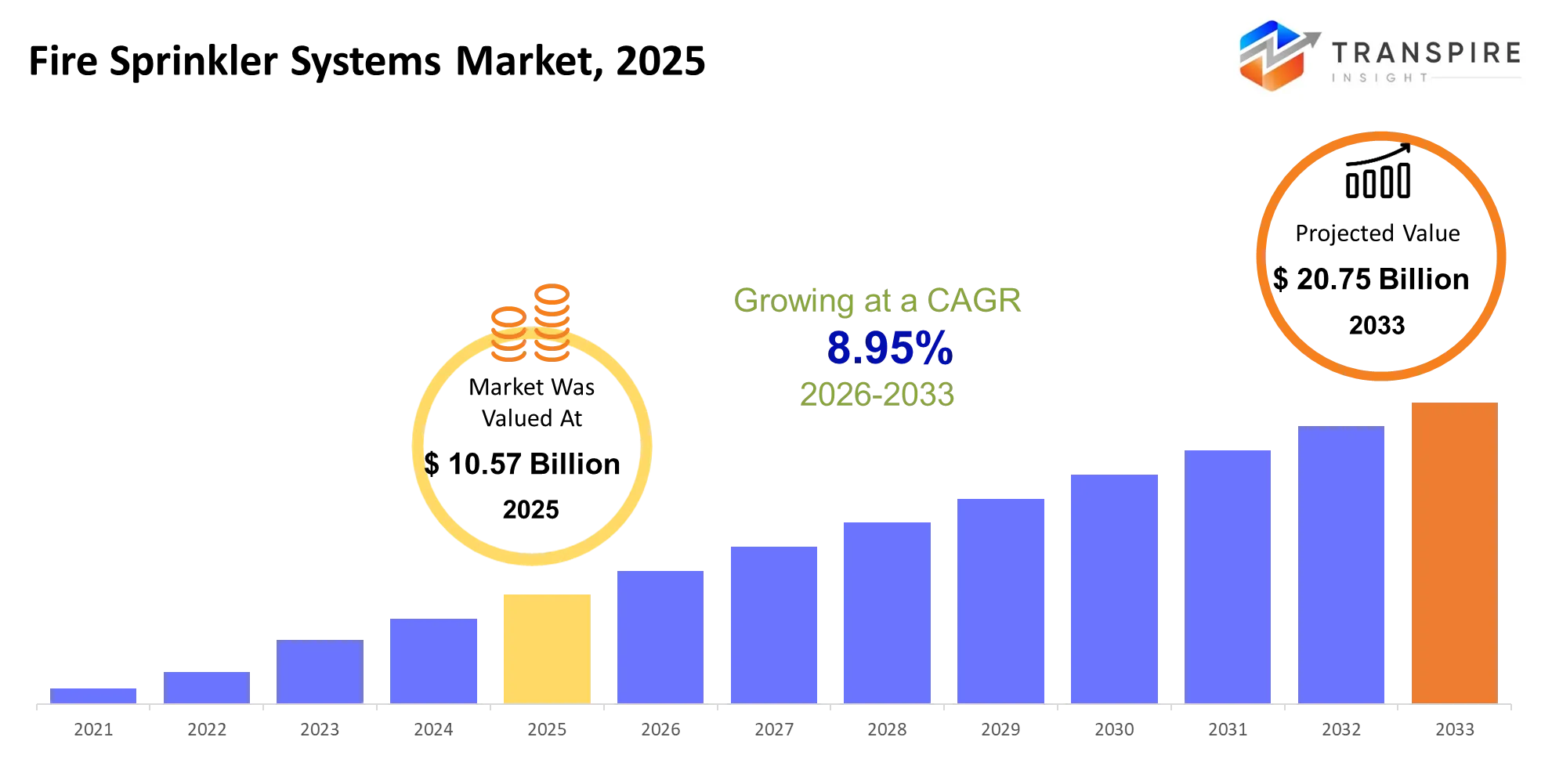
As per Transpire Insight, The Fire Sprinkler Systems Market size is estimated at USD 10.57 billion in 2025 and is anticipated to reach USD 20.75 billion by 2033, growing at a CAGR of 8.95% from 2026 to 2033.
The fire sprinkler systems market is shifting from simple fire suppression to the integrated safety of a building. Today, buildings are required to respond dependably, meet more demanding codes, and sustain assets and tenants before, during, and after an incident. Fire sprinklers protect assets and people by sensing the presence of heat and releasing water or other approved suppression agents near a fire to minimise impact before the arrival of the fire department. Demand for engineered protection has grown in the past three to five years as the rise of warehouses, taller structures, data centres, and investment in industrial infrastructure continues to accelerate. Demand is moving toward connected monitoring, addressable controls, and Internet of Things-enabled equipment that allow operators to monitor system health and identify faults remotely. Notable fires and business disruptions have highlighted the importance of dependable protection, while insurance requirements and local fire codes have driven demand, which continues to grow as owners consider life safety, property safety, building compliance, and operational continuity.
Fire Sprinkler Systems Market Size & Forecast:
- Market Size 2025: USD 10.57 Billion
- Expected Market Value (2033): USD 20.75 Billion
- Forecast CAGR (2026–2033): 8.95%
- Leading Region in 2025: North America
- Fastest Growing Region: Asia Pacific
- Key Company Profiles: Johnson Controls, Siemens, Honeywell, Viking Group, Tyco, Victaulic, Reliable Automatic Sprinkler, Minimax, API Group, Globe Fire Sprinkler, HD Fire Protect, BlazeMaster, Potter Electric Signal, NAFFCO, Marioff.
Key Fire Sprinkler Systems Market Insights:
The market is moving away from standalone suppression equipment and towards connected, risk-specific fire protection, with compliance and maintenance becoming more important in the purchasing process. The ability to match system design to building hazards and to enhance efficiency of inspections, visibility through digital systems, and long-term serviceability will be the key to competitive advantage.
- Wet Pipe Systems account for 46.80%, reinforcing the preference for proven solutions in buildings that are not exposed to freezing.
- Smart/IoT-Enabled Sprinklers indicate an 8.10% CAGR, prompting suppliers to integrate remote monitoring and maintenance analytics.
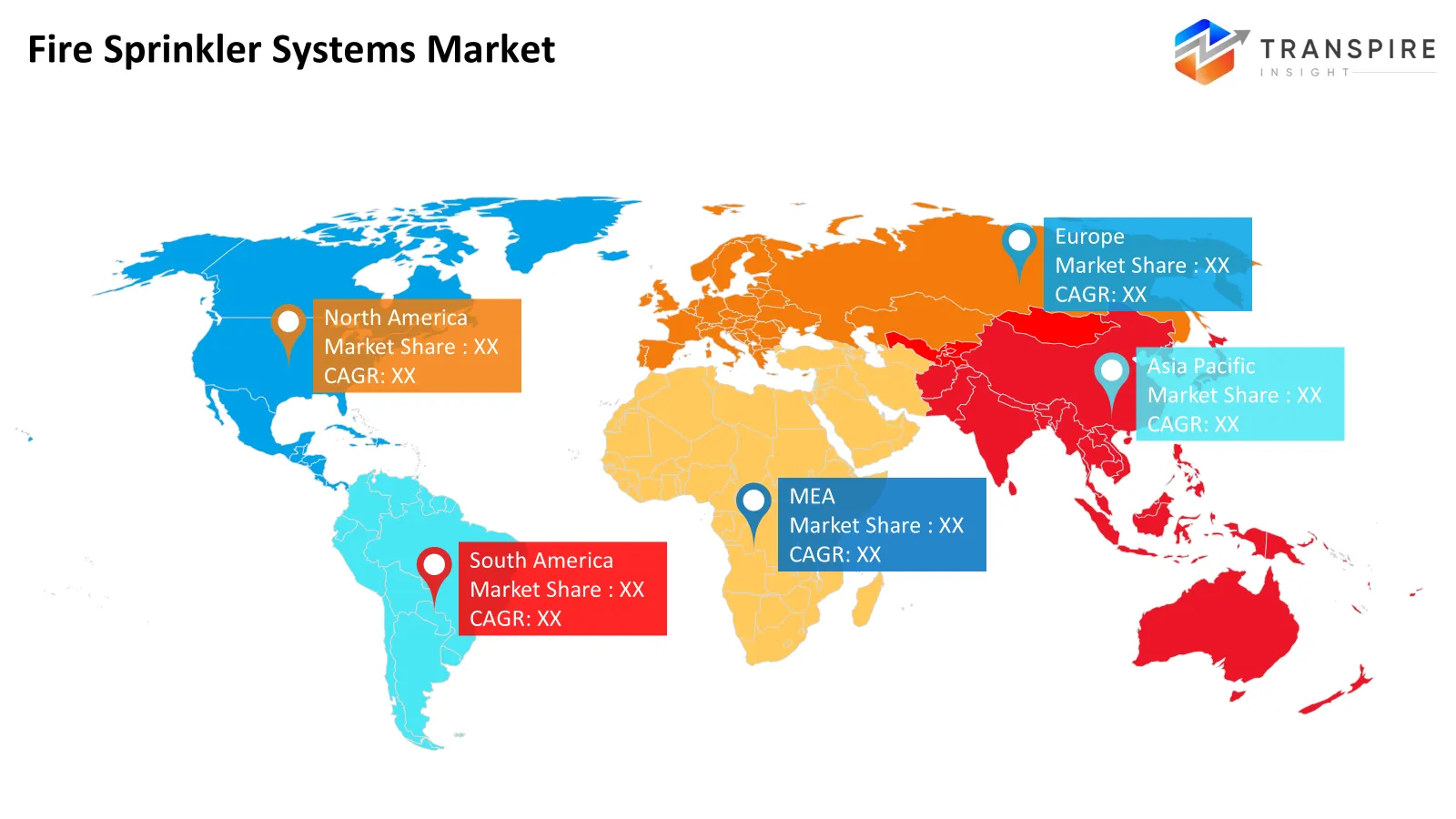
- North America is at 35.90% as it has established fire safety codes and a well-developed inspection ecosystem.
- Europe accounts for 29.00% and has established building standards and refurbishment requirements to keep equipment up to date.
- Asia Pacific accounts for 25.00%, with opportunity for localised systems due to growth in commercial and industrial infrastructure.
- Project financing and installation affordability are factors in Latin America, which represents 5.50% of the total.
- The Middle East & Africa region represents 4.60%, and significant commercial developments offer protection opportunities.
- The trend toward digital oversight and predictive maintenance is demonstrated by Johnson Controls' Connected Sprinkler service.
- The 2025 edition of NFPA 13 introduces changes to installation provisions, highlighting the need for system design and commissioning that align with standards.
What are the Key Drivers, Restraints, and Opportunities in the Fire Sprinkler Systems Market?
Driver:
Regulatory expansion converts fire protection from discretionary expenditure into specified construction scope. England’s guidance covering all new care homes illustrates this mechanism: removing height thresholds broadens the addressable project base. Each protected building generates equipment, installation, commissioning, and subsequent servicing revenue. Separately, lithium battery storage creates engineering requirements around rack configurations and water delivery, supporting specialised design and equipment contracts rather than interchangeable hardware purchases.
Restraint:
High upfront expenditure remains a barrier, particularly in older buildings requiring extensive pipework, water-supply upgrades, structural modifications, and installation downtime. Retrofit projects can become costly when existing layouts cannot accommodate compliant sprinkler coverage. Fragmented building codes, approval processes, and shortages of skilled designers and installers further delay projects, extending purchasing cycles and restricting adoption among smaller property owners.
Opportunity:
Connected monitoring and specialised protection for mission-critical infrastructure offer scope for higher-value contracts. Data centres, automated warehouses, and industrial battery-storage facilities require carefully engineered solutions matched to their fire risks. Johnson Controls’ Connected Sprinkler service demonstrates how digital monitoring and predictive maintenance can support ongoing system oversight. Suppliers that combine compliant equipment, remote diagnostics, installation, and lifecycle maintenance can generate recurring service revenue. Emerging markets also present opportunities through commercial construction and modernisation of existing buildings, provided investment is supported by enforceable safety requirements and reliable water infrastructure.
Driver Impact Analysis – Fire Sprinkler Systems Market
|
Driver |
Relative Impact on Growth (%) |
Geographic Relevance |
Impact Timeline |
Demand Strength |
Growth Mechanism |
Key Beneficiaries |
Major Constraint |
|
Stringent fire safety regulations and building code enforcement |
30% |
North America, Europe, Asia-Pacific |
Short-term (≤2 years) |
High |
Mandates compliant sprinkler installations across regulated buildings |
Certified sprinkler manufacturers and installation contractors |
Uneven enforcement and jurisdiction-specific compliance requirements |
|
Expansion of commercial, industrial, and high-rise infrastructure |
25% |
Asia-Pacific, Middle East, North America |
Medium-term (2–4 years) |
High |
New construction projects require integrated automatic fire suppression systems |
Equipment manufacturers, engineering firms, construction contractors |
Construction delays and reduced capital expenditure |
|
Retrofitting and modernization of existing buildings |
20% |
North America, Europe, developed Asia-Pacific |
Medium-term (2–4 years) |
High |
Aging facilities upgrade outdated systems to meet current safety standards |
Retrofit specialists, maintenance providers, sprinkler suppliers |
High installation costs and operational disruption |
|
Growing demand from warehouses, data centers, and critical industrial facilities |
15% |
North America, Asia-Pacific, Middle East |
Short-term (≤2 years) |
High |
High-value facilities require specialized sprinkler protection solutions |
Industrial sprinkler vendors, data center operators, fire protection engineers |
Complex hazard assessments and specialized system costs |
|
Adoption of smart monitoring and advanced sprinkler technologies |
10% |
North America, Europe, Asia-Pacific |
Long-term (≥4 years) |
Medium |
Connected sensors enable remote supervision and predictive maintenance |
Smart-system vendors, software providers, service contractors |
Integration complexity and cybersecurity concerns |
|
Total |
100% |
Global |
— |
— |
— |
— |
— |
What Has the Impact of Artificial Intelligence Been on the Fire Sprinkler Systems Market?
Artificial intelligence influences the operation of fire sprinklers through connected monitoring, fault detection, and maintenance planning, as opposed to controlling conventional sprinklers through direct intelligence. Sensors are capable of relaying water pressure, flow, valve position, and equipment status to monitoring platforms. These platforms use analytics to detect abnormal values that indicate leakage, a closed valve, or a system failure, enabling facility teams to counter the system weakness before a failure occurs. Predictive maintenance is another use of artificial intelligence. Analytics equipped with inspection history, alarms, and sensor trends can help coordinate maintenance visits, avoid unnecessary inspections, and lower downtime. Johnson Controls' Connected Sprinkler service is an example of movement toward real-time insight and predictive maintenance.
Automation helps high-bay, multi-building facilities centralise supervision of these facilities and enables maintenance teams to take uniform action when multiple buildings report issues. There are limitations to the implementation of artificial intelligence that include sensor installation costs, incompatible ageing equipment, inadequately uniform data, and false alarms, which mean traditional sprinklers have to work according to their thermal and hydraulic engineered design. Artificial intelligence should not replace inspected and verified protection, statutory inspections, or humans; it should be used as an aid.
In April 2026, Johnson Controls acquired Nantum AI to integrate advanced machine learning algorithms directly into its OpenBlue digital ecosystem. This acquisition boosts the platform’s capacity to process real-time operational trends and occupant data, maximising the efficiency of centralised building systems and proactive maintenance planning across large enterprise infrastructures.
Key Fire Sprinkler Systems Market Trends:
Sprinkler purchasing is moving beyond initial compliance toward demonstrable protection readiness throughout building operations, instead of equipment pricing alone. The competitive trend is towards suppliers who can integrate approved suppression equipment with monitoring, specialist engineering and service.
- England's care home guidance extends sprinkler specifications to smaller new developments, from the height threshold.
- Pressure, temperature and water anomalies are now visible from periodic snapshots to constant monitoring between inspections.
- Historical system data is now helping to inform maintenance decisions prior to disruptive failure, from emergency repairs to prioritised intervention.
- Proprietary replacement to retrofit compatibility; hardware-agnostic monitoring provides an upgrade path for existing sprinkler systems.
- The approved water mist options are expanding protection options for sensitive equipment, ranging from traditional computing rooms to AI infrastructure.
- Whether it's general warehouse assumptions or specific engineering of the battery, lithium storage protection is becoming more and more related to rack layout and proven water flow.
- Mobile dashboards enable facilities teams to access alerts and histories from various locations, from building supervision to portfolio management.
- Connected protection opens the door to the possibilities of tying monitoring, technical support, and maintenance together during the lifetime of the asset, from equipment purchases to ongoing services.
Fire Sprinkler Systems Market Segmentation
Product Type:
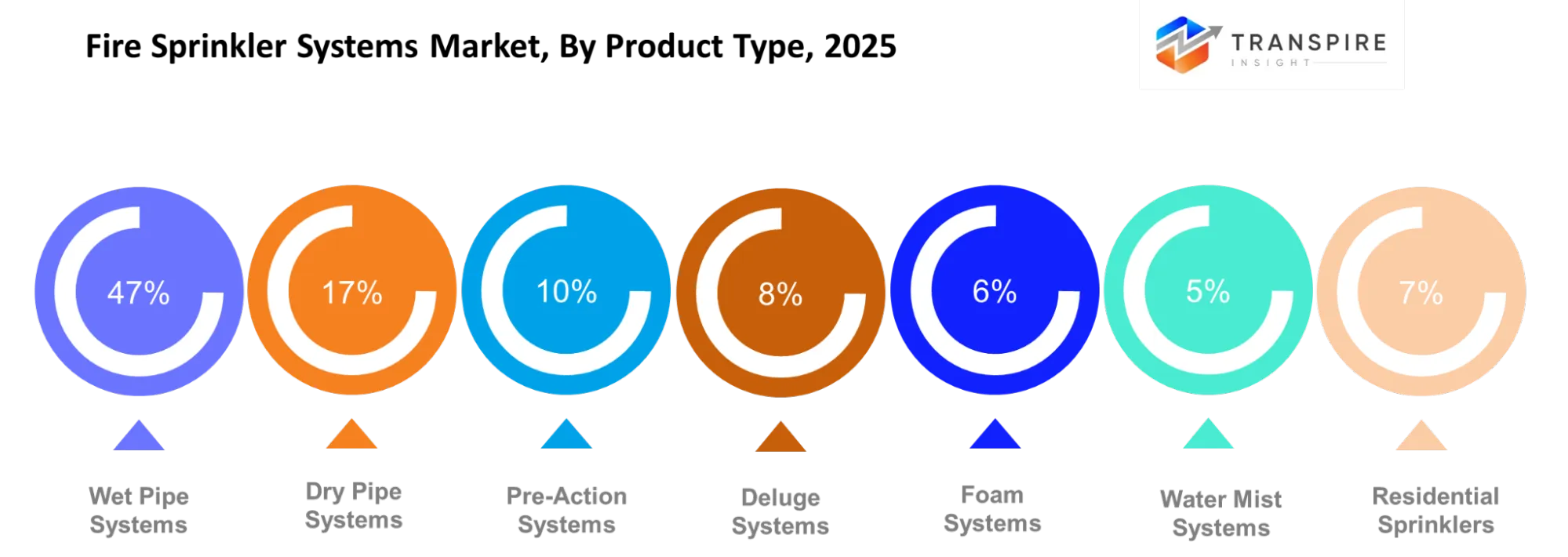
Wet Pipe Systems predominate with a 46.80% market share. This is followed by Dry Pipe Systems at 17.00%, Pre-Action Systems at 10.00%, Deluge Systems at 8.00%, Foam Systems at 6.00%, Water Mist Systems at 5.00%, Residential Sprinklers at 4.00%, and Special Hazard Systems at 3.20%. Wet pipe designs have the benefits of simple installation, dependable operation, and less complexity in non-freezing environments; dry-pipe and pre-action designs are employed in specialised facilities requiring further assurance. Industrial hazards continue to generate demand for deluge, foam, and water-mist applications. These segments account for all of the segmentation offered.
Component:
Sprinkler Heads, Pipes, Valves, Alarm Valves, Flow Switches, Control Panels, Pumps, and Water Tanks support system operation and replacement demand. Hydraulic performance remains central to purchasing decisions, while monitoring technologies are creating additional opportunities for instrumentation, diagnostics, and maintenance services. Suppliers that ensure component compatibility, reliable water delivery, and straightforward servicing can strengthen customer retention. Future revenue will depend on balancing durable equipment sales with recurring inspection, repair, and component replacement requirements across installed systems.
Application:
Commercial Buildings represent an important source of project demand, alongside Residential Buildings, Industrial Facilities, Warehouses, Hospitals, Hotels, Data Centres, and Oil & Gas Facilities. Each application requires protection tailored to occupancy, asset value, and fire hazards. Warehouse automation changes storage configurations, while expanding computing infrastructure increases the importance of specialised protection. Industrial operators also require designs suited to process-specific risks. Suppliers with strong application engineering capabilities can secure projects by delivering compliant solutions that balance safety, installation costs, and operational continuity.
Technology:
Conventional, Addressable, Smart Sprinklers, IoT-Enabled, Wireless, Automated, and AI-Assisted solutions reflect different levels of monitoring and control. The stated 8.10% CAGR applies specifically to Smart/IoT-Enabled Sprinklers, rather than the entire technology category. Connected platforms can improve visibility into system status, support fault identification, and help prioritise maintenance. However, adoption depends on integration with existing building systems, dependable sensor data, and cybersecurity safeguards. Suppliers that combine certified sprinkler equipment with practical digital capabilities can develop service-based revenue while improving maintenance coordination.
Installation Type:
New Construction supports coordinated sprinkler design during initial building development, whereas Retrofit, Replacement, Expansion, Renovation, Modular, and Temporary installations address changing infrastructure needs. Existing buildings often require hydraulic reassessment, pipework modifications, and upgrades to water supplies, making retrofit projects more complex than new installations. Phased execution can help owners minimise disruption and manage capital expenditure. Suppliers offering site assessments, flexible installation planning, and commissioning support can capture modernisation opportunities. Long-term growth will depend on balancing new-build projects with upgrades to ageing commercial, residential, and industrial properties.
End User:
Commercial, Residential, Industrial, Government, Healthcare, Hospitality, and Transportation organisations prioritise compliance, occupant safety, and operational continuity. Commercial property owners seek dependable protection with manageable lifecycle costs, while residential projects depend on affordability and applicable building requirements. Healthcare facilities require reliable systems that accommodate vulnerable occupants and continuous operations; industrial users need solutions matched to specific process hazards. Government and transportation projects also involve procurement standards and complex infrastructure requirements. Suppliers that tailor engineering, maintenance, and inspection services to each end user's operational constraints can build stronger relationships and differentiate beyond equipment pricing.
What are the Key Use Cases Driving the Fire Sprinkler Systems Market?
Wet Pipe Systems account for 46.80% of the market and are generally used in commercial buildings, offices, hotels, and residential buildings where freezing is not a concern. Practical in terms of their known installation procedures and speed of response to an emergency.
Other applications are growing, such as data centres, hospitals, manufacturing plants, and warehouses. Dry Pipe Systems can be used in cold environments, and Pre-Action Systems can be used to protect sensitive equipment. Deluge or foam-based configurations might be necessary for industrial and oil and gas facilities based on the hazards identified.
New applications are the smart monitoring of multi-site properties, the protection of automated logistics facilities, and specific fire strategies for battery-storage facilities. Monitoring through the use of IoT can aid in detecting faults earlier, and engineered designs can help ensure fire protection while maintaining operational continuity.
|
Report Metrics |
Details |
|
Market size value in 2025 |
USD 10.57 Billion |
|
Market size value in 2026 |
USD 11.39 Billion |
|
Revenue forecast in 2033 |
USD 20.75 Billion |
|
Growth rate |
CAGR of 8.95% from 2026 to 2033 |
|
Base year |
2025 |
|
Historical data |
2021 - 2024 |
|
Forecast period |
2026 - 2033 |
|
Report coverage |
Revenue forecast, competitive landscape, growth factors, and trends |
|
Regional scope |
United States; Canada; Mexico; United Kingdom; Germany; France; Italy; Spain; Denmark; Sweden; Norway; China; Japan; India; Australia; South Korea; Thailand; Brazil; Argentina; South Africa; Saudi Arabia; United Arab Emirates |
|
Key companies profiled |
Johnson Controls, Siemens, Honeywell, Viking Group, Tyco, Victaulic, Reliable Automatic Sprinkler, Minimax, API Group, Globe Fire Sprinkler, HD Fire Protect, BlazeMaster, Potter Electric Signal, NAFFCO, Marioff. |
|
Customization scope |
Free report customization (country, regional & segment scope). Available customized purchase options to meet your exact research needs. |
|
Report Segmentation |
Product Type (Wet Pipe Systems, Dry Pipe Systems, Pre-Action Systems, Deluge Systems, Foam Systems, Water Mist Systems, Residential Sprinklers, Special Hazard Systems); Component (Sprinkler Heads, Pipes, Valves, Alarm Valves, Flow Switches, Control Panels, Pumps, Water Tanks); Application (Commercial Buildings, Residential Buildings, Industrial Facilities, Warehouses, Hospitals, Hotels, Data Centers, Oil & Gas Facilities); Technology (Conventional, Addressable, Smart Sprinklers, IoT-Enabled, Wireless, Automated, AI-Assisted); Installation Type (New Construction, Retrofit, Replacement, Expansion, Renovation, Modular, Temporary); End User (Commercial, Residential, Industrial, Government, Healthcare, Hospitality, Transportation) |
Which Regions are Driving the Fire Sprinkler Systems Market Growth?
North America is the largest market, at 35.90%, supported by mature fire-safety regulations, high levels of existing construction, and engineering and inspection capabilities. System specifications are established by National Fire Protection Association guidance and building codes and specifications, while insurance and facility owners value established documentation and tested functioning. Data centres, industrial projects, and building upgrades of older facilities are driving demand for new pre-action systems, replacement devices, and connected maintenance services, benefiting vendors that offer Certified Equipment paired with installation and ongoing service and maintenance.
In October 2026, FCL-X Fire & Safety Inc. launched its new operating division, FCL-X Fire Protection & Compliance Services. This strategic expansion enables the company to combine its advanced technology manufacturing with downstream inspection and lifecycle maintenance, capturing predictable, recurring service revenue driven by strict regulatory compliance.
Europe represents 29.00% of the market, supported by the mature construction industry, the existing infrastructure, the presence of mature safety procedures and the refurbishment of commercial, residential, healthcare and industrial premises. Opportunities for Europe differ from the North America: it is more depending on the national legislative regulations, building regulations and the upgrading of existing buildings. Engineering standards, developed distributors and niche contractors ensure the uniform completion of projects; retrofitting represents a fairly stable demand.
In July 2026, the European Commission signed 15 grant agreements to award €134.9 million under its Public Sector Loan Facility to drive a climate-neutral economic transition across Europe. This funding directly impacts deep retrofitting and infrastructure modernisation by executing urban renewal, healthcare facility upgrades, and railway infrastructure improvements in Czechia, Greece, Germany, and Slovakia.
Asia Pacific accounts for 25.00% of the market and is expected to grow at a compound annual growth rate of 7.50%. Growth in Asia is driven by the rapid pace of urbanisation, manufacturing investment, logistics expansion, and new digital infrastructure stimulating demand for engineered fire protection. The market is shifting from new-build projects to integrated systems and industrial-based specialised designs. Companies that drive localisation of manufacturing processes, increase the strength of their contractor networks, and offer affordable compliant solutions will be able to capitalise on the many opportunities created by the build-out of nascent urban and industrial areas.
In June 2026, Storskogen acquired a majority stake in Singapore-based fire safety provider Safi Equipment and Services. This strategic move expands the Swedish industrial group's infrastructure footprint in Asia, allowing it to leverage localised installation and maintenance services for commercial, retail, and industrial buildings to capture regional growth.
https://app.dealroom.co/news/note/storskogen-acquires-singapore-fire-safety-firm-to-expand-in-asia
Who are the Key Players in the Fire Sprinkler Systems Market, and how do they compete?
The industry includes the manufacturers, service consolidators, and monitoring specialists, although segmentation by independent sprinkler vendor masks the nuance of the value chain. Johnson Controls is owned by Tyco and Victaulic owns Globe Fire Sprinkler, while experts are increasingly as much a matter of performance and installation economics as they are of performance and ongoing customer access.
Johnson Controls improves connected servicing with the leverage gained by Tyco hardware, with Siemens integrating digital monitoring and remote technician dispatch, and Honeywell improving the cloud visibility with its installed alarm base. Victaulic brings Globe offerings into installation-focused systems; Viking Group builds on the company's advanced sprinkler innovations and contractor equipment; and Reliable Automatic Sprinkler leverages robotic production and application approvals to expand project eligibility. Minimax tackles industrial risk via engineered installation programs. The APi Group expands its scale advantage in recurring services through acquisitions; HD Fire Protect combines manufacturing with supply and local backing; NAFFCO offers equipment for regional projects; Blaze Master, a CPVC division of Lubrizol, provides installation practicality through licensed contractors; Potter Electric Signal provides corrosion monitoring; and Marioff expands on permitted HI-FOG water mist for data centres.
Key Players are:
- Johnson Controls
- Siemens
- Honeywell
- Viking Group
- Tyco
- Victaulic
- Reliable Automatic Sprinkler
- Minimax
- API Group
- Globe Fire Sprinkler
- HD Fire Protect
- BlazeMaster
- Potter Electric Signal
- NAFFCO
- Marioff
Fire Sprinkler Systems Market — Enhanced Competitive Benchmarking
|
Company |
Est. Revenue Share Range |
Key Offerings |
Strategic Positioning |
Geographic Strength |
Technology Focus |
|
Johnson Controls International plc |
16–19% |
Tyco sprinklers, Grinnell piping products, valves, storage fire protection systems |
leadership through broad portfolio and distribution |
North America, Europe, Asia Pacific |
Quick-response sprinklers and specialized storage protection |
|
Viking Group, Inc. |
6–9% |
Standard and quick-response sprinklers, valves, fittings, flexible sprinkler assemblies |
Product breadth and specialist fire-protection engineering |
North America, Europe, Asia Pacific |
Extended-coverage and application-specific sprinkler designs |
|
Reliable Automatic Sprinkler Co., Inc. |
4–6% |
Automatic sprinklers, control valves, alarm valves, system accessories |
Specialist manufacturing with contractor-focused product support |
North America, Europe, Asia Pacific |
Hydraulic performance and application-specific sprinkler configurations |
|
Honeywell International Inc. |
3–6% |
Fire-system integration, sprinkler monitoring interfaces, fire detection and control products |
Integrated fire-safety solutions for complex facilities |
North America, Europe, Asia Pacific |
Connected fire detection and building-system integration |
|
Potter Electric Signal Company, LLC |
2–4% |
Waterflow switches, supervisory switches, pressure switches, nitrogen corrosion-control systems |
Specialist differentiation through monitoring and maintenance solutions |
North America, selected international markets |
Automated testing, wireless supervision and corrosion monitoring |
|
Victaulic Company |
2–4% |
FireLock sprinklers, grooved couplings, valves, VicFlex flexible assemblies |
Installation productivity through integrated piping components |
North America, Europe, Asia Pacific |
Grooved mechanical joining and flexible sprinkler connections |
|
Minimax GmbH & Co. KG |
2–4% |
Water-based suppression systems, sprinkler installations, control valves, fire-protection engineering |
Engineering-led protection for industrial and high-hazard facilities |
Europe, North America, Asia Pacific |
Engineered suppression systems and industrial hazard protection |
|
NAFFCO FZCO |
1–3% |
Wet-pipe sprinklers, dry-pipe sprinklers, concealed sprinklers, sidewall sprinklers |
Broad fire-protection portfolio with regional manufacturing and project delivery |
Middle East & Africa, Asia Pacific |
Application-specific sprinkler configurations and system integration |
|
HD Fire Protect Pvt. Ltd. |
1–3% |
Automatic sprinklers, deluge valves, alarm valves, water-spray systems |
Value-oriented manufacturing for industrial and infrastructure projects |
Asia Pacific, Middle East & Africa |
Water-based suppression and specialized industrial protection |
|
Rapidrop Ltd. |
1–3% |
Sprinkler heads, alarm valves, pipe fittings, flexible drop assemblies |
Distributor-led expansion and contractor-oriented product availability |
Europe, Asia Pacific, Middle East & Africa |
Installation-efficient components and certified sprinkler assemblies |
Recent Development News
- In October 2026, Century Fire Protection acquired A&A Fire Protection, LLC, expanding its fire sprinkler design, installation, inspection, and repair capabilities across South Carolina, western North Carolina, and northern Georgia. The acquisition strengthens Century’s regional service coverage and broadens its customer base across commercial end markets. https://www.globenewswire.com/news-release/2026/10/19/3383919/0/en/century-fire-protection-acquires-a-a-fire-protection.html
- In July 2026, AGF Manufacturing introduced its DRYTEST Model 5600, a compact valve assembly designed to simplify trip testing in dry and preaction fire sprinkler systems. By combining the test connection valve and orifice manifold into a single assembly, the product aims to reduce installation complexity, minimise potential leak points, and improve the efficiency of required system testing and maintenance. https://www.buildings.com/products/fire-life-safety/product/55394426/agf-manufacturing-agf-manufacturing-launches-drytest-model-5600-for-fire-sprinkler-trip-testing
- In July 2026, APi Group closed the acquisition of WTech Fire Group. This acquisition integrates WTech's extensive European fire sprinkler, suppression, and detection network into APi’s international portfolio, contributing roughly $175 million in annual revenue. https://www.businesswire.com/news/home/20260702084305/en/APi-Group-Completes-the-Acquisition-of-WTech-Fire-Group-and-Updates-2026-Guidance
What Strategic Insights Define the Future of the Fire Sprinkler Systems Market?
The industry is heading toward a combined protection solution that integrates certified suppression, digital monitoring, and lifecycle servicing. The early differentiator will be system dependability rather than hardware cost. An underlying risk lies within connected monitoring, which could present a false sense of security if there is insufficient sensor care, inaccurate information, and simply not enough conventional check-ups. Another challenge stems from retrofitting complexities, whereby old buildings may need costly hydraulic modifications, disruptive installation work, and awkward integrations with existing controls. Potential opportunities are emerging in data centres, robotics warehouses, and battery infrastructure projects – locations with a dedicated clean hazard requiring a designed-in monitoring system. Asia Pacific's projected 7.50% CAGR highlights regional growth potential, but local regulatory compliance and installer competence are critical factors. Firms will need to target interoperable monitoring, custom product designs, and partnerships with validated installation vendors. Combining the effort of installation, inspections, and predictive maintenance will create recurring revenues and improve customer retention in the future.
Key Segmentations are:
Product Type
- Wet Pipe Systems
- Dry Pipe Systems
- Pre-Action Systems
- Deluge Systems
- Foam Systems
- Water Mist Systems
- Residential Sprinklers
- Special Hazard Systems
Component
- Sprinkler Heads
- Pipes
- Valves
- Alarm Valves
- Flow Switches
- Control Panels
- Pumps
- Water Tanks
Application
- Commercial Buildings
- Residential Buildings
- Industrial Facilities
- Warehouses
- Hospitals
- Hotels
- Data Centres
- Oil & Gas Facilities
Technology
- Conventional
- Addressable
- Smart Sprinklers
- IoT-Enabled
- Wireless
- Automated
- AI-Assisted
Installation Type
- New Construction
- Retrofit
- Replacement
- Expansion
- Renovation
- Modular
- Temporary
End User
- Commercial
- Residential
- Industrial
- Government
- Healthcare
- Hospitality
- Transportation
By Regional Analysis
North America
- US
- Canada
- Mexico
Europe
- Germany
- UK
- France
- Italy
- Spain
- Russia
- Rest of Europe
Asia Pacific
- China
- Japan
- India
- South Korea
- Australia
- Rest of Asia Pacific
South America
- Brazil
- Argentina
- Rest of South America
Middle East & Africa
- UAE
- Saudi Arabia
- Qatar
- South Africa
- Rest of the Middle East & Africa
Frequently Asked Questions
Find quick answers to common questions.
The fire sprinkler systems market size was valued at USD 10.57 billion in 2025 and is poised to reach USD 20.75 billion by 2033, expanding at an 8.95% CAGR.
Key segments for the fire sprinkler systems market are Product Type (Wet Pipe Systems, Dry Pipe Systems, Pre-Action Systems, Deluge Systems, Foam Systems, Water Mist Systems, Residential Sprinklers, Special Hazard Systems); Component (Sprinkler Heads, Pipes, Valves, Alarm Valves, Flow Switches, Control Panels, Pumps, Water Tanks); Application (Commercial Buildings, Residential Buildings, Industrial Facilities, Warehouses, Hospitals, Hotels, Data Centers, Oil & Gas Facilities); Technology (Conventional, Addressable, Smart Sprinklers, IoT-Enabled, Wireless, Automated, AI-Assisted); Installation Type (New Construction, Retrofit, Replacement, Expansion, Renovation, Modular, Temporary); End User (Commercial, Residential, Industrial, Government, Healthcare, Hospitality, Transportation).
Growth is primarily driven by stricter fire-safety regulations, expansion of commercial buildings and warehouses, rising data-centre investments, industrial infrastructure development, and adoption of smart monitoring and predictive maintenance technologies.
The fire sprinkler systems market is led by major manufacturers, including Johnson Controls, Siemens, Honeywell, Viking Group, Tyco, Victaulic, Reliable Automatic Sprinkler, Minimax, API Group, Globe Fire Sprinkler, HD Fire Protect, BlazeMaster, Potter Electric Signal, NAFFCO, and Marioff.
North America holds 35.90% of the market, supported by established fire-safety regulations, mature inspection networks, commercial building retrofits, industrial investment, and growing data-centre infrastructure.
Key opportunities include IoT-enabled sprinkler monitoring, predictive maintenance services, retrofit installations in ageing buildings, specialised fire protection for data centres and warehouses, and expansion across Asia Pacific.
- Johnson Controls
- Siemens
- Honeywell
- Viking Group
- Tyco
- Victaulic
- Reliable Automatic Sprinkler
- Minimax
- API Group
- Globe Fire Sprinkler
- HD Fire Protect
- BlazeMaster
- Potter Electric Signal
- NAFFCO
- Marioff
About the Authors

Avinash Kumar
I’m Avinash Kumar, a Senior Research Analyst at Transpire Insight, with expertise in the Electronics and Semiconductor and Energy & Power industry. My work focuses on analyzing emerging technologies, market trends, industry developments, and innovation across these sectors. I specialize in transforming complex technical and market insights into clear, research-backed content that helps professionals, businesses, and decision-makers stay informed. Through continuous industry research and data-driven analysis, I strive to deliver accurate, reliable, and practical perspectives on the latest advancements shaping the semiconductor and energy landscape.

Chakradhar Khansole
Chakradhar serves as the Research Director at Transpire Insight, bringing over 8 years of experience in technology, innovation, and strategic market intelligence. He specializes in transforming complex market data into actionable business insights that enable organizations to make informed, growth-oriented decisions. Recognized for his strategic vision and analytical expertise, Chakradhar leads high-impact research initiatives, delivering comprehensive market assessments, competitive intelligence, and forward-looking industry analysis.
Recently Published Reports
-
Apr 2026
Fiber Optic Faceplates Market
Fiber Optic Faceplates Market Size, Share & Analysis Report By Type (< 300 mm2, 300-350 mm2, and > 350 mm2, By Application (Night Vision, Holographic Imaging, Medical, and Others), and Geography (North America, Europe, Asia-Pacific, Middle East and Africa, South and Central America), 2021 - 2031
-
Apr 2026
High Temperature Superconductors Market
High Temperature Superconductors Market Size, Share & Analysis Report By Type (1G HTS, and 2G HTS), By Application (Power Cable, Fault Current Limiter, and Transformer), and Geography (North America, Europe, Asia-Pacific, Middle East and Africa, South and Central America), 2021 - 2031
-
Apr 2026
Industrial Plugs and Socket Market
Industrial Plugs and Socket Market Size, Share & Analysis Report By Type (Industrial Plugs, Industrial Sockets), By Current (Up to 32 A, 32 to 125 A, Above 125 A), By Protection (Dustproof and Splash Proof, Waterproof, Explosion Proof), By End User (Heavy Industries, Oil and Gas, Chemicals and Pharmaceuticals, Power Generation, Others), and Geography (North America, Europe, Asia-Pacific, Middle East and Africa, South and Central America), 2021 - 2031
-
Apr 2026
InGaAs Avalanche Photodiodes Market
InGaAs Avalanche Photodiodes Market Size, Share & Analysis Report By Type (1100 - 1700 nm, and 1000 - 1600 nm), By Application (Missile Warning System, Muzzle Flash Detection, Wafer Defect Inspection, Laser Rangefinders, and Others), and Geography (North America, Europe, Asia-Pacific, Middle East and Africa, South and Central America), 2021 - 2031