

Japan Static Random Access Memory (SRAM) Market Size & Forecast:
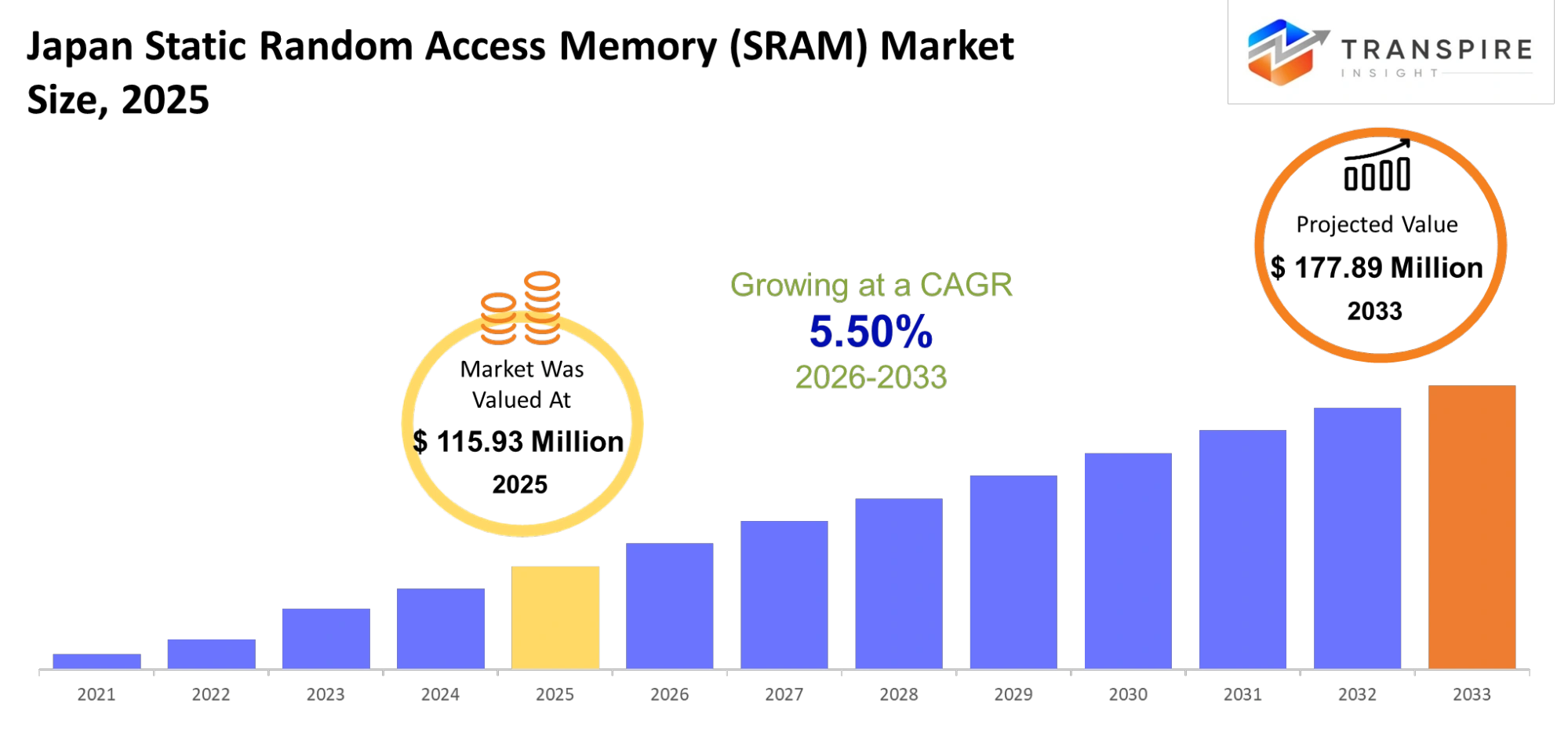
- Japan Static Random Access Memory (SRAM) Market Size 2025: USD 115.93 Million
- Japan Static Random Access Memory (SRAM) Market Size 2033: USD 177.89 Million
- Japan Static Random Access Memory (SRAM) Market CAGR: 5.50%
- Japan Static Random Access Memory (SRAM) Market Segments: By Type (Asynchronous SRAM, Synchronous SRAM, Low-power SRAM, High-speed SRAM, Others); By Application (Consumer Electronics, Automotive, Industrial, Telecom, Data Centers, Networking, Others); By End-User (Electronics Manufacturers, Automotive Companies, Industrial Firms, Telecom Operators, Data Center Operators, Semiconductor Companies, Others); By Technology (CMOS, FinFET, Advanced Nodes, Embedded Memory, Others)
To learn more about this report,  Download Free Sample Report
Japan Static Random Access Memory (SRAM) Market Summary
The Japan Static Random Access Memory (SRAM) Market was valued at USD 115.93 Million in 2025. It is forecast to reach USD 177.89 Million by 2033. That is a CAGR of 5.50% over the period.
The Japan Static Random Access Memory (SRAM) market uses technology that supports quick temporary data storage for devices needing instant response times which include automotive control units and factory automation systems and networking hardware and robotics used in precision manufacturing. The system provides temporary storage which allows processors to maintain their processing speed during tasks that require immediate decision making. The market has experienced structural changes during the past three to five years because system-on-chip architectures require deeper integration of SRAM components to meet demands for reduced power usage and AI-powered edge computing capabilities.
The global semiconductor supply chain disruption which occurred between 2020 and 2022 emerged as the main factor that pushed Japan to adopt localized manufacturing solutions and establish permanent supply contracts because the situation showed how dependent the country was on overseas sources. The domestic design-in process experienced growth because of this development which particularly benefited automotive electronics and industrial systems because these sectors depend on reliability and latency control to achieve production efficiency and safety results.
Key Market Insights
- The Kanto region controls almost 38 percent of the Japan Static Random Access Memory SRAM market, which will reach its peak in 2025 because semiconductor design dominates the area and there are many original equipment manufacturers present.
- The Kyushu region experiences its fastest growth rate from 2025 to 2030 because of new fab construction projects and the expansion of TSMC-based industrial systems.
- The Japan Static Random Access Memory SRAM market shows its highest market share through synchronous SRAM which accounts for 42 percent of the market because embedded systems require high-speed processing.
- Asynchronous SRAM maintains its position as the second most used technology, which finds application in both traditional industrial controllers and networking equipment.
- The Pseudo SRAM segment experiences its fastest growth rate until 2030 because of increasing demand from mobile and low-power IoT applications.
- The automotive electronics sector controls 35% of market share because electric vehicle control units and advanced driver-assistance systems drive its success.
- The industrial automation sector experiences its highest growth because smart factory systems and robotics technology are expanding across Japan.
- Japanese automotive original equipment manufacturers control 40% of the Static Random Access Memory market while electrification trends support their market position.
- The main competitors in the market include Samsung Electronics, SK hynix, Infineon Technologies, Micron Technology, Renesas Electronics, and Sony Semiconductor Solutions.
- Companies develop new SRAM architectural designs to achieve lower power usage and faster processing capabilities.
What are the Key Drivers, Restraints, and Opportunities in the Japan Static Random Access Memory (SRAM) Market?
The Japan Static Random Access Memory (SRAM) Market exists because automotive electronics together with industrial control systems now use high-speed embedded memory technology at a fast pace. The automotive industry now requires ultra-low latency memory solutions because vehicles are moving towards electrification and advanced driver-assistance systems depend on real-time decision-making capabilities inside electronic control units. The combination of this transition with Japan's semiconductor design ecosystem strengths has resulted in increased SRAM usage for automotive-grade chips and edge computing devices which benefits memory suppliers through higher design-in sales.
SRAM technologies face a major obstacle because their essential structure needs high silicon costs per bit to function instead of using more affordable memory solutions like DRAM and new non-volatile memory technologies. The cost disadvantage exists because SRAM systems need speed for their operation which causes them to require more physical space than other storage solutions. The technology confines itself to high-performance applications which prevent companies from expanding their market reach even though there exists increasing demand from other electronic markets.
The most promising opportunity lies in the expansion of AI-enabled edge computing systems within Japan's smart manufacturing sector. Fast on-chip memory becomes essential for new robotic systems and sensor-driven automation technologies which factories implement in Aichi and Kanagawa areas. The ongoing financial backing for Industry 4.0 infrastructure together with semiconductor packaging facilities in local areas will create fresh opportunities for deploying SRAM technology in industrial settings which require low power consumption and high reliability.
What Has the Impact of Artificial Intelligence Been on the Japan Static Random Access Memory (SRAM) Market?
Modern Japan Static Random Access Memory (SRAM) systems undergo transformation through artificial intelligence and advanced digital technologies which enhance edge-level computing systems that automotive electronics and factory automation and industrial control units utilize. AI-driven automation systems now enter modern production facilities through integration with programmable logic controllers and vehicle electronic control units which handle real-time tasks such as motor control and energy distribution and industrial exhaust gas cleaning systems. The systems require high-speed SRAM to handle continuous sensor data which enables them to achieve exact operational control through autonomous system capabilities.
Machine learning models now provide predictive maintenance capabilities that improve efficiency planning processes. AI systems in smart factories use historical machine performance data to predict equipment failures and optimize thermal loads and forecast system degradation which leads to an estimated 10–15% uptime improvement across advanced deployments. Electric vehicle control architectures benefit from similar models which improve energy efficiency and system responsiveness in automotive applications thus enhancing operational stability.
The main problem exists because AI-ready semiconductor systems require expensive integration while edge environments provide insufficient real-time data access. The industrial sites and vehicles of Japan currently experience connectivity problems which create obstacles for continuous data streaming needed to train models with precise accuracy. The complete implementation of intelligent SRAM-dependent processing systems faces delays because of this issue despite high market demand.
Key Market Trends
- The period from 2021 onward has resulted in increased SRAM usage for each vehicle because of automotive ECU electrification and ADAS integration requirements.
- The post-2022 supply chain problems accelerated Japan semiconductor reshoring efforts while the TSMC Kumamoto facility enhanced local SRAM and logic chip manufacturing capabilities.
- The period from 2023 to 2026 will see manufacturing organizations implement AI-based edge computing solutions which will create a demand for synchronous SRAM that supports real-time industrial control systems.
- Pseudo SRAM became more common in mobile IoT devices because it offered better cost and power efficiency compared to traditional SRAM for low-power embedded consumer electronics applications.
- The implementation of advanced 2.5D and 3D packaging methods enabled higher SRAM integration density which allowed better performance in small automotive and industrial chipsets.
- The cost-per-bit increase of DRAM alternatives forced Japanese designers to use SRAM only for essential processing tasks that needed immediate access to data.
- Japanese OEMs established strategic partnerships with Samsung Electronics and SK Hynix to strengthen their market position through SRAM supply relationships with global memory suppliers.
- The expansion of industrial robotics in Aichi and Kansai regions resulted in increased use of SRAM-based control systems which needed rapid processing for their deterministic operations.
Japan Static Random Access Memory (SRAM) Market Segmentation
By Type
The Japan Static Random Access Memory (SRAM) market designates synchronous SRAM as its leading technology because it enables automotive electronics and industrial controllers to operate at high-speed synchronized processing. The technology maintains its market lead because advanced driver-assistance systems and real-time embedded computing systems require precise timing for their operational performance. The demand for high-speed SRAM products remains strong because networking and telecom infrastructure systems need to process data with ultra-low latency requirements. The system-level integration trends that Japan follows will create advantages for synchronous variants as the country develops its edge computing and AI-enabled technologies.
The structural importance of low-power SRAM has increased because device manufacturers now focus on developing energy-efficient solutions for IoT and portable electronics. The automotive ECU systems and battery-powered industrial sensor applications demand lower power operation which drives this market segment. Suppliers will need to achieve performance targets while minimizing energy consumption because demand for hybrid architectures that combine high-speed and low-power SRAM will increase throughout the forecast period.
By Application
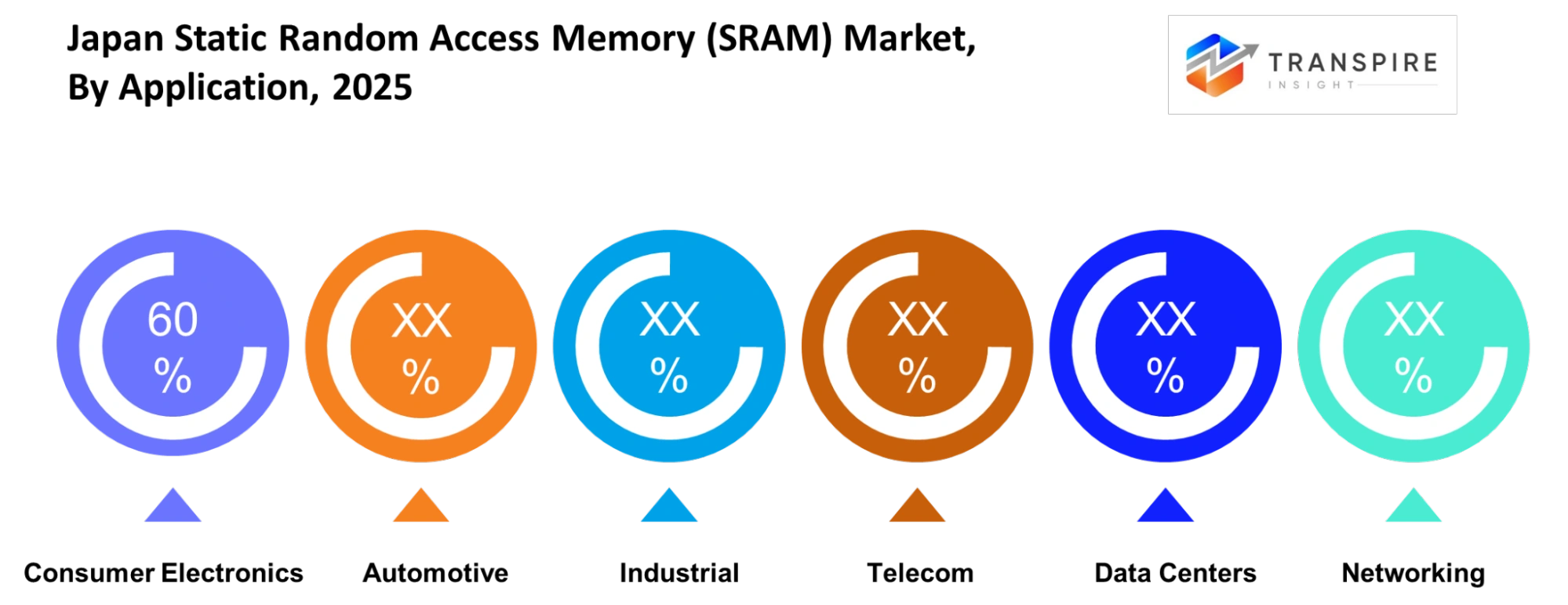
The Japan Static Random Access Memory (SRAM) Market receives its primary support from consumer electronics and automotive applications which benefit from advanced semiconductor technology used in smartphones and infotainment systems and electric vehicle control units. The automotive industry establishes itself as the leading sector because of its accelerated process of vehicle electrification and increasing adoption of electronic components especially in safety and control modules. The need for fast memory access in automation control systems has created a growing demand for real-time monitoring systems which industrial applications use to monitor their equipment.
Data centers and telecom applications are emerging as fast-growth areas due to increased demand for edge processing and 5G network optimization. The shift shows that distributed computing environments need low-latency memory. The future will develop applications which need continuous real-time processing capabilities instead of bulk storage.
To learn more about this report, Download Free Sample Report
By End-User
The electronics sector in Japan commands a major portion of the Static Random Access Memory market because local manufacturers possess advanced semiconductor integration skills and high-level production capabilities. The automotive sector ranks as the second-largest market segment because electric vehicles and autonomous systems use more electronic components. The rise of smart manufacturing in Japan is leading industrial companies to expand their operations throughout the country.
SRAM usage in high-performance computing and cloud-edge infrastructure systems has grown because semiconductor companies and data center operators now use the technology. The system requires faster processing speed because users need to access data. The market demand from end-users will eventually shift towards industries that require AI-powered technologies and real-time data analysis.
By Technology
The Japan Static Random Access Memory (SRAM) Market operates primarily through CMOS technology because it delivers cost-effective and mature solutions which work well with current semiconductor manufacturing methods. The usage of embedded memory in CMOS-based chips enables their widespread implementation across automotive and industrial sectors. The market for FinFET and advanced node technologies is expanding because AI and high-speed computing systems require better performance capabilities.
Advanced nodes are becoming critical for miniaturized, high-density SRAM used in edge devices and high-performance processors. Embedded memory solutions are increasingly preferred because they reduce latency and improve system-level efficiency. Future development will move toward tighter integration of SRAM within system-on-chip architectures which will support Japan's transition toward AI-driven electronics and precision industrial automation.
What are the Key Use Cases Driving the Japan Static Random Access Memory (SRAM) Market?
The Japan Static Random Access Memory (SRAM) Market uses automotive electronics as its primary application because SRAM enables engine control units, battery management systems, and advanced driver-assistance modules to process information in real time. The highest demand arises because electric and hybrid vehicles need immediate access to data that supports safety-critical decisions. The deployment of robotics and factory control systems and
5G network equipment by electronics manufacturers and industrial firms drives the expansion of industrial automation and telecom infrastructure applications which now include these technologies. The systems use SRAM to perform low-latency computation during their continuous monitoring and signal processing operations on production lines and communication nodes.
The new applications of edge AI computing in smart factories and embedded processing for autonomous mobility systems create opportunities for development. Semiconductor companies are conducting research on integrating SRAM into AI accelerators to enable real-time inference processing at the device level. The applications currently exist in the early development phase yet demonstrate high potential for growth as Japan develops its Industry 4.0 and connected mobility ecosystems.
|
Report Metrics |
Details |
|
Market size value in 2025 |
USD 115.93 Million |
|
Market size value in 2026 |
USD 122.31 Million |
|
Revenue forecast in 2033 |
USD 177.89 Million |
|
Growth rate |
CAGR of 5.50% from 2026 to 2033 |
|
Base year |
2025 |
|
Historical data |
2021 - 2024 |
|
Forecast period |
2026 - 2033 |
|
Report coverage |
Revenue forecast, competitive landscape, growth factors, and trends |
|
Country scope |
Japan |
|
Key company profiled |
Samsung, SK Hynix, Micron, Intel, Toshiba, Renesas, NXP, Infineon, STMicroelectronics, Texas Instruments, ON Semiconductor, Broadcom, Qualcomm, MediaTek, AMD |
|
Customization scope |
Free report customization (country, regional & segment scope). Avail customized purchase options to meet your exact research needs. |
|
Report Segmentation |
By Type (Asynchronous SRAM, Synchronous SRAM, Low-power SRAM, High-speed SRAM, Others); By Application (Consumer Electronics, Automotive, Industrial, Telecom, Data Centers, Networking, Others); By End-User (Electronics Manufacturers, Automotive Companies, Industrial Firms, Telecom Operators, Data Center Operators, Semiconductor Companies, Others); By Technology (CMOS, FinFET, Advanced Nodes, Embedded Memory, Others) |
Which Regions are Driving the Japan Static Random Access Memory (SRAM) Market Growth?
The Japan Static Random Access Memory (SRAM) Market identifies Kanto as its leading region because the area contains numerous semiconductor design houses, automotive OEM headquarters, and advanced electronics research and development centers. The Tokyo area and its neighboring prefectures maintain ongoing investment for digital transformation and semiconductor research because they provide strong government support for both initiatives. The area operates with a robust supplier network which enables quick communication between chip designers and testing sites and system integrators. The combined industrial network maintains its market dominance while enabling fast development of technologies which use SRAM.
Kansai serves as a reliable secondary center which operates through its various manufacturing facilities located in Osaka and Kyoto and Hyogo. The design leadership which establishes Kanto as an industrial center functions differently in Kansai which depends on its manufacturing base that supplies automotive parts and produces robotics and precision electronics. The manufacturers in the area demonstrate consistent patterns of SRAM usage because they maintain their equipment during extended periods of time which includes both factory automation and embedded control systems. The steady revenue growth from Kansai operations maintains stability which contrasts with the unpredictable nature of research-focused innovation centers.
Kyushu is the fastest-growing region due to major semiconductor investments which include new fabrication plants that are being built in Kumamoto and supported by global foundry expansion. The recent supply chain localization efforts and government incentives have increased advanced chip production capacity which has created higher demand for SRAM integration. The entrance of major foundries into the market has transformed regional supply chains while attracting electronics manufacturers to the area. Investors who want to enter Japan's growing semiconductor manufacturing market should consider Kyushu because its current development path will reach its peak during 2026 to 2033.
Who are the Key Players in the Japan Static Random Access Memory (SRAM) Market and How Do They Compete?
Japan's Static Random Access Memory (SRAM) Market displays its competitive framework through combined control of global semiconductor companies and a select group of specialized Japanese chip manufacturers. Chip competition depends on advanced process technology and automotive-grade reliability and power efficiency rather than chip volume production. The existing companies use extended supply agreements with automotive and industrial original equipment manufacturers to maintain market share while new businesses encounter high qualification challenges from demanding quality and latency standards. Process node advancement and embedded integration capability and guaranteed supply stability form the primary basis for competition between companies.
Samsung Electronics combines its capacity for large-scale semiconductor production with its expertise in advanced process node technology to deliver efficient memory solutions for automotive and industrial applications. SK hynix enhances its market position through packaging solutions and high-performance memory designs which enable low-latency performance in embedded systems. Micron Technology develops power-efficient memory products which meet the requirements of edge computing and automotive electronics while maintaining reliability during thermal stress tests.
Infineon Technologies creates its unique identity through its ability to achieve automotive-grade certification and create complete solutions for vehicle electronic control systems. Renesas Electronics uses its dominant position in Japan's microcontroller industry to develop custom embedded system designs which include integrated SRAM components for local automotive original equipment manufacturers. Sony Semiconductor Solutions develops specialized high-performance semiconductor solutions through its partnerships with advanced imaging and edge artificial intelligence system providers. Companies use partnerships with foundries and automotive suppliers to establish long-term design contracts which enable them to expand their competitive reach.
Company List
- Samsung
- SK Hynix
- Micron
- Intel
- Toshiba
- Renesas
- NXP
- Infineon
- STMicroelectronics
- Texas Instruments
- ON Semiconductor
- Broadcom
- Qualcomm
- MediaTek
- AMD
Recent Development News
In April 2026, SAIMEMORY announced Japanese government subsidy approval via NEDO for its Intel-co-developed ZAM memory technology targeting AI workloads. The funding and industrial validation accelerate development of high-density memory architectures that complement SRAM-based on-chip caching in next-generation processors, reinforcing Japan’s strategic push into AI memory supply chains. Source https://www.tomshardware.com/
In January 2026, Kioxia Corporation extended its joint venture agreement with SanDisk for advanced memory manufacturing in Japan." While primarily focused on 3D flash memory, the extended partnership through 2034 reinforces Japan’s long-term memory fabrication ecosystem, which includes SRAM-adjacent controller and cache-memory integration used in AI and high-performance storage systems. Source https://apac.kioxia.com/
What Strategic Insights Define the Future of the Japan Static Random Access Memory (SRAM) Market?
The Japan Static Random Access Memory (SRAM) Market will establish its future direction during the next five to seven years through its systems which will establish further connections with artificial intelligence-based edge computing environments and automotive embedded systems. The requirement for ultra-low latency memory which enables immediate decision processes in electrified vehicles and industrial robotics and distributed processing systems drives this transformation. As system-on-chip designs become more complex, SRAM is increasingly embedded rather than deployed as a standalone component, tightening its linkage with advanced semiconductor manufacturing ecosystems.
A less visible risk comes from technology substitution pressure, particularly from emerging non-volatile memory solutions that gradually reduce dependence on traditional SRAM in certain mid-speed applications. The industrial and consumer electronics markets which prioritize economical solutions will experience demand reduction until performance standards reach complete equivalence to existing solutions.
Japan's semiconductor localization expansion in Kyushu creates an opportunity because new fabrication facilities will enable foundries and automotive electronics companies to work together on development projects. The ecosystem provides early access paths for automotive-grade SRAM design wins. Manufacturers should choose long-term design partnerships with OEMs and foundries because these partnerships will help them succeed in developing next-generation embedded systems.
Japan Static Random Access Memory (SRAM) Market Report Segmentation
By Type
- Asynchronous SRAM
- Synchronous SRAM
- Low-power SRAM
- High-speed SRAM
By Application
- Consumer Electronics
- Automotive
- Industrial
- Telecom
- Data Centers
- Networking
By End-User
- Electronics Manufacturers
- Automotive Companies
- Industrial Firms
- Telecom Operators
- Data Center Operators
- Semiconductor Companies
By Technology
- CMOS
- FinFET
- Advanced Nodes
- Embedded Memory
Frequently Asked Questions
Find quick answers to common questions.
The Japan Static Random Access Memory (SRAM) Market size is USD 177.89 Million in 2033.
Key segments for the Japan Static Random Access Memory (SRAM) Market are By Type (Asynchronous SRAM, Synchronous SRAM, Low-power SRAM, High-speed SRAM, Others); By Application (Consumer Electronics, Automotive, Industrial, Telecom, Data Centers, Networking, Others); By End-User (Electronics Manufacturers, Automotive Companies, Industrial Firms, Telecom Operators, Data Center Operators, Semiconductor Companies, Others); By Technology (CMOS, FinFET, Advanced Nodes, Embedded Memory, Others).
Major Japan Static Random Access Memory (SRAM) Market players are Samsung, SK Hynix, Micron, Intel, Toshiba, Renesas, NXP, Infineon, STMicroelectronics, Texas Instruments, ON Semiconductor, Broadcom, Qualcomm, MediaTek, AMD.
The Japan Static Random Access Memory (SRAM) Market size is USD 115.93 Million in 2025.
The Japan Static Random Access Memory (SRAM) Market CAGR is 5.50% from 2026 to 2033.
- Samsung
- SK Hynix
- Micron
- Intel
- Toshiba
- Renesas
- NXP
- Infineon
- STMicroelectronics
- Texas Instruments
- ON Semiconductor
- Broadcom
- Qualcomm
- MediaTek
- AMD
Recently Published Reports
-
Apr 2026
Fiber Optic Faceplates Market
Fiber Optic Faceplates Market Size, Share & Analysis Report By Type (< 300 mm2, 300-350 mm2, and > 350 mm2, By Application (Night Vision, Holographic Imaging, Medical, and Others), and Geography (North America, Europe, Asia-Pacific, Middle East and Africa, South and Central America), 2021 - 2031
-
Apr 2026
High Temperature Superconductors Market
High Temperature Superconductors Market Size, Share & Analysis Report By Type (1G HTS, and 2G HTS), By Application (Power Cable, Fault Current Limiter, and Transformer), and Geography (North America, Europe, Asia-Pacific, Middle East and Africa, South and Central America), 2021 - 2031
-
Apr 2026
Industrial Plugs and Socket Market
Industrial Plugs and Socket Market Size, Share & Analysis Report By Type (Industrial Plugs, Industrial Sockets), By Current (Up to 32 A, 32 to 125 A, Above 125 A), By Protection (Dustproof and Splash Proof, Waterproof, Explosion Proof), By End User (Heavy Industries, Oil and Gas, Chemicals and Pharmaceuticals, Power Generation, Others), and Geography (North America, Europe, Asia-Pacific, Middle East and Africa, South and Central America), 2021 - 2031
-
Apr 2026
InGaAs Avalanche Photodiodes Market
InGaAs Avalanche Photodiodes Market Size, Share & Analysis Report By Type (1100 - 1700 nm, and 1000 - 1600 nm), By Application (Missile Warning System, Muzzle Flash Detection, Wafer Defect Inspection, Laser Rangefinders, and Others), and Geography (North America, Europe, Asia-Pacific, Middle East and Africa, South and Central America), 2021 - 2031