
Japan Small Marine Engine Market Summary:
According to Transpire Insights, a detailed research report on the market reflects that the outboard motors application segment dominates the Japan Small Marine Engine Market, accounting for approximately 62% of Yamaha Motor’s Marine Products revenue. Yamaha Motor Co., Ltd. reported approximately JPY 527.63 billion (about USD 3.52 billion) in global Marine Products revenue in 2025, making it a major contributor to Japan market development, innovation, advanced small marine engine production, expanding manufacturing capabilities, and growth dynamics.
Market Snapshot
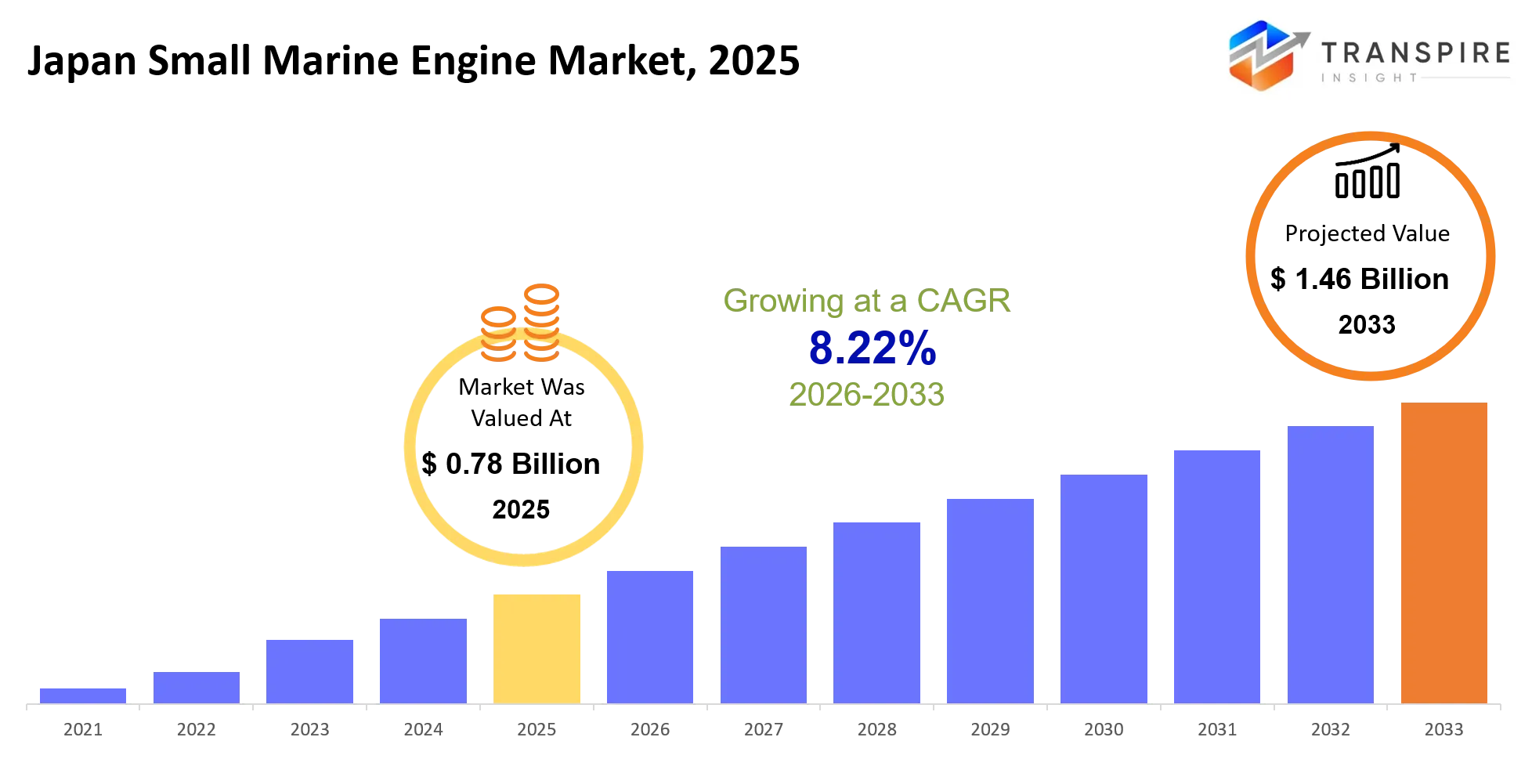
- Market Value (2025): USD 0.78 Billion.
- Expected Market Value (2026): USD 0.84 Billion.
- Estimated Market Value (2033): USD 1.46 Billion.
- Forecast CAGR (2026–2033): 8.22%
Introduction
The small marine engine market consists of the development, production, and selling of small propulsion engines, which are primarily outboard motors, small inboard engines, and auxiliary motors that have low horsepower ratings and minor displacement (usually less than a few liters). The engines mentioned above are used in various applications including recreational boats, small fishing vessels, coastal support vessels, and inland transportation vessels. The term small marine engine refers to a compact internal combustion engine or an electric engine (usually including a variety of outboard, small inboard, and sterndrive engines with either small displacement volumes or lower horsepower ratings) that is employed in powering the vessels that have been classified as small marine. Such engines typically include the complex arrangements of appropriate fuel, cooling, and exhaust systems that are specialized for small marine vessels. Japanese small marine engines are characterized by their precision manufacturing, great durability, and superior marine-grade design allowing them to operate effectively in harsh saltwater conditions. The lightweight construction allows ease of installation even in constrained spaces while providing high power density and operational reliability. State-of-the-art technologies such as electronic fuel injection, optimized combustion, and engine management system provide better fuel efficiency and lower carbon footprints to meet the requirements of the most stringent environmental regulations. Additionally, low-maintenance profile, reliable starting, and presence of monitoring technologies to minimize the unplanned downtime of users contribute to high demand for small marine engines in Japan.
Key Market Highlights: -
- By engine type, the Diesel Engines segment dominated the market and holds nearly 66% share in 2025 and is projected to grow at a substantial CAGR during the forecast period.
- By application, the Recreational Boats segment dominated the market and holds nearly 35% share in 2025 and is projected to grow at a substantial CAGR during the forecast period.
- By end user, the Individual Owners segment dominated the market and holds nearly 80% share in 2025 and is projected to grow at a substantial CAGR during the forecast period.
- Shipbuilding Regeneration Fund: The government of Japan is backing domestic shipbuilding with around ¥1 trillion in public and private investments over a decade, allowing them to modernize and automate their facilities and improve their marine component supply chains. This initiative shows benefits for the Japan Small Marine Engine Market in terms of better manufacturing capabilities of four-stroke engines, their supply chain resilience, and advancement in technology.
How is Technology Driving Growth in the Japan Small Marine Engine Market?
The Japan Small Marine Engine Market is adapting to technological advancements such as AI, IoT, electrification, and Industry 4.0 manufacturing. AI-powered diagnostics and connected sensors enable predictive maintenance, continuous monitoring, fuel-efficiency enhancements, and lower operational downtime in the industrial field. Manufacturers are adopting hybrid propulsion which combines traditional internal combustion and electric power in order to achieve more eco-friendly marine solutions and comply with environmental regulations. Theoretical studies on alternative fuels and advanced computative engineering will contribute to development of more sustainable engines. Furthermore, robotics, automation, and quality control systems are resulting in more precise manufacturing, consistent components, and effective production. Adoption of digital transformation through government policies and maritime modernization initiatives should contribute to the stronger implementation of the technologies along with Japan’s tradition in engineering and reliability.
Market Drivers
The Japan Small Marine Engine Market experiences positive impacts from regulatory changes in environmental conservation, as fuel-efficient and low-emission propulsion systems become more popular. The ongoing modernization of fishing boats and coastal ships facilitates the replacement and renewal of marine engines. Moreover, technological advances in fuel injection methods, lightweight materials, hybrid-electric propulsion, and precision engineering are boosting up engine purchases. At the same time, the growth in the recreational boating industry and popularity of personal watercraft and marine tourism lead to demand for small marine engines. All of these factors together contribute to the enhancement of market development and establishment of innovative sustainable propulsion solutions by manufacturers. The small marine engine industry of Japan has enjoyed the services of technological advances in design and durability, along with manufacturing precision, corrosion-resistance of the materials used, and rigorous quality control. Automation, robots, and digital quality monitoring systems further improve quality and efficiency of the manufacturing process. The new environmental regulations encourage the usage of electronic fuel injection and fuel-saving technologies. Also, Japan has some existing history of reliability in this field of engineering and strong brand recognition in marine markets. Finally, the introduction of integrated engines with telemetry and diagnostics functionality further strengthens the position of Japan in advanced technologies in small marine engines.
Restrain
The Japan Small Marine Engine Market encounters obstacles owing to rigorous environmental laws, escalating technology and research and development costs, supply-chain interruptions, and complicated global emission regulations. Companies have to keep innovating and investing in hybrid propulsion and buildup to ensure low emission produce machinery. Moreover, the landscape of Japan’s domestic market and changing population trends may limit volume growth and encourage manufacturers to start exporting, come up with product innovations, and adopt more advanced technologies for marine engines.
|
Driver |
Relative Impact on Growth (%) |
Geographic Relevance |
Impact Timeline |
Demand Strength |
Growth Mechanism |
Key Beneficiaries |
Major Constraint |
|
Driver 1: Environmental Regulations and Low-Emission Propulsion |
25% |
Nationwide; major coastal shipping regions |
Long-term |
High |
Drives adoption of cleaner, efficient propulsion technologies |
Engine manufacturers, component suppliers, vessel operators |
High development costs for low-emission engines |
|
Driver 2: Fishing and Coastal Fleet Modernization |
22% |
Hokkaido, Tohoku, Kyushu, Shikoku, coastal regions |
Medium-term |
High |
Fleet replacement increases demand for reliable compact engines |
Fishing operators, engine manufacturers, marine service providers |
Limited replacement budgets among small operators |
|
Driver 3: Recreational Boating and Marine Tourism |
20% |
Kanto, Kansai, Chubu, Okinawa, coastal tourism areas |
Medium-term |
High |
Leisure boating expands demand for compact reliable propulsion |
Outboard manufacturers, boat dealers, rental operators |
Aging user base and ownership costs |
|
Driver 4: Digitalization, EFI, and Smart Engine Technologies |
18% |
Nationwide; technology-intensive manufacturing hubs |
Short-term |
High |
Connected diagnostics improve efficiency, reliability, and maintenance |
Engine OEMs, sensor suppliers, software vendors, service providers |
Integration costs and cybersecurity requirements |
|
Driver 5: Shipbuilding Investment and Marine Supply-Chain Strengthening |
15% |
Nationwide; major shipbuilding and marine-equipment clusters |
Long-term |
Medium |
Capacity investment strengthens production and component availability |
Engine OEMs, component suppliers, shipyards, automation vendors |
Skilled-labor shortages and long investment cycles |
Analysis of Prices and Consumer Behaviour
The outboard motor segment commands a large share of the small marine-engine market because of the combined sales of all products in the segment (26.4% in terms of total marine equipment production value). The price of a motor is to a large extent determined by engine performance, fuel efficiency and technology implementation. Japanese manufacturers are focused on enhancing their combustion and emissions technologies. In 2024, Japan produced nearly 264,087 outboard motors. They are sold in great quantities because their range of applications covers the recreational-boating sector as well as fishing-boating and small-craft segments. The outboard motor production value of Japan was about JPY 124 billion in 2024, with Japan’s outboard motors being the biggest category of non-diesel marine equipment by production value. As for purchasing behavior of consumers, it can be noted that they mostly focus on fuel efficiency, engine reliability and durability. Moreover, 33% of consumers are interested in the purchase through bulk agreement or long-term contracts in order to optimize their expenses on purchase of goods and gain reliable supply for their clients across Japan.
Who are the Key Players in the Japan Small Marine Engine Market and how do they compete?
The competitiveness of the Japanese industry of small marine engine manufacturers is determined by companies that develop advanced propulsion systems, specific engine solutions, fuel-saving technologies, long-lasting products, and create solid delivery and post-sales service operations. Thus, producers compete not only by price but also by principles such as reliability, low emissions, electronic fuel injection, digital monitoring, and integration of new generation systems which results in constant innovations in product development, facilitating the improvement of fuel efficiency, reliability, operational efficiency, and environmental compliance of their customers.
As a result of its investments in new outboard motors, information technologies for marine industry, and propulsion developments, Yamaha Motor strengthens its position in the industry. By developing efficient marine engines for the needs of leisure boating, fishing, and the marine business, companies distinguish themselves in terms of efficiency, durability, and fuel savings. An example of the company engaged in such operations is Honda Motor which develops its position due to advanced outboard engines featuring four-stroke fuel-efficient technologies and electronic fuel injection.
Top Companies in the Japan Small Marine Engine Market
- Yamaha Motor
- Suzuki Motor
- Honda Motor
- Tohatsu
- Mercury Marine
- Kawasaki Heavy Industries
- Yanmar
- Volvo Penta
- MAN Energy Solutions
- Cummins
- Torqeedo
- Honda Marine
- Hidea
- Parsun
- Lehr
|
Company |
Est. Revenue Share Range |
Key Offerings |
Strategic Positioning |
Geographic Strength |
Technology Focus |
|
Yamaha Motor Co., Ltd. |
25–32% (Estimated) |
Outboards, marine diesel engines, HARMO electric propulsion, marine control systems |
Premium integrated marine ecosystem strategy |
Asia Pacific, North America, Europe |
EFI, digital controls, electric propulsion, lightweight engineering |
|
Suzuki Motor Corporation |
18–24% (Estimated) |
DF portable outboards, DF mid-range outboards, DF350A, Precision Control |
Fuel-efficient outboard differentiation strategy |
Asia Pacific, North America, Europe |
Lean-burn EFI, VVT, electronic controls, corrosion protection |
|
Honda Motor Co., Ltd. |
10–15% (Estimated) |
BF portable outboards, BF mid-range engines, BF350 V8, electric propulsion |
Reliability-led four-stroke technology strategy |
Asia Pacific, North America, Europe |
Four-stroke EFI, VTEC, electronic controls, electrification |
|
Tohatsu Corporation |
8–12% (Estimated) |
2–20 PS portable outboards, 25–90 PS mid-range, 115–140 PS outboards |
Lightweight compact outboard specialization strategy |
Asia Pacific, North America, Europe |
Compact four-stroke, EFI, lightweight engineering, electric models |
|
Yanmar Holdings Co., Ltd. |
7–11% (Estimated) |
GM engines, YM 15–30 MHP, JH-CR engines, marine controls |
Diesel propulsion and small-craft specialization |
Asia Pacific, Europe, North America |
Common-rail injection, HVO compatibility, digital controls |
|
Mercury Marine (Brunswick Corporation) |
4–7% (Estimated) |
Portable outboards, FourStroke outboards, Mercury controls, electric propulsion |
Global brand and dealer-network differentiation |
North America, Europe, Asia Pacific |
EFI, digital controls, integrated diagnostics, electric propulsion |
|
Volvo Penta |
2–4% (Estimated) |
D1/D2 small diesel engines, sterndrives, marine propulsion systems, controls |
Premium integrated propulsion solutions |
Europe, North America, Asia Pacific |
Electronic engine management, integrated controls, hybrid propulsion |
|
Kawasaki Motors, Ltd. |
1–3% (Estimated) |
Jet Ski engines, STX 160 platform, Ultra 160/310 platforms, marine controls |
Performance-focused personal-watercraft specialization |
Asia Pacific, North America, Europe |
Fuel injection, electronic throttle, supercharging, smart controls |
|
Torqeedo GmbH |
1–2% (Estimated) |
Electric outboards, Cruise systems, batteries, electric propulsion systems |
Electric marine propulsion specialization |
Europe, North America, Asia Pacific |
Lithium batteries, BMS, electric drive systems, digital monitoring |
|
Cummins Inc. |
1–2% (Estimated) |
Compact marine diesel engines, marine power systems, controls, service solutions |
Commercial-duty diesel reliability positioning |
North America, Asia Pacific, Europe |
High-pressure injection, electronic controls, emissions technology |
Japan Small Marine Engine Market Segmentation
The Japan Small Marine Engine Market share is divided into six categories: By engine type, power, fuel, application, boat and end user.
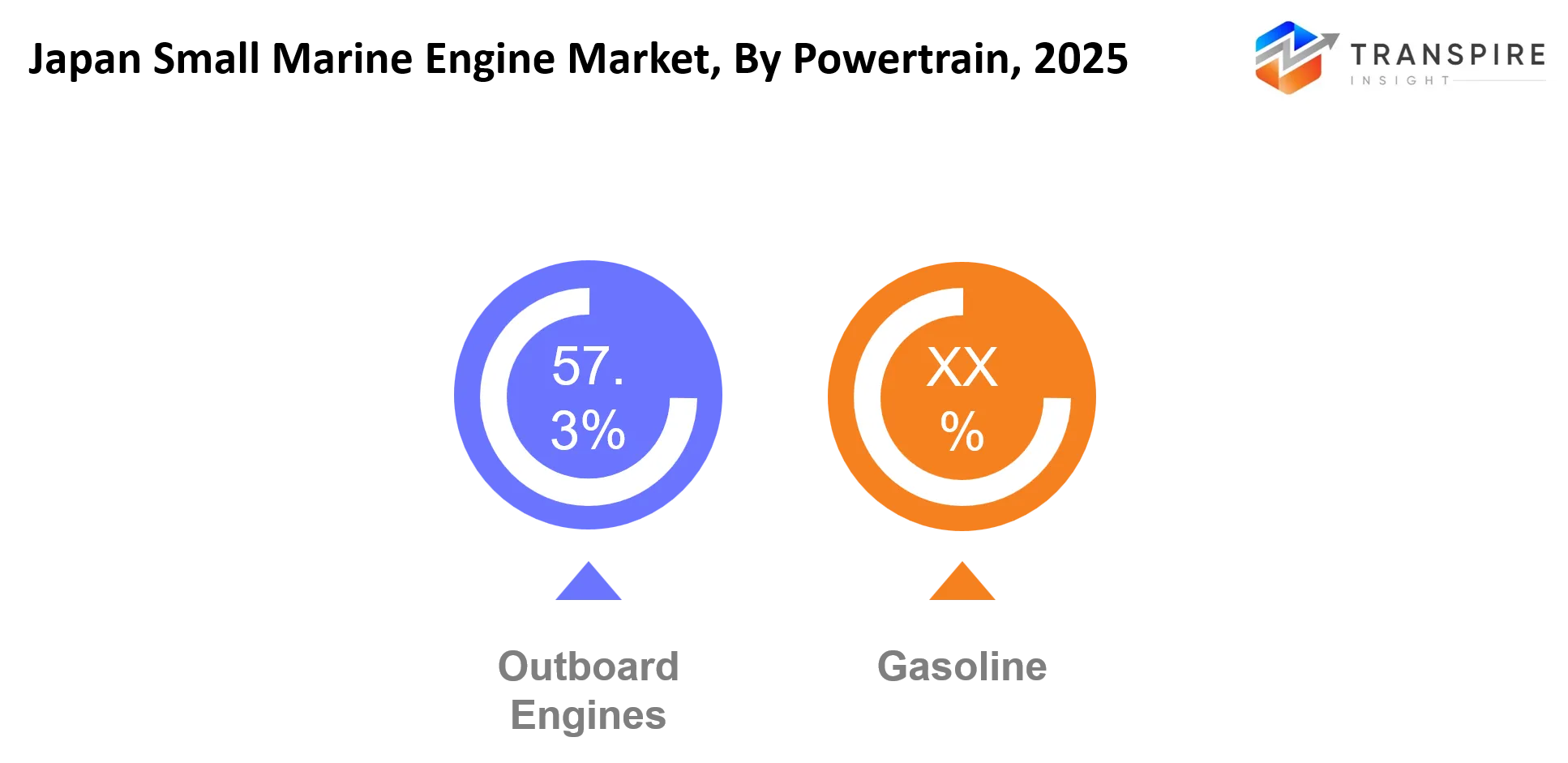
The Diesel Engines dominated the market, accounting for nearly 66% in 2025 and is expected to rise at a significant CAGR during the forecast period.
The Japan Small Marine Engine Market is segmented by engine type into Outboard Engines, Inboard Engines, Sterndrive Engines, Jet Engines, Electric Marine Engines, Hybrid Engines, Diesel Engines, Gasoline Engines. Among these, the Diesel Engines segment dominated the market, accounting for nearly 66% in 2025 and expected to increase at a significant CAGR during the forecast period. In 2025, the Diesel Engines segment of the industry dominated the market, making up close to 66% because of their proven reliability, great torque output, good fuel economy, and suitability for commercial fishing and marine transportation. Fleet modernization, durability requirements, and the need for dependable propulsion systems are expected to drive the growth of the segment.
The Recreational Boats dominated the market, accounting for nearly 35% in 2025, and is expected to rise at a significant CAGR during the forecast period.
The Japan Small Marine Engine Market is segmented by application into Fishing Boats, Recreational Boats, Personal Watercraft, Commercial Boats, Workboats, Sailboats, Patrol Boats, Rescue Boats. Among these, the Recreational Boats segment dominated the market, accounting for nearly 35% in 2025 and expected to increase at a significant CAGR during the forecast period. The Recreational Boats segment led the market in 2025, with a share of about 35%. This growth was prompted by the increasing leisure boating activities, marine tourism, and growing interest in recreational activities based on water. The need for small-sized, cost-effective, and reliable propulsion systems and increase in boat ownership also act as driving forces behind the demand for engines. Moreover, various technological innovations and improved marine facilities contribute to the progress of this segment.
The Individual Owners dominated the market, accounting for nearly 80% in 2025 and is expected to rise at a significant CAGR during the forecast period.
The Japan Small Marine Engine Market is segmented by end user intoCommercial Users, Recreational Users, Fishing Operators, Government Agencies, Tourism Operators, Marine Rental Companies, Boat Manufacturers, Individual Owners. Among these, the Individual Owners segment dominated the market, accounting for nearly 80% in 2025 and expected to increase at a significant CAGR during the forecast period. The Individual Owners category had a leading share in the market in 2025, making up around 80%. This was mainly due to increasing participation in recreational boating activities, the rising number of personal watercraft owners, and reaching demand for dependable and fuel-efficient marine engines. The steady growth of the segment is complemented by a surge in recreational activities, increasing interest in coastal tourism, and advancements in compact low-maintenance engines.
Future Market Trends for the Japan Small Marine Engine Market: -
- Eco-Compliance and Hybrid Integration: The trend in demand for hybrid electric-outboard engines and low-emission structures has increased in importance in coastal fisheries and the small boat market.
- Light-Weight Engineering: There is a marked increase in the use of advanced composites and aluminum alloys for weight saving and fuel efficiency.
- Digital & IoT Connectivity: There is an increased use of digital technology for monitoring, remote diagnostics, and predictive maintenance.
- Electronic Fuel Injection (EFI): The trend is to move towards advanced EFI systems for better combustion control and less emission of exhaust gas.
Recent Development
- In February 2026: Yanmar Power Solutions purchased land in Amagasaki City, Japan, for the construction of a new factory which will contribute to the testing of hydrogen engines and expansion of production capabilities. Expected to start operating in March 2029, the factory is going to reinforce development of new technologies in marine propulsion systems such as engines compatible both with hydrogen and methanol technology.
- In September 2026: Mitsui O.S.K. Lines, Japan Engine Corporation, Kawasaki Heavy Industries, and Yanmar Power Solutions have revealed that they are planning to launch a hydrogen-powered marine engine in January 2027 and start testing it on marine vessels from April 2028. The initiative will enhance Japan’s efforts to innovate marine engines and hydrogen technologies, including clean energy systems and technology focused on the decarbonization of marines, benefiting the overall small marine engine market.
Market Segment
This study forecasts revenue at Japan, regional and country levels from 2020 to 2033. Transpire Insights has segmented the Japan Small Marine Engine Market based on the below-mentioned segments:
Japan Small Marine Engine Market, By Engine Type
- Outboard Engines
- Inboard Engines
- Sterndrive Engines
- Jet Engines
- Electric Marine Engines
- Hybrid Engines
- Diesel Engines
- Gasoline Engines
Japan Small Marine Engine Market, By Power
- Below 5 HP
- 5–20 HP
- 20–50 HP
- 50–100 HP
- 100–200 HP
- 200–300 HP
- 300–500 HP
- Above 500 HP
Japan Small Marine Engine Market, By Fuel
- Gasoline
- Diesel
- Electric
- Hybrid
- LPG
- CNG
- Biofuel
- Hydrogen
Japan Small Marine Engine Market, By Application
- Fishing Boats
- Recreational Boats
- Personal Watercraft
- Commercial Boats
- Workboats
- Sailboats
- Patrol Boats
- Rescue Boats
Japan Small Marine Engine Market, By Boat Type
- Small Fishing Boats
- Speedboats
- Pontoon Boats
- Inflatable Boats
- Cabin Cruisers
- Yachts
- Utility Boats
- Personal Watercraft
Japan Small Marine Engine Market, By End User
- Commercial Users
- Recreational Users
- Fishing Operators
- Government Agencies
- Tourism Operators
- Marine Rental Companies
- Boat Manufacturers
- Individual Owners
Frequently Asked Questions
Find quick answers to common questions.
The market is projected to reach USD 1.46 billion by 2033, growing from USD 0.78 billion in 2025 at an 8.22% CAGR.
Diesel Engines dominate the market, accounting for nearly 66% in 2025, supported by reliability, torque output, fuel efficiency, and marine transportation applications.
Recreational Boats lead with nearly 35% share in 2025, driven by leisure boating, marine tourism, personal watercraft usage, and demand for reliable propulsion systems.
Individual Owners account for nearly 80% in 2025, supported by recreational boating participation, personal watercraft ownership, and demand for compact, fuel-efficient, low-maintenance engines.
Key trends include hybrid-electric propulsion, lightweight engineering, AI and IoT connectivity, predictive maintenance, electronic fuel injection, and low-emission marine technologies.
- Yamaha Motor
- Suzuki Motor
- Honda Motor
- Tohatsu
- Mercury Marine
- Kawasaki Heavy Industries
- Yanmar
- Volvo Penta
- MAN Energy Solutions
- Cummins
- Torqeedo
- Honda Marine
- Hidea
- Parsun
- Lehr
About the Authors

Tejashri Dhatrak
I am Tejashri Dhatrak, a Senior Research Analyst at Transpire Insight, specializing in the Aerospace and Defence sector. My work focuses on analyzing industry trends, defence technologies, market developments, and emerging innovations that shape the global aerospace and security landscape. At Transpire Insight, I research complex topics, evaluate credible sources, and transform technical insights into accurate, well-structured, and easy-to-understand content for industry professionals and decision-makers. My goal is to provide reliable, research-backed information that helps readers stay informed about defence capabilities, aerospace advancements, strategic developments, and the evolving dynamics of the global defence ecosystem.

Chakradhar Khansole
Chakradhar serves as the Research Director at Transpire Insight, bringing over 8 years of experience in technology, innovation, and strategic market intelligence. He specializes in transforming complex market data into actionable business insights that enable organizations to make informed, growth-oriented decisions. Recognized for his strategic vision and analytical expertise, Chakradhar leads high-impact research initiatives, delivering comprehensive market assessments, competitive intelligence, and forward-looking industry analysis.
Recently Published Reports
-
Apr 2026
Aerospace Fluoropolymers Market
Aerospace Fluoropolymers Market Size, Share & Analysis Report By Type (PTFE, FEP, PFA, ETFE, and Others), By Application (Electrical Insulation, Seals & Gaskets, Coatings, and Others), By End User (Commercial Aviation, Military Aviation, General Aviation, and Others), and Geography (North America, Europe, Asia-Pacific, Middle East and Africa, South and Central America), 2021 - 2031
-
Apr 2026
Airborne SATCOM System Market
Airborne SATCOM System Market Size, Share & Analysis Report By Type (SATCOM Terminals, Transceivers, Airborne Radio, Modems and Routers, SATCOM Radomes, and Other), By Application (Government and Defense and Commercial), and Geography (North America, Europe, Asia-Pacific, Middle East and Africa, South and Central America), 2021 – 2031
-
Apr 2026
Ship Leasing Market
Ship Leasing Market Size, Share & Analysis Report By Vessel Type (Container Ships, Bulk Carriers, Tankers, and Specialized Vessels), By Lease Duration (Short-Term Lease (Less than 1 year), Medium-Term Lease (1-5 years), and Long-Term Lease (More than 5 years)), By Lease Type (Bareboat Charter, Time Charter, Financial Lease, and Others), By End-User Industry (Oil and Gas, Manufacturing and Industrial, Automotive, Agriculture and Food, Retail and Consumer Goods, and Others), and Geography (North America, Europe, Asia-Pacific, Middle East and Africa, South and Central America), 2021 – 2031
-
Apr 2026
Thread Rolling Dies Market
Thread Rolling Dies Market Size, Share & Analysis Report By Type (Flat Thread Rolling Dies, Circular (Cylindrical) Dies, Tangential Thread Rolling Dies, Planetary Thread Rolling Dies, and Other Types), By Material Type (High-Speed Steel (HSS), Carbide, Tool Steel, Alloy Steel, and Other Specialized Alloys), By Distribution Channel (Direct Sales, Distributors and Dealers, and Online Platforms), By Application (Automotive Industry, Aerospace and Defense, Construction and Infrastructure, Industrial Machinery, Electronics and Electrical Components, Medical Devices, and Fastener Production), and Geography (North America, Europe, Asia-Pacific, Middle East and Africa, South and Central America), 2021 – 2031
Our Clients