

Japan Silane Coupling Agents Market Size & Forecast:
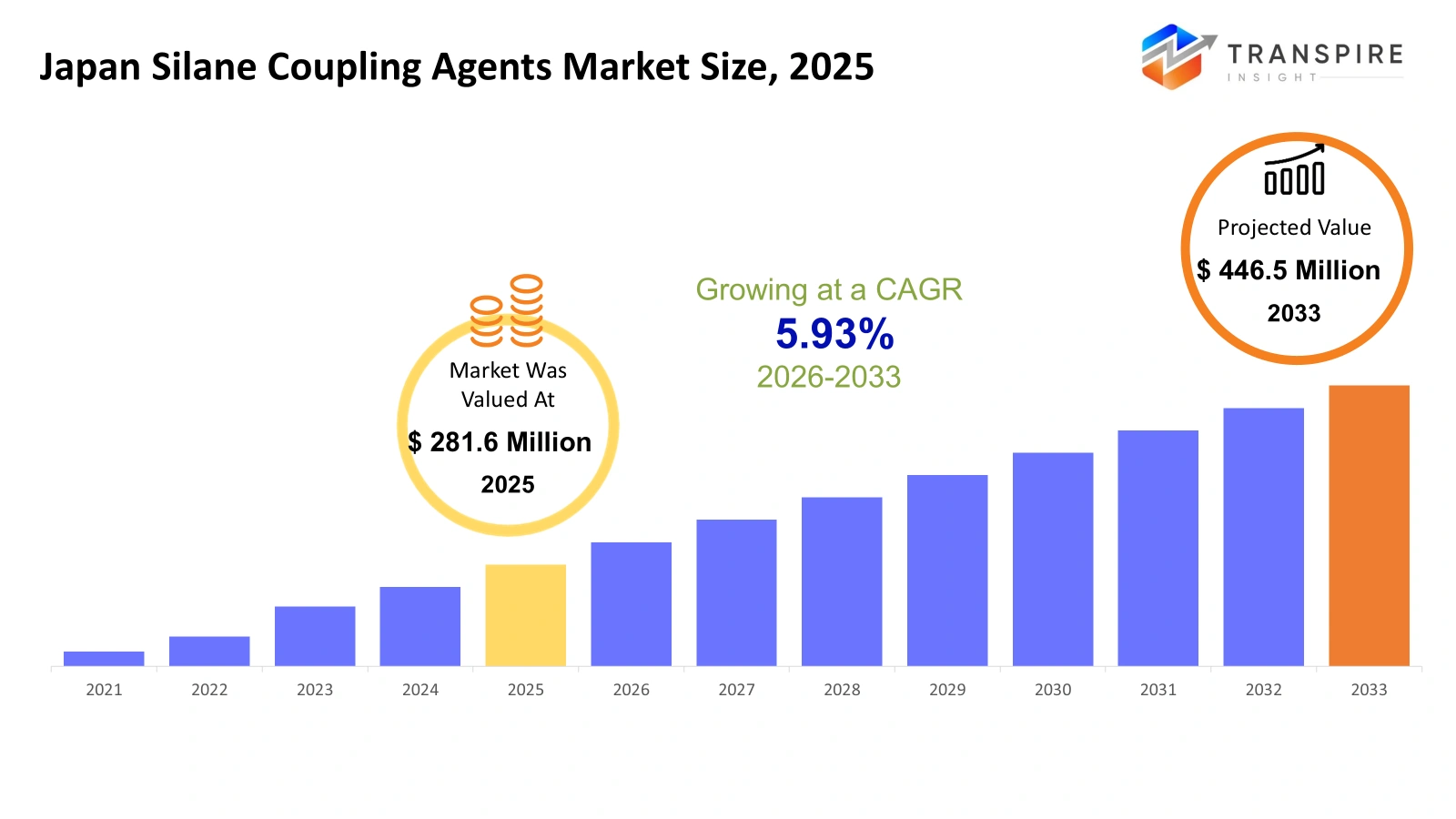
- Japan Silane Coupling Agents Market Size 2025: USD 281.6 Million
- Japan Silane Coupling Agents Market Size 2033: USD 446.5 Million
- Japan Silane Coupling Agents Market CAGR: 5.93%
- Japan Silane Coupling Agents Market Segments:By Product Type (Sulfur Silanes, Amino Silanes, Vinyl Silanes, Epoxy Silanes), By Application (Rubber & Plastics, Adhesives & Sealants, Paints & Coatings, Fiber Treatment) .
To learn more about this report,  Download Free Sample Report
Japan Silane Coupling Agents Market Summary:
The Japan Silane Coupling Agents Market size is estimated at USD 281.6 Million in 2025 and is anticipated to reach USD 446.5 Million by 2033, growing at a CAGR of 5.93% from 2026 to 2033. Japan's silane coupling agents market experiences continuous development because the automotive, electronics and construction sectors require their products. The agents establish critical functions which improve material properties through enhanced adhesion and durability and performance in high-precision applications. Japanese companies dedicate their resources to research advanced manufacturing technologies because the country prioritises their development. The market for this specialty chemical segment in Japan expands because businesses increasingly focus on sustainability and lightweight material development.
Key Market Trends & Insights:
- The automobile industry in Japan now uses silane coupling agents to achieve better bonding between its lightweight materials. The modern vehicle designs achieve fuel efficiency goals through their use of materials which preserve both strength and durability.
- Silane agents find widespread use in Japan because the country serves as a center for advanced electronics. The components function as essential elements which ensure operational dependability together with exactitude for small-sized electronic devices.
- The manufacturing process now focuses on producing silane products which contain low volatile organic compounds and meet environmental protection requirements. The shift to low-VOC silane products controls chemical emissions which adhere to Japan's environmental protection laws and growing public support for sustainable chemical solutions.
- The construction industry is gaining popularity for using silane coupling agents because they enhance the performance of sealants and coatings and improve concrete durability. The ongoing infrastructure development projects in Japan create continuous demand for construction materials.
- The development of high-performance materials requires ongoing research and development efforts to create new silane products which show better resistance to heat and chemicals. These innovations cater to high-end industrial and specialty applications.
- Japan's chemical industry, which has strong domestic chemical companies, enables both market stability and creative product development. Local players utilise advanced technologies to sustain their market edge against domestic and international competitors.
Japan Silane Coupling Agents Market Segmentation
By Product Type
- Sulfur Silanes: Sulfur silanes function as essential components in rubber technology which manufacturers use to produce tyres because the compounds improve the adhesion of rubber to silica filler materials. The Japanese automotive industry drives demand for these products because they enable better vehicle performance and extended durability and improved fuel efficiency in contemporary automobiles.
- Amino Silanes: Amino silanes provide exceptional adhesion abilities, which make them important for use in coatings and adhesives and sealant applications. The Japanese quality-based industries use these materials to enhance surface adhesion and prevent corrosion, which makes them vital for creating durable construction and automotive and industrial materials.
- Vinyl Silanes: Vinyl silanes serve as substances that improve the compatibility of organic polymers with inorganic materials. The Japanese market for plastics and cable insulation products has started to adopt these materials because their abilities to withstand water and high temperatures make them ideal for use in these applications. The industrial sector demands their versatile applications across various business sectors.
- Epoxy Silanes: Epoxy silanes provide strong adhesion abilities and chemical resistance, which makes them suitable for use in protective coatings and advanced composite materials. Japanese industries increasingly use these materials for their high-performance capabilities in electronics and protective coatings, which require dependable and long-lasting performance.
By Application
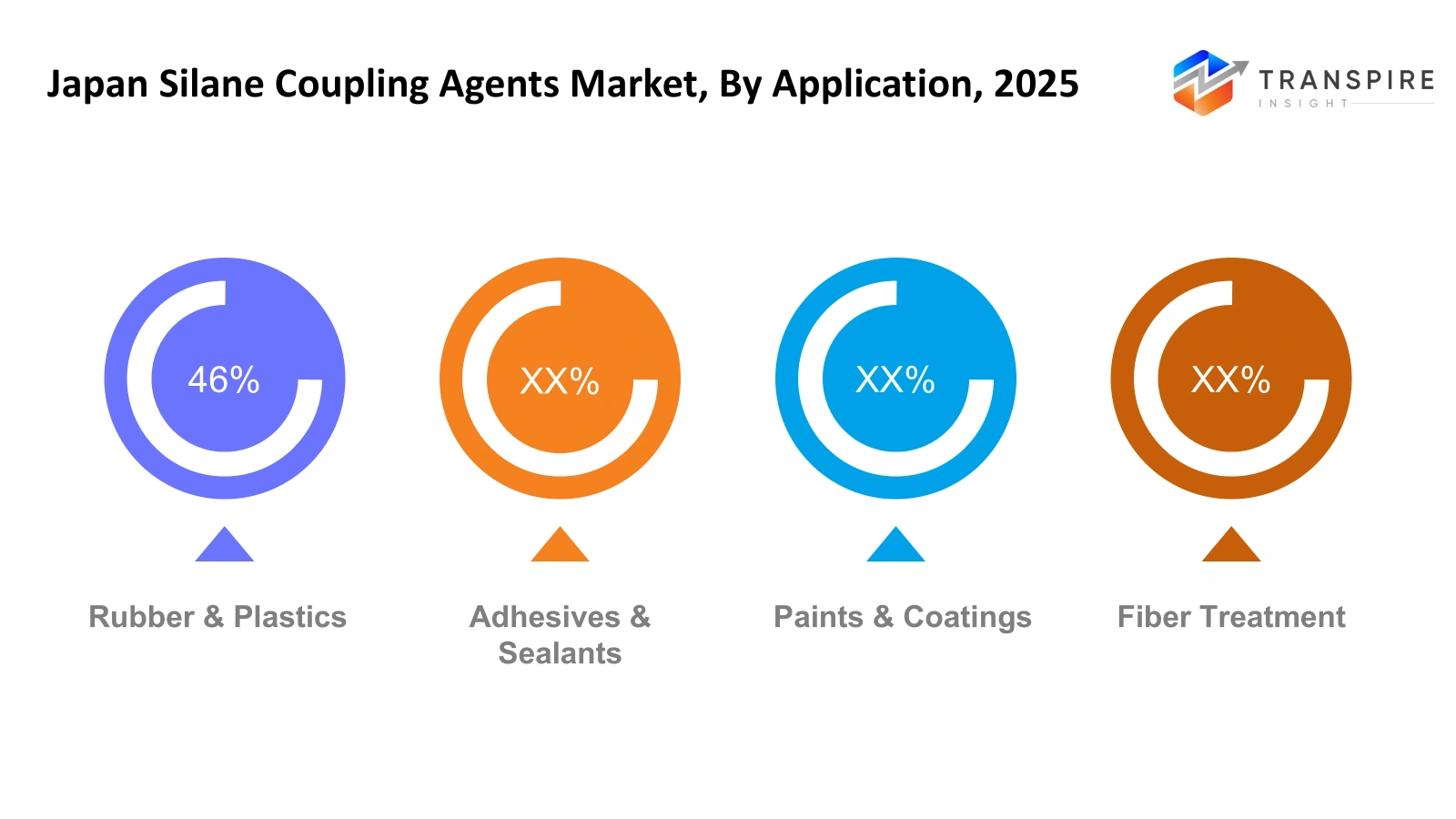
- Rubber & Plastics: Silane coupling agents serve essential purposes in Japan because they enhance the strength and flexibility of rubber and plastic materials which Japanese manufacturers use for production. The material finds extensive application in automotive and industrial products which manufacturers use to achieve optimal performance while decreasing parts wear and extending product operational lifespan.
- Adhesives & Sealants: Silane coupling agents improve both adhesive strength and protective sealant performance, which allows their use in high-stress environments. The Japanese construction and automotive sectors use these materials for bonding applications which require both weather protection and permanent operational strength.
- Paints & Coatings: The agents provide three essential benefits by enhancing coating adhesion, water resistance and durability, which are necessary for producing high-quality finishes. Silanes function as protective agents in Japan's advanced coatings market by extending surface durability and preventing corrosion while preserving visual appeal for automotive and infrastructure applications.
- Fiber Treatment: Composite materials receive improved fiber bonding through the application of silane coupling agents which treat fibers. The application serves as a crucial process in Japan because it enables the production of lightweight yet durable materials which the automotive, aerospace and construction industries use to drive innovation and performance advancements.
To learn more about this report, Download Free Sample Report
Country Insights
The Japanese market for silane coupling agents demonstrates the country's advanced manufacturing capabilities together with its expertise in producing specialty chemicals. The established industrial base of the country provides continuous market demand through three main industries, which include automotive and electronics and construction. The country uses silane agents because its engineers need to meet their precise engineering standards, which require superior material performance and extended product lifespan.
Japan has recently focused on sustainability efforts which require manufacturers to create products that have a low environmental impact and produce no harmful emissions. Environmental regulations and industry awareness have created conditions which support this transition. Local companies use research and development funding to create new products which help them maintain their position as international market leaders. The market will show consistent growth because the ongoing infrastructure improvements and technology progress will create new domestic needs and international demand for high-performance materials.
Recent Development News
Japan Chemical Industry Expands Focus on Eco-Friendly Silanes: Japanese manufacturers are increasingly shifting toward low-VOC and sustainable silane coupling agents. This trend reflects stricter environmental policies and growing demand for green materials across automotive and construction sectors.
Automotive Demand Drives Silane Usage in Japan: Japan’s automotive sector continues to boost demand for silane coupling agents, especially for lightweight and fuel-efficient vehicle components. Tire and rubber applications remain a key growth area.
|
Report Metrics |
Details |
|
Market size value in 2025 |
USD 281.6 Million |
|
Market size value in 2026 |
USD 298.4 Million |
|
Revenue forecast in 2033 |
USD 446.5 Million |
|
Growth rate |
CAGR of 5.93% from 2026 to 2033 |
|
Base year |
2025 |
|
Historical data |
2021 – 2024 |
|
Forecast period |
2026 – 2033 |
|
Report coverage |
Revenue forecast, competitive landscape, growth factors, and trends |
|
Country scope |
Japan |
|
Key company profiled |
Shin-Etsu Chemical Co. Ltd., Dow Inc., Evonik Industries AG, Momentive Performance Materials Inc., Wacker Chemie AG, Gelest Inc., Jiangxi Chenguang New Materials Co. Ltd., Power Chemical Corporation, Nanjing Union Silicon Chemical Co. Ltd., WD Silicone Company Limited, Hubei Bluesky New Materials Inc., Siltech Corporation, PCC Group, Nanjing Capatue Chemical Co. Ltd., Guangzhou Tinci Materials Technology Co. Ltd. |
|
Customization scope |
Free report customization (country, regional & segment scope). Avail customized purchase options to meet your exact research needs. |
|
Report Segmentation |
By Product Type (Sulfur Silanes, Amino Silanes, Vinyl Silanes, Epoxy Silanes), By Application (Rubber & Plastics, Adhesives & Sealants, Paints & Coatings, Fiber Treatment) . |
Key Japan Silane Coupling Agents Company Insights
The Japan silane coupling agents market operates through its established chemical company network, which develops innovative products with precise manufacturing methods. The companies develop advanced products which deliver exceptional performance while minimising environmental impact to meet changing requirements of industrial sectors. The company uses its ongoing funding for research and high-tech equipment to develop its products, which now serve the automotive, electronics and construction industries. Their market strength increases through their partnerships and dedication to sustainable practices. Japanese companies are increasing their export capability while they sustain their global market competitiveness because of rising international demand.
Company List
- Shin-Etsu Chemical Co. Ltd.
- Dow Inc., Evonik Industries AG
- Momentive Performance Materials Inc.
- Wacker Chemie AG
- Gelest Inc.
- Jiangxi Chenguang New Materials Co. Ltd.
- Power Chemical Corporation
- Nanjing Union Silicon Chemical Co. Ltd.
- WD Silicone Company Limited
- Hubei Bluesky New Materials Inc.
- Siltech Corporation
- PCC Group
- Nanjing Capatue Chemical Co. Ltd.
- Guangzhou Tinci Materials Technology Co. Ltd.
Japan Silane Coupling Agents Market Report Segmentation
By Product Type
- Sulfur Silanes
- Amino Silanes
- Vinyl Silanes
- Epoxy Silanes
By Application
- Rubber & Plastics
- Adhesives & Sealants
- Paints & Coatings
- Fiber Treatment
Frequently Asked Questions
Find quick answers to common questions.
The approximate Japan Silane Coupling Agents Market size for the Market will be USD 446.5 Million in 2033.
The key segments of the Japan Silane Coupling Agents Market are By Product Type (Sulfur Silanes, Amino Silanes, Vinyl Silanes, Epoxy Silanes), By Application (Rubber & Plastics, Adhesives & Sealants, Paints & Coatings, Fiber Treatment).
Major players in the Japan Silane Coupling Agents Market are Shin-Etsu Chemical Co. Ltd., Dow Inc., Evonik Industries AG, Momentive Performance Materials Inc., Wacker Chemie AG, Gelest Inc., Jiangxi Chenguang New Materials Co. Ltd., Power Chemical Corporation, Nanjing Union Silicon Chemical Co. Ltd., WD Silicone Company Limited, Hubei Bluesky New Materials Inc., Siltech Corporation, PCC Group, Nanjing Capatue Chemical Co. Ltd., Guangzhou Tinci Materials Technology Co. Ltd.
The current Market size of the Japan Silane Coupling Agents Market is USD 281.6 Million in 2025.
The Japan Silane Coupling Agents Market CAGR is 5.93%.
- Shin-Etsu Chemical Co. Ltd.
- Dow Inc., Evonik Industries AG
- Momentive Performance Materials Inc.
- Wacker Chemie AG
- Gelest Inc.
- Jiangxi Chenguang New Materials Co. Ltd.
- Power Chemical Corporation
- Nanjing Union Silicon Chemical Co. Ltd.
- WD Silicone Company Limited
- Hubei Bluesky New Materials Inc.
- Siltech Corporation
- PCC Group
- Nanjing Capatue Chemical Co. Ltd.
- Guangzhou Tinci Materials Technology Co. Ltd.
Recently Published Reports
-
Apr 2026
Healthcare Polymer Packaging Market
Healthcare Polymer Packaging Market Size, Share & Analysis Report By Packaging Type (Syringes, IV Bottles and Pouches, Clamshells, Blisters, Bottles & Jars, Containers, Tubes, IV Parental Packaging, Others), By Type (Regulated, Non-regulated), By Polymer Type (LDPE (Low-Density Polyethylene), HDPE (High-Density Polyethylene), Homo-polymer (Homo), Random Copolymer (Random), Block Copolymer (Block), PET, Polystyrene, Polyvinyl Chloride, Polyamide/EVOH, Others), and Geography (North America, Europe, Asia-Pacific, Middle East and Africa, South and Central America), 2021 - 2031
-
Apr 2026
Hydrophilic Tape (Waterstop) Market
Hydrophilic Tape (Waterstop) Market Size, Share & Analysis Report By Type (Bentonite-Based Hydrophilic Tape, Rubber-Based Hydrophilic Tape), By Application (Residential Buildings, Commercial Buildings, Infrastructure Projects), and Geography (North America, Europe, Asia-Pacific, Middle East and Africa, South and Central America), 2021 - 2031
-
Apr 2026
Metalens Market
Metalens Market Size, Share & Analysis Report By Type (Visible Light Metalens, and Infrared Metalens), By Application (Consumer Electronics, Automotive Electronics, Industrial, Medical, and Others), and Geography (North America, Europe, Asia-Pacific, Middle East and Africa, South and Central America), 2021 - 2031
-
Apr 2026
PBT Resin Market
PBT Resin Market Size, Share & Analysis Report By Type (Reinforced PBT Resin, Unreinforced PBT Resin), By Processing Method (Injection Molding, Extrusion, Blow Molding, Others), By End-User (Automotive, Electrical & Electronics, Consumer Appliances, Industrial Machinery, Medical Devices, Packaging, Others), and Geography (North America, Europe, Asia-Pacific, Middle East and Africa, South and Central America), 2021 - 2031