

Japan Probiotic Strains Market Summary:
According to Transpire Insight, a detailed research report on the Japan Probiotic Strains Market reflects that the probiotic strains used in functional foods and dietary supplements drive market demand, accounting for a significant share of the market. Yakult Honsha Co., Ltd. leads Japan’s probiotic market through its proprietary Lacticaseibacillus casei strain Shirota, while Meiji Holdings Co., Ltd. and Morinaga Milk Industry Co., Ltd. strengthen the market through advanced probiotic strain development, research-driven innovation, fermentation technologies, expanding product portfolios, and established distribution networks, contributing to the growth and development of Japan’s probiotic strains industry.
Market Snapshot
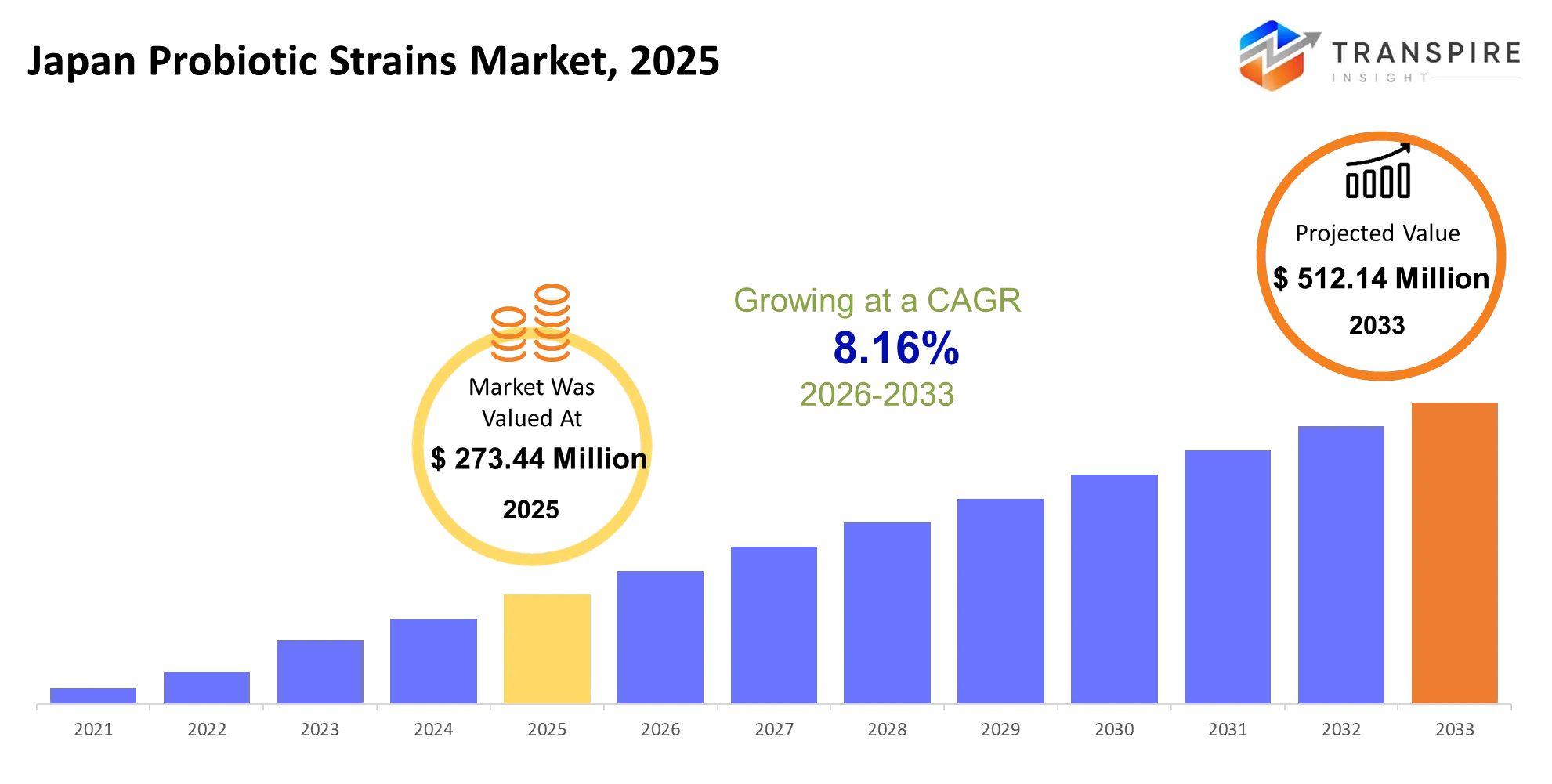
- Market Value (2025): USD 273.44 Million.
- Expected Market Value (2026): USD 295.76 Million.
- Estimated Market Value (2033): USD 512.14 Million.
- Forecast CAGR (2026–2033): 8.16%.
Introduction
Japan Probiotic Strains Market includes the innovation, manufacture, and marketing of beneficial microbes that find application in functional foods, beverages, nutritional supplements, clinical nutrition, and animal feeds. Market growth is driven by growing consumer focus on digestive wellbeing, immunological benefits, preventive healthcare, and microbiota-based nutrition. Japanese producers use their proprietary probiotic strains, innovative fermentation techniques, and science-backed R&D to create unique products meeting various consumer requirements. Regulatory environment like FOSHU and FFC products defines the position and health claims of products. Product innovation in strain discovery, formulation, and heat stable delivery systems is opening up new areas of commercial applicability. Established domestic players and specialty ingredient suppliers keep influencing the competitive landscape through innovations and research-backed commercialization.
Key Market Highlights: -
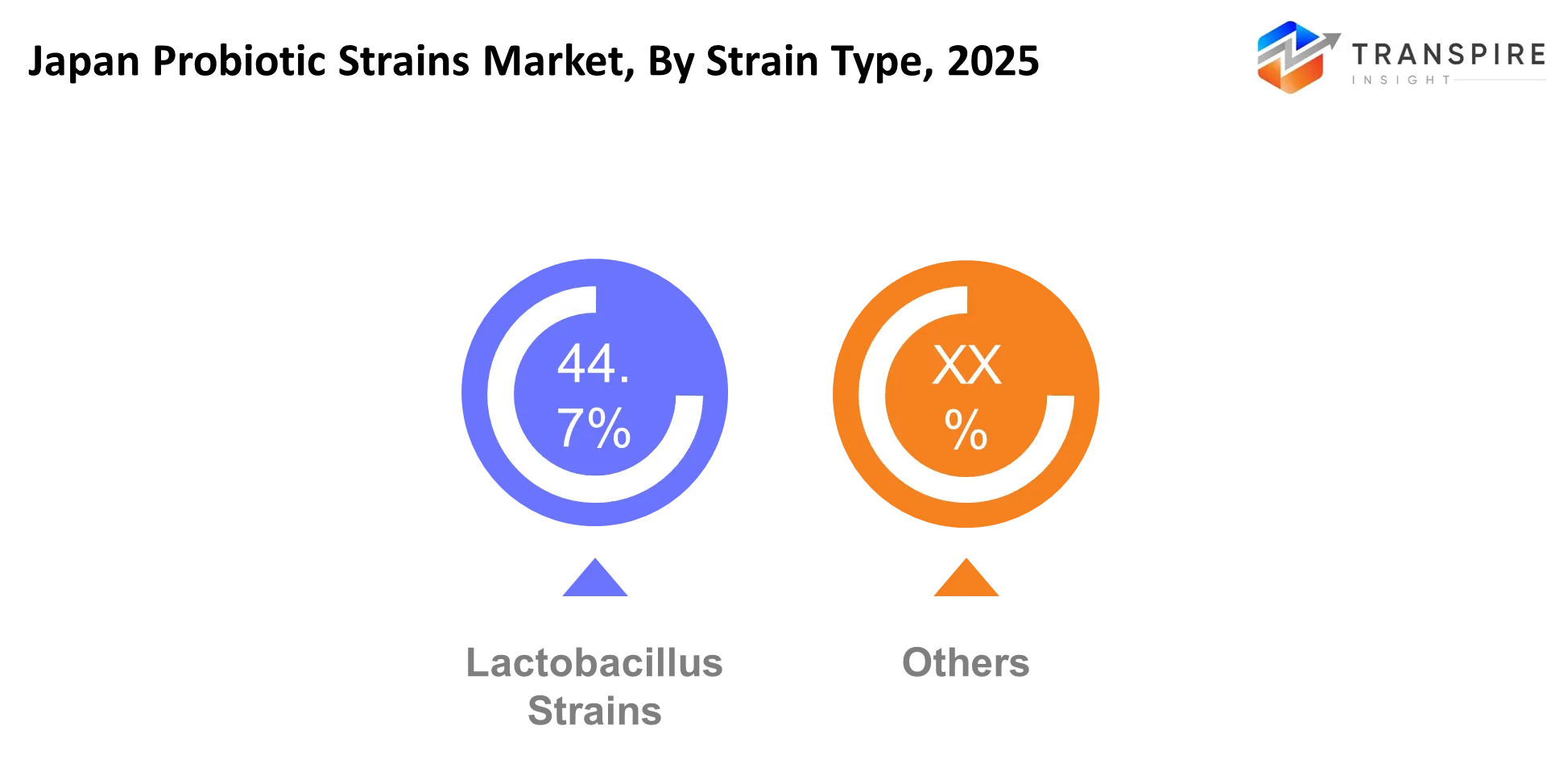
- By Strain Type, the Lactobacillus dominated the market and holds approximately 41.1% share in 2025 and is projected to grow at a substantial CAGR during the forecast period.
- By Application, the FUNCTIONAL FOODS & BEVERAGES dominated the market and holds approximately 63% share in 2025 and is projected to grow at a substantial CAGR during the forecast period.
- By Form, the Liquid Manufacturers segment dominated the market and holds approximately 55% share in 2025 and is projected to grow at a substantial CAGR during the forecast period.
- The market for probiotic strains in Japan enjoys advantages due to aging populations, increasing preventive healthcare consciousness, and increasing consumption of functional foods and digestive wellness products.
How is Technology Driving Growth in the Japan Probiotic Strains Market?
The use of biotechnology, advanced fermentation techniques, and novel methods of delivery is driving the development of probiotics strains in the Japanese market. The ability to conduct research specific to individual strains allows the companies to create probiotic products for improving digestive health, immune function, and wellness. Advanced fermentation and quality control ensure consistent production, viability of the microorganisms used, and stability of the strain. Microencapsulation technologies and special formulations protect the probiotics from destruction during manufacturing, storage, and passage through the gastrointestinal tract. Heat stable microbial ingredients, such as postbiotics, allow the expansion of probiotic products in functional beverages and supplements.
Market Drivers
The Japan Probiotic Strains Market is characterized by increasing consumer demand for preventive health care, good digestion, and functional nutrition. The tradition of consuming fermented foods, such as miso and natto, creates familiarity with the use of microbial products. The Foods with Function Claims system in Japan allows appropriate products to make scientifically backed health claims on their labeling. Strain-specific research, advancements in fermentation technology, and probiotic formulation innovations are contributing to new product developments. Convenience foods, functional beverages, and microbiome-related nutrition applications are creating more business opportunities in the Japanese probiotic strains market.
Restrain
The Challenges in the Japan Probiotic Strains Market involve issues related to the survival of the microbes during storage, transportation, and processing. Stabilization of the microbes is not easy and entails high costs due to clinical studies needed and regulations on food safety and functional claims. The existence of other fermented foods that consumers have wide choices of and competition might be another challenge. Moreover, strain development and quality control along with high prices will limit market access and success.
|
Driver |
Relative Impact on Growth (%) |
Geographic Relevance |
Impact Timeline |
Demand Strength |
Growth Mechanism |
Key Beneficiaries |
Major Constraint |
|
1. Rising demand for digestive and immune health products |
27% |
Nationwide; Tokyo, Osaka, Kanagawa |
Long-term (≥4 years) |
High |
Expands daily consumption of strain-specific gut-health products. |
Probiotic manufacturers, functional food brands, ingredient suppliers. |
Consumer trust and clinical evidence requirements limit adoption. |
|
2. Aging population and preventive healthcare adoption |
23% |
Nationwide; particularly aging regional communities |
Long-term (≥4 years) |
High |
Increases demand for probiotics supporting digestive health and healthy aging. |
Probiotic producers, senior-care providers, healthcare nutrition suppliers. |
Limited evidence for strain-specific benefits in older adults. |
|
3. Functional food innovation and FFC/FOSHU commercialization |
20% |
Nationwide; major consumer markets and retail hubs |
Medium-term (2–4 years) |
High |
Enables differentiated strain products through substantiated functional claims. |
Strain developers, food manufacturers, supplement brands, retailers. |
Stricter compliance increases product development costs. |
|
4. Advances in strain research and manufacturing technologies |
17% |
Nationwide; R&D clusters in Kanto and Kansai |
Medium-term (2–4 years) |
High |
Improves strain identification, viability, stability, and formulation performance. |
Biotechnology firms, culture manufacturers, fermentation technology vendors. |
High R&D costs and strain-specific stability challenges. |
|
5. Expansion of e-commerce and convenient probiotic product formats |
13% |
Nationwide; urban and digitally connected consumer markets |
Short-term (≤2 years) |
Medium |
Broadens access through online subscriptions and shelf-stable formats. |
Online retailers, probiotic brands, packaging and logistics providers. |
Cold-chain costs and price-sensitive consumer purchasing. |
|
Total |
100% |
— |
— |
— |
— |
— |
— |
Analysis of Prices and Consumer Behaviour
The market of Japan Probiotic Strains can be described by high demand for scientifically researched probiotic strains, while the major application sectors include functional foods, fermented dairy products, and dietary supplements. Scientifically supported premium probiotic strains can sell at a higher price because of the necessity for research, advanced fermentation, and quality control procedures. Probiotic powders can provide a wide range of applications for supplementation and functional foods, while shelf stable products can facilitate storage and distribution. Manufacturers of nutraceutical and functional foods can be considered the major buyers. Buying trends are becoming increasingly focused on effectiveness, viability, purity, and scientifically supported properties of probiotics.
|
Company |
Est. Revenue Share Range |
Key Offerings |
Strategic Positioning |
Geographic Strength |
Technology Focus |
|
1. Yakult Honsha Co., Ltd. |
Estimated 15–25% |
L. casei strain Shirota; B. breve strain Yakult; fermented milk cultures |
Proprietary strain leadership and vertically integrated fermentation |
Japan, Asia Pacific |
Proprietary strain libraries and precision fermentation |
|
2. Meiji Holdings Co., Ltd. |
Estimated 12–22% |
L. bulgaricus OLL1073R-1; L. lactis OLL1073R-1; Meiji probiotic cultures |
High-volume functional dairy and research-backed differentiation |
Japan, Asia Pacific |
Functional strain screening and fermentation optimization |
|
3. Morinaga Milk Industry Co., Ltd. |
Estimated 8–16% |
B. longum BB536; B. breve M-16V; B. infantis M-63; B. breve B-3 |
Premium human-residential bifidobacteria and B2B ingredient supply |
Japan, Asia Pacific, North America |
Human-origin strain research and viable-cell stabilization |
|
4. Kirin Holdings Company, Limited |
Estimated 5–10% |
L. lactis strain Plasma; LC-Plasma-containing functional foods and supplements |
Immune-health specialization through proprietary strain science |
Japan, Asia Pacific |
Plasmacytoid dendritic cell activation research |
|
5. Asahi Group Holdings, Ltd. |
Estimated 4–9% |
L. gasseri CP2305; Calpis-derived cultures; fermented beverage strains |
Functional fermented beverages and stress-health differentiation |
Japan, Asia Pacific |
Lactobacillus strain selection and fermentation |
|
6. Megmilk Snow Brand Co., Ltd. |
Estimated 3–7% |
Bifidobacterium cultures; fermented milk cultures; functional yogurt strains |
Domestic dairy reach and consumer-oriented probiotic products |
Japan, Asia Pacific |
Dairy fermentation and culture viability control |
|
7. Danone S.A. |
Estimated 2–6% |
Bifidus ActiRegularis; probiotic yogurt cultures; specialized nutrition strains |
International brand portfolio and science-led nutrition positioning |
Europe, Asia Pacific, North America |
Probiotic formulation and clinical nutrition research |
|
8. Nestlé S.A. |
Estimated 2–5% |
L. rhamnosus GG; probiotic nutrition formulations; specialized nutrition cultures |
Global nutrition expertise and premium health-oriented applications |
Europe, Asia Pacific, North America |
Probiotic formulation and strain-specific nutrition research |
|
9. Novonesis |
Estimated 1–4% |
Probiotic cultures; lactic acid bacteria; custom microbial solutions |
B2B culture supply and industrial biotechnology specialization |
Europe, Asia Pacific, North America |
Microbial strain development and fermentation technology |
|
10. International Flavors & Fragrances Inc. (IFF) |
Estimated 1–4% |
HOWARU® probiotic strains; probiotic blends; culture ingredients |
Science-led ingredient solutions and formulation partnerships |
North America, Europe, Asia Pacific |
Strain characterization and probiotic delivery systems |
Who are the Key Players in the Japan Probiotic Strains Market and how do they compete?
The competitiveness of the Japan Probiotic Strains Market is hinged on organizations that concentrate on innovation in probiotic strains, specific formulation of products, and creation of distribution networks globally. The competition within the Japan Probiotic Strains Market is not only based on price but on scientifically validated strains, advanced fermentation techniques, formulations, and application in food and nutritional uses to continuously come up with products and help organizations enhance product quality, efficiency in manufacturing, and reach of markets.
Yakult Honsha increases its competitive advantage in the Japan Probiotic Strains Market by creating its own strains of probiotics, fermented products, and scientifically validated health solutions. Morinaga Milk Industry creates its competitive advantage over other companies in the market by coming up with specialized probiotic cultures, functional dairy products, and microbial solutions. Meiji creates its competitive advantage by providing strains of probiotics, functional fermented foods, and health solutions.
Top Companies in the Japan Probiotic Strains Market
- Yakult Honsha
- Morinaga Milk Industry
- Meiji
- Danone
- Nestlé
- Chr. Hansen
- IFF
- Novonesis
- Lallemand
- Kerry Group
- Probi
- BioGaia
- DSM-Firmenich
- Asahi Group
- Kirin Holdings
Japan Probiotic Strains Market Segmentation
The Japan Probiotic Strains Market share is divided into six categories: By Strain Type, By Application, By Form, By Health Benefit, By End User, By Distribution Channel.
The Lactobacillus dominated the market, accounting for nearly 41.1% in 2025 and is expected to rise at a significant CAGR during the forecast period.
The Japan Probiotic Strains Market is segmented by strain type into lactobacillus, bifidobacterium, streptococcus, bacillus, saccharomyces, lactococcus, enterococcus, other probiotic strains. Among these, the Lactobacillus segment dominated the market, accounting for nearly 41.1% in 2025 and expected to increase at a significant CAGR during the forecast period. The dominance of Lactobacillus is attributed to its long usage history in fermented dairy, digestive wellness products, research on strains, and increased consumer demand for probiotics in Japan.
The functional foods & beverages dominated the market, accounting for nearly 63% in 2025, and is expected to rise at a significant CAGR during the forecast period.
The Japan Probiotic Strains Market is segmented by application into functional foods, dietary supplements, yogurt & fermented dairy, beverages, infant nutrition, animal feed, pharmaceuticals, clinical nutrition. Among these, the FUNCTIONAL FOODS & BEVERAGES dominated the market, accounting for nearly 63% in 2025 and expected to increase at a significant CAGR during the forecast period. Functional foods and beverages dominate the probiotic strains market in Japan due to established consumption habits of fermented foods, convenience of consumption, and increased consumer demands.
The Liquid dominated the market, accounting for nearly 55% in 2025 and is expected to rise at a significant CAGR during the forecast period.
The Japan Probiotic Strains Market is segmentedby form into capsules, tablets, powders, sachets, liquid, gummies, fermented foods, freeze-dried form. Among these, the Liquid dominated the market, accounting for nearly 55% in 2025 and expected to increase at a significant CAGR during the forecast period. Formulations of liquid-based probiotics dominate the probiotic strains market in Japan due to their convenience of consumption and established consumption habits of fermented beverages.
Future Market Trends for the Japan Probiotic Strains Market: -
- Heat-Stable Probiotics Advances: There is growing focus on heat-stable microbial and postbiotic ingredients, which is widening functional beverage and supplements use cases, while decreasing reliance on chilled distribution channels.
- Personalized and Seniors’ Nutrition: Japan’s aging population along with increasing need for preventive health care is driving strain-specific probiotics development for gut health, immune system, and anti-aging.
- Manufacturing Technology Advancements: Strain study, fermentation process optimization, and automation technology are driving increased manufacturing efficiency and viability among Japanese probiotics strains industry.
Recent Development
- In April 14, 2026 - Morinaga Launch: Morinaga Milk Industry initiated the national launch of Bifidobacteria Yogurt, using the knowledge of BB536 for building up the probiotic yogurt market in Japan.
- In May 28, 2026 - Probi Clinical Milestone: Probi concluded their initial adult study on Lactobacillus plantarum 299v in Japan, which was significant for validating the strain as well as expanding the probiotics market in Japan.
- In October 6, 2026 - ISAPP Scientific Symposium: ISAPP scheduled a scientific symposium in Tokyo, aimed at advancing probiotics research, new strains discoveries and collaboration in Japan’s probiotics industry.
Market Segmentation
This study forecasts revenue at Japan, regional and country levels from 2020 to 2033. Transpire Insight has segmented the Japan Probiotic Strains Market based on the below-mentioned segments:
Japan Probiotic Strains Market, By Strain Type
- Lactobacillus
- Bifidobacterium
- Streptococcus
- Bacillus
- Saccharomyces
- Lactococcus
- Enterococcus
- Other Probiotic Strains
Japan Probiotic Strains Market, By Application
- Functional Foods
- Dietary Supplements
- Yogurt & Fermented Dairy
- Beverages
- Infant Nutrition
- Animal Feed
- Pharmaceuticals
- Clinical Nutrition
Japan Probiotic Strains Market, By Form
- Capsules
- Tablets
- Powders
- Sachets
- Liquid
- Gummies
- Fermented Foods
- Freeze-Dried Form
Japan Probiotic Strains Market, By Health Benefit
- Digestive Health
- Immune Support
- Women's Health
- Oral Health
- Metabolic Health
- Mental Health
- Skin Health
- Cardiovascular Health
Japan Probiotic Strains Market, By End User
- Food Manufacturers
- Dairy Companies
- Pharmaceutical Companies
- Nutraceutical Companies
- Beverage Companies
- Infant Nutrition Companies
- Animal Feed Companies
- Research Institutes
Japan Probiotic Strains Market, By Distribution Channel
- Supermarkets
- Pharmacies
- Health Food Stores
- Online Retail
- Specialty Stores
- Hospitals
- Direct Sales
- E-Commerce
Frequently Asked Questions
Find quick answers to common questions.
Rising digestive health awareness, preventive healthcare adoption, aging demographics, and demand for functional foods are supporting Japan’s probiotic strains market growth.
Lactobacillus leads the market, supported by established use in fermented dairy, digestive wellness products, and extensive strain-specific research.
Functional foods and beverages account for the largest application share, reflecting Japan’s established fermented-food consumption and demand for convenient daily nutrition.
Advanced fermentation, strain-specific research, microencapsulation, and quality control are improving probiotic stability, production consistency, and formulation capabilities.
Microbial viability during storage and processing, stabilization costs, regulatory compliance, clinical evidence requirements, and price sensitivity may constrain market expansion.
- Yakult Honsha
- Morinaga Milk Industry
- Meiji
- Danone
- Nestlé
- Chr. Hansen
- IFF
- Novonesis
- Lallemand
- Kerry Group
- Probi
- BioGaia
- DSM-Firmenich
- Asahi Group
- Kirin Holdings
About the Authors

Chetan Dhatrak
I’m Chetan Dhatrak, a Senior Research Analyst at Transpire Insight, specializing in the Consumer Goods, Foods and Beverages industry. I focus on analyzing market trends, consumer behavior, competitive landscapes, and industry developments to deliver accurate, data-driven insights. My research at Transpire Insight is built on credible sources and in-depth analysis, helping businesses and readers better understand market dynamics, emerging opportunities, and evolving consumer preferences. I’m committed to creating reliable, well-researched content that supports informed decision-making and reflects the latest developments in the consumer goods and food & beverage sectors.

Chakradhar Khansole
Chakradhar serves as the Research Director at Transpire Insight, bringing over 8 years of experience in technology, innovation, and strategic market intelligence. He specializes in transforming complex market data into actionable business insights that enable organizations to make informed, growth-oriented decisions. Recognized for his strategic vision and analytical expertise, Chakradhar leads high-impact research initiatives, delivering comprehensive market assessments, competitive intelligence, and forward-looking industry analysis.
Recently Published Reports
-
Apr 2026
Baby Infant Formula Market
Baby Infant Formula Market Size, Share & Analysis Report By ype (Infant Milk, Follow On Milk, Specialty Baby Milk, Growing-Up Milk), By Ingredient (Carbohydrate, Fat, Protein, Minerals, Vitamins, and Others), By Product Form (Powder, Liquid, and Ready-to-feed), By Distribution Channels (Supermarket/Hypermarket, Specialty Store, Pharmacies, Online Retail, and Others), and Geography (North America, Europe, Asia-Pacific, Middle East and Africa, South and Central America), 2021 - 2031
-
Apr 2026
Edible Insects for Animal Feed Market
Edible Insects for Animal Feed Market Size, Share & Analysis Report By Type (Insect Powder, Insect Meal, Insect Bar, Insect Paste, Insect Oil, and Others), By Insect Type (Beetles, Cricket, Caterpillar, Hymenoptera, Orthoptera, Tree Bugs, and Others), By Application (Livestock, Pet Food, and Aquaculture), By Livestock Type (Poultry, Swine, and Others), and Geography (North America, Europe, Asia-Pacific, Middle East and Africa, South and Central America), 2021 - 2031
-
Apr 2026
Food Industry Disinfection and Bacterial Control Market
Food Industry Disinfection and Bacterial Control Market Size, Share & Analysis Report By Type (Chemical Disinfectants, Physical Disinfectants, and Biocides and Antimicrobials), By Application (Food Processing Equipment Surface Disinfection, Food Preparation Areas Surface Disinfection, Storage Areas Surface Disinfection, Anti-microbial Coatings Food Preservation, and Preservative Solutions Food Preservation), By End User (Meat and Poultry Processing, Dairy Processing, Seafood Processing, Bakery and Confectionery, Restaurants and Commercial Kitchens, and Food Service Providers), By Sales Channel (Online, Offline), and Geography (North America, Europe, Asia-Pacific, Middle East and Africa, South and Central America), 2021 - 2031
-
May 2026
Freeze Dried Food Market
Freeze Dried Food Market Size, Share & Analysis Report By Product Type (Fruits, Vegetables, Freeze-Dried Dairy Products, Freeze-Dried Meat and Seafood, Freeze-Dried Pet Food, and Prepared Meal), By Nature (Organic, and Conventional), By Form (Powdered, Granules, and Diced), By End Use (Breakfast Cereals, Dairy Products, Bakery & Confectionery, Nutritional Bars & Supplements, Powdered Beverages, Snacks, and Retail (Household)), and Geography (North America, Europe, Asia-Pacific, Middle East and Africa, South and Central America), 2021 - 2031