

Japan Polyol Market Size & Forecast:
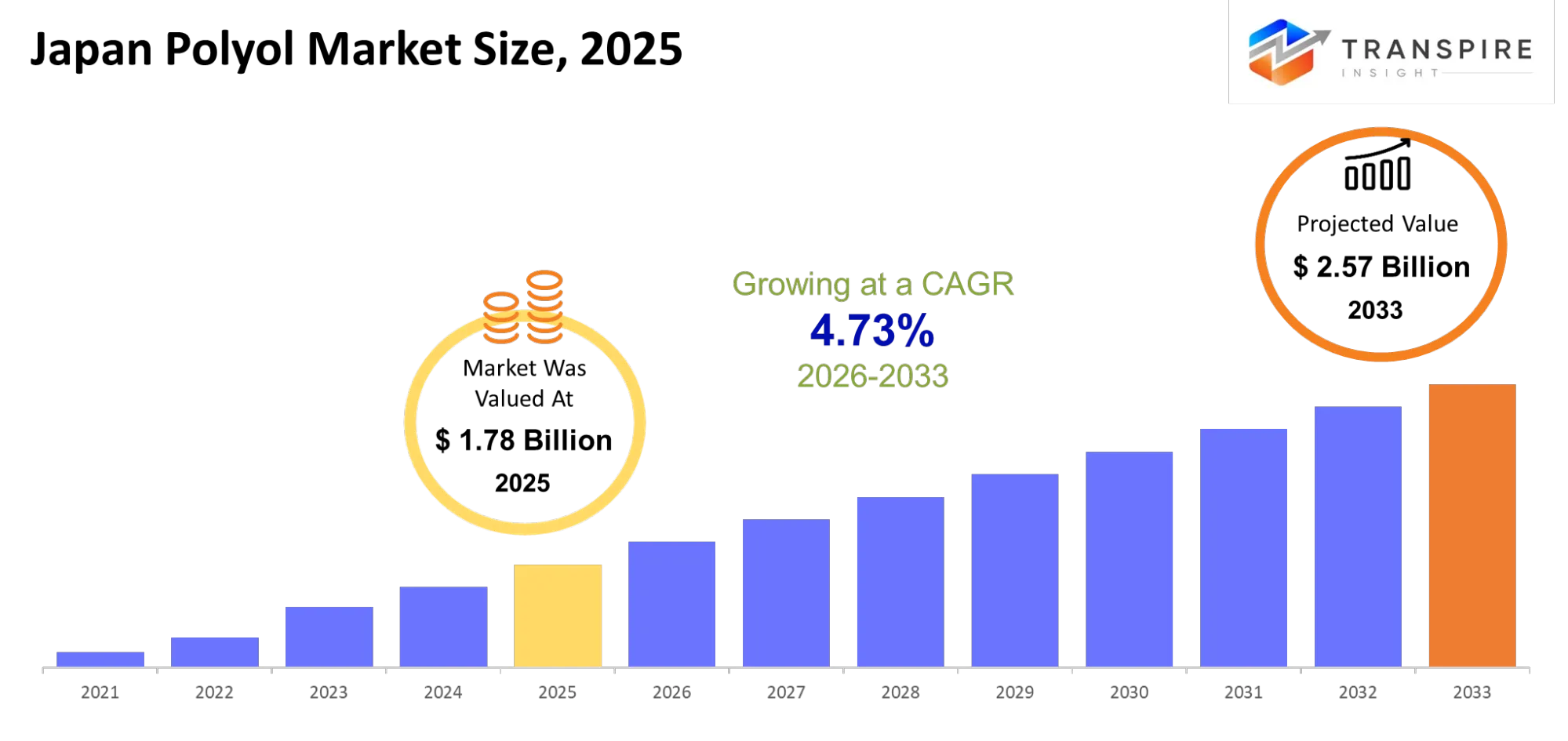
- Japan Polyol Market Size 2025: USD 1.78 Billion
- Japan Polyol Market Size 2033: USD 2.57 Billion
- Japan Polyol Market CAGR: 4.73%
- Japan Polyol Market Segments: By Type (Polyether Polyols, Polyester Polyols, Others); By Application (Polyurethane Foams, Coatings, Adhesives, Sealants, Elastomers, Others); By End-User (Construction, Automotive, Furniture, Packaging, Others); By Form (Liquid, Solid, Others)
To learn more about this report,  Download Free Sample Report
Japan Polyol Market Summary:
The Japan Polyol Market size is estimated at USD 1.78 Billion in 2025 and is anticipated to reach USD 2.57 Billion by 2033, growing at a CAGR of 4.73% from 2026 to 2033.
Japan's polyol market within the specialty chemicals industry will stand as a focused segment tied closely to polyurethane production, where polyols will act as essential building blocks for foams, coatings, adhesives, and elastomers. Japan's material requirements have developed into their present form because buyers demand materials with stable quality standards and minimal emission rates and improved performance for compact products which include automotive interiors and electronics cushioning.
Consumer expectations will continue to lean toward safer low-odor materials which can be recycled. This trend compels manufacturers to develop better bio-based and low-VOC polyols through product refinement. Product design and polymer manufacturing processes will undergo transformation through advancements in material development. Producers will change their formulation methods and sourcing practices because of environmental rules which control carbon emissions and chemical safety.
What Has the Impact of Artificial Intelligence Been on the Japan Polyol Market?
The Japan Polyol Market experiences transformation through artificial intelligence because it enables manufacturers and analysts to assess complex demand signals and pricing dynamics with new methods. The Japan Polyol Market uses AI to create machine learning models which help businesses discover market trends and develop their purchasing methods. Companies that work in the Japan Polyol Market can now forecast demand with better accuracy while they decrease supply chain risks that occur during different supply periods. The artificial intelligence system in the Japan Polyol Market uses real-time data from industries such as automotive and construction to create better strategic planning processes. Japan Polyol Market stakeholders use AI technology to speed up their decision-making processes which helps them achieve better business results during the ongoing digital transformation process.
The Japan Polyol Market gains advantages from AI-powered smart automation which operates throughout production facilities because machine learning systems enhance process control while they decrease waste and boost operational efficiency. The Japan Polyol Market uses predictive analytics and AI-driven supply chain optimization to help manufacturers reduce their inventory expenses while they maintain quick responses to changes in raw material availability. The implementation of digital tools enables stakeholders in the Japan Polyol Market to create innovative solutions which provide customized products and maintain their competitive edge for extended periods.
Key Market Trends & Insights:
- Artificial intelligence for demand forecasting in Japan's Polyol Market delivers 30% improvement for procurement and pricing determination processes.
- The Kanto region will control 38% of the Japanese Polyol Market in 2025 because of its concentrated industrial and construction operations.
- The Kansai region will experience the fastest growth within the Japan Polyol Market because manufacturing growth will drive market development between 2026 and 2032.
- The Japan Polyol Market prefers polyether polyols because they hold 62% market share through their usage in flexible foam and insulation products across multiple industries.
- Polyester polyols maintain their position as the second most popular product because they find extensive application in coatings and adhesives throughout the Japan Polyol Market.
- Bio-based polyols represent the fastest-growing market segment of the Japan Polyol Market because their demand for sustainable products and environmentally friendly materials drives their growth.
- The Japan Polyol Market receives its highest market share from polyurethane foam applications which account for almost 45% of demand, especially through their use in building insulation and refrigeration equipment.
- The Japan Polyol Market identifies construction as its main application sector because infrastructure modernization projects account for approximately 40% of total demand.
- The automotive sector represents the fastest-expanding market segment of the Japan Polyol Market because electric mobility and material innovation drive its development.
- The Japan Polyol Market operates through major companies which include Mitsui Chemicals, Mitsubishi Chemical, BASF, Dow, Covestro, and ADEKA Corporation.
Japan Polyol Market Segmentation
By Type :
The Japan Polyol Market displays distinct product type differences because polyether polyols have emerged as a popular choice for foam production because of their affordable flexible properties. Polyester polyols provide both durability and chemical resistance, which makes them suitable for use in coatings and elastomers. The other types of products meet specific industrial requirements because they provide distinct capabilities needed for different manufacturing environments.
Japan Polyol Market demand for polyether polyols will remain steady because these products have widespread application in insulation and cushioning materials. Industrial coatings will benefit from polyester polyols which provide strength and resistance to damage in their applications. Other categories will maintain smaller yet stable demand, supported by specialty production and specific end-use requirements.
By Application :
Japan Polyol Market uses its products in polyurethane foams because of insulation needs and furniture manufacturing requirements. Coatings and adhesives depend on polyols to provide their bonding strength and surface protection properties. Sealants and elastomers provide essential support for building projects and automotive manufacturing because these materials need to maintain their flexibility and strength throughout all stages of product development.
The Asia Pacific region will drive the Japan Polyol Market because of its rising demand for polyurethane foam which construction and appliance manufacturing industries need. The industrial sector and infrastructure development work together to create continuous demand for coatings and adhesives. The market for sealants and elastomers will experience gradual growth because automotive manufacturing and repair work will drive demand for these products while specialized industrial applications will make up the rest of the market.

To learn more about this report, Download Free Sample Report
By End-User :
The Japan Polyol Market which operates through three main sectors uses insulation materials and coatings to achieve energy efficiency in construction work. The automotive industry requires polyols to manufacture seating systems and interior parts. Flexible foams serve as essential materials for furniture production, while packaging industries use lightweight materials to enhance product handling and decrease shipping expenses.
The expansion of the Japan Polyol Market will continue to depend on construction work and infrastructure development projects. The automotive industry will maintain a constant need for polyol-based materials throughout its production processes. The demand for furniture will drive foam consumption, while packaging industries will increasingly adopt lightweight materials. Other industries will maintain moderate demand based on specific material requirements.
By Form :
The Japan Polyol Market distribution which shows different polyol forms shows that liquid polyols are the most preferred option because they can be easily handled and processed through manufacturing systems. Solid polyols find use in applications where storage stability and controlled reactions are necessary, particularly in specialized industrial processes that require precise formulation.
The Japan Polyol Market will continue to prefer liquid form because it provides better operational efficiency and works well with their large-scale production systems. The smaller share of solid form will continue because it serves specific needs in controlled production settings that require stable material properties and consistent product manufacturing.
What are the Main Challenges for the Japan Polyol Market Growth?
The Japan Polyol Market requires multiple technical and operational solutions to overcome its current challenges which hinder its ability to expand across various end-use sectors. The Japan Polyol Market faces its main challenge because manufacturers need to sustain product quality across different raw material inputs while meeting specific performance standards needed for polyurethane production.
Supply chain disruptions together with reliance on petrochemical feedstocks create production planning instability which results in production planning difficulties for manufacturing operations. The Japan Polyol Market growth obstacles include scalability restrictions because manufacturers find it difficult to achieve high-performance production while maintaining cost-effective operations for their insulation foam and automotive component manufacturing processes.
The Japan Polyol Market faces increasing cost challenges because its energy-intensive production methods need to comply with strict regulatory requirements while industrial production processes. The combination of environmental regulations and safety certifications mandates businesses to follow complex operational procedures which result in extended product approval and market entry times. The Japan Polyol Market requires manufacturers to meet quality and environmental regulations which include emissions control and material safety standards, resulting in extra financial costs and operational difficulties that slow down their ability to innovate new products.
The Japan Polyol Market faces adoption challenges because its existing infrastructure does not meet requirements and its workforce lacks necessary technical skills for implementing advanced polyol formulations. The smaller manufacturing companies face funding shortages which limit their capacity to develop new production technology. The Japan Polyol Market experiences growth restrictions because market limitations affect its expansion into new application sectors.
Country Insights
The Japan Polyol Market shows its industrial development through its current state which uses polyurethane for insulation, coating, adhesive, and flexible foam production. The automotive manufacturing sector and electronics assembly industry will create a steady demand for products. The establishment of product development will follow sustainability regulations and energy-saving materials while gradually shifting toward bio-based polyol solutions.
The Japan Polyol Market benefits from established chemical manufacturers who create dependable supply networks and drive ongoing product development. The domestic manufacturing sector will gain advantages from its research capabilities and strong ties between manufacturers and their customers. The market will experience moderate growth because of its mature state while high-performance applications will create steady demand for specific polyol grades.
The Japan Polyol Market depends on its import and export balance because of raw material shortages and its international trade routes. The Asian region will determine how pricing patterns and supply distribution will develop. The market will experience stable conditions over time because infrastructure improvements and green building requirements and insulation needs will sustain demand.
Recent Development News
In April 2026, BASF SE expanded its polyol production optimization program targeting Asia-Pacific polyurethane demand, including Japan. The initiative improved output efficiency of flexible and rigid polyether polyols used in automotive and insulation applications.
Source https://www.basf.com/
In April 2026, Dow Inc. announced continued expansion of its polyurethane and polyol solutions portfolio for Asia-Pacific markets, including Japan. The company emphasized enhanced formulation support for flexible foam applications in furniture and automotive seating systems.Source https://www.dow.com/
|
Report Metrics |
Details |
|
Market size value in 2025 |
USD 1.78 Billion |
|
Market size value in 2026 |
USD 1.86 Million |
|
Revenue forecast in 2033 |
USD 2.57 Billion |
|
Growth rate |
CAGR of 4.73% from 2026 to 2033 |
|
Base year |
2025 |
|
Historical data |
2021 - 2024 |
|
Forecast period |
2026 - 2033 |
|
Report coverage |
Revenue forecast, competitive landscape, growth factors, and trends |
|
Country scope |
Japan |
|
Key company profiled |
BASF, Dow, Covestro, Huntsman, Mitsui Chemicals, Asahi Kasei, LG Chem, Wanhua Chemical, Shell Chemicals, Repsol, Stepan, Emery Oleochemicals, Perstorp, Arkema, Solvay |
|
Customization scope |
Free report customization (country, regional & segment scope). Avail customized purchase options to meet your exact research needs. |
|
Report Segmentation |
By Type (Polyether Polyols, Polyester Polyols, Others); By Application (Polyurethane Foams, Coatings, Adhesives, Sealants, Elastomers, Others); By End-User (Construction, Automotive, Furniture, Packaging, Others); By Form (Liquid, Solid, Others) |
How Can New Companies Establish a Strong Foothold in the Japan Polyol Market?
New entrants can establish a strong foothold in the Japan Polyol Market by focusing on niche applications and differentiated product innovation while avoiding direct competition with established chemical giants. The Japan Polyol Market offers increasing benefits to companies that create bio-based polyols and low-VOC formulations and high-performance specialty grades designed for automotive lightweighting and construction insulation and healthcare-grade materials.
New players in the Japan Polyol Market can establish themselves as solution providers by following sustainable demand trends and using their advanced research capabilities. Data-driven product development and AI-supported formulation testing create a competitive advantage for companies operating in the changing Japan Polyol Market.
Startups who want to expand their business quickly should use partnerships and collaborations as their main entry method into the Japan Polyol Market. Chemical distributors and polyurethane manufacturers and construction material firms assist new companies in entering the market while increasing their speed to market.
Emerging companies such as GreenPoly Innovations (which serves as a hypothetical startup) are developing bio-based feedstock technologies whereas BioFoam Labs develops energy-efficient insulation solutions to protect smart city infrastructure. New companies in the Japan Polyol Market use innovation-driven methods to create solutions that solve specific industry problems which include improving energy efficiency and reducing costs and developing sustainable materials.
New market entrants in the Japan Polyol Market will achieve operational efficiency improvements by using smart manufacturing technologies which include IoT-enabled production systems and predictive analytics. Companies that integrate digital tools early can better manage supply chain risks, reduce production waste, and improve scalability. The Japan Polyol Market will require companies to differentiate themselves through technology adoption, sustainability initiatives, and specific industry applications to achieve successful market establishment.
Key Japan Polyol Market Company Insights
The Japan Polyol Market maintains consistent demand because it serves various industries which include polyurethane production and coatings and adhesives and automotive applications. The manufacturing of insulation materials combined with flexible foams creates constant demand which exists throughout different industrial sectors. The construction sector needs energy-saving buildings while manufacturing activities are growing which drives market expansion. The availability of raw materials together with their price changes will determine how the market functions throughout upcoming periods.
Industrial usage in Japan Polyol Market remains linked with packaging, electronics, and furniture production. Demand for lightweight and durable materials supports adoption of polyols in multiple formulations. Manufacturers concentrate on achieving stable product quality while they enhance their operational productivity. The market will develop according to how the downstream industries expand and their transition to sustainable chemical sources progresses.
The Japan Polyol Market competitive environment includes international chemical companies and local producers who prioritize product excellence and efficient cost management and reliable supply chain operations. Research and development activities focus on developing better product formulas. Companies expand production capacity and strengthen distribution networks to maintain market position across industrial demand centers.
The Japan Polyol Market market competition demonstrates the industry's dedication to creating new bio-based polyols and improving product performance. The operation of the business depends on both strategic partnerships and long-term supply agreements which create stability. The pricing strategies together with the efficiency of raw material sourcing establish two major elements that determine market competitiveness. The continuous technological advancements in production processes will enable established suppliers and new market entrants to achieve better market positions.
Company List
- BASF
- Dow
- Covestro
- Huntsman
- Mitsui Chemicals
- Asahi Kasei
- LG Chem
- Wanhua Chemical
- Shell Chemicals
- Repsol
- Stepan
- Emery Oleochemicals
- Perstorp
- Arkema
- Solvay
What are the Key Use-Cases Driving the Growth of Japan Polyol Market?
The Japan Polyol Market is experiencing rapid expansion because industrial applications of polyurethane-based products require performance, durability, and energy efficiency. The Japan Polyol Market mainly exists because people need flexible and rigid foams which serve as insulation materials for both residential and commercial building projects. The materials provide thermal efficiency benefits which help Japan meet its energy-saving building requirements. The Japan Polyol Market growth receives a boost from manufacturers who use AI-based material optimization and smart formulation methods to enhance product performance.
The Japan Polyol Market experiences major growth because automotive lightweighting needs become more important with the transition towards electric vehicles and fuel-efficient transportation systems. Polyols function as critical components in vehicle seating systems, interior design elements, and insulation materials which help achieve weight reduction while preserving safety and comfort requirements. Japanese manufacturers presently use advanced polyurethane systems to create high-value applications which support thermal management needs and noise reduction requirements for EV battery systems within their production activities.
The Japan Polyol Market grows in the healthcare and consumer goods sectors because medical-grade foams become more needed for wound care and prosthetics and hospital bedding systems. The applications need polyol-based materials because they need to meet strict hygiene requirements while providing flexible and durable performance. Polyurethane insulation serves as the main material for consumer appliances which include refrigerators and mattresses thus expanding the Japan Polyol Market through everyday products.
Japan Polyol Market Report Segmentation
By Type
- Polyether Polyols
- Polyester Polyols
By Application
- Polyurethane Foams
- Coatings
- Adhesives
- Sealants
- Elastomers
By End-User
- Construction
- Automotive
- Furniture
- Packaging
By Form
- Liquid
- Solid
Frequently Asked Questions
Find quick answers to common questions.
The approximate Japan Polyol Market size for the market will be USD 2.57 Billion in 2033.
Key segments for the Japan Polyol Market are By Type (Polyether Polyols, Polyester Polyols, Others); By Application (Polyurethane Foams, Coatings, Adhesives, Sealants, Elastomers, Others); By End-User (Construction, Automotive, Furniture, Packaging, Others); By Form (Liquid, Solid, Others).
Major Japan Polyol Market players are BASF, Dow, Covestro, Huntsman, Mitsui Chemicals, Asahi Kasei, LG Chem, Wanhua Chemical, Shell Chemicals, Repsol, Stepan, Emery Oleochemicals, Perstorp, Arkema, Solvay.
The Japan Polyol Market size is USD 1.78 Billion in 2025.
The Japan Polyol Market CAGR is 4.73%.
- BASF
- Dow
- Covestro
- Huntsman
- Mitsui Chemicals
- Asahi Kasei
- LG Chem
- Wanhua Chemical
- Shell Chemicals
- Repsol
- Stepan
- Emery Oleochemicals
- Perstorp
- Arkema
- Solvay
Recently Published Reports
-
Apr 2026
Healthcare Polymer Packaging Market
Healthcare Polymer Packaging Market Size, Share & Analysis Report By Packaging Type (Syringes, IV Bottles and Pouches, Clamshells, Blisters, Bottles & Jars, Containers, Tubes, IV Parental Packaging, Others), By Type (Regulated, Non-regulated), By Polymer Type (LDPE (Low-Density Polyethylene), HDPE (High-Density Polyethylene), Homo-polymer (Homo), Random Copolymer (Random), Block Copolymer (Block), PET, Polystyrene, Polyvinyl Chloride, Polyamide/EVOH, Others), and Geography (North America, Europe, Asia-Pacific, Middle East and Africa, South and Central America), 2021 - 2031
-
Apr 2026
Hydrophilic Tape (Waterstop) Market
Hydrophilic Tape (Waterstop) Market Size, Share & Analysis Report By Type (Bentonite-Based Hydrophilic Tape, Rubber-Based Hydrophilic Tape), By Application (Residential Buildings, Commercial Buildings, Infrastructure Projects), and Geography (North America, Europe, Asia-Pacific, Middle East and Africa, South and Central America), 2021 - 2031
-
Apr 2026
Metalens Market
Metalens Market Size, Share & Analysis Report By Type (Visible Light Metalens, and Infrared Metalens), By Application (Consumer Electronics, Automotive Electronics, Industrial, Medical, and Others), and Geography (North America, Europe, Asia-Pacific, Middle East and Africa, South and Central America), 2021 - 2031
-
Apr 2026
PBT Resin Market
PBT Resin Market Size, Share & Analysis Report By Type (Reinforced PBT Resin, Unreinforced PBT Resin), By Processing Method (Injection Molding, Extrusion, Blow Molding, Others), By End-User (Automotive, Electrical & Electronics, Consumer Appliances, Industrial Machinery, Medical Devices, Packaging, Others), and Geography (North America, Europe, Asia-Pacific, Middle East and Africa, South and Central America), 2021 - 2031