

Japan Pentaerythritol Market Size & Forecast:
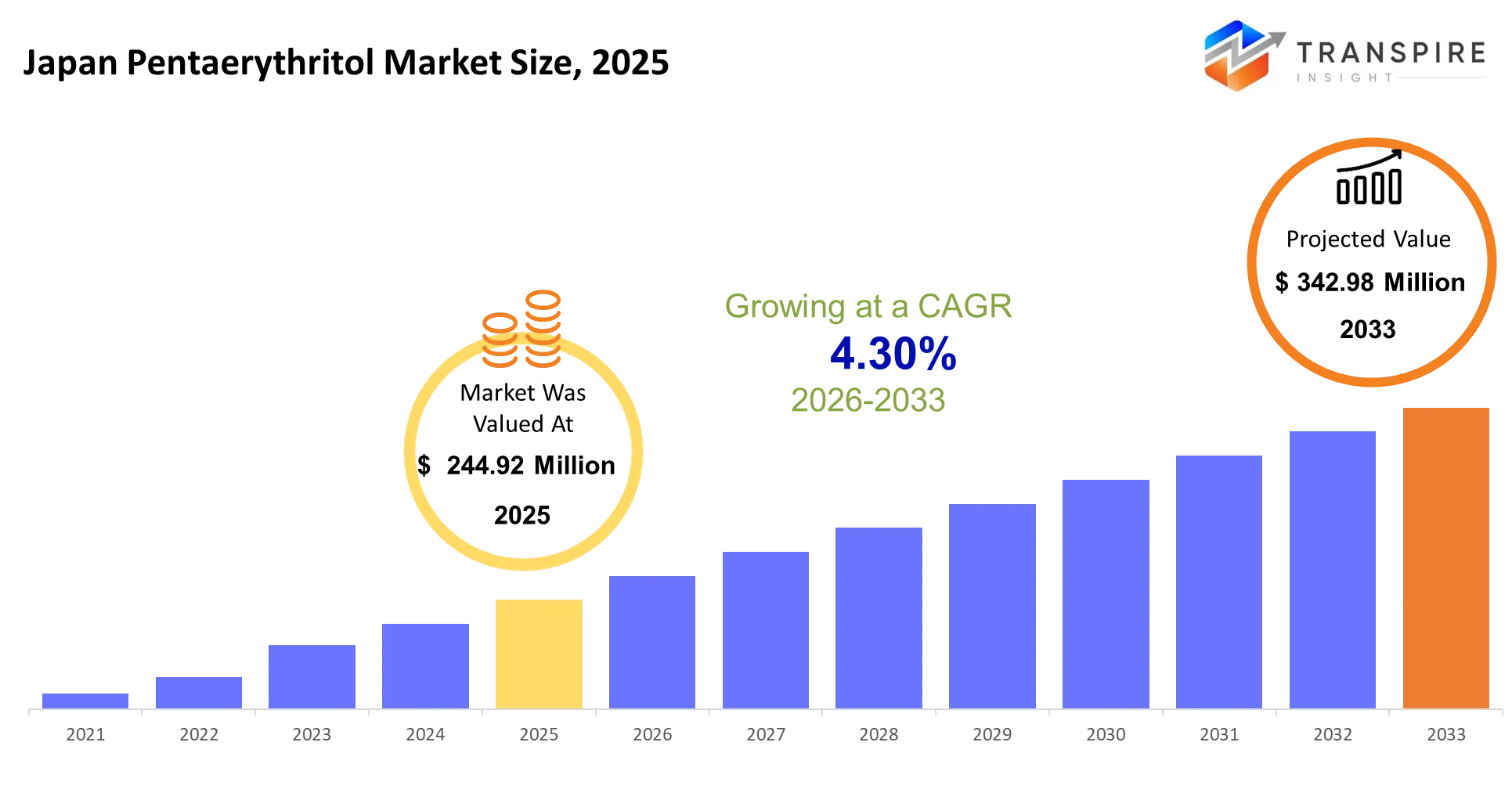
- Japan Pentaerythritol Market Size 2025: USD 244.92 Million
- Japan Pentaerythritol Market Size 2033: USD 342.98 Million
- Japan Pentaerythritol Market CAGR: 4.30%
- Japan Pentaerythritol Market Segments: By Type (Mono-pentaerythritol, Di-pentaerythritol, Tri-pentaerythritol, Others); By Application (Alkyd Resins, Paints & Coatings, Lubricants, Explosives, Plasticizers, Synthetic Resins, Others); By End-User (Construction, Automotive, Chemical Industry, Paint Industry, Industrial Sector, Defense Sector, Others); By Form (Powder, Granules, Others)
To learn more about this report,  Download Free Sample Report
Japan Pentaerythritol Market Summary
The Japan Pentaerythritol Market was valued at USD 244.92 Million in 2025. It is forecast to reach USD 342.98 Million by 2033. That is a CAGR of 4.30% over the period.
Pentaerythritol functions as a fundamental component for producing high-performance coatings and synthetic lubricants and industrial resins which safeguard ships and machinery and infrastructure from corrosion and heat and wear. The manufacturing process enables companies to create alkyd resins and ester-based lubricants which provide extended equipment life while satisfying new industrial performance standards.
The Japanese market currently prefers low-VOC high-solid coating systems because environmental regulations have become more strict during the last three to five years. The pandemic disrupted global chemical supply chains which revealed that the industry depends heavily on imported intermediates. This situation led to increased demand for domestic sourcing and the development of new resin systems.
The combination of regulatory pressure and supply uncertainty has led to increased use of pentaerythritol-based formulations because these formulations provide higher system efficiency and better system durability and regulatory compliance advantages, which enable continuous use throughout the entire coating and lubricant production process.
Key Market Insights
- The Kanto region accounts for 35 to 40 percent of the Japan Pentaerythritol Market because it contains numerous chemical manufacturing sites and coating production facilities.
- Monopentaerythritol dominates the Japan Pentaerythritol Market with nearly 55% share, driven by strong usage in alkyd resin production.
- The high-temperature lubricant market together with the specialty chemical sector have expanded their adoption of Dipentaerythritol, which now serves as the second largest market segment.
- Technical-grade pentaerythritol currently stands as the most rapidly expanding market segment because manufacturers are shifting toward industrial chemical inputs with high-performance capabilities.
- The Coatings and resins segment controls about 45% market share, which industrial surface treatment and infrastructure protection needs drive.
- The lubricant additives market expands most rapidly because industrial machinery upgrades now prioritize efficiency and equipment durability needs.
- The chemical manufacturing sector shows increasing demand for plasticizers and stabilizers in their specialized applications.
- The automotive industry dominates end-user demand in the Japan Pentaerythritol Market, which aggregates approximately 30% of total market demand for its coating and lubricant purposes.
- The industrial manufacturing sector represents the fastest expanding end-user segment because organizations implement automation and equipment lifespan optimization practices.
- Infrastructure development needs corrosion-resistant coatings which drive consistent demand from the construction sector.
What are the Key Drivers, Restraints, and Opportunities in the Japan Pentaerythritol Market?
The Japan Pentaerythritol Market experiences its main growth driver through industrial coatings which require low VOC emissions and provide high durability. The Japanese chemical and manufacturing industries established stricter environmental regulations which forced formulators to switch from solvent-based resins to more stable high-solid materials. Pentaerythritol-based alkyd resins support this transition because they improve film strength, thermal resistance, and lifecycle performance in coatings used for automotive components, marine equipment, and industrial infrastructure. The chemical producers who supply resin intermediates for downstream coating manufacturers have experienced revenue stability because of rising adoption rates from these manufacturers.
The Japan Pentaerythritol Market faces a major limitation because it requires energy-dense manufacturing processes which depend on imported raw material resources. The system constraint exists because Japan has both restricted access to natural resources and requires high energy expenses for manufacturing operations. Producers face margin pressure when global input prices fluctuate, while smaller manufacturers struggle to maintain cost competitiveness. The industry experiences cost challenges which prevent companies from expanding their production facilities while they also face difficulties in increasing their domestic manufacturing capacity. The costs of industrial energy create obstacles which prevent price-sensitive sectors from adopting new technologies.
The expansion of high-performance lubricant formulations offers new business opportunities for precision manufacturing and electric vehicle component production. Japanese automotive suppliers are increasingly investing in next-generation drivetrains, where heat-resistant synthetic esters derived from pentaerythritol are gaining traction. The industrial centers of Aichi and Kanagawa have received lubricant research and development funding which enables the rapid commercialization of advanced ester-based systems that will create new high-value market opportunities and continuous demand growth in Japan's Pentaerythritol Market.
What Has the Impact of Artificial Intelligence Been on the Japan Pentaerythritol Market?
The Japan Pentaerythritol Market experiences operational changes due to artificial intelligence and advanced digital systems which enhance chemical plant operations through better reaction efficiency and energy management and product quality control. Manufacturers use AI-enabled process control systems which maintain constant temperature and pressure and catalyst ratio adjustments to achieve stable pentaerythritol production results with reduced production inconsistencies. Machine learning models operate alongside predictive maintenance systems which monitor reactors and distillation units and heat exchangers to enable operators to detect equipment deterioration before failures happen and prevent unexpected facility downtime.
AI-driven analytics enhance emissions monitoring and compliance reporting for chemical facilities through the combination of exhaust gas cleaning system sensor data and plant-wide environmental control data. The system now achieves higher compliance rates while providing better insight into business operations. The Japan Pentaerythritol Market experiences competitive cost advantages because producers report higher plant uptime and lower energy usage per ton of output and better efficiency in utilizing feedstock materials.
Chemical companies face adoption challenges because they must spend money to integrate AI systems into their existing chemical production facilities. The digital systems required for standardized operations do not exist in many older facilities which also experience problems with collecting real-time process data because their data collection methods leave essential information missing. The variable operating conditions of the system create model accuracy challenges which prevent users from implementing the system despite its proven ability to enhance efficiency.
Key Market Trends
- The environmental regulations which took effect after 2022 brought about the automatic replacement of solvent-heavy resins with pentaerythritol-based low-VOC coatings in Japanese chemical manufacturing facilities.
- The supply chain interruptions which happened in 2021 resulted in domestic manufacturers developing strategies to source materials locally while decreasing their dependence on imported chemical intermediates which they needed for production processes.
- Between 2022 and 2025 alkyd resin producers developed high-solid coating systems which provided better durability performance for automotive and marine applications.
- Mitsubishi Gas Chemical expanded its production efficiency initiatives during 2024 by implementing programs which aimed to enhance yield efficiency while minimizing energy consumption throughout pentaerythritol production facilities.
- The Japanese automotive original equipment manufacturers upgraded their manufacturing processes to use ester-based lubricants because their electric vehicle components needed better thermal resistance performance after 2023.
- After 2022 BASF and Perstorp expanded their specialty chemical business operations across the Asia-Pacific region by using technological innovations and creating regional distribution partnerships.
- The industrial manufacturers adopted predictive maintenance systems between 2023 and 2023. The chemical processing units experienced decreased unplanned downtime because of the system's ability to analyze real-time sensor data.
- Since 2021 coastal infrastructure projects have used corrosion-resistant coatings which created ongoing demand for pentaerythritol-derived resin systems.
- The adoption of digital process control systems increased after 2024, which led to better reaction stability and decreased batch variability for industrial pentaerythritol production facilities.
Japan Pentaerythritol Market Segmentation
By Type :
Mono-pentaerythritol leads the Japanese market for Pentaerythritol. The market experiences high demand because alkyd resins and construction surface protection coatings need these materials. Chemical units maintain constant production levels which deliver consistent paint and resin supply requirements.
Di-pentaerythritol and Tri-pentaerythritrol function as components in lubricant formulations and sophisticated chemical products. These grades help improve performance in industrial applications. Other types serve smaller, specialized uses across chemical processing and material production in Japan.
By Application :
The Japanese market for Pentaerythritol continues to grow because of its main applications which include Alkyd resins and paints and coatings products. The construction industry experiences growth while customers need long-lasting surface materials which results in increased demand for protective and decorative coatings.
Industrial demand increases through the use of lubricants, plasticizers and synthetic resins together with restricted explosives. The manufacturing processes of Japan depend on these applications for their chemical blending needs and performance material creation across various production sectors.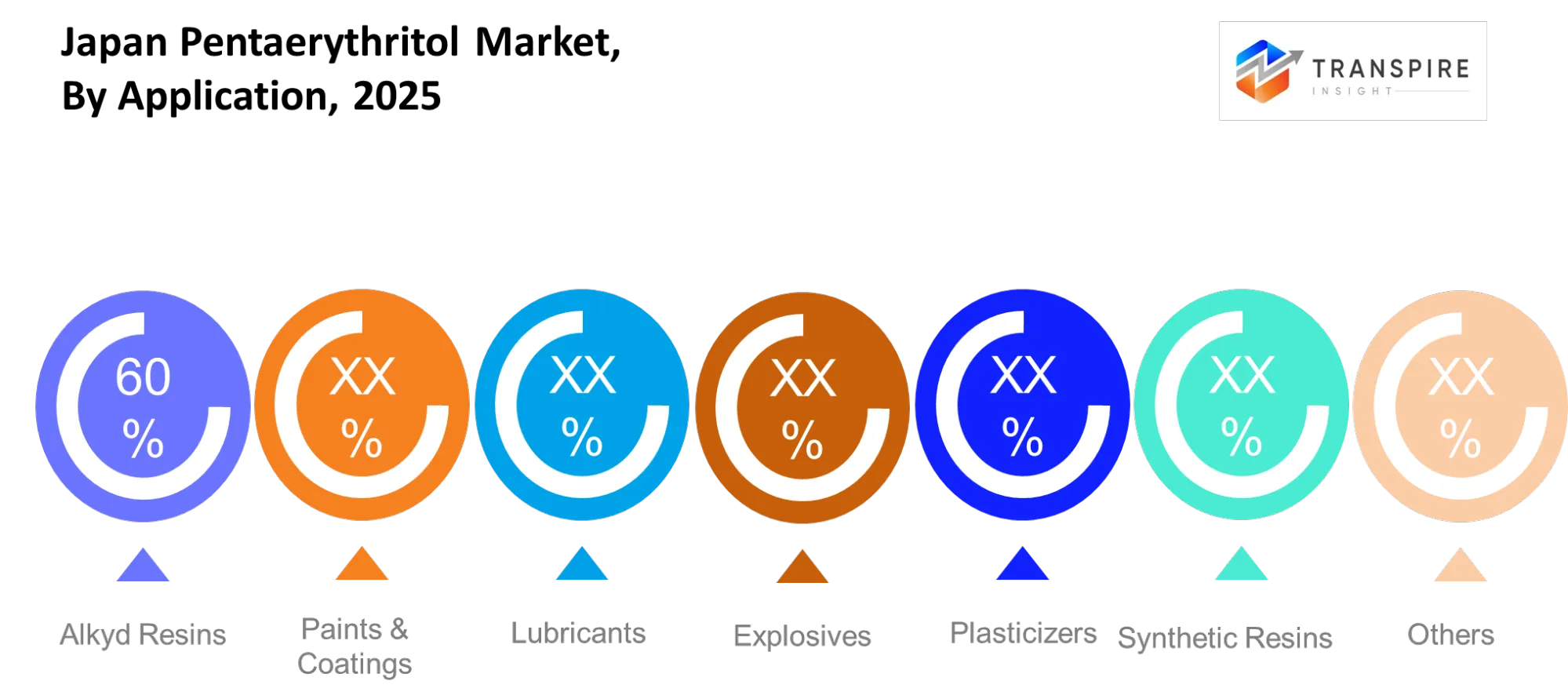
To learn more about this report, Download Free Sample Report
By End-User :
The construction industry and automotive sector and paint industry use pentaerythritol in their products which include coatings and adhesives and protective materials. Japan experiences ongoing material demand because of its expanding infrastructure and increasing vehicle manufacturing activities.
The chemical industry and industrial sector and defense sector and other users of pentaerythritol use it for resin production and specialty formulations and performance-based materials. The different sectors depend on regular chemical deliveries to meet their various production requirements.
By Form :
The Japan Pentaerythritol Market shows powder form as the primary product because it allows simple mixing with resins and coatings and chemical production processes. The fine texture enables smooth blending which produces uniform results during industrial operations at manufacturing facilities.
The use of granules enables safer handling and storage and transportation of materials. The chemical processing and supply chain operations of large-scale production environments require this form because it enables controlled usage and minimizes material waste.
What are the Key Use Cases Driving the Japan Pentaerythritol Market?
The Japan Pentaerythritol Market operates through its main application which handles coating and alkyd resin production. The market demand for corrosion-resistant and durable surface protection materials drives the market because automotive manufacturing and marine equipment and industrial infrastructure require these materials. Pentaerythritol enables high-solid resin systems which extend asset life while meeting stricter environmental compliance requirements.
The expanding applications include synthetic lubricants and plasticizer intermediates which manufacturers use in precision machinery and automotive components. The industrial manufacturers use pentaerythritol-based esters to enhance thermal stability and decrease equipment wear in high-speed systems which operate in Japan's automotive and heavy engineering industries.
Advanced electric vehicle drivetrains and energy-efficient industrial systems are currently developing new application areas which require their emerging use cases. The EV component manufacturing industry and sustainable construction materials market have started to adopt heat-resistant ester fluids and next-generation bio-based resin formulations due to stricter emissions regulations and material innovation programs.
|
Report Metrics |
Details |
|
Market size value in 2025 |
USD 244.92 Million |
|
Market size value in 2026 |
USD 255.45 Million |
|
Revenue forecast in 2033 |
USD 342.98 Million |
|
Growth rate |
CAGR of 4.30% from 2026 to 2033 |
|
Base year |
2025 |
|
Historical data |
2021 - 2024 |
|
Forecast period |
2026 - 2033 |
|
Report coverage |
Revenue forecast, competitive landscape, growth factors, and trends |
|
Country scope |
Japan |
|
Key company profiled |
Perstorp, Ercros, Mitsubishi Gas Chemical, Kanoria Chemicals, Hubei Yihua, LCY Chemical, Celanese, BASF, Arkema, Eastman, U-Jin Chemical, Samyang, Shandong Kelong, Henan Pengcheng, Jiangsu Kailin |
|
Customization scope |
Free report customization (country, regional & segment scope). Avail customized purchase options to meet your exact research needs. |
|
Report Segmentation |
By Type (Mono-pentaerythritol, Di-pentaerythritol, Tri-pentaerythritol, Others); By Application (Alkyd Resins, Paints & Coatings, Lubricants, Explosives, Plasticizers, Synthetic Resins, Others); By End-User (Construction, Automotive, Chemical Industry, Paint Industry, Industrial Sector, Defense Sector, Others); By Form (Powder, Granules, Others) |
Which Regions are Driving the Japan Pentaerythritol Market Growth?
The Kanto region leads the Japan Pentaerythritol Market because chemical manufacturers, automotive OEMs, and coating formulators establish their operations in high numbers throughout the area. The Greater Tokyo region enforces strict VOC emission regulations which leads to companies adopting low-emission resin systems that require pentaerythritol-based materials. The area benefits from well-developed logistics networks which enable smooth raw material import and finished product distribution operations through its proximity to major ports including Yokohama. The integrated industrial ecosystem maintains regular production levels which helps Kanto maintain its market leadership.
The Kansai region maintains a constant market share in the Japan Pentaerythritol Market because Osaka and Kobe and their nearby manufacturing areas create diverse industrial employment opportunities. The demand of Kansai, which operates through established chemical processing centers, receives continuous support from industrial companies which maintain their operations through their mid-sized investments. The industry has adopted regulatory requirements at a gradual speed which enables manufacturers to develop their production methods without stopping their operations. The stable consumption patterns of pentaerythritol in coatings, lubricants and specialty resins make the region a dependable source of revenue for businesses.
The Chubu region is becoming the fastest-expanding area because its automotive electrification and precision engineering sectors are growing quickly. Aichi Prefecture's recent establishment of electric vehicle production facilities has increased the need for high-performance lubricants and heat-resistant resin systems. The introduction of improved industrial corridor infrastructure and supplier localization initiatives after 2023 has enhanced manufacturing productivity. The region presents strong potential for market entrants and investors to achieve substantial benefits through its opportunities.
Who are the Key Players in the Japan Pentaerythritol Market and How Do They Compete?
The Japan Pentaerythritol Market demonstrates moderate market consolidation because a small number of international chemical manufacturers and local market players control the majority of premium product distribution. The market requires competition to focus on achieving product purity and process efficiency and meeting low-VOC and high-performance resin standards. The existing companies maintain their market position through complete production facilities and their extended partnerships with manufacturers in the coatings and automotive and lubricant sectors while smaller local producers work to establish their presence in specific market segments which require lower-grade products.
Mitsubishi Gas Chemical Company strengthens its position through tight integration of upstream methanol derivatives and downstream resin applications. This system enables the company to maintain stable product costs and deliver constant product excellence to its industrial clients from Japan who work in the coatings and specialty chemical markets. BASF SE competes through advanced formulation technology, supplying high-purity pentaerythritol grades tailored for premium alkyd resins and performance lubricants. The company develops its Japanese presence through technical partnerships with local formulators and its ongoing development of application support centers.
Perstorp Group specializes in creating special products through ester-based solutions which deliver better performance stability at high temperatures. The global production capabilities of Celanese Corporation together with its supply chain management expertise, enable the company to provide automotive and industrial customers with dependable shipping schedules. The company develops its niche market through custom resin intermediates which it creates together with Japanese downstream producers enabling better access to advanced coating technologies and automotive industry supply chains.
Company List
- Perstorp
- Ercros
- Mitsubishi Gas Chemical
- Kanoria Chemicals
- Hubei Yihua
- LCY Chemical
- Celanese
- BASF
- Arkema
- Eastman
- U-Jin Chemical
- Samyang
- Shandong Kelong
- Henan Pengcheng
- Jiangsu Kailin
Recent Development News
In April 2026, Mitsui Chemicals, Idemitsu Kosan, and Sumitomo Chemical received Japan Fair Trade Commission clearance for the integration of Sumitomo Chemical’s polypropylene and linear low-density polyethylene businesses into Prime Polymer. The consolidation strengthens Japan’s polyolefin supply chain efficiency and indirectly influences demand for upstream intermediates used in coatings and resin systems such as pentaerythritol derivatives.
Source https://jp.mitsuichemicals.com/
In February 2026, Nagase & Co., Ltd. announced the establishment of a semiconductor high-purity chemical manufacturing subsidiary in Wuxi City. The investment is aimed at strengthening advanced materials production capacity for semiconductor applications and supporting growth in high-purity chemical demand, which indirectly benefits specialty alcohol and resin value chains including pentaerythritol-based derivatives.
Source https://japanir.jp/
What Strategic Insights Define the Future of the Japan Pentaerythritol Market?
The Japan Pentaerythritol Market is experiencing a structural transformation which now demands high-purity chemical solutions that match particular application requirements because downstream industries demand products which extend product lifespan and consume less energy and meet all their regulatory requirements. The upcoming 5 to 7 years will experience growth through two main factors which include the shift to low-VOC coatings and the rising demand for electrification-based lubricants from automotive and precision manufacturing sectors. The shift creates better value-added differentiation because it requires suppliers to create specific product formulations instead of expanding their overall output capacity.
The market faces a hidden threat which comes from bio-based polyols and other polyhydric alcohol alternatives that bio-based polyols and alternative polyhydric alcohols which bio-based polyols and other alternative polyhydric alcohol solutions gain momentum through their inclusion in sustainable chemistry roadmaps. The demand for commodity resin applications will face decline when cost parity reaches its peak because demand will decrease as far as possible. The pentaerythritol derivatives currently present a vital opportunity for integration into upcoming EV thermal management fluids particularly in Japan's Chubu and Kansai manufacturing areas which show rapid growth in electrification projects.
Market participants should establish downstream co-development alliances with automotive companies and coatings producers because these partnerships will secure product-specific customer requirements which will help maintain profitability throughout the specialized industry supply network.
Japan Pentaerythritol Market Report Segmentation
By Type
- Mono-pentaerythritol
- Di-pentaerythritol
- Tri-pentaerythritol
By Application
- Alkyd Resins
- Paints & Coatings
- Lubricants
- Explosives
- Plasticizers
- Synthetic Resins
By End-User
- Construction
- Automotive
- Chemical Industry
- Paint Industry
- Industrial Sector
- Defense Sector
By Form
- Powder
- Granules
Frequently Asked Questions
Find quick answers to common questions.
The Japan Pentaerythritol Market size is USD 342.98 Million in 2033.
Key Segments for the Japan Pentaerythritol Market are By Type (Mono-pentaerythritol, Di-pentaerythritol, Tri-pentaerythritol, Others); By Application (Alkyd Resins, Paints & Coatings, Lubricants, Explosives, Plasticizers, Synthetic Resins, Others); By End-User (Construction, Automotive, Chemical Industry, Paint Industry, Industrial Sector, Defense Sector, Others); By Form (Powder, Granules, Others).
Major Japan Pentaerythritol Market players are Perstorp, Ercros, Mitsubishi Gas Chemical, Kanoria Chemicals, Hubei Yihua, LCY Chemical, Celanese, BASF, Arkema, Eastman, U-Jin Chemical, Samyang, Shandong Kelong, Henan Pengcheng, Jiangsu Kailin.
The Current Japan Pentaerythritol Market size is USD 244.92 Million in 2025.
The Japan Pentaerythritol Market CAGR is 4.30% from 2026 to 2033.
- Perstorp
- Ercros
- Mitsubishi Gas Chemical
- Kanoria Chemicals
- Hubei Yihua
- LCY Chemical
- Celanese
- BASF
- Arkema
- Eastman
- U-Jin Chemical
- Samyang
- Shandong Kelong
- Henan Pengcheng
- Jiangsu Kailin
Recently Published Reports
-
Apr 2026
Healthcare Polymer Packaging Market
Healthcare Polymer Packaging Market Size, Share & Analysis Report By Packaging Type (Syringes, IV Bottles and Pouches, Clamshells, Blisters, Bottles & Jars, Containers, Tubes, IV Parental Packaging, Others), By Type (Regulated, Non-regulated), By Polymer Type (LDPE (Low-Density Polyethylene), HDPE (High-Density Polyethylene), Homo-polymer (Homo), Random Copolymer (Random), Block Copolymer (Block), PET, Polystyrene, Polyvinyl Chloride, Polyamide/EVOH, Others), and Geography (North America, Europe, Asia-Pacific, Middle East and Africa, South and Central America), 2021 - 2031
-
Apr 2026
Hydrophilic Tape (Waterstop) Market
Hydrophilic Tape (Waterstop) Market Size, Share & Analysis Report By Type (Bentonite-Based Hydrophilic Tape, Rubber-Based Hydrophilic Tape), By Application (Residential Buildings, Commercial Buildings, Infrastructure Projects), and Geography (North America, Europe, Asia-Pacific, Middle East and Africa, South and Central America), 2021 - 2031
-
Apr 2026
Metalens Market
Metalens Market Size, Share & Analysis Report By Type (Visible Light Metalens, and Infrared Metalens), By Application (Consumer Electronics, Automotive Electronics, Industrial, Medical, and Others), and Geography (North America, Europe, Asia-Pacific, Middle East and Africa, South and Central America), 2021 - 2031
-
Apr 2026
PBT Resin Market
PBT Resin Market Size, Share & Analysis Report By Type (Reinforced PBT Resin, Unreinforced PBT Resin), By Processing Method (Injection Molding, Extrusion, Blow Molding, Others), By End-User (Automotive, Electrical & Electronics, Consumer Appliances, Industrial Machinery, Medical Devices, Packaging, Others), and Geography (North America, Europe, Asia-Pacific, Middle East and Africa, South and Central America), 2021 - 2031