

Japan Pasta Sauce Market Size & Forecast:
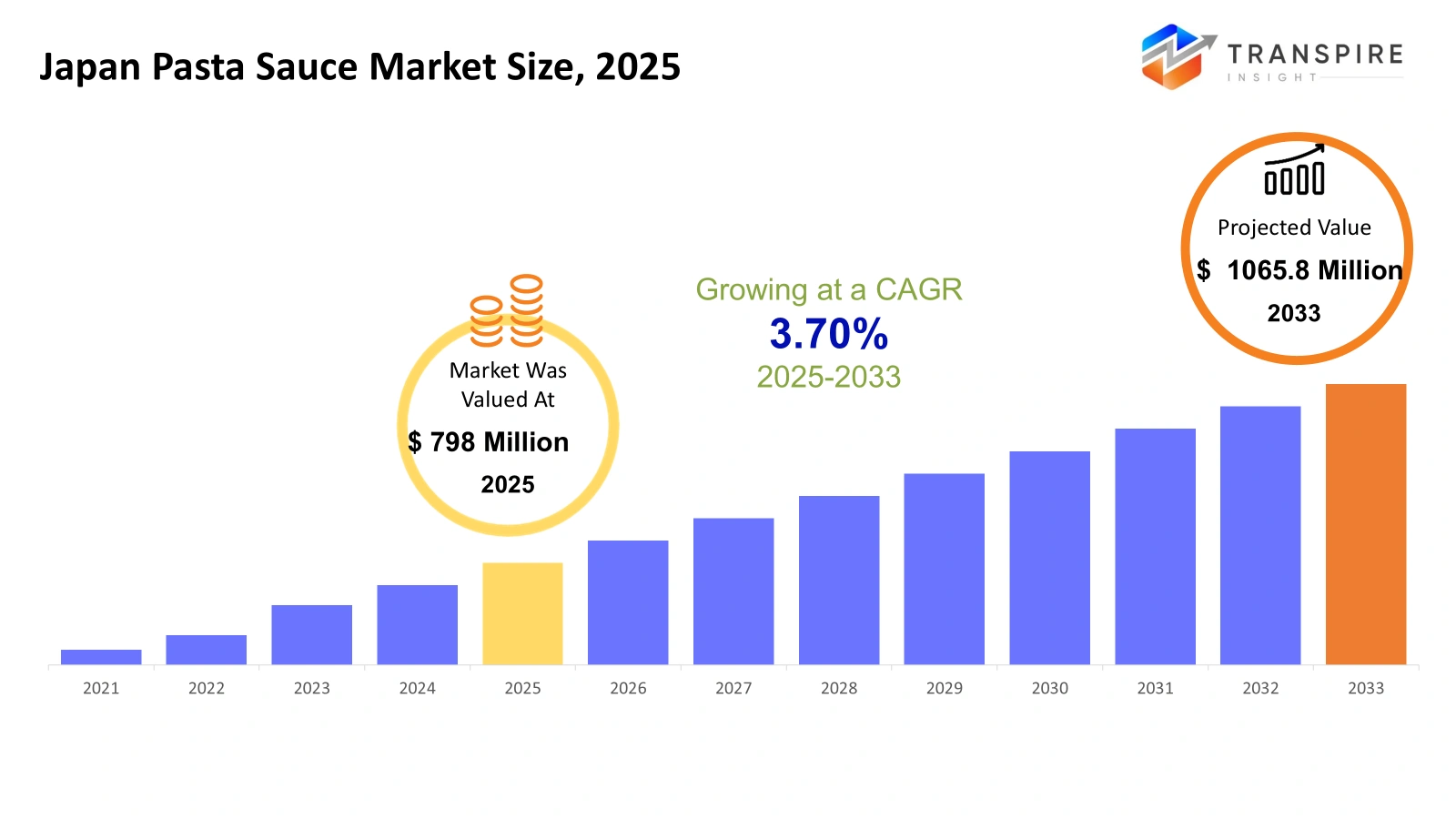
- Japan Pasta Sauce Market Size 2025: USD 798 Million
- Japan Pasta Sauce Market Size 2033: USD 1065.8 Million
- Japan Pasta Sauce Market CAGR: 3.70%
- Japan Pasta Sauce Market Segments:By Product Type (Tomato-Based Sauces, Alfredo Sauces, Pesto Sauces, Others), By Distribution Channel (Supermarkets & Hypermarkets, Convenience Stores, Online Retail), and By Packaging (Glass Jars, Cans, Pouches).
To learn more about this report,  Download Free Sample Report
Japan Pasta Sauce Market Summary:
The Japan Pasta Sauce Market size is estimated at USD 798 Million in 2025 and is anticipated to reach USD 1065.8 Million by 2033, growing at a CAGR of 3.70% from 2026 to 2033. The Japan pasta sauce market shows consistent growth because consumer food preferences have changed and Western-style dining has become more popular. Consumers with active schedules now prefer to use convenient ready-made sauces that enable quick cooking without losing taste. The most common sauce type used by consumers is tomato-based sauces, while they show increasing interest in creamy and speciality sauce options. Brands utilise premium ingredients and natural flavouring and healthier product choices to draw customers. The Japan pasta sauce market keeps expanding because people show more interest in home cooking and international food.
Key Market Trends & Insights:
- People now prefer fast Meal options because of their busy schedules. Japanese consumers prefer ready-made pasta sauces because these sauces make cooking easier during their active daily routines. The product lets people cook delicious home meals with minimal effort, which makes it popular among office workers and compact home residents.
- Western cuisine has become more popular in recent times. Japanese families now prepare Western dishes according to an increasing trend that includes Italian food. The current trend actively increases consumer demand for different pasta sauce options, which include standard tomato sauce, cream sauce and herb cream sauce.
- Japanese shoppers prefer purchasing pasta sauces that contain top-quality ingredients that are produced through authentic methods. Brands use high-quality tomatoes and olive oil together with conventional Italian cooking methods to attract customers who value taste.
- Health awareness is influencing purchasing decisions in the market. Manufacturers are developing sauces that contain less salt and no artificial preservatives and use natural components to satisfy consumers who want healthier food options.
- Supermarkets continue to operate as the main sales channel for products while online shopping platforms gain popularity. E-commerce enables customers to discover additional imported pasta sauces and specialty pasta sauces, which helps drive forward market expansion.
Japan Pasta Sauce Market Segmentation
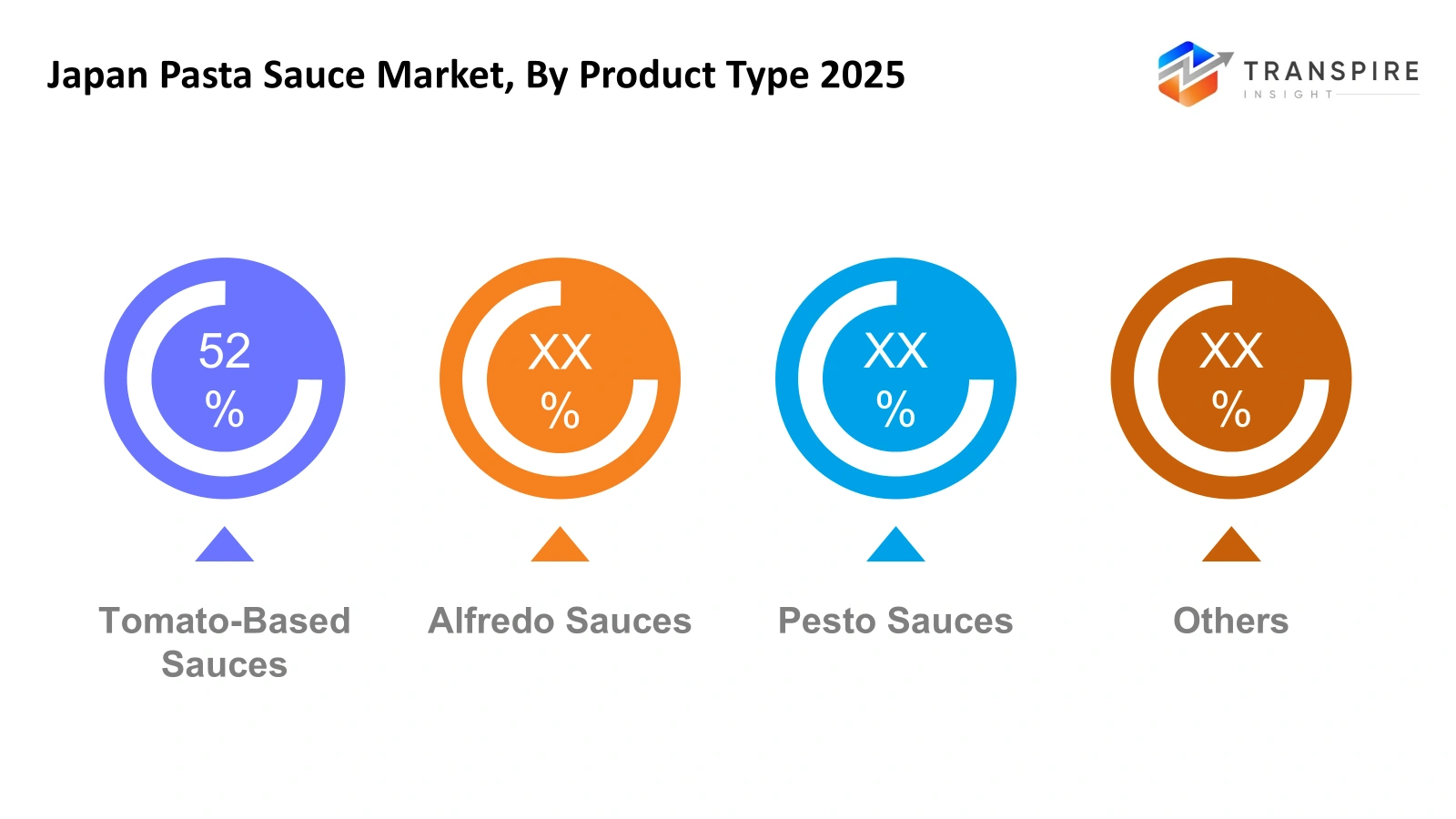
By Product Type
- Tomato-Based Sauces: Tomato-based sauces dominate the Japan pasta sauce market because they provide Japanese consumers with familiar flavour options which can be used in multiple cooking applications. These sauces serve as a daily cooking solution for most households because they complement various pasta dishes. The brands create two types of products which combine traditional recipes with modern premium products by adding garlic, herbs and vegetables.
- Alfredo Sauces: Japanese consumers who prefer rich creamy flavours are showing increased interest in Alfredo sauces, which have started to become popular. Western home cooking and restaurant menus use these sauces as their standard ingredient. The product attracts customers who want luxurious pasta dishes with easy-to-use meal solutions because it provides a smooth texture together with a buttery flavour.
- Pesto Sauces: Pesto sauces are drawing consumer interest because they provide authentic Italian tastes that are not commonly available. Fresh basil leaves and olive oil and cheese create a fresh aroma which pesto adds to pasta dishes. The rising demand for this product shows that Japanese people want to explore international food styles.
- Others: Pasta sauce options include mushroom-based sauces and seafood sauces and spicy sauces and fusion-style sauces which use Japanese culinary elements as inspiration. The food options give customers the ability to create unique meals, which helps companies establish their product identity. Adventurous consumers who want to discover new flavours find these particular food options to be their most exciting choice.
To learn more about this report, Download Free Sample Report
By Distribution Channel
- Supermarkets & Hypermarkets: Supermarkets and hypermarkets remain the leading distribution channels for pasta sauces in Japan. The stores provide a broad selection of domestic and international products, which enables customers to evaluate different products. The retail outlets attract customers because of their appealing discounts, their well-organised product displays and their easy-to-reach store layout.
- Convenience Stores: Convenience stores operate as vital components within Japan's food retail industry. The stores provide accessibility through their extensive operating hours, which enable customers to make fast purchases throughout the day. The small package size of ready-to-use pasta sauces enables busy consumers to prepare their meals through quick cooking solutions.
- Online Retail: The number of people who shop for groceries and speciality items through online retail continues to rise because of their growing preference for digital shopping. E-commerce platforms provide access to a wider range of pasta sauce brands, which includes imported and premium options. The ability to compare products easily with home delivery service creates a major advantage that drives online shopping growth.
By Packaging
- Glass Jars: The usage of glass jars for packaging pasta sauces exists because these containers maintain both taste and product freshness through their design. People think that products which use glass packaging must be of better quality than products which use other types of packaging. The transparent design of the product enables customers to inspect the sauce inside, which establishes trust and makes the product more attractive.
- Cans: Consumers appreciate canned pasta sauces because these products offer excellent durability together with extended storage capabilities. The products function as easy-to-store, easy-to-transport items, which makes them ideal for customers who want to buy items in bulk. Consumers who want to buy practical products tend to choose this packaging style, which majorly uses traditional sauces.
- Pouches: People are increasingly choosing pouches because these packaging solutions offer both lightweight and flexible design benefits. The products need minimal storage space because they use less packaging material to create single-use or small-portion items. Multiple brands now choose pouch packaging as their solution to provide customers with both practical and environmentally friendly product choices.
Country Insights
The Japan pasta sauce market shows how Japanese food customs have changed because people now eat between Japanese dishes and Western dining traditions. The dining habits of younger people and working adults who seek quick meal solutions have made pasta a common dish in their homes. The demand for packaged pasta sauces keeps increasing throughout the nation.
The urban centers of Tokyo, Osaka and Yokohama experience strong demand because their residents lead hectic lives while experiencing various international food options. Japanese consumers value product quality and taste balance and top-grade components, which leads brands to produce sauces that use real tomatoes and authentic Italian herb recipes.
The country uses its strong retail system to create market growth. Supermarkets and convenience stores and online platforms provide customers throughout the country with simple access to pasta sauces. Japan's pasta sauce market will grow steadily because people now cook more at home and explore international dishes while the market changes to meet local flavour needs and health trends.
Recent Development News
Japanese–Italian Fusion Cuisine Boosts Demand for Pasta and Speciality Sauces.
Post‑COVID Trend Keeps Pasta & Sauce Sales Strong in Japan.
|
Report Metrics |
Details |
|
Market size value in 2025 |
USD 798 Million |
|
Market size value in 2026 |
USD 826.7 Million |
|
Revenue forecast in 2033 |
USD 1,065.8 Million |
|
Growth rate |
CAGR of 3.70% from 2026 to 2033 |
|
Base year |
2025 |
|
Historical data |
2021 – 2024 |
|
Forecast period |
2026 – 2033 |
|
Report coverage |
Revenue forecast, competitive landscape, growth factors, and trends |
|
Country scope |
Japan |
|
Key company profiled |
Kagome Co. Ltd., Kewpie Corporation, Heinz Japan, Nestlé SA, Campbell Soup Company, Mizkan Holdings, Barilla Group, Conagra Brands, General Mills Inc., Del Monte Foods, Unilever PLC, Prego (Campbell’s), Classico (Kraft Heinz), Daisho Co. Ltd., Ajinomoto Co. Inc. |
|
Customization scope |
Free report customization (country, regional & segment scope). Avail customized purchase options to meet your exact research needs. |
|
Report Segmentation |
By Product Type (Tomato-Based Sauces, Alfredo Sauces, Pesto Sauces, Others), By Distribution Channel (Supermarkets & Hypermarkets, Convenience Stores, Online Retail), By Packaging (Glass Jars, Cans, Pouches). |
Key Japan Pasta Sauce Company Insights
The Japan pasta sauce market features a mix of well-established domestic food manufacturers and international brands, which compete to meet changing needs of their customers. Companies are focusing on delivering authentic flavours together with premium ingredients and convenient packaging to attract modern consumers. Many brands are also introducing healthier options that contain lower salt content together with natural ingredients and no artificial additives. Innovation plays a key role as firms create new products that blend Italian recipes with Japanese culinary tastes. The companies use strong distribution networks that include supermarkets, convenience stores, and online platforms to reach more customers while achieving continuous growth in the competitive market.
Company List
- Kagome Co. Ltd.
- Kewpie Corporation
- Heinz Japan
- Nestlé SA
- Campbell Soup Company
- Mizkan Holdings
- Barilla Group
- Conagra Brands
- General Mills Inc.
- Del Monte Foods
- Unilever PLC
- Prego (Campbell’s)
- Classico (Kraft Heinz)
- Daisho Co. Ltd.
- Ajinomoto Co. Inc.
Japan Pasta Sauce Market Report Segmentation
By Product Type
- Tomato-Based Sauces
- Alfredo Sauces
- Pesto Sauces
- Others
By Distribution Channel
- Supermarkets & Hypermarkets
- Convenience Stores
- Online Retail
By Packaging
- Glass Jars
- Cans
- Pouches
Frequently Asked Questions
Find quick answers to common questions.
The approximate Japan Pasta Sauce Market size for the market will be USD 1065.8 Million in 2033.
The key segments of the Japan Pasta Sauce Market are By Product Type (Tomato-Based Sauces, Alfredo Sauces, Pesto Sauces, Others), By Distribution Channel (Supermarkets & Hypermarkets, Convenience Stores, Online Retail), By Packaging (Glass Jars, Cans, Pouches).
Major players in the Japan Pasta Sauce Market are Kagome Co. Ltd., Kewpie Corporation, Heinz Japan, Nestlé SA, Campbell Soup Company, Mizkan Holdings, Barilla Group, Conagra Brands, General Mills Inc., Del Monte Foods, Unilever PLC, Prego (Campbell’s), Classico (Kraft Heinz), Daisho Co. Ltd., and Ajinomoto Co. Inc.
The current market size of the Japan Pasta Sauce market is USD 798 Million in 2025.
The Japan Pasta Sauce Market CAGR is 3.70%.
- Kagome Co. Ltd.
- Kewpie Corporation
- Heinz Japan
- Nestlé SA
- Campbell Soup Company
- Mizkan Holdings
- Barilla Group
- Conagra Brands
- General Mills Inc.
- Del Monte Foods
- Unilever PLC
- Prego (Campbell’s)
- Classico (Kraft Heinz)
- Daisho Co. Ltd.
- Ajinomoto Co. Inc.
Recently Published Reports
-
Apr 2026
Baby Infant Formula Market
Baby Infant Formula Market Size, Share & Analysis Report By ype (Infant Milk, Follow On Milk, Specialty Baby Milk, Growing-Up Milk), By Ingredient (Carbohydrate, Fat, Protein, Minerals, Vitamins, and Others), By Product Form (Powder, Liquid, and Ready-to-feed), By Distribution Channels (Supermarket/Hypermarket, Specialty Store, Pharmacies, Online Retail, and Others), and Geography (North America, Europe, Asia-Pacific, Middle East and Africa, South and Central America), 2021 - 2031
-
Apr 2026
Edible Insects for Animal Feed Market
Edible Insects for Animal Feed Market Size, Share & Analysis Report By Type (Insect Powder, Insect Meal, Insect Bar, Insect Paste, Insect Oil, and Others), By Insect Type (Beetles, Cricket, Caterpillar, Hymenoptera, Orthoptera, Tree Bugs, and Others), By Application (Livestock, Pet Food, and Aquaculture), By Livestock Type (Poultry, Swine, and Others), and Geography (North America, Europe, Asia-Pacific, Middle East and Africa, South and Central America), 2021 - 2031
-
Apr 2026
Food Industry Disinfection and Bacterial Control Market
Food Industry Disinfection and Bacterial Control Market Size, Share & Analysis Report By Type (Chemical Disinfectants, Physical Disinfectants, and Biocides and Antimicrobials), By Application (Food Processing Equipment Surface Disinfection, Food Preparation Areas Surface Disinfection, Storage Areas Surface Disinfection, Anti-microbial Coatings Food Preservation, and Preservative Solutions Food Preservation), By End User (Meat and Poultry Processing, Dairy Processing, Seafood Processing, Bakery and Confectionery, Restaurants and Commercial Kitchens, and Food Service Providers), By Sales Channel (Online, Offline), and Geography (North America, Europe, Asia-Pacific, Middle East and Africa, South and Central America), 2021 - 2031
-
Apr 2026
Freeze Dried Food Market
Freeze Dried Food Market Size, Share & Analysis Report By Product Type (Fruits, Vegetables, Freeze-Dried Dairy Products, Freeze-Dried Meat and Seafood, Freeze-Dried Pet Food, and Prepared Meal), By Nature (Organic, and Conventional), By Form (Powdered, Granules, and Diced), By End Use (Breakfast Cereals, Dairy Products, Bakery & Confectionery, Nutritional Bars & Supplements, Powdered Beverages, Snacks, and Retail (Household)), and Geography (North America, Europe, Asia-Pacific, Middle East and Africa, South and Central America), 2021 - 2031