

Japan Organic Photovoltaic (OPV) Market Size & Forecast:
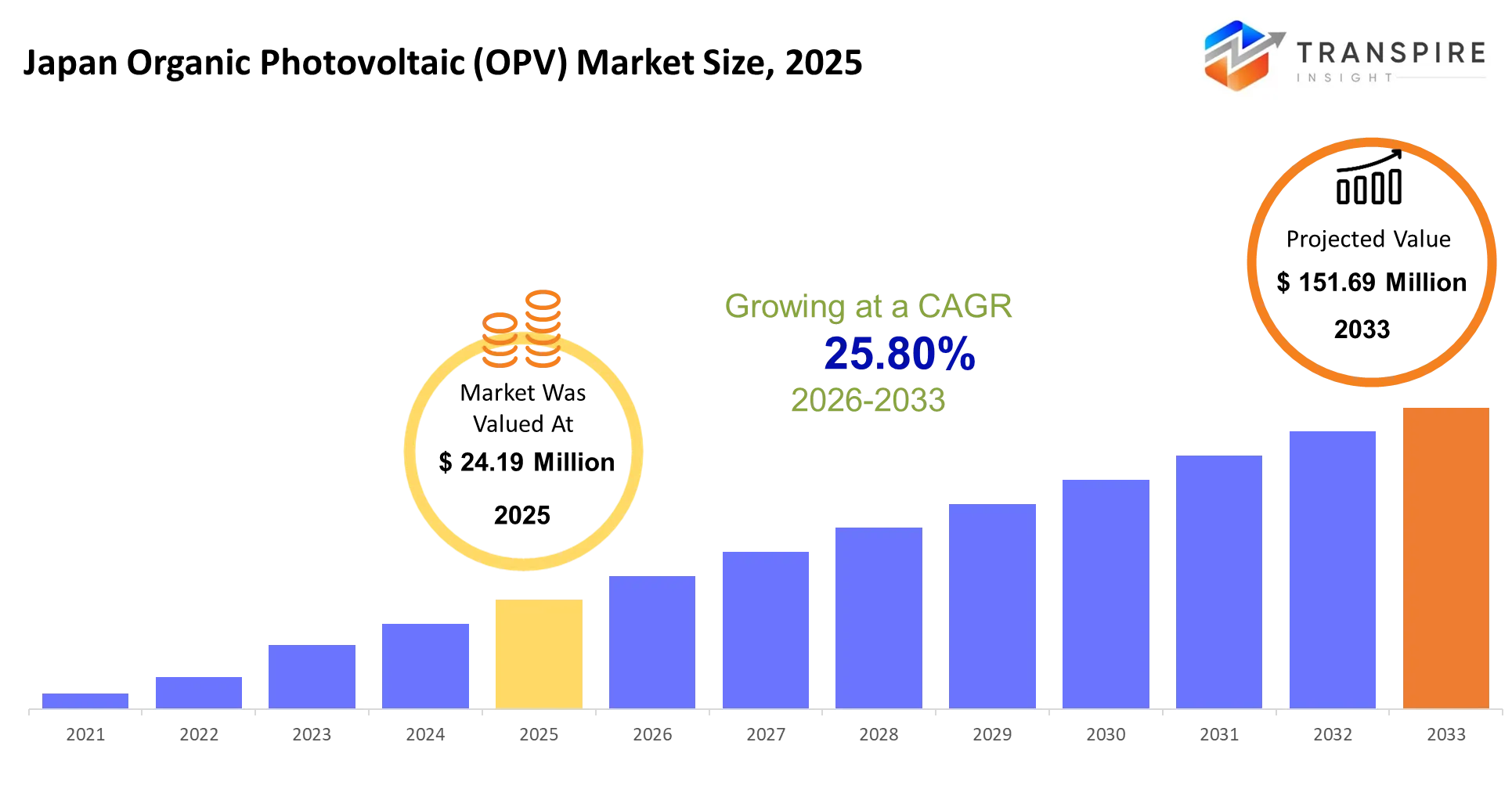
- Japan Organic Photovoltaic (OPV) Market Size 2025: USD 24.19 Million
- Japan Organic Photovoltaic (OPV) Market Size 2033: USD 151.69 Million
- Japan Organic Photovoltaic (OPV) Market CAGR: 25.80%
- Japan Organic Photovoltaic (OPV) Market Segments: By Type (Polymer-based OPV, Small Molecule OPV, Hybrid OPV, Others); By Application (Solar Panels, Wearable Devices, Building-integrated PV, Consumer Electronics, Others); By End-User (Energy Companies, Electronics Industry, Construction Firms, Research Institutes, Others); By Form (Flexible Panels, Rigid Panels, Others)
To learn more about this report,  Download Free Sample Report
Japan Organic Photovoltaic (OPV) Market Summary
The Japan Organic Photovoltaic (OPV) Market was valued at USD 24.19 Million in 2025. It is forecast to reach USD 151.69 Million by 2033. That is a CAGR of 25.80% over the period.
Japan's organic photovoltaic (OPV) market attracts increasing attention because it provides a practical solution to a major issue which all conventional solar panels fail to solve. The actual use of OPV technology exists in building facades and smart windows and portable electronics and low-load industrial applications which require both design flexibility and transparency and reduced structural weight and energy generation capacity. The period between three to five years has seen the market transition from laboratory research activities toward pilot commercialization, which Japan supports through its development of distributed energy systems and building-integrated renewable energy technologies.
The country established stricter decarbonization targets after national energy transition policies received updates, which motivated developers to research urban solar solutions that do not need rooftop space. Manufacturers began to explore alternative solar technologies because supply chain disruptions affected conventional silicon module production methods. The path for growth has developed into two parts, which involve urban developers searching for flexible renewable options while OPV technologies advance toward actual business use, which creates fresh income opportunities for materials vendors and system integrators.
Key Market Insights
- The Kanto region controlled the Japanese Organic Photovoltaic (OPV) market during 2025 when it held approximately 41% market share, which resulted from smart building construction projects throughout Tokyo and Yokohama.
- The Kansai region will experience its most rapid market growth until 2030 because of industrial sustainability spending and fast-paced clean energy retrofitting programs.
- Electronics manufacturers are expanding their flexible photovoltaic systems in Chubu, which is gaining popularity as industries develop advanced manufacturing hubs.
- The market share for flexible OPV films reached 48% in 2025 because their lightweight design enabled simple integration with building surfaces.
- Semi-transparent OPV modules ranked second with 31% share, supported by their use in smart window and façade applications.
- The segment of printable OPV solutions will experience its fastest growth until 2030 because production costs have decreased and roll-to-roll manufacturing becomes economically viable.
- The 2025 Japanese OPV market distribution shows that building-integrated photovoltaics generated 44% of total market value because urban areas needed energy-producing building systems.
- The market for wearable electronics together with portable IoT devices stands as the fastest-expanding application sector which will achieve annual growth rates beyond 14% according to market predictions.
- The development of automotive interior energy harvesting systems has become a key strategic technology for all future electric vehicle platforms.
- The OPV technology adoption by commercial infrastructure developers reached 39% market share in 2025 because they used it for their environmentally friendly construction projects that required green certification.
What are the Key Drivers, Restraints, and Opportunities in the Japan Organic Photovoltaic (OPV) Market?
The Japan Organic Photovoltaic (OPV) Market exists because the government wants to reverse carbon emissions in cities where standard solar panels cannot function. The shift acquired new strength because national energy policies began to focus on building-integrated renewable energy systems as the solution for renewable energy targets. Developers adopted OPV technology to create façades and windows and lightweight structures that lack the capacity to use silicon modules. The transition to OPV from pilot tests to commercial operations emerged through metropolitan construction projects which required energy efficiency compliance for project funding and approvals process.
The most significant restraint is the technology’s lower power conversion efficiency and shorter operational lifespan compared to crystalline silicon. This limitation is structural because material properties create a need for research breakthroughs that require extended time periods to achieve. The developers will experience lower energy production through each square meter while their equipment will need more frequent replacements which results in lower returns on investment and creates obstacles for their cost-sensitive industries to implement widespread use.
The main opportunity exists in roll-to-roll printable OPV production because its current costs have reached levels that enable large-scale production. Companies are developing production facilities that allow them to make flexible solar films at much reduced manufacturing costs. This technology provides especially valuable advantages for use in consumer electronics and vehicle interior systems because it enables development of lightweight energy solutions that can be tailored to create completely new business opportunities beyond standard building applications.
What Has the Impact of Artificial Intelligence Been on the Japan Organic Photovoltaic (OPV) Market?
The Japanese organic photovoltaic industry now experiences changes because of artificial intelligence and advanced digital technologies which enhance building material research and manufacturing accuracy and system performance assessment. AI-driven process control systems now operate at manufacturing facilities to automatically adjust coating thickness while aligning substrates and detecting defects during roll-to-roll production processes. The systems use real-time sensor data analysis to ensure consistent film deposition which the process needs because even small changes will decrease conversion efficiency. The automation process enables pilot facilities to decrease material waste while increasing production yield through specific measurable improvements which lead to reduced manufacturing expenses.
Machine learning now improves prediction abilities throughout flexible solar panel systems. The algorithms analyze environmental exposure data together with temperature changes and material degradation patterns to predict performance decline while determining optimal maintenance schedules. Predictive models for building-integrated photovoltaic systems enable operators to predict energy output more accurately while determining optimal equipment placement and operational settings to improve performance. The result of this process has created better system uptime together with improved lifecycle management which provides commercial developers more accurate return-on-investment assessments.
Digital twin technology has become an essential tool that enables manufacturers to create OPV simulations whichtest Japanese climate conditions. The main obstacle to research progress exists because researchers need long-term operational datasets which remain unobtainable. The limited number of commercial-scale installations prevents AI models from acquiring enough real-world training data which decreases their forecasting accuracy and hinders the adoption of advanced optimization systems.
Key Market Trends
- Japanese developers have started using façade-integrated OPV systems for their research work since 2022 because city construction projects now require energy-producing materials for building design.
- Toray Industries and other manufacturers developed wider market distribution plans after their laboratory research achieved over 20% efficiency improvements from 2021 onward.
- Electronics companies began using organic photovoltaic solutions made in their home countries because silicon import restrictions disrupted their supply chains from 2022 until 2024.
- Municipality authorities now prefer lightweight solar solutions for public building upgrades since Japan announced its updated 2030 decarbonization plan.
- Manufacturers established major roll-to-roll production facilities after 2023 because those facilities helped them decrease material waste while producing affordable scalable solar film products.
- Since 2024, construction buyers have stopped purchasing separate renewable energy systems because they prefer to use OPV technology which they can integrate into their building's glass and facade components.
- Panasonic Holdings reached a higher level of research development collaboration with universities and material innovators after 2023 to boost their durability research efforts.
- The automotive industry has started using OPV technology to test interior energy collection systems because it provides an efficient method to produce power through lightweight additional systems which have become popular.
- Since 2021, the competitive focus in the industry has shifted away from achieving maximum efficiency to developing products that last longer because commercial buyers now choose to assess the long-term operating costs of their products instead of evaluating their prototype performance.
Japan Organic Photovoltaic (OPV) Market Segmentation
By Type:
The Japanese Organic Photovoltaic Market shows significant interest in polymer-based OPV because this technology provides flexible lightweight materials which manufacturers can produce in large quantities. The demand for products keeps increasing because manufacturers create energy solutions which work efficiently in small spaces. Efficiency gains from small molecule OPV development drive its adoption while hybrid OPV development improves stability through material blending techniques.
Other types continue to support experimental and specialized uses where performance customization remains important. Research activity across Japan enables scientists to develop methods that increase product durability and conversion efficiency, which creates more business opportunities. Continuous material innovation investment will direct product development while type-based market segmentation will help predict upcoming business trends.
By Application:
The Japan Organic Photovoltaic (OPV) Market uses solar panels as its main application because light photovoltaic systems match contemporary urban energy requirements. The ability to use space-efficient solutions in tightly populated areas provides essential benefits for urban environments. Architects begin to use energy-producing surfaces which offer design freedom and eco-friendly design according to the rising trend of building-integrated energy systems.
The development of new business prospects arises from wearable technology and consumer electronic products which use small flexible power sources to enable device miniaturization. The use of OPV technology in portable electronic devices provides users with enhanced convenience and decreased need for charging their devices. The ongoing evaluation of experimental transport systems and public infrastructure projects together with technological improvements creates better chances for future developments.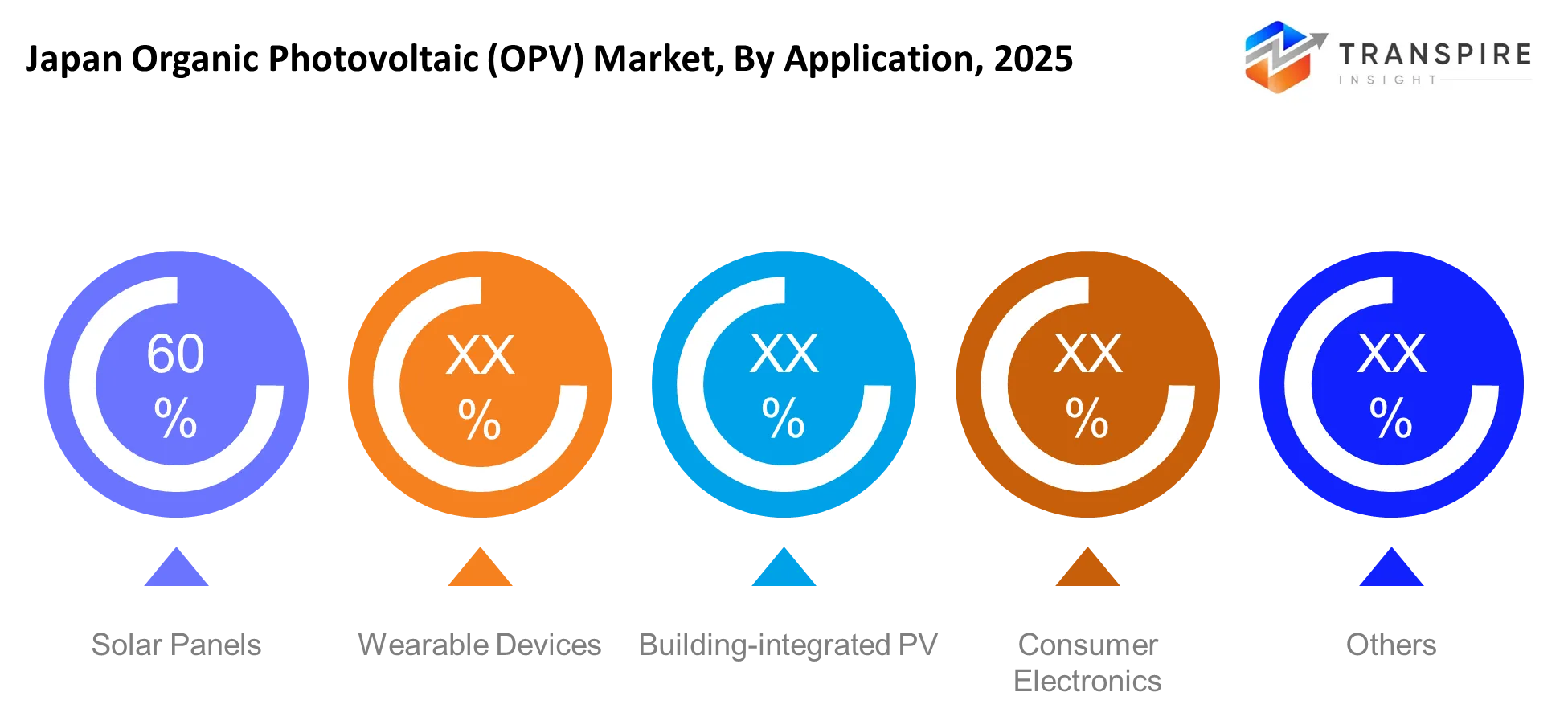
To learn more about this report, Download Free Sample Report
By End-User:
Energy companies represent a significant part of demand in the Japan Organic Photovoltaic (OPV) Market as renewable diversification remains a strategic priority. The deployment of pilot projects together with distributed generation systems is driving expansion of the system. The construction industry is boosting its use of sustainable building materials which have become popular for both commercial and residential projects.
The electronics industry drives expansion by enabling lightweight portable devices to use its products which show practical advantages through their flexible design. Research institutes continue to support commercial readiness through their testing activities and material development work. Public sector innovation programs and other end-users work together to create wider recognition and acceptance of their solutions across different industrial sectors.
By Form:
The Japan Organic Photovoltaic (OPV) Market shows strong support for flexible panels because these systems provide installation capabilities on various curved and unconventional surfaces. The current design standards for modern products require this design approach which enables designers to achieve both weight reduction and product portability. People prefer this material because it can easily be integrated into three different applications which include textiles and portable electronics and architectural surfaces.
Rigid panels maintain their value for applications that demand both structural integrity and fixed equipment placement. The panels are selected for projects which require standard installation techniques that work with the current infrastructure. The two systems operate under different requirements but manufacturing process improvements will boost performance in both systems while the market will expand during upcoming years.
What are the Key Use Cases Driving the Japan Organic Photovoltaic (OPV) Market?
The primary application of organic photovoltaic systems in Japan demonstrates that these systems serve as power generation systems which operate through their integration into building designs. The application generates its highest market demand because urban developers require lightweight renewable systems which meet both structural and space requirements of their projects in densely populated urban areas.
The use of OPV technology has expanded beyond construction into both consumer electronics and industrial IoT applications. Electronics manufacturers use flexible photovoltaic films to enhance battery performance in their wearables, low-power sensors and portable device products. Logistics and manufacturing operators are testing these systems to monitor equipment autonomously through constant low-level power which helps them maintain dependable operations.
New applications emerge in both automotive interior design and transportation infrastructure development. Automotive suppliers are evaluating OPV films for dashboard surfaces and cabin energy harvesting in electric vehicles. Railway operators and smart mobility planners are also exploring transparent photovoltaic integration for station canopies and transit shelters, where distributed power generation could support lighting, displays, and connected monitoring systems over the forecast period.
|
Report Metrics |
Details |
|
Market size value in 2025 |
USD 24.19 Million |
|
Market size value in 2026 |
USD 30.43 Million |
|
Revenue forecast in 2033 |
USD 151.69 Million |
|
Growth rate |
CAGR of 25.80% from 2026 to 2033 |
|
Base year |
2025 |
|
Historical data |
2021 - 2024 |
|
Forecast period |
2026 - 2033 |
|
Report coverage |
Revenue forecast, competitive landscape, growth factors, and trends |
|
Country scope |
Japan |
|
Key company profiled |
Heliatek, Armor, Mitsubishi Chemical, Sumitomo Chemical, Toray, BASF, Merck, Solarmer, InfinityPV, Konarka, NanoFlex Power, Belectric, First Solar, Hanergy, Sharp |
|
Customization scope |
Free report customization (country, regional & segment scope). Avail customized purchase options to meet your exact research needs. |
|
Report Segmentation |
By Type (Polymer-based OPV, Small Molecule OPV, Hybrid OPV, Others); By Application (Solar Panels, Wearable Devices, Building-integrated PV, Consumer Electronics, Others); By End-User (Energy Companies, Electronics Industry, Construction Firms, Research Institutes, Others); By Form (Flexible Panels, Rigid Panels, Others) |
Which Regions are Driving the Japan Organic Photovoltaic (OPV) Market Growth?
The Kanto region leads Japan's organic photovoltaic market because it combines the country's strongest policy support for urban decarbonization with the highest concentration of commercial redevelopment projects. Tokyo and Yokohama have established green building standards which create a need for lightweight solar materials that can be integrated into façades and transparent surfaces. The region possesses a developed innovation system which depends on research institutions and advanced materials manufacturers and major real estate companies that are willing to invest in pilot-to-commercial transitions. The combination of regulatory compliance and capital accessibility and technical skills enables Kanto to maintain its position as the top market in the region.
The Kansai region shows different development patterns from Kanto because its growth comes from consistent industrial development instead of massive urban redevelopment projects. Osaka and Kyoto support a resilient advanced manufacturing base where electronics and specialty materials companies have consistently invested in flexible energy technologies. The region expands its development through consistent corporate research and development expenses and controlled implementation methods instead of intense construction activities linked to policy requirements. The long-term industrial partnerships and product development initiatives make Kansai a reliable source of market revenue.
The Chubu region is emerging as the fastest-growing area due to recent investments tied to automotive electrification and smart manufacturing modernization. The testing of OPV films for vehicle interiors and linked industrial systems has been increased by manufacturers in Aichi and its neighboring regions since 2024. The industry now develops next-generation mobility platforms with lightweight auxiliary power systems as their standard power solution. Chubu momentum provides market entrants and investors with valuable commercial opportunities through 2033 because of its automotive partnerships and industrial applications that can grow.
Who are the Key Players in the Japan Organic Photovoltaic (OPV) Market and How Do They Compete?
The Japanese organic photovoltaic market exhibits moderate competitive fragmentation which results from the presence of major materials companies and electronics manufacturers and dedicated photovoltaic research companies. The industry tests products through technical assessments which evaluate conversion efficiency and durability and commercial manufacturing capabilities. Japanese companies maintain their market position through extensive research and development activities and their connections to local industrial ecosystems while small technology companies try to transform the industry by developing new printable materials and flexible module technologies. The main competitive area involves transforming laboratory efficiency improvements into dependable performance across large commercial deployments.
Mitsubishi Chemical Group develops advanced organic semiconductor materials while using its chemical engineering expertise to enhance OPV stability. The company distinguishes itself through its materials optimization capabilities which enable extended product lifecycles that serve as essential requirements for commercial building integration. The company is expanding through partnerships with academic research institutions to accelerate next-generation material commercialization.
Panasonic Holdings uses its device integration skills to compete in the market for consumer electronics and smart infrastructure systems which require product compatibility. Toray Industries has developed competitive advantages through its lightweight film technology and its ability to produce large quantities of substrate material which enables efficient roll-to-roll manufacturing. Heliatek establishes its market position through its advanced flexible OPV modules while entering the Japanese market through partnerships with construction companies and smart building developers who need proven commercial building experience.
Company List
- Heliatek
- Armor
- Mitsubishi Chemical
- Sumitomo Chemical
- Toray
- BASF
- Merck
- Solarmer
- InfinityPV
- Konarka
- NanoFlex Power
- Belectric
- First Solar
- Hanergy
- Sharp
Recent Development News
In September 2025, Japan’s Ministry of Economy, Trade and Industry secured funding commitments for Panasonic Holdings, Ricoh, and EneCoat Technologies. The ¥24.6 billion subsidy package was allocated to accelerate pilot production and scale-up of lightweight thin-film/perovskite photovoltaic technologies, strengthening Japan’s commercialization pipeline for next-generation flexible solar applications relevant to the organic photovoltaic market.Source https://www.solarbeglobal.com/
In October 2025, the Japanese government selected Mitsubishi Electric and PXP Corporation for a joint solar-cell development initiative. The partnership focuses on advancing tandem thin-film solar cell technology for space applications, a move expected to accelerate high-efficiency material innovation and spill over into Japan’s terrestrial organic and flexible photovoltaic development ecosystem. Source https://www.solarbeglobal.com/
What Strategic Insights Define the Future of the Japan Organic Photovoltaic (OPV) Market?
The organic photovoltaic market in Japan will develop through specialized commercial systems during the next five to seven years instead of establishing widespread renewable energy systems. The most significant growth will occur in situations where traditional silicon materials do not work because they need to be used for transparent building materials and lightweight mobility devices and embedded low-energy electronics. Japan focuses on developing advanced material engineering while its urban infrastructure limits development options.
The hidden danger in this situation arises from technology replacement through next-generation perovskite solar cells which Japanese researchers develop at a rapid pace. The technology will compete with existing OPV markets when these new solar cells reach their target durability and cost performance standards. The market faces a structural problem because domestic material suppliers control a large portion of the market which creates difficulties for companies that want to expand their business operations.
The growing need for smart mobility systems in Tokyo and Nagoya creates a new market opportunity for transparent photovoltaic systems which serve as part of their transit networks. The best approach for market participants involves establishing co-development partnerships with construction glass manufacturers and automotive suppliers. The company will achieve better commercial protection through product design that matches specific sector integration needs than through its laboratory efficiency tests.
Japan Organic Photovoltaic (OPV) Market Report Segmentation
By Type
- Polymer-based OPV
- Small Molecule OPV
- Hybrid OPV
By Application
- Solar Panels
- Wearable Devices
- Building-integrated PV
- Consumer Electronics
By End-User
- Energy Companies
- Electronics Industry
- Construction Firms
- Research Institutes
By Form
- Flexible Panels
- Rigid Panels
Frequently Asked Questions
Find quick answers to common questions.
The Japan Organic Photovoltaic (OPV) Market size is USD 151.69 Million in 2033.
Key segments for the Japan Organic Photovoltaic (OPV) Market are By Type (Polymer-based OPV, Small Molecule OPV, Hybrid OPV, Others); By Application (Solar Panels, Wearable Devices, Building-integrated PV, Consumer Electronics, Others); By End-User (Energy Companies, Electronics Industry, Construction Firms, Research Institutes, Others); By Form (Flexible Panels, Rigid Panels, Others).
Major Japan Organic Photovoltaic (OPV) Market players are Heliatek, Armor, Mitsubishi Chemical, Sumitomo Chemical, Toray, BASF, Merck, Solarmer, InfinityPV, Konarka, NanoFlex Power, Belectric, First Solar, Hanergy, Sharp.
The Japan Organic Photovoltaic (OPV) Market size is USD 24.19 Million in 2025.
The Japan Organic Photovoltaic (OPV) Market CAGR is 25.80% from 2026 to 2033.
- Heliatek
- Armor
- Mitsubishi Chemical
- Sumitomo Chemical
- Toray
- BASF
- Merck
- Solarmer
- InfinityPV
- Konarka
- NanoFlex Power
- Belectric
- First Solar
- Hanergy
- Sharp
Recently Published Reports
-
Apr 2026
Active Power Filter Market
Active Power Filter Market Size, Share & Analysis Report By Type (Shunt Active Power Filters, Series Active Power Filter, Hybrid Active Power Filter), By Application (Harmonics Mitigation, Reactive Power Compensation, Voltage Regulation, Power Factor Correction), By Phase (Single Phase, Three Phase), By End-User Industry (Manufacturing, Healthcare, Commercial, Automotive, Oil and Gas, Others), and Geography (North America, Europe, Asia-Pacific, Middle East and Africa, South and Central America), 2021 - 2031
-
Apr 2026
Electrical Transformer Market
Electrical Transformer Market Size, Share & Analysis Report By Core (Closed, Shell, and Berry), By Insulation (Gas, Oil, Solid, Air, and Other), By Phase (Single, and Three), By Rating (100 MVA to 500 MVA, 501 MVA to 800 MVA, and 801 MVA to 1200 MVA), and Geography (North America, Europe, Asia-Pacific, Middle East and Africa, South and Central America), 2021 – 2031
-
Apr 2026
Hydraulic Piston Pumps Market
Hydraulic Piston Pumps Market Size, Share & Analysis Report By Type (Axial Piston Pumps, Radial Piston Pumps), By Operating Pressure (Low Pressure, Medium Pressure, High Pressure), By Application (Construction, Mining, Agriculture, Automotive, Oil & Gas, Industrial Machinery, Others), By End-User (OEMs, Aftermarket), and Geography (North America, Europe, Asia-Pacific, Middle East and Africa, South and Central America), 2021 – 2031
-
Apr 2026
Laboratory Gas Generators Market
Laboratory Gas Generators Market Size, Share & Analysis Report By Product (Nitrogen Gas Generator, Hydrogen Gas Generator, Zero Air Gas Generator, Purge Gas Generator, TOC Gas Generators, Others), By Application (Gas Chromatography, Liquid Chromatography-mass Spectrometry (LC-MS), Gas Analyzers, Others), By End-user (Life Science, Chemical & Petrochemical, Food & Beverage, Others), and Geography (North America, Europe, Asia-Pacific, Middle East and Africa, South and Central America), 2021 – 2031