

Japan Optical Fiber Components Market Summary:
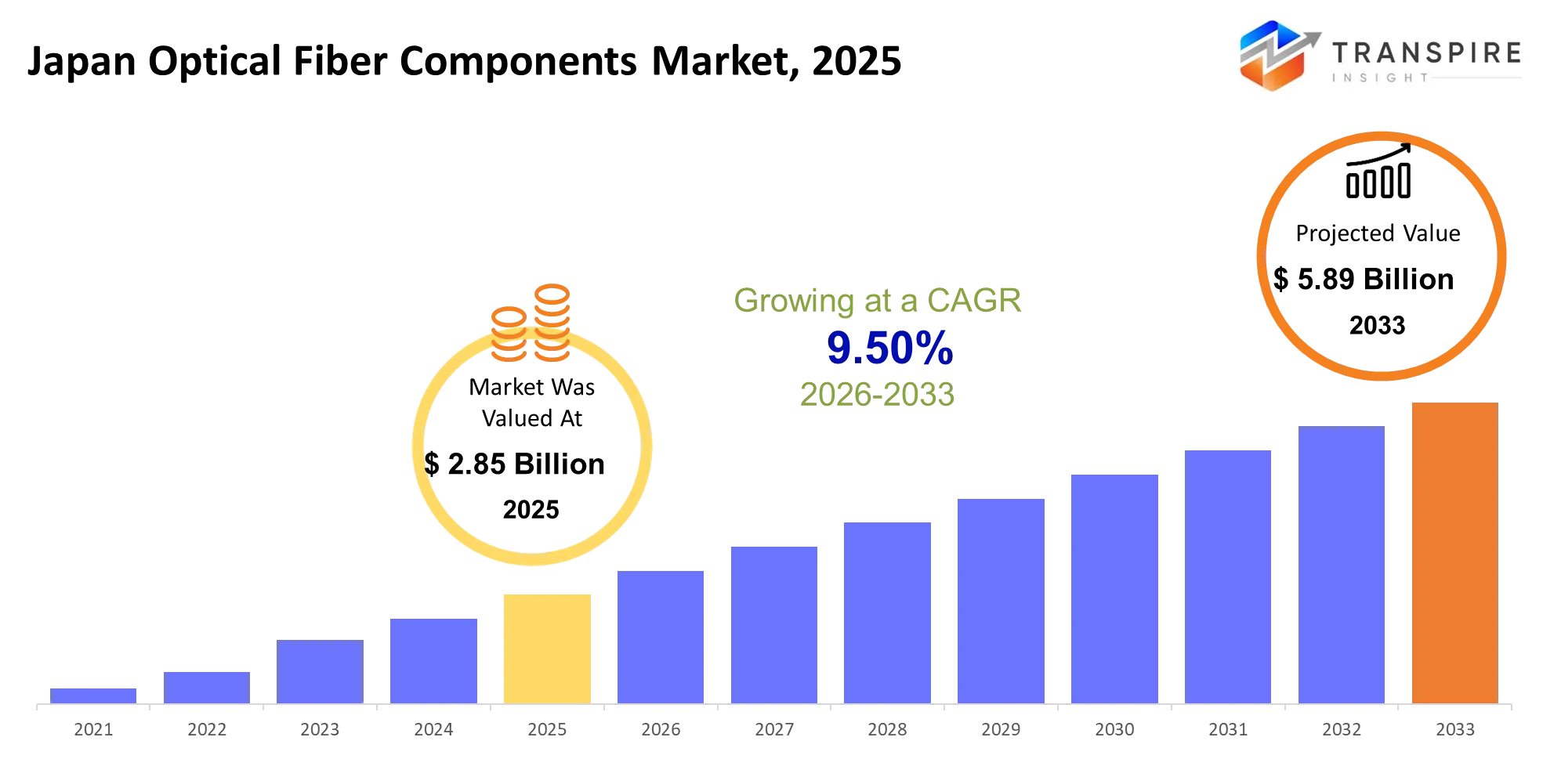
According to Transpire Insight, a detailed research report on the market reflects that the Japan Optical Fiber Components Market is valued at approximately USD 2.85 billion in 2025, is expected to reach USD 3.12 billion in 2026, and is projected to reach approximately USD 5.89 billion by 2033, expanding at a forecast CAGR of 9.50% during 2026–2033, making it a significant contributor to Japan’s optical communications infrastructure, advanced photonic component production, telecommunications network expansion, manufacturing capabilities, technological innovation, and overall market growth dynamics.
Market Snapshot
- Market Value (2025): USD 2.85 Billion.
- Expected Market Value (2026): USD 3.12 Billion.
- Estimated Market Value (2033): USD 5.89 Billion.
- Forecast CAGR (2026–2033): 9.50%.
Introduction
Japan’s optical fiber components market is an important part of the country’s digital infrastructure, covering the design, manufacture and deployment of fibers, connectors, transceivers, amplifiers and splitters for ultra-fast, low-loss data transmission. Telecom operators are deploying next-generation networks and enterprises are expanding data center capacity to meet rising computational demand. These components enable the seamless flow of information across increasingly complex digital ecosystems. The country also continues to be the global leader in precision manufacturing and materials engineering, with a mature supplier base and a strong focus on reliability and miniaturization, which further strengthens Japan’s competitive edge. The increasing use of optical connectivity in industrial automation, robotics and smart infrastructure enhances the strategic importance of the market, positioning it as a critical enabler of the country’s broader digital transformation and connected technology aspirations.
Key Market Highlights: -
- By Component Type, the Optical Transceivers dominated the market and holds approximately 50% share in 2025 and is projected to grow at a substantial CAGR during the forecast period.
- By Fiber Type, the SINGLE-MODE FIBER dominated the market and holds approximately 65% share in 2025 and is projected to grow at a substantial CAGR during the forecast period.
- By Application, the Telecommunications Manufacturers segment dominated the market and holds approximately 60% share in 2025 and is projected to grow at a substantial CAGR during the forecast period.
- Government-backed initiatives like nationwide fiber rollout, Society 5.0 convergence and NTT’s IOWN/APN all-photonic network are accelerating the adoption of next-generation optical infrastructure in Japan’s telecommunication and industrial ecosystems.
How is Technology Driving Growth in the Japan Optical Fiber Components Market?
Technological innovation is the key driver for the Japan optical fiber components market. The industry is driven by the expansion of next-generation 5G and 6G networks and the increasing shift from copper to fiber interconnects in data centers for GPU-intensive workloads. Domestic leaders such as Fujikura are pioneering multicore fiber designs and global connector standardization, with new co-packaged optics and optical-electrical integration lowering power consumption and improving transmission reliability. Meanwhile, Japan’s advanced robotics and smart-factory ecosystem is creating strong demand for precision splitters and patch cords, with artificial intelligence further boosting manufacturing accuracy and enabling predictive network maintenance across the industry.
Market Drivers
Japan’s optical fiber components market is growing due to the rapid rollout of 5G and beyond 5G (6G) networks in the country and the rising data traffic requiring high-density and low-loss connectivity among hyperscale data centers, cloud computing platforms, and fiber-to-the-home (FTTH) networks. Japan’s position as an industry leader within industrial automation, where ultra-reliable, high-speed data transmission is an essential component of smart factories and AI-powered robotics ecosystems under Industry 4.0 frameworks, further fuels demand for high-performance optical components. This trend is further reinforced by strong government incentives for nationwide digital transformation, smart city initiatives and vital infrastructure upgrades, making optical connectivity a key pillar for Japan’s future technology competitiveness and evolution into next-generation, data-driven digital ecosystems.
Restrain
High installation cost involved in trenching and raw material procurement, and technical challenges in maintaining accurate fiber alignment and low insertion loss are restraining the market growth. Japan faces shortages of skilled photonic technicians due to its aging workforce and the need for expensive protective infrastructure against environmental vulnerabilities like earthquakes and severe weather. In addition, the integration of cutting edge optical systems with legacy networks and interoperability issues of multi-vendor equipment further complicate seamless deployment and scalability.
Analysis of Prices and Consumer Behaviour
The optical fiber components market is dominated by high performance optical components (68% of the total market; mainly due to the demand from telecommunications, data centers and high-speed communication infrastructure industries). A high-performance, standardized optical fiber component including advanced photonic technologies is forecast to cost 35% more than other products. The product will be fabricated with advanced manufacturing technology, quality-certified materials and precision-engineered components to ensure consistent optical performance and reliability. About 45% of all unit sales of optical fiber components are fiber-optic connectivity and transmission components. The sales volume is determined by the versatility of use in high-speed communication networks and the long service life and reliability of optical fiber components. Sales volumes are driven by the versatility of use in high speed communication networks and the long life and reliability of optical fiber components. The telecommunications and data center industries make up about 70% of the demand from these industries. The purchasing behavior of customers reveals that 55% of customers give highest importance to optical performance, component quality and manufacturing standardization. 33% of the customers also prefer to buy products through bulk agreements or long-term contracts to reduce their costs related to the procurement of optical fiber components and ensure a reliable source of supply to their customers across Japan.
Top Companies in the Japan Optical Fiber Components Market
- Fujikura
- Furukawa Electric
- Sumitomo Electric
- NTT Electronics
- NEC
- Mitsubishi Electric
- Yokogawa Electric
- Oki Electric
- Fujitsu
- Hitachi
- Hoya
- Hamamatsu Photonics
- Kyocera
- Senko Advanced Components
- Molex
Japan Optical Fiber Components Market Segmentation
The Japan Optical Fiber Components Market share is divided into six categories: By Component Type, By Fiber Type, By Application, By Technology, By Connector Type, By End User.
The Optical Transceivers dominated the market, accounting for nearly 50% in 2025 and is expected to rise at a significant CAGR during the forecast period.
The Japan Optical Fiber Components Market is segmented by component type into optical connectors, optical transceivers, optical couplers, optical splitters, fiber optic adapters, optical amplifiers, wdm components, fiber optic sensors. Among these, the Optical Transceivers segment dominated the market, accounting for nearly 50% in 2025 and expected to increase at a significant CAGR during the forecast period. Optical transceivers are in the lead, driven by increasing demand for high-speed data center interconnects, 5G infrastructure expansion and bandwidth-hungry AI-driven network workloads.
The Single-Mode Fiber dominated the market, accounting for nearly 65% in 2025, and is expected to rise at a significant CAGR during the forecast period.
The Japan Optical Fiber Components Market is segmented By Fiber Type into Single-Mode Fiber, Multimode Fiber, Bend-Insensitive Fiber, Dispersion-Shifted Fiber, Polarization-Maintaining Fiber, Plastic Optical Fiber, Specialty Fiber, Hollow-Core Fiber. Among these, the Single-Mode Fiber dominated the market, accounting for nearly 65% in 2025 and expected to increase at a significant CAGR during the forecast period. Single-mode fiber leads due to better long-distance transmission, lower signal attenuation and the growing demand for high-bandwidth telecom and FTTH networks.
The Telecommunications dominated the market, accounting for nearly 60% in 2025 and is expected to rise at a significant CAGR during the forecast period.
The Japan Optical Fiber Components Market is segmented by application into telecommunications, data centers, ftth, 5g networks, cable television, industrial networking, aerospace & defense, medical. Among these, the Telecommunications dominated the market, accounting for nearly 60% in 2025 and expected to increase at a significant CAGR during the forecast period. Telecoms are booming with the nationwide rollout of 5G, FTTH deployments and growing data traffic requiring high-capacity, low-latency optical infrastructure.
Future Market Trends for the Japan Optical Fiber Components Market: -
- Major Future Developments 5G/6G Network Rollout: Demand for high-density, low-loss connectors, patch cords and splitters to carry increasing amounts of data across the country is being driven by government-backed telecom infrastructure upgrades.
- Industrial Automation Applications: Optical fiber connectivity solutions are being incorporated into smart factories, collaborative robots and digital twin systems by leading robotics manufacturers such as FANUC and Yaskawa.
- AI and IoT-Related Growth: Demand for ultra-high-speed, low-latency optical transmission components throughout enterprise networks is being driven by increasing cloud computing and AI adoption.
Recent Development
- In March 2026: Japan Aviation Electronics and NTT announced 1.6Tbps optical connectors for IOWN infrastructure, presenting ultra-low signal loss and high field-trial reliability.
- In August 2026: Furukawa Electric announced multi-region capital investment through its Lightera Japan subsidiary to expand the production of optical fiber and Rollable Ribbon Cable for generative AI data centers.
- In June 2026: Fujikura lifted its fiscal forecast, buoyed by robust profit growth, driven by increased global orders for high-count AI-linked optical fiber cables.
- In January 2026: OPTAGE Inc. delivered all-optical connectivity services in the Tokyo area, providing high-capacity 100Gbps and 400Gbps data center transport links.
Market Segmentation
This study forecasts revenue at Japan, regional and country levels from 2020 to 2033. Transpire Insight has segmented the Japan Optical Fiber Components Market based on the below-mentioned segments:
Japan Optical Fiber Components Market, By Component Type
- Optical Connectors
- Optical Transceivers
- Optical Couplers
- Optical Splitters
- Fiber Optic Adapters
- Optical Amplifiers
- WDM Components
- Fiber Optic Sensors
Japan Optical Fiber Components Market, By Fiber Type
- Single-Mode Fiber
- Multimode Fiber
- Bend-Insensitive Fiber
- Dispersion-Shifted Fiber
- Polarization-Maintaining Fiber
- Plastic Optical Fiber
- Specialty Fiber
- Hollow-Core Fiber
Japan Optical Fiber Components Market, By Application
- Telecommunications
- Data Centers
- FTTH
- 5G Networks
- Cable Television
- Industrial Networking
- Aerospace & Defense
- Medical
Japan Optical Fiber Components Market, By Technology
- WDM
- CWDM
- DWDM
- PON
- Active Optical Components
- Passive Optical Components
- Photonic Integrated Circuits
- Fiber Sensing
Japan Optical Fiber Components Market, By Connector Type
- LC
- SC
- ST
- FC
- MPO/MTP
- MU
- E2000
- Other Connectors
Japan Optical Fiber Components Market, By End User
- Telecom Operators
- Data Center Operators
- Network Equipment Manufacturers
- Cable Companies
- Enterprises
- Government
- Industrial Companies
- Research Institutes
Frequently Asked Questions
Find quick answers to common questions.
The market is valued at approximately USD 2.85 billion in 2025 and is projected to reach USD 5.89 billion by 2033.
The market is forecast to expand at a compound annual growth rate (CAGR) of 9.50% between 2026 and 2033.
Optical Transceivers dominate, holding nearly 50% market share in 2025, driven by data center and 5G infrastructure demand.
Single-Mode Fiber leads with approximately 65% share in 2025, favored for long-distance, low-attenuation, high-bandwidth telecommunications applications.
Leading companies include Fujikura, Furukawa Electric, Sumitomo Electric, NTT Electronics, NEC, Mitsubishi Electric, and Yokogawa Electric.
- Fujikura
- Furukawa Electric
- Sumitomo Electric
- NTT Electronics
- NEC
- Mitsubishi Electric
- Yokogawa Electric
- Oki Electric
- Fujitsu
- Hitachi
- Hoya
- Hamamatsu Photonics
- Kyocera
- Senko Advanced Components
- Molex
About the Authors

Avinash Kumar
I’m Avinash Kumar, a Senior Research Analyst at Transpire Insight, with expertise in the Electronics and Semiconductor and Energy & Power industry. My work focuses on analyzing emerging technologies, market trends, industry developments, and innovation across these sectors. I specialize in transforming complex technical and market insights into clear, research-backed content that helps professionals, businesses, and decision-makers stay informed. Through continuous industry research and data-driven analysis, I strive to deliver accurate, reliable, and practical perspectives on the latest advancements shaping the semiconductor and energy landscape.

Chakradhar Khansole
Chakradhar serves as the Research Director at Transpire Insight, bringing over 8 years of experience in technology, innovation, and strategic market intelligence. He specializes in transforming complex market data into actionable business insights that enable organizations to make informed, growth-oriented decisions. Recognized for his strategic vision and analytical expertise, Chakradhar leads high-impact research initiatives, delivering comprehensive market assessments, competitive intelligence, and forward-looking industry analysis.
Recently Published Reports
-
Apr 2026
Fiber Optic Faceplates Market
Fiber Optic Faceplates Market Size, Share & Analysis Report By Type (< 300 mm2, 300-350 mm2, and > 350 mm2, By Application (Night Vision, Holographic Imaging, Medical, and Others), and Geography (North America, Europe, Asia-Pacific, Middle East and Africa, South and Central America), 2021 - 2031
-
Apr 2026
High Temperature Superconductors Market
High Temperature Superconductors Market Size, Share & Analysis Report By Type (1G HTS, and 2G HTS), By Application (Power Cable, Fault Current Limiter, and Transformer), and Geography (North America, Europe, Asia-Pacific, Middle East and Africa, South and Central America), 2021 - 2031
-
Apr 2026
Industrial Plugs and Socket Market
Industrial Plugs and Socket Market Size, Share & Analysis Report By Type (Industrial Plugs, Industrial Sockets), By Current (Up to 32 A, 32 to 125 A, Above 125 A), By Protection (Dustproof and Splash Proof, Waterproof, Explosion Proof), By End User (Heavy Industries, Oil and Gas, Chemicals and Pharmaceuticals, Power Generation, Others), and Geography (North America, Europe, Asia-Pacific, Middle East and Africa, South and Central America), 2021 - 2031
-
Apr 2026
InGaAs Avalanche Photodiodes Market
InGaAs Avalanche Photodiodes Market Size, Share & Analysis Report By Type (1100 - 1700 nm, and 1000 - 1600 nm), By Application (Missile Warning System, Muzzle Flash Detection, Wafer Defect Inspection, Laser Rangefinders, and Others), and Geography (North America, Europe, Asia-Pacific, Middle East and Africa, South and Central America), 2021 - 2031