

Japan Night Vision Device Market Summary:
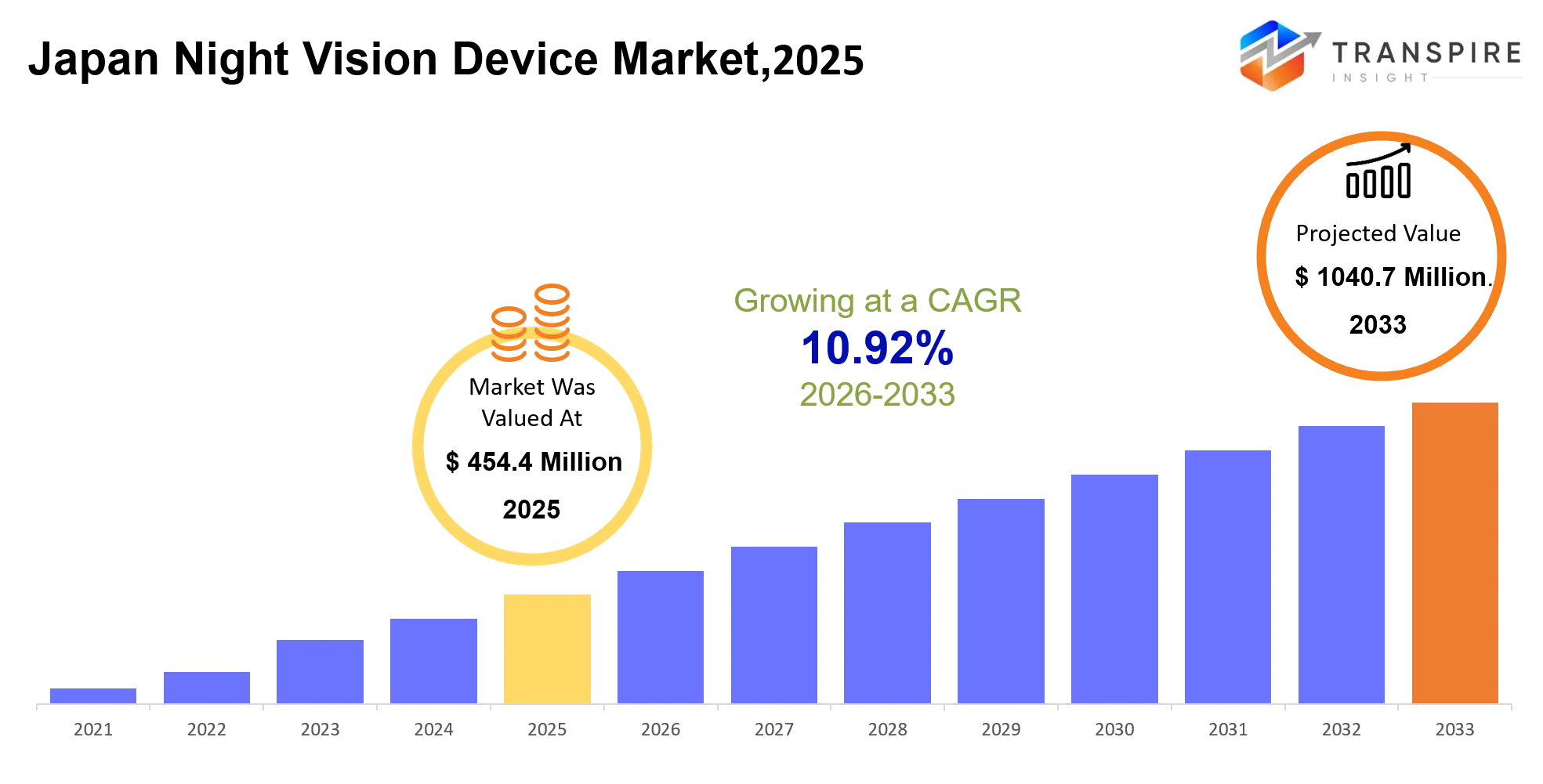
According to Transpire Insights, a detailed research report on the market reflects that the Japan Night Vision Device Market is experiencing significant growth, with the market valued at approximately USD 454.4 million in 2025, expected to reach USD 503.9 million in 2026, and projected to reach approximately USD 1,040.7 million by 2033, expanding at a CAGR of 10.92% during 2026–2033. The market reflects increasing development, innovation, advanced night vision device technologies, expanding manufacturing capabilities, and evolving growth dynamics across Japan.
Market Snapshot
- Market Value (2025): USD 454.4 Million.
- Expected Market Value (2026): USD 503.9 Million.
- Estimated Market Value (2033): USD 1040.7 Million.
- Forecast CAGR (2026–2033): 10.92%.
Introduction
The Japan Nite Vision Device Market consists of advanced optical and imaging technologies that enhance visibility and situational awareness in low-light and nighttime conditions. The market encompasses image intensification, thermal imaging, digital nite vision and integrated sensing solutions used in defence, public safety, automotive, industrial and surveillance applications. Japan’s strong precision manufacturing ecosystem, advanced electronics capabilities, and established robotics and automation infrastructure support the development of compact, reliable, and high-performance night vision solutions. Increasing adoption of intelligent surveillance, autonomous mobility, emergency response equipment, and security systems is creating new application opportunities. In addition, ongoing innovation in infrared sensing, image processing, sensor integration, and lightweight device design is enhancing product functionality and supporting the broader adoption of night vision devices in Japan.
Key Market Highlights: -
- By Device Type, the Night Vision Goggles dominated the market and holds approximately 35% share in 2025 and is projected to grow at a substantial CAGR during the forecast period.
- By Technology, the THERMAL IMAGING dominated the market and holds approximately 42% share in 2025 and is projected to grow at a substantial CAGR during the forecast period.
- By Application, the Generation 2 Manufacturers segment dominated the market and holds approximately 25% share in 2025 and is projected to grow at a substantial CAGR during the forecast period.
- The Japanese government is keen on investing in technology like sensing, modernizing the military forces, robotics, and Society 5.0. These developments have increased the need for technological night vision devices.
How is Technology Driving Growth in the Japan Night Vision Device Market?
Advancements in thermal sensors, infrared imaging, artificial intelligence, and digital image processing are driving the growth of the Japan Nite Vision Device Market. Higher sensor sensitivity and smaller components are increasing visibility and reducing device size and power consumption. AI-enabled image analysis assists in automated target detection, object recognition and real-time situational awareness in surveillance and security applications. Thanks to integration with automotive safety systems and robotics, nite vision is finding its way into more applications beyond conventional defence. Japan is also a leader in precision electronics and manufacturing, which helps to make sure imaging equipment is reliable, durable and increasingly sophisticated. Additional progress in sensor fusion and smart processing is improving performance in difficult nite and low-visibility environments.
Market Drivers
Growth in the Japan Nite Vision Device Market is being fuelled by factors such as defence modernisation, the need for maritime security, disaster preparedness, and ongoing technological advancements. Investment in advanced surveillance and tactical equipment is driving the adoption of observation sophisticated nite vision solutions across military and security applications. Japan’s extensive maritime domain also creates a requirement for dependable imaging systems to enable nighttime coastal monitoring and surveillance operations. Moreover, the frequency of natural disasters emphasises the necessity of reliable nite vision equipment for search-and-rescue and emergency-response operations. Technological advancements in thermal imaging, infrared sensing, artificial intelligence, sensor fusion, and lightweight device design are broadening applications across automotive, industrial, commercial, and public safety settings, bolstering the overall market potential for advanced nite vision devices in Japan.
Restrain
High equipment costs, complex system integration, regulatory requirements, and supply-chain constraints are limiting the Japan Nite Vision Device Market. Manufacturing and procurement costs are enhanced by specialised optics, thermal sensors, image-intensification technologies and advanced electronics, which limit adoption among cost-sensitive commercial users. Regulatory controls on defence and dual-use technologies can also complicate deployment and international distribution. Furthermore, the integration of the system with existing security, automotive and industrial systems may require significant technical expertise and infrastructure investment.
Analysis of Prices and Consumer Behaviour
High-performance nite vision systems hold the largest share of the Japan Nite Vision Devices market (68% of total market), mainly due to demand from defence, security, surveillance, automotive and emergency-response applications. Advanced high-resolution nite vision devices are anticipated to be 35% more expensive than other products. These systems use sophisticated thermal imaging, infrared sensing, advanced image processing and quality-certified components to offer consistent performance in low-light environments. Compact digital and portable nite vision devices represent about 45% of all unit sales. Their versatility in surveillance, security, automotive and outdoor applications, coupled with their portability and ease of deployment, are driving sales volume.About 70% of the demand from these industries is from the defence, security and industrial surveillance industries. Consumer purchasing behaviour Consumer behaviour shows that 55% of consumers consider image clarity, detection performance and product reliability to be the most important. 33% of consumers also prefer to purchase their products in bulk or under long-term contracts to cut down on costs in procuring equipment and to assure a steady source of supply for their customers in various parts of Japan.
Top Companies in the Japan Night Vision Device Market
- Hamamatsu Photonics
- Canon
- Sony
- Panasonic
- Nikon
- Olympus
- Ricoh
- NEC
- Fujitsu
- Toshiba
- FLIR
- SiOnyx
- Photonis
- Excelitas Technologies
- Bushnell
Japan Night Vision Device Market Segmentation
The Japan Night Vision Device Market share is divided into six categories: By Device Type, By Technology, By Generation, By Application, By Range, By End User.
The Night Vision Goggles dominated the market, accounting for nearly 35% in 2025 and is expected to rise at a significant CAGR during the forecast period.
The Japan Night Vision Device Market is segmented by device type into night vision goggles, night vision monoculars, night vision binoculars, night vision scopes, night vision cameras, thermal-night vision devices, digital night vision devices, night vision sensors. Among these, the Night Vision Goggles segment dominated the market, accounting for nearly 35% in 2025 and expected to increase at a significant CAGR during the forecast period. Nite vision goggles dominated the market with nearly 35% share in 2025 owing to high demand for hands-free visibility, tactical surveillance and rapid nighttime operations.
The Thermal imaging dominated the market, accounting for nearly 42% in 2025, and is expected to rise at a significant CAGR during the forecast period.
The Japan Night Vision Device Market is segmented by technology into image intensification, digital night vision, infrared illumination, thermal imaging, cmos-based imaging, ccd-based imaging, fusion imaging, low-light imaging. Among these, the Thermal imaging dominated the market, accounting for nearly 42% in 2025 and expected to increase at a significant CAGR during the forecast period. Thermal imaging technology accounted for the largest market share of about 42% in 2025, owing to its superior ability to detect in darkness, fog and low visibility situations in defence, security and surveillance applications.
The Generation 2 dominated the market, accounting for nearly 25% in 2025 and is expected to rise at a significant CAGR during the forecast period.
The Japan Night Vision Device Market is segmented by generation into generation 1, generation 2, generation 3, digital generation, advanced digital, thermal hybrid, fusion systems, specialty systems. Among these, the Generation 2 dominated the market, accounting for nearly 25% in 2025 and expected to increase at a significant CAGR during the forecast period. Generation 2 dominated the market, accounting for nearly 25% in 2025, due to better image clarity, consistent low-light performance, robustness and cost-effective deployment in security applications.
Future Market Trends for the Japan Night Vision Device Market: -
AI-Enabled Smart Surveillance: Integration of artificial intelligence, edge computing, and advanced analytics is expected to enhance automated detection, target recognition, and real-time situational awareness across night vision applications.
Thermal and Multispectral Fusion: Growing adoption of thermal imaging, digital sensors, and multispectral fusion technologies is expected to improve detection accuracy and operational performance in challenging nighttime environments.
Compact and Intelligent Devices: Manufacturers are increasingly developing lightweight, energy-efficient, and connected night vision devices to support defense, emergency response, automotive, industrial surveillance, and smart mobility applications.
Recent Development
In August 2026: Japanese nite vision manufacturers introduced compact imaging systems with AI and edge analytics, plus augmented reality for better real-time surveillance and situational awareness.
In August 2026: Japanese technology suppliers unveiled lightweight, energy-efficient and waterproof nite vision goggles for industrial automation, emergency response and disaster management applications.
In August 2026 – Japanese automotive technology developers introduced advanced nite vision camera solutions for smart mobility, driver assistance and intelligent urban surveillance applications.
Market Segmentation
This study forecasts revenue at Japan, regional and country levels from 2020 to 2033. Transpire Insights has segmented the Japan Night Vision Device Market based on the below-mentioned segments:
Japan Night Vision Device Market, By Device Type
- Night Vision Goggles
- Night Vision Monoculars
- Night Vision Binoculars
- Night Vision Scopes
- Night Vision Cameras
- Thermal-Night Vision Devices
- Digital Night Vision Devices
- Night Vision Sensors
Japan Night Vision Device Market, By Technology
- Image Intensification
- Digital Night Vision
- Infrared Illumination
- Thermal Imaging
- CMOS-Based Imaging
- CCD-Based Imaging
- Fusion Imaging
- Low-Light Imaging
Japan Night Vision Device Market, By Generation
- Generation 1
- Generation 2
- Generation 3
- Digital Generation
- Advanced Digital
- Thermal Hybrid
- Fusion Systems
- Specialty Systems
Japan Night Vision Device Market, By Application
- Security & Surveillance
- Wildlife Observation
- Search & Rescue
- Marine Navigation
- Industrial Inspection
- Automotive
- Law Enforcement
- Outdoor Recreation
Japan Night Vision Device Market, By Range
- Short Range
- Medium Range
- Long Range
- Ultra-Long Range
- Close Observation
- Wide-Area Observation
- Low-Light Range
- IR-Assisted Range
Japan Night Vision Device Market, By End User
- Security Companies
- Government Agencies
- Search & Rescue Organizations
- Industrial Companies
- Wildlife Researchers
- Marine Operators
- Outdoor Users
- Automotive Companies
Frequently Asked Questions
Find quick answers to common questions.
The Japan Night Vision Device Market is projected to grow at a 10.92% CAGR during 2026–2033, reaching USD 1,040.7 million
Night Vision Goggles dominate the Japan Night Vision Device Market, accounting for approximately 35% share in 2025, driven by tactical applications.
Thermal Imaging dominates Japan’s night vision market with approximately 42% share in 2025, supported by superior detection in challenging conditions.
Generation 2 leads the Japan Night Vision Device Market, accounting for approximately 25% share in 2025, offering clarity, reliability, and affordability.
Defense modernization, maritime security, disaster preparedness, AI integration, thermal imaging, sensor fusion, and expanding industrial applications are driving market growth.
- Hamamatsu Photonics
- Canon
- Sony
- Panasonic
- Nikon
- Olympus
- Ricoh
- NEC
- Fujitsu
- Toshiba
- FLIR
- SiOnyx
- Photonis
- Excelitas Technologies
- Bushnell
About the Authors

Avinash Kumar
I’m Avinash Kumar, a Senior Research Analyst at Transpire Insight, with expertise in the Electronics and Semiconductor and Energy & Power industry. My work focuses on analyzing emerging technologies, market trends, industry developments, and innovation across these sectors. I specialize in transforming complex technical and market insights into clear, research-backed content that helps professionals, businesses, and decision-makers stay informed. Through continuous industry research and data-driven analysis, I strive to deliver accurate, reliable, and practical perspectives on the latest advancements shaping the semiconductor and energy landscape.

Chakradhar Khansole
Chakradhar serves as the Research Director at Transpire Insight, bringing over 8 years of experience in technology, innovation, and strategic market intelligence. He specializes in transforming complex market data into actionable business insights that enable organizations to make informed, growth-oriented decisions. Recognized for his strategic vision and analytical expertise, Chakradhar leads high-impact research initiatives, delivering comprehensive market assessments, competitive intelligence, and forward-looking industry analysis.
Recently Published Reports
-
Apr 2026
Fiber Optic Faceplates Market
Fiber Optic Faceplates Market Size, Share & Analysis Report By Type (< 300 mm2, 300-350 mm2, and > 350 mm2, By Application (Night Vision, Holographic Imaging, Medical, and Others), and Geography (North America, Europe, Asia-Pacific, Middle East and Africa, South and Central America), 2021 - 2031
-
Apr 2026
High Temperature Superconductors Market
High Temperature Superconductors Market Size, Share & Analysis Report By Type (1G HTS, and 2G HTS), By Application (Power Cable, Fault Current Limiter, and Transformer), and Geography (North America, Europe, Asia-Pacific, Middle East and Africa, South and Central America), 2021 - 2031
-
Apr 2026
Industrial Plugs and Socket Market
Industrial Plugs and Socket Market Size, Share & Analysis Report By Type (Industrial Plugs, Industrial Sockets), By Current (Up to 32 A, 32 to 125 A, Above 125 A), By Protection (Dustproof and Splash Proof, Waterproof, Explosion Proof), By End User (Heavy Industries, Oil and Gas, Chemicals and Pharmaceuticals, Power Generation, Others), and Geography (North America, Europe, Asia-Pacific, Middle East and Africa, South and Central America), 2021 - 2031
-
Apr 2026
InGaAs Avalanche Photodiodes Market
InGaAs Avalanche Photodiodes Market Size, Share & Analysis Report By Type (1100 - 1700 nm, and 1000 - 1600 nm), By Application (Missile Warning System, Muzzle Flash Detection, Wafer Defect Inspection, Laser Rangefinders, and Others), and Geography (North America, Europe, Asia-Pacific, Middle East and Africa, South and Central America), 2021 - 2031