
Japan Military Antenna Market Size & Forecast:
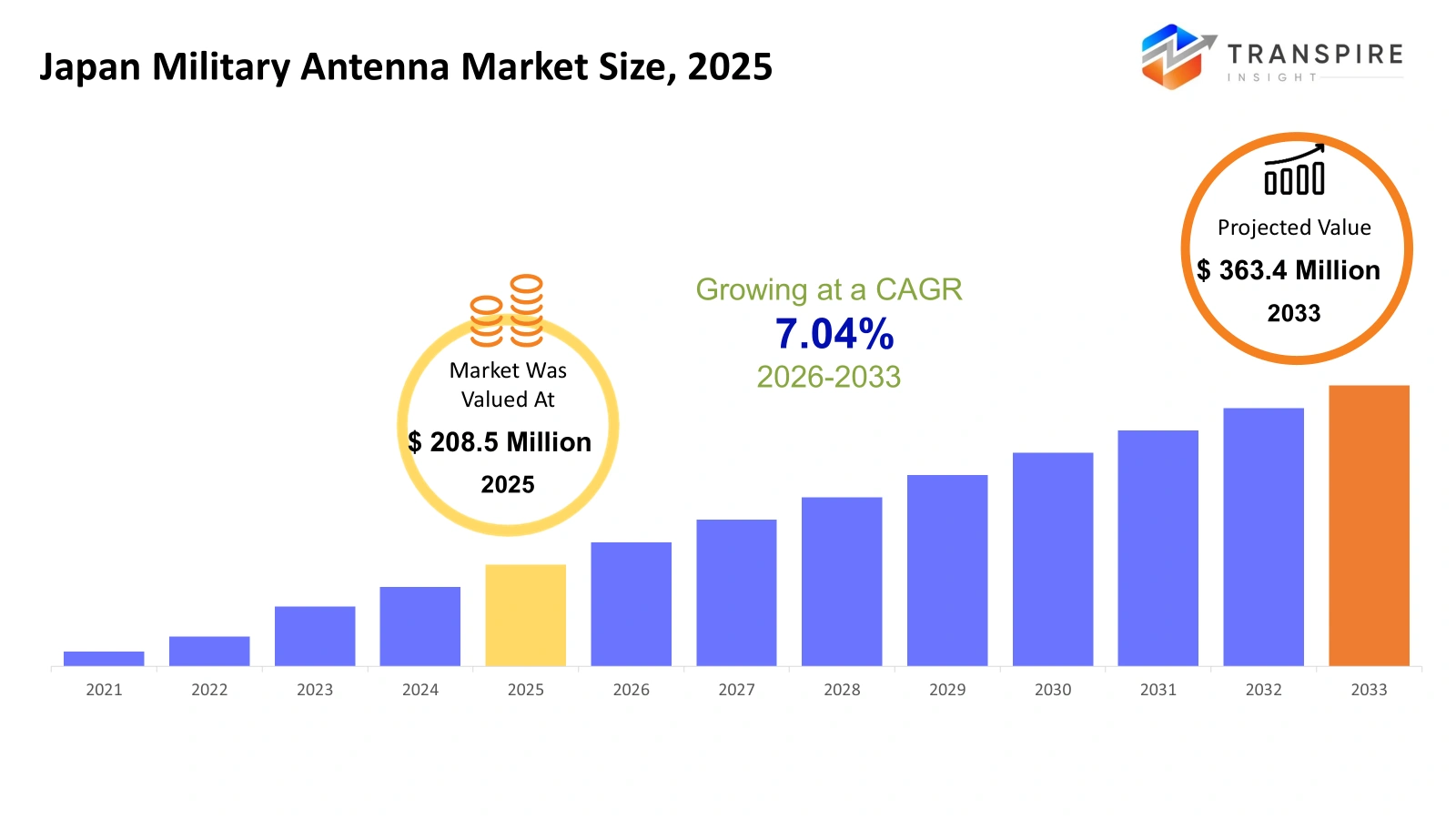
- Japan Military Antenna Market Size 2025: USD 208.5 Million
- Japan Military Antenna Market Size 2033: USD 363.4 Million
- Japan Military Antenna Market CAGR: 7.04%
- Japan Military Antenna Market Segments:By Frequency Band (HF, VHF/UHF, SHF), By Platform (Ground-Based, Airborne, Naval), By Application (Communication, Surveillance, Electronic Warfare).
To learn more about this report,  Download Free Sample Report
Japan Military Antenna Market Summary:
The Japan Military Antenna Market size is estimated at USD 208.5 Million in 2025 and is anticipated to reach USD 363.4 Million by 2033, growing at a CAGR of 7.04% from 2026 to 2033. The Japan Military Antenna Market continues its development because Japan improves its defence communication systems. Japan develops advanced antennas which enable secure and reliable high-speed communication solutions for multiple platforms according to modern warfare requirements. The market demand is driven by increased use of satellite communication and electronic warfare systems together with next-generation radar technologies. The continuous defense modernization programs and technology company partnerships drive innovation, which makes military antennas essential for improving Japan's defence capabilities and operational performance.
Key Market Trends & Insights:
- The defence sector of Japan needs to establish communication systems that protect information and maintain constant operational connectivity. The military is now using advanced antenna technology to achieve stable data transmission throughout its land, naval, and air defence operations.
- Military operations require high-performance antennas which correspond to the increased usage of satellite-based communication systems. These antennas enable long-distance communication and surveillance operations while providing real-time data transmission between command centres and field personnel.
- The Japanese government is currently implementing military modernisation programmes which involve the acquisition of new defence equipment and advanced communication systems. The modernisation programme will include the deployment of new antenna systems which will support the upcoming generation of radar and aircraft and naval system technologies.
- Japan is developing its electronic warfare capabilities to meet the evolving demands of modern military conflict. Advanced antennas enable defence systems to execute signal intelligence operations while operating jamming equipment and detection devices.
- Defence manufacturers develop antennas which exist in two essential design requirements of compactness and lightweight construction while their systems function across various frequency bands. The new technologies enhance performance capabilities because they enable simple integration into drones and portable communication systems and modern military vehicles.
Japan Military Antenna Market Segmentation
By Frequency Band
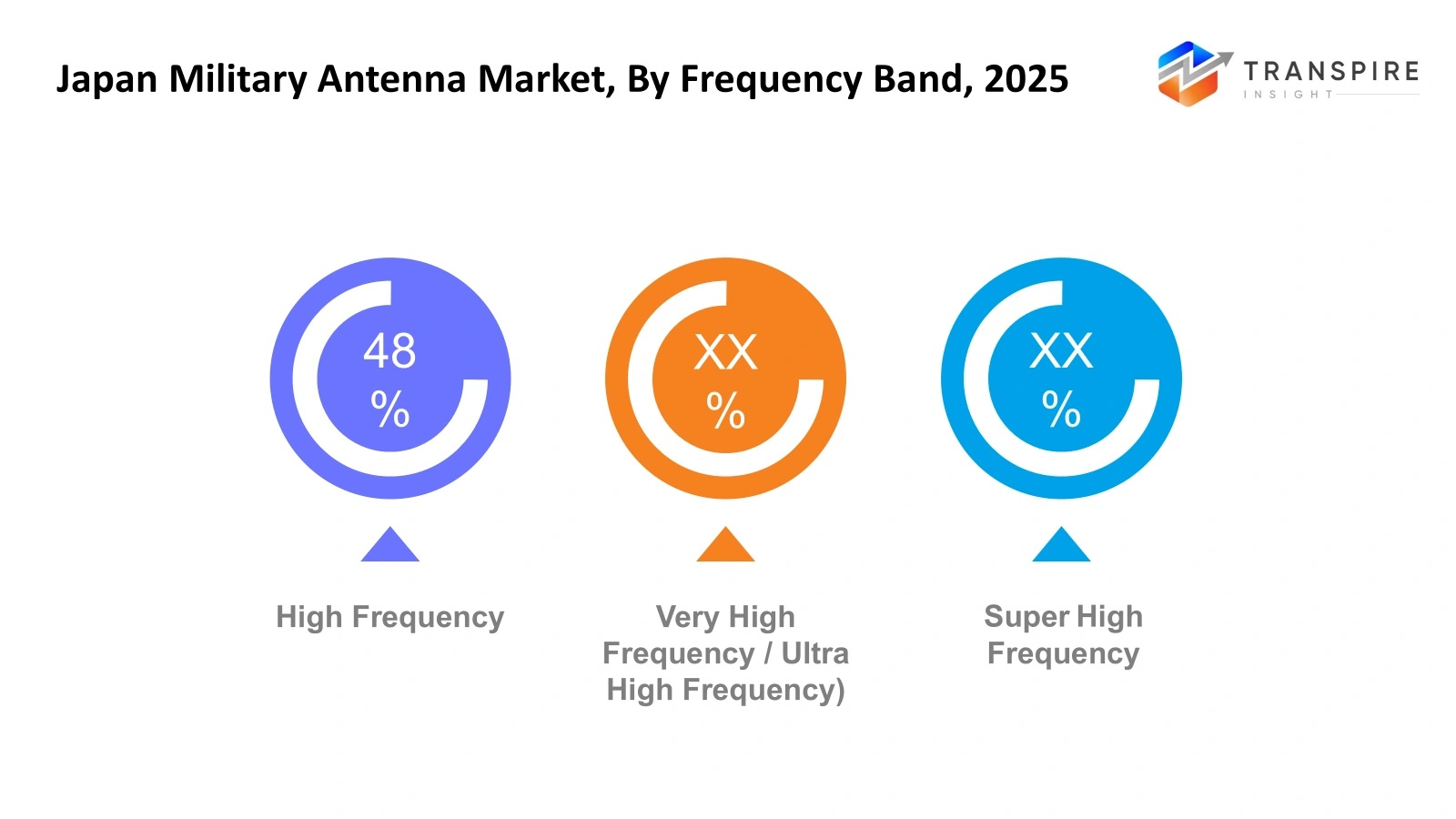
- HF (High Frequency): The military uses HF antennas because they maintain long-range communication capabilities even under conditions where satellite systems face operational limitations. Japanese defence forces depend on HF systems to establish reliable communication links for ground operations and maritime activities, as well as disaster response efforts and critical mission backup systems which protect against electronic interruptions.
- VHF/UHF (Very High Frequency / Ultra High Frequency): VHF and UHF antennas serve as the primary solution for military field communication because they deliver reliable short-to-medium distance audio transmission. The antennas used in Japan's defence operations enable seamless communication between vehicles and troops and aircraft and naval units, which supports effective mission coordination during both training and operational deployment.
- SHF (Super High Frequency): Japanese military forces increasingly use SHF antennas to support both satellite communication and sophisticated radar systems. The antennas provide high-speed data transmission capabilities together with secure communication links and enhanced surveillance functions, which modern defence operations need to maintain real-time intelligence and exact situational understanding.
To learn more about this report, Download Free Sample Report
By Platform
- Ground-Based: Military bases and command centres and mobile communication units use ground-based antennas as their primary antenna system. These systems in Japan provide secure communication networks and radar systems and monitoring facilities which enable defence forces to maintain operational connectivity for their regional operations.
- Airborne: Military aircraft, helicopters and surveillance drones use airborne antennas as their communication system. The Japanese military employs antennas for navigation and radar operations which enable real-time communication between airborne units and ground command centres to facilitate effective coordination during reconnaissance missions and strategic defence operations.
- Naval: Warships and submarines depend on naval antennas to operate their communication and navigation systems. Japanese maritime defence operations use these antennas to create secure communication links which support radar surveillance and enable coordination between naval fleets and coastal bases and allied defence forces.
By Application
- Communication: Military antennas serve their main purpose for military communication in Japan. The systems provide military units and command centres and allied forces with secure voice and video and data transmission capabilities which enable them to work together effectively during defence operations and emergency response missions.
- Surveillance: Military antennas serve a critical function in both surveillance and monitoring operations. Japanese defence forces use these systems to operate radar and detection technologies which enable them to track aircraft and ships and assess potential threats while establishing national security measures.
- Electronic Warfare: Advanced antenna systems serve as the fundamental technology for electronic warfare applications. Japan’s defence sector uses specialised antennas for signal interception, jamming and electronic intelligence gathering, which enables military units to detect enemy communications and disrupt hostile systems while gaining strategic advantages in defence operations.
Country Insights
The Japan Military Antenna Market is growing at a consistent rate because the nation strengthens its defence systems through better communication and surveillance technologies. Japan has expanded its defence system investments to develop advanced defence technologies, including high-performance antenna systems for communication, radar, and electronic warfare, as security threats have increased across the Asia-Pacific region. Military antennas are essential components which provide dependable communication links between ground troops, naval ships, and aircraft.
Japan’s focus on modernising its Self-Defence Forces has encouraged the adoption of next-generation communication networks and satellite-based systems. The market needs compact antenna systems that operate across multiple frequency bands and at high frequencies, as these systems enable secure, real-time data transmission. Domestic defence manufacturers and technology firms work together to create products which boost antenna design capabilities and performance.
The government programmes, which aim to boost national security and enhance defence force cooperation with allied nations, create new market opportunities while establishing Japan as a key player in advanced military communication systems.
Recent Development News
Japanese Communication Antenna Technology Enhances Stealth Capabilities for Indian Warships.
Japan to Showcase Defense Electronics and Communication Technologies at DSEI UK Defense Expo.
|
Report Metrics |
Details |
|
Market size value in 2025 |
USD 208.5 Million |
|
Market size value in 2026 |
USD 225.8 Million |
|
Revenue forecast in 2033 |
USD 363.4 Million |
|
Growth rate |
CAGR of 7.04% from 2026 to 2033 |
|
Base year |
2025 |
|
Historical data |
2021 – 2024 |
|
Forecast period |
2026 – 2033 |
|
Report coverage |
Revenue forecast, competitive landscape, growth factors, and trends |
|
Country scope |
Japan |
|
Key company profiled |
L3Harris Technologies, Cobham Limited, Thales Group, Rohde & Schwarz GmbH, BAE Systems PLC, Lockheed Martin Corporation, Northrop Grumman Corporation, Raytheon Technologies, Antenna Products Corporation, Alaris Holdings Ltd., Comrod Communication AS, MTI Wireless Edge Ltd., Honeywell International Inc., General Dynamics Corporation, Saab AB. |
|
Customization scope |
Free report customization (country, regional & segment scope). Avail customized purchase options to meet your exact research needs. |
|
Report Segmentation |
By Frequency Band (HF, VHF/UHF, SHF), By Platform (Ground-Based, Airborne, Naval), By Application (Communication, Surveillance, Electronic Warfare). |
Key Japan Military Antenna Company Insights
The Japan Military Antenna Market features the presence of several domestic and international defence technology companies working to develop advanced communication and radar solutions. The main companies of the industry build antennas which deliver superior performance to secure military communication and surveillance and electronic warfare operations. Japanese technology companies are actively investing in research and development to create compact, multi-band, and high-frequency antennas suitable for modern defence platforms. The companies develop their skills through global defence partner collaboration and ongoing product development, which enables them to create dependable communication systems that support Japan's changing military and security needs.
Company List
- L3Harris Technologies
- Cobham Limited
- Thales Group
- Rohde & Schwarz GmbH
- BAE Systems PLC
- Lockheed Martin Corporation
- Northrop Grumman Corporation
- Raytheon Technologies
- Antenna Products Corporation
- Alaris Holdings Ltd.
- Comrod Communication AS
- MTI Wireless Edge Ltd.
- Honeywell International Inc.
- General Dynamics Corporation
- Saab AB.
Japan Military Antenna Market Report Segmentation
By Frequency Band
- HF
- VHF/UHF
- SHF
By Platform
- Ground-Based
- Airborne
- Naval
By Application
- Communication
- Surveillance
- Electronic Warfare
Frequently Asked Questions
Find quick answers to common questions.
The approximate Japan Military Antenna Market size will be USD 363.4 Million in 2033.
The key segments of the Japan Military Antenna Market are By Frequency Band (HF, VHF/UHF, SHF), By Platform (Ground-Based, Airborne, Naval), By Application (Communication, Surveillance, Electronic Warfare).
Major players in the Japan Military Antenna Market are L3Harris Technologies, Cobham Limited, Thales Group, Rohde & Schwarz GmbH, BAE Systems PLC, Lockheed Martin Corporation, Northrop Grumman Corporation, Raytheon Technologies, Antenna Products Corporation, Alaris Holdings Ltd., Comrod Communication AS, MTI Wireless Edge Ltd., Honeywell International Inc., General Dynamics Corporation, Saab AB.
The current market size of the Japan Military Antenna Market is USD 208.5 Million in 2025.
The Japan Military Antenna Market CAGR is 7.04%.
- L3Harris Technologies
- Cobham Limited
- Thales Group
- Rohde & Schwarz GmbH
- BAE Systems PLC
- Lockheed Martin Corporation
- Northrop Grumman Corporation
- Raytheon Technologies
- Antenna Products Corporation
- Alaris Holdings Ltd.
- Comrod Communication AS
- MTI Wireless Edge Ltd.
- Honeywell International Inc.
- General Dynamics Corporation
- Saab AB.
Recently Published Reports
-
Apr 2026
Aerospace Fluoropolymers Market
Aerospace Fluoropolymers Market Size, Share & Analysis Report By Type (PTFE, FEP, PFA, ETFE, and Others), By Application (Electrical Insulation, Seals & Gaskets, Coatings, and Others), By End User (Commercial Aviation, Military Aviation, General Aviation, and Others), and Geography (North America, Europe, Asia-Pacific, Middle East and Africa, South and Central America), 2021 - 2031
-
Apr 2026
Airborne SATCOM System Market
Airborne SATCOM System Market Size, Share & Analysis Report By Type (SATCOM Terminals, Transceivers, Airborne Radio, Modems and Routers, SATCOM Radomes, and Other), By Application (Government and Defense and Commercial), and Geography (North America, Europe, Asia-Pacific, Middle East and Africa, South and Central America), 2021 – 2031
-
Apr 2026
Ship Leasing Market
Ship Leasing Market Size, Share & Analysis Report By Vessel Type (Container Ships, Bulk Carriers, Tankers, and Specialized Vessels), By Lease Duration (Short-Term Lease (Less than 1 year), Medium-Term Lease (1-5 years), and Long-Term Lease (More than 5 years)), By Lease Type (Bareboat Charter, Time Charter, Financial Lease, and Others), By End-User Industry (Oil and Gas, Manufacturing and Industrial, Automotive, Agriculture and Food, Retail and Consumer Goods, and Others), and Geography (North America, Europe, Asia-Pacific, Middle East and Africa, South and Central America), 2021 – 2031
-
Apr 2026
Thread Rolling Dies Market
Thread Rolling Dies Market Size, Share & Analysis Report By Type (Flat Thread Rolling Dies, Circular (Cylindrical) Dies, Tangential Thread Rolling Dies, Planetary Thread Rolling Dies, and Other Types), By Material Type (High-Speed Steel (HSS), Carbide, Tool Steel, Alloy Steel, and Other Specialized Alloys), By Distribution Channel (Direct Sales, Distributors and Dealers, and Online Platforms), By Application (Automotive Industry, Aerospace and Defense, Construction and Infrastructure, Industrial Machinery, Electronics and Electrical Components, Medical Devices, and Fastener Production), and Geography (North America, Europe, Asia-Pacific, Middle East and Africa, South and Central America), 2021 – 2031
Our Clients