

Japan Isostearic Acid Market Size & Forecast:
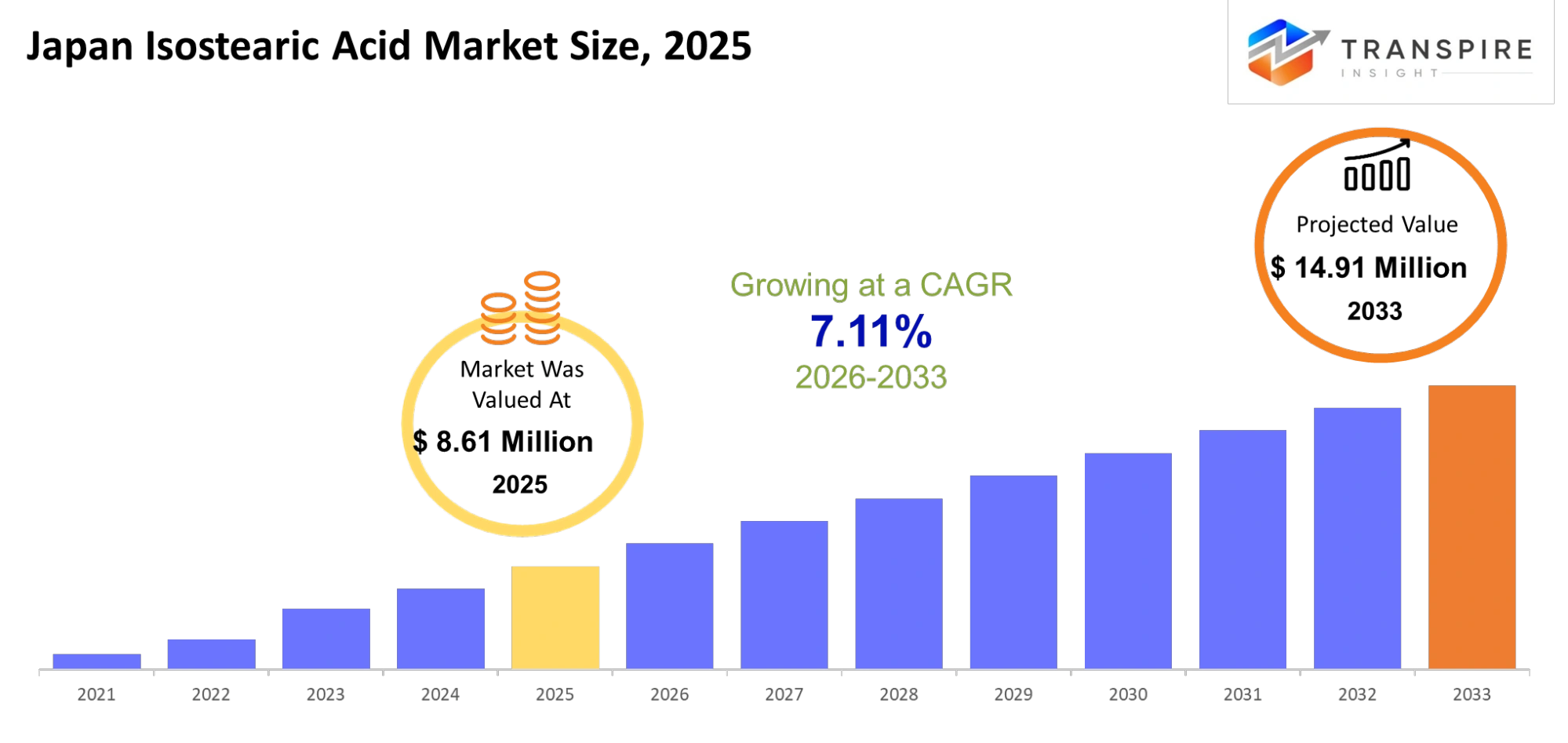
- Japan Isostearic Acid Market Size 2025: USD 8.61 Million
- Japan Isostearic Acid Market Size 2033: USD 14.91 Million
- Japan Isostearic Acid Market CAGR: 7.11%
- Japan Isostearic Acid Market Segments: By Type (Natural Isostearic Acid, Synthetic Isostearic Acid, Others); By Application (Cosmetics, Lubricants, Adhesives, Sealants, Personal Care, Others); By End-User (Cosmetic Companies, Chemical Industry, FMCG Companies, Industrial Firms, Others); By Form (Liquid, Solid, Others)
To learn more about this report,  Download Free Sample Report
Japan Isostearic Acid Market Summary
The Japan Isostearic Acid Market was valued at USD 8.61 Million in 2025. It is forecast to reach USD 14.91 Million by 2033. That is a CAGR of 7.11% over the period.
The Japan Isostearic Acid Market enables manufacturers to create high-performance ingredients which they use in their cosmetics and personal care products and their lubricants and specialty coatings. The technology enables manufacturers to produce consistent low-odor oxidation-resistant products which maintain their performance throughout humid environments and extended storage periods which proves vital for Japan's high-end skincare products and precise industrial applications.
The market has undergone structural changes during the past three to five years because cosmetic and industrial manufacturers now use bio-based and low-irritation formulation systems which replace traditional petrochemical materials with sustainable fatty acid substitutes. Japanese formulators faced supply chain disruptions from global palm oil export restrictions and Southeast Asian price fluctuations which forced them to seek new sources and develop stable products that met compliance requirements. The development of electric vehicle compatible synthetic lubricants combined with increasing chemical safety regulations has driven faster adoption of these products. The market now demands high-purity isostearic acid for specialized applications which create additional value instead of its use as a standard bulk material.
Key Market Insights
- The Kanto region dominates the Japan Isostearic Acid Market with nearly 38% share in 2025, driven by dense cosmetics and chemical manufacturing hubs.
- Regional demand reflects strong industrial integration which supports the Japan Isostearic Acid Market expansion throughout urban manufacturing areas.
- Cosmetic-grade isostearic acid leads with approximately 52% share in 2025, supported by Japan’s premium skincare formulation industry.
- The industrial-grade segment holds the second-largest share due to lubricant and coating applications in precision machinery.
- The bio-based high-purity variants show the highest growth rate between 2025 and 2030 because of sustainability-driven reformulation trends.
- The Japan Isostearic Acid Market base demand drivers use cosmetics and personal care products which will reach 60 percent market share in 2025, according to market data.
- The fastest-growing application segment in industrial lubricants exists due to the demand for EV-compatible and high-temperature stability industrial lubricants.
- Skincare innovation drives personal care manufacturers to maintain their position as the top end-user group, which holds more than 55% market share in 2025.
- The primary end-user group which includes industrial chemical producers as its fastest-growing segment today expands to new production capabilities beyond cosmetic products.
- The Japan Isostearic Acid Market will experience continuous growth because high-performance formulation industries increasingly adopt the product.
What are the Key Drivers, Restraints, and Opportunities in the Japan Isostearic Acid Market?
The primary driver supporting the Japan Isostearic Acid Market development process involves businesses adopting bio-based ingredients which demonstrate advanced performance capabilities for use in cosmetics and industrial specialized products. The implementation of Japan's stricter chemical safety regulations together with its new labeling requirements resulted in manufacturers choosing safer fatty acid options as replacements for their traditional petrochemical emollients.
Cosmetic formulators based in Tokyo and Osaka now use isostearic acid in their premium skincare products because it provides benefits for oxidation control and compatibility with skin. The combined effect of regulatory changes and formula modifications results in higher product demand which benefits both domestic manufacturers and specialty chemical distributors.
The primary limitation of the process results from challenges in sourcing high-purity feedstock materials which restrict the production capacity of essential oleochemical inputs. The production of isostearic acid depends on refined fatty acid chains which face price fluctuations due to changes in global palm and vegetable oil markets.
Japan lacks adequate domestic raw material resources which creates a structural limitation that forces the country to depend on foreign imports. The outcome leads to irregular cost changes which create obstacles for long-term procurement agreements while restricting profit growth for mid-tier companies operating in the Japan Isostearic Acid Market.
The market for electric vehicle-compatible synthetic lubricants is currently developing because there is increasing demand for additives which can maintain thermal stability while showing minimal oxidation. Japanese industrial firms such as those in Aichi’s automotive cluster are actively testing isostearic acid derivatives in next-generation electric drivetrains. The successful implementation of this transition will enable the market to grow from its current focus on cosmetics toward high-value mobility products which will create new industrial opportunities until 2030.
What Has the Impact of Artificial Intelligence Been on the Japan Isostearic Acid Market?
The implementation of artificial intelligence with advanced digital systems for scrubber performance systems and their associated marine emission control technologies leads to better monitoring and optimization methods which results in increased demand for specialty chemical inputs including isostearic acid that is required for making corrosion-resistant and lubrication products. The operational environment of AI-enabled control systems will function through their integration with exhaust gas cleaning technology to enable continuous monitoring of essential operational parameters which include flow rate and pressure and washwater efficiency. The system achieves two objectives because it requires less human control while achieving better results with the new maritime emission regulations which become more strict.
Predictive maintenance methods based on machine learning models are being used to maintain scrubber systems which operate on vessels throughout Japanese and regional shipping routes. The systems use vibration data and fuel sulfur fluctuations and exhaust composition patterns to predict equipment deterioration while determining the best time for maintenance which will increase vessel operational time by 8 to 12 percent in fleets that use digital management systems. The company achieves operational cost reductions through the process while maintaining constant product demand for advanced chemical additives which are essential to their supporting system operations.
The main obstacle to this research work exists because scientists cannot obtain reliable data from actual marine environments which supports their study. The model prediction accuracy decreases because at sea operations experience both satellite connectivity limitations and sensor calibration problems which affect their performance. The shipping industry in Japan's Isostearic Acid Market needs to complete its AI implementation process because restricted access to smaller shipping companies hinders their progress.
Key Market Trends
- After 2023 cosmetic safety regulations came into effect, cosmetics manufacturers started using bio-based isostearic acid as their primary ingredient for high-end skincare products instead of petroleum-based emollients.
- The Japanese manufacturers increased their need for Southeast Asian oleochemical feedstocks after the supply disruptions of 2022, which forced them to find new sources of raw materials.
- BASF and Kao Corporation established new production facilities for high-purity fatty acids in 2024, which will enable them to meet the enhanced operational standards for cosmetics through improved odor control and oxidation resistance.
- The testing of electric vehicle lubricants extended its operations to 2023 and this expansion created a greater requirement for isostearic acid derivatives which can sustain high-temperature stability in future vehicle drivetrain systems.
- The Japanese government introduced new cosmetic ingredient disclosure rules in 2025 which increased regulatory compliance expenses for mid-tier manufacturers, who responded by reformulating their products.
- The adoption of digital quality control systems experienced a substantial increase after 2024 which resulted in better batch consistency for fatty acid processing facilities throughout Japan.
- In 2025 Croda International built stronger relationships with Japanese skincare companies to develop emulsifier systems which use isostearic acid as their primary component.
- The manufacturers established permanent agreements while they partially developed their own production capabilities to handle the price fluctuations of palm-based materials which occurred between 2022 and 2024.
- Specialty chemical companies raised their research and development budget after 2023 to create low-odor chemical products which would maintain stability under conditions typical of humid environments.
Japan Isostearic Acid Market Segmentation
By Type :
The market demand for natural isostearic acid will remain stable because people prefer plant-based ingredients which have low toxicity for use in personal care and cosmetic products. The first type of product will enable better formulation progress because it provides secure functional performance which makes the product suitable for skin application and drives its growing acceptance in premium Japanese products.
The industrial sector and budget-conscious markets will continue to depend on synthetic isostearic acid for their operational needs. The manufacturing processes will produce products with consistent quality which can meet the demands of large-scale production. The other category will include blended and modified forms which will meet specific performance requirements through their dedicated formulation flexibility for niche applications.
By Application :
The main application of isostearic acid will be in cosmetics because it helps to improve product texture and spreadability and maintains product stability. The demand for high-performance ingredients which enhance user experience and extend product shelf life will increase in Japan because of the rising interest in advanced skincare formulations.
Isostearic acid will be used in lubricants and adhesives and sealants to deliver better stability and resistance performance. The personal care market will grow because consumers increasingly seek products that are gentle and suitable for their skin. The others segment will include industrial and specialty uses where performance enhancement and formulation compatibility will remain important.

To learn more about this report, Download Free Sample Report
By End-User :
The ongoing product development process at cosmetic companies will create significant market demand because they need to use stable emollient ingredients and their products will continue to evolve. Isostearic acid will serve as the primary component for product development pipelines which need better sensory performance and consistent product formulation in skincare and haircare products.
Chemical industry players will use isostearic acid as an intermediate in multiple formulations. FMCG companies will use the ingredient to manufacture personal care and hygiene products which they will distribute to mass-market consumers.Performance-based applications will be the main focus for industrial firms but small manufacturers and specialty product developers will also use the product.
By Form :
The liquid state will become the primary form used in cosmetic and personal care product development because it allows for simpler combinations with other ingredients. The development of smooth mixing capabilities will enable skincare and topical product manufacturing plants throughout Japan to achieve better production outcomes because they will have easier methods of implementing their manufacturing processes.
The solid material will serve applications that need methods of maintaining storage stability and handling control. The material will provide both transportation advantages and extended shelf life for specific industrial uses. The two material forms will remain essential for production processes that require specific product design and processing methods.
What are the Key Use Cases Driving the Japan Isostearic Acid Market?
The primary application for Japan Isostearic Acid Market exists in cosmetic and personal care products that utilize the substance as both an emollient and stabilization agent for premium skincare formulations. Japanese skincare brands need isostearic acid because their products must achieve texture stability while protecting against oxidation and delivering skin-friendly properties. The highest demand from cosmetic manufacturers exists because of this strong alignment with formulation quality standards.
Industrial lubricants and specialty coatings have developed new applications because automotive component producers and precision machinery manufacturers now use these products. The end-users apply isostearic acid to their high-performance systems in order to achieve better thermal stability and decreased friction. Chemical formulators who support electronics manufacturing show increasing demand for products that need controlled viscosity and low residue properties.
The automotive industry now has two new use cases which include EV drivetrain lubricants and advanced polymer additives used in next-generation materials development. Aichi automotive research and development centers now evaluate isostearic acid derivatives to determine their effects on electric vehicle performance and durability. The marine maintenance coatings industry currently investigates the use of this product to improve corrosion resistance according to new environmental compliance standards which demonstrates their initial efforts to develop new products beyond cosmetics.
|
Report Metrics |
Details |
|
Market size value in 2025 |
USD 8.61 Million |
|
Market size value in 2026 |
USD 9.221 Million |
|
Revenue forecast in 2033 |
USD 14.91 Million |
|
Growth rate |
CAGR of 7.11% from 2026 to 2033 |
|
Base year |
2025 |
|
Historical data |
2021 - 2024 |
|
Forecast period |
2026 - 2033 |
|
Report coverage |
Revenue forecast, competitive landscape, growth factors, and trends |
|
Country scope |
Japan |
|
Key company profiled |
Croda, BASF, Oleon, Emery Oleochemicals, KLK Oleo, IOI Group, Kao Corporation, Evonik, Solvay, Arkema, Vantage Specialty Chemicals, Stepan, Godrej Industries, Wilmar, Musim Mas |
|
Customization scope |
Free report customization (country, regional & segment scope). Avail customized purchase options to meet your exact research needs. |
|
Report Segmentation |
By Type (Natural Isostearic Acid, Synthetic Isostearic Acid, Others); By Application (Cosmetics, Lubricants, Adhesives, Sealants, Personal Care, Others); By End-User (Cosmetic Companies, Chemical Industry, FMCG Companies, Industrial Firms, Others); By Form (Liquid, Solid, Others) |
Which Regions are Driving the Japan Isostearic Acid Market Growth?
Kanto dominates the Japan Isostearic Acid Market because it hosts major cosmetic companies and chemical manufacturers and research facilities throughout Tokyo and its nearby industrial areas. National agencies based in the capital enforce strict regulations which lead to businesses achieving early compliance with ingredient safety and formulation standards. The region benefits from supply chains which connect Yokohama port with specialty chemical companies that handle chemical imports. The ecosystem enables Kanto to commercialize high-purity fatty acid derivatives quickly which strengthens its position as the market leader.
Kansai serves as a stable second contributor, driven by its diversified industrial base across Osaka, Kobe, and surrounding prefectures. Kansai chemical manufacturing clusters from the past enable the region to operate its industrial base through its partnerships with automotive and machinery equipment manufacturers. Industrial buyers and shipowners in this area establish long-term contracts which create stable demand for their services. Kansai provides its customers with predictable revenue streams which enable the company to operate throughout worldwide feedstock price changes while maintaining stability in national market operations.
Recent investments in port modernization and expanded chemical processing capacity for export-oriented industries have made Kyushu the fastest-growing region in Japan. The Fukuoka and Kitakyushu ports have experienced improved efficiency for oleochemical imports because of their new logistics upgrades which began in 2023. The regional green manufacturing incentives have successfully motivated businesses to adopt bio-based specialty chemicals. The current momentum makes Kyushu an important entry point for investors who want to pursue export-related growth opportunities until 2033.
Who are the Key Players in the Japan Isostearic Acid Market and How Do They Compete?
The Japan Isostearic Acid Market operates with moderate market concentration because international specialty chemical companies and established Japanese producers compete to meet demand for high-purity bio-based products. The competition between companies depends on three factors: the quality of their formulations, their ability to meet regulatory requirements, and their methods for obtaining raw materials, while price matters only to a limited degree. The existing companies maintain their market share through technical product adjustments and their extended agreements for product delivery. The possession of technological expertise determines how companies will maintain their market advantage throughout their existence.
BASF, Croda, and Oleon compete through differentiated strategies. BASF uses its integrated fatty acid production system to provide Japanese cosmetic formulators with stable pricing and dependable product availability. Croda develops high-performance esters through its innovation laboratories, which work together with skincare companies. Oleon uses its sustainable sourcing methods and low-carbon oleochemical certification to secure high-value customer contracts.
Kao Corporation expands its market presence by combining domestic production of cosmetics with its unique expertise in developing proprietary formulas. Nissan Chemical establishes its unique market position through its production of high-purity chemicals and its collaboration with partners to create EV lubricants. Emery Oleochemicals concentrates on exporting specialized oleochemical products while expanding its distribution networks throughout Asia to serve specialized industrial customers better.
Company List
- Croda
- BASF
- Oleon
- Emery Oleochemicals
- KLK Oleo
- IOI Group
- Kao Corporation
- Evonik
- Solvay
- Arkema
- Vantage Specialty Chemicals
- Stepan
- Godrej Industries
- Wilmar
- Musim Mas
Recent Development News
"In June 2025, Nippon Shokubai announced the acquisition of ISCC PLUS certification for acrylic acid and superabsorbent polymers through its U.S. group company. The certification strengthens its global low-carbon feedstock supply chain for fatty acid–derived materials used in personal care and industrial applications closely linked to isostearic acid demand.
Source https://www.prnewswire.com/
In June 2025, Nippon Shokubai implemented a multi-region expansion of ISCC PLUS-certified production systems across Japan, Belgium, Indonesia, and the United States. This development enhances traceable bio-based chemical supply capabilities, indirectly supporting Japan’s fatty acid and specialty surfactant markets where isostearic acid is widely utilized.
Source https://www.nonwovens-industry.com/
What Strategic Insights Define the Future of the Japan Isostearic Acid Market?
The Japan Isostearic Acid Market will develop high-purity sustainable specialty inputs for cosmetic and advanced industrial product formulations which will become the commercial standard during the next 5 to 7 years. The industry now requires stricter chemical safety regulations which lead to Japanese manufacturers shifting from petroleum-based emollients to bio-based alternatives in their premium products. Companies will achieve value creation through product development and supply chain documentation instead of increasing production capacity.
Producers face hidden danger because they rely excessively on foreign sources of oleochemical feedstocks which makes them vulnerable to both political disruptions and climate-related agricultural fluctuations in Southeast Asia. The company faces margin difficulties in the current market environment yet needs more time to establish long-term contracts.
The market for EV thermal management lubricants presents a new opportunity because researchers are testing isostearic acid derivatives to enhance next-generation drivetrain performance and heat management. This development could create demand for products which extend beyond cosmetics into the field of mobility engineering. Market participants should invest early in application-specific R&D partnerships with automotive and chemical formulation hubs in Japan to secure long-term positioning before standards fully crystallize.
Japan Isostearic Acid Market Report Segmentation
By Type
- Natural Isostearic Acid
- Synthetic Isostearic Acid
By Application
- Cosmetics
- Lubricants
- Adhesives
- Sealants
- Personal Care
By End-User
- Cosmetic Companies
- Chemical Industry
- FMCG Companies
- Industrial Firms
By Form
- Liquid
- Solid
Frequently Asked Questions
Find quick answers to common questions.
The Japan Isostearic Acid Market size is USD 14.91 Million in 2033.
Key segments for the Japan Isostearic Acid Market are By Type (Natural Isostearic Acid, Synthetic Isostearic Acid, Others); By Application (Cosmetics, Lubricants, Adhesives, Sealants, Personal Care, Others); By End-User (Cosmetic Companies, Chemical Industry, FMCG Companies, Industrial Firms, Others); By Form (Liquid, Solid, Others).
Major Japan Isostearic Acid Market players are Croda, BASF, Oleon, Emery Oleochemicals, KLK Oleo, IOI Group, Kao Corporation, Evonik, Solvay, Arkema, Vantage Specialty Chemicals, Stepan, Godrej Industries, Wilmar, Musim Mas.
The Japan Isostearic Acid Market size is USD 8.61 Million in 2025.
The Japan Isostearic Acid Market CAGR is 7.11% from 2026 to 2033.
- Croda
- BASF
- Oleon
- Emery Oleochemicals
- KLK Oleo
- IOI Group
- Kao Corporation
- Evonik
- Solvay
- Arkema
- Vantage Specialty Chemicals
- Stepan
- Godrej Industries
- Wilmar
- Musim Mas
Recently Published Reports
-
Apr 2026
Healthcare Polymer Packaging Market
Healthcare Polymer Packaging Market Size, Share & Analysis Report By Packaging Type (Syringes, IV Bottles and Pouches, Clamshells, Blisters, Bottles & Jars, Containers, Tubes, IV Parental Packaging, Others), By Type (Regulated, Non-regulated), By Polymer Type (LDPE (Low-Density Polyethylene), HDPE (High-Density Polyethylene), Homo-polymer (Homo), Random Copolymer (Random), Block Copolymer (Block), PET, Polystyrene, Polyvinyl Chloride, Polyamide/EVOH, Others), and Geography (North America, Europe, Asia-Pacific, Middle East and Africa, South and Central America), 2021 - 2031
-
Apr 2026
Hydrophilic Tape (Waterstop) Market
Hydrophilic Tape (Waterstop) Market Size, Share & Analysis Report By Type (Bentonite-Based Hydrophilic Tape, Rubber-Based Hydrophilic Tape), By Application (Residential Buildings, Commercial Buildings, Infrastructure Projects), and Geography (North America, Europe, Asia-Pacific, Middle East and Africa, South and Central America), 2021 - 2031
-
Apr 2026
Metalens Market
Metalens Market Size, Share & Analysis Report By Type (Visible Light Metalens, and Infrared Metalens), By Application (Consumer Electronics, Automotive Electronics, Industrial, Medical, and Others), and Geography (North America, Europe, Asia-Pacific, Middle East and Africa, South and Central America), 2021 - 2031
-
Apr 2026
PBT Resin Market
PBT Resin Market Size, Share & Analysis Report By Type (Reinforced PBT Resin, Unreinforced PBT Resin), By Processing Method (Injection Molding, Extrusion, Blow Molding, Others), By End-User (Automotive, Electrical & Electronics, Consumer Appliances, Industrial Machinery, Medical Devices, Packaging, Others), and Geography (North America, Europe, Asia-Pacific, Middle East and Africa, South and Central America), 2021 - 2031