

Japan Interferon-Gamma Release Assays (IGRAs) Market Summary:
According to Transpire Insights, a detailed research report on the Japan Interferon-Gamma Release Assays (IGRAs) Market reflects that the tuberculosis screening application segment dominates the market, accounting for a significant share of demand across Japan. QIAGEN N.V. leads the market with its established QuantiFERON-TB Gold Plus diagnostic platform, making it a leading contributor to market development, innovation, advanced interferon-gamma release assay production, expanding diagnostic capabilities, and market growth dynamics.
Market Snapshot
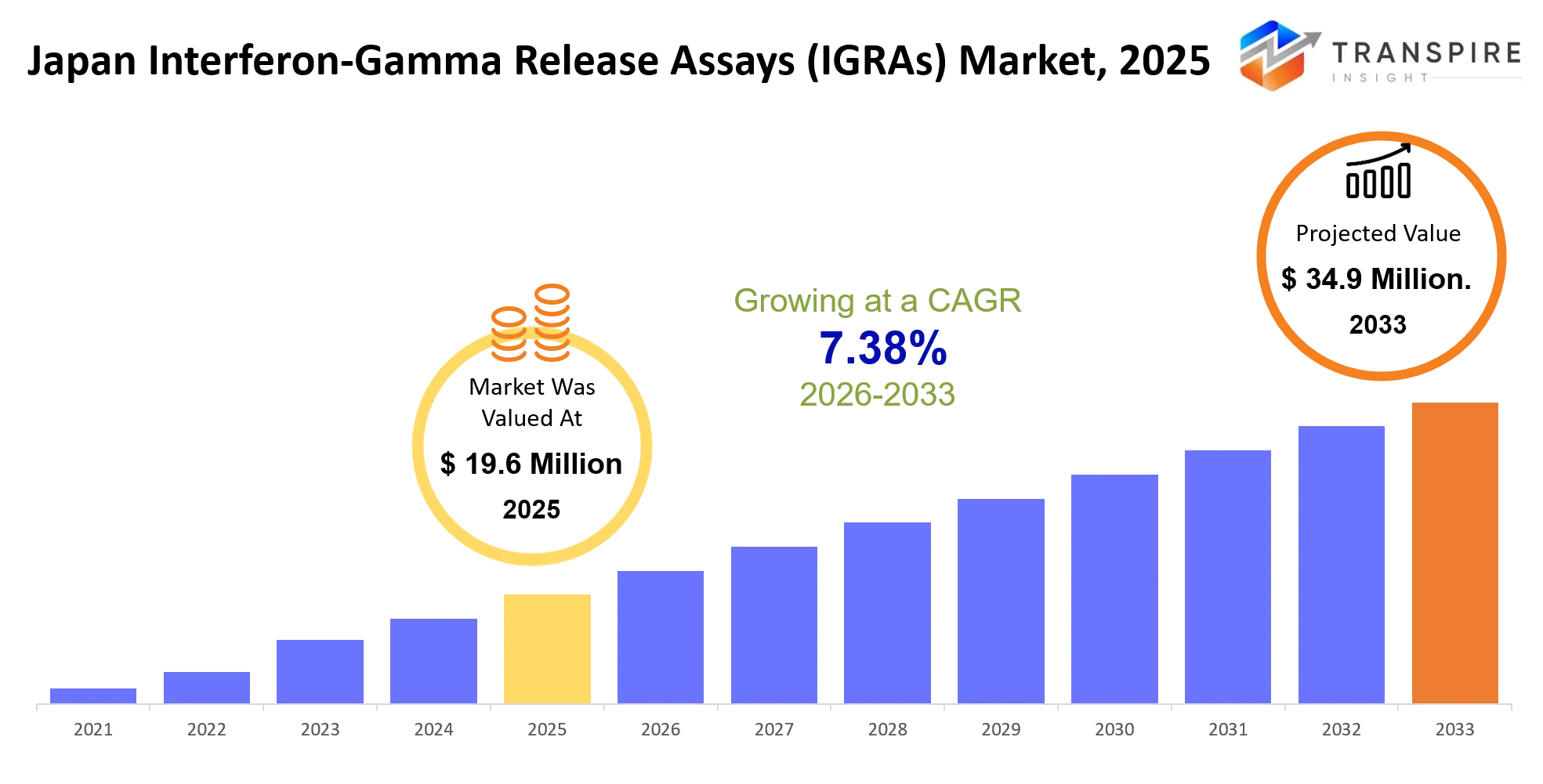
- Market Value (2025): USD 19.6 Million.
- Expected Market Value (2026): USD 21.2 Million.
- Estimated Market Value (2033): USD 34.9 Million.
- Forecast CAGR (2026–2033): 7.38%.
Introduction
The Japan Interferon-Gamma Release Assays (IGRAs) Market is defined as blood tests, kits, laboratory systems, and associated consumables that are involved in the detection of Mycobacterium tuberculosis infection. The IGRAs test for the presence of interferon-gamma production by sensitized T-cells in response to the antigens specific to the disease. In Japan, there has been an increase in the usage of IGRAs in order to control tuberculosis since these tests can differentiate the effects caused by tuberculosis from those of BCG (Bacillus Calmette–Guérin) vaccinations. In addition, the increased need for focused testing among healthcare workers and other high-risk individuals is driving the market growth.
Key Market Highlights: -
- By Test Type, the QuantiFERON-TB Gold Plus dominated the market and holds approximately 70% share in 2025 and is projected to grow at a substantial CAGR during the forecast period.
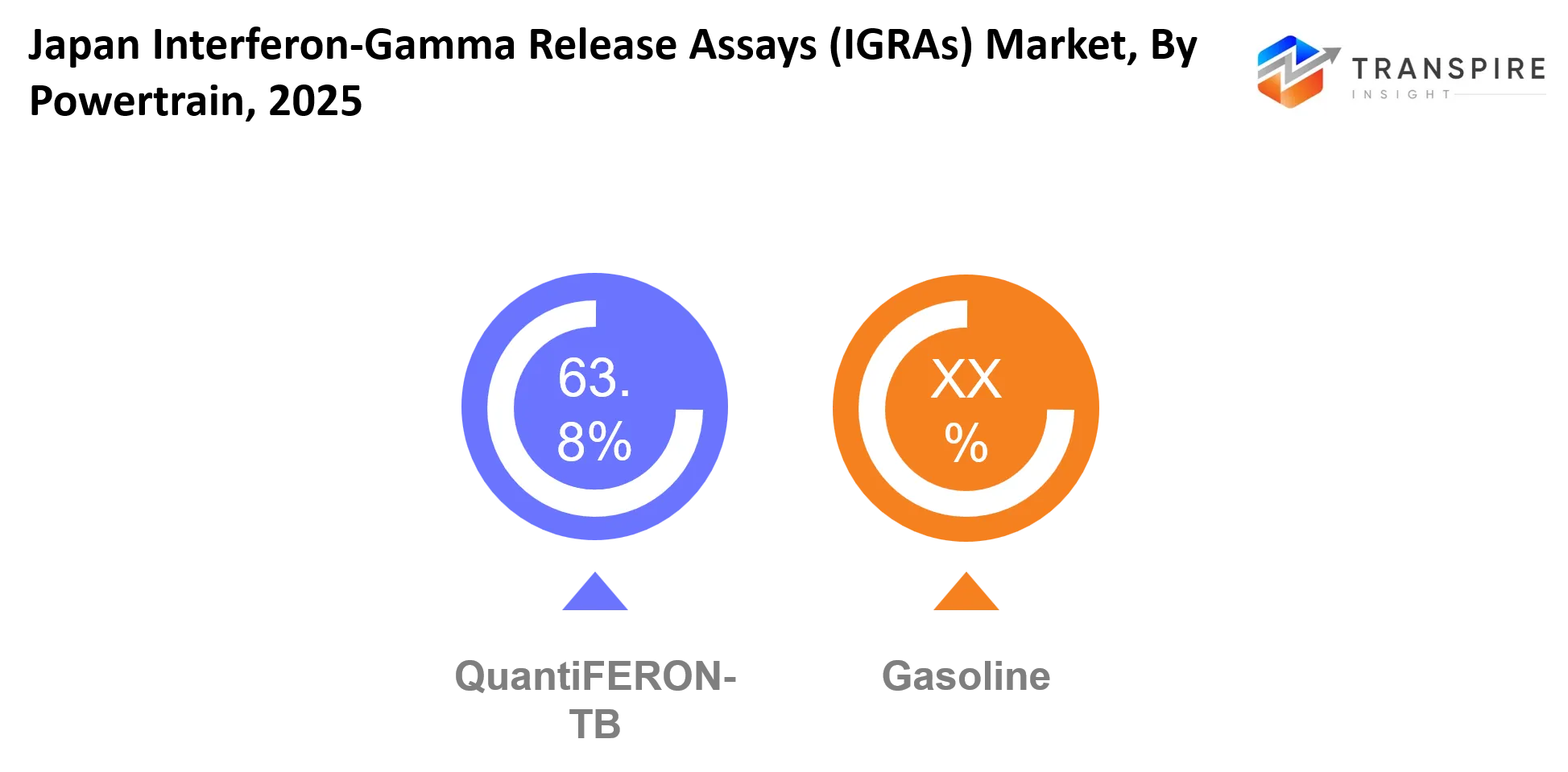
- By Technology, the ELISA dominated the market and holds approximately 63% share in 2025 and is projected to grow at a substantial CAGR during the forecast period.
- By Sample Type, the Whole Blood segment Manufacturers segment dominated the market and holds approximately 55% share in 2025 and is projected to grow at a substantial CAGR during the forecast period.
- The Japanese efforts in managing tuberculosis, screening program, investigations, and treatments for latent tuberculosis require the use of IGRA testing in various healthcare and public health settings.
How is Technology Driving Growth in the Japan Interferon-Gamma Release Assays (IGRAs) Market?
Automation in laboratories, improvement in formulation and increased efficiency in the diagnosis process are some of the technological factors that are responsible for the growth in the Japan Interferon-Gamma Release Assays (IGRAs) Market. The next generation of tests such as the QuantiFERON-TB Gold Plus assists in detecting specific immunity reactions to tuberculosis infection, while BCG-free tests decrease the number of false positives as a result of the vaccine. Automation in laboratories increases efficiency in the testing process, whereas the use of technology in the laboratory process enables specimen management and reporting.
Market Drivers
The Japan Interferon-Gamma Release Assays (IGRAs) Market is fueled by factors such as aging demographics, tuberculosis prevention efforts, and the need for LTBI screening. Aging individuals are at greater risk of developing TB, thereby fueling demand for diagnostic tests. The presence of tuberculosis cases in foreign-born populations and screening efforts further contribute to the demand for testing. Japan’s pre-entry TB screening programs also add to the overall demand for testing. Furthermore, IGRA tests like QuantiFERON-TB Gold Plus and T-SPOT.TB have the benefit of being less susceptible to giving out false positives due to BCG vaccination when compared to the tuberculin skin test.
Restrain
Higher testing cost, testing logistics, and clinical limitations pose challenges for the Japan Interferon-Gamma Release Assays (IGRAs) Market. As compared to tuberculin skin testing, testing for IGRA demands more lab testing equipment and specimen processing procedures. Imbalance in immune system and elderly patients might lead to either false positive or false negative results of IGRA test. In addition, declining rates of domestic cases of tuberculosis might hamper routine screening process while inability of IGRAs to differentiate between latent infection and active tuberculosis will result in further testing.
|
Driver |
Relative Impact on Growth (%) |
Geographic Relevance |
Impact Timeline |
Demand Strength |
Growth Mechanism (5–10 words) |
Key Beneficiaries (5–10 words) |
Major Constraint (5–10 words) |
|
1. Expansion of Tuberculosis Screening and Latent TB Detection |
28% |
Nationwide; urban hospitals, public health centers, and designated screening facilities |
Short-term (≤2 years) |
High |
Expands IGRA testing for latent tuberculosis identification and screening. |
Diagnostic manufacturers, laboratories, hospitals, and public health providers. |
Screening eligibility limitations and competing diagnostic methods. |
|
2. Government-Led Pre-Entry Tuberculosis Screening Programs |
24% |
Nationwide; designated screening facilities and international referral networks |
Short-term (≤2 years) |
High |
Creates additional testing demand through pre-entry screening requirements. |
IGRA manufacturers, designated clinics, diagnostic laboratories, and distributors. |
IGRA is not universally required for all applicants. |
|
3. Increasing Clinical Preference for Blood-Based TB Testing |
19% |
Nationwide; hospitals, occupational health clinics, and outpatient diagnostic centers |
Medium-term (2–4 years) |
High |
Supports adoption through convenient, objective blood-based testing. |
Healthcare providers, assay manufacturers, laboratory networks, and patients. |
Higher test costs and laboratory processing requirements. |
|
4. Advancements in IGRA Assay Technology and Laboratory Automation |
16% |
Major metropolitan diagnostic hubs and regional reference laboratories |
Medium-term (2–4 years) |
Medium |
Improves throughput, workflow efficiency, and testing consistency. |
Diagnostic technology vendors, laboratories, hospitals, and assay manufacturers. |
Capital expenditure and technical validation requirements. |
|
5. Strengthening TB Surveillance and High-Risk Population Screening |
13% |
Nationwide; regions with higher-risk populations and healthcare facilities |
Long-term (≥4 years) |
Medium |
Increases targeted testing through risk-based tuberculosis surveillance. |
Public health agencies, laboratories, healthcare providers, and manufacturers. |
Declining TB incidence may limit screening volumes. |
|
Total |
100% |
Japan |
— |
— |
— |
— |
— |
Analysis of Prices and Consumer Behaviour
The market for Interferon-Gamma Release Assays (IGRAs) in Japan is stimulated by the need for better quality tests, with QuantiFERON-TB Gold Plus and T-SPOT.TB being the existing testing systems. IGRAs provide better specificity compared to conventional tuberculin skin tests especially in people who have been vaccinated with BCG vaccine. Laboratory blood testing is conducted along with clinical testing while automation enhances testing process. Hospitals, laboratories and public health organizations are driving the market demand through tuberculosis testing and latent TB infection testing. Health care providers emphasize the importance of accurate diagnosis, consistent results and proper testing techniques. Assay performance, test costs, laboratory capabilities and reagents supply are the factors affecting procurement decisions. Specific percentages for Japan related to product quality, price premium, test format and procurement preferences are unknown from the given data.
|
Company |
Est. Revenue Share Range |
Key Offerings |
Strategic Positioning |
Geographic Strength |
Technology Focus |
|
QIAGEN N.V. |
Estimated 55–75% |
QuantiFERON-TB Gold Plus; QFT collection tubes; TB1/TB2 antigen tubes; automated ELISA workflows |
Established whole-blood IGRA leader in Japan |
Japan, Europe, North America |
Whole-blood ELISA and TB-specific antigens |
|
Revvity, Inc. |
Estimated 15–30% |
T-SPOT.TB; T-SPOT.TB test kits; ELISpot-based TB testing; laboratory testing solutions |
Specialized cellular immune-response diagnostic platform |
Japan, Europe, North America |
ELISpot technology and PBMC-based assays |
|
WANTAI BioPharm |
Estimated 0–5% |
WANTAI TB-IGRA; TB-specific antigen assay; IGRA diagnostic reagents |
International expansion through cost-conscious assay offerings |
Asia Pacific, selected international markets |
Antigen-stimulated interferon-gamma detection |
|
Sysmex Corporation |
Estimated 0–5% |
QuantiFERON-TB Gold Plus distribution; diagnostic laboratory support; clinical testing solutions |
Domestic diagnostic distribution and laboratory access |
Japan, Asia Pacific |
Diagnostic workflow integration and laboratory support |
|
Riken Genesis Co., Ltd. |
Estimated 0–5% |
T-SPOT.TB domestic marketing authorization; product regulatory support; clinical information services |
Japan-specific regulatory and commercialization partner |
Japan |
IVD regulatory expertise and assay commercialization |
|
H.U. Group Holdings, Inc. |
Estimated 0–5% |
IGRA-related reference testing; clinical laboratory services; specimen handling |
Laboratory-service-based diagnostic access |
Japan |
Centralized testing and specimen logistics |
|
BML, Inc. |
Estimated 0–5% |
IGRA-related clinical laboratory testing; outsourced diagnostic services; specimen transport |
Nationwide clinical laboratory network participation |
Japan |
High-throughput laboratory testing and logistics |
|
SRL, Inc. |
Estimated 0–5% |
IGRA-related outsourced testing; clinical laboratory services; hospital testing support |
Hospital-linked diagnostic outsourcing |
Japan |
Centralized clinical testing workflows |
|
LSI Medience Corporation |
Estimated 0–5% |
Clinical laboratory testing; infectious disease diagnostic services; outsourced testing |
Established clinical laboratory service provider |
Japan |
Clinical laboratory systems and diagnostic processing |
|
Thermo Fisher Scientific Inc. |
Estimated 0–5% |
ELISA laboratory instruments; immunoassay reagents; laboratory automation components |
Enabling technology supplier rather than core Japanese IGRA brand |
North America, Europe, Asia Pacific |
ELISA instrumentation and laboratory automation |
Who are the Key Players in the Japan Interferon-Gamma Release Assays (IGRAs) Market and how do they compete?
Competitiveness of Japan IGRAs Market is ensured by companies that excel in innovation in diagnostic technologies, clinical solutions, and establishment of distribution channels on an international level. Apart from competing on price, firms compete in diagnostics, assay technologies, automated diagnostics solutions, and the integration of laboratory and clinical solutions that ensure both the development of products and improvement of the performance of healthcare facilities.
In developing advanced interferon-gamma release assays, TB specific diagnostic platforms, and automated laboratory testing solutions, Qiagen establishes its competitive edge in the market. By developing specialized T-SPOT.TB diagnostic assays for screening of tuberculosis and detecting latent TB infections, Oxford Immunotec distinguishes itself from other players. Thermo Fisher Scientific gains its competitive advantage by providing laboratory instrumentation, immunoassay and automated diagnostic solutions that help increase testing efficiency and operational performance.
Top Companies in the Japan Interferon-Gamma Release Assays (IGRAs) Market
- Qiagen
- Oxford Immunotec
- Thermo Fisher Scientific
- Fujirebio
- Abbott
- Roche Diagnostics
- bioMérieux
- Sysmex
- Hologic
- Becton Dickinson
- Danaher
- Siemens Healthineers
- Fujifilm
- Eiken Chemical
- Denka
Japan Interferon-Gamma Release Assays (IGRAs) Market Segmentation
The Japan Interferon-Gamma Release Assays (IGRAs) Market share is divided into six categories: By Test Type, By Technology, By Sample Type, By Application, By End User, By Distribution Channel.
The QuantiFERON-TB Gold Plus dominated the market, accounting for nearly 70% in 2025 and is expected to rise at a significant CAGR during the forecast period.
The Japan Interferon-Gamma Release Assays (IGRAs) Market is segmented by test type into quantiferon-tb gold, t-spot.tb, quantiferon-tb plus, other igra tests, automated igra, manual igra, laboratory-based igra, point-of-care igra. Among these, the QuantiFERON-TB Gold Plus segment dominated the market, accounting for nearly 70% in 2025 and expected to increase at a significant CAGR during the forecast period. QuantiFERON-TB Gold Plus is at the forefront in terms of clinical practice, ability to test BCG-negative samples, accurate diagnostics, and robust laboratory integration in Japanese tuberculosis testing.
The ELISA dominated the market, accounting for nearly 63% in 2025, and is expected to rise at a significant CAGR during the forecast period.
The Japan Interferon-Gamma Release Assays (IGRAs) Market is segmented by technology into elisa, elispot, chemiluminescence, automated immunoassay, manual immunoassay, multiplex assay, digital reading, other technologies. Among these, the ELISA dominated the market, accounting for nearly 63% in 2025 and expected to increase at a significant CAGR during the forecast period. ELISA is the frontrunner based on well-established laboratory procedures, standardized protocols, accurate measurement of interferon-gamma levels, and automation capabilities to meet Japanese tuberculosis testing needs.
The Whole Blood segment dominated the market, accounting for nearly 55% in 2025 and is expected to rise at a significant CAGR during the forecast period.
The Japan Interferon-Gamma Release Assays (IGRAs) Market is segmentedby sample type into whole blood, plasma, peripheral blood, serum, other biological samples, pediatric samples, adult samples, immunocompromised samples. Among these, the Whole Blood segment dominated the market, accounting for nearly 55% in 2025 and expected to increase at a significant CAGR during the forecast period. Whole blood assays are the most common due to the ease of sample collection, simplicity of procedure, accuracy of interferon-gamma levels, and suitability for routine tuberculosis testing in Japan.
Future Market Trends for the Japan Interferon-Gamma Release Assays (IGRAs) Market: -
- Increasing use of blood-based tuberculin tests: There is likely to be an increase in demand for IGRA in Japan, due to demand for testing that does not require BCG, better screening, and better assessment of latent tuberculosis infection.
- Increasing numbers of patients at high risk of infection: Testing using IGRA in patients prior to selected immunosuppressive treatments and among individuals exposed to tuberculosis infection can drive demand for test accuracy.
- Improvements in test technology and automation: There are potential improvements in the sensitivity of testing and laboratory automation that can increase efficiency and testing accuracy.
Recent Development
In 2026 May 7 – QIAGEN Automation Development: QIAGEN unveiled plans to develop a new risk stratification AI technology for improving QuantiFERON TB test procedures for the development of IGRA automation.
In Summer 2026 – AXELIOS Sequencing Solution Launch: Roche announced the Summer 2026 launch of the AXELIOS sequencing solution as part of the diagnostic technologies development pertinent to the changing Japanese IVD sector.
In 2026 fiscal year – Japan Multicenter Clinical Trials Review Reform: The development of the single-IRB review system in Japan might simplify multicenter clinical trials and validate new diagnostic technologies, such as IGRA assays.
Market Segmentation
This study forecasts revenue at Japan, regional and country levels from 2020 to 2033. Transpire Insights has segmented the Japan Interferon-Gamma Release Assays (IGRAs) Market based on the below-mentioned segments:
Japan Interferon-Gamma Release Assays (IGRAs) Market, By Test Type
- QuantiFERON-TB Gold
- T-SPOT.TB
- QuantiFERON-TB Plus
- Other IGRA Tests
- Automated IGRA
- Manual IGRA
- Laboratory-Based IGRA
- Point-of-Care IGRA
Japan Interferon-Gamma Release Assays (IGRAs) Market, By Technology
- ELISA
- ELISPOT
- Chemiluminescence
- Automated Immunoassay
- Manual Immunoassay
- Multiplex Assay
- Digital Reading
- Other Technologies
Japan Interferon-Gamma Release Assays (IGRAs) Market, By Sample Type
- Whole Blood
- Plasma
- Peripheral Blood
- Serum
- Other Biological Samples
- Pediatric Samples
- Adult Samples
- Immunocompromised Samples
Japan Interferon-Gamma Release Assays (IGRAs) Market, By Application
- Latent TB Detection
- Active TB Support
- Pre-Treatment Screening
- Healthcare Worker Screening
- Contact Screening
- Immigration Screening
- Hospital Screening
- Research
Japan Interferon-Gamma Release Assays (IGRAs) Market, By End User
- Hospitals
- Diagnostic Laboratories
- Public Health Centers
- Research Institutes
- Universities
- Occupational Health Centers
- Clinics
- Government Agencies
Japan Interferon-Gamma Release Assays (IGRAs) Market, By Distribution Channel
- Direct Sales
- Laboratory Distributors
- Hospital Procurement
- Diagnostic Distributors
- Government Procurement
- Specialty Suppliers
- Online B2B
- Contract Supply
Frequently Asked Questions
Find quick answers to common questions.
The market comprises blood-based diagnostic tests, assay kits, laboratory systems, and consumables used to detect tuberculosis infection in Japan.
Growth is supported by tuberculosis prevention initiatives, latent TB screening, high-risk population testing, and demand for BCG-independent diagnostic methods.
QuantiFERON-TB Gold Plus leads the market, supported by established clinical use, TB-specific antigen testing, and integration into laboratory workflows.
Whole blood supports convenient specimen collection, streamlined processing, reliable interferon-gamma measurement, and routine tuberculosis screening across Japanese healthcare settings.
Key challenges include testing costs, specimen-handling requirements, possible indeterminate results, and IGRA’s inability to distinguish latent from active tuberculosis infection.
- Qiagen
- Oxford Immunotec
- Thermo Fisher Scientific
- Fujirebio
- Abbott
- Roche Diagnostics
- bioMérieux
- Sysmex
- Hologic
- Becton Dickinson
- Danaher
- Siemens Healthineers
- Fujifilm
- Eiken Chemical
- Denka
About the Authors

Pankaj Ghogare Patil
I am Pankaj Ghogare Patil, a Senior Research Analyst at Transpire Insight, specializing in the Pharmaceutical, Chemicals & Materials, Healthcare IT, and Biotechnology industry. My expertise lies in conducting comprehensive market research, analyzing industry trends, evaluating competitive landscapes, and translating complex data into actionable insights. At Transpire Insight, I closely follow emerging technologies, regulatory developments, and market innovations to create accurate, well-researched, and informative content that helps businesses and professionals make informed decisions. I am committed to producing credible, evidence-based articles that reflect industry best practices while making technical topics accessible and valuable for a broad audience.

Chakradhar Khansole
Chakradhar serves as the Research Director at Transpire Insight, bringing over 8 years of experience in technology, innovation, and strategic market intelligence. He specializes in transforming complex market data into actionable business insights that enable organizations to make informed, growth-oriented decisions. Recognized for his strategic vision and analytical expertise, Chakradhar leads high-impact research initiatives, delivering comprehensive market assessments, competitive intelligence, and forward-looking industry analysis.
Recently Published Reports
-
Apr 2026
AI in Diabetic Retinopathy Market
AI in Diabetic Retinopathy Market Size, Share & Analysis Report By Type (Screening AI Systems, Diagnostic AI Systems, and Predictive AI Models), By Application Segment (Hospitals, Ophthalmology Clinics, Diagnostic Centers, and Research and Development), and Geography (North America, Europe, Asia-Pacific, Middle East and Africa, South and Central America), 2021 - 2031
-
Apr 2026
Psychometric Tests Market
Psychometric Tests Market Size, Share & Analysis Report By Type (Personality Tests, Ability/Aptitude Tests, Skill/Knowledge Tests, and Others), By Application (Talent Acquisition and Talent Management), and Geography (North America, Europe, Asia-Pacific, Middle East and Africa, South and Central America), 2021 – 2031
-
Apr 2026
Rare Biological Sample Collection Market
Rare Biological Sample Collection Market Size, Share & Analysis Report By Type (Isolation Kits & Reagent, Blood Collection Tubes, and Others), By Application (Oncology, Transcriptomics, Pharmacogenomics, and Others), and Geography (North America, Europe, Asia-Pacific, Middle East and Africa, South and Central America), 2021 – 2031
-
Jul 2026
Diabetic Retinopathy Market
Diabetic Retinopathy Market Size, Share & Analysis Report By Type (Proliferative Diabetic Retinopathy, and Diabetic Macular Edema (DME)), By Treatment Type (Anti VEGF Drug, Steroid Implants, Laser Surgeries, and Vitrectomy), and Geography (North America, Europe, Asia-Pacific, Middle East and Africa, South and Central America), 2021 – 2031
Our Clients







