
Japan Indonesia Halal Market Summary:
According to Transpire Insights, a detailed research report on the market reflects that the halal food and beverages application segment dominates the Japan Indonesia Halal Market, accounting for approximately 53% of the total share worldwide. Indofood Sukses Makmur Tbk PT leads the market with approximately (around USD 7.0 billion) in annual revenue and an estimated 5–8% Japan Indonesia market share, making it a leading contributor to Japan Indonesia market development, innovation, advanced halal food production, expanding manufacturing capabilities, and growth dynamics.
Market Snapshot
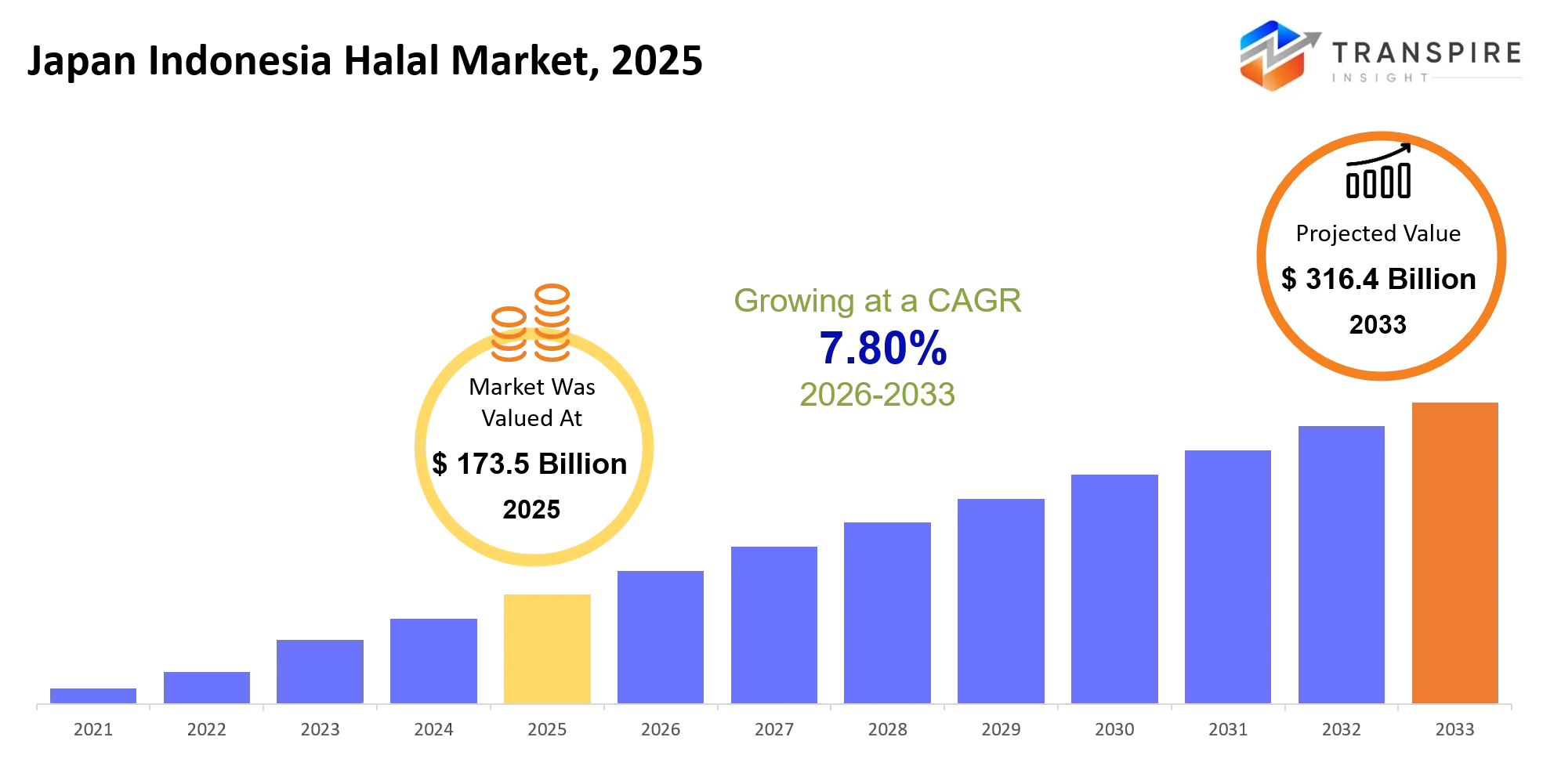
- Market Value (2025): USD 173.5 Billion.
- Expected Market Value (2026): USD 187.0 Billion.
- Estimated Market Value (2033): USD 316.4 Billion.
- Forecast CAGR (2026–2033): 7.80%
- Introduction
A halal market is an economic system as well as an ecosystem of trade and commerce where goods and services are in accordance with Islamic laws (Sharia), including food, cosmetics, pharmaceuticals, and lifestyle activities. The term “Japan Indonesia Halal Market” has significance in relation to the bilateral trade and economic cooperation between Japan and Indonesia regarding Halal-compliant goods and services. The Japan Indonesia Halal Market offers many advantages through increased access to markets, increased tourism, enhanced customer trust, and new revenue streams. Halal certification will enable Japanese makers of food and beverages, as well as cosmetics and pharmaceutical businesses with a large consumer market in Indonesia, thus enhancing export potential and international competitiveness. Properties such as hotels, restaurants, and tour companies in Japan can be more attractive to Indonesian and foreign travelers since halal-certified facilities allow them to enjoy halal meals and products.
Key Market Highlights: -
- By product type, the Halal Food segment dominated the market and holds nearly 77% share in 2025 and is projected to grow at a substantial CAGR during the forecast period.
- By certification, the MUI/BPJPH Certified segment dominated the market and holds nearly 82% share in 2025 and is projected to grow at a substantial CAGR during the forecast period.
- By end user, the Households segment dominated the market and holds nearly 61% share in 2025 and is projected to grow at a substantial CAGR during the forecast period.
- The Cool Japan Strategy: The Japan Halal Food Project implemented by METI helped Japanese food companies to enter into Indonesia with their halal-certified products as well as their certification. The project was launched as part of the Cool Japan Strategy Promotion Program; it also contributed to promoting halal trade between Japan and Indonesia, creating opportunities for Japanese companies and assisting producers in penetrating the expanding halal market, which offers access to Muslim consumers.
How is Technology Driving Growth in the Japan Indonesia Halal Market?
The Japanese halal market is being shaped to a greater degree by technology applied in AI, digital certification, automation, blockchain, IoT, and e-commerce. Certification platforms powered by AI make it easy to manage documentation, checking of ingredients and adherence to regulations and improve processing efficiency. Industrial automation and robotics enable a hygienic, uniform and scalable halal production process. Using blockchain-based traceability, the halal market benefits from increased transparency thanks to secure ingredient tracking. On top of that, IoT-enabled sensors allow for monitoring all logistics in real-time, thus enabling the maintaining halal quality during the transportation between Japan and Indonesia. Likewise, the use of digital trade and e-commerce platforms provides Japanese producers, Indonesian buyers and distributors with easier ways to contact each other, as well as opens new opportunities for SMEs to achieve international expansion.
Market Drivers
The need for halal certification and adherence to rules in Indonesia is increasing due to the rise of halal compliance processes to assure the same for imported items. As a result of this, there is a growing demand for halal food in the country driven by the increase in the number of Muslims tourists as well as expatriates living in the country. The mix of Sharia compliance with Japan's high manufacturing and quality standards has fostered an environment in which consumers can be confident about the halal products consumed in Japan. The Japan Indonesia Halal Market offers substantial opportunities by acknowledging cross-border certifications, making it easier for Japanese exporters to comply with halal requirements in Indonesia and avoid multiple certification processes. The emergence of tourism and economic development has paved the way for halal hotels, restaurants, and food vendors to meet the demands of visitors from Southeast Asia. The ethical appeal of halal opens up new possibilities since halal certification enhances the public perception of product quality and transparency as well as responsible production for consumers. Furthermore, Japanese firms gain access to a new market through the development of the value chain, while Indonesian producers export halal-certified products, such as seasonings, instant noodles, and other products, to different parts of East Asia.
Restrain
The Indonesian Halal market in Japan has to deal with many challenges, such as regulatory barriers, high costs, bureaucratic delays, and complex compliance issues. The differences between the voluntary certification system in Japan and Indonesia’s mandatory halal system can complicate access to the market. Challenges of contamination, non-halal ingredients, limited halal logistics systems, and sourcing of raw materials further complicate the situation. Moreover, lack of halal awareness among businesses in Japan causes the slow adoption of halal certification.
|
Driver |
Relative Impact on Growth (%) |
Geographic Relevance |
Impact Timeline |
Demand Strength |
Growth Mechanism |
Key Beneficiaries |
Major Constraint |
|
Driver 1: Mandatory Halal Certification & Regulatory Enforcement |
28% |
Indonesia; Japanese exporters |
Short-term |
High |
Expands certification demand for imported products |
Certification bodies, exporters, manufacturers, consultants |
Compliance costs and certification complexity |
|
Driver 2: Japan–Indonesia Halal Trade & Market Access |
22% |
Japan–Indonesia trade corridors |
Medium-term |
High |
Facilitates cross-border distribution of certified products |
Exporters, distributors, retailers, food manufacturers |
Differences in certification procedures |
|
Driver 3: Muslim Tourism & Halal Consumer Demand |
20% |
Japan's major tourism destinations; Indonesia |
Medium-term |
High |
Expands demand for halal food and hospitality services |
Restaurants, hotels, retailers, tourism operators |
Limited halal infrastructure outside major cities |
|
Driver 4: Digital Traceability & Halal Certification Technology |
16% |
Japan and Indonesia; major supply-chain hubs |
Medium-term |
High |
Improves ingredient verification and supply-chain transparency |
Technology vendors, manufacturers, certifiers |
Integration costs and fragmented systems |
|
Driver 5: Expansion of Halal Product Categories & Manufacturing |
14% |
Japan and Indonesia; manufacturing clusters |
Long-term |
Medium |
Broadens halal adoption across consumer industries |
Food, cosmetics, pharmaceutical manufacturers |
Raw-material sourcing and production segregation |
Analysis of Prices and Consumer Behaviour
The halal food and beverage industry is dominated by halal certified food products which represent the bulk of total market consumption. In 2024, the value of the worldwide halal food and beverage industry is estimated at around USD 1.5 trillion and Indonesia constitutes around USD 165.4billion of that, which is roughly 11% of the total. This is mainly attributed to the characteristics of product sales volume, heavily influenced by the consumption of bakery product and their growing penetration into various retail and catering channels. Halal products are considered to be the largest part of the global Islamic economy with Indonesia being the largest national halal market. According to survey results, 37% of respondents from Indonesia stated that halal is the most important factor in choosing their food and beverages. Halal certification and their compliance with halal requirements represent another significant purchasing factor.
Who are the Key Players in the Japan Indonesia Halal Market and how do they compete?
To excel in the international halal products market, it is essential for organizations to specialize in certain competencies, including halal certification, the quality of goods offered, industry-specific capabilities, and international distribution networks. Instead of focusing on price competition, the companies enter the competition on the basis of the internationally recognized halal certificate, as well as through their commitment to transparent sourcing, traceability, food safety, and integration with retail and foodservice channels; this approach enables them to continuously improve their products and increase the level of public trust, regulatory compliance and visibility across the halal supply chain.
In order to strengthen their positions in the halal products market, many companies have started working on various halal certified products, traceability solutions, and digital compliance platforms. Companies have differentiated themselves from their competitors by developing high-quality halal products, which are meant for different industries: food manufacturing, retail industry, hospitality, tourism, and international trade. The successful operations of LPPOM and BPJPH can be attributed to their provision of integrated halal certification and compliance services, while also educating Japanese and Indonesian companies on how to comply with the respective requirements.
Top Companies in the Japan Indonesia Halal Market
- LPPOM MUI
- BPJPH
- Indofood
- Mayora Indah
- Unilever Indonesia
- Paragon Technology and Innovation
- Wardah
- Kalbe Farma
- Wings Group
- Garudafood
- Sido Muncul
- Ajinomoto Indonesia
- Nestlé Indonesia
- Bank Syariah Indonesia
- Japan Halal Foundation
|
Company |
Est. Revenue Share Range |
Key Offerings |
Strategic Positioning |
Geographic Strength |
Technology Focus |
|
Indofood |
4–7% |
Halal foods, instant noodles, consumer brands, food ingredients |
Integrated halal food portfolio and supply-chain leadership |
Indonesia, Asia Pacific, Middle East |
Halal assurance systems and supply-chain traceability |
|
Mayora Indah |
3–5% |
Biscuits, wafers, coffee, confectionery, instant foods |
Mass-market halal food and export diversification strategy |
Indonesia, Asia Pacific, Middle East |
Automated food processing and quality-control systems |
|
Ajinomoto Indonesia |
2–4% |
Seasonings, MSG, food ingredients, cooking products |
Ingredient leadership through certified halal manufacturing |
Indonesia, Japan, Asia Pacific |
Advanced food safety and halal assurance systems |
|
Unilever Indonesia |
2–4% |
Foods, personal care, home care, consumer products |
Broad halal portfolio with strong consumer distribution |
Indonesia, Asia Pacific, Middle East |
Digital supply-chain and quality management systems |
|
Nestlé Indonesia |
2–4% |
Coffee, dairy, nutrition, beverages, prepared foods |
Large-scale certified production and portfolio diversification |
Indonesia, Asia Pacific, Europe |
Integrated halal supply-chain and production controls |
|
Wings Group |
2–3% |
Food products, beverages, household products, personal care |
Value-oriented domestic halal consumer portfolio |
Indonesia, Southeast Asia |
Automated manufacturing and quality assurance systems |
|
Paragon Technology and Innovation |
1–3% |
Wardah cosmetics, halal beauty, personal care |
Halal beauty specialization and brand-led differentiation |
Indonesia, Southeast Asia |
Cosmetic formulation and digital consumer platforms |
|
Kalbe Farma |
1–2% |
Pharmaceuticals, nutrition, supplements, halal healthcare products |
Healthcare diversification with halal product development |
Indonesia, Asia Pacific, international markets |
Pharmaceutical manufacturing and quality-control technologies |
|
Garudafood |
1–2% |
Snacks, beverages, dairy, confectionery, packaged foods |
Domestic halal food specialization and export expansion |
Indonesia, Asia Pacific |
Traceable halal production and food-safety systems |
|
LPPOM-YANO Halal Solution |
<1% |
BPJPH certification support, Japan halal certification, consulting, training |
Japan–Indonesia halal certification and market-entry specialization |
Japan, Indonesia, Southeast Asia |
Digital certification and compliance-management platforms |
Japan Indonesia Halal Market Segmentation
The Japan Indonesia Halal Market share is divided into six categories: By product type, food category, certification, distribution channel, consumer and end user.
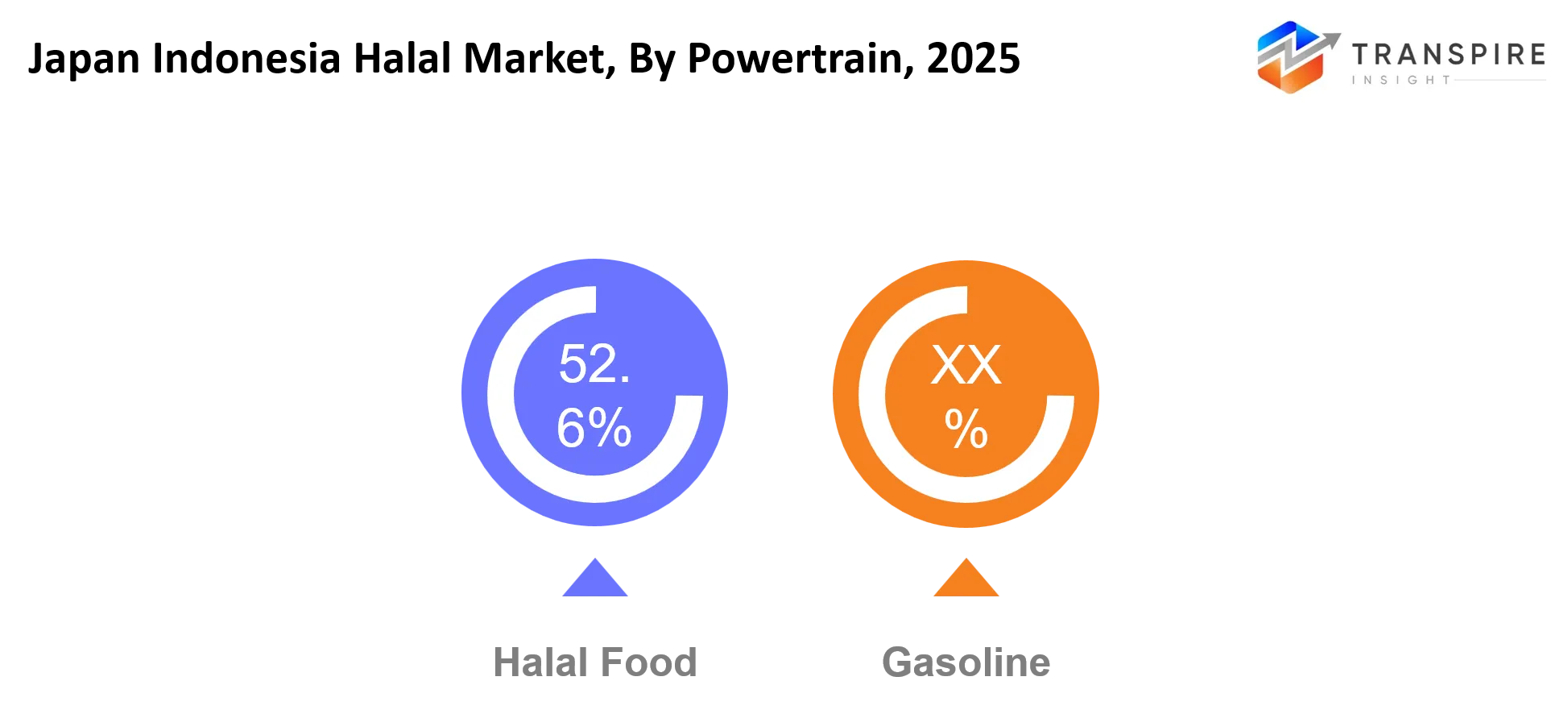
The Halal Food dominated the market, accounting for nearly 77% in 2025 and is expected to rise at a significant CAGR during the forecast period.
The Japan Indonesia Halal Market is segmented by product type into Halal Food, Halal Beverages, Halal Cosmetics, Halal Pharmaceuticals, Halal Personal Care, Halal Ingredients, Halal Tourism, Halal Services. Among these, the Halal Food segment dominated the market, accounting for nearly 77% in 2025 and expected to increase at a significant CAGR during the forecast period. The Halal Food sector led the market for halal food in Japan and Indonesia, with close to 77% share in 2025, by virtue of tremendous demand from Muslim consumers, necessary halal compliance in Indonesia, growing supply of halal-certified food, and the expanding food trade between Japan and Indonesia. Additionally, the rise in Muslim tourism, broader retail distribution, and increased consumer inclination towards certified products help in growth of the segment.
The MUI/BPJPH Certified dominated the market, accounting for nearly 82% in 2025, and is expected to rise at a significant CAGR during the forecast period.
The Japan Indonesia Halal Market is segmented by certification into MUI/BPJPH Certified, International Halal Certification, Imported Certification, Self-Declared Certification, Sharia-Compliant, Traceability Certified, Ingredient Certified, Process Certified. Among these, the MUI/BPJPH Certified segment dominated the market, accounting for nearly 82% in 2025 and expected to increase at a significant CAGR during the forecast period. In addition, because of Indonesia’s improved halal assurance framework, compulsory certification requirements, high level of trust among consumers in halal certifying bodies, and greater adoption of halal products, the MUI & BPJPH certified market in the Japan Indonesia halal market accounted for almost 82% of the total market share in 2025. Rising exports from Japan to Indonesia are expected to increase the demand for internationally recognized halal certification and regulations among consumers.
The Households dominated the market, accounting for nearly 61% in 2025 and is expected to rise at a significant CAGR during the forecast period.
The Japan Indonesia Halal Market is segmented by end user into Households, Restaurants, Hotels, Food Manufacturers, Pharmaceutical Companies, Cosmetic Companies, Travel Companies, Retailers. Among these, the Households segment dominated the market, accounting for nearly 61% in 2025 and expected to increase at a significant CAGR during the forecast period. With nearly 61% of the country’s share in 2025, the Households category led the Japan Indonesia Halal market due to the steady household consumption of halal-approved food and beverage, the growing Muslim consumer population, and the growing knowledge about halal standards, as well as increased availability of halal food in stores. The increasing demand for trusted and certified products would keep boosting household spending in the segment.
Future Market Trends for the Japan Indonesia Halal Market: -
- National Certifiation Deadlines: Indonesia's BPJPH laws promote strict adherence that forces Japanese exporters from having to pursue legitimate halal certifications of food, cosmetic and raw materials.
- Exporting Agricultural Advancement: Japan is exporting more halal-certified Wagyu beef and raw ingredients to Indonesia and other Southeast Asian nations.
- Tracking and Digital Certificates: The utilization of blockchain, QR codes, and digital audit tracing guarantee compliance with Islamic laws and eliminate the possibilities of cheating in the supply chain.
- Automation and Production Innovation: The food producers in Japan successfully utilize robotics and AI to overcome cross-contamination and boost production effectiveness.
- Ethical and Pure "Tayyib" Trend: The demand of consumers increasingly connects the need for religious support with clean labels and eco-friendly production practices.
Recent Development
- In May 2026: The webinar was conducted by Yano Research Institute to announce the launch of halal certification services through LPPOM-Yano Halal Solution. The project offers Japanese companies a comprehensive solution for the halal certification process in both Japan and Indonesia by providing them with the necessary assistance, consulting, training, and support related to compliance.
- In August 2026: The new Japan-Indonesia Economic Partnership Agreement (JIEPA) was launched, bringing significant improvements to bilateral trade through improved trade access, introduction of tariffs, new measures regarding services, and e-commerce. The deal also promotes better cross-border trading for Japanese and Indonesian companies and ensures rapid and efficient exchange of halal food and halal products and services.
Market Segment
This study forecasts revenue at Japan, regional and country levels from 2020 to 2033. Transpire Insights has segmented the Japan Indonesia Halal Market based on the below-mentioned segments:
Japan Indonesia Halal Market, By Product Type
- Halal Food
- Halal Beverages
- Halal Cosmetics
- Halal Pharmaceuticals
- Halal Personal Care
- Halal Ingredients
- Halal Tourism
- Halal Services
Japan Indonesia Halal Market, By Food Category
- Meat & Poultry
- Seafood, Dairy
- Bakery
- Confectionery
- Processed Foods
- Beverages
- Ready-to-Eat Foods
Japan Indonesia Halal Market, By Certification
- MUI/BPJPH Certified
- International Halal Certification
- Imported Certification
- Self-Declared Certification
- Sharia-Compliant
- Traceability Certified
- Ingredient Certified
- Process Certified
Japan Indonesia Halal Market, By Distribution Channel
- Supermarkets
- Convenience Stores
- Specialty Stores
- Restaurants
- E-Commerce
- Foodservice
- Wholesale
- Direct Sales
Japan Indonesia Halal Market, By Consumer Type
- Muslim Consumers
- Halal-Conscious Consumers
- Families
- Young Adults
- Tourists
- International Consumers
- Institutional Buyers
- Premium Consumers
Japan Indonesia Halal Market, By End User
- Households
- Restaurants
- Hotels
- Food Manufacturers
- Pharmaceutical Companies
- Cosmetic Companies
- Travel Companies
- Retailers
Frequently Asked Questions
Find quick answers to common questions.
Halal demand, certification requirements, Muslim tourism, bilateral trade, and growing consumer preference for certified products drive market expansion.
Halal Food dominates, accounting for nearly 77% in 2025, supported by strong consumption and expanding certified food availability.
MUI/BPJPH certification supports Indonesian regulatory compliance, strengthens consumer trust, and facilitates Japanese exporters’ market access
Key players include LPPOM MUI, BPJPH, Indofood, Mayora Indah, Unilever Indonesia, Wardah, Kalbe Farma, and Garudafood.
AI, blockchain, IoT, digital certification, automation, and e-commerce improve traceability, compliance, production efficiency, and cross-border halal trade.
- LPPOM MUI
- BPJPH
- Indofood
- Mayora Indah
- Unilever Indonesia
- Paragon Technology and Innovation
- Wardah
- Kalbe Farma
- Wings Group
- Garudafood
- Sido Muncul
- Ajinomoto Indonesia
- Nestlé Indonesia
- Bank Syariah Indonesia
- Japan Halal Foundation
About the Authors

Chetan Dhatrak
I’m Chetan Dhatrak, a Senior Research Analyst at Transpire Insight, specializing in the Consumer Goods, Foods and Beverages industry. I focus on analyzing market trends, consumer behavior, competitive landscapes, and industry developments to deliver accurate, data-driven insights. My research at Transpire Insight is built on credible sources and in-depth analysis, helping businesses and readers better understand market dynamics, emerging opportunities, and evolving consumer preferences. I’m committed to creating reliable, well-researched content that supports informed decision-making and reflects the latest developments in the consumer goods and food & beverage sectors.

Chakradhar Khansole
Chakradhar serves as the Research Director at Transpire Insight, bringing over 8 years of experience in technology, innovation, and strategic market intelligence. He specializes in transforming complex market data into actionable business insights that enable organizations to make informed, growth-oriented decisions. Recognized for his strategic vision and analytical expertise, Chakradhar leads high-impact research initiatives, delivering comprehensive market assessments, competitive intelligence, and forward-looking industry analysis.
Recently Published Reports
-
Apr 2026
Baby Infant Formula Market
Baby Infant Formula Market Size, Share & Analysis Report By ype (Infant Milk, Follow On Milk, Specialty Baby Milk, Growing-Up Milk), By Ingredient (Carbohydrate, Fat, Protein, Minerals, Vitamins, and Others), By Product Form (Powder, Liquid, and Ready-to-feed), By Distribution Channels (Supermarket/Hypermarket, Specialty Store, Pharmacies, Online Retail, and Others), and Geography (North America, Europe, Asia-Pacific, Middle East and Africa, South and Central America), 2021 - 2031
-
Apr 2026
Edible Insects for Animal Feed Market
Edible Insects for Animal Feed Market Size, Share & Analysis Report By Type (Insect Powder, Insect Meal, Insect Bar, Insect Paste, Insect Oil, and Others), By Insect Type (Beetles, Cricket, Caterpillar, Hymenoptera, Orthoptera, Tree Bugs, and Others), By Application (Livestock, Pet Food, and Aquaculture), By Livestock Type (Poultry, Swine, and Others), and Geography (North America, Europe, Asia-Pacific, Middle East and Africa, South and Central America), 2021 - 2031
-
Apr 2026
Food Industry Disinfection and Bacterial Control Market
Food Industry Disinfection and Bacterial Control Market Size, Share & Analysis Report By Type (Chemical Disinfectants, Physical Disinfectants, and Biocides and Antimicrobials), By Application (Food Processing Equipment Surface Disinfection, Food Preparation Areas Surface Disinfection, Storage Areas Surface Disinfection, Anti-microbial Coatings Food Preservation, and Preservative Solutions Food Preservation), By End User (Meat and Poultry Processing, Dairy Processing, Seafood Processing, Bakery and Confectionery, Restaurants and Commercial Kitchens, and Food Service Providers), By Sales Channel (Online, Offline), and Geography (North America, Europe, Asia-Pacific, Middle East and Africa, South and Central America), 2021 - 2031
-
May 2026
Freeze Dried Food Market
Freeze Dried Food Market Size, Share & Analysis Report By Product Type (Fruits, Vegetables, Freeze-Dried Dairy Products, Freeze-Dried Meat and Seafood, Freeze-Dried Pet Food, and Prepared Meal), By Nature (Organic, and Conventional), By Form (Powdered, Granules, and Diced), By End Use (Breakfast Cereals, Dairy Products, Bakery & Confectionery, Nutritional Bars & Supplements, Powdered Beverages, Snacks, and Retail (Household)), and Geography (North America, Europe, Asia-Pacific, Middle East and Africa, South and Central America), 2021 - 2031