

Japan Herbicide Tolerance Market Summary:
According to Transpire Insights, a detailed research report on the market reflects that the soybean application segment dominates the Japan Herbicide Tolerance Market, accounting for approximately 61% of the total share worldwide. Bayer AG leads the market with approximately (around USD 6.0 billion) in annual herbicide revenue and an estimated 12–16% Japan market share, making it the leading contributor to Japan market development, innovation, advanced herbicide tolerance technologies, expanding manufacturing capabilities, and growth dynamics.
Market Snapshot
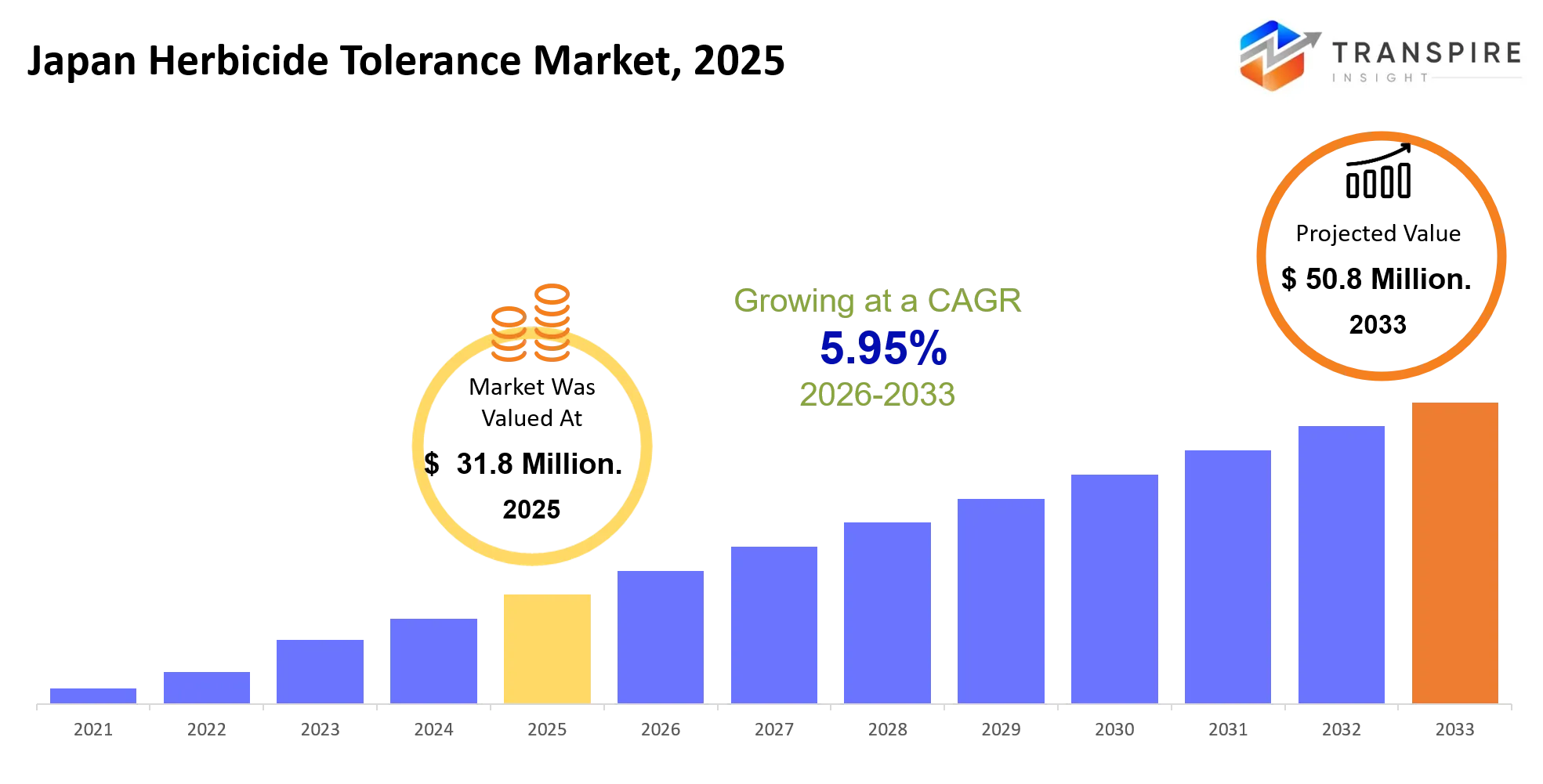
- Market Value (2025): USD 31.8 Million.
- Expected Market Value (2026): USD 33.9 Million.
- Estimated Market Value (2033): USD 50.8 Million.
- Forecast CAGR (2026–2033): 5.95%
Introduction
The herbicide business involves the sale of chemical, synthetic, or biological materials that are intended to kill, reduce, or inhibit the growth of weeds competing with the crops for necessary nutrients, water, and sunlight. With regard to the Japanese herbicide tolerance and crop protection business, the market involves special formulations (for instance, glyphosate and paddy herbicides) used in staple foods like rice, soybeans, and fruits or vegetable crops to enhance their efficiency and reduce labor costs. Herbicide is a substance or a chemical that is meant to control, inhibit, or completely destroy the unwanted plants (weeds) competing with the crops for necessary nutrients, water, and sunlight. Herbicide Tolerance is the inherited ability of a particular plant species to survive and reproduce after application of a certain amount of a chemical weed killer that could kill other plants. It can either be inherent to the plant itself or genetically engineered into its DNA. The Japan Herbicide Tolerance Market has seen growth due to reduction in labor costs, increase in yield, efficiency, and sustainable agriculture practices. Application of chemical and selective weed control practices reduces the need for labor, which could be helpful for those farms that have labor problems. Effective weed management ensures higher productivity because the weeds reduce nutrient absorption from the soil. In addition, precision application systems and automation in agriculture reduce wastage of inputs and make the farm activities more effective. At the same time, selective use of crop protection practices helps the farm comply with residue norms of Japan.
Key Market Highlights: -
- By crop, the Soybean segment dominated the market and holds nearly 47% share in 2025 and is projected to grow at a substantial CAGR during the forecast period.
- By application, the Weed Management segment dominated the market and holds nearly 38% share in 2025 and is projected to grow at a substantial CAGR during the forecast period.
- By end user, the Commercial Farms segment dominated the market and holds nearly 55% share in 2025 and is projected to grow at a substantial CAGR during the forecast period.
- Government Subsidies and Grants: The Japanese government grants subsidies and research funds for sustainable agriculture, precision farming, and decrease in pesticide application, agricultural drones, and improved weed management systems. Such activities promote environmentally sound crop protection, stimulate innovation within the agriculture sector, and present growth avenues for the Japan Herbicide Tolerance Market.
How is Technology Driving Growth in the Japan Herbicide Tolerance Market?
The Japan Herbicide Tolerance Market is highly impacted by robotics, automation, artificial intelligence, and smart farming technologies. Agricultural robots can solve the problem of labor scarcity and older population of farmers through automation of routine activities related to weed control and spraying. Automation will ensure consistent application, workload reduction, and effective usage of herbicides. In turn, precision agriculture using AI can ensure precise weed detection and specific application of herbicides, which reduces the usage of chemicals. IoT sensors and edge computing allow optimizing the schedule of spraying according to the conditions in the field. The platforms for monitoring crops provide constant information about health of the crops and weeds, and thus, their treatment.
Market Drivers
The Herbicide Tolerance Market of Japan is influenced by an aging farming population, sustainability movements, technology adoption, and increasing weed resistance challenges. In 2025, the average age of Japan’s farming population was 67.7 years old, contributing to higher demand for labor-saving weed control mechanisms. The Japanese Government’s MIDORI Strategy aims for a 50% cut in risk-weighted use of chemical pesticides by 2050, promoting precision farming and integrated pest management strategies. Additionally, advances in agricultural AI crop monitoring and spraying systems, IoT, and agricultural robotics have been boosting efficiency of farms. The Japan Herbicide Tolerance Market presents various growth opportunities because of reduced labor needs, optimal yield, precision farming, and sustainability in crop protection. Management practices of herbicide-tolerant crops will not only ensure reduced manual weed control but also increase efficiency on farms. Proper weed control ensures that the plants are protected from being deprived of water, nutrients, and sunlight due to other growing weeds. In addition, the implementation of technologies involving the use of artificial intelligence, robotics, Internet of Things (IoT), and precision spraying increases efficiency and application accuracy. In addition, sustainability policies implemented in Japan promote the use of low risk pesticides and integrated pest management.
Restrain
Issues like GMO-based consumer worries, high levels of biotech and pesticide regulation, and 50% decrease in chemical pesticide risk posed by the country’s MIDORI Strategy by 2050 are some of the hurdles that the Herbicide Tolerance market in Japan is facing. Rising concerns about herbicide resistance can lead to a decline in the use of single mode weed control methods.
|
Driver |
Relative Impact on Growth (%) |
Geographic Relevance |
Impact Ti meline |
Demand Strength |
Growth Mechanism |
Key Beneficiaries |
Major Constraint |
|
Driver 1: Aging Agricultural Workforce and Labor Shortages |
27% |
Nationwide Japan; major farming regions |
Long-term |
High |
Labor shortages accelerate labor-saving weed-control adoption. |
Commercial farms, agrochemical firms, robotics providers |
High technology adoption costs |
|
Driver 2: Precision Agriculture, AI, and Smart Spraying |
23% |
Nationwide; technology-intensive farming regions |
Medium-term |
High |
AI enables targeted weed detection and spraying. |
Technology vendors, farms, drone providers |
Infrastructure and skill requirements |
|
Driver 3: MIDORI Strategy and Sustainable Crop Protection |
21% |
Nationwide Japan |
Long-term |
High |
Sustainability targets encourage efficient pesticide utilization. |
Biotech firms, agrochemical companies, sustainable farms |
Stricter pesticide-use requirements |
|
Driver 4: Expansion of Smart-Farming Subsidies and Automation |
16% |
Nationwide; commercial farming clusters |
Short-term |
Medium |
Subsidies lower barriers to smart equipment adoption. |
Equipment vendors, service providers, commercial farms |
Funding availability and eligibility |
|
Driver 5: Rising Need for Herbicide Resistance Management |
13% |
Rice, soybean, corn-growing areas |
Medium-term |
Medium |
Resistance concerns increase demand for diversified weed-control technologies. |
Herbicide developers, seed companies, farmers |
Regulatory approval and resistance complexity |
Analysis of Prices and Consumer Behaviour
The major market segments in Japan herbicide tolerance are Vegetables herbicide-based crop protection products which account for 47.63 % of total Japan crop protection chemicals market revenue in 2025 (majorly because of the need for effective weed management). Price of herbicide tolerant seeds will be 35% higher than regular seed products, since the product will require advanced trait development and biotechnology. Also 45 % of all unit sales of herbicide tolerance products are in seed form. Sales volumes will be propelled by versatility of use in major crops and benefits from effective weed management. The agricultural and commercial farming industry will be responsible for about 70 % of the demand from those industries. Consumer buying pattern shows that 55 % of consumers have the highest priority for herbicide tolerance, crop performance and trait reliability. Another 33% of consumers prefer buying the products by bulk or long term agreement so as to cut down cost of procurement of products and have a consistent supply to their customers all over Japan.
Who are the Key Players in the Japan Herbicide Tolerance Market and how do they compete?
Competitiveness in the international market of herbicide tolerance involves companies that focus on innovations in the field of agricultural biotechnology, specific crops solutions, and establishment of distribution networks internationally. Competing not on prices but on technologies of herbicide tolerance of crops, advanced seed traits, crop protection solutions, resistance management, and precision agriculture, this strategy of competition is associated with continuous product development and higher efficiency of weed control, crop productivity, and sustainable agriculture management.
Developing such technologies as high-performance herbicide-tolerant seeds, crop protection solutions, and systems of weed management, Corteva Agriscience establishes itself in the market. Developing advanced technologies of herbicide-tolerant crop traits used for soybeans, corn, cotton, and other crops, companies distinguish themselves from the competitors. Bayer establishes its position with integrated crop protection, seed technologies, and herbicide tolerance solutions in synergy with modern farming practice and resistance management programs.
Top Companies in the Japan Herbicide Tolerance Market
- Bayer
- Corteva Agriscience
- BASF
- Syngenta
- FMC
- Sumitomo Chemical
- Monsanto legacy technology
- KWS
- Limagrain
- Sakata Seed
- Japan Agricultural Cooperatives
- Nippon Soda
- Kumiai Chemical
- Nihon Nohyaku
- OAT Agrio
|
Company |
Est. Revenue Share Range |
Key Offerings |
Strategic Positioning |
Geographic Strength |
Technology Focus |
|
Bayer |
10–15% |
Roundup, glyphosate-tolerant traits, glufosinate-tolerant traits, dicamba-tolerant traits |
Trait leadership with integrated crop protection |
North America, Latin America, Asia-Pacific |
GM traits, molecular breeding, herbicide platforms |
|
Sumitomo Chemical |
9–13% |
Sumisoya, Resource, imazosulfuron, sulfosulfuron, Cremart |
Integrated Japanese crop-protection leadership |
Japan, Asia-Pacific, Latin America |
Novel chemistry, formulation, resistance management |
|
BASF |
8–12% |
Basta, Basagran, rice herbicides, xarvio FIELD MANAGER |
Diversified crop-protection and digital agriculture |
Europe, Asia-Pacific, North America |
Herbicides, tolerant traits, AI precision agriculture |
|
Kumiai Chemical |
8–12% |
AXEEV, Effeeda, pyroxasulfone, paddy herbicides |
Japan-focused herbicide specialization and innovation |
Japan, Asia-Pacific, North America |
Novel herbicides, resistance control, formulation technology |
|
Syngenta |
7–10% |
Rice herbicides, grass-weed solutions, herbicide-tolerant traits, crop-protection products |
Global crop-protection portfolio diversification |
Asia-Pacific, Latin America, Europe |
Trait systems, herbicide chemistry, resistance management |
|
Nissan Chemical |
5–8% |
SIRIUS, Altair, TARGA, Permit, Ryzonic |
Rice herbicide and novel-chemistry specialization |
Japan, Asia-Pacific, North America |
Novel molecules, formulations, selective herbicides |
|
Corteva Agriscience |
4–7% |
Herbicide-tolerant corn traits, rice/crop protection, seed technologies |
Seed-trait innovation with crop protection |
North America, Latin America, Asia-Pacific |
Trait stacking, GM traits, molecular breeding |
|
FMC |
3–6% |
Dodhylex/tetflupyrolimet, rice herbicides, resistance-management solutions |
Innovation-led novel herbicide development |
North America, Asia-Pacific, Latin America |
Novel modes of action, resistance management |
|
Nihon Nohyaku |
3–5% |
Rice herbicides, horticultural herbicides, WeedCore, Clincher |
Domestic specialty crop-protection specialization |
Japan, Asia-Pacific |
Selective chemistry, AI crop diagnostics, formulations |
|
Nippon Soda |
2–4% |
NABU, sethoxydim, tepraloxydim, agrochemical intermediates |
Specialty chemistry and agrochemical niche leadership |
Japan, Asia-Pacific, North America |
Selective herbicides, active ingredients, formulation chemistry |
Japan Herbicide Tolerance Market Segmentation
The Japan Herbicide Tolerance Market share is divided into six categories: By trait type, crop, technology, herbicide, application and end user.
The Soybean dominated the market, accounting for nearly 47% in 2025 and is expected to rise at a significant CAGR during the forecast period.
The Japan Herbicide Tolerance Market is segmented by crop into Soybean, Corn, Cotton, Canola, Rice, Wheat, Sugar Beet, Vegetables. Among these, the Soybean segment dominated the market, accounting for nearly 47% in 2025 and expected to increase at a significant CAGR during the forecast period. The Soybean category held the largest market share in the Japan Herbicide Tolerance Market in 2025, making up around 47%, owing to its large application in food, feed, and oil manufacture, along with well-established herbicide tolerance traits and weed management benefits. An increase in demand for higher productivity and labor efficiency is expected to drive future growth.
The Weed Management dominated the market, accounting for nearly 38% in 2025, and is expected to rise at a significant CAGR during the forecast period.
The Japan Herbicide Tolerance Market is segmented by application into Weed Management, Pre-Emergence Control, Post-Emergence Control, Broadleaf Weed Control, Grass Weed Control, Resistance Management, Crop Protection, Integrated Weed Management. Among these, the Weed Management segment dominated the market, accounting for nearly 38% in 2025 and expected to increase at a significant CAGR during the forecast period. The Weed Management section led the Japan Herbicide Tolerance Market in 2025, capturing about 38% of the market share due to labor shortage and old age farmers. Herbicide-tolerant technology facilitates selective weed control, helps in eliminating competition for nutrients for crops and helps in boosting operational efficiency and precision farming.
The Commercial Farms dominated the market, accounting for nearly 55% in 2025 and is expected to rise at a significant CAGR during the forecast period.
The Japan Herbicide Tolerance Market is segmented by end user intoCommercial Farms, Seed Companies, Agricultural Cooperatives, Research Institutes, Government Agencies, Agrochemical Companies, Biotechnology Companies, Contract Farmers. Among these, the Commercial Farms segment dominated the market, accounting for nearly 55% in 2025 and expected to increase at a significant CAGR during the forecast period. The Commercial Farms category dominated the Japan Herbicide Tolerance Market in 2025, representing almost 55% of the total share, owing to factors such as larger scale farming, increased need for effective weed control, lack of laborers, and the incorporation of modern crop protection technology. This trend will contribute to the growth of the Japan Herbicide Tolerance market.
Future Market Trends for the Japan Herbicide Tolerance Market: -
- Precision & Smart Agriculture: Greater reliance on drone spraying and AI monitoring to achieve maximum efficiency.
- Formulations: Highly efficient and low residue liquid formulations suited for automation.
- Resistance Management: Multi-action and biological product mixes to overcome weed resistance issues.
- New Applications: Increase in non-agricultural uses such as forestry and vegetative control infrastructure.
Recent Development
- In September 2026: Corteva Agriscience made known the expansion plans of Vylor in terms of the next generation of soybean seed technology and genetics technologies. The pipeline technology of Vylor can be used for innovations in seed technology and will help in the development of the Japan Herbicide Tolerance Market.
- In July 2026: The MRLs for six pesticides were revised by Japan’s Consumer Affairs Agency (CAA), including glufosinate and pentoxazone. This amendment is consistent with Japan’s tough policy on pesticide residues and would promote responsible use of herbicides, compliance with regulations, and innovations in crop protection technologies in the Japan Herbicide Tolerance Market.
- In June 2026:The introduction of Ryzonic® (iptriazopyrid) by Nissan Chemical is planned for launch as an advanced herbicide for paddy rice beginning from 2027 in key regions such as Japan and India. It will help in tackling resistant weed problems, fostering innovations in rice weed control techniques and helping Japan's cutting-edge herbicides market.
Market Segment
This study forecasts revenue at Japan, regional and country levels from 2020 to 2033. Transpire Insights has segmented the Japan Herbicide Tolerance Market based on the below-mentioned segments:
Japan Herbicide Tolerance Market, By Trait Type
- Glyphosate Tolerance
- Glufosinate Tolerance
- Dicamba Tolerance
- 2,4-D Tolerance
- ALS-Inhibitor Tolerance
- PPO-Inhibitor Tolerance
- Multiple-Herbicide Tolerance
- Other Traits
Japan Herbicide Tolerance Market, By Crop
- Soybean
- Corn, Cotton
- Canola
- Rice
- Wheat
- Sugar Beet
- Vegetables
Japan Herbicide Tolerance Market, By Technology
- Genetic Modification
- Gene Editing
- Conventional Breeding
- Trait Stacking
- Molecular Breeding
- CRISPR-Based Traits
- Marker-Assisted Breeding
- Other Technologies
Japan Herbicide Tolerance Market, By Herbicide
- Glyphosate
- Glufosinate
- Dicamba
- 2,4-D
- Atrazine
- ALS Inhibitors
- PPO Inhibitors
- HPPD Inhibitors
Japan Herbicide Tolerance Market, By Application
- Weed Management
- Pre-Emergence Control
- Post-Emergence Control
- Broadleaf Weed Control
- Grass Weed Control
- Resistance Management
- Crop Protection
- Integrated Weed Management
Japan Herbicide Tolerance Market, By End User
- Commercial Farms
- Seed Companies
- Agricultural Cooperatives
- Research Institutes
- Government Agencies
- Agrochemical Companies
- Biotechnology Companies
- Contract Farmers
Frequently Asked Questions
Find quick answers to common questions.
The market is projected to reach USD 50.8 million by 2033, growing at a 5.95% CAGR during 2026–2033.
Soybean dominates, accounting for nearly 47% in 2025, supported by food, feed, oil demand, productivity, and efficient weed-management requirements.
Weed Management dominates, accounting for nearly 38% in 2025, driven by labor shortages, aging farmers, precision agriculture, and efficient weed control.
Labor shortages, aging farmers, precision farming, AI, robotics, IoT, and sustainable crop-protection initiatives are key market growth drivers.
Commercial Farms dominate, accounting for nearly 55% in 2025, driven by large-scale farming, labor constraints, efficient weed control, and modern technologies.
- Bayer
- Corteva Agriscience
- BASF
- Syngenta
- FMC
- Sumitomo Chemical
- Monsanto legacy technology
- KWS
- Limagrain
- Sakata Seed
- Japan Agricultural Cooperatives
- Nippon Soda
- Kumiai Chemical
- Nihon Nohyaku
- OAT Agrio
About the Authors

Pankaj Ghogare Patil
I am Pankaj Ghogare Patil, a Senior Research Analyst at Transpire Insight, specializing in the Pharmaceutical, Chemicals & Materials, Healthcare IT, and Biotechnology industry. My expertise lies in conducting comprehensive market research, analyzing industry trends, evaluating competitive landscapes, and translating complex data into actionable insights. At Transpire Insight, I closely follow emerging technologies, regulatory developments, and market innovations to create accurate, well-researched, and informative content that helps businesses and professionals make informed decisions. I am committed to producing credible, evidence-based articles that reflect industry best practices while making technical topics accessible and valuable for a broad audience.

Chakradhar Khansole
Chakradhar serves as the Research Director at Transpire Insight, bringing over 8 years of experience in technology, innovation, and strategic market intelligence. He specializes in transforming complex market data into actionable business insights that enable organizations to make informed, growth-oriented decisions. Recognized for his strategic vision and analytical expertise, Chakradhar leads high-impact research initiatives, delivering comprehensive market assessments, competitive intelligence, and forward-looking industry analysis.
Recently Published Reports
-
May 2026
Healthcare Polymer Packaging Market
Healthcare Polymer Packaging Market Size, Share & Analysis Report By Packaging Type (Syringes, IV Bottles and Pouches, Clamshells, Blisters, Bottles & Jars, Containers, Tubes, IV Parental Packaging, Others), By Type (Regulated, Non-regulated), By Polymer Type (LDPE (Low-Density Polyethylene), HDPE (High-Density Polyethylene), Homo-polymer (Homo), Random Copolymer (Random), Block Copolymer (Block), PET, Polystyrene, Polyvinyl Chloride, Polyamide/EVOH, Others), and Geography (North America, Europe, Asia-Pacific, Middle East and Africa, South and Central America), 2021 - 2031
-
Apr 2026
Hydrophilic Tape (Waterstop) Market
Hydrophilic Tape (Waterstop) Market Size, Share & Analysis Report By Type (Bentonite-Based Hydrophilic Tape, Rubber-Based Hydrophilic Tape), By Application (Residential Buildings, Commercial Buildings, Infrastructure Projects), and Geography (North America, Europe, Asia-Pacific, Middle East and Africa, South and Central America), 2021 - 2031
-
Apr 2026
Metalens Market
Metalens Market Size, Share & Analysis Report By Type (Visible Light Metalens, and Infrared Metalens), By Application (Consumer Electronics, Automotive Electronics, Industrial, Medical, and Others), and Geography (North America, Europe, Asia-Pacific, Middle East and Africa, South and Central America), 2021 - 2031
-
Apr 2026
PBT Resin Market
PBT Resin Market Size, Share & Analysis Report By Type (Reinforced PBT Resin, Unreinforced PBT Resin), By Processing Method (Injection Molding, Extrusion, Blow Molding, Others), By End-User (Automotive, Electrical & Electronics, Consumer Appliances, Industrial Machinery, Medical Devices, Packaging, Others), and Geography (North America, Europe, Asia-Pacific, Middle East and Africa, South and Central America), 2021 - 2031