

Japan GCC Market Size & Forecast:
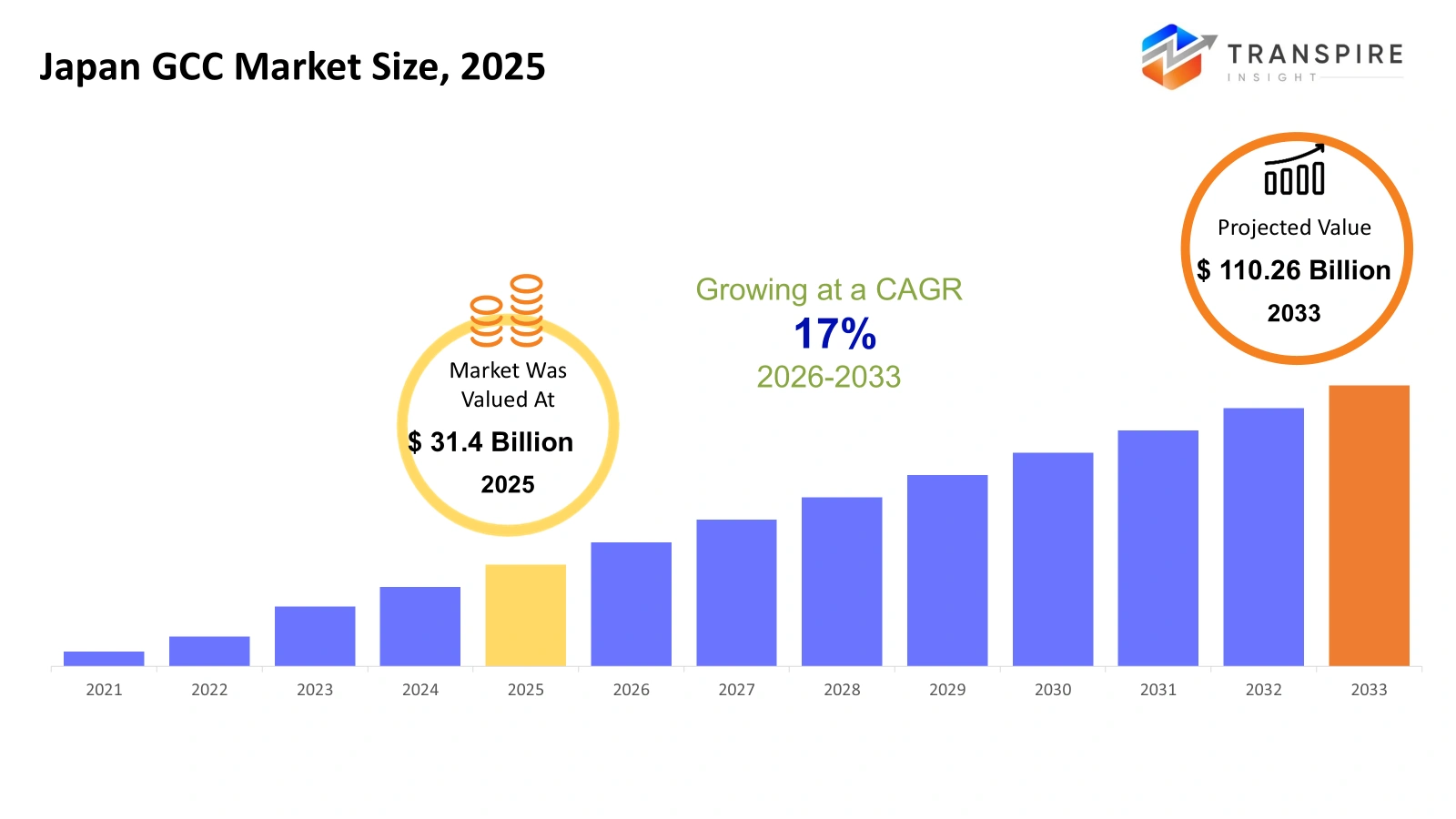
- Japan GCC Market Size 2025: USD 31.4 Billion
- Japan GCC Market Size 2033: USD 110.26 Billion
- Japan GCC Market CAGR: 17%
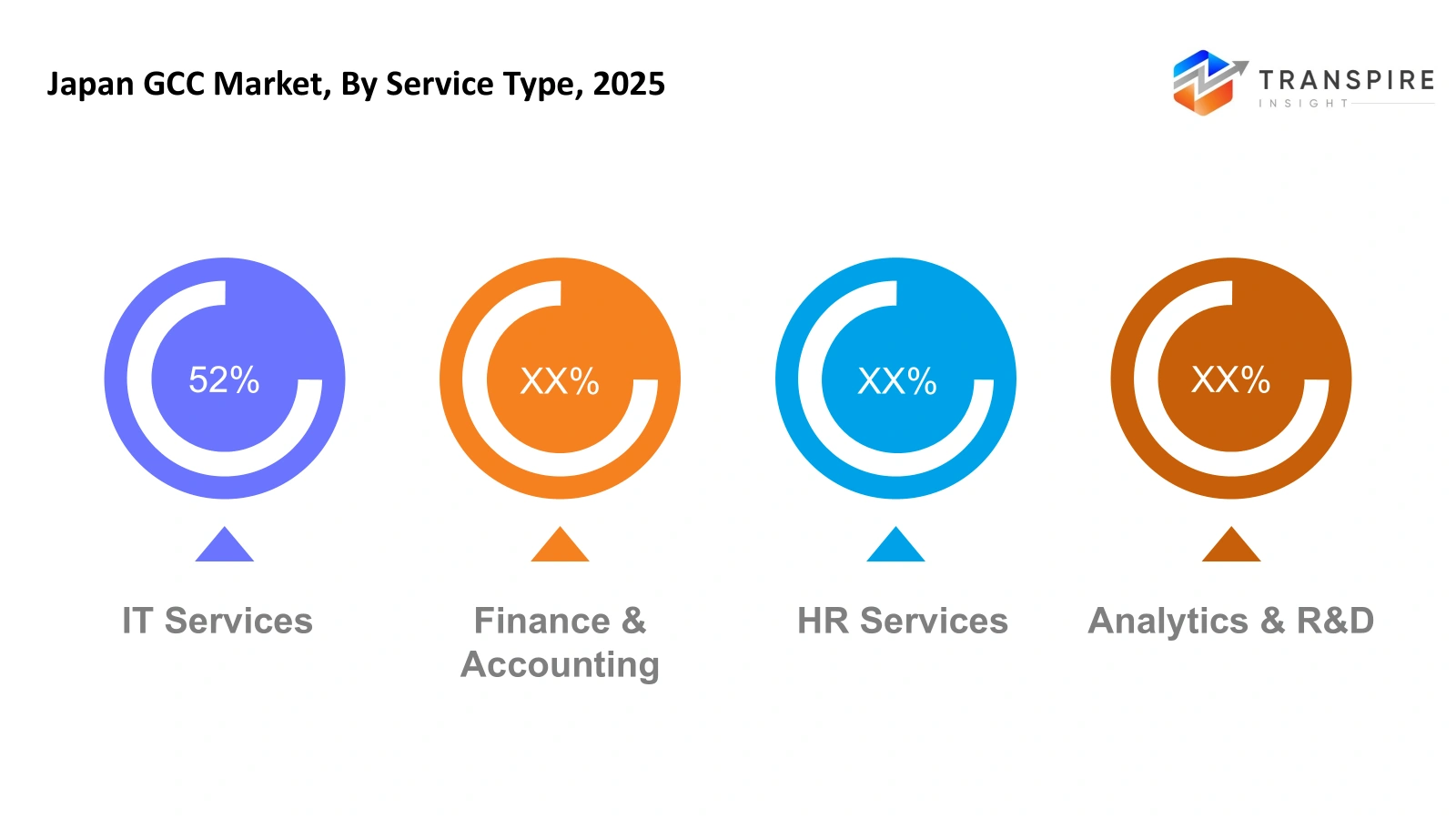
- Japan GCC Market Segments:By Service Type (IT Services, Finance & Accounting, HR Services, Analytics & R&D), By Industry Vertical (BFSI, IT & Telecom, Healthcare, Manufacturing).
To learn more about this report,  Download Free Sample Report
Japan GCC Market Summary:
The Japan GCC Market size is estimated at USD 31.4 Billion in 2025 and is anticipated to reach USD 110.26 Billion by 2033, growing at a CAGR of 17% from 2026 to 2033. Japan's Global Capability Centres market is experiencing growth because businesses need to improve their operations without decreasing their quality standards. Japan's advanced technology systems and professional workforce and commitment to research and development make it an appealing location for companies to establish their specialised Global Capability Center operations, which include research and development and engineering and digital transformation activities. Japanese companies which used to be careful about outsourcing their work are now adopting international delivery systems. The new business model creates possibilities for companies in both local and international markets to work together while they enhance operational efficiency and business agility and achieve sustained value for their companies.
Key Market Trends & Insights:
- Japanese companies are increasingly establishing GCCs to implement digital projects which include AI and cloud and automation technologies. The centres have evolved into innovation centres which operate beyond their initial purpose of providing business support.
- Japanese GCCs dedicate their resources toward research activities and product creation and high-level engineering work. Companies prefer to maintain their most important knowledge-based activities at locations which are near their primary business functions.
- Japanese companies which used to maintain strict traditional values now show higher willingness to adopt international delivery systems. This development boosts international cooperation while expanding GCC operations to international markets.
- GCCs assist organisations in filling their workforce shortages through their capacity to employ experienced workers. Organisations provide training programmes to their staff while accessing international talent for key positions.
- GCCs are implementing automation tools together with AI technologies to enhance operational efficiency while decreasing their running expenses. The present trend alters the management methods which organisations employ for their daily activities and their complicated processes.
- Japan puts strong focus on protecting data privacy rights and following data protection laws. GCCs implement strong security systems which comply with both domestic and international security requirements.
Japan GCC Market Segmentation
By Service Type
- IT Services: Japan's GCC sector primarily operates through IT services because there exists a growing need for cloud computing and cybersecurity and system integration services. Companies use GCCs to modernise their outdated systems while they proceed with digital transformation efforts. The centres establish faster innovation cycles which create high-quality results that meet the standards of Japan's precision-orientated business environment.
- Finance & Accounting: GCCs that manage finance and accounting operations enable Japanese businesses to enhance their reporting and auditing and compliance procedures. Companies depend on centralised centres to achieve both accuracy and transparency because regulatory requirements have become more difficult to manage. The implementation of automation and analytics solutions enables finance departments to increase their operational efficiency while spending less time on everyday activities.
- HR Services: GCCs now offer human resource services that extend beyond basic payroll and recruitment functions. Companies in Japan establish these centres to improve their employee engagement and talent management and training programmes. GCCs support organisations in developing flexible human resource systems that handle workforce challenges which arise from ageing populations.
- Analytics & R&D: The Japanese GCC model depends on analytics and R&D as its fundamental operational elements. The centres develop data-driven insights through their work on innovation and product development projects. Companies use them to stay competitive in technology and manufacturing. Research results accelerate when GCCs combine their regional expertise with their international resources, which enables companies to develop better business tactics.
To learn more about this report, Download Free Sample Report
By Industry Vertical
- BFSI (Banking, Financial Services, and Insurance): Japanese banks and financial organisations, together with their insurance partners, now use GCCs to boost their capabilities for handling risks and meeting regulations while providing better service to customers. The centres provide support for digital banking projects and data analysis activities. Financial institutions use GCCs to stay operationally flexible while maintaining security standards and delivering high-quality financial products because of the combination of competitive market conditions and increasing regulatory requirements.
- IT & Telecom: The IT and telecom industry in Japan depends on GCCs to provide software development services and network management solutions and drive innovation efforts. The centres provide support for new technologies which include 5G, the Internet of Things and artificial intelligence. Companies need to use GCCs because they provide the ability to expand their business activities while creating savings and protecting their market position in today's fast-changing digital environment.
- Healthcare: GCCs provide support for clinical research activities and data management tasks and the development of digital health applications within the healthcare industry. Japanese organisations use these centres to improve patient care and streamline operations. GCCs function as essential components which support innovations and provide advanced healthcare services to meet rising demand.
- Manufacturing: The manufacturing sector serves as a fundamental part of Japan's economic system, while GCCs provide manufacturing companies with engineering assistance and automation solutions and supply chain optimisation services, which enhance their operational productivity. The centres dedicate their efforts to creating new solutions and maintaining high standards of quality while enhancing their existing procedures. GCCs enable manufacturers to achieve international business success through their implementation of cutting-edge technologies, which help maintain Japan's status as an industrial leader.
Country Insights
The Global Capability Centers (GCC) market of Japan combines advanced technology and precise operations with its international business development. Japan has chosen to develop high-value research and engineering and advanced analytics functions instead of using traditional offshore sites. The country’s strong infrastructure, its robust data security standards and its quality control focus make it an ideal location for specialised GCC operations.
Japanese companies have historically been hesitant to adopt outsourcing practices; however, their approach is changing because of increasing globalisation trends. Organisations are using GCCs to improve their innovation processes while solving workforce needs and maintaining their market position in a world that prioritises digital technologies. The government provides support for both digital transformation initiatives and smart technology adoption, which helps speed up technology implementation.
The primary advantage of Japanese GCCs extends beyond cost efficiency because they help businesses achieve operational excellence while developing new solutions and attaining their strategic business goals in a competitive market.
Recent Development News
Japan Expands Global Delivery with New GCC in Hyderabad: Japan-based consulting firms are strengthening global delivery capabilities through new GCC setups in India. This reflects a growing focus on digital transformation and talent access.
Insurance Giant Builds First Overseas GCC: A major Japanese insurance company is investing in its first GCC outside Japan to boost AI and digital capabilities. This marks a shift toward global capability building.
|
Report Metrics |
Details |
|
Market size value in 2025 |
USD 31.4 Billion |
|
Market size value in 2026 |
USD 36.74 Billion |
|
Revenue forecast in 2033 |
USD 110.26 Billion |
|
Growth rate |
CAGR of 17% from 2026 to 2033 |
|
Base year |
2025 |
|
Historical data |
2021 – 2024 |
|
Forecast period |
2026 – 2033 |
|
Report coverage |
Revenue forecast, competitive landscape, growth factors, and trends |
|
Country scope |
Japan |
|
Key company profiled |
Accenture PLC, IBM Corporation, Tata Consultancy Services Ltd., Infosys Ltd., Capgemini SE, Cognizant Technology Solutions, Wipro Ltd., HCL Technologies Ltd., Genpact Ltd., NTT Data Corporation, Fujitsu Limited, Hitachi Consulting, Deloitte Consulting LLP, KPMG International, Ernst & Young Global Ltd. |
|
Customization scope |
Free report customization (country, regional & segment scope). Avail customized purchase options to meet your exact research needs. |
|
Report Segmentation |
By Service Type (IT Services, Finance & Accounting, HR Services, Analytics & R&D), By Industry Vertical (BFSI, IT & Telecom, Healthcare, Manufacturing). |
Key Japan GCC Company Insights
Companies that prioritise precision and innovation together with long-term value creation, which exceeds short-term profits, transform the Japan GCC market. Leading organisations are establishing GCCs to strengthen core capabilities in areas like digital transformation, engineering, and data analytics. Companies develop their GCCs as strategic assets because they believe these facilities will improve their business operations and market position. Companies now establish partnerships with their international vendors and technology providers to obtain various types of specialised knowledge. Japanese companies are turning their GCCs into modern centres which produce expertise and innovation because their business requirements lead them to do so.
Company List
- Accenture PLC
- IBM Corporation
- Tata Consultancy Services Ltd.
- Infosys Ltd.
- Capgemini SE
- Cognizant Technology Solutions
- Wipro Ltd.
- HCL Technologies Ltd.
- Genpact Ltd.
- NTT Data Corporation
- Fujitsu Limited
- Hitachi Consulting
- Deloitte Consulting LLP
- KPMG International
- Ernst & Young Global Ltd.
Japan GCC Market Report Segmentation
By Service Type
- IT Services
- Finance & Accounting
- HR Services
- Analytics & R&D
By Industry Vertical
- BFSI
- IT & Telecom
- Healthcare, Manufacturing
Frequently Asked Questions
Find quick answers to common questions.
The approximate Japan GCC Market size for the Market will be USD 110.26 Billion in 2033.
The key segments of the Japan GCC Market are By Service Type (IT Services, Finance & Accounting, HR Services, Analytics & R & R&D), By Industry Vertical (BFSI, IT & Telecom, Healthcare, Manufacturing).
Major Players in the Japan GCC Market are Accenture PLC, IBM Corporation, Tata Consultancy Services Ltd., Infosys Ltd., Capgemini SE, Cognizant Technology Solutions, Wipro Ltd., HCL Technologies Ltd., Genpact Ltd., NTT Data Corporation, Fujitsu Limited, Hitachi Consulting, Deloitte Consulting LLP, KPMG International, Ernst & Young Global Ltd.
The Current Market size of the Japan GCC Market is USD 31.4 billion in 2025.
The Japan GCC Market CAGR is 17%.
- Accenture PLC
- IBM Corporation
- Tata Consultancy Services Ltd.
- Infosys Ltd.
- Capgemini SE
- Cognizant Technology Solutions
- Wipro Ltd.
- HCL Technologies Ltd.
- Genpact Ltd.
- NTT Data Corporation
- Fujitsu Limited
- Hitachi Consulting
- Deloitte Consulting LLP
- KPMG International
- Ernst & Young Global Ltd.
Recently Published Reports
-
Apr 2026
3D Optical Profiler Market
3D Optical Profiler Market Size, Share & Analysis Report By Type (Desktop 3D Optical Profiler, and Portable 3D Optical Profiler), By Technology (Confocal Technology, and White Light Interference), By End-Use Industry (Manufacturing, Research Institutions, Automotive, Aerospace and Defense, Medical Devices, and Other), and Geography (North America, Europe, Asia-Pacific, Middle East and Africa, South and Central America), 2021 - 2031
-
Apr 2026
Depth Sensor Market
Depth Sensor Market Size, Share & Analysis Report By Type (Infrared Depth Sensors, Time-of-Flight (ToF) Sensors, Stereo Vision Sensors, Structured Light Sensors, Ultrasonic Depth Sensors), By Application (Automotive, Robotics, Gaming, Consumer Electronics, Industrial Automation, Healthcare, Security & Surveillance, Others), By End Users (Automotive Manufacturers, Consumer Electronics Companies, Healthcare Providers, Industrial Companies, Security Agencies, Gaming Companies, Robotics Companies, Others), and Geography (North America, Europe, Asia-Pacific, Middle East and Africa, South and Central America), 2021 – 2031
-
Apr 2026
Digital Manufacturing Market
Digital Manufacturing Market Size, Share & Analysis Report By Component (Hardware, Software, and Services), By Technology (Robotics, 3D Printing, Internet of Things (IoT), and Others), By Application (Automotive and Transportation, Aerospace and Defense, Consumer Electronics, Industrial Machinery, and Others), By Process Type (Computer-Based Designing, Computer-Based Simulation, Computer 3D Visualization, Analytics, and Others), and Geography (North America, Europe, Asia-Pacific, Middle East and Africa, South and Central America), 2021 – 2031
-
Apr 2026
Digital Visa Services Market
Digital Visa Services Market Size, Share & Analysis Report By Type (Individual Travelers, Group Travelers), By Application (Tourism, Business Travel, Others), and Geography (North America, Europe, Asia-Pacific, Middle East and Africa, South and Central America), 2021 – 2031