

Japan Driverless Tractor Market Summary:
According to Transpire Insight, a detailed research report on the market reflects that the large-scale farming application segment dominates the Japan Driverless Tractor Market, accounting for approximately 55% of the total market share. Kubota Corporation leads the market with its advanced autonomous tractor technologies and an estimated 18–22% Japan market share, making it a leading contributor to Japan market development, innovation, autonomous tractor technology, precision farming, expanding product capabilities, and growth dynamics.
Market Snapshot
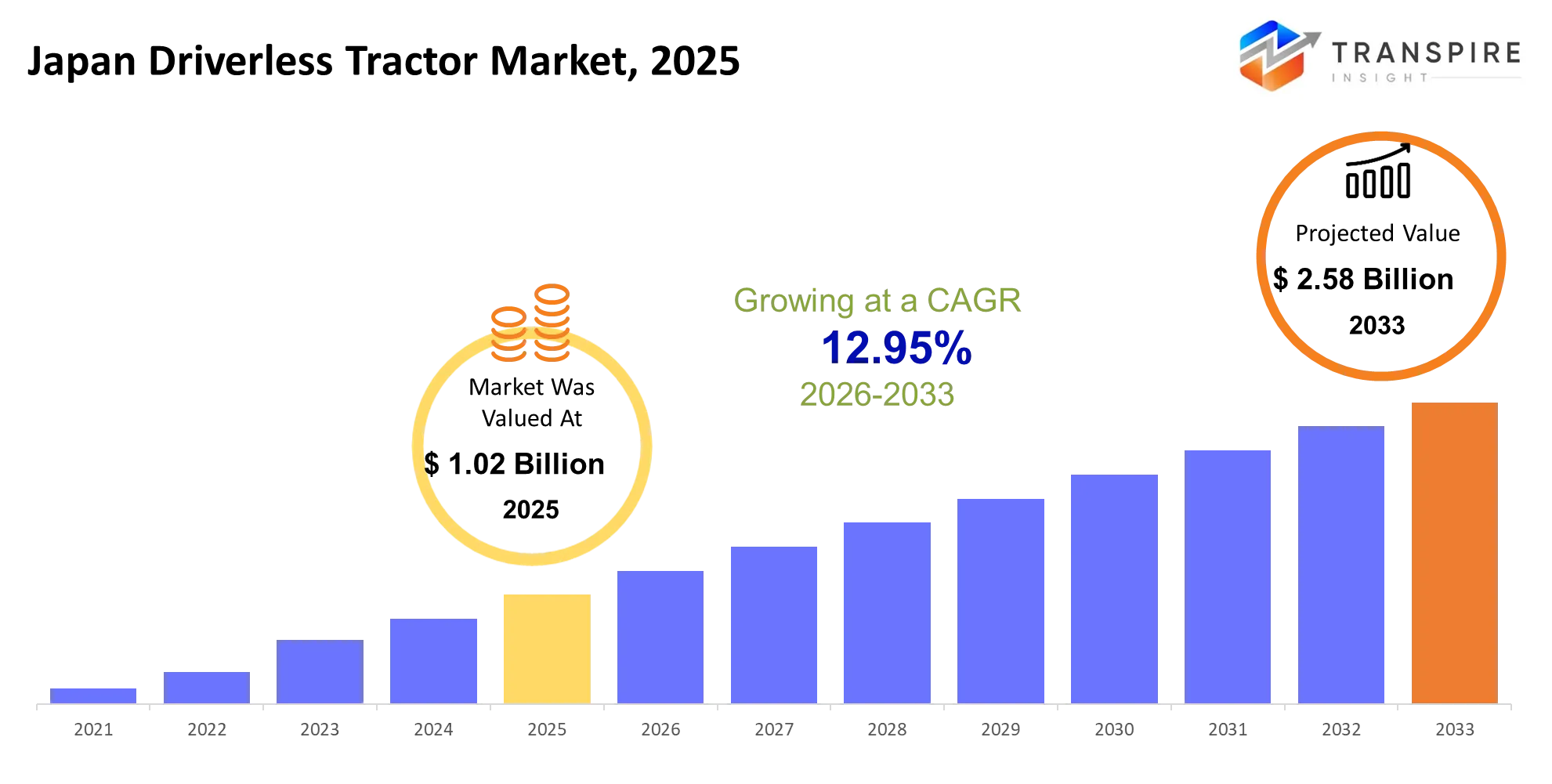
- Market Value (2025): USD 1.02 Billion.
- Expected Market Value (2026): USD 1.1 Billion.
- Estimated Market Value (2033): USD 2.58 Billion.
- Forecast CAGR (2026–2033): 12.95%
Introduction
The Japan agricultural driverless tractor market includes the production, development of software and the implementation of self-driving tractors used to carry out farming operations such as ploughing, tilling, spraying and harvesting without any human control. This includes the use of GPS technology, IoT and AI to move around the field and maneuver around any obstacle. Drivers/ Autonomous Tractor is a self-moving farming machine fitted with GPS, LiDAR, cameras and AI software for carrying out various agricultural operations (tilling, seeding and spraying) without human presence inside the cab. Operational and productivity benefits associated with driverless tractors in Japan. Labor Crisis Solution minimizes reliance on agricultural workforce by allowing unmanned and supervised operation of the tractor. 24/7 Work provides prolonged field operation, thus ensuring that timely plowing, tilling, and spraying are performed. Precision Efficiency utilizes GPS, artificial intelligence, and automated steering for higher efficiency of material application, less overlap, and reduced wastage of inputs. Safety Enhancement incorporates the use of LiDAR sensors, AI cameras, obstacle detection, and emergency brake systems, ensuring safer autonomous operations. Improved sustainability due to introduction of electric and hydrogen-powered tractors providing low-emission agricultural mechanization solutions.
Key Market Highlights: -
- By tractor type, the Utility Tractors segment dominated the market and holds nearly 46% share in 2025 and is projected to grow at a substantial CAGR during the forecast period.
- By application, the Plowing segment dominated the market and holds nearly 38% share in 2025 and is projected to grow at a substantial CAGR during the forecast period.
- By end user, the Large Farms segment dominated the market and holds nearly 48% share in 2025 and is projected to grow at a substantial CAGR during the forecast period.
- The Smart Agriculture Initiative: In order to implement smart agriculture, the Ministry of Agriculture, Forestry, and Fisheries (MAFF) of Japan has initiated several programs like subsidies, demonstrations in the field, and implementation of technology. These initiatives will facilitate the use of artificial intelligence, robotics, autonomous equipment, and precision farming in Japan, leading to mechanized agriculture.
How is Technology Driving Growth in the Japan Driverless Tractor Market?
AI, IoT, and high-resolution GNSS/GPS are revolutionizing Japan's driverless tractor market with autonomous field management, live obstacle sensing, and precise resource usage. Smart farming involves the use of information obtained from the soil and agricultural equipment for effective operation. Digital twins and cloud robotics aid virtual testing, remote tracking, and predictive maintenance. Government programs through Japan's Ministry of Agriculture, Forestry, and Fisheries (MAFF) are aimed at the adoption of smart agriculture through demonstration and infrastructure development. The QZSS navigation system offers better navigational precision. In the meantime, manufacturers are focusing on energy-efficient innovations like hydrogen-fueled autonomous tractors and small tractor models ideal for Japanese agriculture.
Market Drivers
Several factors contribute to the driverless tractors market of Japan. Firstly, the aging farming population and shrinking rural demographics are fueling the adoption of self-driving tractors which help farmers to depend less on the labor force. Labor shortage is also driving the adoption of driverless tractors especially for performing repetitive and highly precise tasks in the farm field. Smart agriculture initiatives by the government are also promoting the use of robot and precision farming technology among farmers. In addition to this, technological integration which includes artificial intelligence based obstacle detection systems, high accuracy GNSS systems, IoT connected systems, 5G communication systems, and autonomous control systems is improving efficiency in operations. The driverless tractors have many benefits in terms of operations and economy for agriculture in Japan. 24/7 Efficiency means that the autonomous equipment is able to work in a continuous manner on the fields for long hours because of repetitive operations during certain periods of time. Labor Cost and Availability Reduction means that it decreases dependency on manpower and allows remote monitoring of the agricultural processes. Precision and Resource Management helps to plant in an accurate way and applies fertilizers and chemicals properly and economically. Safety and Navigation helps the autonomous tractor to navigate around the agricultural site with the help of sensors and positioning systems.
Restrain
The market for Japan’s driverless tractors has a very high entry cost, making the technology unavailable to small-scale and part-time farmers. Geographical factors such as narrow fields, terraced land, and hilly landscape have been a hindrance to the use of autonomous machines. Farm abandonment and reduction in number of farming households has also been a limitation on the target audience.
|
Driver |
Relative Impact on Growth (%) |
Geographic Relevance |
Impact Timeline |
Demand Strength |
Growth Mechanism |
Key Beneficiaries |
Major Constraint |
|
Driver 1: Agricultural Labor Shortages and Aging Workforce |
30% |
Nationwide; rural farming regions |
Short-term |
High |
Automates repetitive tasks amid persistent labor shortages |
Tractor manufacturers, large farms, agricultural service providers |
High acquisition costs limit small-farm adoption |
|
Driver 2: Government Smart-Agriculture Support and Regulatory Enablement |
23% |
Nationwide; smart-agriculture demonstration regions |
Short-term |
High |
Subsidies and policy support accelerate autonomous machinery deployment |
Farmers, technology vendors, machinery manufacturers |
Subsidy eligibility and implementation requirements constrain access |
|
Driver 3: Advances in Autonomous Navigation and AI Technologies |
20% |
Nationwide; technology-intensive farming areas |
Medium-term |
High |
AI, GNSS, sensors improve autonomous precision and safety |
Robotics firms, OEMs, precision-agriculture providers |
Complex terrain challenges autonomous navigation reliability |
|
Driver 4: Precision Farming and Productivity Optimization |
15% |
Hokkaido, Tohoku, Kanto, Kyushu |
Medium-term |
Medium |
Automated guidance improves field efficiency and input utilization |
Commercial farms, OEMs, farm-management technology providers |
Fragmented and irregular fields restrict operational efficiency |
|
Driver 5: Remote Monitoring and Unmanned Tractor Adoption |
12% |
Nationwide; larger commercial farms |
Long-term |
Medium |
Remote supervision reduces onsite labor requirements |
Farmers, OEMs, telematics providers, service companies |
Connectivity and safety-system requirements increase complexity |
Analysis of Prices and Consumer Behaviour
Driverless tractor market growth can be attributed to the rising demand for autonomous agricultural equipment that has been driven by labor shortage, the aging agricultural workforce, and the adoption of smart farming solutions. Autonomous tractors are more expensive than traditional tractors since they feature modern GNSS/RTK positioning, autonomous control systems, obstacles detection, and remote monitoring solutions. In 2025, tractors accounted for 41.30% of total revenue generated by agricultural machinery in Japan. The adoption of fully autonomous agricultural equipment is expected to grow at a CAGR of 11.68% from 2021 to 2031. Purchasing decisions of customers are becoming more focused on autonomous functionality, precision control, safety, labor savings, and technological features. The share of authorized dealerships in agricultural machinery distribution channels amounted to 91.10% in 2025.
Who are the Key Players in the Japan Driverless Tractor Market and how do they compete?
Competition in the Japanese market for driverless tractors can be ensured through enterprises specializing in autonomous technology, precision farming systems, innovative navigation systems, and agricultural machines innovations. Competitive not only because of the price but also due to autonomous features, GNSS/RTK navigation, obstacle detection via AI, remote monitoring, and the integration with smart farming platforms, such a competitive strategy will contribute to the constant development of the product line while increasing productivity and efficiency for farmers.
By creating solutions for autonomous tractors, precision farming, and remote monitoring, Kubota Corporation increases its competitive advantage in the market. By manufacturing advanced agricultural machinery with autonomous features and navigation, Yanmar Holdings differentiates itself from other companies. Advanced agricultural machines and solutions for smart farming developed by ISEKI & Co., Ltd. give an advantage over other companies in the market.
Top Companies in the Japan Driverless Tractor Market
- Kubota
- Yanmar
- Iseki
- Mitsubishi Mahindra Agricultural Machinery
- John Deere
- CNH Industrial
- AGCO
- CLAAS
- Fendt
- Deutz-Fahr
- SDF Group
- Topcon
- Trimble
- Raven Industries
- Naïo Technologies
|
Company |
Est. Revenue Share Range |
Key Offerings |
Strategic Positioning |
Geographic Strength |
Technology Focus |
|
Kubota Corporation |
25–32% |
Agri Robo Tractors, MR Series, autonomous agricultural machinery, remote monitoring |
Domestic leadership through integrated smart agriculture solutions |
Japan, Asia Pacific, North America |
AI autonomy, GNSS, obstacle detection, remote monitoring |
|
Yanmar Holdings Co., Ltd. |
18–24% |
YT Robot Tractors, Auto Tractors, SMARTPILOT®, RTK-GNSS systems |
Automation-led differentiation across multiple tractor segments |
Japan, Asia Pacific, Europe |
RTK-GNSS, autonomous driving, tablet control, robotics |
|
ISEKI & Co., Ltd. |
10–15% |
TJV5 Robot Tractor, automatic steering tractors, smart agricultural machinery |
Specialized Japanese robotics and precision-farming positioning |
Japan, Asia Pacific |
RTK-GNSS, automated routing, robotic operation |
|
Mitsubishi Mahindra Agricultural Machinery Co., Ltd. |
5–9% |
Tractors, automatic steering systems, smart farming machinery |
Value-oriented machinery with precision technology integration |
Japan, Asia Pacific |
GNSS guidance, automation, precision-control systems |
|
Nihon New Holland Co., Ltd. |
4–7% |
New Holland tractors, GNSS guidance, precision-farming systems |
Imported high-performance machinery and technology integration |
Japan, Europe, North America |
GNSS guidance, ISOBUS, precision agriculture |
|
John Deere |
3–6% |
Autonomous tractor technology, AutoTrac, precision agriculture systems |
Global autonomy expertise targeting advanced farming operations |
North America, Europe, Asia Pacific |
AI autonomy, computer vision, GNSS, automation |
|
AGCO Corporation |
2–5% |
Fendt tractors, precision farming systems, guidance technologies |
Premium precision farming and automation specialization |
Europe, North America, Asia Pacific |
RTK guidance, automation, telemetry, precision control |
|
CLAAS KGaA GmbH |
1–4% |
Tractor systems, CEMOS, GPS PILOT, digital farming solutions |
Precision automation integrated with farm machinery |
Europe, Asia Pacific |
GPS guidance, machine automation, digital farming |
|
Topcon Corporation |
1–3% |
AGS-2, Value Line, automated steering systems, GNSS solutions |
Technology-focused precision-navigation and retrofit specialization |
Japan, North America, Europe |
Multi-GNSS, RTK positioning, automated steering |
|
Nikon-Trimble Co., Ltd. |
1–3% |
High-G, Trimble guidance, CenterPoint RTX, GNSS positioning |
High-precision positioning technology for agricultural automation |
Japan, North America, Europe |
RTK, PPP, GNSS correction, precision guidance |
Japan Driverless Tractor Market Segmentation
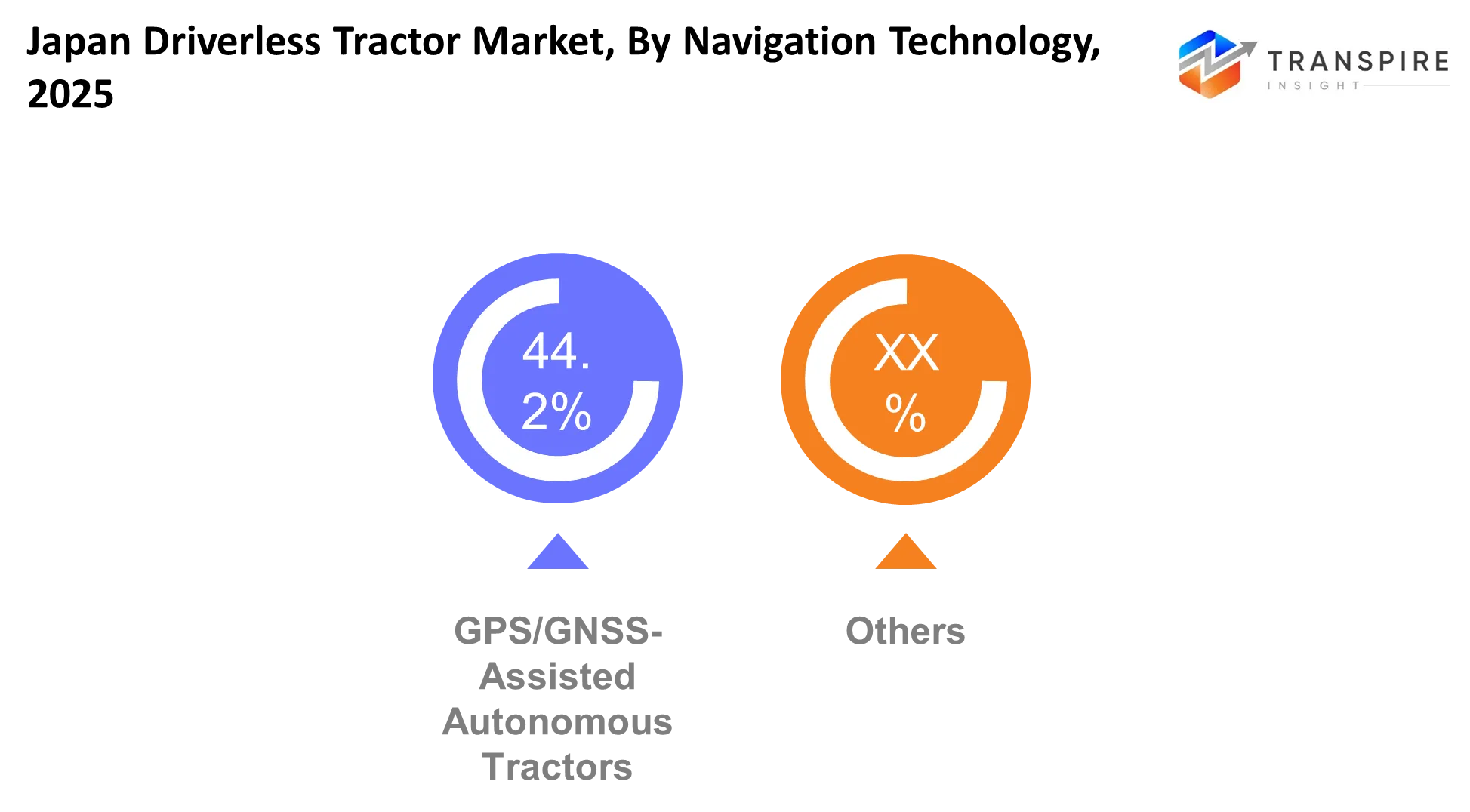
The Japan Driverless Tractor Market share is divided into six categories: By tractor type, automation level, application, power, navigation technology and end user.
The Utility Tractors dominated the market, accounting for nearly 46% in 2025 and is expected to rise at a significant CAGR during the forecast period.
The Japan Driverless Tractor Market is segmented by tractor type into Autonomous Tractors, Semi-Autonomous Tractors, Electric Autonomous Tractors, Hybrid Tractors, Compact Tractors, Utility Tractors, Row-Crop Tractors, Specialty Tractors. Among these, the Utility Tractors segment dominated the market, accounting for nearly 46% in 2025 and expected to increase at a significant CAGR during the forecast period. Utility tractors held a major share of around 46% in 2025 and estimated to witness a considerable CAGR over the forecast period. This high market share can be attributed to its usage for multiple applications such as plowing, tilling, seeding, transportation, and farming operations in general. Increasing need for versatile agriculture equipment and machinery along with labor saving equipment is anticipated to increase utility tractor installations, especially in commercial farms.
The Plowing dominated the market, accounting for nearly 38% in 2025, and is expected to rise at a significant CAGR during the forecast period.
The Japan Driverless Tractor Market is segmented by application into Plowing, Seeding, Harvesting, Spraying, Tillage, Fertilization, Mowing, Material Handling. Among these, the Plowing segment dominated the market, accounting for nearly 38% in 2025 and expected to increase at a significant CAGR during the forecast period. The Plowing accounted for a considerable share of nearly 38% in 2025, and it is projected to grow significantly during the forecast period at a significant CAGR. The growth is fueled by the importance of plowing in preparing the soil, seedbed preparation, weed removal, and increased crop production. The growth will also be driven by mechanization in agriculture, labor shortage, and efficiency in field operations.
The Large Farms dominated the market, accounting for nearly 48% in 2025 and is expected to rise at a significant CAGR during the forecast period.
The Japan Driverless Tractor Market is segmented by end user into Large Farms, Small Farms, Agricultural Cooperatives, Contract Farming, Government Farms, Research Farms, Greenhouses, Plantation Farms. Among these, the Large Farms segment dominated the market, accounting for nearly 48% in 2025 and expected to increase at a significant CAGR during the forecast period. The Large Farms segment has major shares in the industry, having 48% in 2025 and is estimated to have a notable CAGR over the forecast period. The high share held by the segment is due to the need for more mechanization, labor shortage, and demand for self-driving agricultural machinery. The Large Farms derive benefits out of the self-driving tractors because of efficiency, precision, less dependence on labor, etc.
Future Market Trends for the Japan Driverless Tractor Market: -
- Integration with AI & 5G/IoT: Robotractors utilize fast 5G communication and artificial intelligence technology to achieve real-time navigation and cloud-based fleet management systems.
- Pocket-Friendly & Custom-Made: The emphasis is laid on designing compact and mid-size farm vehicles that are compatible with narrow, terraced, and small-scale rice paddies in Japan.
- Zero-Emission & Eco-Friendly: Rising trends of zero emissions are bringing about a massive shift towards electrically powered driverless tractors.
- Synchronized Farm Work: Latest technological advancements allow a single person to control and manage several unmanned tractors at the same time.
- Domestic Development & Export Markets: Domestic leaders such as Kubota, Yanmar, and Iseki are expanding their automated range in their domestic market as well as expanding in export markets of Asia.
- Costly but Secure: Research & Development efforts emphasize cost reduction and cybersecurity concerns for small-to-medium farms.
Recent Development
- In August 2026: The Kubota Corporation introduced the Agri Robo Tractor MR Series, set to be launched in Japan in April 2027. This tractor is equipped with tablet-controlled remote monitoring, AI camera, millimeter wave radar, and advanced positioning systems, which aid in achieving autonomous operation and enhanced safety, among others.
- In June 2026: The Japanese company Yanmar introduced its new YT4S/5S Series, which consisted of four variants ranging between JPY 13.013 million to JPY 18.249 million. These high precision tractors are provided with straight line assistance using RTK-GNSS technology and will help in the transition towards precision farming in Japan.
Market Segment
This study forecasts revenue at Japan, regional and country levels from 2020 to 2033. Transpire Insight has segmented the Japan Driverless Tractor Market based on the below-mentioned segments:
Japan Driverless Tractor Market, By Tractor Type
- Autonomous Tractors
- Semi-Autonomous Tractors
- Electric Autonomous Tractors
- Hybrid Tractors
- Compact Tractors
- Utility Tractors
- Row-Crop Tractors
- Specialty Tractors
Japan Driverless Tractor Market, By Automation Level
- Level 1
- Level 2
- Level 3
- Level 4
- Level 5
- GPS-Assisted
- Remote-Controlled
- Fully Autonomous
Japan Driverless Tractor Market, By Application
- Plowing
- Seeding
- Harvesting
- Spraying
- Tillage
- Fertilization
- Mowing
- Material Handling
Japan Driverless Tractor Market, By Power
- Below 50 HP
- 50–100 HP
- 100–150 HP
- 150–200 HP
- 200–300 HP
- 300–400 HP
- Above 400 HP
- Electric Power
Japan Driverless Tractor Market, By Navigation Technology
- GPS/GNSS
- LiDAR
- Radar
- Computer Vision
- RTK
- AI
- Sensor Fusion
- Remote Monitoring
Japan Driverless Tractor Market, By End User
- Large Farms
- Small Farms
- Agricultural Cooperatives
- Contract Farming
- Government Farms
- Research Farms
- Greenhouses
- Plantation Farms
Frequently Asked Questions
Find quick answers to common questions.
Labor shortages, aging farmers, smart-agriculture policies, precision farming, and AI-enabled autonomous technologies are accelerating Japan’s driverless tractor market growth.
Utility Tractors dominated with nearly 46% in 2025, supported by their versatility across plowing, tilling, seeding, transportation, and farming operations.
AI, GNSS, RTK, sensors, radar, and remote monitoring improve autonomous navigation, precision, safety, productivity, and operational efficiency across Japanese farms.
Plowing dominated with nearly 38% in 2025, driven by soil preparation requirements, agricultural mechanization, labor shortages, and efficient field operations.
Large Farms dominated with nearly 48% in 2025, driven by mechanization needs, labor shortages, autonomous machinery adoption, productivity improvements, and resource optimization.
- Kubota
- Yanmar
- Iseki
- Mitsubishi Mahindra Agricultural Machinery
- John Deere
- CNH Industrial
- AGCO
- CLAAS
- Fendt
- Deutz-Fahr
- SDF Group
- Topcon
- Trimble
- Raven Industries
- Naïo Technologies
About the Authors

Mayur Shinde
I am Mayur Shinde, a Senior Research Analyst at Transpire Insight, specializing in the Automotive & Transportation and Information & Communication Technology (ICT) Industry. My work focuses on analyzing emerging market trends, technological advancements, competitive landscapes, and industry developments to deliver accurate, data-driven insights. I am passionate about transforming complex market information into clear, actionable content that helps businesses, professionals, and decision-makers stay informed and make confident strategic decisions.

Chakradhar Khansole
Chakradhar serves as the Research Director at Transpire Insight, bringing over 8 years of experience in technology, innovation, and strategic market intelligence. He specializes in transforming complex market data into actionable business insights that enable organizations to make informed, growth-oriented decisions. Recognized for his strategic vision and analytical expertise, Chakradhar leads high-impact research initiatives, delivering comprehensive market assessments, competitive intelligence, and forward-looking industry analysis.
Recently Published Reports
-
Apr 2026
ATV & UTV Market
ATV & UTV Market Size, Share & Analysis Report By Type (ATV, and UTV), By Variants (Less Than 400 CC, 400 CC To 800 CC, and More Than 800 CC), and Geography (North America, Europe, Asia-Pacific, Middle East and Africa, South and Central America), 2021 - 2031
-
Apr 2026
Automotive Central Gateway Module Market
Automotive Central Gateway Module Market Size, Share & Analysis Report By Type (Ethernet Central Gateway Module, CAN Central Gateway Module, LIN Central Gateway Module, and FlexRay), By Application (Powertrain Control, Body Control, Infotainment System, Advanced Driver Assistance Systems (ADAS), and Others), By End User (Passenger Vehicles, and Commercial Vehicles), and Geography (North America, Europe, Asia-Pacific, Middle East and Africa, South and Central America), 2021 - 2031
-
Apr 2026
Automotive Engine Oil Filter Market
Automotive Engine Oil Filter Market Size, Share & Analysis Report By Filter Type (Fuel Filter, Engine Oil Filter, Hydraulic Oil Filter, and Others), By Filter Media (Cellulose, Synthetic, and Micro), By Sales Channel (OEMs, and Aftermarket), By Vehicle Type (Passenger Cars, Light Commercial Vehicles, Heavy Duty Trucks, Buses and Coaches, and Off-road Vehicles), and Geography (North America, Europe, Asia-Pacific, Middle East and Africa, South and Central America), 2021 - 2031
-
Apr 2026
Automotive Parts Aluminium Die Casting Market
Automotive Parts Aluminium Die Casting Market Size, Share & Analysis Report By Production Process (Pressure Die Casting, Vacuum Die Casting, Squeeze Die Casting, Gravity Die Casting), By Application (Body Parts, Engine Parts, Transmission Parts, Battery And Related Components, Other Application Types), and Geography (North America, Europe, Asia-Pacific, Middle East and Africa, South and Central America), 2021 - 2031
Our Clients



