
Japan Diamond Blackfan Anemia Treatment Market Size & Forecast:
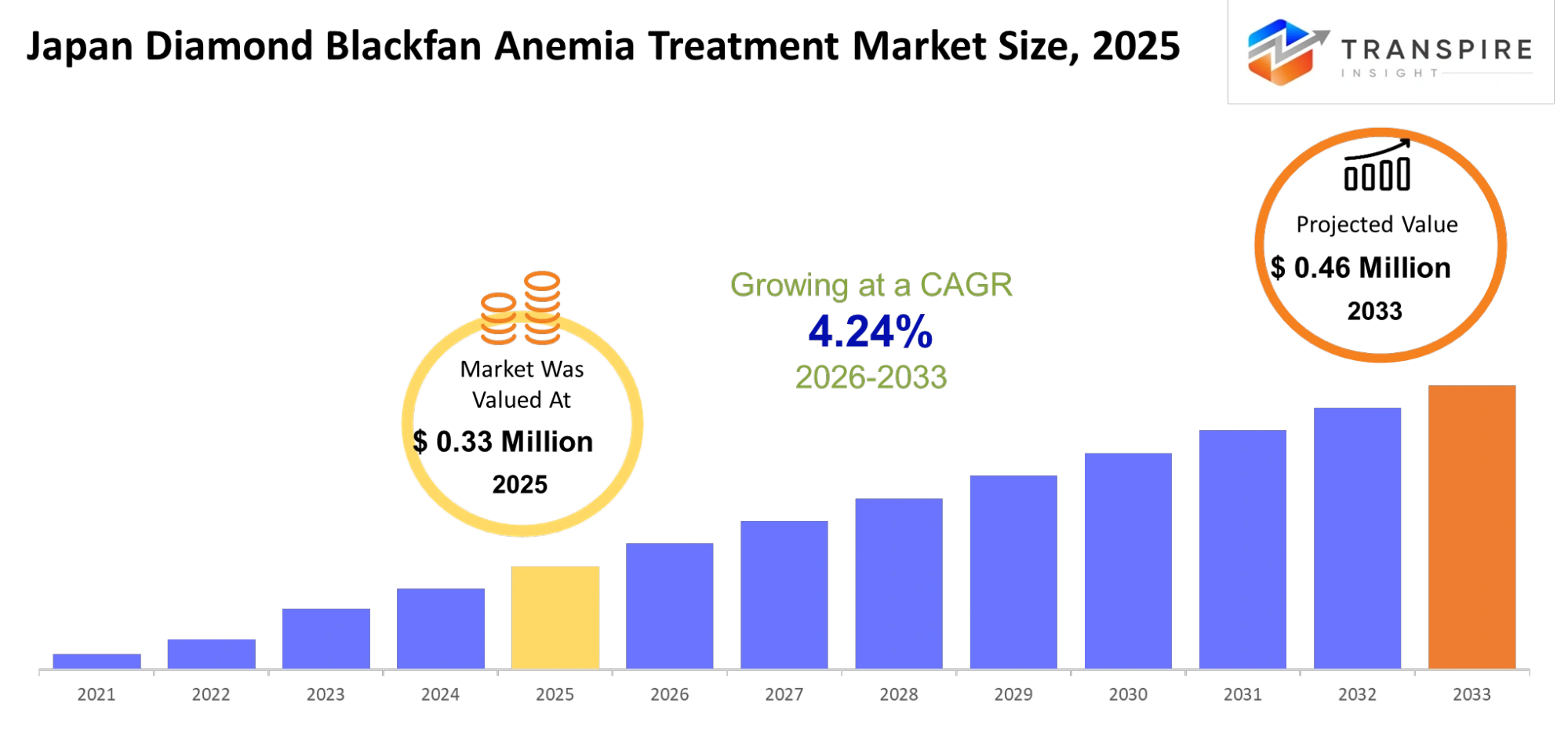
- Japan Diamond Blackfan Anemia Treatment Market Size 2025: USD 0.33 Million
- Japan Diamond Blackfan Anemia Treatment Market Size 2033: USD 0.46 Million
- Japan Diamond Blackfan Anemia Treatment Market CAGR: 4.24%
- Japan Diamond Blackfan Anemia Treatment Market Segments: By Type (Corticosteroids, Blood Transfusion, Stem Cell Therapy, Others); By Application (Anemia Treatment, Genetic Disorders, Others); By End-User (Hospitals, Clinics, Research Institutes, Others); By Distribution (Hospitals, Pharmacies, Others)
To learn more about this report,  Download Free Sample Report
Japan Diamond Blackfan Anemia Treatment Market Summary:
The Japan Diamond Blackfan Anemia Treatment Market size is estimated at USD 0.33 Million in 2025 and is anticipated to reach USD 0.46 Million by 2033, growing at a CAGR of 4.24% from 2026 to 2033.
The japan diamond blackfan anemia treatment market, positioned within Japan’s rare disease therapeutics industry, will continue to reflect the country’s focused approach toward precision medicine and ultra-specialized hematology care. The market has evolved through a gradual process which transformed general treatment methods into specific therapeutic pathways that match each patient's unique genetic makeup.
Clinical attention will increasingly center on earlier diagnosis through expanded neonatal and pediatric screening practices which Japan's advanced hospital network and strong academic research partnerships will support. Patient expectations have also changed because families want treatment options which will decrease their need for corticosteroids while minimizing the frequency of blood transfusions. The demand shift will increase research efforts on treatments which create long-term blood count stability while medical facilities will focus on care methods that enhance patient wellbeing and treatment results.
The Japan diamond blackfan anemia treatment market will experience ongoing changes because technological advancements will create new opportunities through gene-editing research and stem cell treatments and biomarker-based treatment monitoring. Japanese pharmaceutical developers and university-led research institutions will likely deepen collaborations to accelerate clinical validation for next-generation therapies tailored to rare inherited bone marrow disorders. The regulatory process has undergone substantial changes because Japan's orphan drug support system now offers accelerated review procedures for drugs which target small populations of patients with rare diseases.
The current system enables medical professionals to monitor patients while assessing their progress through digital health technologies which have been integrated into specialist hospitals. The upcoming changes will transform the market into a specialized scientific field which operates within the Japanese healthcare system to develop personalized treatment methods that produce measurable results for patients.
What Has the Impact of Artificial Intelligence Been on the Japan Diamond Blackfan Anemia Treatment Market?
The healthcare industry and rare disease treatment methods undergo transformation from artificial intelligence while AI increasingly affects the Japanese diamond blackfan anemia treatment market. The Japanese diamond blackfan anemia treatment market research benefits from AI technology which enables researchers to analyze clinical data with better speed and accuracy while pharmaceutical companies and healthcare providers can use the data to identify treatment patterns and patient response rates and upcoming market developments.
The Japan diamond blackfan anemia treatment market stakeholders use machine learning and predictive analytics to determine disease prevalence and assess therapy effectiveness while they make evidence-based treatment development decisions. The implementation of artificial intelligence technology in Japan's diamond blackfan anemia treatment market operations results in improved operational efficiency for all production and distribution processes.
Smart automation enables faster processing of clinical trial data, while predictive analytics improves demand forecasting for corticosteroids, blood transfusion therapies, and stem cell-based treatments. The Japan diamond blackfan anemia treatment market companies use this technology to enhance supply chain operations while they decrease expenses and provide patients with timely access to necessary treatments.
Researchers use AI-driven personalization to develop treatment methods that match genetic information and patient-specific data. The diamond blackfan anemia treatment market in Japan uses artificial intelligence to create competitive advantages through its support of precision medicine and development of market intelligence and fast response capabilities to changing healthcare needs in Japan.
Key Market Trends & Insights:
- Kanto holds 2025 market leadership with 41.9% market share because of its advanced hospital facilities and dedicated hematology treatment centers.
- The Kansai region stands as the second-largest area because of its established academic research partnerships and biotechnology funding activities.
- Chubu serves as the fastest-growing region which will expand at 6.4% CAGR until 2032 because of rising healthcare modernization projects.
- The Japanese diamond blackfan anemia treatment market is dominated by corticosteroid therapies which will account for 48% market share in 2025.
- Blood transfusion-based supportive treatments serve as the second-largest treatment method which operates with high clinical use in pediatric treatment centers.
- Stem cell transplantation represents the most rapidly expanding sector which will continue to experience strong growth until 2032 because of its connection to regenerative medicine.
- The market demonstrates dominance in pediatric treatment applications which account for approximately 68% of total market share because early diagnosis occurs more frequently in infant and child patient populations.
- The application of personalized genomic therapy shows the fastest growth because of new developments in molecular diagnostics and targeted therapeutic treatments.
- Specialty hospitals control about 56% of the market because their facilities offer comprehensive hematology services through their various medical specialists.
- The end-user category of research institutes currently shows the highest growth rate because clinical trials and translational rare disease studies are increasing.
Japan Diamond Blackfan Anemia Treatment Market Segmentation
By Type :
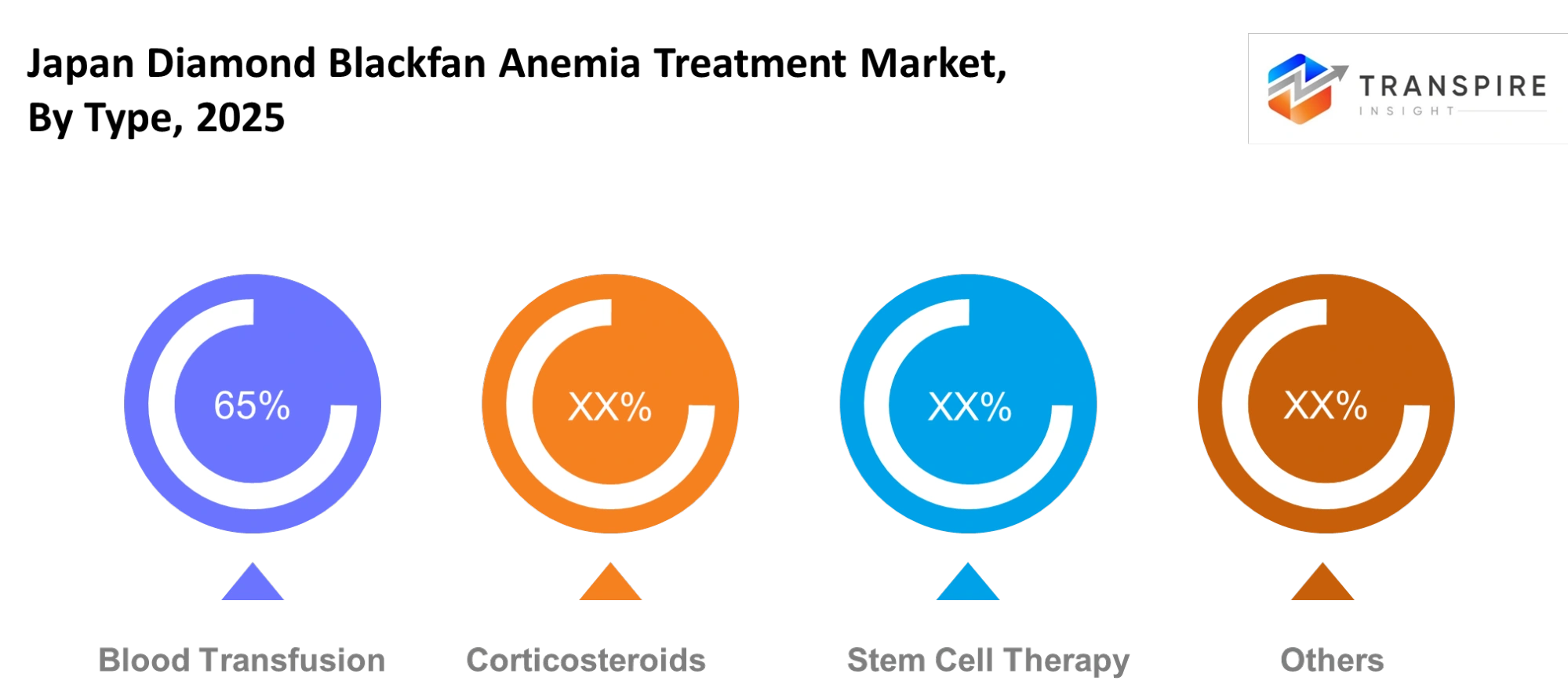
The Japan Diamond Blackfan Anemia Treatment Market shows strong demand for corticosteroids because medical professionals prefer to use them for treating early symptoms. Japanese medical facilities depend on corticosteroid treatments because doctors can track patient progress during the first treatment period. The established treatment guidelines and doctor expertise will maintain the market need for this medical approach.
Blood transfusion remains essential for patients who need ongoing red blood cell support because their primary drug treatment shows decreasing effectiveness. Stem cell therapy is gaining greater attention because research institutions and specialty hospitals focus on developing long-term treatment methods. The other category includes supportive therapies and investigational options that address patient-specific needs. The multiple treatment categories create a market balance which exists between present medical methods and upcoming medical progress.
To learn more about this report, Download Free Sample Report
By Application :
The primary treatment area for Diamond Blackfan anemia because the disorder impairs red blood cell production and needs specific medical treatment. Japanese hospitals and specialized treatment facilities still focus on methods that help patients maintain stable hemoglobin levels while enhancing their overall well-being. The application segment remains crucial for treatment requirements because effective symptom management will continue to be developed as treatment needs increase.
The genetic disorders segment is expanding as awareness regarding inherited blood conditions grows across the healthcare system. The demand for treatment strategies which address underlying genetic causes has increased because more genetic testing and diagnosis procedures are now available. The other category includes supportive care applications, monitoring services, and broader rare disease management approaches that contribute to overall treatment development within the market.
By End-User :
The Japan Diamond Blackfan Anemia Treatment Market shows hospitals as its main segment because large medical centers provide specialized treatment and advanced medical care and dedicated monitoring services. The comprehensive management of rare blood disorders requires hospitals to provide both transfusion services and stem cell-related procedures which make them the main treatment centers.
Clinics provide essential services for both medical follow-up and continuous monitoring of patients especially those with stable conditions who need regular health checks. The research institutes play a vital role in advancing both treatment studies and genetic analysis and development of new treatments. The other segment includes specialty care centers and academic medical facilities that contribute to diagnosis and treatment expansion which supports broader access to rare disease care.
By Distribution :
The distribution of hospital-based leads occurs because Diamond Blackfan anemia treatment requires specialized methods which need two particular requirements. Hospital systems handle three essential functions which include prescription management and transfusion support and direct treatment coordination. The framework guarantees correct treatment delivery while enabling continuous patient monitoring during treatment periods.
The number of pharmacies which take part in outpatient medication distribution programs through Japan's expanding medication access system. The growth of pharmacy distribution networks has resulted from better communication between healthcare specialists and retail pharmacies which provide maintenance drugs and essential medications. The market will keep growing because treatment access improves which helps develop supply chain efficiency throughout the entire industry.
What are the Main Challenges for the Japan Diamond Blackfan Anemia Treatment Market Growth?
The Japanese market for Diamond Blackfan anemia treatments encounters multiple technical and operational obstacles which restrict its potential for expansion. The treatment of rare diseases in Japan presents major challenges because its treatment protocols require long-term corticosteroid treatment combined with ongoing transfusion procedures. The limited number of available patients makes it difficult to create substantial clinical datasets while the different ways patients receive treatment prevent standardization methods to create scalable solutions. The market faces additional restrictions because of supply chain problems with specialized biologic products and their necessary supporting treatments.
Japan's Diamond Blackfan anemia treatment market encounters two main obstacles which prevent its development through manufacturing restrictions and commercial distribution challenges. The development of advanced therapies requires stem cell transplantation support systems and gene-based treatments to follow Good Manufacturing Practice standards which leads to higher production expenses and longer approval times.
The Japanese regulatory system for orphan drugs requires extensive clinical validation which results in slow market entry and hampers the commercialization process. The Japanese market for Diamond Blackfan anemia treatments faces multiple obstacles which specifically affect smaller biotechnology companies that have insufficient financial resources.
The ongoing problem of adoption challenges exists because specialized hematology centers and trained professionals only operate in major urban healthcare locations. The general public lacks essential knowledge about diagnostic procedures which leads to delays in diagnosing medical conditions and decreases the chances of receiving prompt treatment.
The market entry of new hematological treatments faces two major obstacles which include pricing pressure from reimbursement restrictions and competition from existing hematological treatment methods. The development of the Japanese diamond blackfan anemia treatment market will require innovative solutions together with infrastructure development and enhanced collaboration between public and private sectors to overcome existing structural and technological challenges.
Country Insights
The Japan Diamond Blackfan Anemia Treatment Market develops at a constant pace because hospitals and diagnostic laboratories and hematology centers operate throughout major urban areas. Timely diagnosis receives support from early screening programs and bone marrow evaluation access. Academic medical institutions create better clinical coordination by developing treatment pathways for rare blood disorder management.
The country continues expanding rare disease research through collaboration between biotechnology firms, universities, and public health agencies. Clinical studies focused on corticosteroid response, stem cell transplantation outcomes, and supportive care methods are creating valuable treatment data. Regulatory bodies will expedite their evaluation process for new treatment options which medical researchers are developing as they increase their focus on orphan disease therapies.
Medical professionals have become more aware about genetic testing which has led to improved diagnosis rates and increased demand for targeted care solutions. The healthcare system will become more effective at treating rare diseases because reimbursement programs and precision medicine investments will support rare disease management. The market will expand as healthcare spending on rare hematologic conditions increases and specialized therapy innovations emerge.
Recent Development News
In March 2026, Epifrontier Therapeutics received major public funding support. The company secured up to $32 million from Japan’s AMED to advance EPF-001, a therapy targeting blood disorders including beta thalassemia, into Phase 2 trials, reflecting growing investment in rare hematologic treatments relevant to DBA pathways.Sourcehttps://sicklecellanemianews.com/
In April 2026, Takeda Pharmaceutical Company announced the upcoming fiscal year 2025 earnings disclosure. Takeda confirmed its FY25 earnings call for May 13 following continued investment updates across rare disease and hematology portfolios relevant to Japan’s orphan blood-disorder treatment ecosystem.Sourcehttps://www.takeda.com/
|
Report Metrics |
Details |
|
Market size value in 2025 |
USD 0.33 Million |
|
Market size value in 2026 |
USD 0.344 Million |
|
Revenue forecast in 2033 |
USD 0.46 Million |
|
Growth rate |
CAGR of 4.24% from 2026 to 2033 |
|
Base year |
2025 |
|
Historical data |
2021 - 2024 |
|
Forecast period |
2026 - 2033 |
|
Report coverage |
Revenue forecast, competitive landscape, growth factors, and trends |
|
Country scope |
Japan |
|
Key company profiled |
Pfizer, Novartis, Roche, Bristol Myers Squibb, Sanofi, GSK, AstraZeneca, Takeda, AbbVie, Amgen, Eli Lilly, Johnson & Johnson, Bayer, Teva, Biogen |
|
Customization scope |
Free report customization (country, regional & segment scope). Avail customized purchase options to meet your exact research needs. |
|
Report Segmentation |
By Type (Corticosteroids, Blood Transfusion, Stem Cell Therapy, Others); By Application (Anemia Treatment, Genetic Disorders, Others); By End-User (Hospitals, Clinics, Research Institutes, Others); By Distribution (Hospitals, Pharmacies, Others) |
How Can New Companies Establish a Strong Foothold in the Japan Diamond Blackfan Anemia Treatment Market?
New businesses that want to enter the Japan diamond blackfan anemia treatment market need to search for particular treatment solutions which exist within the rare disease therapeutics field. The companies need to develop precision medicine solutions together with biomarker-based treatments and specific therapies which match existing clinical requirements because the patient group exhibits restricted size. The Japan diamond blackfan anemia treatment market research requires organizations to discover existing treatment deficiencies which exist in current corticosteroid and transfusion methods while their development efforts must comply with both industry developments and Japan orphan drug research regulations.
The establishment of strategic partnerships functions as a fundamental requirement which enables market expansion while companies establish their credibility. New businesses can establish themselves within the Japan diamond blackfan anemia treatment market by forming partnerships which include academic hematology research institutes and specialty hospitals and established pharmaceutical companies.
These partnerships enable new market entrants to obtain access to clinical trial networks and regulatory knowledge and advanced manufacturing resources. The use of AI-powered systems for patient monitoring together with predictive analytics and genomic diagnostics enables businesses to establish market differentiation which leads to enhanced treatment personalization and improved patient outcomes.
The continuing development of new companies shows how existing businesses should approach entering new markets. The research and development expenditures which Beam Therapeutics and Rocket Pharmaceuticals direct toward their gene therapy systems produce their ability to penetrate the rare blood disorders market. The Japanese diamond blackfan anemia treatment market needs solutions which startups can develop through their adoption barrier research and their cost reduction methods and their development of marketable solutions which suit Japan's strict healthcare regulations.
Key Japan Diamond Blackfan Anemia Treatment Market Company Insights
The Japan Diamond Blackfan Anemia Treatment Market demonstrates controlled market competition which results from restricted patient numbers and the existence of specialized medical expertise and particular pharmaceutical companies. Established biotechnology firms, hospital-linked research groups, and rare disease therapy developers continue strengthening treatment access through improved corticosteroid formulations, supportive transfusion management, and stem cell transplantation advancements. The regulatory framework which backs orphan drug development has created a steady commercial progression.
The market will depend on strategic academic partnerships with pharmaceutical companies as its primary method for establishing market presence. Major healthcare centers will receive ongoing funding for research on gene-based treatments and precision diagnostic systems and rare disease education programs. Market participants establish distribution networks and clinical trial participation and specialist treatment access to maintain their long-term presence in Japan's highly regulated healthcare system.
Company List
- Pfizer
- Novartis
- Roche
- Bristol Myers Squibb
- Sanofi
- GSK
- AstraZeneca
- Takeda
- AbbVie
- Amgen
- Eli Lilly
- Johnson & Johnson
- Bayer
- Teva
- Biogen
What are the Key Use-Cases Driving the Growth of Japan Diamond Blackfan Anemia Treatment Market?
The japan diamond blackfan anemia treatment market experiences its most significant growth through use-case applications which enable doctors to identify their patients' medical conditions at their initial stage and maintain their health throughout their lives from their first diagnosis. The demand for advanced diagnostic screening and genetic testing and early therapeutic intervention keeps growing because Diamond Blackfan anemia usually gets diagnosed during the first year of life.
The clinical applications create a market expansion for diamond blackfan anemia treatment in Japan because they provide quick diagnoses and better treatment solutions to hematology centers throughout the country. The Japan diamond blackfan anemia treatment market uses corticosteroid therapy management and chronic blood transfusion support as its primary treatment method.
The treatment methods function as essential tools which help doctors control red blood cell production in their patients who need treatment but cannot receive immediate curative solutions. Digital monitoring tools together with predictive treatment management systems have become standard equipment for hospitals and specialty care providers because these systems help doctors create better dosage plans which reduce their patients' future health problems. The healthcare sector in Japan sees better patient outcomes through precision healthcare technology implementation which hospitals and healthcare facilities throughout the country are now adopting.
The Japanese market for Diamond Blackfan Anemia treatment currently experiences major innovation development through new stem cell transplant methods and gene therapy treatment methods. Research institutions and biotechnology firms are focusing on regenerative medicine and genomic correction therapies to provide long-term disease resolution. The Japanese Diamond Blackfan Anemia treatment market will experience future growth through scalable innovation pathways which emerge from developments in personalized medicine and AI-based treatment modeling.
Japan Diamond Blackfan Anemia Treatment Market Report Segmentation
By Type
- Corticosteroids
- Blood Transfusion
- Stem Cell Therapy
By Application
- Anemia Treatment
- Genetic Disorders
By End-User
- Hospitals
- Clinics
- Research Institutes
By Distribution
- Hospitals
- Pharmacies
Frequently Asked Questions
Find quick answers to common questions.
The approximate Japan Diamond Blackfan Anemia Treatment Market size for the market will be USD 0.46 Million in 2033.
Key segments for the Japan Diamond Blackfan Anemia Treatment Market are By Type (Corticosteroids, Blood Transfusion, Stem Cell Therapy, Others); By Application (Anemia Treatment, Genetic Disorders, Others); By End-User (Hospitals, Clinics, Research Institutes, Others); By Distribution (Hospitals, Pharmacies, Others).
Major Japan Diamond Blackfan Anemia Treatment Market players are Pfizer, Novartis, Roche, Bristol Myers Squibb, Sanofi, GSK, AstraZeneca, Takeda, AbbVie, Amgen, Eli Lilly, Johnson & Johnson, Bayer, Teva, Biogen.
The Japan Diamond Blackfan Anemia Treatment Market size is USD 0.33 Million in 2025.
The Japan Diamond Blackfan Anemia Treatment Market CAGR is 4.24%.
- Pfizer
- Novartis
- Roche
- Bristol Myers Squibb
- Sanofi
- GSK
- AstraZeneca
- Takeda
- AbbVie
- Amgen
- Eli Lilly
- Johnson & Johnson
- Bayer
- Teva
- Biogen
Recently Published Reports
-
Apr 2026
AI in Diabetic Retinopathy Market
AI in Diabetic Retinopathy Market Size, Share & Analysis Report By Type (Screening AI Systems, Diagnostic AI Systems, and Predictive AI Models), By Application Segment (Hospitals, Ophthalmology Clinics, Diagnostic Centers, and Research and Development), and Geography (North America, Europe, Asia-Pacific, Middle East and Africa, South and Central America), 2021 - 2031
-
Apr 2026
Psychometric Tests Market
Psychometric Tests Market Size, Share & Analysis Report By Type (Personality Tests, Ability/Aptitude Tests, Skill/Knowledge Tests, and Others), By Application (Talent Acquisition and Talent Management), and Geography (North America, Europe, Asia-Pacific, Middle East and Africa, South and Central America), 2021 – 2031
-
Apr 2026
Rare Biological Sample Collection Market
Rare Biological Sample Collection Market Size, Share & Analysis Report By Type (Isolation Kits & Reagent, Blood Collection Tubes, and Others), By Application (Oncology, Transcriptomics, Pharmacogenomics, and Others), and Geography (North America, Europe, Asia-Pacific, Middle East and Africa, South and Central America), 2021 – 2031
-
Apr 2026
Patient Lift Pendant Market
Patient Lift Pendant Market By Product Type (Wired Pendants, Wireless, Programmable), By Operation Type(Manual, Electric), By End-Users (Healthcare Professionals, Patients), By Application (Hospitals, Homecare, Rehabilitation Centers, Others), By Industry Analysis, Size, Share, Growth, Trends, and Forecasts 2021-2033
Our Clients
.jpg)