
Japan Complete Androgen Insensitivity Reactivity Market Size & Forecast:
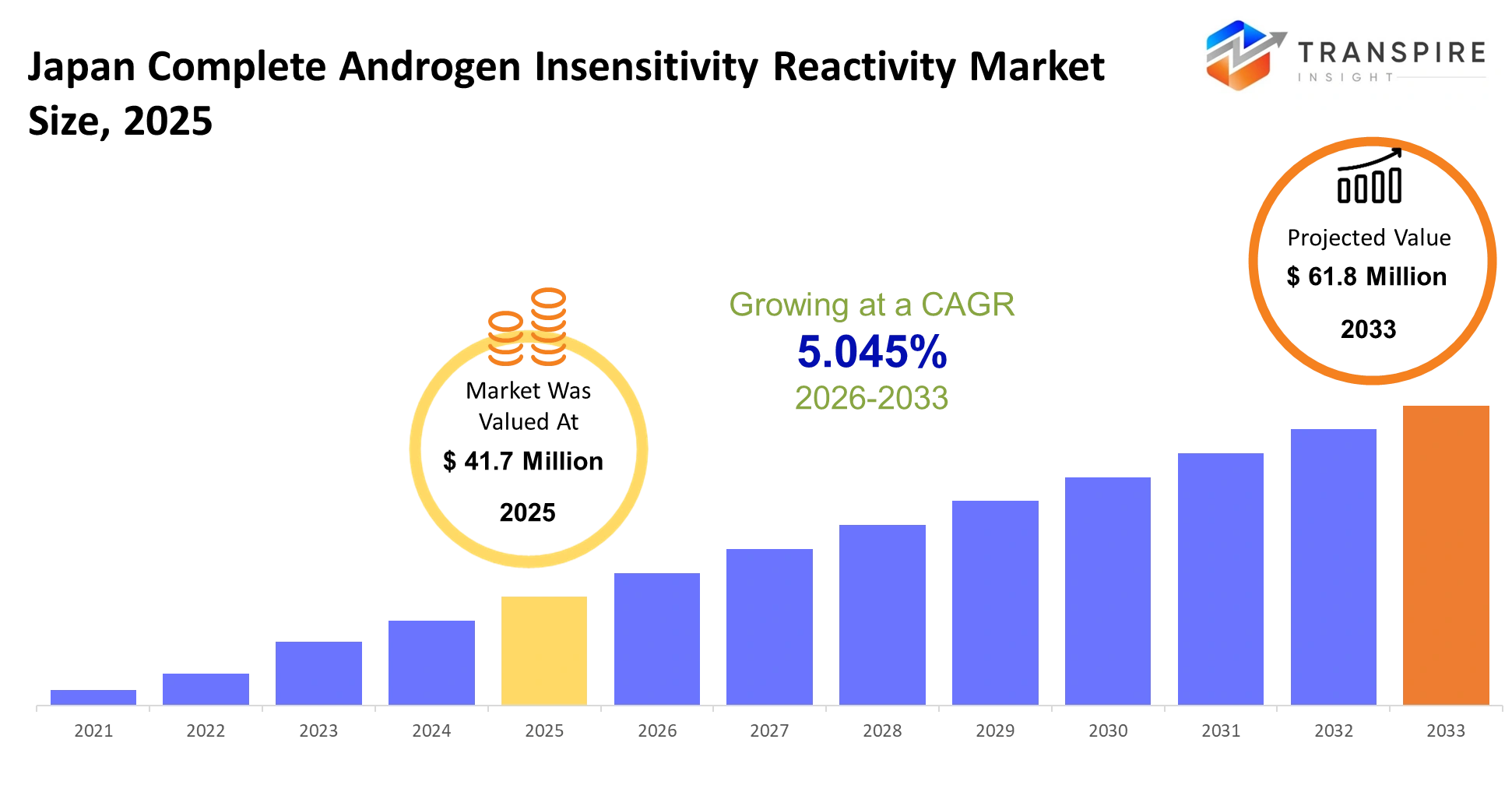
- Japan Complete Androgen Insensitivity Reactivity Market Size 2025: USD 41.7 Million
- Japan Complete Androgen Insensitivity Reactivity Market Size 2033: USD 61.8 Million
- Japan Complete Androgen Insensitivity Reactivity Market CAGR: 5.045%
- Japan Complete Androgen Insensitivity Reactivity Market Segments: By Type (Hormonal Therapy, Surgery, Diagnostics, Counseling), By Application (Hospitals, Clinics, Research Centers, Genetic Labs), By End-User (Patients, Hospitals, Clinics, Research Institutes)
To learn more about this report,  Download Free Sample Report
Japan Complete Androgen Insensitivity Reactivity Market Summary:
The Japan Complete Androgen Insensitivity Reactivity Market size is estimated at USD 41.7 Million in 2025 and is anticipated to reach USD 61.8 Million by 2033, growing at a CAGR of 5.045% from 2026 to 2033. The Japan Complete Androgen Insensitivity Syndrome market currently experiences its modern evolution through three key factors which include better diagnostic methods and ongoing clinical trials and newly developed androgen treatment solutions. Recent 2025 clinical studies demonstrate that histopathological techniques, including frozen section analysis, enhance diagnostic precision which enables medical professionals to identify CAIS cases at an earlier and more accurate stage. Japan is currently experiencing a critical moment because medical professionals now focus on detecting diseases at their earliest stages while treating patients through team-based approaches which include endocrinology and gynecology and psychological support to improve patient results and happiness.
The research and treatment field shows progress through the development of androgen receptor-targeted treatments which originated from Japanese prostate cancer research to create better treatment solutions for CAIS patients. Research conducted from 2024 until 2026 shows that medical professionals increasingly use androgen receptor signaling inhibitors (ARSIs) and personalized hormone treatment methods which demonstrate the movement toward precision medicine. The ongoing development of new products and clinical studies currently aims to enhance hormone balance control and long-term medical care for AIS patients which will drive continuous innovation and market growth in Japan throughout the next several years.
Key Market Trends & Insights:
- The rising awareness of Complete Androgen Insensitivity Syndrome (CAIS) combined with its early diagnosis in Japan creates a need for better genetic and hormonal testing methods. The development of better screening methods, together with enhanced physician training programs, enables healthcare professionals to identify medical conditions at earlier stages, resulting in improved patient management and better health outcomes throughout their lives.
- The development of precision medicine, together with personalized hormone treatments creates new methods for treating patients with Complete Androgen Insensitivity Syndrome. The implementation of personalized estrogen replacement treatments together with customized treatment plans for 93 patients leads to better health results because it decreases problems that arise from incorrect hormone levels and postponed medical care.
- Japan is adopting multidisciplinary care models which join together endocrinologists and gynaecologists with geneticists and mental health specialists. The collaborative method provides all-inclusive medical treatment which satisfies the physical and mental requirements of CAIS patients while enabling patient-centered medical practices.
- The growing focus on androgen receptor research, along with clinical studies in this area, helps scientists better understand complete androgen insensitivity syndrome. The research mainly originates from oncology studies, which focus on androgen-related disorders, but these discoveries are creating new methods for diagnosing and treating complete androgen insensitivity syndrome.
- The increasing demand for patient support services, together with counseling services is creating a new system for healthcare delivery which operates within the Japanese healthcare system. Japanese healthcare systems provide gender identity counseling services together with psychological support and long-term follow-up care to patients because they want to create healthcare services which value their profession while serving patients needs.
Japan Complete Androgen Insensitivity Reactivity Market Segmentation
By Type
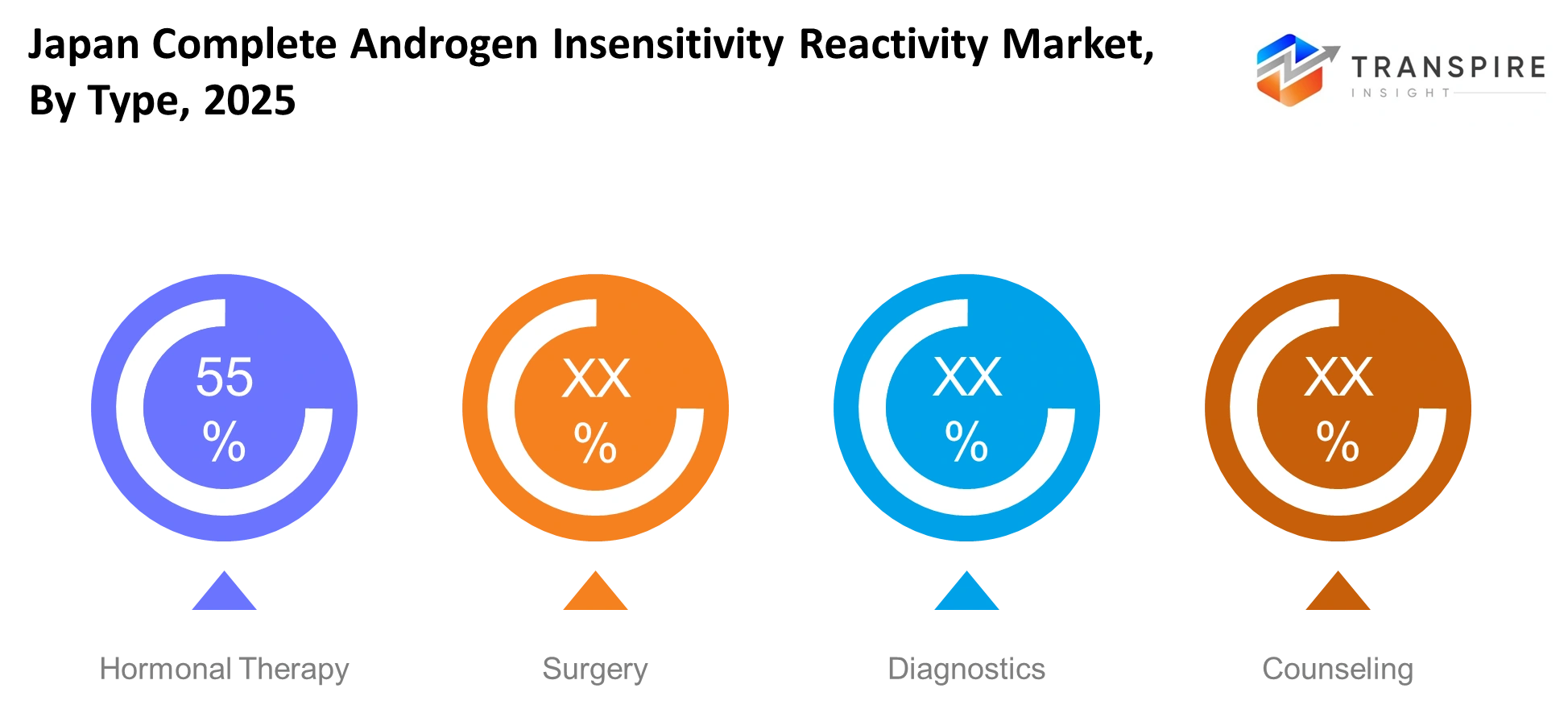
- Hormonal Therapy: Hormonal Therapy Hormonal therapy serves as the main treatment method for CAIS patients who require estrogen treatment after undergoing gonadectomy to sustain their secondary sexual features and bone structure. The adoption of personalized hormone treatments in Japan has increased their use, which results in better long-term patient outcomes and enables doctors to create treatments that match each patient's particular needs.
- Surgery: Surgical procedures, especially gonadectomy, serve as standard treatment methods for CAIS patients because they help reduce the cancer risks that arise from their undescended testes condition. The medical field in Japan benefits from enhanced patient safety, shorter recovery times, and improved overall post-surgical quality of life through advanced minimally invasive surgical methods and improved surgical timing.
- Diagnostics: Diagnostics use various methods to identify CAIS cases through genetic testing, hormonal assessments and imaging studies. The healthcare system in Japan has begun adopting advanced diagnostic methods, including molecular testing and karyotyping, that enable clinicians to identify intersex and endocrine disorders at an early stage and differentiate them from other conditions.
- Counseling: The psychological needs of people with CAIS require counseling services, which provide support for their emotional and social development. The growing focus on mental health treatment, gender identity support and family counseling in Japan allows patients to deal with their needs, which helps them receive comprehensive care beyond their medical treatment.
To learn more about this report, Download Free Sample Report
By Application
- Hospitals: Hospitals are the main sector for CAIS because they deliver comprehensive diagnostic services, surgical procedures, and hormonal treatment within one facility. Japanese tertiary care hospitals operate as central treatment centers for complex CAIS cases because they possess both advanced medical technologies and multidisciplinary medical teams.
- Clinics: Clinics deliver ongoing medical treatment and follow-up services to CAIS patients through hormone treatment and routine health assessments. Specialized endocrine and gynaecology clinics in Japan present a growing solution for patients to receive affordable and continuous medical treatment outside of large hospital facilities.
- Research Centers: Japanese research centers conduct studies about genetic mutations and androgen receptor mechanisms which lead to CAIS. These institutions develop new methods for diagnosing diseases and treating patients which enhance worldwide scientific knowledge and create new advanced treatment methods.
- Genetic Labs: Genetic laboratories use chromosomal testing and gene sequencing to establish CAIS diagnosis. The expansion of advanced genetic testing infrastructure in Japan is enhancing diagnostic capabilities while enabling early disease detection and individualized treatment development for patients.
By End-User
- Patients: The primary end users of diagnostic, treatment, and support service improvements are patients who seek medical care. The growing public understanding of specialized medical services in Japan enables patients with CAIS to obtain prompt diagnostic evaluation and individualized treatment that lasts throughout their lives.
- Hospitals: Hospitals serve as primary end users and implement advanced technologies alongside their treatment procedures to manage CAIS patients. The Japanese healthcare system operates through its multidisciplinary team system because it needs both infrastructure and medical personnel to deliver sophisticated surgical and hormonal treatment.
- Clinics: Clinics function as major end-user organizations because they provide outpatient medical treatment together with ongoing care for CAIS patients. Japanese clinics implement contemporary medical treatment methods together with diagnostic procedures to enhance patient access and maintain medical care in lower intensity treatment facilities.
- Research Institutes: Research institutes serve as primary end-user organizations that conduct clinical studies and genetic research to expand their understanding of CAIS. Japanese research institutes work with hospitals and universities to develop new diagnostic methods while investigating innovative treatment options to improve patient outcomes.
Country Insights
Japan's CAIS market benefits from three main factors, which include its advanced healthcare system, its robust diagnostic system and its growing public understanding of rare genetic disorders. The country emphasizes early diagnosis through genetic testing and hormonal evaluation, which is supported by its network of equipped hospitals and specialized laboratories. The government establishes initiatives which drive research on rare diseases and precision medicine to enhance diagnostic systems and promote early treatment of CAIS patients.
Japan now moves toward care systems which combine multiple medical fields to offer treatment that focuses on individual patient needs through its three specialties of endocrinology and gynaecology, and genetic counseling and psychological support. Research institutions, along with academic institutions, perform essential work investigating androgen receptor mutations while developing new treatment methods. The increasing demand for mental health resources and gender-sensitive services together with extended care solutions, leads to better patient care results, which also drives business expansion.
Recent Development News
- The International Olympic Committee established genetic screening requirements for female athletes in 2026 with the exception of specific medical conditions which include CAIS. The world has developed greater awareness about androgen-related disorders, while governmental bodies have started to create policies to address these conditions.
- The recent clinical and research developments demonstrate that scientists increasingly use advanced genetic testing together with androgen receptor studies to enhance diagnosis accuracy and develop customized treatment methods for CAIS. These advancements lead to better patient care within the Japanese healthcare system dedicated to rare diseases.
|
Report Metrics |
Details |
|
Market size value in 2025 |
USD 41.7 Million |
|
Market size value in 2026 |
USD 43.8 Million |
|
Revenue forecast in 2033 |
USD 61.8 Million |
|
Growth rate |
CAGR of 5.045% from 2026 to 2033 |
|
Base year |
2025 |
|
Historical data |
2021 – 2024 |
|
Forecast period |
2026 – 2033 |
|
Report coverage |
Revenue forecast, competitive landscape, growth factors, and trends |
|
Country scope |
Japan |
|
Key company profiled |
Pfizer, Novartis, Roche, Bayer, Merck, Takeda, Astellas, AbbVie, Sanofi, GSK, Eli Lilly, AstraZeneca, Teva, Bristol Myers Squibb, Daiichi Sankyo |
|
Customization scope |
Free report customization (country, regional & segment scope). Avail customized purchase options to meet your exact research needs. |
|
Report Segmentation |
By Type (Hormonal Therapy, Surgery, Diagnostics, Counseling), By Application (Hospitals, Clinics, Research Centers, Genetic Labs), By End-User (Patients, Hospitals, Clinics, Research Institutes) |
Key Japan Complete Androgen Insensitivity Reactivity Market Company Insights
Pfizer, Novartis, and Roche as leading pharmaceutical companies invest their efforts into research about androgen-related therapies and rare medical conditions which helps to improve CAIS treatment methods. The companies develop vital solutions for CAIS treatment through their research activities which focus on hormone therapies and their investigations of androgen receptors used in oncology and their development of personalized medicine solutions. Their work in clinical trials and genetic studies together with their endocrine treatment development activities has resulted in better diagnostic methods and more treatment options.
Bayer and Merck use their knowledge of hormone-based medical solutions and cancer research to create new therapies that target androgen receptors. Research into prostate cancer and endocrine disorders has revealed important information about androgen signaling pathways, which scientists study to better understand CAIS. The companies collaborate to strengthen Japan's rare disease ecosystem through their research and development expenditures and their establishment of strategic partnerships, and their creation of new treatment methods which will boost long-term market development.
Company List
- Pfizer
- Novartis
- Roche
- Bayer
- Merck
- Takeda
- Astellas
- AbbVie
- Sanofi
- GSK
- Eli Lilly
- AstraZeneca
- Teva
- Bristol Myers Squibb
- Daiichi Sankyo
Japan Complete Androgen Insensitivity Reactivity Market Report Segmentation
By Type
- Hormonal Therapy
- Surgery
- Diagnostics
- Counseling
By Application
- Hospitals
- Clinics
- Research Centers
- Genetic Labs
By End-User
- Patients
- Hospitals
- Clinics
- Research Institutes
Frequently Asked Questions
Find quick answers to common questions.
The Approximate Japan Complete Androgen Insensitivity Reactivity Market size for the Market will be USD 61.8 Million in 2033.
Key Segments for the Japan Complete Androgen Insensitivity Reactivity Market are By Type (Hormonal Therapy, Surgery, Diagnostics, Counseling), By Application (Hospitals, Clinics, Research Centers, Genetic Labs), By End-User (Patients, Hospitals, Clinics, Research Institutes).
Major Japan Complete Androgen Insensitivity Reactivity Market Players are Pfizer, Novartis, Roche, Bayer, Merck, Takeda, Astellas, AbbVie, Sanofi, GSK, Eli Lilly, AstraZeneca, Teva, Bristol Myers Squibb, Daiichi Sankyo.
The current Japan Complete Androgen Insensitivity Reactivity Market size is USD 41.7 Million in 2025.
The Japan Complete Androgen Insensitivity Reactivity Market CAGR is 5.045%.
- Pfizer
- Novartis
- Roche
- Bayer
- Merck
- Takeda
- Astellas
- AbbVie
- Sanofi
- GSK
- Eli Lilly
- AstraZeneca
- Teva
- Bristol Myers Squibb
- Daiichi Sankyo
Recently Published Reports
-
May 2026
Biosimilars Market
Biosimilars Market By Product Type (Monoclonal Antibodies, Recombinant Hormones, Erythropoietin, G-CSF, Others), By Indication (Oncology, Autoimmune Diseases, Blood Disorders, Diabetes, Others), By Manufacturing Type (In-House Manufacturing, Contract Manufacturing), By Distribution Channel (Hospital Pharmacies, Retail Pharmacies, Online Pharmacies), By Industry Analysis, Size, Share, Growth, Trends, and Forecasts 2021-2033
-
Apr 2026
Gastrointestinal Endoscopy Market
Gastrointestinal Endoscopy Market By Type (Rigid Gastrointestinal Endoscope, Flexible Gastrointestinal Endoscopes, Disposable Gastrointestinal Endoscope), By Procedure Type (Colonoscopy, Gastroscopy, Duodenoscopy, Enteroscopy, Flexible Sigmoidoscopy, Others), By Application (Diagnosis, Treatment), By End-Users (Hospitals, Ambulatory Surgical Centers, Specialty Clinics, Laboratories, Others), By Industry Analysis, Size, Share, Growth, Trends, and Forecasts 2021-2033
-
Apr 2026
Rare Inherited Metabolic Disorder Drug Market
Rare Inherited Metabolic Disorder Drug Market By Drug Class (Enzyme Replacement Drugs, Gene Therapy Drugs, Substrate Reduction Drugs, Small Module Drugs, Protein Drugs), By Route of Administration(Parenteral, Oral, Intrathecal), By Clinical Development (Marketed Drugs, Late Stage Clinical Phase III, Early Stage Clinical Phase I-II, Preclinical Candidates), By Indication (Lysosomal Storage Disorders, Urea Cycle Disorders, Amino Acid Metabolic Disorders, organic Acidemias, Peroximal Disorders), By Industry Analysis, Size, Share, Growth, Trends, and Forecasts 2021-2033
-
Jan 2026
Pharmaceutical Cleanroom Technology Market
Pharmaceutical Cleanroom Technology Market By Product (Equipment, Consumables, Services); By Cleanroom Type (Standard Cleanrooms, Modular Cleanrooms); By End Use (Pharmaceutical Companies, Biotechnology Companies), By Industry Analysis, Size, Share, Growth, Trends, and Forecasts 2021-2033