

Japan Commercial Fitness Equipment Market Summary:
According to Transpire Insight, a detailed research report on the market reflects that the commercial segment dominates the Japan Commercial Fitness Equipment Market, accounting for approximately 70.8% of the total market value in 2025. Johnson Health Tech. Co., Ltd. is among the leading players in the market, making it a key contributor to Japan market development, innovation, advanced commercial fitness equipment manufacturing, expanding product capabilities, and growth dynamics.
Market Snapshot
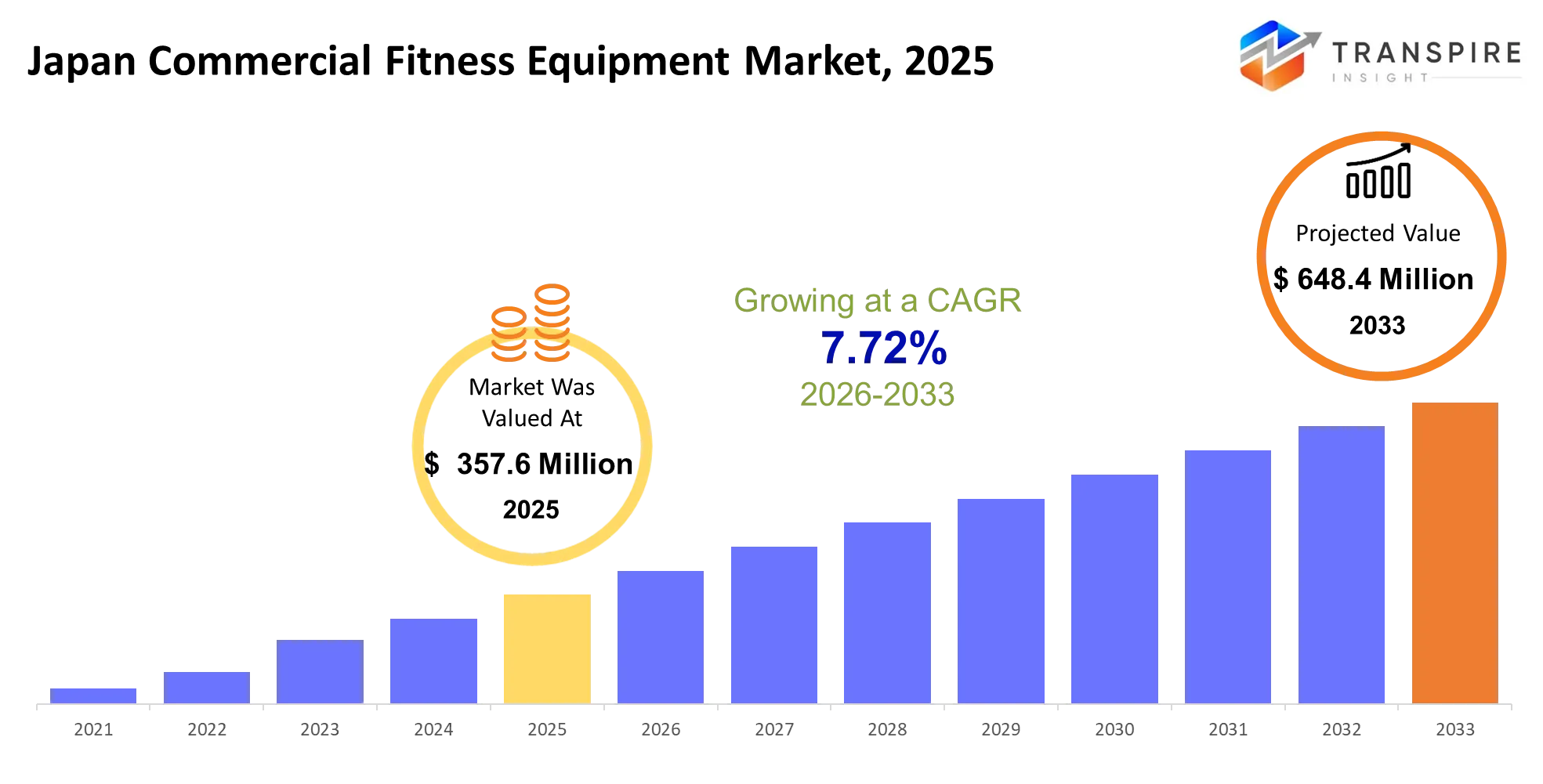
- Market Value (2025): USD 357.6 Million.
- Expected Market Value (2026): USD 385.3 Million.
- Estimated Market Value (2033): USD 648.4 Million.
- Forecast CAGR (2026–2033): 7.72%
Introduction
The commercial fitness equipment sector consists of producing, delivering and selling heavy-duty commercial-grade fitness machines and devices. These are oriented towards institutional usage rather than an individual one. Commercial fitness equipment refers to sturdy and durable exercise machines designed for continuous and simultaneous use in public places. Unlike home fitness equipment, commercial equipment is made of thicker steel and comes with longer guarantee periods and specialized support services. The Japanese gym equipment industry is moving towards specialized, technology-led, and space-saving fitness solutions. Gym equipment manufacturers are making devices with biometric tracking, low resistance machines and devices aimed at rehabilitation of older generations in Japan in mind. Design plans of gym equipment manufacturers are taking shape in line with the trends of compact designs and low noise to fit well in large cities where space is limited. More and more data-driven operations are being offered thanks to the use of cloud technologies, internet-connected devices as well as digital solutions which allow for predictive maintenance, providing users with personalized analytical data and ensuring higher engagement rates. Equipment that is durable and heavy-duty will be gaining higher demand, too, because of its reliability, performance and ability to stand the days of heavy use in gyms, hotels and wellness centres.
Key Market Highlights: -
- By product type, the Treadmills segment dominated the market and holds nearly 26% share in 2025 and is projected to grow at a substantial CAGR during the forecast period.
- By end user, the Health Clubs segment dominated the market and holds nearly 40% share in 2025 and is projected to grow at a substantial CAGR during the forecast period.
- By technology, the Non-Connected Equipment segment dominated the market and holds nearly 74% share in 2025 and is projected to grow at a substantial CAGR during the forecast period.
- Health Japan 21 (Third Term) is a Japan-wide health promotion program for the period between 2024 and 2035, focusing on encouraging people to have physical activities, exercise regularly, and promote good health. The emphasis on leading an active lifestyle has resulted in the increase in the need for commercial fitness facilities as well as modern gym equipment, which provides a conducive environment for the growth of the commercial fitness equipment market in Japan.
How is Technology Driving Growth in the Japan Commercial Fitness Equipment Market?
The market for gym equipment in Japan is becoming more and more influenced by smart technologies, robotics, artificial intelligence, and connected wearables. The fitness equipment fitted with IoT devices helps in tracking performance in real-time, having interactive displays and ensuring personalized workout schedules. Japan’s enhanced capabilities in robotics are further paving way for the development of automated assistive fitness equipment used in rehabilitation, wellness, and specialized training. AI-enabled technologies help fitness businesses to monitor their gym equipment more effectively, improve maintenance processes, analyze user patterns, and optimize facility work. Additionally, compatibility with Smartwatches and wearables allows users to track their fitness progress from any place and in a seamless manner.
Market Drivers
The emergence of an elderly yet fitness-aware Japanese population, which requires functional exercise equipment for maintaining their health and mobility, is a major growth factor for the Japanese gym equipment market. Increased enthusiasm for private fitness centers, gyms operating round-the-clock, as well as different types of boutique fitness studios (such as Pilates and strength training) are associated with higher demands for commercial gym equipment. The process of technological application is contributing significantly to market development due to the introduction of advanced fitness devices that can operate with the use of the Internet of Things and artificial intelligence to track sports performance and create personalized workouts. Moreover, the Japanese government initiates a number of physical activities programs, while private companies create their corporate wellness initiatives designed to promote healthier lifestyles through the promotion of gym and exercise equipment. The gym equipment industry in Japan offers fantastic opportunities for investment, which is bolstered by progress in technology, demographic changes, and the establishment of favorable policies. The introduction of advanced technology, such as robots, AI-driven performance tracking applications, and smart gym equipment, has elevated users’ experiences and created demand for commercial fitness gear. Japan presents a unique market because of existing demand among senior citizens who consider fitness important. Various policies related to health promotion implemented by the government as well as digital transformation help provide a favorable environment for gyms.
Restrain
The gym equipment market in Japan appears to have to deal with high procurement and maintenance costs related to advanced commercial fitness machines. Urban saturation of memberships limits expansion of facilities and demand for equipment in large cities. Changes in demographics result in increased demand for specific fitness solutions, while alternative trends like outdoor activities, bodyweight training, and at-home connected fitness may decrease the reliance on commercial fitness equipment.
Analysis of Prices and Consumer Behaviour
The commercial segment dominates the commercial fitness equipment market (70.8% market value in 2025) due to the presence of institutional users, namely gyms, health clubs, hotels, corporate wellness facilities, etc. The commercial fitness equipment market will be more expensive as compared to the consumer fitness equipment market as the equipment is engineered for higher usage, rate of durability, advanced technologies, etc. As per statistics, the commercial segment accounts for 70.8% of the market in Japan. The volume of sales can be attributed to increasing services in the fitness industry and the need for modern fitness equipment in the industry. The fitness sector including gym, health club, hotel and corporate wellness sectors is a major user of this product. The commercial buyers show that equipment durability, functionality and aftersales services are important factors affecting their buying behavior. One more factor affecting the decisions of commercial buyers is maintenance and service.
Top Companies in the Japan Commercial Fitness Equipment Market
- Life Fitness
- Technogym
- Matrix Fitness
- Johnson Health Tech
- Precor
- TRUE Fitness
- Cybex
- Nautilus
- BH Fitness
- Impulse Fitness
- SportsArt
- Panasonic
- Mitsubishi Electric
- Tanita
- Konami Sports
Japan Commercial Fitness Equipment Market Segmentation
The Japan Commercial Fitness Equipment Market share is divided into six categories: By equipment type, product, end user, buyer, distribution channel and technology.
The Treadmills dominated the market, accounting for nearly 26% in 2025 and is expected to rise at a significant CAGR during the forecast period.
The Japan Commercial Fitness Equipment Market is segmented by product into Treadmills, Elliptical Machines, Exercise Cycles, Rowing Machines, Stair Steppers, Weight Machines, Dumbbells & Weight Plates, Functional Racks. Among these, the Treadmills segment dominated the market, accounting for nearly 26% in 2025 and expected to increase at a significant CAGR during the forecast period. In 2025, treadmills maintained a leading position in the Japan commercial fitness equipment market with a share of almost 26%, as they offer excellent opportunities for cardiovascular training, are suitable for indoor workouts, and allow for diverse use. Their increased use in fitness centers, hotels, and wellness centers, along with new technologies available such as connectivity and customized workouts, is expected to underpin the favorable dynamics of the market.
The Health Clubs dominated the market, accounting for nearly 40% in 2025, and is expected to rise at a significant CAGR during the forecast period.
The Japan Commercial Fitness Equipment Market is segmented by end user into Health Clubs, Gyms, Hotels, Corporate Wellness Centers, Hospitals, Universities, Sports Clubs, Public Institutions Among these, the Health Clubs segment dominated the market, accounting for nearly 40% in 2025 and expected to increase at a significant CAGR during the forecast period. Health Clubs played an important part in the Japan Commercial Fitness Equipment Market in 2025, making up almost 40% of the market, due to increasing consumer involvement in fitness, health, and preventive care activities. With the increase of health clubs, membership payments, training services provided by professionals, as well as introduction of superior cardio and strength equipment, the demand for equipment is expected to stay high.
The Non-Connected Equipment dominated the market, accounting for nearly 74% in 2025 and is expected to rise at a significant CAGR during the forecast period.
The Japan Commercial Fitness Equipment Market is segmented by technology into Connected Equipment, Touchscreen Equipment, AI-Based Equipment, IoT-Enabled Equipment, Performance Tracking, Virtual Training, Cloud-Connected Equipment, Non-Connected Equipment. Among these, the Non-Connected Equipment segment dominated the market, accounting for nearly 74% in 2025 and expected to increase at a significant CAGR during the forecast period. In 2025, the Japan Commercial Fitness Equipment Market was led by non-connected equipment, which dominated with the share of almost 74%. This happened due to the low price, easy handling, high reliability, and minor maintenance needs of non-connected machines. Thus, these items are popular among commercial gyms and fitness centers, as they provide the necessary reliability without complicated digital systems.
Future Market Trends for the Japan Commercial Fitness Equipment Market: -
- Incorporating AI and Robotics: Commercial gyms are leveraging AI-based personal trainers, real-time form analysis devices, and automated IoT systems to help them run data-driven fitness regimes.
- Catering to Elderly Consumers: Companies are creating specialized and rehabilitation-oriented devices to meet the needs of Japan's older population, combining fitness with longevity and physical rehabilitation.
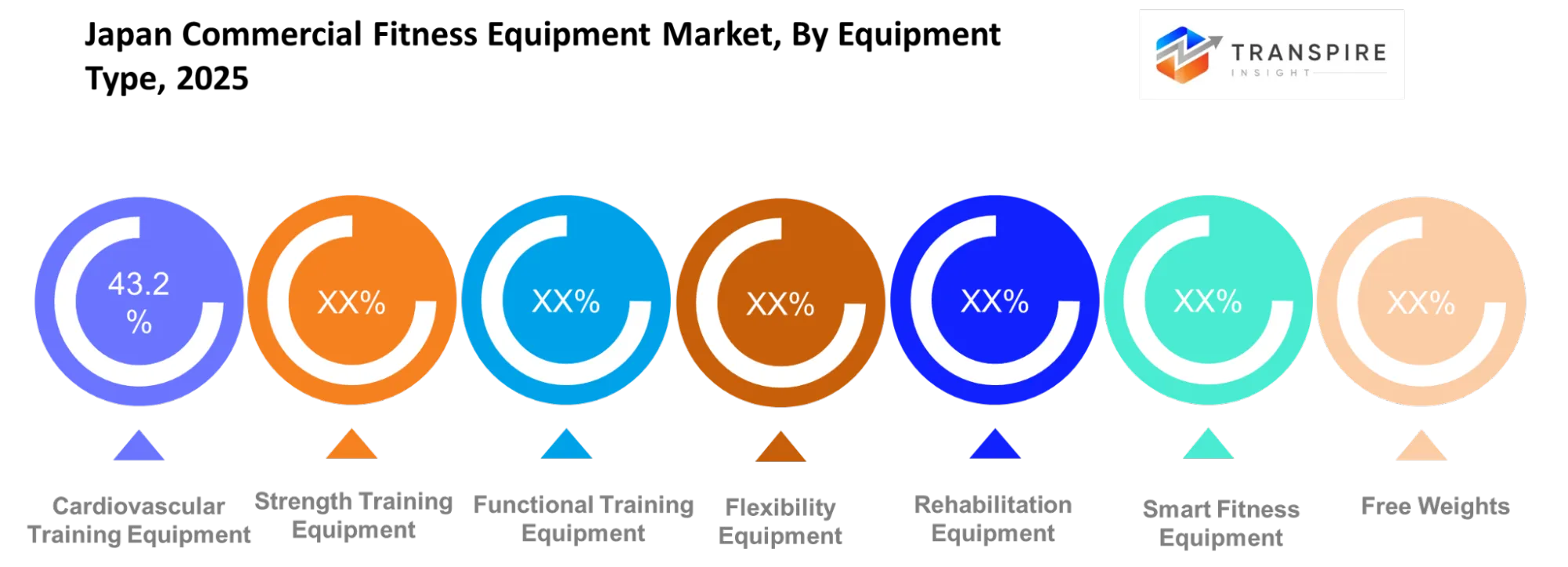
- Cardiovascular Equipment Takes Charge: Cardiovascular devices like treadmills, cross trainers, and exercise bikes maintain their dominant position in the market due to high attention to heart health and well-being.
- Developing Smart Connected Gyms: Gymnasiums are utilizing cloud-based management, digital twins, and automated registration to improve their operations efficiency and reduce personnel expenses.
- Government Programs for Corporate Welfare: Public programs to support healthier workplaces are feeding the demand for commercial machines in the corporate and public sectors.
Recent Development
- In July 2026: Mizuno made an announcement about entering the pickleball market in Japan, launching its ACROSTRIKE LX paddle which has adjustable weights. This paddle is a sign of increased interest in recreational sports as well as active lifestyles and it opens doors for growth in fitness centers and sports clubs as well as in the entire commercial fitness equipment sector in Japan.
- In August 2026: Analyses of the market show the increasing use of innovative, connected strength-training equipment throughout Japan, such as electronically-equipped weight benches and selectorized strength machines. The technology enables real-time tracking of performance, customized workouts, space efficiency and data-driven gym management. Thus, the demand for progressive commercial fitness equipment has grown as a result of this trend in Japan Gym Fitness Industry.
Market Segment
This study forecasts revenue at Japan, regional and country levels from 2020 to 2033. Transpire Insight has segmented the Japan Commercial Fitness Equipment Market based on the below-mentioned segments:
Japan Commercial Fitness Equipment Market, By Equipment Type
- Cardiovascular Equipment
- Strength Training Equipment
- Functional Training Equipment
- Flexibility Equipment
- Rehabilitation Equipment
- Smart Fitness Equipment
- Free Weights
- Other Equipment
Japan Commercial Fitness Equipment Market, By Product
- Treadmills
- Elliptical Machines
- Exercise Cycles
- Rowing Machines
- Stair Steppers
- Weight Machines
- Dumbbells & Weight Plates
- Functional Racks
Japan Commercial Fitness Equipment Market, By End User
- Health Clubs
- Gyms
- Hotels
- Corporate Wellness Centers
- Hospitals
- Universities
- Sports Clubs
- Public Institutions
Japan Commercial Fitness Equipment Market, By Buyer Type
- Fitness Chains
- Independent Gyms
- Hotels
- Corporates
- Government Institutions
- Hospitals
- Educational Institutions
- Sports Organizations
Japan Commercial Fitness Equipment Market, By Distribution Channel
- Direct Sales
- Specialty Stores
- Online Retail
- Sports Stores
- Distributors
- Dealer Networks
- OEM Sales
- Institutional Procurement
Japan Commercial Fitness Equipment Market, By Technology
- Connected Equipment
- Touchscreen Equipment
- AI-Based Equipment
- IoT-Enabled Equipment
- Performance Tracking
- Virtual Training
- Cloud-Connected Equipment
- Non-Connected Equipment
Frequently Asked Questions
Find quick answers to common questions.
The market is projected to reach USD 648.4 million by 2033, expanding at a 7.72% CAGR during 2026–2033.
Treadmills dominated in 2025 with nearly 26% share, driven by cardiovascular training demand and widespread adoption across fitness facilities.
Health Clubs led in 2025 with nearly 40% share, supported by increasing fitness participation, memberships, and investments in modern equipment.
Non-connected equipment dominated with nearly 74% share in 2025, supported by affordability, reliability, durability, and lower maintenance requirements.
Key trends include AI, robotics, smart gyms, rehabilitation equipment, wearable integration, cardiovascular solutions, and cloud-based fitness management technologies.
- Life Fitness
- Technogym
- Matrix Fitness
- Johnson Health Tech
- Precor
- TRUE Fitness
- Cybex
- Nautilus
- BH Fitness
- Impulse Fitness
- SportsArt
- Panasonic
- Mitsubishi Electric
- Tanita
- Konami Sports
About the Authors

Chetan Dhatrak
I’m Chetan Dhatrak, a Senior Research Analyst at Transpire Insight, specializing in the Consumer Goods, Foods and Beverages industry. I focus on analyzing market trends, consumer behavior, competitive landscapes, and industry developments to deliver accurate, data-driven insights. My research at Transpire Insight is built on credible sources and in-depth analysis, helping businesses and readers better understand market dynamics, emerging opportunities, and evolving consumer preferences. I’m committed to creating reliable, well-researched content that supports informed decision-making and reflects the latest developments in the consumer goods and food & beverage sectors.

Chakradhar Khansole
Chakradhar serves as the Research Director at Transpire Insight, bringing over 8 years of experience in technology, innovation, and strategic market intelligence. He specializes in transforming complex market data into actionable business insights that enable organizations to make informed, growth-oriented decisions. Recognized for his strategic vision and analytical expertise, Chakradhar leads high-impact research initiatives, delivering comprehensive market assessments, competitive intelligence, and forward-looking industry analysis.
Recently Published Reports
-
Apr 2026
Bottled Water Market
Bottled Water Market Size, Share & Analysis Report By Product Type (Still Bottled Water, Carbonated Bottled Water, Functional Bottled Water, and Others), By Packaging (PET, Cans, and Others), By Sales Channel (Supermarkets/Hypermarkets, Convenience Stores/Drug Stores, Grocery Stores/Club Stores, Foodservice, and Others) and Geography (North America, Europe, Asia-Pacific, Middle East and Africa, South and Central America), 2021 - 2032
-
Apr 2026
Color Cosmetic Packaging Market
Color Cosmetic Packaging Market Size, Share & Analysis Report By Application (Mascara Packaging, Liquid Packaging, and Liquid Face), By Type (Tubes & Bottles, Pens & Markers, Compacts & Containers, and Droppers & Pumps), and Geography (North America, Europe, Asia-Pacific, Middle East and Africa, South and Central America), 2021 - 2031
-
Apr 2026
External Microphone For Camera Market
External Microphone For Camera Market Size, Share & Analysis Report By Type (Shotgun Microphone, Lavalier Microphone, and Others), By Application (Digital Camera, Professional Video Camera, and Others), and Geography (North America, Europe, Asia-Pacific, Middle East and Africa, South and Central America), 2021 - 2031
-
Apr 2026
Foot Orthotic Insoles Market
Foot Orthotic Insoles Market Size, Share & Analysis Report By Type (Pre-fabricated, and Custom-made), By Material (Thermoplastic, Composite Carbon Fiber, and Others), By Distribution Channel (Drug Stores, Hospitals & Clinics, and Others), and Geography (North America, Europe, Asia-Pacific, Middle East and Africa, South and Central America), 2021 - 2031