

Japan Cognitive Computing Market Summary:
According to Transpire Insight, a detailed research report on the market reflects that the Cloud deployment segment dominates the Japan Cognitive Computing Market, accounting for approximately 86.96% of the total market share in 2024. Fujitsu, NEC Corporation, IBM Japan, Hitachi, and other leading technology companies are significant contributors to Japan market development, innovation, advanced cognitive computing solutions, expanding AI and machine learning capabilities, enterprise digital transformation, and growth dynamics.
Market Snapshot
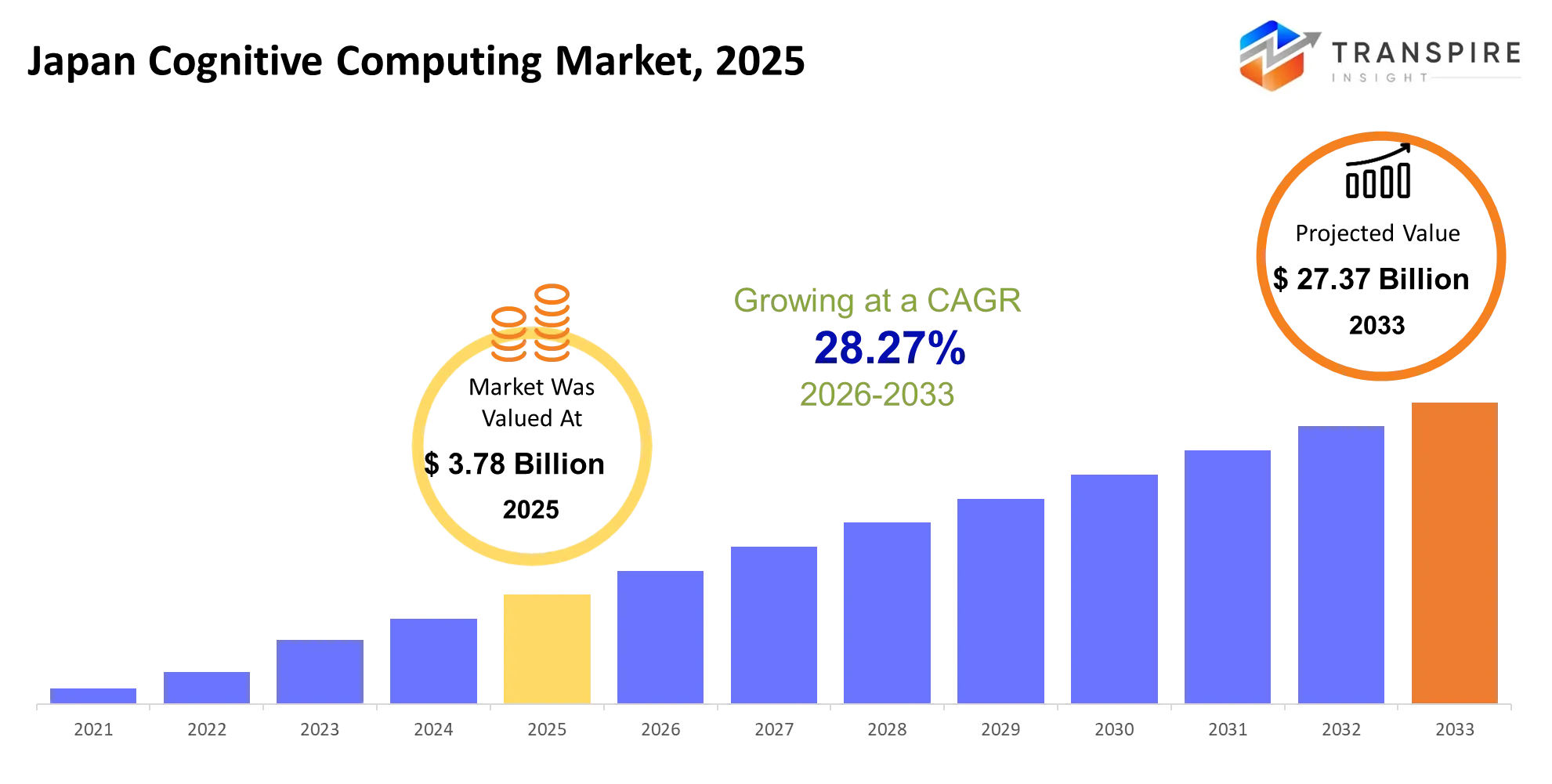
- Market Value (2025): USD 3.78 Billion.
- Expected Market Value (2026): USD 4.79 Billion.
- Estimated Market Value (2033): USD 27.37 Billion.
- Forecast CAGR (2026–2033): 28.27%
Introduction
Cognitive computing is a field of artificial intelligence (AI) which replicates the cognitive functions of the human mind through computational simulation. Cognitive computing uses the technology of machine learning, NLP, deep learning and pattern recognition for analyzing complex and unstructured data and helping humans make better decisions. Cognitive computing is a field of AI which develops computer models to replicate problem solving capabilities of the human mind. Cognitive computing employs self-learning systems, data mining, and pattern recognition to sense, predict and conclude on complex scenarios without human programming. Japan’s Cognitive Computing Market is highly beneficial as it helps in overcoming manpower constraints, rapid data processing, improving decision-making, and providing localization. The intelligent automation feature minimizes unnecessary tasks and helps in retrieving information for enterprises, which can help increase productivity owing to the declining manpower in Japan. Cognitive computing systems process the unstructured information such as Japanese text, images, operation logs, and various other types of data to provide insights for further action. Analytics powered by AI improves decision-making in the case of industrial automation, predictive maintenance, and workflow processes in corporations. Moreover, the presence of the developed technological landscape in Japan allows for localization of cognitive computing solutions.
Key Market Highlights: -
- By component, the Software segment dominated the market and holds nearly 45% share in 2025 and is projected to grow at a substantial CAGR during the forecast period.
- By application, the BFSI segment dominated the market and holds nearly 25% share in 2025 and is projected to grow at a substantial CAGR during the forecast period.
- By end user, the Banks segment dominated the market and holds nearly 30% share in 2025 and is projected to grow at a substantial CAGR during the forecast period.
- Public Investments: Growth Strategy in Japan aims at investing about ¥10.5 trillion in cumulative public-private investments up to FY2040 for Physical AI, including AI Robots and autonomous activities. The public investment in Physical AI creates a conducive environment for the development of Cognitive Computing by providing a robust ecosystem of AI in Japan.
How is Technology Driving Growth in the Japan Cognitive Computing Market?
The Cognitive Computing Market in Japan is progressing via means of AI, ML, NLP, cloud computing, and edge computing. The combination of AI and ML helps machines to process complicated unstructured data along with offering predictive analysis. NLP facilitates man and machine interaction by means of intelligent virtual assistants, multilingual capabilities, and customer service automation. Cloud platforms offer infrastructure for cognitive computing, whereas edge computing is useful for low latency robotics and physical AI. Growth strategies at national level, investments by both public and private sectors, semiconductor developments, and data center expansion help to strengthen the market infrastructure. Health care institutes are using cognitive technology for precise medicine and administration, whereas manufacturing units are making use of industrial data sets for localized model creation and process optimization..
Market Drivers
Market Drivers of Japan’s Cognitive Computing Market include increased data creation, complexities, convergence of technologies, and demographic factors. Exponential increase in structured and unstructured data is creating the need for sophisticated cognitive computing technologies to derive insights and make informed decisions through analysis of data. Complex business scenarios are driving companies towards using intelligent and adaptive systems that help boost efficiency and effectiveness. Convergence of Artificial Intelligence (AI), Machine Learning (ML) and Natural Language Processing (NLP) is enabling better cognitive capabilities in systems. Furthermore, the aging population in Japan, in addition to workforce shortage, is driving automation and usage of AI in health care, finance, manufacturing, and other sectors. The Cognitive Computing Market in Japan offers numerous growth opportunities due to the country's demographics, digitalization, advanced infrastructure, and growing complexities of data. Lack of workers makes companies use intelligent automation, automated decision making based on artificial intelligence, and cognitive technologies in order to become more productive and efficient. DX (Digital Transformation) government policies are pushing companies to invest in advanced computing, artificial intelligence, and automation. The country’s advanced infrastructure and manufacturing base make it possible to implement cognitive technologies. In addition, rapid increase in volumes of enterprise data is leading to the growing need for advanced data analysis and cognitive solutions in order to improve business decisions.
Restrain
Several constraints exist in the Cognitive Computing Market of Japan, which include expensive initial investment, shortage of expert workforce in artificial intelligence, threat to data security, and risk related to algorithm reliability. Infrastructure and integration expenses are one of the major reasons that could hamper the adoption of cognitive computing. Moreover, due to certain security, algorithm bias, privacy issues, and unanticipated results, the deployment is hindered in regulated industries like healthcare and finance.
Analysis of Prices and Consumer Behaviour
In the Japan Cognitive Computing Market, there is a high concentration of cloud-based cognitive computing systems (market share of 86.96% in 2024 mainly due to the increased use of scalable AI, machine learning, natural language processing and data analytics). The market operates under the influence of the adoption of sophisticated cognitive computing technologies used for automated decision-making, predictive analytics and intelligent applications within businesses. Cloud computing plays an especially important role in the market as it provides scalability of computing resources and flexibility of infrastructure as well as facilitates the integration of cognitive systems into enterprise applications. The size of the Japan cognitive computing market reached about USD 3,780.4 million in 2025 and is forecast to grow with a 26.70% CAGR between 2026 and 2034. Japan captured about 4.5% of the global market for cognitive computing in 2024 as the country is characterized by active adoption of AI-enabled enterprise technologies. There are no publicly available verifiable statistics on price premiums, unit sales, consumers' preferences and long-term contract procurement in Japan; therefore, this information cannot be considered factual market statistics.
Top Companies in the Japan Cognitive Computing Market
- IBM
- Microsoft
- Amazon Web Services
- Oracle
- Fujitsu
- NEC
- NTT DATA
- Hitachi
- Toshiba
- Panasonic
- Sony
- SoftBank
- Rakuten
- Mitsubishi Electric
Japan Cognitive Computing Market Segmentation
The Japan Cognitive Computing Market share is divided into six categories: By component, technology, deployment, application, enterprise size and end user.
The Software dominated the market, accounting for nearly 45% in 2025 and is expected to rise at a significant CAGR during the forecast period.
The Japan Cognitive Computing Market is segmented by component intoHardware, Software, Services, AI Platforms, Analytics, Cloud Infrastructure, Consulting, Integration. Among these, the Software segment dominated the market, accounting for nearly 45% in 2025 and expected to increase at a significant CAGR during the forecast period. The Software segment leads owing to the rising need for modern digital solutions, automation, cloud computing, cybersecurity, and data-based operations. There is an increased adoption of software platforms among organizations to boost efficiency, scalability, and cost optimization. Innovations in technology and increasing enterprise spending on intelligent software solutions are additional drivers behind the growth of this segment.
The BFSI dominated the market, accounting for nearly 25% in 2025, and is expected to rise at a significant CAGR during the forecast period.
The Japan Cognitive Computing Market is segmented by application into Healthcare, BFSI, Retail, Manufacturing, Automotive, Government, Telecom, Energy. Among these, the BFSI segment dominated the market, accounting for nearly 25% in 2025 and expected to increase at a significant CAGR during the forecast period. The BFSI segment is leading since there is an increase in the use of digital banking, cloud computing, cybersecurity, artificial intelligence, and automated financial services. It is essential that the financial organizations need advanced technology in order to become more efficient, more secure, be able to comply with the regulations, and ensure better customer experiences.
The Banks dominated the market, accounting for nearly 30% in 2025 and is expected to rise at a significant CAGR during the forecast period.
The Japan Cognitive Computing Market is segmented by end user intoBanks, Hospitals, Manufacturers, Retailers, Automotive Companies, Government Agencies, Telecom Operators, Energy Companies. Among these, the Banks segment dominated the market, accounting for nearly 30% in 2025 and expected to increase at a significant CAGR during the forecast period. Banks are expected to hold the leading position in the market owing to the growing use of digital banking systems, cloud computing, cyber security solutions, and automated finance technology. The banks are deploying sophisticated software solutions that would help them operate efficiently, safeguard their data, comply with regulations, and provide customized services to customers.
Future Market Trends for the Japan Cognitive Computing Market: -
- Cloud-Based Integration: Organizations are quickly moving towards using cloud computing in order to manage their real-time data analytics and digital transformation needs.
- Industry-Specific Uses of AI: Increasing needs for predictive analytics, intelligent customer services, and diagnostic services in industries such as manufacturing and health care due to lack of labor force and aging populations.
- Advances in Natural Language Processing (NLP): Increasing use of Japanese language capable machine learning and NLP tools for easier local enterprise communication and automated customer support.
Recent Development
- In July 2026: Japan's forecasted shortage of about 790,000 IT specialists by 2030 has increased the requirement for AI-driven automation, smart software engineering, and cognitive process technologies. Increasing usage of AI coding bots and enterprise automation solutions has resulted in productivity improvements, knowledge discovery, legacy system updates, and digital transformation. All this has created good growth prospects for Japan's Cognitive Computing Market.
- In May 2026: The GENNAI Generative AI Pilot was conducted by Japan’s Digital Agency, reaching out to about 180,000 government workers. This has boosted the Japanese Cognitive Computing Market by ensuring faster enterprise-level use of AI, intelligent information processing, natural language processing, workflow automation, and decision-making using AI in government agencies.
- In March 2026: As a product of the GENIAC project of Japan, Rakuten AI 3.0 was launched as a large language model with Japanese optimization for writing, code generation, document understanding, and information retrieval. This development bolsters the Cognitive Computing Market in Japan in terms of natural language processing, enterprise AI applications, intelligent data analytics, and decision-making with AI.
Market Segment
This study forecasts revenue at Japan, regional and country levels from 2020 to 2033. Transpire Insight has segmented the Japan Cognitive Computing Market based on the below-mentioned segments:
Japan Cognitive Computing Market, By Component
- Hardware
- Software
- Services
- AI Platforms
- Analytics
- Cloud Infrastructure
- Consulting
- Integration
Japan Cognitive Computing Market, By Technology
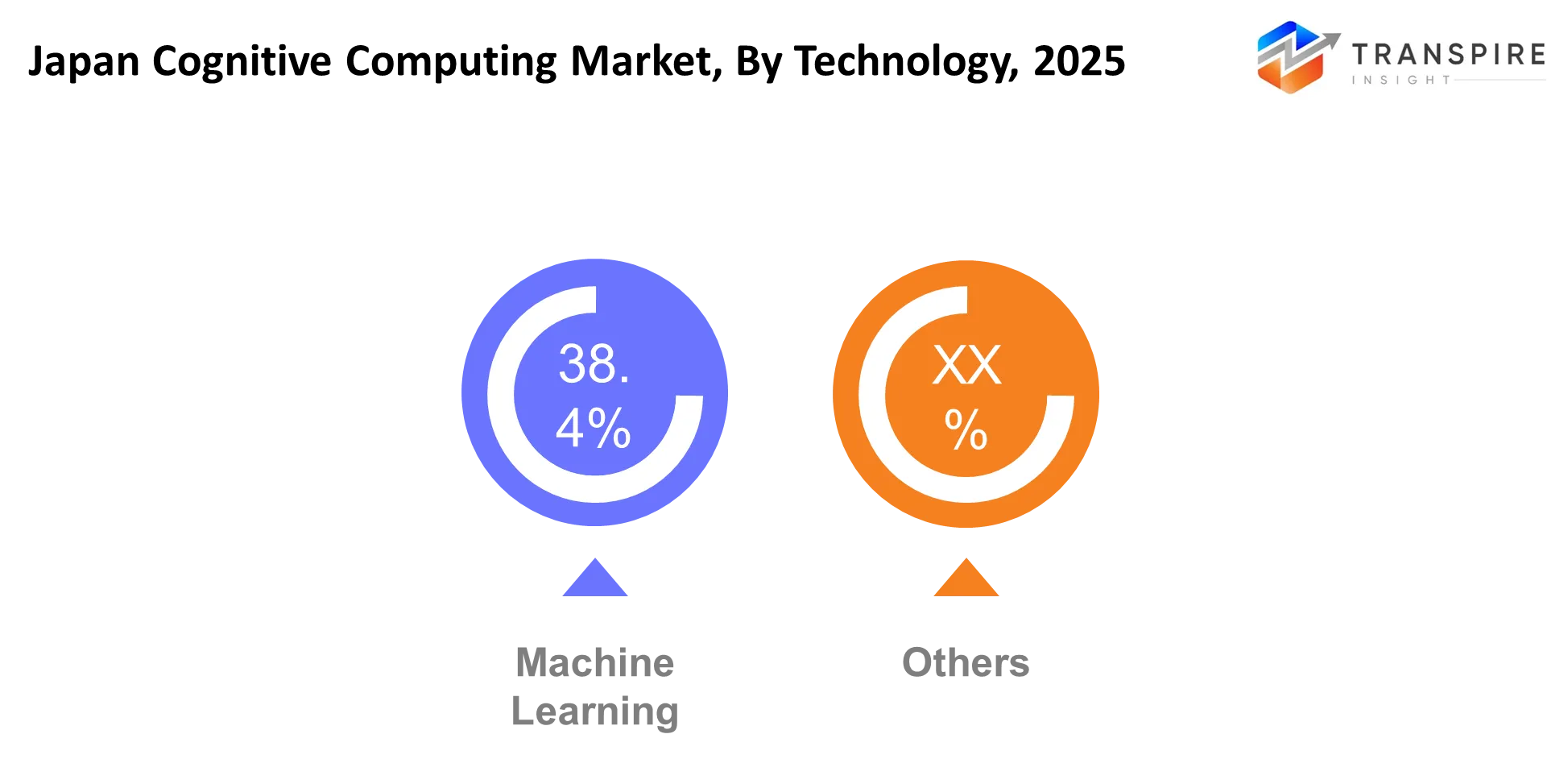
- Machine Learning
- Deep Learning
- NLP
- Computer Vision
- Knowledge Representation
- Neural Networks
- Predictive Analytics
- Expert Systems
Japan Cognitive Computing Market, By Deployment
- Cloud
- On-Premise
- Hybrid
- Edge
- Public Cloud
- Private Cloud
- SaaS
- Managed Services
Japan Cognitive Computing Market, By Application
- Healthcare
- BFSI
- Retail
- Manufacturing
- Automotive
- Government
- Telecom
- Energy
Japan Cognitive Computing Market, By Enterprise Size
- Large Enterprises
- SMEs
- Startups
- Government
- Multinational Corporations
- Research Institutions
- Universities
- Public Organizations
Japan Cognitive Computing Market, By End User
- Banks
- Hospitals
- Manufacturers
- Retailers
- Automotive Companies
- Government Agencies
- Telecom Operators
- Energy Companies
Frequently Asked Questions
Find quick answers to common questions.
The market is projected to reach USD 27.37 billion by 2033, expanding at a 28.27% CAGR from 2026–2033.
Cloud deployment dominates, supported by scalable infrastructure, AI adoption, data analytics, enterprise applications, and accelerating digital transformation across Japan.
BFSI leads, driven by digital banking, cybersecurity, artificial intelligence, automated financial services, predictive analytics, and improved customer experiences.
AI adoption, workforce shortages, increasing data volumes, digital transformation, cloud computing, NLP advancements, automation, and intelligent decision-making drive market growth.
Key players include IBM, Microsoft, Google, AWS, Oracle, Fujitsu, NEC, NTT DATA, Hitachi, Toshiba, Panasonic, Sony, SoftBank, and Rakuten.
- IBM
- Microsoft
- Amazon Web Services
- Oracle
- Fujitsu
- NEC
- NTT DATA
- Hitachi
- Toshiba
- Panasonic
- Sony
- SoftBank
- Rakuten
- Mitsubishi Electric
About the Authors

Mayur Shinde
I am Mayur Shinde, a Senior Research Analyst at Transpire Insight, specializing in the Automotive & Transportation and Information & Communication Technology (ICT) Industry. My work focuses on analyzing emerging market trends, technological advancements, competitive landscapes, and industry developments to deliver accurate, data-driven insights. I am passionate about transforming complex market information into clear, actionable content that helps businesses, professionals, and decision-makers stay informed and make confident strategic decisions.

Chakradhar Khansole
Chakradhar serves as the Research Director at Transpire Insight, bringing over 8 years of experience in technology, innovation, and strategic market intelligence. He specializes in transforming complex market data into actionable business insights that enable organizations to make informed, growth-oriented decisions. Recognized for his strategic vision and analytical expertise, Chakradhar leads high-impact research initiatives, delivering comprehensive market assessments, competitive intelligence, and forward-looking industry analysis.
Recently Published Reports
-
Apr 2026
3D Optical Profiler Market
3D Optical Profiler Market Size, Share & Analysis Report By Type (Desktop 3D Optical Profiler, and Portable 3D Optical Profiler), By Technology (Confocal Technology, and White Light Interference), By End-Use Industry (Manufacturing, Research Institutions, Automotive, Aerospace and Defense, Medical Devices, and Other), and Geography (North America, Europe, Asia-Pacific, Middle East and Africa, South and Central America), 2021 - 2031
-
Apr 2026
Depth Sensor Market
Depth Sensor Market Size, Share & Analysis Report By Type (Infrared Depth Sensors, Time-of-Flight (ToF) Sensors, Stereo Vision Sensors, Structured Light Sensors, Ultrasonic Depth Sensors), By Application (Automotive, Robotics, Gaming, Consumer Electronics, Industrial Automation, Healthcare, Security & Surveillance, Others), By End Users (Automotive Manufacturers, Consumer Electronics Companies, Healthcare Providers, Industrial Companies, Security Agencies, Gaming Companies, Robotics Companies, Others), and Geography (North America, Europe, Asia-Pacific, Middle East and Africa, South and Central America), 2021 – 2031
-
Apr 2026
Digital Manufacturing Market
Digital Manufacturing Market Size, Share & Analysis Report By Component (Hardware, Software, and Services), By Technology (Robotics, 3D Printing, Internet of Things (IoT), and Others), By Application (Automotive and Transportation, Aerospace and Defense, Consumer Electronics, Industrial Machinery, and Others), By Process Type (Computer-Based Designing, Computer-Based Simulation, Computer 3D Visualization, Analytics, and Others), and Geography (North America, Europe, Asia-Pacific, Middle East and Africa, South and Central America), 2021 – 2031
-
Apr 2026
Digital Visa Services Market
Digital Visa Services Market Size, Share & Analysis Report By Type (Individual Travelers, Group Travelers), By Application (Tourism, Business Travel, Others), and Geography (North America, Europe, Asia-Pacific, Middle East and Africa, South and Central America), 2021 – 2031