
Japan Circular Construction Market Size & Forecast:
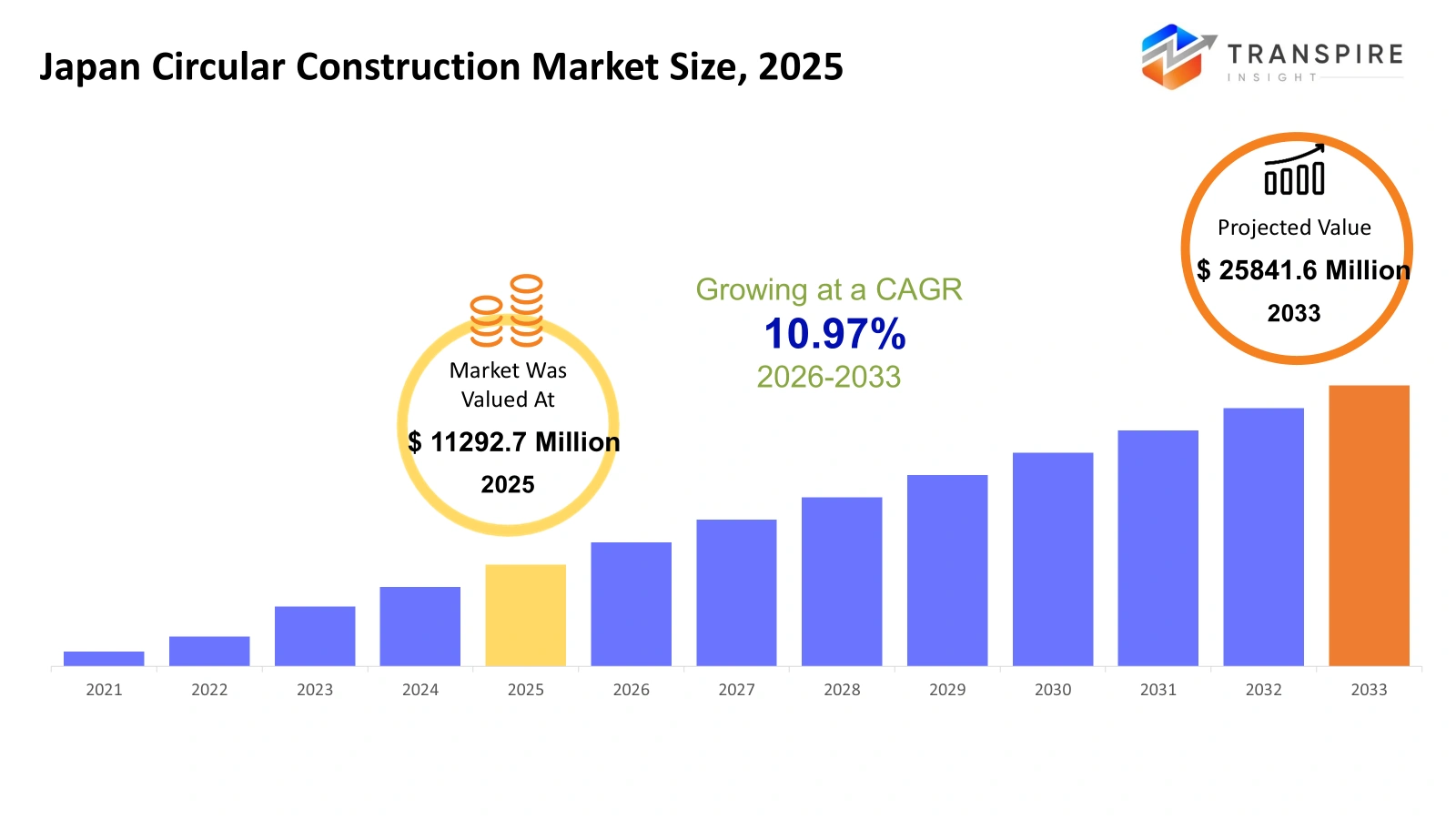
- Japan Circular Construction Market Size 2025: USD 11292.7 Million
- Japan Circular Construction Market Size 2033: USD 25841.6 Million
- Japan Circular Construction Market CAGR: 10.97%
- Japan Circular Construction Market Segments: By Material Type (Recycled Concrete, Recycled Metals, Recycled Plastics), By Application (Residential Construction, Commercial Construction, Infrastructure).
To learn more about this report,  Download Free Sample Report
Japan Circular Construction Market Summary:
The Japan Circular Construction Market size is estimated at USD 11292.7 Million in 2025 and is anticipated to reach USD 25841.6 Million by 2033, growing at a CAGR of 10.97% from 2026 to 2033. Japan's circular construction market is experiencing growth because sustainable building practices now dominate the country's construction methods. The companies now implement recycled materials together with modular designs and waste reduction methods to decrease their environmental footprint. The construction industry receives more environmentally friendly solutions because of government support and the enforcement of strict building regulations. Circular principles enable urban redevelopment and infrastructure projects to prolong material life cycles while decreasing their carbon emissions. The construction market in Japan develops more environmentally sustainable practices through increasing innovation and resource-efficient methods.
Key Market Trends & Insights:
- The usage of modular building methods is becoming more popular because these methods enable the reuse and repurposing of building components. The method reduces waste produced at construction sites while it decreases the time required to complete building projects.
- The combination of strict environmental regulations together with green building incentives fuels business adoption of circular economy methods. Sustainable construction practices become standard through public sector projects which demonstrate these methods.
- Urban redevelopment projects receive increased attention from developers who prefer to transform existing buildings instead of constructing new ones. The trend enables cities to maintain their existing resource base while keeping their urban areas intact.
- Digital technologies enable organisations to modernise their operations through digital technology integration. Building Information Modelling (BIM) systems enable organisations to monitor material usage while improving their resource management functions. The system helps organisations to reuse their resources while enhancing their project performance.
- The value chain now experiences enhanced collaboration among all involved parties. Developers, together with contractors and material suppliers, develop stronger relationships to create circular solutions. The partnership method helps organisations to establish better project strategies while decreasing their total waste production.
- Japanese companies achieve carbon neutrality by using low-emission materials and processes which align with the country’s climate objectives. The construction industry uses circular construction methods to decrease its total carbon emissions.
Japan Circular Construction Market Segmentation
By Material Type
- Recycled Concrete: Japanese construction projects use recycled concrete because builders want to decrease waste from their buildings and use materials from demolished structures. The material provides the same durability as standard concrete, whereas it creates less environmental damage through its use. The increasing use of the material in infrastructure development and city renewal projects demonstrates the nation's dedication to sustainable methods and circular economy construction methods.
- Recycled Metals: Japan's circular construction system depends on recycled metals, with steel serving as the most important component of this system. The materials receive high evaluation because they possess strong properties which allow for recycling, and they generate lower carbon emissions during their life cycle. The construction industry depends more on recycled metal materials because they help businesses save money and protect the environment while constructing residential and commercial buildings.
- Recycled Plastics: Construction materials are beginning to adopt recycled plastics for use in insulation systems and piping networks and panel production. In Japan, innovation is driving their use as a lightweight and versatile material. This development decreases plastic waste while creating sustainable building solutions for contemporary buildings and redevelopment projects.
By Application
- Residential Construction: Circular practices now serve as the basis for constructing residential buildings which produce environmentally sustainable, energy-efficient residences. The developers of the project use recycled materials together with modular design systems to achieve both waste reduction and cost savings. The residential market has developed into a sustainable market because homebuyers demand builders construct environmentally friendly housing units throughout Japan.
- Commercial Construction: Japanese commercial construction projects use circular construction methods as a means to achieve corporate sustainability objectives. The design of offices together with retail spaces and multi-purpose buildings uses recycled materials together with adaptable architectural elements. The organisation increases its environmental performance while providing businesses with environmentally sustainable infrastructure solutions that support responsible business practices.
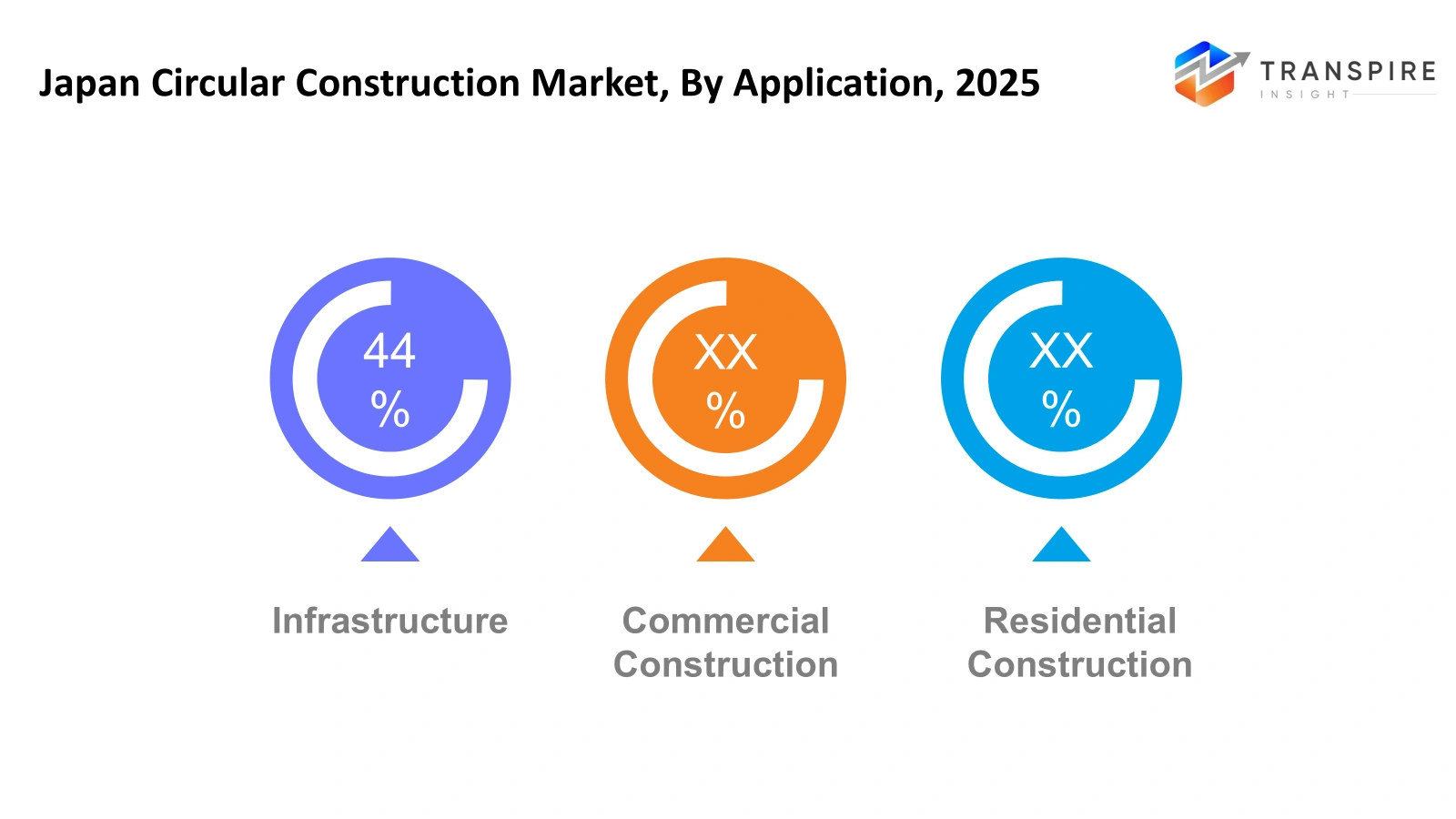
- Infrastructure: Circular construction methods have gained increasing adoption for infrastructure projects which include road construction and bridge building and public facility development. Japan focuses on extending the lifecycle of materials and reducing resource consumption. The method guarantees enduring sustainable development while upholding the necessary quality standards which essential infrastructure systems demand in the country.
To learn more about this report, Download Free Sample Report
Country Insights
The circular construction market in Japan demonstrates how deeply the nation values environmental protection and operational efficiency and technological progress. The limited natural resources of Japan have led the country to use circular construction methods which focus on material reuse and waste reduction as a fundamental approach in its building industry. The combination of sustainability-focused government policies and demanding construction standards leads businesses to implement recycled materials together with energy-saving architectural solutions.
The process of urban redevelopment, which involves renovating existing infrastructure, makes a great impact because it keeps both resources and historical importance intact. Material tracking and lifecycle management processes receive better results through the use of smart construction systems and digital planning tools, which serve as advanced technological solutions. The public and private sectors work together in strong ways, which results in faster progress toward sustainable building methods.
The circular construction market in Japan will experience continuous growth, which will help the country achieve its carbon neutrality objectives while creating a built environment that is sustainable and resilient for future generations.
Recent Development News
Japan Launches First Window Glass Circular Recycling Project: A groundbreaking project in the Kansai region will recycle window glass from renovations back into new architectural glass, promoting closed‑loop material reuse and cutting landfill waste.
Housing Construction Starts Rise in Japan: Recent data shows a month‑on‑month rise in housing construction starts, reflecting ongoing investment in residential projects even amid broader economic shifts.
|
Report Metrics |
Details |
|
Market size value in 2025 |
USD 11292.7 Million |
|
Market size value in 2026 |
USD 12472.8 Million |
|
Revenue forecast in 2033 |
USD 25841.6 Million |
|
Growth rate |
CAGR of 10.97% from 2026 to 2033 |
|
Base year |
2025 |
|
Historical data |
2021 – 2024 |
|
Forecast period |
2026 – 2033 |
|
Report coverage |
Revenue forecast, competitive landscape, growth factors, and trends |
|
Country scope |
Japan |
|
Key company profiled |
Holcim Group, Heidelberg Materials AG, CRH PLC, Skanska AB, Vinci SA, Bouygues Construction, Bechtel Corporation, Kajima Corporation, Obayashi Corporation, Shimizu Corporation, Taisei Corporation, Komatsu Ltd., Caterpillar Inc., Hitachi Construction Machinery Co. Ltd., Kiewit Corporation. |
|
Customization scope |
Free report customization (country, regional & segment scope). Avail customized purchase options to meet your exact research needs. |
|
Report Segmentation |
By Material Type (Recycled Concrete, Recycled Metals, Recycled Plastics), By Application (Residential Construction, Commercial Construction, Infrastructure). |
Key Japan Circular Construction Company Insights
The circular construction market in Japan is experiencing rapid development because companies are adopting sustainable practices and new technological solutions. The top construction companies are using recycled materials which include concrete and metals and plastics for their projects while they implement modular designs to decrease environmental waste. The construction process achieves cost savings through efficient material reuse when contractors work together with developers and suppliers. Digital resources are being used by multiple companies to monitor their assets and improve their project management processes. Japanese construction firms are establishing themselves as leaders in sustainable development through government backing and increasing demand for environmentally friendly buildings which will create a circular economy that builds a more sustainable future.
Company List
- Holcim Group
- Heidelberg Materials AG
- CRH PLC
- Skanska AB
- Vinci SA
- Bouygues Construction
- Bechtel Corporation
- Kajima Corporation
- Obayashi Corporation
- Shimizu Corporation
- Taisei Corporation
- Komatsu Ltd.
- Caterpillar Inc.
- Hitachi Construction Machinery Co. Ltd.
- Kiewit Corporation
Japan Circular Construction Market Report Segmentation
By Material Type
- Recycled Concrete
- Recycled Metals
- Recycled Plastics
By Application
- Residential Construction
- Commercial Construction
- Infrastructure
Frequently Asked Questions
Find quick answers to common questions.
The approximate Japan Circular Construction Market size for the market will be USD 25841.6 Million in 2033.
The key segments of the Japan Circular Construction Market are By Material Type (Recycled Concrete, Recycled Metals, Recycled Plastics), By Application (Residential Construction, Commercial Construction, Infrastructure).
Major players in the Japan Circular Construction Market are Holcim Group, Heidelberg Materials AG, CRH PLC, Skanska AB, Vinci SA, Bouygues Construction, Bechtel Corporation, Kajima Corporation, Obayashi Corporation, Shimizu Corporation, Taisei Corporation, Komatsu Ltd., Caterpillar Inc., Hitachi Construction Machinery Co. Ltd., Kiewit Corporation.
The current market size of the Japan Circular Construction Market is USD 11292.7 Million in 2025.
The Japan Circular Construction Market CAGR is 10.97%.
- Holcim Group
- Heidelberg Materials AG
- CRH PLC
- Skanska AB
- Vinci SA
- Bouygues Construction
- Bechtel Corporation
- Kajima Corporation
- Obayashi Corporation
- Shimizu Corporation
- Taisei Corporation
- Komatsu Ltd.
- Caterpillar Inc.
- Hitachi Construction Machinery Co. Ltd.
- Kiewit Corporation
Recently Published Reports
-
Apr 2026
Handling and Lifting Equipment Market
Handling and Lifting Equipment Market Size, Share & Analysis Report By Product (Cranes and Hoists, Forklifts, Conveyor Systems, Aerial Work Platforms, Others), By Application (E-Commerce, Automotive and Railway, Food and Beverages, Aviation, Others), and Geography (North America, Europe, Asia-Pacific, Middle East and Africa, South and Central America), 2021 - 2031
-
Apr 2026
HVAC Equipment Market
HVAC Equipment Market Size, Share & Analysis Report By Heating Equipment Type (Boilers and Furnaces, Heat Pumps, and Unitary Heaters), By Ventilation Equipment (Air Handling Units, Humidifiers and Dehumidifiers, Air Filters, and Fan Coiling Units), By Air Conditioning Equipment (Unitary Air Conditioners, Room Air Conditioners, Packaged Terminal Air Conditioners, and Chillers), By End User (Commercial, Residential, Industrial, and others), and Geography (North America, Europe, Asia-Pacific, Middle East and Africa, South and Central America), 2021 – 2031
-
Apr 2026
Refrigeration Valves Market
Refrigeration Valves Market Size, Share & Analysis Report By Type (Solenoid Valves, Expansion Valves, Check Valves, Service Valves, Others), By Application (Commercial Refrigeration, Industrial Refrigeration, Transport Refrigeration, Residential Refrigeration, Air Conditioning Systems), By End User (Food and Beverage Industry, Pharmaceutical Industry, HVAC Industry, Chemical Industry, Others), and Geography (North America, Europe, Asia-Pacific, Middle East and Africa, South and Central America), 2021 – 2031
-
Apr 2026
E-Commerce Packaging Materials Market
E-Commerce Packaging Materials Market By Material Type (Corrugated Boxes, Paper & Paperboard, Foam & Cushioning Materials, Plastic Packaging, Flexible Packaging, Protective Packaging, Others), By Product(Primary Packaging, Secondary Packaging, Tertiary Packaging), By Packaging Function (Protective Packaging, Branding & Presentation Packaging, Transit & Logistic Packaging, Sustainable Packaging, Tamper Evidence Packaging), By End-User (Retail & Consumer Goods, Electronic Appliances, Food & Beverages, Healthcare & Pharmaceutical, Fashion & Apparel, Home & Furnishing, Others); By Industry Analysis, Size, Share, Growth, Trends, and Forecasts 2021-2033