

Japan Circuit Breaker Market Summary
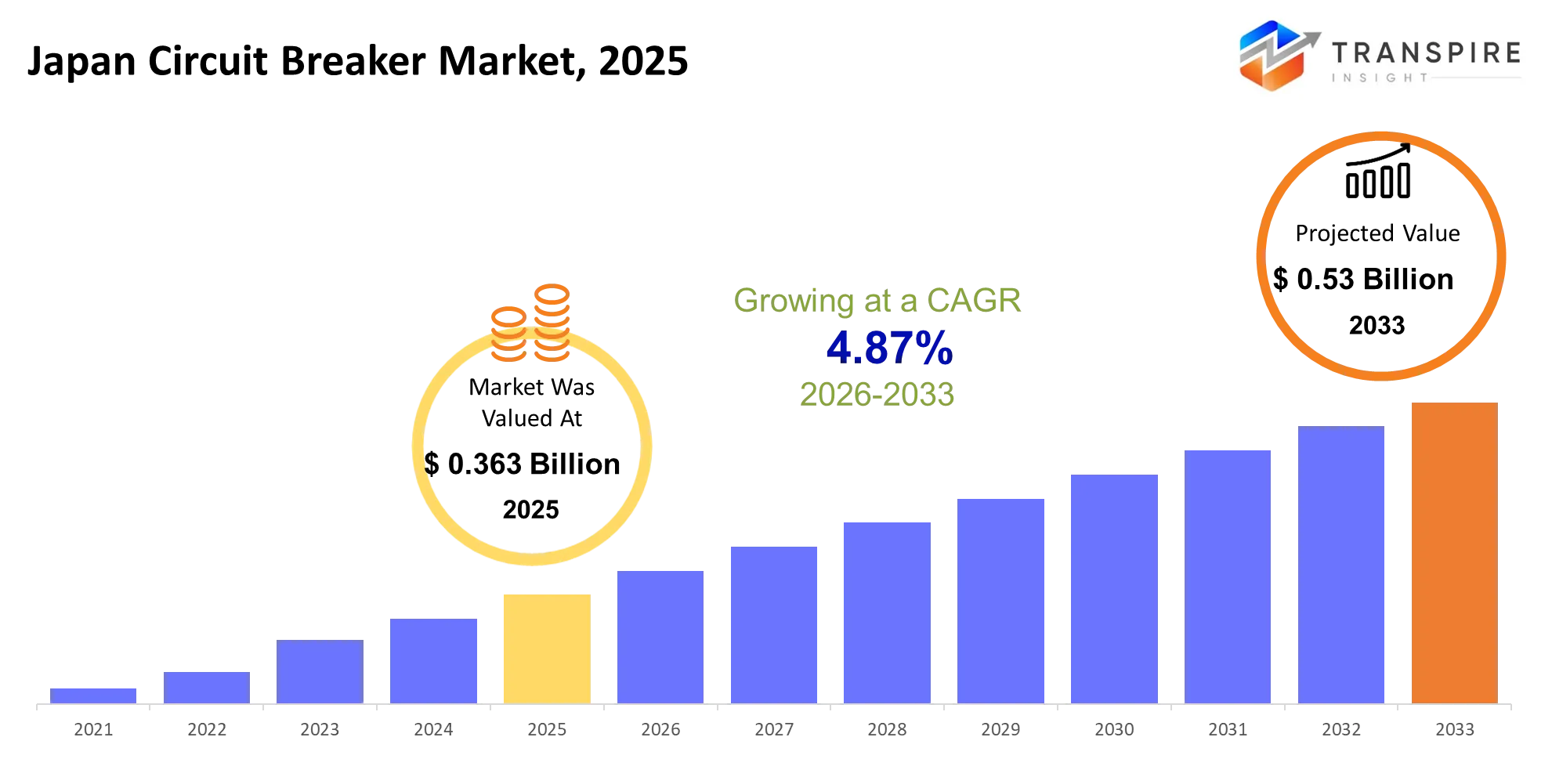
As per Transpire Insight, the Japan Circuit Breaker Market size is estimated at USD 0.363 Billion in 2025 and is anticipated to reach USD 0.53 Billion by 2033, growing at a CAGR of 4.87% from 2026 to 2033.
From Transpire Insight, it’s estimated that the Japan Circuit Breaker Market sits around USD 0.363 Billion in 2025 , then moves toward about USD 0.53 Billion by 2033. In practice, circuit breakers are pretty much indispensable to Japan’s power infrastructure, because they automatically isolate electrical faults before those faults go and hurt industrial equipment, service buildings, transport systems, or even utility networks. Over the last five years, the market vibe has tilted more and more toward intelligent digital circuit breakers, with remote monitoring in mind and predictive asset management support, kind of swapping out conventional protective devices across modern substations and industrial facilities.
At the same time Japan’s carbon neutrality roadmap and the faster renewable energy push, have reshaped what grid protection needs to do. Then add COVID-19 related supply chain disruptions, which, in turn , motivated utilities and equipment makers to focus more on strengthening domestic electrical infrastructure investments. All of this has nudged budgets higher for advanced protection gear, helped modernize aging transmission assets, and fueled smart manufacturing initiatives, so manufacturers that provide dependable and digitally connected circuit protection solutions can expect steadier revenue paths.
Japan Circuit Breaker Market Size & Forecast:
- Japan Circuit Breaker Market Size 2025: USD 0.363 Billion
- Expected Market Value 2033: USD 0.53 Billion
- Forecast CAGR: 4.87%
- Leading region in 2025:Kanto Kanto
- Fastest Growing region:Kyushu
- Key Profile: Mitsubishi Electric, Fuji Electric, Toshiba Energy Systems, Hitachi Energy, Schneider Electric, ABB Ltd., Siemens AG, Eaton Corporation, Legrand, LS Electric, CHINT Group, Hyundai Electric, Rockwell Automation, Larsen & Toubro, Panasonic Holdings
Key Market Insights
- Regional Analysis: Kanto is sort of taking the lead in the Japan circuit breaker market with an estimated share of around 38% in 2025, mainly because there are so many industrial facilities , utilities, and commercial infrastructure packed in close proximity.
- Regional Growth: Looking ahead, Kyushu should become the fastest-growing regional market through 2033, largely thanks to renewable energy schemes and additional power transmission spend that keeps rolling in.
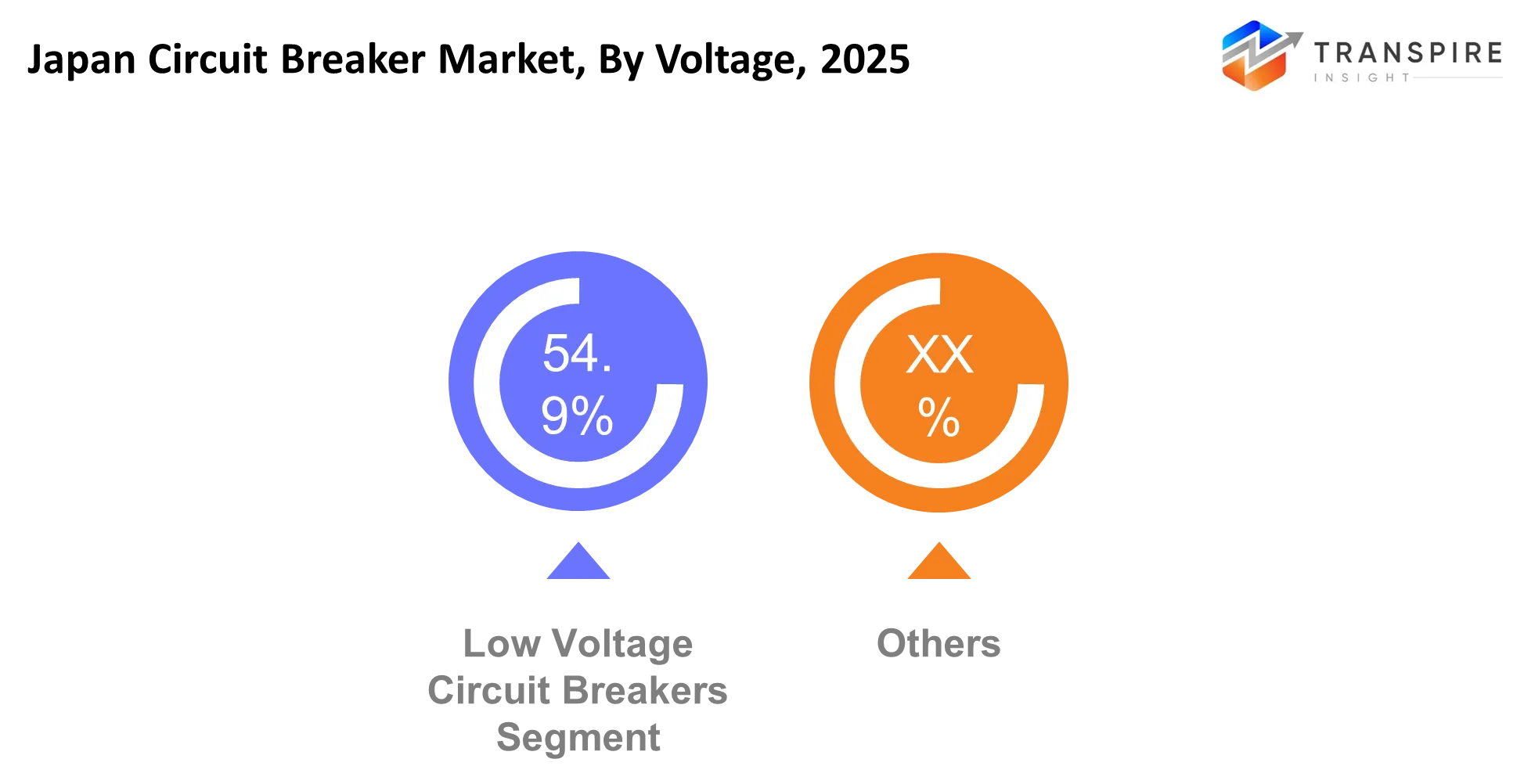
- Segment Analysis: In the segments, low-voltage circuit breakers are leading with roughly 46% market share in 2025, and that’s tied to commercial buildings, residential projects , and manufacturing sites that want dependable protection.
- Molded Case Circuit Breakers (MCCBs) stay in the #2 position, mostly because industrial plants need higher fault-current safeguarding and consistent operational reliability.
- Vacuum circuit breakers are expected to grow fastest during the forecast period , as utilities update their medium-voltage distribution networks and improve system stability.
- Application Insights: For applications, power distribution is close to 42% of revenue, with grid modernization and substation upgrades acting like the main push.
- Industrial automation is also showing up as the fastest-growing application , since manufacturers are setting up digital factories that lean on intelligent electrical protection systems.
- End-User Insights: On the end-user side, utilities remain the dominant group with about 39% market share, supported by continuous transmission and distribution network investments.
- Manufacturing is the fastest-growing end-user category too, as factories adopt Industry 4.0 tools and move toward automated production operations.
- Competitive Landscape: The competitive scene includes Mitsubishi Electric, Fuji Electric, ABB Ltd., Schneider Electric, Siemens AG, and Hitachi Energy, all pushing intelligent circuit breakers, digital monitoring platforms, joint ventures or strategic partnerships, localized manufacturing, and smart grid technology investments.
What are the Key Drivers, Restraints, and Opportunities in theJapan Circuit Breaker Market ?
The strongest growth driver is kinda Japan modernization of aging electrical infrastructure, mixed with rapid renewable energy integration . On top of that, Government policies for carbon neutrality and resilient electricity networks have pushed investments in substations, industrial facilities , and smart grids. Renewable energy installations bring around fluctuating power flows, so protection devices have to act faster, and also be more “intelligent” about keeping the grid steady. As utilities swap conventional switchgear for digitally connected circuit breakers, manufacturers get to sell higher value products, especially those with remote diagnostics, communication features , and predictive maintenance functions.
The main restraint is really the high cost and the technical complexity, when it comes to replacing legacy electrical infrastructure. A lot of industrial plants and utilities are still running equipment that’s decades old, and it was built around existing protection architectures. If modern digital circuit breakers are going in, it often means extensive engineering changes, compatibility testing that takes time, communication network upgrades, and planned shutdowns that mess with day to day operations. Those structural issues are not something you fix quickly , since critical infrastructure has to keep continuous power supply and also follow strict safety standards.
There is a noticeable opportunity in broadening intelligent circuit protection solutions for distributed energy resources and microgrids. Japan keeps investing in solar generation, battery energy storage systems , and resilient local power networks, partly to improve energy security. These decentralized setups need advanced protection equipment that can handle real-time communication, adaptive fault detection, and coordinated control.
What Has the Impact of Artificial Intelligence Been on theJapan Circuit Breaker Market ?
Artificial intelligence is, kind of , reshaping electrical protection systems by making monitoring feel more “smart” and by supporting predictive maintenance, plus kind of automated asset management across utilities and industrial sites. Today’s digital circuit breakers keep pulling in real time operational data such as load profiles, temperature, switching frequency insulation condition , and even fault history. Then machine learning algorithms dig through those datasets to spot odd operating behaviors before anything actually breaks down. This means maintenance teams can line up repairs ahead of time instead of waiting for outages that show up out of nowhere. On the utility side, they are also using AI analytics to fine tune protection coordination , because renewables bring more shifting electricity flows into distribution networks.
On top of that, the newer digital layer improves day to day efficiency through automated fault diagnostics, remote equipment inspection, and a more condition- based maintenance plan. Intelligent monitoring platforms help reduce sudden downtime, stretch equipment life , and boost grid reliability. They also tend to cut maintenance spending by flagging the high risk assets first rather than later. In industrial settings, AI assisted protection systems can further help operators manage energy usage, while keeping up with compliance tied to electrical safety rules that are getting more intricate all the time.
Still, AI adoption is not effortless. It’s slowed by high integration costs and the reality that many facilities still rely on legacy infrastructure. Older protection equipment often does not include standardized digital communication interfaces , so there is less access to good quality operational data. And without that kind of input it is harder to train accurate machine learning models. Even with those limitations, as digital substations and smart factories keep expanding, AI enabled circuit protection is expected to move toward being a standard part of Japan’s modern electrical infrastructure.
Key Market Trends
- Digital circuit breakers are slowly replacing the more conventional stuff as utilities push remote monitoring and this predictive asset management , kind of thing. Since 2021 the renewable energy ramp up really sped things along, with adaptive protection systems that can handle variable electricity flows.
- The makers have also been shifting their money toward IoT enabled protection equipment, which supports cloud based diagnostics and condition monitoring.
- Vacuum circuit breakers are still picking up market share, especially as utilities modernize medium voltage substations and distribution infrastructure .
- Industrial buyers, on the other hand, are starting to care more about lifecycle performance and predictive maintenance than the upfront purchase price of the equipment.
- There are more strategic collaborations now between electrical equipment manufacturers and software providers, and it is widening the digital grid management capabilities.
- Also supply chain localization got stronger after pandemic disruptions, so there is a bigger push for domestic sourcing of the critical electrical components, yes that.
- Smart factory investments keep nudging adoption of intelligent protection devices that are integrated with industrial automation platforms.
- Utilities also increasingly roll out digital substations, using IEC 61850 communication standards, to get more operational flexibility and better fault management.
- Companies like Mitsubishi Electric , ABB , Schneider Electric , Siemens, and Hitachi Energy are continuing to broaden their intelligent protection portfolios through software integration and advanced digital technologies.
Japan Circuit Breaker Market Segmentation
By Product Type:
Miniature circuit breakers are used for low-current electrical protection across residential buildings, offices, and light commercial facilities, basically you know, everyday applications. Meanwhile molded case circuit breakers handle larger electrical loads in factories, commercial complexes and infrastructure projects where the higher fault current protection is a must. For high-capacity power distribution systems in industrial plants, data centers, and even utility installations, air circuit breakers are often the go-to choice. Vacuum circuit breakers are still expanding in medium-voltage scenarios, mainly because reliable arc interruption plus lower maintenance really does help day to day operational performance.
SF6 circuit breakers remain a key option for high-voltage transmission networks, where dependable switching performance backs grid stability during demanding operating conditions. There are also other product types, like specialized protection devices made for renewable energy systems, transportation infrastructure, marine installations, and customized industrial applications. In practice the selection process leans on the voltage level, the installation environment, the switching frequency, and those system reliability requirements too. And honestly continuous product innovation matters because it supports improved digital monitoring, stronger operational safety, and longer-term equipment performance, all at once, not separately.
By Voltage:
Low Voltage equipment ends up taking the biggest share since residential buildings, commercial properties, manufacturing facilities, and public infrastructure all need dependable electrical protection for everyday operations. Medium Voltage products back industrial production sites, renewable power facilities, transportation systems, and distribution substations where larger electrical loads show up much more often. High Voltage solutions safeguard transmission networks, where electricity keeping running without interruptions is basically non negotiable for national energy security. And the voltage classification itself really steers the whole path for how the equipment is designed, what protection capability it can deliver, and even what installation standards get followed.
There are other voltage categories too, and they end up serving specialized uses that sit outside the usual classifications or that call for customized electrical protection. The push for extra renewable power generation and the arrival of more modern industrial facilities keeps boosting the demand for medium AND high voltage protection equipment. Infrastructure modernization also keeps opening doors across every voltage category, somehow. Meanwhile, digital monitoring functions keep getting better, and that improves operational efficiency across the different voltage classes.
By Installation:
Indoor installations make up a large share of overall deployment, since factories, commercial buildings, hospitals, educational institutions, and residential complexes typically need protected electrical distribution networks inside controlled areas. When operating conditions are steadier it actually helps in extending equipment life, and it also makes routine service tasks simpler, in a way that engineers like. Indoor layouts additionally enable compact switchgear arrangements, especially for facilities that have very limited installation space to begin with, so it’s not just a preference. Safety regulations still push installation upgrades across newer buildings, and older ones too.
Outdoor installations, on the other hand, are usually tied to transmission networks, substations, renewable energy sites, transportation corridors, and industrial plants that are exposed to fluctuating weather. Strong enclosure designs help keep performance dependable even when conditions get harsh, hot, cold, wet, whatever comes along. There are also other installation categories for special locations, where customized engineering is needed or where space-efficient protection systems are required, rather than a standard one. Continued infrastructure expansion keeps a kind of balance in growth between indoor and outdoor installations.
By End User:
Residential applications lean on electrical safety devices to keep overloads, brief short circuits, and damage from spreading to wiring, appliances, and the overall setup in homes or apartment developments. Commercial spaces like office buildings , hospitals, retail centers and educational campuses need dependable protection, so daily work keeps running without interruptions. Industrial sites use more advanced protection equipment, because the manufacturing process involves intricate machinery and a kind of constant electrical demand. When power is protected well , downtime falls and operational efficiency improves too.
Utilities are still among the most important end users, since electricity transmission and distribution grids demand high-performance switching plus protection hardware. At the same time, adding renewable energy sources keeps pushing more investment into utility infrastructure. Other end users pop up in transportation systems, public infrastructure, mining sites, marine facilities, and specialized industrial operations that run 24/7. As general infrastructure keeps growing, the number of opportunities keeps expanding across basically every end-user group.
By Distribution Channel:
Direct Sales still seems the go-to channel for large industrial projects, utilities, infrastructure developments and those customized electrical installations, because the hands on technical consultation plus project specific engineering backup, really add a lot of weight. You know, the long term service agreements and the maintenance contracts also helps keep the customer relationship stable. And for big procurement programs, there s a clear advantage when there s direct manufacturer involvement during the full project execution. In general, that technical know how supports the whole installation and commissioning, without too much drama.
Electrical Distributors provide standardized products to contractors, commercial customers and regional businesses using established distribution networks. Online Sales keeps growing too, mostly because product comparison, digital catalogs, and faster procurement make it simpler to buy, especially for smaller projects and for replacement needs. Other avenues for distribution are system integrators, engineering firms, and specialized industrial suppliers, serving those niche applications. Having multiple sales channels means better product accessibility across various customer groups, at least that s how it tends to work.
What are the Key Use Cases Driving theJapan Circuit Breaker Market ?
Electrical distribution networks show up as the primary use case, mainly because dependable fault protection helps keep power running with fewer interruptions across substations, manufacturing sites, commercial buildings, and even residential areas. Utility operators end up investing in more advanced protection gear so they can keep the grid stable, lessen equipment harm, and also allow renewable energy to join the mix, all while system reliability doesn’t take a hit.
Meanwhile industrial automation and commercial infrastructure keep pushing the demand upward. Automotive manufacturing plants, semiconductor production facilities, data centers, and transport infrastructure need smart protection systems that keep things operating continuously, while cutting down those annoying maintenance shutdowns. On top of that, smart building efforts help expand deployments across all kinds of commercial developments.
Then there are the newer directions, like battery energy storage systems, hydrogen production facilities, and community microgrids, which seem to have strong long range promise. Grid modernization programs, along with more decentralized energy projects, need protection technology that can handle bidirectional power flow, provide digital monitoring, and enable adaptive fault management, which opens further opportunities across the whole forecast timeline.
|
Report Metrics |
Details |
|
Market size value in 2025 |
USD 0.363 Billion |
|
Market size value in 2026 |
USD 0.38 Billion |
|
Revenue forecast in 2033 |
USD 0.53 Billion |
|
Growth rate |
CAGR of 4.87% from 2026 to 2033 |
|
Base year |
2025 |
|
Historical data |
2021 - 2024 |
|
Forecast period |
2026 - 2033 |
|
Report coverage |
Revenue forecast, competitive landscape, growth factors, and trends |
|
Regional scope |
Japan |
|
Key company profiled |
Mitsubishi Electric, Fuji Electric, Toshiba Energy Systems, Hitachi Energy, Schneider Electric, ABB Ltd., Siemens AG, Eaton Corporation, Legrand, LS Electric, CHINT Group, Hyundai Electric, Rockwell Automation, Larsen & Toubro, Panasonic Holdings |
|
Customization scope |
Free report customization (country, regional & segment scope). Avail customized purchase options to meet your exact research needs. |
|
Report Segmentation |
By Product Type (Miniature Circuit Breakers, Molded Case Circuit Breakers, Air Circuit Breakers, Vacuum Circuit Breakers, SF6 Circuit Breakers, Others); By Voltage (Low Voltage, Medium Voltage, High Voltage, Others); By Installation (Indoor, Outdoor, Others); By End User (Residential, Commercial, Industrial, Utilities, Others); By Distribution Channel (Direct Sales, Electrical Distributors, Online Sales, Others) |
Which Regions are Driving theJapan Circuit Breaker Market Growth?
The Kanto region has the largest share of the Japan Circuit Breaker Market, mainly because it gathers the nations biggest commercial hubs, manufacturing sites, utilities, and a lot of power-heavy industries. Also, those government backed smart grid efforts plus broad transmission infrastructure, along with ongoing spending to modernize the electrical network, keeps the long term needs for advanced protection equipment pretty stable. Big cities such as Tokyo, and Yokohama, still need electrical systems that are very reliable for rail and transit, data centers, and commercial building operations too.
The Kansai region adds to demand in a steady way, but more through a varied industrial base, not as much from the sheer infrastructure size you see in Kanto. In practice, manufacturing lines in electronics, machinery, chemicals, and automotive production keep swapping out older electrical setups for higher performance protection solutions when planned plant upgrades happen. With steady private-sector capital spending, and also reliable regulatory compliance, the buying patterns for electrical protection products stay pretty predictable. Plus, long running industrial activities and maintenance programs that are already well established, make Kansai a dependable contributor to overall market revenue, even if its investment profile looks a bit different.
For Kyushu, the region is expected to grow the quickest from 2026 to 2033, since renewable energy buildouts, battery storage programs, and transmission improvements speed up across the area. Solar generation expansion, offshore wind activities, and grid reinforcement initiatives have pushed up the need for intelligent medium- and high-voltage circuit protection systems. Utilities there are also putting money into digital substations and modern switching equipment, aiming to boost grid flexibility while still handling more decentralized power generation, without much disruption.
Who are the Key Players in theJapan Circuit Breaker Market and How Do They Compete?
Competition in the Japan Circuit Breaker Market is sort of moderately consolidated, with major electrical equipment makers going at it mostly via tech updates , product dependability, digital monitoring features and then the long-run service support that customers tend to care about. The big domestic names keep pretty tight relationships with Japanese utilities and industrial operators, while overseas suppliers show up with more advanced automation platforms, environmentally sustainable technologies and integrated power management solutions. What usually decides the big infrastructure stuff is product performance , total lifecycle cost ,and engineering support… not price by itself ,at least not most of the time.
Mitsubishi Electric seems to separate itself using advanced digital protection systems that are aimed at smart substations and industrial automation initiatives across Japan. Fuji Electric keeps leaning into tailored power distribution equipment for manufacturing sites and critical infrastructure, backed by solid domestic engineering and ongoing maintenance know-how. Hitachi Energy is pushing forward with SF₆-free high-voltage technologies and digital grid solutions, sort of helping utilities lower environmental impact while also boosting transmission reliability in practice.
Schneider Electric boosts its position by tying circuit protection into EcoStruxure digital energy management platforms, so customers can do real-time monitoring and get predictive maintenance insights. ABB Ltd. keeps putting money into intelligent low- and medium-voltage protection technologies, while also expanding digital asset management capabilities for industrial clients and utility customers alike.
Company List
- Mitsubishi Electric
- Fuji Electric
- Toshiba Energy Systems
- Hitachi Energy
- Schneider Electric
- ABB Ltd.
- Siemens AG
- Eaton Corporation
- Legrand
- LS Electric
- CHINT Group
- Hyundai Electric
- Rockwell Automation
- Larsen & Toubro
- Panasonic Holdings
Recent Development News
- In April 2026, Toshiba announced successful verification of a 300 kV SF₆-free gas-insulated switchgear and gas circuit breaker using natural-origin gases. The milestone advances commercialization of environmentally friendly high-voltage equipment and supports the transition toward sustainable transmission infrastructure.http://www.global.toshiba
- In March 2026, Hitachi Ltd. secured an order from Chubu Electric Power Grid for the world's first fully SF₆-free 550 kV gas-insulated switchgear. The project strengthens Japan's transmission network while significantly reducing greenhouse gas emissions from high-voltage infrastructure.http://www.hitachi.com
- In May 2026, Hitachi Energy launched its EconiQ 800 kV SF₆-free dead tank circuit breaker at the IEEE PES T&D Conference. The product expands environmentally sustainable high-voltage switching technology for future transmission grids while maintaining ultra-high-voltage performance.http://www.hitachienergy.com
What Strategic Insights Define the Future of theJapan Circuit Breaker Market ?
Japan’s Circuit Breaker Market is kind of moving toward smarter, digitally linked, and more environmentally sound protection set ups as utilities modernize their older transmission assets, and also pull in higher volumes of renewable power into the grid. You can see it in digital substations, predictive upkeep , and SF₆-free switching technologies that will steadily influence what gets bought over the next 5 to 7 years. There’s also a quieter kind of risk that doesn’t get talked about as much, like how too many critical component suppliers and specialized raw materials are concentrated in a few places, that can end up stretching delivery timelines and nudging project expenses higher when disruptions hit supply.
Meanwhile, the flip side is that intelligent protection systems built for battery energy storage facilities, microgrids, and hydrogen related infrastructure are starting to show up as an opportunity, but it still feels underpenetrated today. So manufacturers , investors should really put emphasis on software-enabled circuit protection, widen cooperation with utilities, and build stronger local manufacturing capabilities to snag more long-term value. That should also help improve resilience when the supply chain gets unstable in the future.
Japan Circuit Breaker Market Report Segmentation
By Product Type
- Miniature Circuit Breakers
- Molded Case Circuit Breakers
- Air Circuit Breakers
- Vacuum Circuit Breakers
- SF6 Circuit Breakers
- Others
By Voltage
- Low Voltage
- Medium Voltage
- High Voltage
- Others
By Installation
- Indoor
- Outdoor
- Others
By End User
- Residential
- Commercial
- Industrial
- Utilities
- Others
By Distribution Channel
- Direct Sales
- Electrical Distributors
- Online Sales
- Others
Frequently Asked Questions
Find quick answers to common questions.
The expected Japan Circuit Breaker Market size for the market will be USD 0.53 Billion in 2033.
Key segments for theJapan Circuit Breaker Market are By Product Type (Miniature Circuit Breakers, Molded Case Circuit Breakers, Air Circuit Breakers, Vacuum Circuit Breakers, SF6 Circuit Breakers, Others); By Voltage (Low Voltage, Medium Voltage, High Voltage, Others); By Installation (Indoor, Outdoor, Others); By End User (Residential, Commercial, Industrial, Utilities, Others); By Distribution Channel (Direct Sales, Electrical Distributors, Online Sales, Others).
MajorJapan Circuit Breaker Market players are Mitsubishi Electric, Fuji Electric, Toshiba Energy Systems, Hitachi Energy, Schneider Electric, ABB Ltd., Siemens AG, Eaton Corporation, Legrand, LS Electric, CHINT Group, Hyundai Electric, Rockwell Automation, Larsen & Toubro, Panasonic Holdings.
The Japan Circuit Breaker Market size is USD 0.363 Billion in 2025.
The Japan Circuit Breaker Market CAGR is 4.87% from 2026 to 2033.
- Mitsubishi Electric
- Fuji Electric
- Toshiba Energy Systems
- Hitachi Energy
- Schneider Electric
- ABB Ltd.
- Siemens AG
- Eaton Corporation
- Legrand
- LS Electric
- CHINT Group
- Hyundai Electric
- Rockwell Automation
- Larsen & Toubro
- Panasonic Holdings
About the Authors

Avinash Kumar
I’m Avinash Kumar, a Senior Research Analyst at Transpire Insight, with expertise in the Electronics and Semiconductor and Energy & Power industry. My work focuses on analyzing emerging technologies, market trends, industry developments, and innovation across these sectors. I specialize in transforming complex technical and market insights into clear, research-backed content that helps professionals, businesses, and decision-makers stay informed. Through continuous industry research and data-driven analysis, I strive to deliver accurate, reliable, and practical perspectives on the latest advancements shaping the semiconductor and energy landscape.

Chakradhar Khansole
Chakradhar serves as the Research Director at Transpire Insight, bringing over 8 years of experience in technology, innovation, and strategic market intelligence. He specializes in transforming complex market data into actionable business insights that enable organizations to make informed, growth-oriented decisions. Recognized for his strategic vision and analytical expertise, Chakradhar leads high-impact research initiatives, delivering comprehensive market assessments, competitive intelligence, and forward-looking industry analysis.
Recently Published Reports
-
Apr 2026
Fiber Optic Faceplates Market
Fiber Optic Faceplates Market Size, Share & Analysis Report By Type (< 300 mm2, 300-350 mm2, and > 350 mm2, By Application (Night Vision, Holographic Imaging, Medical, and Others), and Geography (North America, Europe, Asia-Pacific, Middle East and Africa, South and Central America), 2021 - 2031
-
Apr 2026
High Temperature Superconductors Market
High Temperature Superconductors Market Size, Share & Analysis Report By Type (1G HTS, and 2G HTS), By Application (Power Cable, Fault Current Limiter, and Transformer), and Geography (North America, Europe, Asia-Pacific, Middle East and Africa, South and Central America), 2021 - 2031
-
Apr 2026
Industrial Plugs and Socket Market
Industrial Plugs and Socket Market Size, Share & Analysis Report By Type (Industrial Plugs, Industrial Sockets), By Current (Up to 32 A, 32 to 125 A, Above 125 A), By Protection (Dustproof and Splash Proof, Waterproof, Explosion Proof), By End User (Heavy Industries, Oil and Gas, Chemicals and Pharmaceuticals, Power Generation, Others), and Geography (North America, Europe, Asia-Pacific, Middle East and Africa, South and Central America), 2021 - 2031
-
Apr 2026
InGaAs Avalanche Photodiodes Market
InGaAs Avalanche Photodiodes Market Size, Share & Analysis Report By Type (1100 - 1700 nm, and 1000 - 1600 nm), By Application (Missile Warning System, Muzzle Flash Detection, Wafer Defect Inspection, Laser Rangefinders, and Others), and Geography (North America, Europe, Asia-Pacific, Middle East and Africa, South and Central America), 2021 - 2031