
Japan Attitude and Heading Reference Systems (AHRS) Market Summary:
According to Transpire Insight, a detailed research report on the market reflects that the digital data segment dominates the Japan Attitude and Heading Reference Systems (AHRS) Market, accounting for approximately USD 33.92 million in 2024. Honeywell International Inc., Thales, Parker Hannifin Corp., Northrop Grumman, and Safran are prominent companies analyzed in the market, contributing to Japan market development, innovation, advanced AHRS technologies, expanding technological capabilities, and growth dynamics.
Market Snapshot
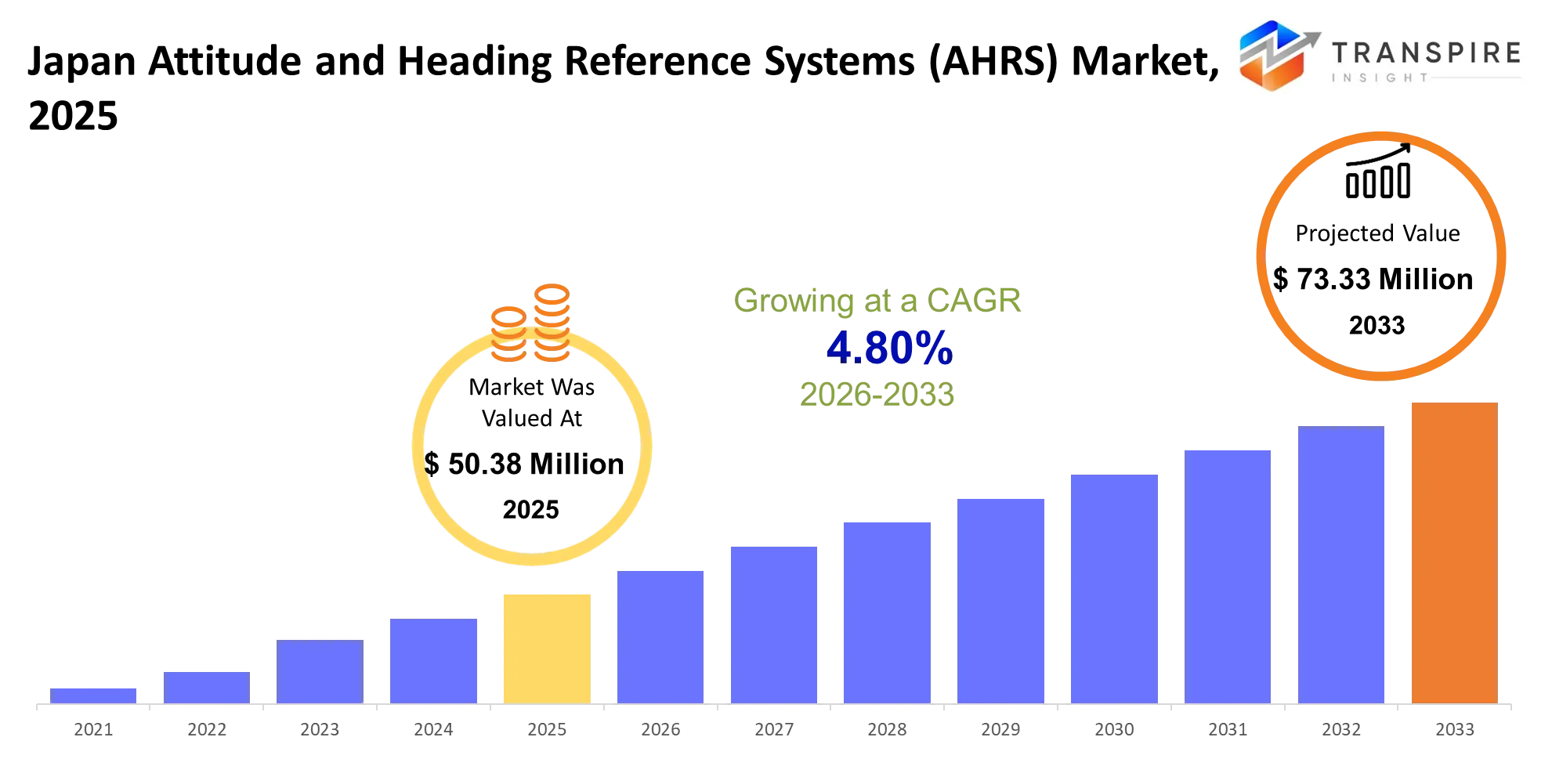
- Market Value (2025): USD 50.38 Million.
- Expected Market Value (2026): USD 52.80 Million.
- Estimated Market Value (2033): USD 73.33 Million.
- Forecast CAGR (2026–2033): 4.80%
Introduction
The attitude and heading reference system (AHRS) is an electronic unit that consists of three-axis sensors (gyroscopes, accelerometers, and magnetometers) along with processing algorithms and provides accurate and up-to-date information on the heading and orientation of the vehicle. AHRS (Attitude and Heading Reference System) an electronic unit with internal processing and several sensors providing stable roll, pitch, and yaw data. The Japan Attitude and Heading Reference Systems (AHRS) market is favored due to factors like high precision, reduction in weight, safety, and low maintenance needs. High-performance AHRS systems offer real-time readings for yaw, roll, and pitch, which enable efficient navigation and orientation of flights. The use of MEMS sensors ensures that the size of the equipment is reduced and the weight is minimized, which might even improve the carrying capacity and fuel economy. Safety of flights is greatly improved with the help of the data provided by AHRS systems when there is poor visibility, difficult terrain, and no GPS coverage.
Key Market Highlights: -
- By component, the IMUs segment dominated the market and holds nearly 42% share in 2025 and is projected to grow at a substantial CAGR during the forecast period.
- By application, the Aerospace segment dominated the market and holds nearly 50% share in 2025 and is projected to grow at a substantial CAGR during the forecast period.
- By end user, the Defense segment dominated the market and holds nearly 45% share in 2025 and is projected to grow at a substantial CAGR during the forecast period.
- State-Supported Defense Production Facilities: Japan is reinforcing its defense manufacturing base through state-supported production facilities and defense production activities conducted by the private contractors. This strategy ensures the stability of production processes and improves the resilience of the defense value chain. The higher localization rate of modern defense technologies may help boost the demand for AHRS.
How is Technology Driving Growth in the Japan Attitude and Heading Reference Systems (AHRS) Market?
In Japan, the AHRS market will develop due to factors like miniaturization, MEMS technology, advanced sensor fusion, digital signal processing, aviation modernization, and indigenous research and development activities. Smaller and lightweight MEMS AHRS solutions would make way for AHRS integration into UAVs, drones, and advanced aircraft. The use of advanced algorithms that can fuse data from the gyroscope, accelerometer, magnetometer, and GPS would provide precise real-time measurement of the aircraft’s pitch, roll, and yaw angles. Aviation modernization activities are increasing the need for integrating AHRS with the autopilot and flight-control systems. In addition to this, indigenous R&D activities in navigation technologies and defense modernization in Japan are providing impetus to the AHRS market.
Market Drivers
The Japan AHRS Market is driven by rising defense spending and modernization projects, contributing to the demand for high-end aircraft, UAVs, and surveillance equipment, which require accurate navigation. Modernization initiatives in commercial aircraft fleets and strict safety norms also contribute to the growth of the AHRS market. Innovations in technology like MEMS technology, GPS assisted sensors, and miniaturization have led to the development of lightweight, compact, and power efficient AHRS systems. Moreover, increased adoption of automated navigation, maritime automation, drones, and urban air mobility technology has boosted the demand for high-end AHRS systems in Japan. Japan AHRS Market is witnessing improvements in safety, accuracy, miniaturization, efficiency, and reliability. The AHRS system incorporates the use of gyroscopes, accelerometers, and magnetometers to give accurate readings of pitch, roll, and yaw angles, resulting in enhanced situational awareness in difficult operational environments. Modern MEMS and solid-state designs are offering compact and lightweight AHRS that help in saving space and reducing the weight of the aircraft. This would help in achieving better fuel efficiency and payload capacities for the commercial aviation industry as well as UAVs. In addition, solid-state design ensures minimal wear and tear and reduces maintenance costs and downtime.
Restrain
Restraints faced by the Japan AHRS market include high costs of integration and certification, technology challenges, and limitations of the supply chain. Complex integration and drift correction techniques need specific knowledge and testing processes. Also, lack of aerospace components, high-quality requirements, and certification processes may lead to cost escalation, delayed deployment, and market expansion limitations.
Analysis of Prices and Consumer Behaviour
Japan AHRS and Heading Reference Systems Market are led by digital systems (USD 33.92 million in 2024; majorly owing to demand from aerospace, defense, civil aviation, and unmanned vehicles applications). Price of advanced AHRS systems is determined based on sensor type, performance grade, integration requirement, and certification requirements. Japan AHRS Market size was estimated at USD 36.47 million in 2024 and is forecasted to reach USD 68.91 million by 2032, growing at a CAGR of 11.23%. USD 22.26 million of the total market size in 2024 comes from the Hardware products category. Performance grade high category accounted for USD 17.86 million in 2024. End-user category civil aviation accounted for USD 14.05 million in 2024, while digital AHRS accounted for USD 33.92 million in 2024.
Top Companies in the Japan Attitude and Heading Reference Systems (AHRS) Market
- Honeywell
- Safran
- Northrop Grumman
- Collins Aerospace
- Thales
- Garmin
- Analog Devices
- Bosch Sensortec
- Murata
- Epson
- SBG Systems
- VectorNav
- Trimble
- Japan Aviation Electronics
- Tamagawa Seiki
Japan Attitude and Heading Reference Systems (AHRS) Market Segmentation
The Japan Attitude and Heading Reference Systems (AHRS) Market share is divided into six categories: By component, technology, application, platform, accuracy and end user.
The IMUs dominated the market, accounting for nearly 42% in 2025 and is expected to rise at a significant CAGR during the forecast period.
The Japan Attitude and Heading Reference Systems (AHRS) Market is segmented by component into Gyroscopes, Accelerometers, Magnetometers, IMUs, GPS/GNSS Modules, Processing Units, Sensors, Software. Among these, the IMUs segment dominated the market, accounting for nearly 42% in 2025 and expected to increase at a significant CAGR during the forecast period. IMUs have gained high market dominance because of their widespread use in smartphones, automotive applications, drones, robotics, and industrial automation applications. The increasing need for motion sensing, navigation, and stabilization applications is making the application of IMUs more common, which is fueling market growth at a considerable CAGR rate.
The Aerospace dominated the market, accounting for nearly 50% in 2025, and is expected to rise at a significant CAGR during the forecast period.
The Japan Attitude and Heading Reference Systems (AHRS) Market is segmented by application into, Aerospace, Defense, Marine, Automotive, Robotics, UAVs, Industrial, Surveying. Among these, the Aerospace segment dominated the market, accounting for nearly 50% in 2025 and expected to increase at a significant CAGR during the forecast period. The aerospace industry accounts for the majority of the segment, thanks to rising requirements for precise navigation, guidance, stabilization, and flight control systems on both civil and military aircrafts. The growth in the segment is attributed to an increase in production of aircrafts, fleet renewal programs, autonomous flight, and usage of sophisticated inertial measurement units.
The Defense dominated the market, accounting for nearly 45% in 2025 and is expected to rise at a significant CAGR during the forecast period.
The Japan Attitude and Heading Reference Systems (AHRS) Market is segmented by application into Defense, Aviation, Automotive, Marine, Industrial Automation, Robotics, Space, Research Institutions. Among these, the Defense segment dominated the market, accounting for nearly 45% in 2025 and expected to increase at a significant CAGR during the forecast period. The defense vertical is dominant owing to increasing demand for highly sophisticated navigation, guidance, target acquisition, and stabilization systems within military equipment. Rising defense modernization initiatives, unmanned systems, missiles, and autonomous systems are driving this trend. Higher investments in precision technology, sensing, and situational awareness on the battlefield have helped drive this trend and market growth.
Future Market Trends for the Japan Attitude and Heading Reference Systems (AHRS) Market: -
- MEMS Miniaturization: Use of MEMS leads to a decrease in size, weight, and power usage.
- Aerospace Modernization: Updates in domestic civil fleet and development of future aircraft programs leads to high accuracy of avionics equipment needed.
- Autonomous Vehicles: Growing use of UAVs and autonomous ground and maritime vehicles necessitates precise real-time orientation data.
- Defense Spending: The national security strategy of Japan spurs adoption in military and defense maritime applications.
- Sensor Fusion and Artificial Intelligence: Algorithms combine GPS, magnetometer, and inertial data for robust GNSS-denied navigation.
Recent Development
- In August 2026: Japan deployed its Quasi-Zenith Satellite-7 (QZS-7 / Michibiki-7) using the H3 Flight 9 rocket. This advancement aids in improving the positioning and timekeeping capabilities of Japan. It can also be used alongside the AHRS to enhance navigational efficiency in several domains, such as aerospace and UAVs.
- In June 2026: Japanese innovations in FOG technology for internal navigation systems with high accuracy have been made for applications such as rocket navigation and satellite attitude control. This would help increase Japanese capabilities in domestic navigation technology and meet the need for advanced attitude and heading reference systems for various applications.
Market Segment
This study forecasts revenue at Japan, regional and country levels from 2020 to 2033. Transpire Insight has segmented the Japan Attitude and Heading Reference Systems (AHRS) Market based on the below-mentioned segments:
Japan Attitude and Heading Reference Systems (AHRS) Market, By Component
- Gyroscopes
- Accelerometers
- Magnetometers
- IMUs
- GPS/GNSS Modules
- Processing Units
- Sensors
- Software
Japan Attitude and Heading Reference Systems (AHRS) Market, By Technology
- MEMS
- Fiber Optic
- Ring Laser
- Quartz
- Mechanical
- Hybrid
- Solid-State
- Digital
Japan Attitude and Heading Reference Systems (AHRS) Market, By Application
- Aerospace
- Defense
- Marine
- Automotive
- Robotics
- UAVs
- Industrial
- Surveying
Japan Attitude and Heading Reference Systems (AHRS) Market, By Platform
- Aircraft
- Helicopters
- UAVs
- Ships
- Submarines
- Ground Vehicles
- Robots
- Spacecraft
Japan Attitude and Heading Reference Systems (AHRS) Market, By Accuracy
- Low Accuracy
- Medium Accuracy
- High Accuracy
- Tactical Grade
- Navigation Grade
- Precision Grade
- Ultra-Precision
- Commercial Grade
Japan Attitude and Heading Reference Systems (AHRS) Market, End User
- Defense
- Aviation
- Automotive
- Marine
- Industrial Automation
- Robotics
- Space
- Research Institutions
Frequently Asked Questions
Find quick answers to common questions.
The market is projected to reach USD 73.33 million by 2033, growing at a 4.80% CAGR from 2026.
IMUs dominate with nearly 42% share in 2025, driven by navigation, stabilization, motion sensing, and autonomous-system applications.
Aerospace leads with nearly 50% share in 2025, supported by precision navigation, guidance, stabilization, and flight-control requirements.
Defense holds nearly 45% share, driven by modernization programs, unmanned systems, missile guidance, navigation, and stabilization requirements.
Key trends include MEMS miniaturization, aerospace modernization, autonomous vehicles, defense spending, sensor fusion, AI, and GNSS-denied navigation technologies.
- Honeywell
- Safran
- Northrop Grumman
- Collins Aerospace
- Thales
- Garmin
- Analog Devices
- Bosch Sensortec
- Murata
- Epson
- SBG Systems
- VectorNav
- Trimble
- Japan Aviation Electronics
- Tamagawa Seiki
About the Authors

Tejashri Dhatrak
I am Tejashri Dhatrak, a Senior Research Analyst at Transpire Insight, specializing in the Aerospace and Defence sector. My work focuses on analyzing industry trends, defence technologies, market developments, and emerging innovations that shape the global aerospace and security landscape. At Transpire Insight, I research complex topics, evaluate credible sources, and transform technical insights into accurate, well-structured, and easy-to-understand content for industry professionals and decision-makers. My goal is to provide reliable, research-backed information that helps readers stay informed about defence capabilities, aerospace advancements, strategic developments, and the evolving dynamics of the global defence ecosystem.

Chakradhar Khansole
Chakradhar serves as the Research Director at Transpire Insight, bringing over 8 years of experience in technology, innovation, and strategic market intelligence. He specializes in transforming complex market data into actionable business insights that enable organizations to make informed, growth-oriented decisions. Recognized for his strategic vision and analytical expertise, Chakradhar leads high-impact research initiatives, delivering comprehensive market assessments, competitive intelligence, and forward-looking industry analysis.
Recently Published Reports
-
Apr 2026
Aerospace Fluoropolymers Market
Aerospace Fluoropolymers Market Size, Share & Analysis Report By Type (PTFE, FEP, PFA, ETFE, and Others), By Application (Electrical Insulation, Seals & Gaskets, Coatings, and Others), By End User (Commercial Aviation, Military Aviation, General Aviation, and Others), and Geography (North America, Europe, Asia-Pacific, Middle East and Africa, South and Central America), 2021 - 2031
-
Apr 2026
Airborne SATCOM System Market
Airborne SATCOM System Market Size, Share & Analysis Report By Type (SATCOM Terminals, Transceivers, Airborne Radio, Modems and Routers, SATCOM Radomes, and Other), By Application (Government and Defense and Commercial), and Geography (North America, Europe, Asia-Pacific, Middle East and Africa, South and Central America), 2021 – 2031
-
Apr 2026
Ship Leasing Market
Ship Leasing Market Size, Share & Analysis Report By Vessel Type (Container Ships, Bulk Carriers, Tankers, and Specialized Vessels), By Lease Duration (Short-Term Lease (Less than 1 year), Medium-Term Lease (1-5 years), and Long-Term Lease (More than 5 years)), By Lease Type (Bareboat Charter, Time Charter, Financial Lease, and Others), By End-User Industry (Oil and Gas, Manufacturing and Industrial, Automotive, Agriculture and Food, Retail and Consumer Goods, and Others), and Geography (North America, Europe, Asia-Pacific, Middle East and Africa, South and Central America), 2021 – 2031
-
Apr 2026
Thread Rolling Dies Market
Thread Rolling Dies Market Size, Share & Analysis Report By Type (Flat Thread Rolling Dies, Circular (Cylindrical) Dies, Tangential Thread Rolling Dies, Planetary Thread Rolling Dies, and Other Types), By Material Type (High-Speed Steel (HSS), Carbide, Tool Steel, Alloy Steel, and Other Specialized Alloys), By Distribution Channel (Direct Sales, Distributors and Dealers, and Online Platforms), By Application (Automotive Industry, Aerospace and Defense, Construction and Infrastructure, Industrial Machinery, Electronics and Electrical Components, Medical Devices, and Fastener Production), and Geography (North America, Europe, Asia-Pacific, Middle East and Africa, South and Central America), 2021 – 2031
Our Clients