

Europe Micro-Electro-Mechanical System (MEMS) Market Size & Forecast:
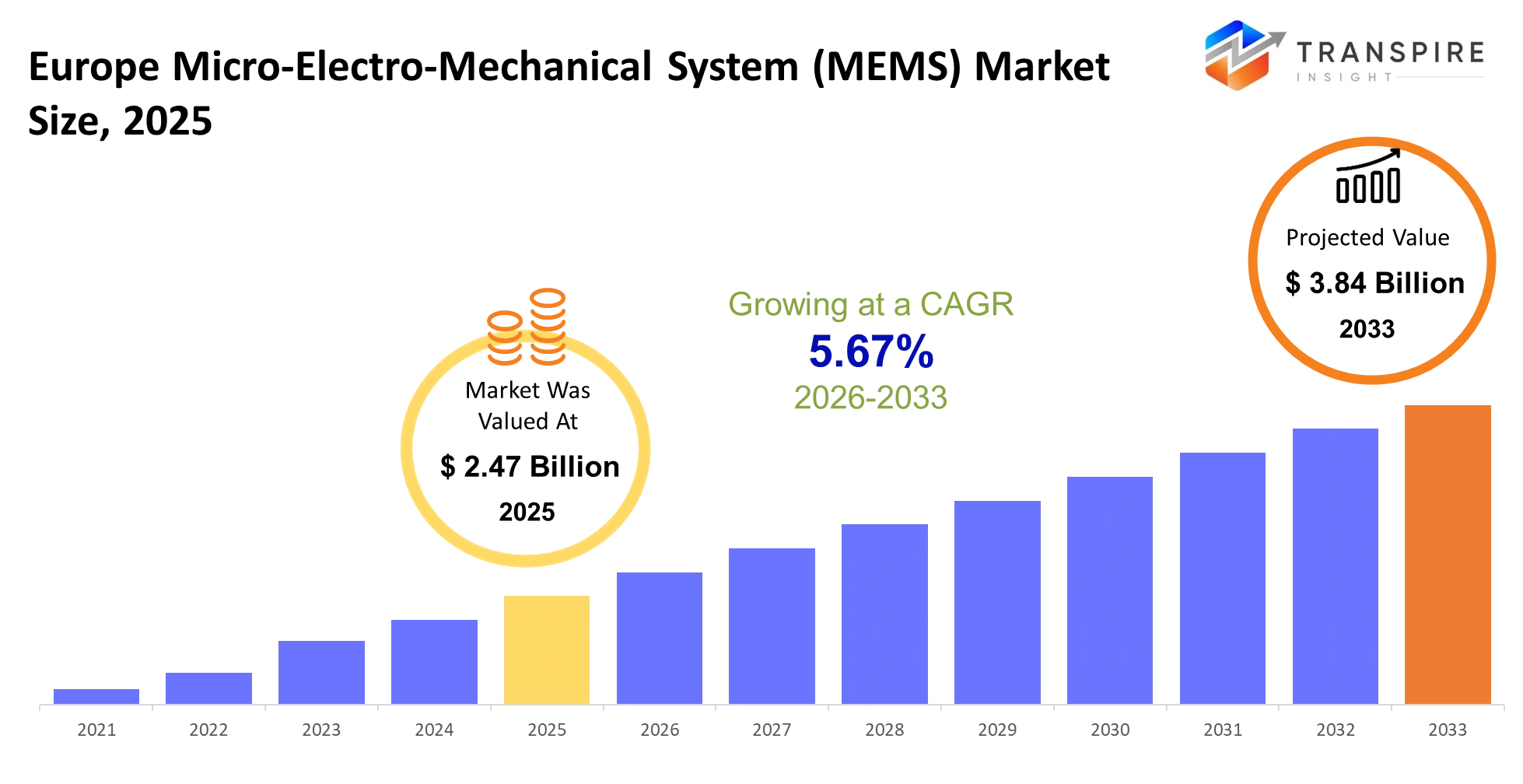
- Europe Micro-Electro-Mechanical System (MEMS) Market Size 2025: USD 2.47 Billion
- Europe Micro-Electro-Mechanical System (MEMS) Market Size 2033: USD 3.84 Billion
- Europe Micro-Electro-Mechanical System (MEMS) Market CAGR: 5.67%
- Europe Micro-Electro-Mechanical System (MEMS) Market Segments: By Type (Sensors, Actuators, Microstructures, RF MEMS, Optical MEMS, Others); By Application (Automotive, Consumer Electronics, Healthcare, Industrial, Aerospace, Others); By End-User (Electronics, Automotive, Healthcare, Industrial, Defense, Others); By Material (Silicon, Polymers, Metals, Ceramics, Composites, Others).
To learn more about this report,  Download Free Sample Report
Europe Micro-Electro-Mechanical System (MEMS) Market Summary:
The Europe Micro-Electro-Mechanical System (MEMS) Market size is estimated at USD 2.47 Billion in 2025 and is anticipated to reach USD 3.84 Billion by 2033, growing at a CAGR of 5.67% from 2026 to 2033. The europe mems market, which will be an exemplary example of the integration of miniaturization and usability, will be driven by customer demand for sophisticated wearables, intelligent automobile safety systems, and energy-saving industrial instruments that react quickly to any physical input. The European producers will focus on developing sophisticated MEMS with an emphasis on reliability rather than quantity, and will be geared towards applications in the field of medicine and mobility. Low power usage and easy compatibility with chips equipped with artificial intelligence will dominate the design process of these micro-systems. Moreover, the strict European data accuracy regulations will have an impact on their development and implementation.
What Has the Impact of Artificial Intelligence Been on the Europe Micro-Electro-Mechanical System (MEMS) Market?
Artificial intelligence is reshaping the analytical depth and operational precision of the europe micro-electro-mechanical system (mems) market, turning traditional design and production cycles into data-driven processes. AI in europe micro-electro-mechanical system (mems) market environments will enhance market research by processing large datasets from sensors, end-users, and industrial systems, enabling more accurate demand forecasting and real-time trend prediction. Machine learning models will identify subtle usage patterns across automotive safety sensors, medical devices, and consumer electronics, helping manufacturers refine product strategies and align with shifting market trends.
At the operational level, artificial intelligence in europe micro-electro-mechanical system (mems) market ecosystems will improve production efficiency through smart automation and predictive analytics. AI-powered inspection systems will detect micro-level defects during fabrication, reducing waste and ensuring higher reliability in sensitive applications. In parallel, supply chain optimization will benefit from AI-driven demand planning and inventory management, lowering operational costs while maintaining supply consistency. These capabilities will give companies within the europe micro-electro-mechanical system (mems) market a measurable competitive advantage.
Beyond efficiency, AI will act as a catalyst for innovation and customization. The integration of intelligent algorithms with MEMS sensors will enable adaptive systems that respond to environmental changes in real time, particularly in healthcare monitoring and autonomous mobility. As a result, the europe micro-electro-mechanical system (mems) market will continue evolving toward highly personalized, intelligent solutions shaped by continuous data feedback and advanced computational capabilities.
Key Market Trends & Insights:
- The europe mems market is experiencing growth as there is growing integration of sensors into automotive safety systems, medical devices, and automated industrial processes.
- The growing popularity of IoT-enabled devices is causing demand to grow due to sensors that perform real-time data analysis and predictions.
- With technological advancements that allow smaller and less power-hungry devices, more efficient applications have been developed, which include high-performance electronic products.
- One of the trends in the industry is integration with AI and machine learning to increase intelligence and adaptability of the sensors.
- The western europe mems market accounts for nearly 40% of market share in 2024 due to its automotive and industrial application base.
- The northern europe region leads in growth as it is expected to grow at an annual rate exceeding 7% until 2030 owing to innovations in health care and wearables.
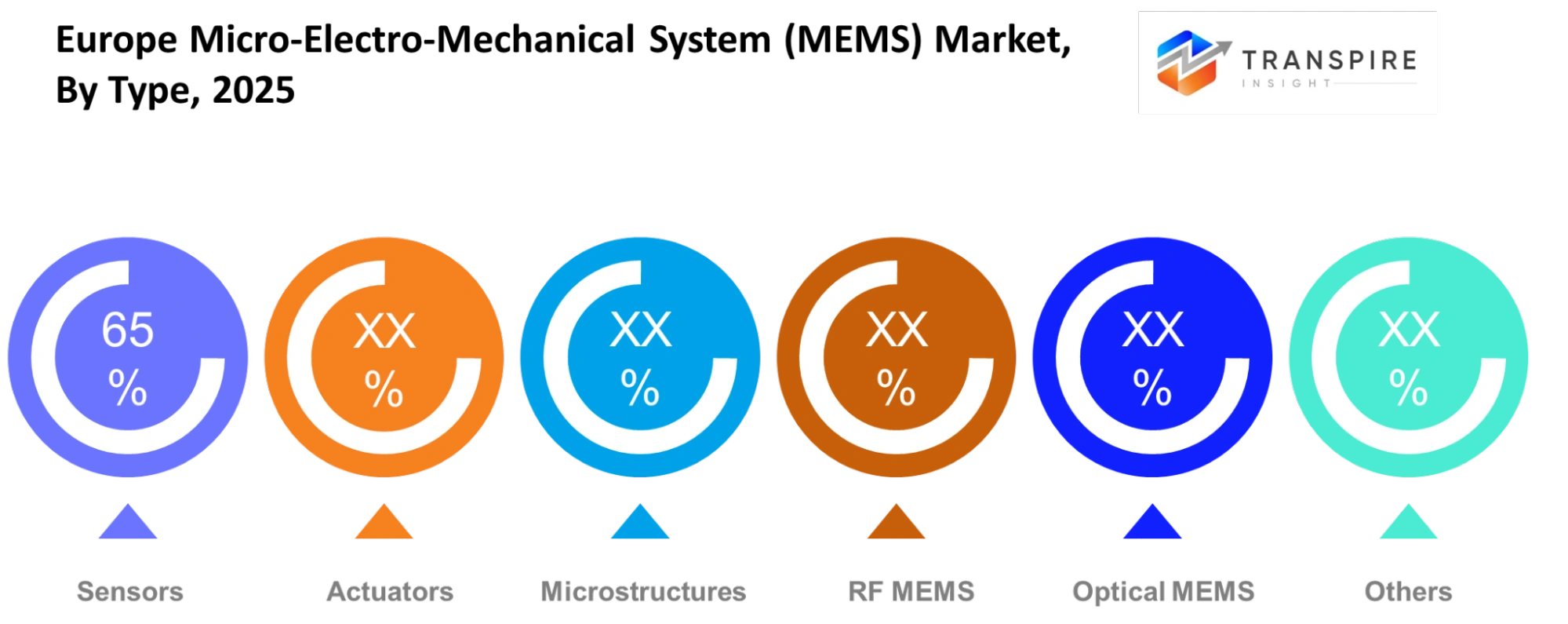
- The Sensors segment is leading in the europe mems market share as it makes up over 55% of market share due to applications in consumer electronics and automobiles.
- The Optical MEMS segment is the fastest growing one as the need for it is growing in the telecommunications and VR/AR segments.
- Automotive applications lead as it accounts for over 35% of the share of the europe mems market.
Europe Micro-Electro-Mechanical System (MEMS) Market Segmentation
By Type
Sensors will dominate due to widespread use in detecting motion, pressure, and environmental changes across multiple industries. Actuators will support precise mechanical movement in compact systems, especially in automotive and industrial automation. Microstructures will provide the physical framework that allows integration of electrical and mechanical functions within a limited space. RF MEMS will be applied in communication systems to improve signal performance and reduce power loss.
Optical MEMS will gain attention in imaging and display technologies, where light control at a micro scale will be required. Other types will include specialized components designed for niche applications such as biotechnology and advanced instrumentation. Each category will evolve with a focus on reliability and compact design. Design improvements will continue to reduce size while maintaining consistent performance across demanding environments.
To learn more about this report, Download Free Sample Report
By Application
Automotive applications will lead due to increasing integration of safety features such as airbags, tire pressure monitoring, and navigation systems. Consumer electronics will rely on compact sensors for smartphones, wearables, and smart home devices. Healthcare applications will expand through diagnostic tools and patient monitoring systems that require accurate and continuous data collection. Industrial usage will include automation systems where precision and durability will remain essential.
Aerospace applications will demand high-performance components that will function reliably under extreme conditions. Other applications will include environmental monitoring and research-based equipment. Each application area will shape product development based on specific operational needs. Demand patterns will shift as industries continue to adopt smarter and more connected technologies.
By End-User
Electronics sector will remain the largest end-user due to constant demand for compact and efficient devices. Automotive sector will follow closely with increasing adoption of advanced safety and navigation systems. Healthcare sector will expand with growing use of wearable monitoring and diagnostic equipment. Industrial sector will depend on these systems for automation and process control.
Defense sector will require highly reliable components for surveillance, navigation, and communication systems. Other end-users will include research institutions and specialized engineering fields. Each segment will influence product specifications and quality expectations. Demand from these industries will drive continuous refinement in design and manufacturing processes.
By Material
Silicon will remain the primary material due to compatibility with semiconductor manufacturing and cost efficiency. Polymers will be used for flexible applications where lightweight and adaptability will be important. Metals will provide strength and conductivity in applications requiring durability. Ceramics will be preferred for high-temperature and high-stress environments.
Composites will combine multiple material properties to enhance performance in specialized applications. Other materials will include emerging alternatives designed for specific technical requirements. Material selection will directly influence performance, cost, and reliability of final products. Continuous research will support development of materials that will meet changing industrial and environmental standards.
What are the Main Challenges for the Europe Micro-Electro-Mechanical System (MEMS) Market Growth?
The europe micro-electro-mechanical system (mems) market faces several technical and operational challenges that continue to limit its full potential. One of the key challenges in europe micro-electro-mechanical system (mems) market development is maintaining long-term product stability at micro scale, where even minor defects can affect performance. Complex design architectures and integration with advanced electronics increase the risk of system failure, especially in high-precision sectors such as healthcare and automotive. In addition, supply chain constraints, particularly for specialized materials and fabrication tools, create delays and impact scalability across manufacturers.
Manufacturing and commercialization barriers also present significant growth barriers for the europe micro-electro-mechanical system (mems) market. Production processes require highly controlled environments and advanced fabrication techniques, which increase operational costs and limit entry for smaller players. Strict European regulatory frameworks around safety, quality, and environmental compliance further extend product approval timelines. These market limitations often slow down innovation cycles and delay the transition from prototype to large-scale commercialization.
Adoption challenges remain another critical factor affecting the europe micro-electro-mechanical system (mems) market. Limited availability of skilled professionals with expertise in microfabrication and system integration restricts development capacity. Infrastructure gaps in certain regions and high initial investment requirements discourage widespread adoption, particularly among small and medium enterprises. These factors collectively reduce the pace at which new technologies are implemented across industries.
Competitive pressure from alternative sensing and nano-scale technologies introduces additional uncertainty for the europe micro-electro-mechanical system (mems) market. Rapid advancements in competing solutions, along with pricing pressures and evolving technology standards, create future risks for established players. Companies must continuously invest in innovation and cost optimization to remain competitive in a market shaped by constant technological change.
Regional Insights
Regional Insights: Western Europe will hold a dominant position due to strong automotive manufacturing, semiconductor expertise, and established research infrastructure. Germany and France will lead innovation with consistent investment in sensor technologies and industrial automation systems. Demand will remain steady across healthcare and consumer electronics sectors driven by precision requirements.
Northern Europe will show faster adoption trends supported by advanced digital infrastructure and focus on smart healthcare solutions. Countries such as Sweden and Finland will encourage development through innovation funding and technology-driven policies. Southern and Eastern Europe will gradually expand presence with improving industrial capabilities and increasing participation in electronics manufacturing supply chains.
Recent Development News
In February 2026, STMicroelectronics announced acquisition. The company completed the acquisition of NXP Semiconductors’ MEMS sensors business to strengthen automotive and industrial sensor capabilities.
Source: https://newsroom.st.com
In April 2026, STMicroelectronics reported earnings growth. The company posted stronger-than-expected Q1 2026 results, supported by improved demand in automotive and industrial semiconductor segments.
Source: https://www.reuters.com
|
Report Metrics |
Details |
|
Market size value in 2025 |
USD 2.47 Billion |
|
Market size value in 2026 |
USD 2.61 Billion |
|
Revenue forecast in 2033 |
USD 3.84 Billion |
|
Growth rate |
CAGR of 5.67% from 2026 to 2033 |
|
Base year |
2025 |
|
Historical data |
2021 - 2024 |
|
Forecast period |
2026 - 2033 |
|
Report coverage |
Revenue forecast, competitive landscape, growth factors, and trends |
|
Regional scope |
Europe (Germany, United Kingdom, France, Italy, Spain, Rest of Europe) |
|
Key company profiled |
STMicroelectronics, Bosch, Texas Instruments, Analog Devices, Infineon, NXP, Qualcomm, Honeywell, Panasonic, Sony, Murata, TDK, Broadcom, Samsung, TE Connectivity. |
|
Customization scope |
Free report customization (country, regional & segment scope). Avail customized purchase options to meet your exact research needs. |
|
Report Segmentation |
By Type (Sensors, Actuators, Microstructures, RF MEMS, Optical MEMS, Others); By Application (Automotive, Consumer Electronics, Healthcare, Industrial, Aerospace, Others); By End-User (Electronics, Automotive, Healthcare, Industrial, Defense, Others); By Material (Silicon, Polymers, Metals, Ceramics, Composites, Others). |
How Can New Companies Establish a Strong Foothold in the Europe Micro-Electro-Mechanical System (MEMS) Market?
New entrants can build a strong position in the europe micro-electro-mechanical system (mems) market by focusing on niche, high-value applications rather than competing on scale. Targeting segments such as medical diagnostics, wearable monitoring, or precision industrial sensing will allow companies to address unmet needs with specialized solutions. The europe micro-electro-mechanical system (mems) market rewards firms that solve specific pain points, such as improving sensor accuracy in healthcare or reducing power consumption in smart city infrastructure.
Innovation strategies will play a central role in gaining traction within the europe micro-electro-mechanical system (mems) market. Startups that invest in AI-enabled sensing, ultra-low power designs, and advanced materials will differentiate their offerings from established competitors. Partnerships with semiconductor foundries, research institutions, and OEMs will accelerate product development and market entry. Collaborations will also help emerging players navigate regulatory requirements and integrate their technologies into existing ecosystems.
Technology differentiation combined with agile execution will define success in the europe micro-electro-mechanical system (mems) market. For instance, companies like Nanusens are developing nano-scale sensors aimed at consumer electronics and healthcare applications, while Syntiant is advancing intelligent sensor processing for edge devices. Such emerging players highlight how focused innovation and clear value propositions can create competitive advantage and support long-term market growth.
Key Europe Micro-Electro-Mechanical System (MEMS) Market Company Insights
Competitive insights: Strong competition will exist among established semiconductor companies and emerging innovators focusing on specialized sensor technologies. Large players will maintain advantage through advanced manufacturing capabilities and wide distribution networks. Continuous investment in research and development will strengthen product performance and reliability across automotive, healthcare, and industrial applications.
Strategic collaborations and acquisitions will shape competitive positioning, allowing companies to expand technological capabilities and regional presence. Smaller firms will compete by offering niche solutions with high precision and low power consumption. Pricing pressure and rapid technological changes will encourage constant innovation to sustain long-term market relevance.
Company List
- STMicroelectronics
- Bosch
- Texas Instruments
- Analog Devices
- Infineon
- NXP
- Qualcomm
- Honeywell
- Panasonic
- Sony
- Murata
- TDK
- Broadcom
- Samsung
- TE Connectivity
What are the Key Use-Cases Driving the Growth of the Europe Micro-Electro-Mechanical System (MEMS) Market?
The europe micro-electro-mechanical system (mems) market is expanding through strong adoption in automotive safety and mobility systems. MEMS-based sensors are widely used in airbags, electronic stability control, and advanced driver-assistance systems, where precision and reliability directly impact passenger safety. The shift toward electric and autonomous vehicles will further increase demand, as manufacturers integrate more sensing capabilities for navigation and performance monitoring.
Healthcare is another critical use-case shaping the europe micro-electro-mechanical system (mems) market. Miniaturized sensors are enabling wearable health devices, remote patient monitoring, and minimally invasive diagnostic tools. These applications are improving real-time data collection and patient outcomes, while reducing the burden on healthcare infrastructure. Increasing focus on preventive care and digital health solutions will continue to support adoption across European medical systems.
In industrial and manufacturing environments, the europe micro-electro-mechanical system (mems) market is driven by automation and predictive maintenance. MEMS sensors are used to monitor vibration, pressure, and temperature in machinery, helping reduce downtime and improve operational efficiency. At the same time, consumer electronics such as smartphones, wearables, and smart home devices are integrating MEMS components to enhance user interaction and device performance, creating scalable opportunities across high-volume markets.
Europe Micro-Electro-Mechanical System (MEMS) Market Report Segmentation
By Type
- Sensors
- Actuators
- Microstructures
- RF MEMS
- Optical MEMS
- Others
By Application
- Automotive
- Consumer Electronics
- Healthcare
- Industrial
- Aerospace
- Others
By End-User
- Electronics
- Automotive
- Healthcare
- Industrial
- Defense
- Others
By Material
- Silicon
- Polymers
- Metals
- Ceramics
- Composites
- Others
Frequently Asked Questions
Find quick answers to common questions.
The approximate Europe Micro-Electro-Mechanical System (MEMS) Market size for the market will be USD 3.84 Billion in 2033.
Key segments for the Europe Micro-Electro-Mechanical System (MEMS) Market are By Type (Sensors, Actuators, Microstructures, RF MEMS, Optical MEMS, Others); By Application (Automotive, Consumer Electronics, Healthcare, Industrial, Aerospace, Others); By End-User (Electronics, Automotive, Healthcare, Industrial, Defense, Others); By Material (Silicon, Polymers, Metals, Ceramics, Composites, Others).
Major Europe Micro-Electro-Mechanical System (MEMS) Market players are STMicroelectronics, Bosch, Texas Instruments, Analog Devices, Infineon, NXP, Qualcomm, Honeywell, Panasonic, Sony, Murata, TDK, Broadcom, Samsung, TE Connectivity.
The Europe Micro-Electro-Mechanical System (MEMS) Market size is USD 2.47 Billion in 2025.
The Europe Micro-Electro-Mechanical System (MEMS) Market CAGR is 5.67%.
- STMicroelectronics
- Bosch
- Texas Instruments
- Analog Devices
- Infineon
- NXP
- Qualcomm
- Honeywell
- Panasonic
- Sony
- Murata
- TDK
- Broadcom
- Samsung
- TE Connectivity
Recently Published Reports
-
Apr 2026
Fiber Optic Faceplates Market
Fiber Optic Faceplates Market Size, Share & Analysis Report By Type (< 300 mm2, 300-350 mm2, and > 350 mm2, By Application (Night Vision, Holographic Imaging, Medical, and Others), and Geography (North America, Europe, Asia-Pacific, Middle East and Africa, South and Central America), 2021 - 2031
-
Apr 2026
High Temperature Superconductors Market
High Temperature Superconductors Market Size, Share & Analysis Report By Type (1G HTS, and 2G HTS), By Application (Power Cable, Fault Current Limiter, and Transformer), and Geography (North America, Europe, Asia-Pacific, Middle East and Africa, South and Central America), 2021 - 2031
-
Apr 2026
Industrial Plugs and Socket Market
Industrial Plugs and Socket Market Size, Share & Analysis Report By Type (Industrial Plugs, Industrial Sockets), By Current (Up to 32 A, 32 to 125 A, Above 125 A), By Protection (Dustproof and Splash Proof, Waterproof, Explosion Proof), By End User (Heavy Industries, Oil and Gas, Chemicals and Pharmaceuticals, Power Generation, Others), and Geography (North America, Europe, Asia-Pacific, Middle East and Africa, South and Central America), 2021 - 2031
-
Apr 2026
InGaAs Avalanche Photodiodes Market
InGaAs Avalanche Photodiodes Market Size, Share & Analysis Report By Type (1100 - 1700 nm, and 1000 - 1600 nm), By Application (Missile Warning System, Muzzle Flash Detection, Wafer Defect Inspection, Laser Rangefinders, and Others), and Geography (North America, Europe, Asia-Pacific, Middle East and Africa, South and Central America), 2021 - 2031