

Japan Acesulfame Potassium Market Summary:
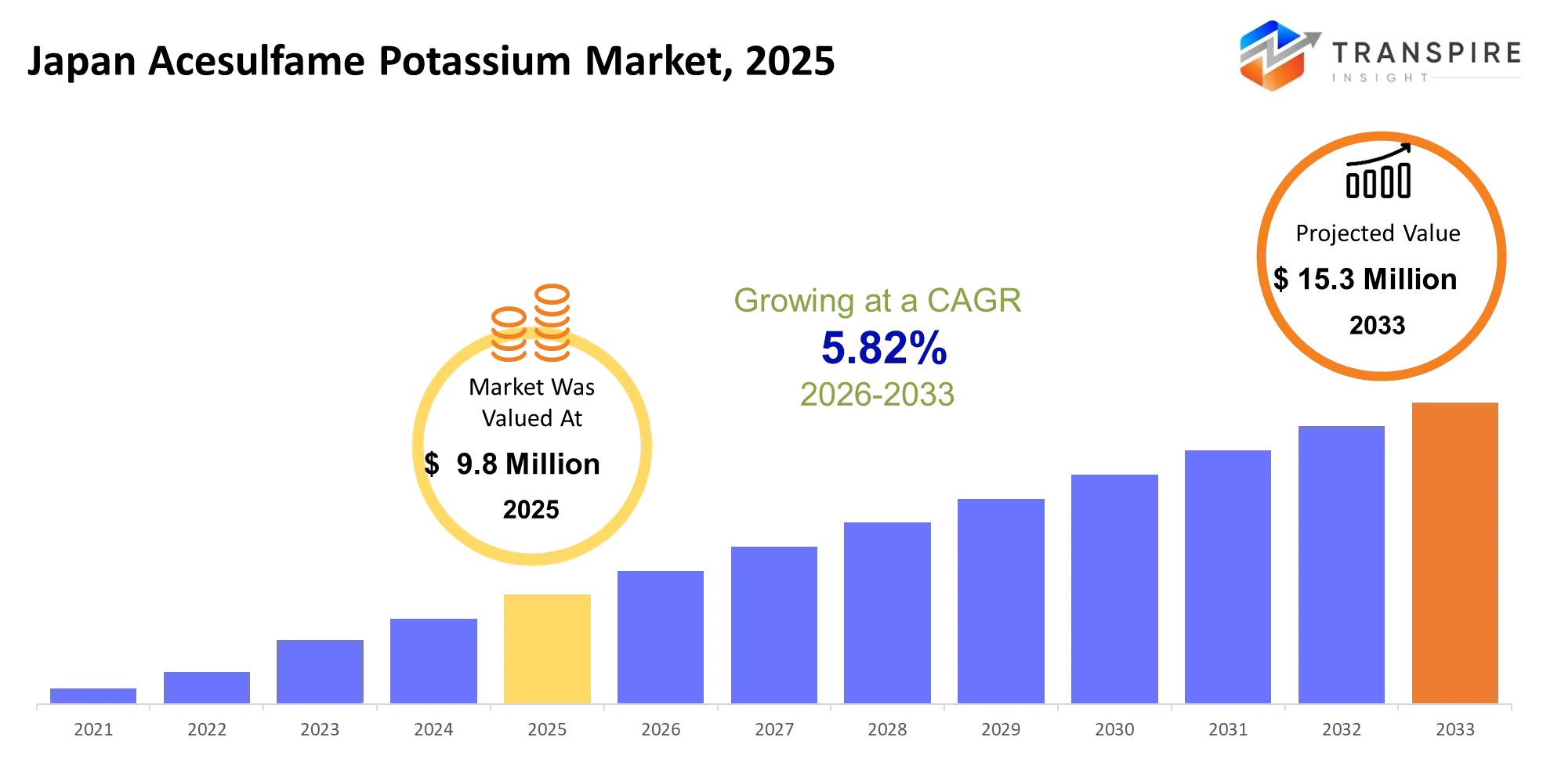
According to Transpire Insight, a detailed research report on the market reflects that the Japan Acesulfame Potassium Market was valued at approximately USD 9.8 million in 2025, is expected to reach approximately USD 10.3 million in 2026, and is estimated to reach USD 15.3 million by 2033, registering a forecast CAGR of 5.82% during 2026–2033. The Japan Acesulfame Potassium Market is making a significant contribution to market development, innovation, advanced acesulfame potassium production, expanding manufacturing capabilities, and growth dynamics.
Market Snapshot
- Market Value (2025): USD 9.8 Million.
- Expected Market Value (2026): USD 10.3 Million.
- Estimated Market Value (2033): USD 15.3 Million.
- Forecast CAGR (2026–2033): 5.82%.
Introduction
The Japan Acesulfame Potassium (Ace-K) market stands out as an important sub-market of the country's growing food additives and sweeteners market, with growing consumer interest in lower-sugar and healthier foods being one of the main driving factors. As a synthetic high-intensity sweetener, Ace-K is valued highly for its remarkable thermal and pH stability, which makes it a perfect ingredient for use in beverages, bakery, dairy, confectionery, and even pharmaceutical product formulas. With zero calories and the ability to combine with other sweeteners, it is widely used as an alternative to regular sugar. Being supported by Japan's well-developed manufacturing base, strong regulatory framework, and health-aware older population, the Japan Ace-K market remains dynamic, changing with dietary trends. This is the introductory part of the report on Ace-K market in Japan.
Key Market Highlights: -
- By Grade, the Food Grade dominated the market and holds approximately 55% share in 2025 and is projected to grow at a substantial CAGR during the forecast period.
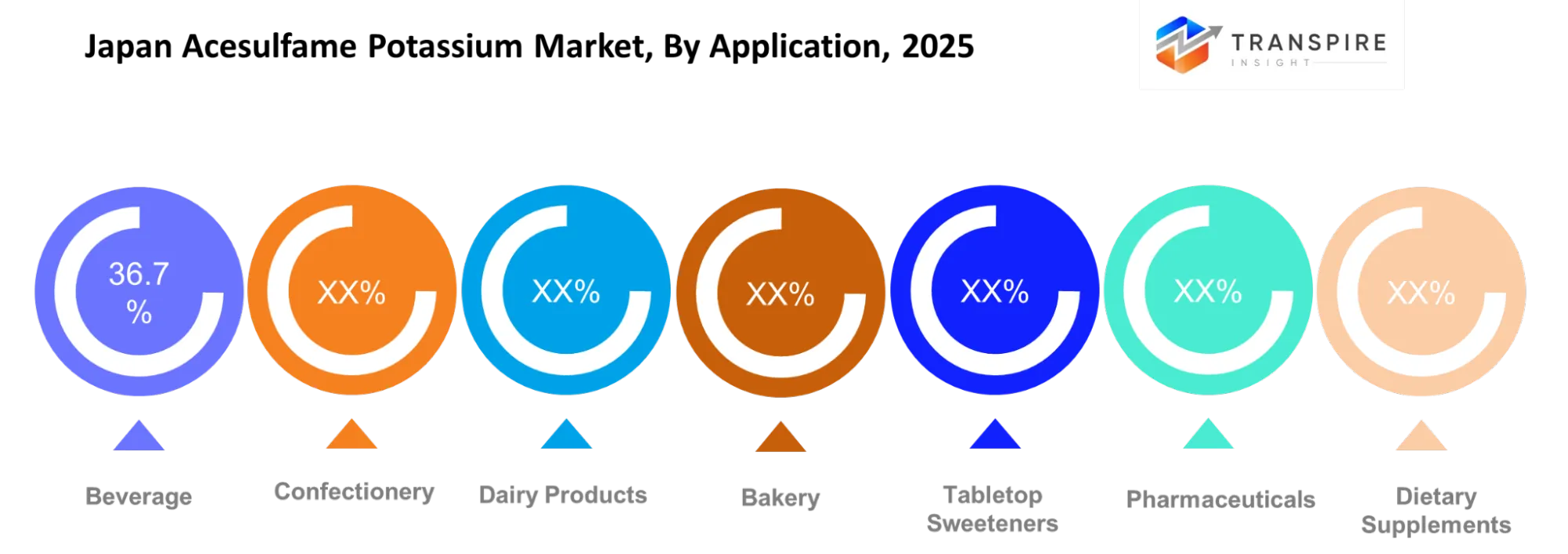
- By Application, the BEVERAGES dominated the market and holds approximately 38% share in 2025 and is projected to grow at a substantial CAGR during the forecast period.
- By Product Form, the Powder segment Manufacturers segment dominated the market and holds approximately 70% share in 2025 and is projected to grow at a substantial CAGR during the forecast period.
- Trust among consumers has been gained by Ace-K due to Japan's Positive List System and Food Sanitation Act labeling requirements, thereby making consumer demands stable for the product in sugar-reduced beverages, functional foods, and pharmaceutical formulas.
How is Technology Driving Growth in the Japan Acesulfame Potassium Market?
Technology is very important for growth in the market of Ace-K in Japan. It is estimated that the market size of Japan's Ace-K will grow from USD 22.5 million in 2025 to USD 37.4 million in 2035 at 5.2% CAGR. Robots and smart factories of Industry 4.0 technology help in precision production in food, beverage, and pharmaceutical use while reducing the chances of errors and increasing efficiency. Technology allows Ace-K to blend perfectly well with other sweeteners for enhancing taste.
Market Drivers
Several overlapping drivers propel the growth of the Ace-K market in Japan. First, Japan is experiencing an accelerated aging of its population, along with increased consciousness regarding diseases linked to one’s lifestyle, including diabetes and obesity. These factors increase the demand for calorie-free products among consumers. Second, manufacturers are adopting a vigorous strategy of reducing the use of sugar in their products, and therefore, Ace-K becomes a desired ingredient in zero-calorie beverages and diet drinks having low glycemic index. In view of the Japanese consumer’s high degree of sensitivity, food chemists use a synergic blend of different sweeteners, including Ace-K and sucralose or aspartame, to eliminate any unpleasant artificial taste in their products.
Restrain
The major threat to the Ace-K market in Japan includes the increasing consumer preference for natural sweetener sources such as stevia, coupled with persistent disadvantages such as bitter/metallic aftertaste when used in higher concentrations. Moreover, the increasing worldwide skepticism about the health impact of artificial ingredients further adds to the caution among consumers. Furthermore, the stringent provisions of the Food Sanitation Act in Japan limits the usage levels of the ingredients.
Analysis of Prices and Consumer Behaviour
The Japan Acesulfame Potassium market is made up of high-quality, food-grade acesulfame potassium (accounting for 68% of total market share; mainly due to demand from food and beverage, pharmaceutical and processed food industries). The price of a high-quality, standardized acesulfame potassium product is expected to be 35% higher than other products due to the fact that the product will be manufactured using advanced technology, certified and have consistency in terms of sweetness potency. About 45% of all units sold of acesulfame potassium come in powder form. The sales volume is due to the versatile nature of use of the product in food and beverage formulations as well as having a longer shelf-life. Food and beverages and pharmaceuticals industries account for about 70% of the demand from these industries. The consumer buying behavior shows that 55% of all consumers prioritize sweetness potency, purity of the product and consistency in quality. Another 33% of consumers prefer to buy their products through bulk arrangements or long-term contract since they want to cut down on their procurement costs and ensure an assured supply for their consumers in various parts of Japan.
Top Companies in the Japan Acesulfame Potassium Market
- Celanese
- Nutrinova
- Ajinomoto
- Mitsubishi Chemical
- Mitsui Chemicals
- Tate & Lyle
- Ingredion
- Kerry Group
- Jungbunzlauer
- Roquette
- Cargill Archer Daniels Midland
- T. Hasegawa
- San-Ei Gen F.F.I.
- Taiyo Kagaku
Japan Acesulfame Potassium Market Segmentation
The Japan Acesulfame Potassium Market share is divided into six categories: By Grade, By Application, By Product Form, By Blend, By End User, and By Distribution Channel.
The Food Grade dominated the market, accounting for nearly 55% in 2025 and is expected to rise at a significant CAGR during the forecast period.
The Japan Acesulfame Potassium Market is segmented by grade into food grade, pharmaceutical grade, beverage grade, high-purity grade, industrial grade, tabletop sweetener grade, confectionery grade, specialty grade. Among these, the Food Grade segment dominated the market, accounting for nearly 55% in 2025 and expected to increase at a significant CAGR during the forecast period. The food grade Ace-K takes precedence over other grades because there is an increasing need for heat-stable and cost-effective sweetening solutions in beverages with reduced sugar content, baked goods, and confectionary items.
The BEVERAGES dominated the market, accounting for nearly 38% in 2025, and is expected to rise at a significant CAGR during the forecast period.
The Japan Acesulfame Potassium Market is segmented by application into beverages, confectionery, dairy products, bakery, tabletop sweeteners, pharmaceuticals, dietary supplements, processed foods. Among these, the BEVERAGES dominated the market, accounting for nearly 38% in 2025 and expected to increase at a significant CAGR during the forecast period. Beverages take the lead because of the increased need for sugarless carbonated drinks, functional drinks, and diet soft drinks that require stable and heat-resistant sweetening solutions.
The Powder segment dominated the market, accounting for nearly 70% in 2025 and is expected to rise at a significant CAGR during the forecast period.
The Japan Acesulfame Potassium Market is segmented by product form into powder, granules, tablets, liquid blends, premixes, sachets, compressed sweeteners, blended sweeteners. Among these, the Powder segment dominated the market, accounting for nearly 70% in 2025 and expected to increase at a significant CAGR during the forecast period. The powder type takes precedence because of its high shelf stability, easy mixing capacity, easy dosing, and cost-effectiveness in food production.
Future Market Trends for the Japan Acesulfame Potassium Market: -
- Expansion in Functional Foods: The demand for diabetes-friendly and low glycemic foods has led to the incorporation of Ace-K into functional foods and supplements for the Japanese market.
- Smart Manufacturing: The adoption of smart manufacturing in the country because of its robotics and Industry 4.0 technologies ensures that there is accuracy, efficiency, and scale in the production of Ace-K.
- Transparency: There is an increased awareness of synthetic substances among consumers, leading to more labeling efforts by manufacturers.
Recent Development
- In September 1, 2026 – Regulatory Consultation: Japan's CAA initiates regulatory consultation for Potassium Acetate additive standards, emphasizing strict testing standards in domestic food-grade chains involving potassium derivatives.
- In April 7, 2026 – Compliance Update on the Positive List: Japan's CAA publishes new additives standards in Announcement No. 140, in connection to enforcement of the Positive List impacting formulations and labeling compliance.
- In June 2026 – Launch of the Hybrid Sweetener: Japanese brands launch new weight management beverages featuring natural-adjacent ingredients and Ace-K in 2026.
Market Segmentation
This study forecasts revenue at Japan, regional and country levels from 2020 to 2033. Transpire Insight has segmented the Japan Acesulfame Potassium Market based on the below-mentioned segments:
Japan Acesulfame Potassium Market, By Grade
- Food Grade
- Pharmaceutical Grade
- Beverage Grade
- High-Purity Grade
- Industrial Grade
- Tabletop Sweetener Grade
- Confectionery Grade
- Specialty Grade
Japan Acesulfame Potassium Market, By Application
- Beverages
- Confectionery
- Dairy Products
- Bakery
- Tabletop Sweeteners
- Pharmaceuticals
- Dietary Supplements
- Processed Foods
Japan Acesulfame Potassium Market, By Product Form
- Powder
- Granules
- Tablets
- Liquid Blends
- Premixes
- Sachets
- Compressed Sweeteners
- Blended Sweeteners
Japan Acesulfame Potassium Market, By Blend
- Acesulfame K Alone
- Acesulfame K + Aspartame
- Acesulfame K + Sucralose
- Acesulfame K + Saccharin
- Acesulfame K + Stevia
- Multi-Sweetener Blends
- Sugar-Reduction Blends
- Custom Blends
Japan Acesulfame Potassium Market, By End User
- Food Manufacturers
- Beverage Companies
- Pharmaceutical Companies
- Dairy Manufacturers
- Bakeries
- Confectionery Companies
- Nutraceutical Companies
- Foodservice
Japan Acesulfame Potassium Market, By Distribution Channel
- Direct Sales
- Ingredient Distributors
- Foodservice Distributors
- Chemical Distributors
- Retail
- Online B2B
- Wholesale
- Specialty Suppliers
Frequently Asked Questions
Find quick answers to common questions.
The market was valued at USD 9.8 million in 2025, projected to reach USD 15.3 million by 2033 at 5.82% CAGR.
Food Grade dominates, holding nearly 55% share in 2025, driven by demand for heat-stable, cost-effective sweetening in beverages and bakery goods.
Beverages lead with approximately 38% share in 2025, fueled by rising demand for sugar-free carbonated drinks and functional beverages.
Powder holds nearly 70% share due to superior shelf stability, easy blending, precise dosing, and cost-efficient industrial-scale manufacturing handling.
Leading companies include Celanese, Nutrinova, Ajinomoto, Mitsubishi Chemical, Mitsui Chemicals, Tate & Lyle, Ingredion, Kerry Group, and Roquette.
- Celanese
- Nutrinova
- Ajinomoto
- Mitsubishi Chemical
- Mitsui Chemicals
- Tate & Lyle
- Ingredion
- Kerry Group
- Jungbunzlauer
- Roquette
- Cargill Archer Daniels Midland
- T. Hasegawa
- San-Ei Gen F.F.I.
- Taiyo Kagaku
About the Authors

Pankaj Ghogare Patil
I am Pankaj Ghogare Patil, a Senior Research Analyst at Transpire Insight, specializing in the Pharmaceutical, Chemicals & Materials, Healthcare IT, and Biotechnology industry. My expertise lies in conducting comprehensive market research, analyzing industry trends, evaluating competitive landscapes, and translating complex data into actionable insights. At Transpire Insight, I closely follow emerging technologies, regulatory developments, and market innovations to create accurate, well-researched, and informative content that helps businesses and professionals make informed decisions. I am committed to producing credible, evidence-based articles that reflect industry best practices while making technical topics accessible and valuable for a broad audience.

Chakradhar Khansole
Chakradhar serves as the Research Director at Transpire Insight, bringing over 8 years of experience in technology, innovation, and strategic market intelligence. He specializes in transforming complex market data into actionable business insights that enable organizations to make informed, growth-oriented decisions. Recognized for his strategic vision and analytical expertise, Chakradhar leads high-impact research initiatives, delivering comprehensive market assessments, competitive intelligence, and forward-looking industry analysis.
Recently Published Reports
-
May 2026
Healthcare Polymer Packaging Market
Healthcare Polymer Packaging Market Size, Share & Analysis Report By Packaging Type (Syringes, IV Bottles and Pouches, Clamshells, Blisters, Bottles & Jars, Containers, Tubes, IV Parental Packaging, Others), By Type (Regulated, Non-regulated), By Polymer Type (LDPE (Low-Density Polyethylene), HDPE (High-Density Polyethylene), Homo-polymer (Homo), Random Copolymer (Random), Block Copolymer (Block), PET, Polystyrene, Polyvinyl Chloride, Polyamide/EVOH, Others), and Geography (North America, Europe, Asia-Pacific, Middle East and Africa, South and Central America), 2021 - 2031
-
Apr 2026
Hydrophilic Tape (Waterstop) Market
Hydrophilic Tape (Waterstop) Market Size, Share & Analysis Report By Type (Bentonite-Based Hydrophilic Tape, Rubber-Based Hydrophilic Tape), By Application (Residential Buildings, Commercial Buildings, Infrastructure Projects), and Geography (North America, Europe, Asia-Pacific, Middle East and Africa, South and Central America), 2021 - 2031
-
Apr 2026
Metalens Market
Metalens Market Size, Share & Analysis Report By Type (Visible Light Metalens, and Infrared Metalens), By Application (Consumer Electronics, Automotive Electronics, Industrial, Medical, and Others), and Geography (North America, Europe, Asia-Pacific, Middle East and Africa, South and Central America), 2021 - 2031
-
Apr 2026
PBT Resin Market
PBT Resin Market Size, Share & Analysis Report By Type (Reinforced PBT Resin, Unreinforced PBT Resin), By Processing Method (Injection Molding, Extrusion, Blow Molding, Others), By End-User (Automotive, Electrical & Electronics, Consumer Appliances, Industrial Machinery, Medical Devices, Packaging, Others), and Geography (North America, Europe, Asia-Pacific, Middle East and Africa, South and Central America), 2021 - 2031