
Israel Quantum Cryptography Market Size & Forecast:
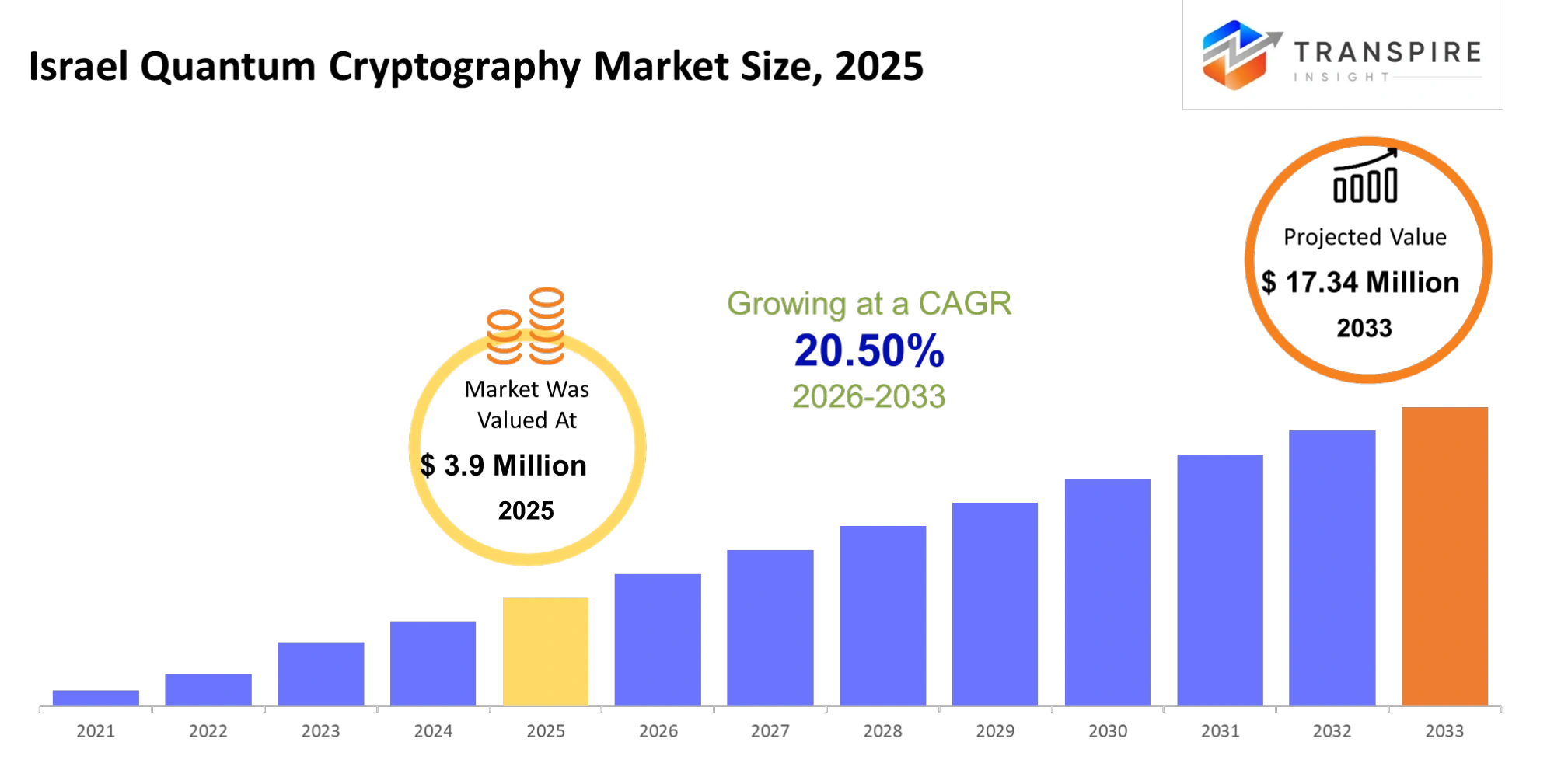
- Israel Quantum Cryptography Market Size 2025: USD 3.9 Million
- Israel Quantum Cryptography Market Size 2033: USD 17.34 Million
- Israel Quantum Cryptography Market CAGR: 20.50%
- Israel Quantum Cryptography Market Segments: ByComponent (Hardware, Software, Services), By Application (Network Security, Secure Communications, Banking & Financial Security, Government & Defense), By End User (BFSI, Government, Telecom, Enterprises).
To learn more about this report,  Download Free Sample Report
Israel Quantum Cryptography Market Summary:
The Israel Quantum Cryptography Market size is estimated at USD 3.9 Million in 2025 and is anticipated to reach USD 17.34 Million by 2033, growing at a CAGR of 20.50% from 2026 to 2033.
The Israeli quantum cryptography market, being a part of the broader cybersecurity industry, will grow as organizations look to prepare for future data security risks related to quantum computing advancements. Banks, defense companies, and technology providers in Israel will look to focus on the future reliability of encryption methods rather than cost savings in the near future. Consumers will look for solutions that offer future reliability in terms of security from decryption risks. Technology advancements in quantum key distribution and hybrid encryption methods will aid in the gradual adoption of the technology into the broader network infrastructure. In addition, regulatory recommendations will aid in the adoption of quantum-resistant encryption methods..
Key Market Trends & Insights:
The quantum cryptography space in Israel will continue to reflect national security concerns in which secure communications are not limited to military use but are also extended to civilian infrastructure. This will reflect a growing understanding of proactive security measures as opposed to reactive security measures in various industries.
Another trend that will likely become visible in the quantum industry in Israel is related to cooperation between startups and academic institutions. In the quantum space in Israel, quantum key distribution applications are likely to gain traction in a practical sense. This means that quantum key distribution will not be limited to specialized environments or government-backed ones.
The buying habits of enterprises will slowly transform as they seek encryption technologies that have a long-term guarantee against emerging advancements. This will, in turn, affect buying strategies as enterprises will seek technologies that have the ability to change and become compatible with emerging technologies. This will prompt vendors to develop hybrid encryption technologies that will enable enterprises to upgrade their technologies without having to change their entire digital infrastructure.
Israel Quantum Cryptography Market Segmentation
By Component
Hardware- Hardware solutions will comprise quantum key distribution devices, photon detectors, and secure transmission solutions. Israeli companies will be developing these solutions in a compact and scalable form, such that they can be easily integrated into the existing fiber and satellite communications infrastructure.
Software- The software development process will create a system that supports quantum-safe encryption algorithms key management platforms and integration tools as its main focus. The vendors are developing flexible systems that can accommodate a hybrid approach to meet organizational needs without disrupting current cybersecurity infrastructures..
Services- These services would include consulting, system integration, maintenance, and security evaluation. These service providers would assist enterprises in adopting these systems, ensuring compatibility with existing systems and addressing changing regulatory requirements and long-term operational security requirements.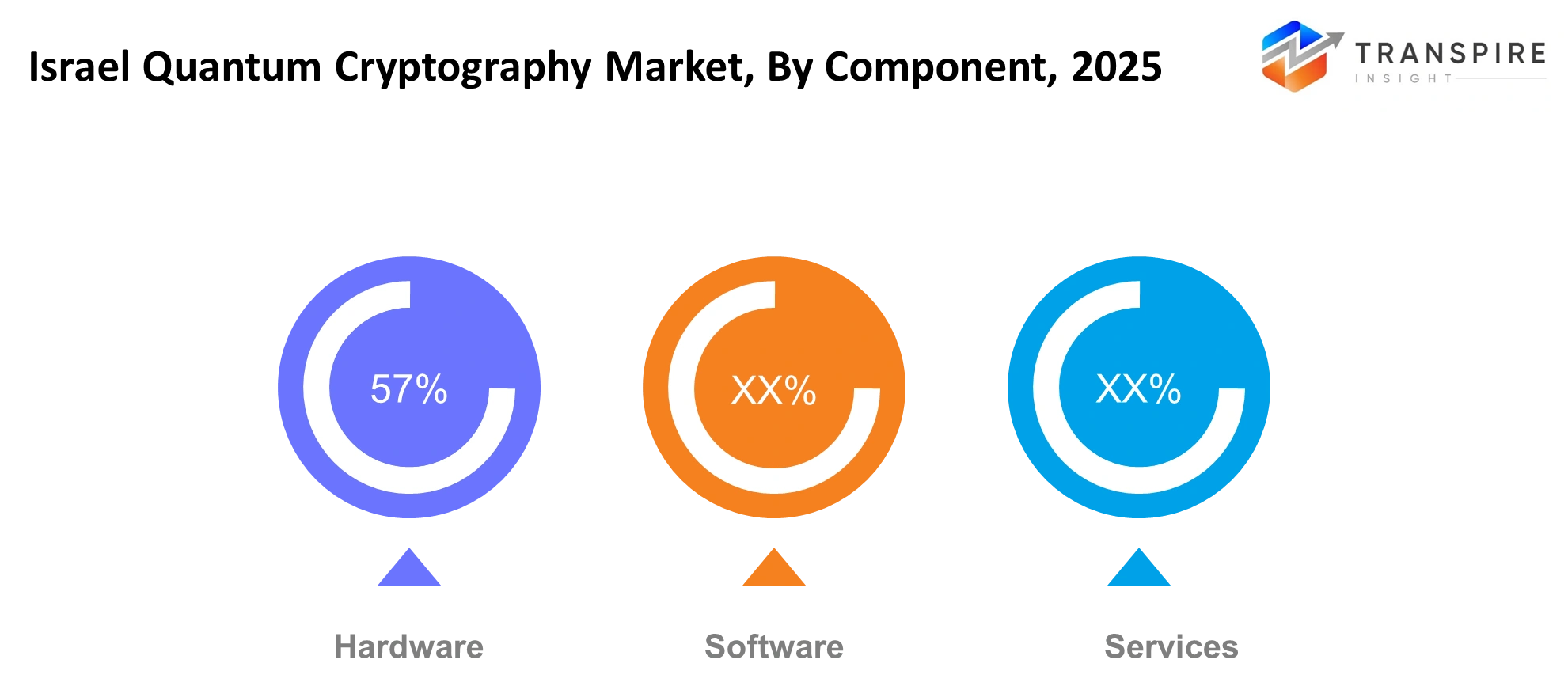
To learn more about this report, Download Free Sample Report
By Application
Network Security- Applications for secure communication will be designed around protecting voice, video, and data communications. Governments and organizations will use encryption through quantum-based systems to maintain confidentiality of information, especially in situations where leakage of information would pose major risks.
Secure Communications- Financial institutions will use quantum-safe encryption for transactions, customer information, and inter-bank communications. This will help build trust while avoiding any potential cyber threats in the future and will comply with the increasing regulations in a digital banking setup.
Banking & Financial Security- Financial institutions will use quantum-safe encryption for transactions, customer information, and inter-bank communications. This will help build trust while avoiding any potential cyber threats in the future and will comply with the increasing regulations in a digital banking setup.
Government & Defense- Government and defense organizations will maintain strong interest in quantum cryptography because it provides secure solutions for their essential communication requirements. The applications will protect data transmission and intelligence activities while securing infrastructure from advanced cyber threats and future computing developments.
By End User
BFSI- The BFSI sector is expected to invest in quantum-safe solutions for the security of their financial transactions and records. They will be focusing on long-term data security, so that the data is not decrypted in the future.
Government- The main drivers of quantum technology adoption will be government organizations who shall be granting assistance and making infrastructure investments to this effect. They will use quantum cryptography to ensure security in their communications and data, and to make their overall security stronger.
Telecom- Telecom companies will use the technology to provide secure communication services by integrating quantum encryption into the infrastructure of the networks. This is expected to increase the level of trust from enterprise clients. It will also be useful for the next wave of connectivity needs.
Enterprises- Various types of enterprises from different sectors of the economy will utilize quantum cryptography. Enterprises will seek future-proof cybersecurity systems. They will be looking for flexible systems that are scalable to ensure the security of their digital processes since computational technology is advancing rapidly.
Country Insights
The position of Israel as a technology-driven country is bound to significantly shape the development and progress of quantum cryptography in the country. This is because of the high level of interaction between security companies and defense interests. This will ensure that research is immediately implemented. Furthermore, the geographical size of the country will be beneficial in testing secure communication networks in a controlled environment.
Investment in quantum cryptography in Israel will be shaped by strategic interests in long-term digital security. There is a high possibility that venture capital and government investments will be directed towards startups in quantum cryptography. This is bound to encourage innovation in the country since startups will be able to collaborate with already-established companies in the development and implementation of advanced cryptography solutions.
Industry-wise adoption of the technology will differ; defense and financial services industries are likely to take the lead in adopting the technology. Telecommunications services are also likely to follow suit in adopting a secure transmission system. Enterprises are likely to start adopting a hybrid approach to encryption, weighing the need to factor in future computational threats that might compromise current security systems in place.
Regulatory support will continue to influence the direction of the industry; authorities are likely to promote standards that encourage early adoption of quantum-resistant technologies. Public sector efforts are likely to set the pace for private sector organizations; efforts to create a sense of security and trust in new technologies are likely to be achieved.
Recent Development News
One of the notable changes is the acceleration of the Israeli quantum environment, fueled by robust investment and cooperation. In 2025, Israeli quantum startups raised hundreds of millions of dollars collectively. This is a reflection of the rising confidence of investors. It is expected to propel the pace of the commercialization of secure communication systems, like encryption systems, which are secure against future computational risks.
Another notable change is the emergence of technology integration initiatives. In the past, an Israeli company launched a technology platform that integrates quantum computing technology with advanced processing systems. It is expected to bridge the gap between research and practical applications, like secure communication systems.
|
Report Metrics |
Details |
|
Market size value in 2025 |
USD 3.9 Million |
|
Market size value in 2026 |
USD 4.7 Million |
|
Revenue forecast in 2033 |
USD 17.34 Million |
|
Growth rate |
CAGR of 20.50% from 2026 to 2033 |
|
Base year |
2025 |
|
Historical data |
2021 – 2024 |
|
Forecast period |
2026 – 2033 |
|
Report coverage |
Revenue forecast, competitive landscape, growth factors, and trends |
|
Country scope |
Israel |
|
Key company profiled |
ID Quantique, Toshiba Corporation, Quantum Xchange, QuintessenceLabs, MagiQ Technologies, IBM Corporation, Microsoft Corporation, Huawei Technologies, NEC Corporation, SK Telecom, Alibaba Group, Thales Group, Nokia Corporation, Arqit Quantum, QNu Labs. |
|
Customization scope |
Free report customization (country, regional & segment scope). Avail customized purchase options to meet your exact research needs. |
|
Report Segmentation |
By Component (Hardware, Software, Services), By Application (Network Security, Secure Communications, Banking & Financial Security, Government & Defense), By End User (BFSI, Government, Telecom, Enterprises) |
Key Israel Quantum Cryptography Market Company Insights
Some of the key players in the quantum cryptography market in Israel will include startups, research-based companies, and cybersecurity firms. These companies will be working on developing quantum key distribution systems and hybrid encryption systems. These will be achieved through collaborations and partnerships with educational institutions and government agencies. Strategic partnerships will also help in accelerating business and market development.
Company List
- ID Quantique
- Toshiba Corporation
- Quantum Xchange
- QuintessenceLabs
- MagiQ Technologies
- IBM Corporation
- Microsoft Corporation
- Huawei Technologies
- NEC Corporation
- SK Telecom
- Alibaba Group
- Thales Group
- Nokia Corporation
- Arqit Quantum
- QNu Labs
Israel Quantum Cryptography Market Report Segmentation
By Component
- Hardware
- Software
- Services
By Application
- Network Security
- Secure Communications
- Banking & Financial Security
- Government & Defense
By End User
- BFSI
- Government
- Telecom
- Enterprises
Frequently Asked Questions
Find quick answers to common questions.
The approximate Israel Quantum Cryptography Market size for the market will be USD 17.34 Million in 2033.
Key segments for the Israel Quantum Cryptography Market By Component (Hardware, Software, Services), By Application (Network Security, Secure Communications, Banking & Financial Security, Government & Defense), By End User (BFSI, Government, Telecom, Enterprises).
Major players in the Israel Quantum Cryptography Market are ID Quantique, Toshiba Corporation, Quantum Xchange, QuintessenceLabs, MagiQ Technologies, IBM Corporation, Microsoft Corporation, Huawei Technologies, NEC Corporation, SK Telecom, Alibaba Group, Thales Group, Nokia Corporation, Arqit Quantum, QNu Labs.
The Israel Quantum Cryptography Market size is USD 3.9 Million in 2025.
The Israel Quantum Cryptography Market CAGR is 20.50%.
- ID Quantique
- Toshiba Corporation
- Quantum Xchange
- QuintessenceLabs
- MagiQ Technologies
- IBM Corporation
- Microsoft Corporation
- Huawei Technologies
- NEC Corporation
- SK Telecom
- Alibaba Group
- Thales Group
- Nokia Corporation
- Arqit Quantum
- QNu Labs
Recently Published Reports
-
Apr 2026
3D Optical Profiler Market
3D Optical Profiler Market Size, Share & Analysis Report By Type (Desktop 3D Optical Profiler, and Portable 3D Optical Profiler), By Technology (Confocal Technology, and White Light Interference), By End-Use Industry (Manufacturing, Research Institutions, Automotive, Aerospace and Defense, Medical Devices, and Other), and Geography (North America, Europe, Asia-Pacific, Middle East and Africa, South and Central America), 2021 - 2031
-
Apr 2026
Depth Sensor Market
Depth Sensor Market Size, Share & Analysis Report By Type (Infrared Depth Sensors, Time-of-Flight (ToF) Sensors, Stereo Vision Sensors, Structured Light Sensors, Ultrasonic Depth Sensors), By Application (Automotive, Robotics, Gaming, Consumer Electronics, Industrial Automation, Healthcare, Security & Surveillance, Others), By End Users (Automotive Manufacturers, Consumer Electronics Companies, Healthcare Providers, Industrial Companies, Security Agencies, Gaming Companies, Robotics Companies, Others), and Geography (North America, Europe, Asia-Pacific, Middle East and Africa, South and Central America), 2021 – 2031
-
Apr 2026
Digital Manufacturing Market
Digital Manufacturing Market Size, Share & Analysis Report By Component (Hardware, Software, and Services), By Technology (Robotics, 3D Printing, Internet of Things (IoT), and Others), By Application (Automotive and Transportation, Aerospace and Defense, Consumer Electronics, Industrial Machinery, and Others), By Process Type (Computer-Based Designing, Computer-Based Simulation, Computer 3D Visualization, Analytics, and Others), and Geography (North America, Europe, Asia-Pacific, Middle East and Africa, South and Central America), 2021 – 2031
-
Apr 2026
Digital Visa Services Market
Digital Visa Services Market Size, Share & Analysis Report By Type (Individual Travelers, Group Travelers), By Application (Tourism, Business Travel, Others), and Geography (North America, Europe, Asia-Pacific, Middle East and Africa, South and Central America), 2021 – 2031