

Industrial Tablet PC Market Summary:
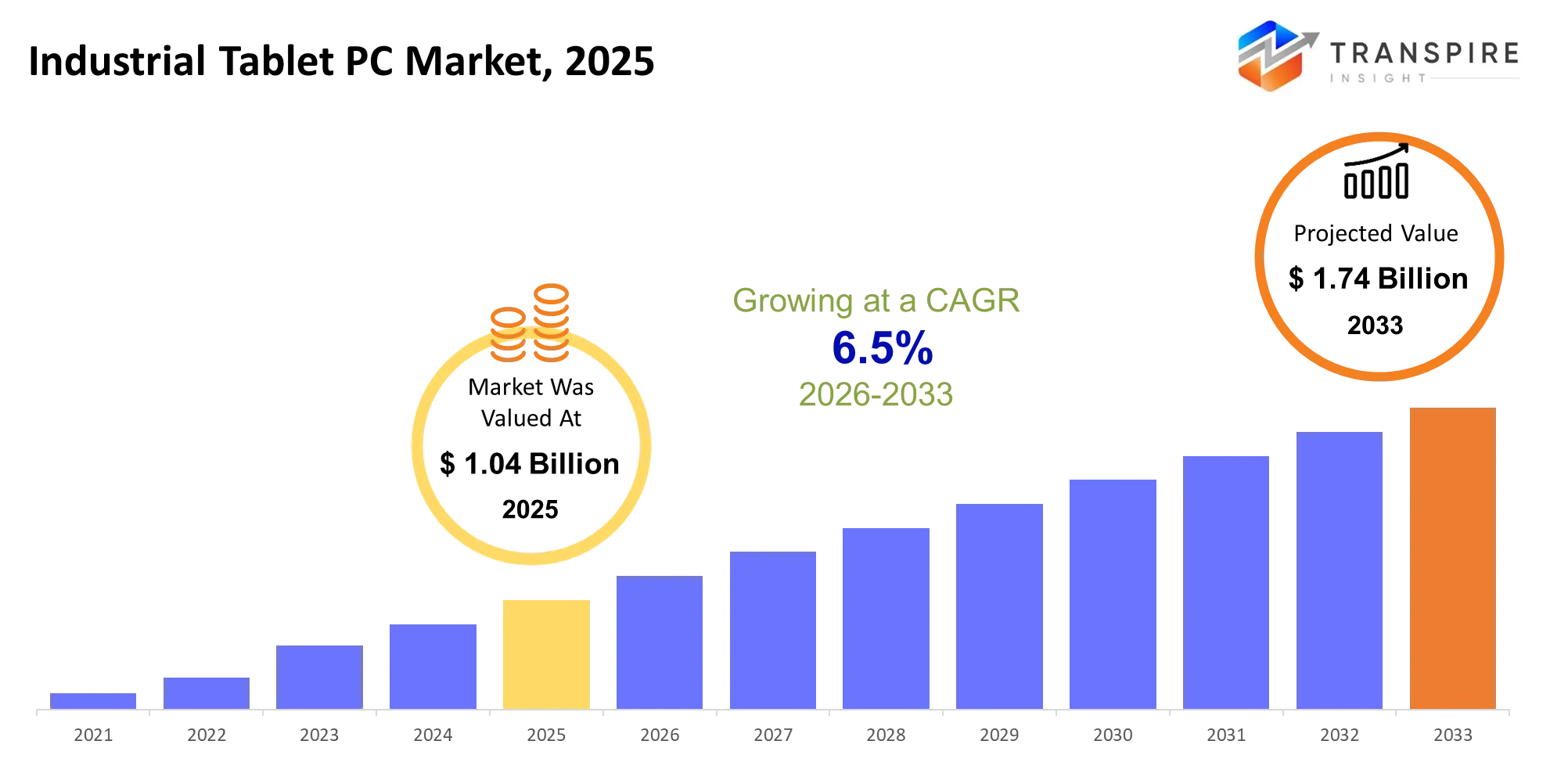
As per Transpire Insight Analysis, the Industrial Tablet PC Market size is estimated at USD 1.04 billion in 2025 and is anticipated to reach USD 1.74 billion by 2033, growing at a CAGR of 6.5% from 2026 to 2033.
The international industrial tablet PC industry provides computers to workers who require computers in challenging conditions such as in factories, warehouses, transportation, field services, medical, and construction industries. In the past few years, people who buy these devices have started moving away from simple rugged hardware and instead are looking for connected devices that offer mobility, better processing power, real-time data collection and smart computing at the edge. A big change has been the shift to processors that're ready for artificial intelligence and faster wireless connections. As more factories and logistics operations become connected, there is a need for tablets that can keep working without stopping in the place where the work is happening. New products that have come out recently show that manufacturers are adding intelligence directly on the device, better connections, brighter screens and options to change the setup. Growth is connected to improvements in how productive workers are. Workers can get instructions, take notes, check equipment, talk to their teams and finish service jobs without having to go to a fixed desk. This cuts down on delays. Helps make quicker decisions at work.
Industrial Tablet PC Market Size & Forecast:
- Market Size 2025: USD 1.04 Billion
- Expected Market Value (2033): USD 1.74 Billion
- Forecast CAGR (2026–2033): 6.5%
- Leading Region in 2025: North America
- Fastest Growing Region: Asia Pacific
- Key Company Profiles: Panasonic, Zebra Technologies, Getac, Dell, Honeywell, Advantech, Durabook, Winmate, Samsung, Lenovo, Siemens, Datalogic, AAEON, Juniper Systems, RuggON
Key Market Insights:
The market is moving towards rugged devices that are durable and connected, capable of processing AI software and application-specific capabilities. The rugged tablets are the major players in the market, whereas the new capabilities of connectivity and edge computing are opening up new areas for growth.
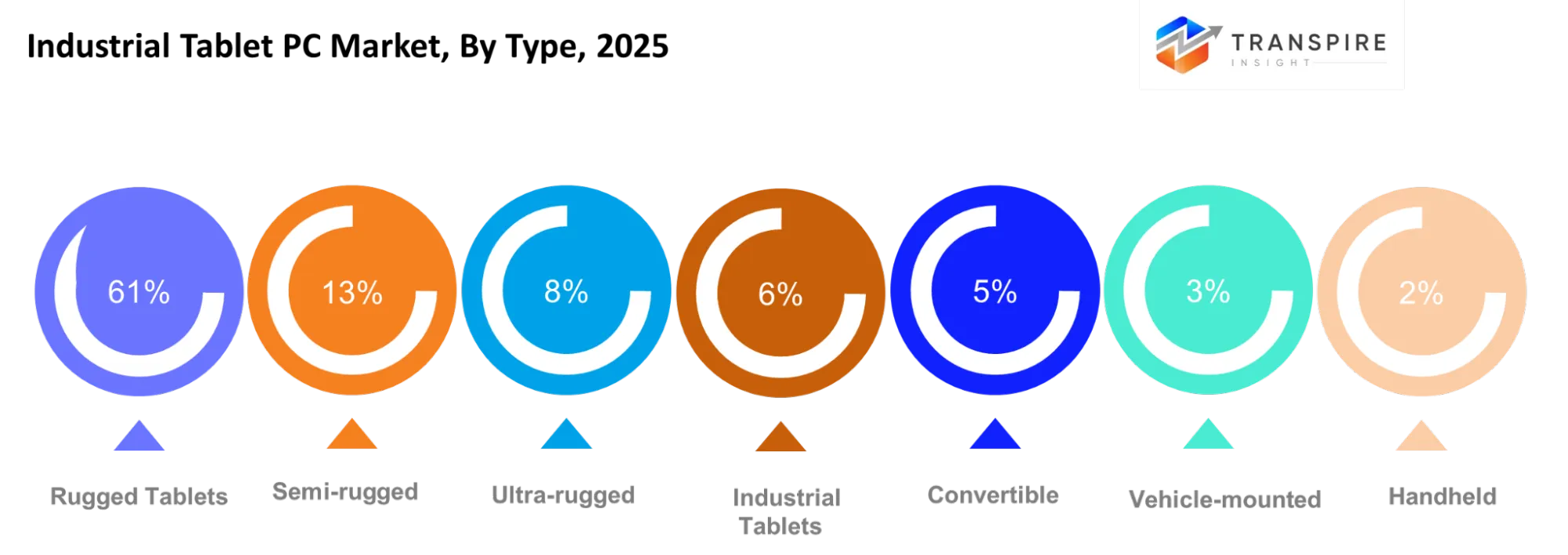
- The Rugged Tablets constitute 61% of the type segmentation supplied due to the ongoing popularity of tablets that are capable of enduring harsh conditions, including exposure to dust, drops, vibrations, water, among others.
- Semi-Rugged Tablets contribute to 13% of the segment and are favoured by organisations that require
- tablets that are more robust than consumer equipment but not up to the standard of ultra-rugged tablets.
- Industrial Tablets contribute to 6% and have been taken up owing to their use in manufacturing floor applications, digital work instructions, inspection and equipment monitoring systems.
- Convertible Tablets are 5% of the market segment and cater to users that alternate between mobile field work and office computing.
- Handheld Tablets make up 2% of the type segmentation and cater to small-sized data capture and mobility needs.
What are the Key Drivers, Restraints, and Opportunities in the Industrial Tablet PC Market?
Drivers
The growth has been fueled by the transition towards mobile-first manufacturing workflows. There is an increased demand among people working in manufacturing companies, logistics companies, utility companies, and field service to capture information at the point of work, without having to wait until they transfer notes. The accuracy of data increases along with the shortened period between the occurrence of events and reactions to them.
Restraints
The limitation is the increased cost of buying and owning rugged tablets as compared to regular consumer tablets. Ruggedised products have special needs such as tough casing, special screens, extended batteries, certificates, security measures, and longer support periods. This makes the purchase expensive and sometimes replacement difficult, especially when dealing with small companies.
Opportunities
An opportunity is that of rugged hardware coupled with edge AI and fast connectivity. Some recent products have highlighted a shift towards embedding intelligence within the hardware of field workers, as opposed to depending entirely on cloud architecture. The AI-ready range from Getac in India focuses on industries including manufacturing, automobile, pharmaceutical, aviation, and railways.
What Has the Impact of Artificial Intelligence Been on the Industrial Tablet PC Market?
AI technology is revolutionising industrial tablets from simple mobile workstations to powerful tools that make decision-making at the point of action possible. Specialised hardware components such as processors and NPUs make it possible to perform chosen operations on-device, which reduces reliance on a constant connection to the cloud. Visual inspection, predictive maintenance guidance, voice recognition, smart instructions, document analytics, and diagnostic tools may become available for manufacturing and field service operations. The bottom line is that people will be able to get the relevant data much closer to the source of the issue, which should help decrease reaction time and standardise the process. The emergence of new hardware designed to accommodate AI is one of the impacts of the technology on the industry. There are some limitations associated with AI adoption. More sophisticated processors, software solutions, data preparation, increased cybersecurity standards, and costs associated with implementation may lead to greater investments. Additionally, organisations have to make sure that the accuracy of the AI results is satisfactory.
Instance
In September 2025, Getac Technology Corporation released the F120 rugged tablet with Copilot+ PC and AI capabilities, which provides real-time diagnostics, image processing, and analysis for applications such as manufacturing, utilities, automotive, and defence. This demonstrates how AI is used to extend the capabilities of industrial tablets.https://www.getac.com/us/news/getac-launches-f120-worlds-first-fully-rugged-tablet-copilot-plus-pc/
Key Market Trends
The market for industrial tablets is shifting from just ruggedised mobile devices to connected, smart, and application-oriented computing devices. There is an emphasis on developing industrial products that incorporate ruggedness along with AI, connectivity, longevity, and flexibility.
- The rugged tablets are advancing from mere data input devices to complete mobile workstations for frontline workers.
- The AI-ready processors have become quite prevalent as manufacturers are bringing intelligence right into the field devices.
- 5G technology has become very significant for industrial customers, who desire faster communications and more responsive remote applications.
- The rugged tablets are getting lighter while still retaining ruggedness to facilitate easy use during extended field shifts.
- Hot-swappable battery systems have become highly important for operations where downtime for charging cannot be afforded.
- Windows and Android-based devices are being designed keeping in view the industrial workflow rather than general-purpose tablet usage.
Industrial Tablet PC Market Segmentation
By Type
Rugged Tablets constitute 61%, being the most predominant due to the continued preference by industrial customers for toughness against impacts from drops, dust, water, vibration, and temperature fluctuations. The Semi-Rugged Tablets comprise 13%, catering to individuals requiring toughness but operating in relatively controlled conditions. The Ultra Rugged Tablets make up 8%, offering support to applications that require maximum toughness. Industrial Tablets consist of 6% and Convertible Tablets of 5%, while Vehicle-Mounted Tablets constitute 3%, Hand-held Tablets 2%, and Others 2%.
By Operating System
Windows continues to be relevant where enterprises have their legacy enterprise application programs, software, security solutions, and IT infrastructure in place. Android is still relevant for enterprises looking for flexible mobile applications, easy-to-use user interfaces, and low complexity in deployment. Linux caters to the needs of specialised industrial environments where customisation and control is required, whereas iOS has little to offer in industrial implementations. Proprietary OS, Chrome OS, Embedded OS, and other types cater to specialised needs of those who need specific software environments.
By Screen Size
Devices with less than 8 inches screens have an emphasis on portability for use by technicians and mobile employees, whereas 8–10 inch tablets strike a balance between portability and readability of information. Devices with 10-12 inch screens cater to the need for applications that require large dashboards, maps, work instructions, and enterprise software. Devices of 12-14 inch and 14-16 inch sizes support applications where screen visibility and computing power are more important than portability.
By Application
Manufacturing is one of the crucial sectors in which the tablet is used for manufacturing control, inspection, instructions, maintenance, and logistics purposes. Logistics operations utilise the tablets for scanning, picking, shipping, and tracking. Field service utilises tablets for diagnostics, documentation, customer information, and remote assistance. Healthcare, retail, construction, and other sectors use industrial tablets when they need robust and mobile connectivity to operational systems.
By Connectivity
Wi-Fi is used in facilities where there is a wireless connection available. Bluetooth connects the tablet with other devices such as scanners, sensors, printers, etc. 4G LTE is useful for mobility and fieldwork, while 5G facilitates faster connection with low latency. Ethernet is used for fixed or special applications, while NFC and GPS are utilised in identification and fieldwork.
By End User
The manufacturing industry is an essential demand source for tablets due to the need for constant information access and rugged portability in production settings. The transportation industry uses tablets for logistics operations. Tablets are used in healthcare organisations for clinical and administrative tasks. The energy industry requires robust gadgets for field use, while other sectors use tablets based on the unique requirements of portability and connectivity.
By Distribution
Direct Sales will continue to have significance for industrial customers who require custom-designed hardware as well as services such as installation and support over an extended period of time through agreements. The use of dealers and distributors widens the market scope and especially caters to regional customers and small business firms. The Internet provides customers with an easy way to purchase off-the-shelf configurations, while System Integrators cater to places where the hardware has to be linked to software.
What are the Key Use Cases Driving the Industrial Tablet PC Market?
The rugged tablets are being used for the purposes of manufacturing floor functions, such as production tracking, quality checks, inventory updates, machinery checks, and electronic work instructions. Their durability makes it possible for staff to look for information while continuing with their tasks. The use of tablets has grown significantly among logistics and warehouse staff for receiving products, picking, bar coding, verifying shipments, fleet management, and managing inventory. In field services, tablets are being used to document maintenance activities, diagnose, manage customer files, troubleshoot from afar, and perform tasks that depend on location. New applications include inspection, maintenance prediction, connected vehicles, edge analytics, digital twins, and real-time decision-making. These types of applications are particularly pertinent for the manufacturing, transport, energy, construction, and other industries that require people to work outside office premises.
|
Report Metrics |
Details |
|
Market size value in 2025 |
USD 1.04 Billion |
|
Market size value in 2026 |
USD 1.12 Billion |
|
Revenue forecast in 2033 |
USD 1.74 Billion |
|
Growth rate |
CAGR of 6.5% from 2026 to 2033 |
|
Base year |
2025 |
|
Historical data |
2021 - 2024 |
|
Forecast period |
2026 - 2033 |
|
Report coverage |
Revenue forecast, competitive landscape, growth factors, and trends |
|
Regional scope |
United States; Canada; Mexico; United Kingdom; Germany; France; Italy; Spain; Denmark; Sweden; Norway; China; Japan; India; Australia; South Korea; Thailand; Brazil; Argentina; South Africa; Saudi Arabia; United Arab Emirates |
|
Key company profiled |
Panasonic, Zebra Technologies, Getac, Dell, Honeywell, Advantech, Durabook, Winmate, Samsung, Lenovo, Siemens, Datalogic, AAEON, Juniper Systems, RuggON |
|
Customization scope |
Free report customization (country, regional & segment scope). Avail customized purchase options to meet your exact research needs. |
|
Report Segmentation |
By Type (Rugged Tablets, Semi-rugged Tablets, Ultra-rugged Tablets, Industrial Tablets, Convertible Tablets, Vehicle-mounted Tablets, Handheld Tablets, Others); By Operating System (Windows, Android, Linux, iOS, Proprietary OS, Chrome OS, Embedded OS, Others); By Screen Size (Below 8-inch, 8–10-inch, 10–12-inch, 12–14-inch, 14–16-inch, Above 16-inch, Foldable, Others); By Application (Manufacturing, Logistics, Warehouse, Field Service, Healthcare, Retail, Construction, Others); By Connectivity (Wi-Fi, Bluetooth, 4G LTE, 5G, Ethernet, NFC, GPS, Others); By End User (Manufacturing, Transportation, Healthcare, Energy, Retail, Construction, Government, Others); By Distribution (Direct Sales, Dealers, Distributors, Online, System Integrators, OEMs, Rental, Others) |
Which Regions are Driving the Industrial Tablet PC Market Growth?
North America
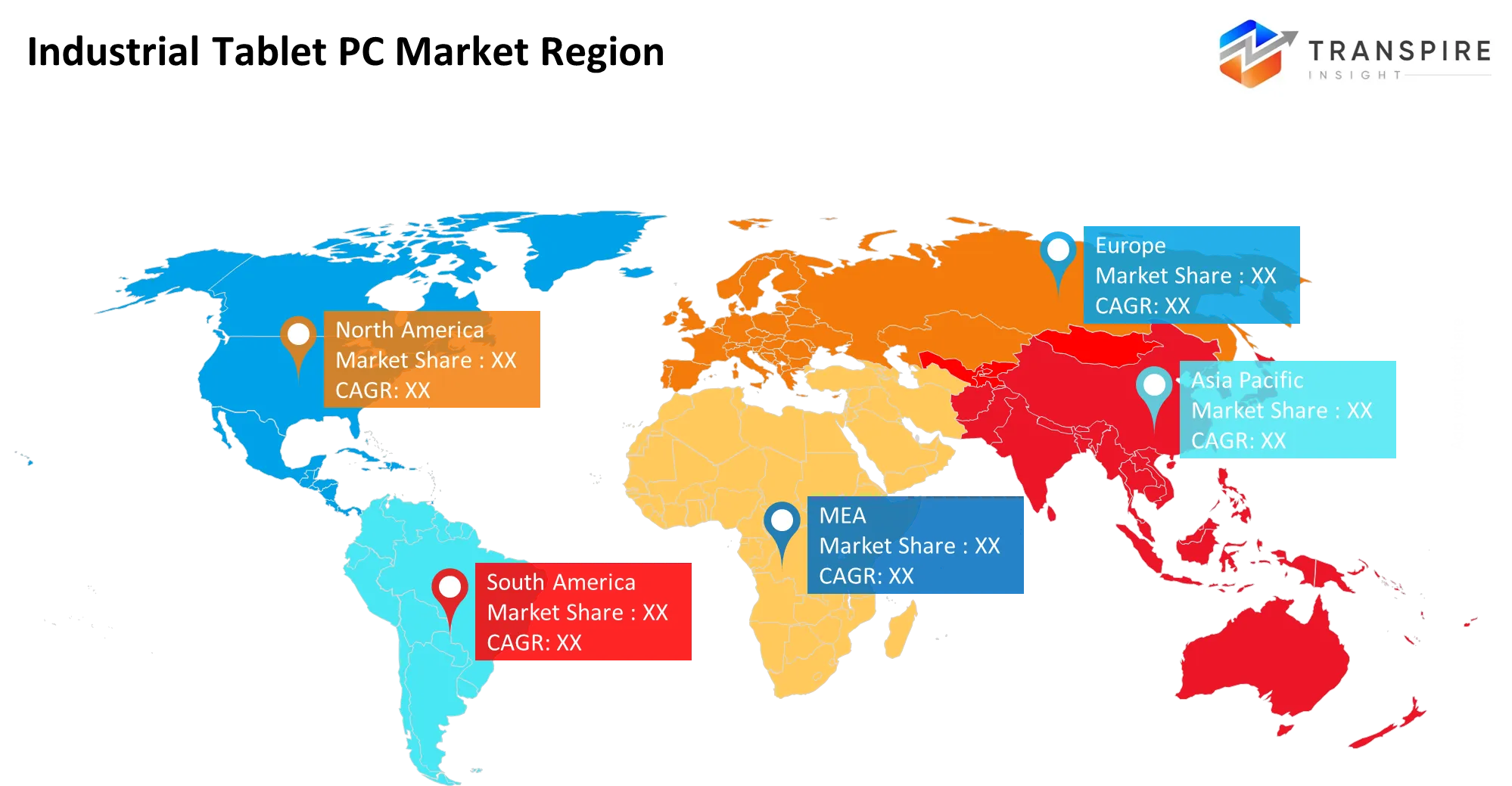
North America is leading the worldwide market for industrial tablet PCs with a share of 36%. The reason why this region is ahead in the market is the presence of industrial automation, good enterprise IT infrastructure, and the use of field service connectivity solutions in the region. There is manufacturing, transport, utilities, public safety, and government-related demands for the product.
In April 2026, Getac Technology Corporation unveiled the G140 fully rugged tablet computer, which was Getac's first Copilot+ PC tablet computer powered by AMD. It was designed for use by professionals in the public safety, automotive, and manufacturing industries who require the processing of edge-AI applications at their worksites.https://www.getac.com/us/news/getac-redefines-rugged-mobility-with-launch-of-g140-copilot-pc/
Europe
Europe represents 24% of the market, and the continent retains its demand with the help of industrial manufacturing, logistics, transport, utilities, and government-related applications. Unlike North America, Europe's market is highly integrated with the existing industrial and automotive industry ecosystems. Companies keep on making investments in mobility technologies to boost workforce efficiency and digital process management.
In May 2025, Panasonic Connect released an IP65-certified military adaptor for its TOUGHBOOK G2 rugged tablet in the UK. The adaptor is made at the European Services and Solutions Centre of Panasonic in Cardiff and enables defence personnel to plug military accessories into the tablet, keeping their tablets protected from dust and water ingress.https://eu.connect.panasonic.com/gb/en/news/panasonic-launches-ip65-rated-military-adaptor-toughbook-g2-rugged-tablet
Asia Pacific
The Asia Pacific accounts for 32% of the market and is the fastest-growing region with a CAGR of 9.6%. Growth in manufacturing, warehouse automation, and logistics modernisation, along with digital transformation, will increase the requirement for rugged mobile computers. This region also provides opportunities since companies are upgrading their manufacturing and field processes. The growth in connected factories and mobile workforce solutions will lead to more opportunities for industrial tablets.
In August 2025, Samsung Electronics released the Galaxy Tab Active5 Enterprise Edition in India, which is a rugged tablet built to endure harsh enterprise settings. Samsung marketed the tablet as ideal for sectors like defence, public safety, logistics, manufacturing, healthcare, retail, and field services, with attributes like MIL-STD-810H certification, IP68 rating, 5G support, and enterprise security.https://news.samsung.com/in/samsung-launches-galaxy-tab-active5-in-india-rugged-5g-enabled-tablet-built-for-enterprise-workforce
Who are the Key Players in the Industrial Tablet PC Market and how do they compete?
The industrial tablet PC competition focuses on the features of durability, processing power, connectivity, security, customisation, software compatibility, and longevity. Competitors nowadays distinguish themselves by producing devices for certain industries rather than by competing through hardware specifications alone. The capabilities of artificial intelligence have become another aspect of competition since manufacturers provide processors and software that facilitate edge computing and field intelligence. The positioning of Panasonic TOUGHBOOK is focused on the provision of rugged mobile computing that is needed for industrial and manufacturing purposes. Panasonic Connect has announced a collaboration with Honeywell to expand the availability of rugged devices to the public sector, healthcare industry, utilities, and governments. Durabook differentiates itself by producing flexible rugged devices and through channel expansion. The R10 model represents a combination of a rugged device and a detachable keyboard, whereas Durabook partners with distributors to make their products available in European countries.
Industrial Tablet PC Market companies
- Panasonic
- Zebra Technologies
- Getac
- Dell
- Honeywell
- Advantech
- Durabook
- Winmate
- Samsung
- Lenovo
- Siemens
- Datalogic
- AAEON
- Juniper Systems
- RuggON
Recent Development News
In January 2026, Unitech introduced the RT112 Windows industrial-grade tablet, running on Qualcomm Snapdragon and Windows 11 on ARM. The introduction of the product helps to improve mobility for businesses since the tablet is robust enough to be used outdoors, saves energy while working, and runs on the Windows environment.https://www.prnewswire.com/news-releases/unitech-launches-worlds-first-industrial-grade-windows-on-arm-tablet-bringing-enterprise-mobility-to-the-frontline-302652540.html
In October 2025, Durabook released the R10 Copilot+ PC rugged tablet featuring Intel Core Ultra 200V processors. The 10-inch rugged tablet comes with artificial intelligence capabilities and a detachable keyboard, making it suitable for industrial environments.https://www.durabook.com/us/2025/10/durabook-announces-all-new-r10-copilot-pc-rugged-tablet/
What Strategic Insights Define the Future of the Industrial Tablet PC Market?
The market of industrial tablet PCs is evolving towards ruggedised units that integrate enterprise computing capabilities with connectivity and edge computing. The customers will probably be more interested in the total cost of ownership of the devices, including factors such as battery longevity, reparability, security, software ecosystem compatibility, management, and support. An invisible threat here is the acceleration of technological cycles that could lead to incompatibility and obsolescence issues for long-operating industrial fleets. Transition costs will arise if the new AI-based hardware leads to modifications of the software and its peripherals. One of the opportunities is implementing AI-based tablets into connected manufacturing, logistics, utility operations, transportation, and field maintenance processes. Local processing could help in completing inspections, work instructions, voice communication, and some predictive activities in case of limited connectivity. Vendors could capitalise on this opportunity by developing software ecosystems on top of ruggedised hardware and industrial analytics, security, and applications. It would be rational to concentrate strategic investments on realistic AI use cases with tangible productivity gains.
By Type
- Rugged Tablets
- Semi-rugged Tablets
- Ultra-rugged Tablets
- Industrial Tablets
- Convertible Tablets
- Vehicle-mounted Tablets
- Handheld Tablets
- Others
By Operating System
- Windows
- Android
- Linux
- iOS
- Proprietary OS
- Chrome OS
- Embedded OS
- Others
By Screen Size
- Below 8-inch
- 8–10-inch
- 10–12-inch
- 12–14-inch
- 14–16-inch
- Above 16-inch
- Foldable
- Others
By Application
- Manufacturing
- Logistics
- Warehouse
- Field Service
- Healthcare
- Retail
- Construction
- Others
By Connectivity
- Wi-Fi
- Bluetooth
- 4G LTE
- 5G
- Ethernet
- NFC
- GPS
- Others
By End User
- Manufacturing
- Transportation
- Healthcare
- Energy
- Retail
- Construction
- Government
- Others
By Distribution
- Direct Sales
- Dealers
- Distributors
- Online
- System Integrators
- OEMs
- Rental
- Others
By Regional Analysis
North America
- US
- Canada
- Mexico
Europe
- Germany
- UK
- France
- Italy
- Spain
- Russia
- Rest of Europe
Asia Pacific
- China
- Japan
- India
- South Korea
- Australia
- Rest of Asia Pacific
South America
- Brazil
- Argentina
- Rest of South America
Middle East & Africa
- UAE
- Saudi Arabia
- Qatar
- South Africa
- Rest of the Middle East & Africa
Frequently Asked Questions
Find quick answers to common questions.
The industrial tablet pc market size was valued at USD 1.04 billion in 2025 and is poised to reach USD 1.74 billion by 2033, expanding at a 6.5% CAGR.
Key segments for the industrial tablet pc market are By Type (Rugged Tablets, Semi-rugged Tablets, Ultra-rugged Tablets, Industrial Tablets, Convertible Tablets, Vehicle-mounted Tablets, Handheld Tablets, Others); By Operating System (Windows, Android, Linux, iOS, Proprietary OS, Chrome OS, Embedded OS, Others); By Screen Size (Below 8-inch, 8–10-inch, 10–12-inch, 12–14-inch, 14–16-inch, Above 16-inch, Foldable, Others); By Application (Manufacturing, Logistics, Warehouse, Field Service, Healthcare, Retail, Construction, Others); By Connectivity (Wi-Fi, Bluetooth, 4G LTE, 5G, Ethernet, NFC, GPS, Others); By End User (Manufacturing, Transportation, Healthcare, Energy, Retail, Construction, Government, Others); By Distribution (Direct Sales, Dealers, Distributors, Online, System Integrators, OEMs, Rental, Others)
Growth is primarily driven by increase in the automation and digitization process in industries, increasing use in logistics and warehousing, and increasing demand for real-time access to data and connectivity in field applications.
The market is led by major manufacturers including Panasonic, Zebra Technologies, Getac, Dell, Honeywell, Advantech, Durabook, Winmate, Samsung, Lenovo, Siemens, Datalogic, AAEON, Juniper Systems, RuggON
North America holds 36% of the total industrial tablet PC market, driven by high penetration within industries such as manufacturing, logistics, health care, transportation, and field services. The advanced industrial infrastructure, requirement for rugged computers, and increasing connectivity in North America add to its market significance.
The commercial opportunities present in the international industrial tablet PC market are growth in the demand for rugged tablets in the field, increasing use in logistics and warehousing, incorporation of 5G and IoT capabilities, and increasing demand for customised tablets for industrial applications.
- Panasonic
- Zebra Technologies
- Getac
- Dell
- Honeywell
- Advantech
- Durabook
- Winmate
- Samsung
- Lenovo
- Siemens
- Datalogic
- AAEON
- Juniper Systems
- RuggON
About the Authors

Avinash Kumar
I’m Avinash Kumar, a Senior Research Analyst at Transpire Insight, with expertise in the Electronics and Semiconductor and Energy & Power industry. My work focuses on analyzing emerging technologies, market trends, industry developments, and innovation across these sectors. I specialize in transforming complex technical and market insights into clear, research-backed content that helps professionals, businesses, and decision-makers stay informed. Through continuous industry research and data-driven analysis, I strive to deliver accurate, reliable, and practical perspectives on the latest advancements shaping the semiconductor and energy landscape.

Chakradhar Khansole
Chakradhar serves as the Research Director at Transpire Insight, bringing over 8 years of experience in technology, innovation, and strategic market intelligence. He specializes in transforming complex market data into actionable business insights that enable organizations to make informed, growth-oriented decisions. Recognized for his strategic vision and analytical expertise, Chakradhar leads high-impact research initiatives, delivering comprehensive market assessments, competitive intelligence, and forward-looking industry analysis.
Recently Published Reports
-
Apr 2026
Fiber Optic Faceplates Market
Fiber Optic Faceplates Market Size, Share & Analysis Report By Type (< 300 mm2, 300-350 mm2, and > 350 mm2, By Application (Night Vision, Holographic Imaging, Medical, and Others), and Geography (North America, Europe, Asia-Pacific, Middle East and Africa, South and Central America), 2021 - 2031
-
Apr 2026
High Temperature Superconductors Market
High Temperature Superconductors Market Size, Share & Analysis Report By Type (1G HTS, and 2G HTS), By Application (Power Cable, Fault Current Limiter, and Transformer), and Geography (North America, Europe, Asia-Pacific, Middle East and Africa, South and Central America), 2021 - 2031
-
Apr 2026
Industrial Plugs and Socket Market
Industrial Plugs and Socket Market Size, Share & Analysis Report By Type (Industrial Plugs, Industrial Sockets), By Current (Up to 32 A, 32 to 125 A, Above 125 A), By Protection (Dustproof and Splash Proof, Waterproof, Explosion Proof), By End User (Heavy Industries, Oil and Gas, Chemicals and Pharmaceuticals, Power Generation, Others), and Geography (North America, Europe, Asia-Pacific, Middle East and Africa, South and Central America), 2021 - 2031
-
Apr 2026
InGaAs Avalanche Photodiodes Market
InGaAs Avalanche Photodiodes Market Size, Share & Analysis Report By Type (1100 - 1700 nm, and 1000 - 1600 nm), By Application (Missile Warning System, Muzzle Flash Detection, Wafer Defect Inspection, Laser Rangefinders, and Others), and Geography (North America, Europe, Asia-Pacific, Middle East and Africa, South and Central America), 2021 - 2031