

Human Capital Management Software Market Summary:
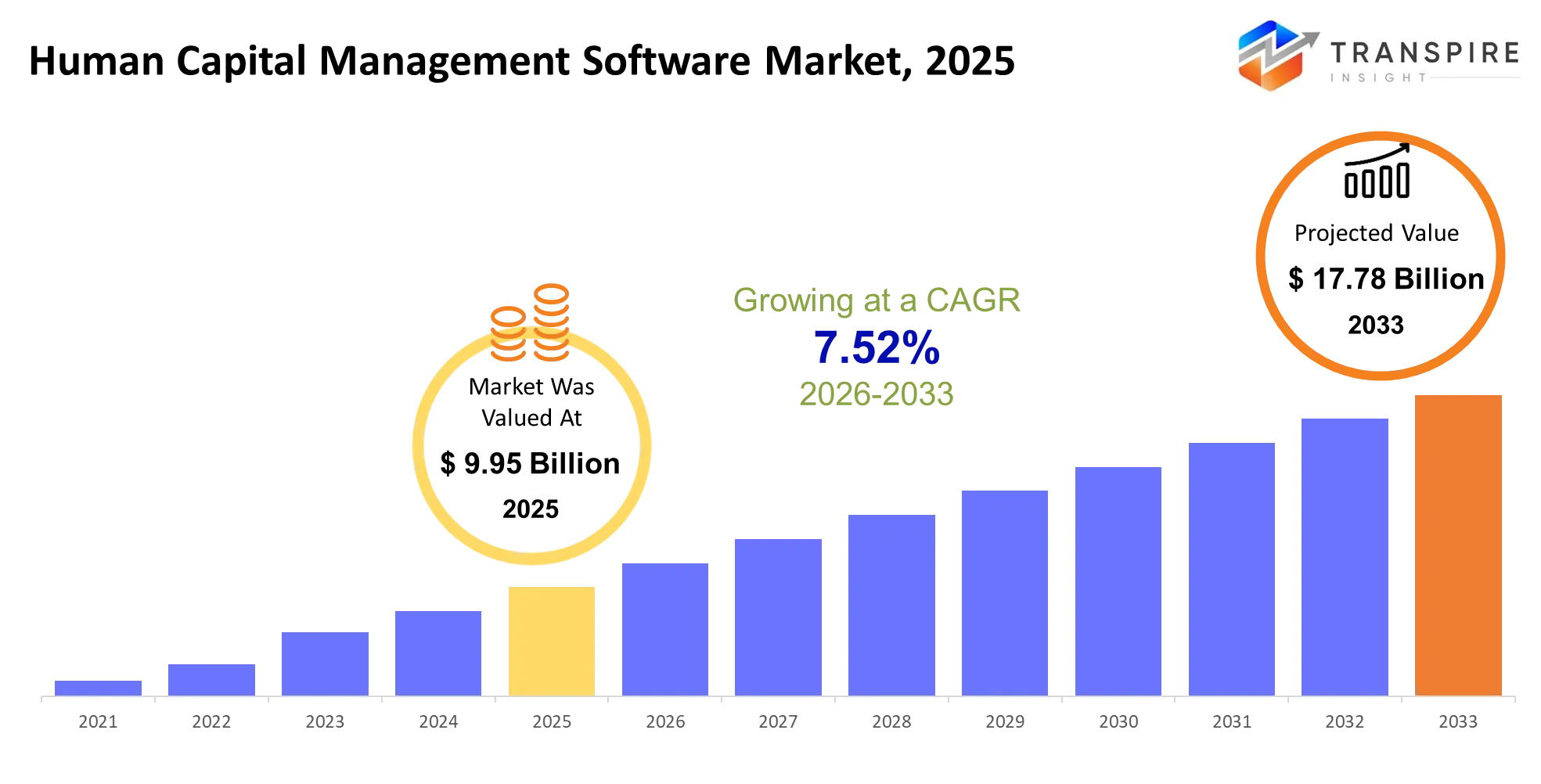
As per Transpire Insight Analysis, the Human Capital Management Software Market size is estimated at USD 9.95 billion in 2025 and is anticipated to reach USD 17.78 billion by 2033, growing at a CAGR of 7.52% from 2026 to 2033.
Human capital management software supports companies handle employee details, payrolls, hiring, time tracking, performance reviews, training and planning the workforce using systems that work together. In the past three to five years, companies have gone past simple HR tasks and started using cloud-based tools that let employees manage their own information, give real-time reports and make decisions based on data. A big change is adding intelligence to regular HR systems. This lets companies do repeated jobs faster and see patterns in the workforce clearly. The rise of working-from-home teams spread out in places, and more complicated jobs have made it even more important to have a single HR system. Companies with workers in different countries need good tools to handle payroll, check rules and report on the workforce. These needs are making businesses switch from separate programs to one complete HCM system. Because of this, software companies are now trying to beat each other by offering better automation experiences for employees, better analysis tools and the ability to link HR with other parts of the business.
Human Capital Management Software Market Size & Forecast:
- Market Size 2025: USD 9.95 Billion
- Expected Market Value (2033): USD 17.78 Billion
- Forecast CAGR (2026–2033): 7.52%
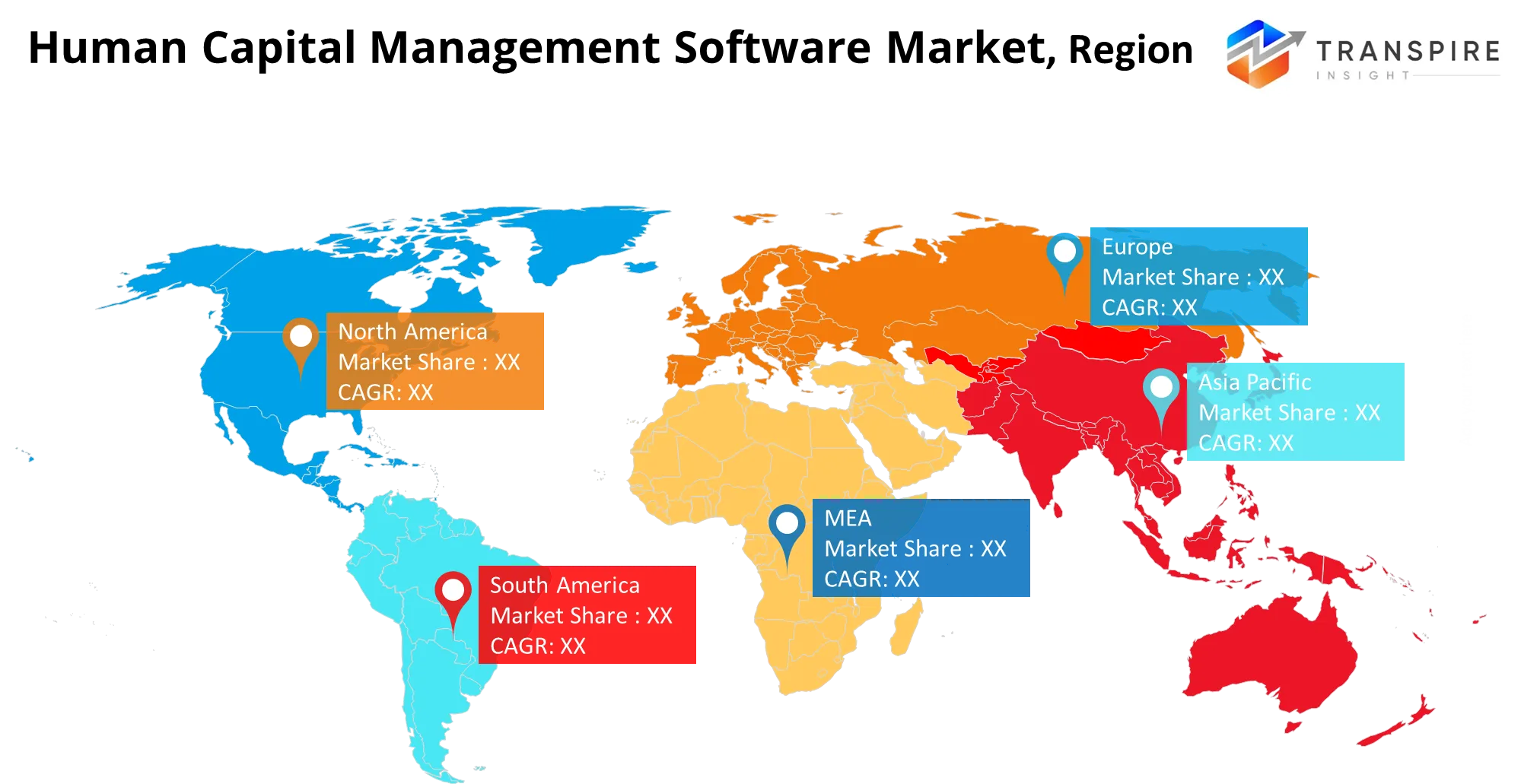
- Leading Region in 2025: North America
- Fastest Growing Region: Asia Pacific
- Key Company Profiles: Workday, SAP, Oracle, ADP, UKG, Ceridian, Dayforce, Cornerstone, Infor, Paychex, BambooHR, HiBob, Rippling, Paycom, Sage
Key Market Insights
The market is shifting from administrative HR solutions towards the development of integrated workforce platforms incorporating employee services, analytics, and intelligent automation.
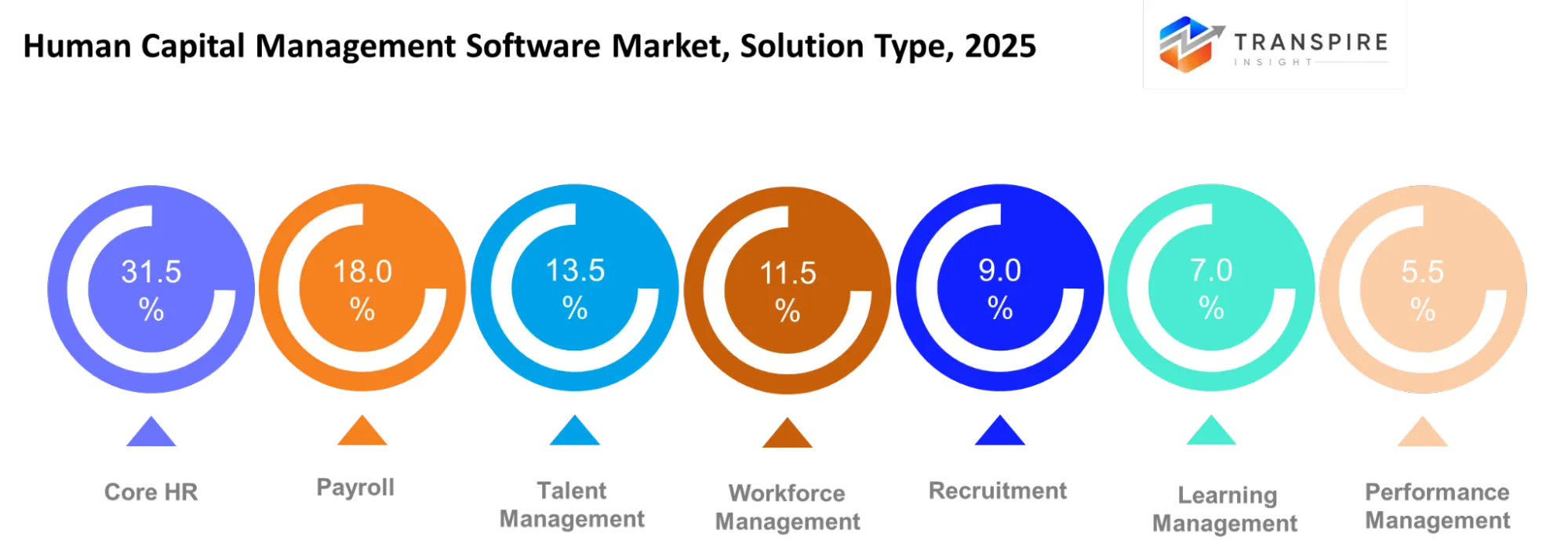
- The Core HR solution constituted 31.5% of the solution market share, due to the significance of employee information and structure maintenance.
- Payroll occupied 18.0% of the solution market share, as there is always a need for reliable salary calculation, taxation, and compliance management.
- Talent Management constituted 13.5%, since employers try to integrate performance evaluations, succession planning, and staff development.
- Workforce Management made up 11.5%, because of the scheduling, attendance, and labour planning solutions used by shift-based industries.
- The Recruitment solution accounted for 9.0%, as there are improvements in applicant tracking, communication, and workflow automation in recruitment processes.
- Learning Management holds 7.0%, based on corporate and digital learning programmes and training programs.
What are the Key Drivers, Restraints, and Opportunities in the Human Capital Management Software Market?
Drivers
The shift from isolated HR solutions to integrated cloud solutions is another important driver of HCM software adoption. When employee data, payroll, time and attendance, and performance data are stored in different systems, it creates duplicated processes, reporting bottlenecks, and higher chances of errors. Cloud-based HCM solutions can unify these processes and better make workforce data available to employees' trusted teams. The rise of hybrid work and non-centralised operations has further highlighted this need, since HR teams want to ensure use of consistent processes by their teams across locations. Employers are also adding employee self-service features that reduce repetitive admin requests while enabling HR teams to focus on workforce planning and coaching.
Restraints
the cost of migration and implementation can pose challenges for implementation, particularly for small companies. All of these tools have different formats and processes that make them hard to integrate. Companies have to deal with the issue of employee privacy, permission to access, security concerns, and changing labour legislation in order to gain from these systems. All of these factors may result in high implementation costs and slower ROI.
Opportunities
Workforce planning and predictive analytics as well as conversational HR assistants powered by AI will give rise to the possibility of adding more operational value for the software vendors. Intelligent systems will help with finding workforce shortages, answering employees' questions and selecting candidates, while most of the decision-making will still be done by human managers. Furthermore, there is a rise of new markets in Asia Pacific as organisations adopt digitisation of their HR process and move to the cloud. Vendors that provide flexible payment schemes, payroll services, languages and integrations will be in demand among mid-size organisations with limited IT staff.
|
Driver |
Relative Impact on Growth (%) |
Geographic Relevance |
Impact Timeline |
Demand Strength |
Growth Mechanism (5–10 words) |
Key Beneficiaries (5–10 words) |
Major Constraint (5–10 words) |
|
Cloud-Based HR Platform Adoption |
25% |
North America, Europe, Asia-Pacific |
Short-term |
High |
Enables scalable, centralized, and cost-efficient workforce management. |
Cloud HCM vendors, enterprises, implementation service providers. |
Data migration challenges and integration with legacy systems. |
|
AI and HR Analytics Integration |
23% |
North America, Europe, Asia-Pacific |
Medium-term |
High |
Automates recruitment, predicts workforce needs, and improves decisions. |
AI software vendors, HR teams, enterprise technology providers. |
Algorithmic bias, privacy concerns, and implementation complexity. |
|
Workforce Digitalization and Process Automation |
20% |
Asia-Pacific, North America, Europe |
Short-term |
High |
Digitizes payroll, attendance, onboarding, and performance management. |
HCM software providers, HR departments, large enterprises. |
High deployment costs and employee resistance to change. |
|
Regulatory Compliance and Payroll Complexity |
17% |
Europe, North America, Asia-Pacific |
Short-term |
High |
Automates compliance, tax calculations, reporting, and recordkeeping. |
Payroll vendors, compliance specialists, multinational employers. |
Frequently changing regulations and country-specific compliance requirements. |
|
Growing Demand for Talent Management and Employee Experience |
15% |
North America, Europe, Asia-Pacific |
Medium-term |
High |
Improves retention, skills development, engagement, and succession planning. |
Talent management vendors, employers, learning platform providers. |
Budget limitations and difficulties measuring employee engagement outcomes. |
|
Total |
100% |
— |
— |
— |
— |
— |
— |
What Has the Impact of Artificial Intelligence Been on the Human Capital Management Software Market?
Artificial intelligence technologies enable HCM systems to move from recordkeeping to managing staff with speedier, data-oriented processes. AI software is used for preparing job descriptions, candidate matching, addressing questions of employees, processing documents and classifying HR inquiries. This way, repetitive actions are minimized which makes it possible for HR departments to focus on employee engagement, employee development, and strategy development. Predictive analytics makes it possible to use data to predict upcoming challenges such as shortage of staff, turnover, absenteeism and the need for skills. The managers of HR can analyze that data in order to rethink recruitment, use funds wisely, and develop the right training programs. Nevertheless, predictions depend on the quality, relevance and completeness of data.At the same time, using AI assistants and automation of workflows can be used in order to simplify access to information for employees. That information might refer to leave policy, benefits, onboarding and HR processes inside the company. Despite the great amount of benefits that these tools bring, it is important to remember about implementation costs, integration problems, issues with confidentiality, and historical bias. Consequently, decision-making in HR with the help of AI should always be supervised by people.
Instance
In October 2026, Workday launched AI agents for automating HR-related activities such as recruiting and managing employees. This is an illustration of how AI assists organisations in eliminating repetitive processes, enhancing the recruitment process, and making quicker decisions regarding workforce management.https://newsroom.workday.com/2026-10-13-Workday-Launches-Autopilot-Agents-That-Get-Real-Work-Done-Across-HR,-Finance,-and-IT
Key Market Trends:
Trends include a shift from a wide range of administration tools to a single employee management system. Intelligent automation, accessibility to HR services, and better integrations with enterprise applications have become the focus of vendors.
- There is a shift from on-premises HR systems to cloud-based systems used by remote workforces and providing centralized workforce data.
- Workforce analytics, which involves historical data analysis, is giving way to predictive planning helping managers predict the needs in staffing and skills.
- Payroll and time management applications are becoming more integrated to help manage the working hours, salary, and attendance of employees.
- Employee experience is receiving more attention as onboarding, benefits management, performance reviews, and internal communications are being simplified.
- HR platforms are becoming more integrated with finance, enterprise resource planning, collaboration, and identity management systems to prevent information silos.
- Information security and AI governance are becoming more important due to the processing of sensitive employee data and workforce-related decisions.
Human Capital Management Software Market Segmentation
By solution type
Core HR was the leading solution type, accounting for 31.5%. The reason behind this is the importance of employee records, organisational structure, personnel information, and administrative processes in HR operations. Payroll was 18.0%, owing to the need for proper payment processing and compliance with regulations. Talent Management was 13.5%, while Workforce Management was 11.5%, indicating continuous investment in employee development, performance management, scheduling, and labour allocation. Recruitment was 9.0%, while Learning Management was 7.0%, Performance Management was 5.5%, and Workforce Analytics was 4.0%. This accounts for 100% of the supplied solution mix. Artificial Intelligence-enabled HCM, which is expected to grow at a CAGR of 14.2%, is one of the upcoming growth sectors as vendors incorporate intelligent assistance and predictive features into the existing HR functions.
By deployment
The benefits of cloud computing include remote access, regular upgrades and updates, and reduced dependence on internal infrastructure. The traditional on-site solution will continue to make sense in situations where the organisation needs more control over its data, infrastructure, or processes. A hybrid solution will be able to satisfy the needs of organisations that need some features of cloud computing but at the same time do not wish to discard their existing infrastructure. There are several solutions, including software as a service, private cloud, public cloud, hosted solutions.
By enterprise size
In the case of larger organisations and multinational corporations, there will be a need for extensive reporting for employees, complex organisational structure, multi-country payroll, and support for multiple locations. In the case of mid-market organisations, there is a need for scalable solutions as the number of employees increases. In the case of SMEs and start-ups, easy deployment, affordable pricing, and out-of-the-box HR processes are required. Government, non-profit, and higher education organisations have an emphasis on accountability and budgets. Solutions that are modular and scalable will satisfy the needs of all these organisations.
By application
employee management serves as the true foundation, since it preserves data on a firm's entire workforce and backs up the daily HR managing procedures. Payroll and benefits management assist companies manage pay and benefits, whereas recruitment applications allow them to deal with opening administration, candidates, and their hiring methods. Workforce planning applications assist managers analyze staffing needs, employee engagement applications support them get their worker feedback and inner communication, compliance applications assist them manage rules and legal compliance, whereas analytics allow them to look at their workforce information.
By end user
Banking, financial services and insurance organizations, who need secure access to employee data and reliable compliance. It and telecommunications organizations, who require flexible recruiting, skills development and workforce planning for dynamic roles. Education, government, and other public organizations, who require structured employee management. Professional services organizations, where skills, utilization, and talent retention are essential. Manufacturing and retail organizations, who need attendance monitoring, shift scheduling and payroll management to support their operational workforces.
By technology
Artificial intelligence and machine learning lead to a smarter approach to help, talent match and work force predictions. RPA will automate repetitive activities whereas predictive analytics identifies trends in the work force and highlights areas where resource shortages exist. NLP makes interactions between people and computers less complex and uses more natural language. Cloud computing will further allow for scalability, whereas mobile technology will allow the work to be done by the staff away from their office. Expect to see more connected and contextually aware tools in the future, depending, of course, on how well the information is available and integrated with other tools.
What are the Key Use Cases Driving the Human Capital Management Software Market?
Core HR is a use case because organisations need a robust system to maintain record of all the employee details, structure of the organisation, positions and HR services. In this sense, a centralised system can be used by the organisations to provide self-service to employees, recruitment and workforce related information. Some other use cases are payroll coordination, recruitment, absence management, benefits administration, and performance appraisal. All these use cases are very helpful for large organisations, healthcare facilities, manufacturing facilities, retailers, and multinationals who have to deal with various workforces and work schedules.New use cases include AI based assistance to employees, predictive workforce planning, skill gap assessment and intelligent recruitment process. These tools will help organisations to plan ahead for future needs and reduce unnecessary paperwork, provided that the information of employees is properly managed.
|
Report Metrics |
Details |
|
Market size value in 2025 |
USD 9.95 Billion |
|
Market size value in 2026 |
USD 10.70 Billion |
|
Revenue forecast in 2033 |
USD 17.78 Billion |
|
Growth rate |
CAGR of 7.52% from 2026 to 2033 |
|
Base year |
2025 |
|
Historical data |
2021 - 2024 |
|
Forecast period |
2026 - 2033 |
|
Report coverage |
Revenue forecast, competitive landscape, growth factors, and trends |
|
Regional scope |
United States; Canada; Mexico; United Kingdom; Germany; France; Italy; Spain; Denmark; Sweden; Norway; China; Japan; India; Australia; South Korea; Thailand; Brazil; Argentina; South Africa; Saudi Arabia; United Arab Emirates |
|
Key company profiled |
Workday, SAP, Oracle, ADP, UKG, Ceridian, Dayforce, Cornerstone, Infor, Paychex, BambooHR, HiBob, Rippling, Paycom, Sage |
|
Customization scope |
Free report customization (country, regional & segment scope). Avail customized purchase options to meet your exact research needs. |
|
Report Segmentation |
Solution Type (Core HR, Payroll, Talent Management, Workforce Management, Recruitment, Learning Management, Performance Management, Workforce Analytics)Deployment (Cloud, On-Premise, Hybrid, SaaS, Private Cloud, Public Cloud, Hosted, Others)Enterprise Size (Large Enterprises, Mid-Sized Enterprises, SMEs, Startups, Multinational Corporations, Government Organizations, Nonprofits, Others)Application (Employee Management, Payroll, Recruitment, Benefits Administration, Workforce Planning, Employee Engagement, Compliance, Analytics)End User (BFSI, IT & Telecom, Healthcare, Manufacturing, Retail, Education, Government, Professional Services)Technology (AI, Machine Learning, RPA, Predictive Analytics, NLP, Cloud Computing, Mobile Technology, Others) |
Which Regions are Driving the Human Capital Management Software Market Growth?
North America
North America constitutes a 37.62% share of the market. There are several reasons why companies in this region invest in the adoption of integrated workforce platforms: there is a developed enterprise software ecosystem, well-developed cloud architecture, and a mature HR technology market in North America. All this helps businesses use such features as automation, employee analytics, payroll integration, and AI-assisted HR technology solutions.
In May 2025, Workday developed a new set of AI agents for HR and finance automation, recruitment, and employee services. It is a clear sign that AI recruitment, workforce management, and employee self-service solutions are becoming increasingly popular among HCM software providers in North America.https://investor.workday.com/news-and-events/press-releases/news-details/2025/Workday-Unveils-Next-Generation-of-Illuminate-Agents-to-Transform-HR-and-Finance-Operations-05-19-2025/default.aspx
Europe
Europe accounted for 27.8%; it is the second-largest region among those that are currently in the process of using HR solutions. The main drivers of the demand in Europe are workforce digitisation, usage of enterprise software, and the need to handle various employment regulations in different countries. Thus, while choosing an HCM platform, one should take into account such aspects as data privacy, employment regulations, languages, and payroll differences.
In October 2025, SAP released upgrades for the SuccessFactors platform to integrate AI technology, manage workforce planning and skills development, and automate HR processes. The improvements will help European organisations deal with employee data and HR processes as well as meet workforce needs in various countries. https://news.sap.com/2025/10/sap-successfactors-2h-2025-release-ai-skills-people-insights/
Asia Pacific
Asia Pacific holds 22.0% of the supply and will continue to exhibit the highest CAGR of 9.61%. There are several drivers in Asia Pacific that include opportunities owing to increasing business activities, initiatives to adopt digital solutions, and the use of cloud-based solutions for enterprise-wide applications. Organisations need solutions that can cope with their growing labour force, multilingual environments, and consistent HR management.
In May 2025, Darwinbox, the HCM software from India, announced the development of a Model Context Protocol (MCP) server that will allow AI agents compatible with its system to interact with the HR platform. The move is an example of the growing importance of AI workforce management and enterprise software integration in the region. https://darwinbox.com/blog/darwinbox-becomes-the-first-hcm-platform-ly-to-launch-an-mcp-server
Who are the Key Players in the Human Capital Management Software Market and how do they Compete?
Competition among HCM software products involves enterprises, payroll software solutions, workforce management solutions, and HR software as a service platforms. Enterprises compete based on their wide ranges of software solutions, implementations, integration features, sectoral focus, prices, and AI developments. The market has no particular way in which the players are involved, as there are differences in technical needs between large multinational organisations and SMEs.Oracle stands out for its differentiation in Fusion Cloud HCM software and the broad range of enterprise software products, which makes it attractive for enterprises looking for connected business processes. The main areas of differentiation of ADP include expertise in payroll, compliance, and services for businesses of various sizes. Paychex stands out due to its focus on providing payroll and HR software for businesses of various sizes. In turn, BambooHR provides an easy-to-use HR software solution, while Rippling focuses on connected HR software and IT administration. HiBob also differentiates itself with the help of modern HR workflows and employee engagement.
Human Capital Management Software Market companies
- Workday
- SAP
- Oracle
- ADP
- UKG
- Ceridian
- Dayforce
- Cornerstone
- Infor
- Paychex
- BambooHR
- HiBob
- Rippling
- Paycom
- Sage
|
Company |
Est. Revenue Share Range |
Key Offerings |
Strategic Positioning |
Geographic Strength |
Technology Focus |
|
Workday |
Estimated 8–11% |
Workday HCM, Talent Management, Workforce Planning, People Analytics |
Enterprise cloud suite integrating HR and finance |
North America, Europe, Asia Pacific |
AI-powered HR workflows and unified cloud data |
|
SAP SE |
Estimated 4–6% |
SAP SuccessFactors Employee Central, Recruiting, Learning, Performance Management |
enterprise HR ecosystem provider |
Europe, North America, Asia Pacific |
Generative AI, skills intelligence and cloud integration |
|
Oracle Corporation |
Estimated 3–5% |
Oracle Fusion Cloud HCM, Recruiting, Talent Management, Workforce Management |
Comprehensive enterprise HCM platform provider |
North America, Europe, Asia Pacific |
Embedded AI, predictive analytics and process automation |
|
UKG |
Estimated 5–7% |
UKG Pro, UKG Ready, UKG Pro Workforce Management |
Workforce management and industry-specific HR solutions |
North America, Europe, Asia Pacific |
AI scheduling, workforce analytics and time tracking |
|
ADP |
Estimated 3–5% |
ADP Workforce Now, ADP Vantage HCM, Payroll, Talent Solutions |
Payroll-led HCM with compliance capabilities |
North America, Europe, Latin America |
Payroll automation, compliance analytics and cloud integration |
|
Dayforce |
Estimated 2–4% |
Dayforce HCM, Payroll, Workforce Management, Talent Management |
Unified workforce platform connecting HR and payroll |
North America, Europe, Asia Pacific |
Continuous payroll, AI and real-time workforce data |
|
Paycom |
Estimated 2–4% |
Beti, Payroll, HR Management, Talent Acquisition |
Integrated payroll automation for mid-sized employers |
North America, particularly the United States |
Employee-led payroll and automated HR workflows |
|
Paylocity |
Estimated 1–3% |
HR and Payroll, Talent Management, Workforce Management, Employee Experience |
Mid-market HCM focused on employee engagement |
North America, particularly the United States |
AI-assisted workflows, analytics and employee self-service |
|
Cornerstone OnDemand |
Estimated 1–2% |
Cornerstone Learning, Talent Management, Performance Management, Workforce Agility |
Specialist provider of learning and talent development |
North America, Europe, Asia Pacific |
AI-driven skills intelligence and personalised learning |
|
Paychex |
Estimated 2–4% |
Paychex Flex, HR Services, Payroll, Benefits Administration |
Payroll-centred HCM for small and medium-sized businesses |
North America, particularly the United States |
Cloud HR automation, payroll analytics and digital self-service |
Recent Development News
In May 2026, Workday and Google Cloud extended their strategic alliance to include integration of the Workday Sana self-service agent into Gemini Enterprise and further development of connected AI-agent workflows for HR and finance. The partnership aims to provide access to employee services and common workforce operations in familiar digital working environments. https://investor.workday.com/news-and-events/press-releases/news-details/2026/Workday-and-Google-Cloud-Expand-Strategic-Partnership-to-Bring-AI-Agents-for-HR-and-Finance-Into-Employees-Daily-Workflows/default.aspx
In December 2025, Tata Consultancy Services launched a sales and services alliance with Workday. Under the agreement, TCS has extended its scope of sales, implementation, and support services for Workday offerings, including HCM. It could help companies gain implementation expertise and develop connected HR and employee experience workflows. https://www.tcs.com/who-we-are/newsroom/news-alert/tcs-partners-workday-unlock-power-human-capital-supercharge-workplaces-ai
What Strategic Insights Define the Future of the Human Capital Management Software Market?
Future success in the HCM software market will depend on the ability to provide value through automation and workforce data. Core HR software will make up the foundation of many solutions, while differentiation will occur around the integration of employee services, predictive planning, and AI-powered workflows. The vendors that are capable of integrating payroll, talent, analytics, and workforce management capabilities without creating too much complexity are better positioned for enterprise business. Data integrity and consistency will be a hidden problem related to the accuracy and consistency of the data collected in old systems and other applications. Poor data will affect predictive models, cause payroll issues, and reduce trust in the decisions made by the AI algorithms. The other trend to leverage is the demand for scalable and locally-oriented HCM solutions for mid-sized firms and fast-growing businesses in Asia Pacific. The vendors can address it with flexible pricing model, multilingual interface, integration, and local payroll capabilities. In terms of the strategy, the vendors have to guarantee secure integrations, value of automation, transparency of controls for AI, and good implementation experience. On the side of the buyers, the considerations will include total cost of ownership, data portability, compliance
Solution Type
- Core HR
- Payroll
- Talent Management
- Workforce Management
- Recruitment
- Learning Management
- Performance Management
- Workforce Analytics
Deployment
- Cloud
- On-Premise
- Hybrid
- SaaS
- Private Cloud
- Public Cloud
- Hosted
- Others
Enterprise Size
- Large Enterprises
- Mid-Sized Enterprises
- SMEs
- Startups
- Multinational Corporations
- Government Organizations
- Nonprofits
- Others
Application
- Employee Management
- Payroll
- Recruitment
- Benefits Administration
- Workforce Planning
- Employee Engagement
- Compliance
- Analytics
End User
- BFSI
- IT & Telecom
- Healthcare
- Manufacturing
- Retail
- Education
- Government
- Professional Services
Technology
- AI
- Machine Learning
- RPA
- Predictive Analytics
- NLP
- Cloud Computing
- Mobile Technology
- Others
By Regional Analysis
North America
- US
- Canada
- Mexico
Europe
- Germany
- UK
- France
- Italy
- Spain
- Russia
- Rest of Europe
Asia Pacific
- China
- Japan
- India
- South Korea
- Australia
- Rest of Asia Pacific
South America
- Brazil
- Argentina
- Rest of South America
Middle East & Africa
- UAE
- Saudi Arabia
- Qatar
- South Africa
- Rest of the Middle East & Africa
Frequently Asked Questions
Find quick answers to common questions.
The human capital management software market size was valued at USD 9.95 billion in 2025 and is poised to reach USD 17.78 billion by 2033, expanding at a 7.52% CAGR.
Key segments for the human capital management software market are Solution Type (Core HR, Payroll, Talent Management, Workforce Management, Recruitment, Learning Management, Performance Management, Workforce Analytics)Deployment (Cloud, On-Premise, Hybrid, SaaS, Private Cloud, Public Cloud, Hosted, Others)Enterprise Size (Large Enterprises, Mid-Sized Enterprises, SMEs, Startups, Multinational Corporations, Government Organizations, Nonprofits, Others)Application (Employee Management, Payroll, Recruitment, Benefits Administration, Workforce Planning, Employee Engagement, Compliance, Analytics)End User (BFSI, IT & Telecom, Healthcare, Manufacturing, Retail, Education, Government, Professional Services)Technology (AI, Machine Learning, RPA, Predictive Analytics, NLP, Cloud Computing, Mobile Technology, Others)
Growth is primarily driven by increasing adoption of cloud-based HR solutions, rising demand for workforce automation, growing use of AI in recruitment and employee management, and the need for efficient talent acquisition, payroll processing, and performance tracking.
The market is led by major manufacturers including Workday, SAP, Oracle, ADP, UKG, Ceridian, Dayforce, Cornerstone, Infor, Paychex, BambooHR, HiBob, Rippling, Paycom, Sage
The North American region has a 37.62% share in the human capital management software market owing to the extensive use of cloud-based HR applications, sophisticated digital infrastructure, high demands for workforce analytics, and availability of major software vendors in the region. Increasing emphasis on employee engagement and talent management adds to the market strength in the region.
Business opportunities in the human capital management software market consist of rising demand for AI-based HR software, cloud-based workforce management software, recruitment automation software, and predictive workforce analytics software. Opportunities will also arise due to the rising adoption of employee engagement and talent development software solutions by small, medium, and large organizations.
- Workday
- SAP
- Oracle
- ADP
- UKG
- Ceridian
- Dayforce
- Cornerstone
- Infor
- Paychex
- BambooHR
- HiBob
- Rippling
- Paycom
- Sage
About the Authors

Mayur Shinde
I am Mayur Shinde, a Senior Research Analyst at Transpire Insight, specializing in the Automotive & Transportation and Information & Communication Technology (ICT) Industry. My work focuses on analyzing emerging market trends, technological advancements, competitive landscapes, and industry developments to deliver accurate, data-driven insights. I am passionate about transforming complex market information into clear, actionable content that helps businesses, professionals, and decision-makers stay informed and make confident strategic decisions.

Chakradhar Khansole
Chakradhar serves as the Research Director at Transpire Insight, bringing over 8 years of experience in technology, innovation, and strategic market intelligence. He specializes in transforming complex market data into actionable business insights that enable organizations to make informed, growth-oriented decisions. Recognized for his strategic vision and analytical expertise, Chakradhar leads high-impact research initiatives, delivering comprehensive market assessments, competitive intelligence, and forward-looking industry analysis.
Recently Published Reports
-
Apr 2026
3D Optical Profiler Market
3D Optical Profiler Market Size, Share & Analysis Report By Type (Desktop 3D Optical Profiler, and Portable 3D Optical Profiler), By Technology (Confocal Technology, and White Light Interference), By End-Use Industry (Manufacturing, Research Institutions, Automotive, Aerospace and Defense, Medical Devices, and Other), and Geography (North America, Europe, Asia-Pacific, Middle East and Africa, South and Central America), 2021 - 2031
-
Apr 2026
Depth Sensor Market
Depth Sensor Market Size, Share & Analysis Report By Type (Infrared Depth Sensors, Time-of-Flight (ToF) Sensors, Stereo Vision Sensors, Structured Light Sensors, Ultrasonic Depth Sensors), By Application (Automotive, Robotics, Gaming, Consumer Electronics, Industrial Automation, Healthcare, Security & Surveillance, Others), By End Users (Automotive Manufacturers, Consumer Electronics Companies, Healthcare Providers, Industrial Companies, Security Agencies, Gaming Companies, Robotics Companies, Others), and Geography (North America, Europe, Asia-Pacific, Middle East and Africa, South and Central America), 2021 – 2031
-
Apr 2026
Digital Manufacturing Market
Digital Manufacturing Market Size, Share & Analysis Report By Component (Hardware, Software, and Services), By Technology (Robotics, 3D Printing, Internet of Things (IoT), and Others), By Application (Automotive and Transportation, Aerospace and Defense, Consumer Electronics, Industrial Machinery, and Others), By Process Type (Computer-Based Designing, Computer-Based Simulation, Computer 3D Visualization, Analytics, and Others), and Geography (North America, Europe, Asia-Pacific, Middle East and Africa, South and Central America), 2021 – 2031
-
Apr 2026
Digital Visa Services Market
Digital Visa Services Market Size, Share & Analysis Report By Type (Individual Travelers, Group Travelers), By Application (Tourism, Business Travel, Others), and Geography (North America, Europe, Asia-Pacific, Middle East and Africa, South and Central America), 2021 – 2031